REVIEW 4 major objections 3 minor 13 references
EduClaw-Bench: A Long-Horizon Benchmark for Pedagogical LLM Agents with Simulated Learners
T0 review · 4 major / 3 minor · reviewed 2026-08-05 · deepseek-v4-flash
Pith's one-line read EduClaw-Bench puts agent tutors in a 30-day relationship with a knowledge-tracing-grounded simulated learner and shows that tutoring quality is a joint property of base model and harness, while almost no combination sustains learning over t
desk verdict Substantial benchmark with a load-bearing fixable flaw: the simulated learner's answers don't actually use the updated KT belief, so the learning-gain axis is not measuring learning. read the letter →
The pith
A machine-rendered reading of the paper's core claim, the machinery that carries it, and where it could break.
The reading
What carries the argument
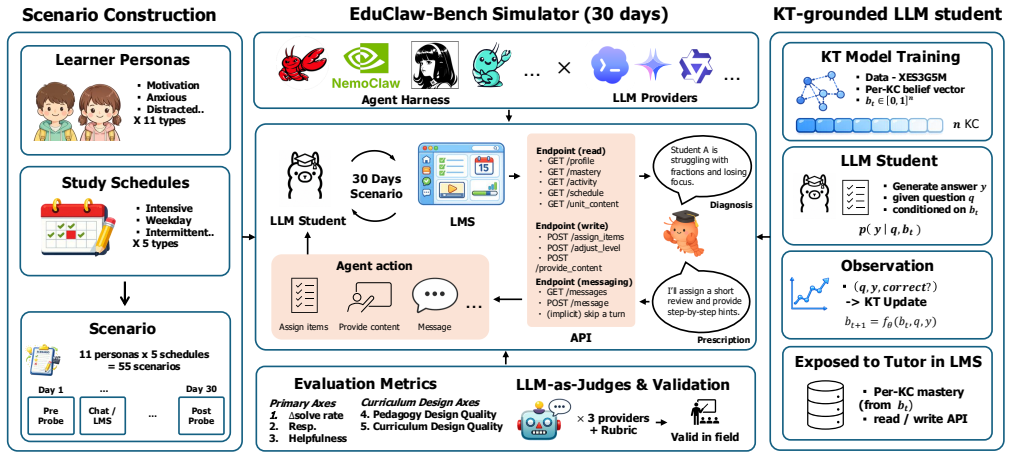
The KT-grounded simulated learner: a per-knowledge-concept belief vector $b_{s,d}\in[0,1]^K$ (K = 831) maintained by an Attentive Knowledge Tracing (AKT) model trained on the XES3G5M dataset, updated by $b_{s,d+1}=f_\theta(b_{s,d},q,k,y)$ after each observed question–concept–response triple. This belief both conditions the LLM student's probe answers, $p(y\mid q,b_{s,d},c_{s,d})$, and is exposed to the tutor as per-KC mastery through an LMS read endpoint. The coupling is what makes the learner learn from the tutor's actions rather than merely role-play a fixed persona.
What would settle it
Re-run the 55 scenarios with the student prompt built only from the initial belief $b_{s,1}$ and with the per-day KT update disabled, keeping all tutor behavior fixed; if the learning-gain rankings and per-day accuracy trajectories are essentially unchanged, then the KT state is not what drives the learner and the ECE 0.049 check is a self-consistency measure rather than evidence of tracking reality.
Extended reading notes
Core claim
The paper's central claim is that a simulated learner grounded in knowledge tracing can make a 30-day tutoring benchmark trustworthy. The learner's state is a per-concept belief vector $b_{s,d}\in[0,1]^{831}$, produced by an Attentive Knowledge Tracing (AKT) model trained on the XES3G5M elementary-math interaction dataset; each probe answer the student generates is conditioned on this belief, and every graded observation updates it through $b_{s,d+1}=f_\theta(b_{s,d},q,k,y)$. Across 55 scenarios (11 learner personalities × 5 study schedules) and 10 agent adapters on 3 base-model tiers, no adapter leads on learning gain on more than one tier, and per-day student accuracy plateaus by day 5–10.
Load-bearing premise
The simulated student's answers are actually driven by the current, per-day KT belief vector $b_{s,d}$—not just by the static ability label and initial beliefs used to build its prompt; if freezing the belief at day 1 changed nothing, the learning-gain axis would not be measuring learning.
Editorial extensions
If this is right
- A single-tier leaderboard misranks the same adapters, so vendors must evaluate base-model/harness pairs rather than reuse a generic ranking.
- First-5-day or first-10-day rankings are uncorrelated with or even inverted from the 30-day ranking, so short-horizon evaluation cannot order tutors reliably.
- Because learning gain and curriculum coherence are near-independent axes and helpfulness is the stable ranking anchor, composite rewards are gameable; separate axes should be reported.
- The dominant failure is not answer leakage but absence of curriculum and learning gain, which shifts the target of future tutor training from refusal behavior to sustained pedagogical structure.
Reading between the lines
- If the KT belief is the true driver of student behavior, the same simulator could be repurposed for studying forgetting curves, spacing schedules, and intervention timing, not just for ranking tutors.
- The plateau result suggests the bottleneck may be the harness's inability to maintain a curriculum rather than the base model's capacity; a testable extension would give adapters an oracle curriculum planner and see whether the 30-day trajectory flattens later.
- The paper's own appendix shows delta-solve rankings invert across student models (Kendall tau as low as -0.42), while helpfulness rankings are stable; future benchmark iterations will likely need multi-seed learning-gain estimates before using gain as a gate.
- The field study validates the rubric, not any adapter's rank; a same-system field deployment comparing a top-ranked and bottom-ranked adapter would test whether the simulation's ordering transfers to real classrooms.
Editorial analysis
A structured set of objections, weighed in public.
Referee Report
Summary. EduClaw-Bench proposes a 30-day, LMS-based benchmark in which an agent tutor interacts with a simulated learner whose knowledge mastery is maintained by an AKT knowledge-tracing model trained on XES3G5M. The benchmark spans 55 persona-by-schedule scenarios and scores tutors on five axes: ΔSolve Rate, Responsiveness, Helpfulness, and two curriculum-design rubrics (Gagné and Rosenshine). Ten agent adapters are evaluated across three base-model tiers. The paper reports two headline findings: tutoring quality is a joint property of base model and harness, and almost no combination sustains learning over the full horizon. Validity is argued from an ECE of 0.049 and a live-classroom field study.
Significance. If the validity concerns are resolved, this would be a valuable and unusual contribution: a reproducible, long-horizon environment for pedagogical agents with direct outcome measurement, released with code, scenarios, per-run traces, and LoRA checkpoints. The scale of the evaluation (8,637 completed runs across three tiers, 1.19M item attempts) is substantial. The paper also honestly reports limitations in its appendices, including cross-student ranking instability for ΔSolve and silent-run rates. However, the central claim that the simulated learner's KT-grounded belief drives its answers and that the calibration check confirms it tracks reality is not currently supported by the evidence as written.
major comments (4)
- [Section 3.2 / Figure 1 / Eq. (1)-(2)] The LLM student's system prompt is specified as composed from ability level, grade band, and weakest/strongest KCs extracted from b_{s,1} by thresholding. No current-mastery field or per-day chained update is described. Thus p(y|q,b_{s,d},c_{s,d}) is not actually implemented: probe answers are conditioned on the initial belief, not the dynamically updated belief. If so, ΔSolveRate in Eq. (2) measures tutor-context and probe-noise effects, not learning gain caused by the tutor. This is load-bearing for the abstract, Section 5.1, and Section 6.1. Please provide the exact prompt template, and either add an ablation that injects b_{s,d} vs. a fixed b_{s,1}, or rerun the benchmark with true dynamic conditioning.
- [Section 6.1] The ECE=0.049 calibration check bins AKT-predicted mastery against observed probe accuracy, but the same probe outcomes are fed back into Eq. (1) to update the belief. This is a self-consistency check of the Kalman-like filter; under a reasonably specified KT model, calibration on the updating data is expected and is not independent confirmation that the simulated learner tracks real students. A convincing test would hold out real XES3G5M test-student responses, condition on the same interaction history, and compare the simulated learner's next-response accuracy with those real students' accuracy, reporting ECE/Brier on that held-out comparison.
- [Appendix D, Table 10] The mean pairwise Kendall τ of ΔSolve Rate rankings across the four student models is 0.24, -0.09, and 0.21 for Solar, Codex, and Qwen tiers, with a worst pair of -0.42. The paper itself recommends treating ΔSolve as a monitoring signal, not a gate. This directly undercuts the abstract and Section 5.1's use of Axis I leaders to support the base-model/harness interaction finding and the long-horizon plateau finding. Please either provide multi-seed confidence intervals and a cross-student stability analysis that supports ΔSolve as a ranking axis, or demote the learning-gain emphasis and make Helpfulness/curriculum the primary headline axes.
- [Section 5.2 / Appendix G / Abstract] The field study uses a different tutor (regex claw on solar-mini) outside the simulation grid, so it validates transfer of the Helpfulness rubric to real transcripts; it does not validate the simulated learner's learning dynamics or the learning-gain axis. The abstract's statement that 'the simulated learner and its measurements track reality' is therefore overbroad. Please add a same-system simulation-vs-field comparison or explicitly scope the field-study claim to the Helpfulness instrument.
minor comments (3)
- [Section 3.2] The notation 'b_{s,d} ∈ [0,1] K' should be 'b_{s,d} ∈ [0,1]^K'; also 'K=831KCs' is awkward. Please normalize math notation throughout.
- [Section 5.1] Typo: 'excessoverthenominalbudget' is missing a space. Also, Table 3's caption says 'Axis IV runs 1–5'; the text and Eq. (5) refer to Axes IVa/IVb, so the wording should be aligned.
- [Appendix D] The terms 'ΔSolve' and 'DeltaSolve' are used inconsistently; the prose in Appendix D says 'DeltaSolve' in one place and 'ΔSolve Rate' elsewhere. Please unify.
Circularity Check
The simulated-learner calibration check is self-consistency with the same probe outcomes used to update the KT belief, and the LLM student prompt is specified from the initial belief b_{s,1} rather than the live b_{s,d}, so the realism claim and the learning-gain axis are weaker than stated.
-
fitted input called prediction
[Section 6.1 (Figure 2 center) and Section 3.2, Eq. (1)]
"Graded probe outcomes are fed back into fθ, so KT and LLM stay coupled across D = 30 virtual days. ... binning all 176,187 (run, day) pairs by predicted mastery against observed accuracy gives an Expected Calibration Error of 0.049 ... so its knowledge state tracks the real-student KT model rather than drifting."
Eq. (1) updates b_{s,d+1} from the same graded probe outcomes (q, k, y) that Section 6.1 later bins as 'observed accuracy' against 'predicted mastery.' A recursive filter calibrated on its own observation stream is a self-consistency property, not an independent confirmation that the LLM student matches real students. The AKT base model was trained on real XES3G5M data, but the online belief is updated from LLM-generated answers; hence ECE=0.049 only shows that the KT loop agrees with the answers it consumed. It cannot certify that the simulated learner tracks reality, yet the paper calls this check 'load-bearing' and uses it to support the trustworthiness of all three primary axes.
-
other
[Section 3.2, 'LLM role-play' and Section 3.3, Algorithm 1]
"An LLM student generates ŷ ∼ pLLM(· | q, b_{s,d}, c_{s,d}) on each probe ... The system prompt is composed on the fly from three ingredients, namely the ability level (weak / average / strong), a grade band derived from the persona seed’s XES3G5M metadata (roughly grades 5–8), and the weakest and strongest KCs extracted from b_{s,1} by thresholding."
The stated answer distribution conditions on the live belief b_{s,d}, but the prompt ingredients are static: ability level, grade band, and strongest/weakest KCs from the initial b_{s,1}. No current-mastery field is described in the prompt, so the LLM student's answers are not actually driven by the dynamically updated KT belief. Consequently Eq. (2)'s ΔSolveRate measures differences under a fixed persona prompt plus tutor context, not KT-grounded learning gain. This breaks the claimed derivation chain from b_{s,d} to the learning-gain axis. Appendix D corroborates the problem: ΔSolve rankings invert across student models (mean Kendall τ from −0.09 to 0.24) and the authors recommend treating ΔSolve as a monitoring signal rather than a gate.
full rationale
The benchmark's core construction is largely self-contained and externally anchored: the KT model is trained on the public XES3G5M dataset, the 55 scenarios and agent interactions are new, the judge panel is compared against human experts, and the field study uses real K-12 transcripts. Those elements are not circular. However, two load-bearing validity steps are problematic. First, the ECE=0.049 calibration is computed on the same probe outcomes that are fed into the KT update (Eq. 1), so it is an in-sample self-consistency check rather than independent evidence that the simulated learner tracks real students. Second, the LLM-student system prompt is specified from b_{s,1} (initial belief), not b_{s,d}; the paper's claimed conditioning on the live belief is not realized, so ΔSolveRate cannot be read as KT-grounded learning gain. The paper itself flags the instability of ΔSolve rankings across student models (Appendix D) and recommends treating ΔSolve as a monitoring signal rather than a gate, which further undermines the headline learning-gain finding. The self-citation of (Lee et al. 2026) for the ΔSolve formulation is not load-bearing because the formula is independently defined in this paper. Overall, the circularity is partial and concentrated in the realism/calibration argument, so the score is 4 rather than higher; the benchmark still contains substantial independent content in its scenario construction, judge validation, and field study of the Helpfulness instrument.
Assumptions & free parameters
free parameters (6)
- Global random seed 42 =
42
- Ability level for all simulated students =
average
- Weak/average/strong ability thresholds on initial KT belief
- RFT composite reward weights (I/II/III) =
0.4 / 0.4 / 0.2
- No-curriculum threshold (Gagne < 1.5) =
1.5
- Judge panel temperature and trials =
0.3, 1
assumptions (6)
- domain assumption The XES3G5M dataset and its KC annotations are a valid representation of real elementary mathematics students.
- domain assumption The AKT transition f_theta, trained on XES3G5M, correctly predicts a learner's probability of answering an item correctly after tutor interventions.
- ad hoc to paper The LLM student's response distribution is approximately p(y|q,b,c), i.e., correctness probability is actually driven by the KT belief.
- domain assumption LLM judge panel scores are valid proxies for human judgments of helpfulness and curriculum design.
- domain assumption Thirty virtual days with daily probes captures the long-horizon learning phenomenon of interest.
- domain assumption The Gagne and Rosenshine rubrics, as implemented by judge prompts, measure curriculum coherence and continuity.
invented entities (2)
-
KT-grounded LLM student (simulated learner)
-
Learner personalities (11 types)
Cite this review
Pith. "Pith review of EduClaw-Bench: A Long-Horizon Benchmark for Pedagogical LLM Agents with Simulated Learners." pith.science (2026). https://pith.science/paper/BFCUZQBF
@misc{pith2026260803206,
  author       = {Pith},
  title        = {Pith review of: EduClaw-Bench: A Long-Horizon Benchmark for Pedagogical LLM Agents with Simulated Learners},
  year         = {2026},
  howpublished = {\url{https://pith.science/paper/BFCUZQBF}},
  note         = {Machine review of arXiv:2608.03206}
}
abstract
Large language models (LLMs) power educational applications from tutoring to essay scoring, but each is a point solution to a single task, and only recently have these point solutions been integrated into agents operating over a learning management system (LMS). Yet tutoring is long-horizon, since a learner improves over days and weeks rather than in a single turn, and no benchmark evaluates an agent tutor across a sustained relationship. We introduce EduClaw-Bench, a benchmark that places an agent tutor in a continuous 30-day relationship with a simulated learner grounded in knowledge tracing (KT), whose knowledge-concept mastery, from a KT model trained on real-student data, drives its answers and is probed for learning gain across 55 scenarios. Each agent is scored on three primary axes (learning gain, responsiveness, and helpfulness) and two curriculum-design axes (Gagn\'e and Rosenshine), with helpfulness and the curriculum axes judged by a cross-family panel of three LLM judges. Evaluating 10 agent adapters over three base-model tiers yields two findings that single-tier, single-session evaluation cannot reach. First, tutoring quality belongs to the base model and the agent harness together rather than either alone. Second, almost no combination sustains good tutoring over the full horizon. A calibration check ($\text{ECE}=0.049$) and a live-classroom field study confirm that the simulated learner and its measurements track reality. Our work is a step toward trustworthy AI tutors for future education.
Figures

Reference graph
Works this paper leans on
-
[3]
ISD-Agent-Bench: A Comprehensive Benchmark for Evaluating LLM-based Instructional Design Agents. arXiv:2602.10620. Kapoor, S.; Stroebl, B.; Siegel, Z. S.; Nadgir, N.; and Narayanan, A
-
[4]
Kargupta,P.;Agarwal,I.;Hakkani-Tur,D.;andHan,J.2024
AI Agents That Matter.Transactions on Machine Learning Research (TMLR). Kargupta,P.;Agarwal,I.;Hakkani-Tur,D.;andHan,J.2024. Instruct, Not Assist: LLM-based Multi-Turn Planning and Hierarchical Questioning for Socratic Code Debugging. In Findings of the Association for Computational Linguistics: EMNLP
work page 2024
-
[5]
Lee, U.; Bae, J.; Park, J.; Park, H.; Park, T.; Jeon, Y.; Cho, S.; Koh, J.; Jeong, Y.; and Lee, G
Evaluating Gemini in an Arena for Learning.arXiv:2505.24477. Lee, U.; Bae, J.; Park, J.; Park, H.; Park, T.; Jeon, Y.; Cho, S.; Koh, J.; Jeong, Y.; and Lee, G
-
[6]
Rewarding How Models Think Pedagogically: Integrating Pedagogical Reasoning and Thinking Rewards for LLMs in Education. arXiv:2601.14560. Li, N.; Zhang, Z.; Huang, Z.; Li, R.; Zhan, Y.; Luo, Y.; Liu, Q.; and Chen, E
-
[8]
Unifying AI Tutor Evaluation: An Evaluation Tax- onomyforPedagogicalAbilityAssessmentofLLM-Powered AI Tutors. InProceedings of the 2025 Conference of the NationsoftheAmericasChapteroftheAssociationforCom- putational Linguistics (NAACL). Ozyurt,Y.;Feuerriegel,S.;andSachan,M.2024.Automated Knowledge Concept Annotation and Question Representa- tion Learning ...
arXiv 2025
-
[10]
In Findings of the Association for Computational Linguistics: EMNLP 2024, 13641–13650
PedagogicalAlignmentofLargeLanguageModels. In Findings of the Association for Computational Linguistics: EMNLP 2024, 13641–13650. Srivatsa, K. A.; Maurya, K. K.; and Kochmar, E
work page 2024
-
[11]
Xie, T.; Zhang, D.; Chen, J.; Li, X.; Zhao, S.; Cao, R.; Hua, T
Tutor CoPilot: A Human-AI Approach for Scaling Real-Time Expertise.arXiv:2410.03017. Xie, T.; Zhang, D.; Chen, J.; Li, X.; Zhao, S.; Cao, R.; Hua, T. J.; Cheng, Z.; Shin, D.; Lei, F.; Liu, Y.; Xu, Y.; Zhou, S.; Savarese, S.; Xiong, C.; Zhong, V.; and Yu, T
-
[12]
Zhao, J.; Knežević, M.; and Käser, T
DeepTutor: Towards Agentic Personalized Tutoring.arXiv:2604.26962. Zhao, J.; Knežević, M.; and Käser, T
Show all 13 references
-
[13]
partially helpful,
A Unified FrameworkfortheEvaluationofLLMAgenticCapabilities. arXiv:2605.27898. Appendix A Scenario Inventory The 55 scenarios are the Cartesian product of the 11 learner personalities and 5 study schedules in Table 6, each run for 30 virtual days. Table 6: The 55 scenarios pai...
2025 arXiv
-
[39]
Sim- ulatedStudentsinTutoringDialogues:SubstanceorIllusion? InProceedingsofthe64thAnnualMeetingoftheAssociation for Computational Linguistics (ACL)
Scarlatos,A.;Lee,J.;Woodhead,S.;andLan,A.2026. Sim- ulatedStudentsinTutoringDialogues:SubstanceorIllusion? InProceedingsofthe64thAnnualMeetingoftheAssociation for Computational Linguistics (ACL). Scarlatos,A.;Liu,N.;Lee,J.;Baraniuk,R.;andLan,A.2025. Training LLM-Based Tutors t...
2026
-
[2024]
InInternationalConferenceon Learning Representations (ICLR)
AgentBench: EvaluatingLLMsasAgents. InInternationalConferenceon Learning Representations (ICLR). Liu, Z.; Liu, Q.; Guo, T.; Chen, J.; Huang, S.; Zhao, X.; Tang,J.;Luo,W.;andWeng,J.2023. XES3G5M:AKnowl- edge Tracing Benchmark Dataset with Auxiliary Informa- tion. InAdvancesinNe...
2023
-
[2025]
Chen, Z.; Liu, P.; Sheng, R.; Li, H.; Tu, J.; Deng, X.; Shum, K.;Liu,D.;andQu,H.2026
Rank-Then-Score: Enhancing Large Language Models for Automated Essay Scoring.arXiv:2504.05736. Chen, Z.; Liu, P.; Sheng, R.; Li, H.; Tu, J.; Deng, X.; Shum, K.;Liu,D.;andQu,H.2026. AreAgentsReadytoTeach?A Multi-StageBenchmarkforReal-WorldTeachingWorkflows (EduAgentBench).arXiv...
2026 arXiv
-
[2026]
Gagné,R.M.1985.TheConditionsofLearningandTheory of Instruction
Simulating Stu- dents or Sycophantic Problem Solving? On Misconception Faithfulness of LLM Simulators.arXiv:2605.12748. Gagné,R.M.1985.TheConditionsofLearningandTheory of Instruction. New York: Holt, Rinehart and Winston, 4th edition. ISBN 0-03-063688-7. Ghosh, A.; Heffernan, ...
1985 arXiv
Reviewed August 5, 2026 · model on record in the stance chip above.
Discussion (0). Sign in to comment.