REVIEW 3 major objections 7 minor 47 references
Renormalization of the Mott gap by lattice entropy: The case of 1T-TaS2
T0 review · 3 major / 7 minor · reviewed 2026-08-14 · deepseek-v4-flash
Pith's one-line read Lattice vibrations halve the Mott gap in 1T-TaS2
desk verdict A careful AIMD study of 1T-TaS2 whose qualitative mechanism is plausible, but the headline 'gap halved by lattice entropy' rests on a questionable identification of the time-averaged Kohn-Sham gap with the measured spectral gap. read the letter →
The pith
A machine-rendered reading of the paper's core claim, the machinery that carries it, and where it could break.
The reading
What carries the argument
The load-bearing object is the time-averaged Born-Oppenheimer gap $\langle E_g^{\text{BO}}\rangle$, defined as the mean over the molecular-dynamics trajectory of the instantaneous $\Gamma$-point gap between the highest occupied and lowest unoccupied DFT+U levels. Comparing $\langle E_g^{\text{BO}}\rangle$ with the static gap $E_g^{\text{static}}$, recomputed for the time-averaged structure at each temperature, isolates the effect of lattice dynamics from that of static distortion. The CDW order parameter $\varphi_{\text{SD}} = \bar{d}_{\text{inter}} - \bar{d}_{\text{intra}}$ distinguishes amplitude changes from fluctuation effects, and maximally-localized Wannier functions map each instantaneous structure onto a tight-binding model whose onsite-energy difference $\Delta_{cs}$ is the parameter that tracks the gap.
What would settle it
A decisive test would be a scanning-tunneling-spectroscopy measurement that tracks the Mott-gap width continuously from 5 K to above 250 K while a diffraction measurement monitors the CDW amplitude: the paper predicts the gap shrinks by roughly half while the CDW amplitude stays constant, so observing a nearly constant gap until the first-order transition would falsify the claim.
Extended reading notes
Core claim
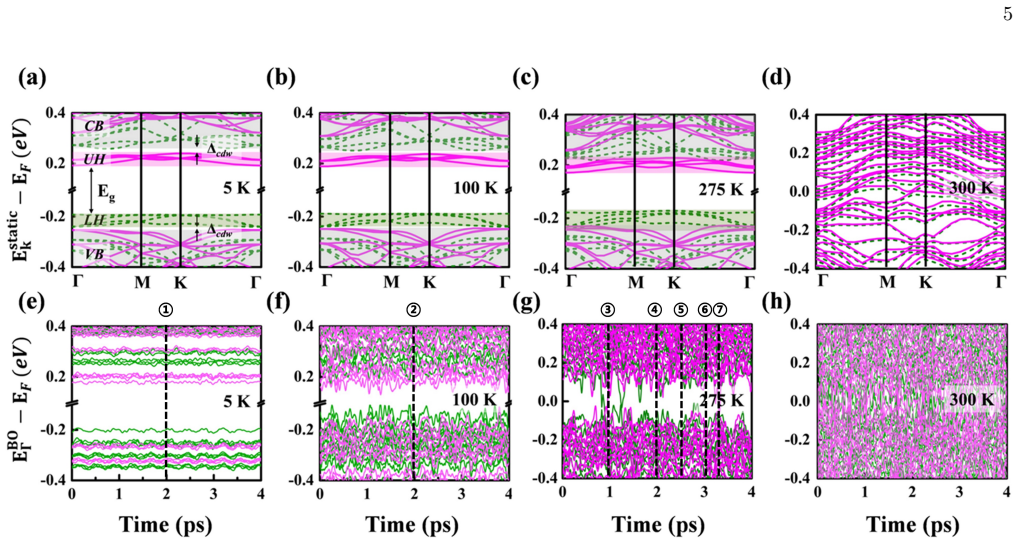
The central discovery is a large, purely dynamical renormalization of a Mott gap. In a DFT+U molecular-dynamics simulation of a single 1T-TaS2 layer, the authors compare the static gap $E_g^{\text{static}}$ from the time-averaged lattice structure with the time-averaged Born-Oppenheimer gap $\langle E_g^{\text{BO}}\rangle$, which is the mean over the trajectory of the instantaneous $\Gamma$-point highest-occupied to lowest-unoccupied gap. $E_g^{\text{static}}$ remains nearly constant below the transition, whereas $\langle E_g^{\text{BO}}\rangle$ drops from roughly 0.4 eV at 5 K to roughly 0.2 eV at $T_C$, i.e., by about half. Since the CDW order parameter $\varphi_{\text{SD}}$ changes little over this range, the gap shrinking is driven by thermal CDW fluctuations rather than by amplitude reduction. A Wannier-function projection of the instantaneous structures shows that the gap correlates with $\Delta_{cs}$, the onsite energy difference between the central and edge orbitals of the Star-of-David cluster, while the hopping parameters are nearly inert; this identifies $\Delta_{cs}$ as the key electron-phonon coupling channel, echoing the site-selective Mott mechanism proposed for rare-earth nickelates.
Load-bearing premise
The paper assumes that averaging the instantaneous electronic gap over a lattice-vibration trajectory, with spins frozen and electrons at zero temperature, faithfully reproduces the gap measured in experiments.
Editorial extensions
If this is right
- In 1T-TaS2, the Mott gap measured below the transition should be interpreted as a thermally renormalized quantity, so STM and transport data must be compared with $\langle E_g^{\text{BO}}\rangle$, not with the static DFT+U gap.
- A nearly temperature-independent CDW amplitude does not imply a temperature-independent electronic gap; dynamical fluctuations of that amplitude can dominate the gap's temperature dependence.
- The same methodology—time-averaging instantaneous gaps over ab initio molecular dynamics—can be applied to other transition-metal dichalcogenides and oxides to estimate the magnitude of lattice-entropy effects in their metal-insulator transitions.
- The identification of $\Delta_{cs}$ as the relevant coupling parameter suggests that the site-selective Mott scenario (an onsite potential difference from a lattice distortion) is the microscopic channel through which lattice vibrations renormalize the gap.
Reading between the lines
- Because the simulation uses only the $\Gamma$ point and a small supercell, the true spectral gap renormalization could be momentum-dependent; extending the same time-averaging to k-point samples would test whether the halving is uniform across the Brillouin zone.
- If lattice entropy is the dominant mechanism, then altering the vibrational spectrum—for example by isotope substitution or by strain that does not change the static structure—should shift the gap at a fixed temperature, a prediction the paper does not make.
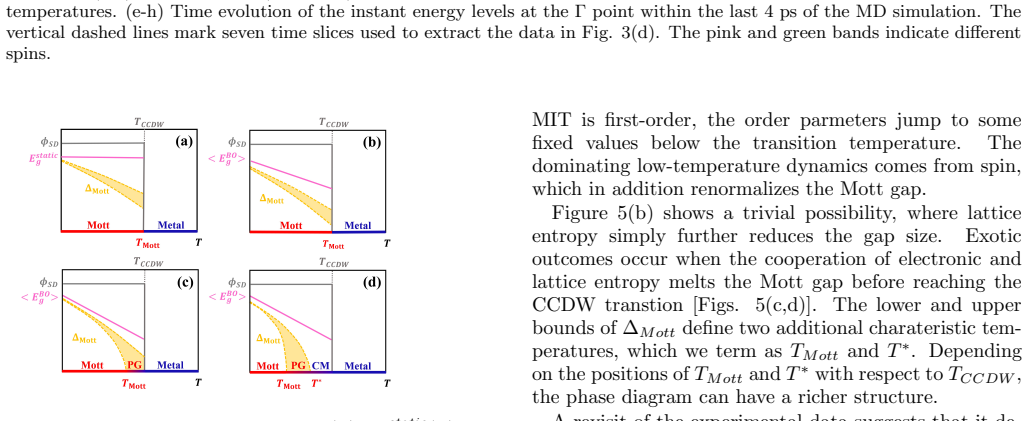
- The paper's use of the mean instantaneous gap as the experimental gap estimator is an approximation; near $T_C$ level crossings occur, so the true spectral gap might close even faster than $\langle E_g^{\text{BO}}\rangle$, possibly producing a pseudogap regime below the first-order transition.
Signed reviews
Editorial analysis
A structured set of objections, weighed in public.
Referee Report
Summary. The paper presents ab initio molecular dynamics simulations of a 1T-TaS2 layer, using DFT+U to compute instantaneous electronic structures along the trajectory. The time-averaged Γ-point HOMO–LUMO gap is found to decrease from about 0.4 eV at 5 K to about 0.2 eV at the CDW transition temperature, while the gap of the time-averaged structure remains nearly constant. The authors interpret this as dynamical CDW fluctuations renormalizing the Mott gap and support this with Wannier analysis identifying the on-site energy Δcs as the key electron–phonon coupled parameter. They also compare with STM data and speculate on possible pseudogap phases.
Significance. If the central claim is correct, the work offers a general computational methodology for quantifying lattice entropy effects on Mott gaps and provides a plausible interpretation of 1T-TaS2's temperature-dependent spectral features. The paper has notable strengths: the Hubbard U is taken from an independent linear-response calculation rather than fitted, the MD equilibration is carefully checked via heating–cooling cycles, and the Wannier analysis provides a transparent physical mechanism (Δcs modulation). The qualitative conclusion that lattice dynamics, not the static CDW amplitude, drives the gap renormalization is compelling. However, the quantitative prediction rests on the identification of the time-averaged instantaneous gap with the observable spectral gap, which is not justified.
major comments (3)
- [Sec. III, Fig. 3(c) and Sec. IV] The time-averaged instantaneous Γ-point gap ⟨E_BO_g⟩ is not the gap of the thermally averaged single-particle spectral function that STM probes. For each ionic configuration R, the Kohn–Sham spectrum has a gap g(R); the disorder-averaged spectral function A(ω)=∫P(R)A_R(ω)dR has zero weight only in the intersection of the individual gaps, so its gap is at most min_R g(R), not ⟨g(R)⟩. Since Fig. 4(h) shows level crossings at 275 K, some snapshots have near-zero gaps, and the averaged spectral function should develop subgap weight or close, making ⟨E_BO_g⟩ an overestimate of the spectral gap. The quantitative claim of a half reduction (0.4→0.2 eV) and the comparison with STM in Sec. IV therefore validate a proxy, not the measured gap. The authors should either compute the actual spectral function from the MD trajectory or clearly re-frame the claim as a property of the instantaneous gap distribution.
- [Sec. II.A and Sec. III] The gap is evaluated only at the Γ point. The authors mention in Sec. IV that the gap melting can be momentum dependent, but the MD trajectory data and the central Fig. 3(c) use only the Γ-point HOMO–LUMO gap. If the minimum gap lies elsewhere in the Brillouin zone, or if the STM dI/dV measurement is sensitive to k≠0 states, the quantitative reduction reported may be different. The authors should justify that the Γ-point gap is representative or at least discuss the uncertainty this introduces.
- [Sec. II.D and Sec. IV] The authors correctly state that DFT+U is a mean-field approximation and that electronic entropy is missing, yet in Sec. IV they plot ⟨E_BO_g⟩ against experimental STM data as if it were the actual Mott gap. Given the issues above, the comparison is premature. The discussion would be strengthened by explicitly distinguishing the calculated quantity (a BO, mean-field, spin-polarized Γ-point gap) from the experimental Mott gap, and by treating the STM comparison as suggestive rather than confirmatory.
minor comments (7)
- [Sec. II.A] It is unclear why the initial spin polarization of the four SDs is set to be the same; some discussion of the sensitivity of the results to the spin configuration would be helpful.
- [Sec. III, Fig. 3(a)] The definition of φSD uses the SD positions from the CCDW phase even in the high-T phase; this is stated in the text but should also be noted in the figure caption for clarity.
- [Table I] No uncertainties are given for the Wannier-derived parameters. A brief statement about the robustness of the Wannierization would increase confidence in Fig. 3(d).
- [Sec. IV] The phrase 'one order of magnitude larger than the lattice temperature variation' is ambiguous; the quantitative statement is Δ⟨E_BO_g⟩/k_B ΔT ≈ −10, which is a dimensionless ratio, not a comparison of energies.
- [Sec. IV] There are several typographical errors, including 'Accrodingly' (should be 'Accordingly'), 'investiations' (should be 'investigations'), and 'transtion' (should be 'transition').
- [Reference 28] The reference for Ritschel et al. is given as Phys. Rev. B 11, 328 (2015), which appears incorrect; the proper citation is likely Phys. Rev. B 92, 115142 (2015).
- [Sec. II.C] The term 'site-selective Mott transition' is used; a brief definition or citation would help readers unfamiliar with the rare-earth nickelate literature.
Circularity Check
No circular derivation: the gap-vs-temperature curve is computed directly from DFT+U MD with independently fixed U, and the self-cited Wannier model is used only for interpretation.
full rationale
The central quantity ⟨E_BO_g⟩ is defined in Sec. III as the time average of instantaneous Γ-point gaps obtained from DFT+U along ab initio MD trajectories (Figs. 4(e-h)), with U=2.27 eV taken from an independent linear-response calculation (Ref. 38), not fitted to the STM data. The static gap E_static_g is separately computed from time-averaged structures, so the contrast between E_static_g(T) and ⟨E_BO_g(T)⟩ is a direct simulation outcome rather than a self-consistency condition. The only author self-citation (Ref. 18) supplies the Wannier-orbital decomposition and the zero-temperature parameters in Table I, but the main claim—that dynamical fluctuations reduce the gap before the first-order CDW transition—does not rely on that model; the Wannier analysis is used afterward to identify Δcs as a correlated parameter. Section II D explicitly acknowledges the missing electronic entropy and labels the simulated system 'hypothetical,' which is a limitation for comparison with experiments but not a circular step. No fitted parameter is renamed as a prediction, and no uniqueness theorem or ansatz is imported from the authors' prior work to force the conclusion.
Assumptions & free parameters
assumptions (5)
- domain assumption Born-Oppenheimer approximation separates electronic and nuclear motion.
- domain assumption DFT+U with the Dudarev corrective functional captures the correlated electronic ground state of 1T-TaS2, including the Mott gap.
- domain assumption The Hubbard U value 2.27 eV from Ref. 38 is valid for the MD supercell and all instantaneous configurations sampled.
- domain assumption Classical molecular dynamics with a Nose thermostat describes the lattice thermodynamics of a single 1T-TaS2 layer.
- ad hoc to paper The time-averaged instantaneous Gamma-point gap <E_BO_g> is the appropriate representative of the thermally renormalized gap observed in experiment.
Cite this review
Pith. "Pith review of Renormalization of the Mott gap by lattice entropy: The case of 1T-TaS2." pith.science (2026). https://pith.science/paper/BFZYURM5
@misc{pith2026190804455,
  author       = {Pith},
  title        = {Pith review of: Renormalization of the Mott gap by lattice entropy: The case of 1T-TaS2},
  year         = {2026},
  howpublished = {\url{https://pith.science/paper/BFZYURM5}},
  note         = {Machine review of arXiv:1908.04455}
}
read the original abstract
In many transition-metal oxides and dichalcogenides, the electronic and lattice degrees of freedom are strongly coupled, giving rise to remarkable phenomena, such as metal-insulator transition (MIT) and charge-density wave (CDW) order. We study this interplay by tracing the instant electronic structure under ab initio molecular dynamics. Applying this method to a 1T-TaS2 layer, we show that the CDW-triggered Mott gap undergoes a continuous reduction as the lattice temperature raises, despite a nearly constant CDW amplitude. Before the CDW order undergoes a sharp first-order transition around the room temperature, the dynamical CDW fluctuation already shrinks the Mott gap size by half. The gap size reduction is one order of magnitude larger than the lattice temperature variation. Our calculation not only provides an important clue to understand the thermodynamics behavior in 1T-TaS2, but also demonstrates a general approach to quantify the lattice entropy effect in MIT.
Figures


Figures from the paper (2 more)
Reference graph
Works this paper leans on
-
[1]
author author B. Sipos , author A. F. \ Kusmartseva , author A. Akrap , author H. Berger , author L. Forr \'o , \ and\ author E. Tuti s ,\ @noop journal journal Nat. Mater. \ volume 7 ,\ pages 960 ( year 2008 ) NoStop
work page 2008
-
[2]
author author J. Wilson , author F. D. \ Salvo , \ and\ author S. Mahajan ,\ 10.1080/00018737500101391 journal journal Adv. Phys. \ volume 24 ,\ pages 117 ( year 1975 ) NoStop
-
[3]
author author P. Fazekas \ and\ author E. Tosatti ,\ @noop journal journal Philos. Mag. B \ volume 39 ,\ pages 229 ( year 1979 ) NoStop
work page 1979
-
[4]
author author X. L. \ Wu \ and\ author C. M. \ Lieber ,\ @noop journal journal Science \ volume 243 ,\ pages 1703 ( year 1989 ) NoStop
work page 1989
-
[5]
author author B. Burk , author R. E. \ Thomson , author A. Zettl , \ and\ author J. Clarke ,\ @noop journal journal Phys. Rev. Lett. \ volume 66 ,\ pages 3040 ( year 1991 ) NoStop
work page 1991
-
[6]
author author J.-J. \ Kim , author W. Yamaguchi , author T. Hasegawa , \ and\ author K. Kitazawa ,\ @noop journal journal Phys. Rev. Lett. \ volume 73 ,\ pages 2103 ( year 1994 ) NoStop
work page 1994
-
[7]
author author R. A. \ Pollak , author D. E. \ Eastman , author F. J. \ Himpsel , author P. Heimann , \ and\ author B. Reihl ,\ @noop journal journal Phys. Rev. B \ volume 24 ,\ pages 7435 ( year 1981 ) NoStop
work page 1981
-
[8]
author author N. Smith , author S. Kevan , \ and\ author F. DiSalvo ,\ @noop journal journal J. Phys. C: Solid State Phys. \ volume 18 ,\ pages 3175 ( year 1985 ) NoStop
work page 1985
Show all 47 references
-
[9]
Manzke , author O
author author R. Manzke , author O. Anderson , \ and\ author M. Skibowski ,\ @noop journal journal J. Phys. C: Solid State Phys. \ volume 21 ,\ pages 2399 ( year 1988 ) NoStop
1988
-
[10]
Manzke , author T
author author R. Manzke , author T. Buslaps , author B. Pfalzgraf , author M. Skibowski , \ and\ author O. Anderson ,\ @noop journal journal EPL-Europhys. Lett. \ volume 8 ,\ pages 195 ( year 1989 ) NoStop
1989
-
[11]
Law \ and\ author P
author author K. Law \ and\ author P. A. \ Lee ,\ @noop journal journal P. Natl. Acad. Sci. USA \ volume 114 ,\ pages 6996 ( year 2017 ) NoStop
2017
-
[12]
Klanj s ek , author A
author author M. Klanj s ek , author A. Zorko , author J. Mravlje , author Z. Jagli c i \'c , author P. K. \ Biswas , author P. Prelov s ek , author D. Mihailovic , author D. Ar c on , et al. ,\ @noop journal journal Nat. Phys. \ volume 13 ,\ pages 1130 ( year 2017 ) NoStop
2017
-
[13]
Kratochvilova , author A
author author M. Kratochvilova , author A. D. \ Hillier , author A. R. \ Wildes , author L. Wang , author S.-W. \ Cheong , \ and\ author J.-G. \ Park ,\ @noop journal journal npj Quantum Mater. \ volume 2 ,\ pages 42 ( year 2017 ) NoStop
2017
-
[14]
Ribak , author I
author author A. Ribak , author I. Silber , author C. Baines , author K. Chashka , author Z. Salman , author Y. Dagan , \ and\ author A. Kanigel ,\ @noop journal journal Phys. Rev. B \ volume 96 ,\ pages 195131 ( year 2017 ) NoStop
2017
-
[15]
author author A. S. \ Ngankeu , author S. K. \ Mahatha , author K. Guilloy , author M. Bianchi , author C. E. \ Sanders , author K. Hanff , author K. Rossnagel , author J. A. \ Miwa , author C. B. \ Nielsen , author M. Bremholm , et al. ,\ @noop journal journal Phys. Rev. B \ ...
2017
-
[16]
Ravnik , author I
author author J. Ravnik , author I. Vaskivskyi , author T. Mertelj , \ and\ author D. Mihailovic ,\ @noop journal journal Phys. Rev. B \ volume 97 ,\ pages 075304 ( year 2018 ) NoStop
2018
-
[17]
Rossnagel ,\ 10.1088/0953-8984/23/21/213001 journal journal J
author author K. Rossnagel ,\ 10.1088/0953-8984/23/21/213001 journal journal J. Phys.: Condens. Mat. \ volume 23 ,\ pages 213001 ( year 2011 ) NoStop
2011 doi
-
[18]
Qiao , author X
author author S. Qiao , author X. Li , author N. Wang , author W. Ruan , author C. Ye , author P. Cai , author Z. Hao , author H. Yao , author X. Chen , author J. Wu , et al. ,\ @noop journal journal Phys. Rev. X \ volume 7 ,\ pages 041054 ( year 2017 ) NoStop
2017
-
[19]
Cho , author Y.-H
author author D. Cho , author Y.-H. \ Cho , author S.-W. \ Cheong , author K.-S. \ Kim , \ and\ author H. W. \ Yeom ,\ @noop journal journal Phys. Rev. B \ volume 92 ,\ pages 085132 ( year 2015 ) NoStop
2015
-
[20]
Lutsyk , author M
author author I. Lutsyk , author M. Rogala , author P. Dabrowski , author P. Krukowski , author P. J. \ Kowalczyk , author A. Busiakiewicz , author D. A. \ Kowalczyk , author E. Lacinska , author J. Binder , author N. Olszowska , et al. ,\ @noop journal journal Phys. Rev. B \ ...
2018
-
[21]
Zwick , author H
author author F. Zwick , author H. Berger , author I. Vobornik , author G. Margaritondo , author L. Forr \'o , author C. Beeli , author M. Onellion , author G. Panaccione , author A. Taleb-Ibrahimi , \ and\ author M. Grioni ,\ @noop journal journal Phys. Rev. Lett. \ volume 81...
1998
-
[22]
author author D. F. \ Shao , author R. C. \ Xiao , author W. J. \ Lu , author H. Y. \ Lv , author J. Y. \ Li , author X. B. \ Zhu , \ and\ author Y. P. \ Sun ,\ @noop journal journal Phys. Rev. B \ volume 94 ,\ pages 125126 ( year 2016 ) NoStop
2016
-
[23]
Ang , author Y
author author R. Ang , author Y. Tanaka , author E. Ieki , author K. Nakayama , author T. Sato , author L. J. \ Li , author W. J. \ Lu , author Y. P. \ Sun , \ and\ author T. Takahashi ,\ @noop journal journal Phys. Rev. Lett. \ volume 109 ,\ pages 176403 ( year 2012 ) NoStop
2012
-
[24]
Li , author W
author author L. Li , author W. Lu , author X. Zhu , author L. Ling , author Z. Qu , \ and\ author Y. Sun ,\ @noop journal journal EPL-Europhys. Lett. \ volume 97 ,\ pages 67005 ( year 2012 ) NoStop
2012
-
[25]
Liu , author R
author author Y. Liu , author R. Ang , author W. Lu , author W. Song , author L. Li , \ and\ author Y. Sun ,\ @noop journal journal Appl. Phys. Lett. \ volume 102 ,\ pages 192602 ( year 2013 ) NoStop
2013
-
[26]
Yu , author F
author author Y. Yu , author F. Yang , author X. F. \ Lu , author Y. J. \ Yan , author Y.-H. \ Cho , author L. Ma , author X. Niu , author S. Kim , author Y.-W. \ Son , author D. Feng , author S. Li , author S.-W. \ Cheong , author X. H. \ Chen , \ and\ author Y. Zhang ,\ @noo...
2015
-
[27]
Cho , author S
author author D. Cho , author S. Cheon , author K.-S. \ Kim , author S.-H. \ Lee , author Y.-H. \ Cho , author S.-W. \ Cheong , \ and\ author H. W. \ Yeom ,\ @noop journal journal Nat. Commun. \ volume 7 ,\ pages 10453 ( year 2016 ) NoStop
2016
-
[28]
Ritschel , author J
author author T. Ritschel , author J. Trinckauf , author K. Koepernik , author B. Büchner , author M. v. Zimmermann , author H. Berger , author Y. I. \ Joe , author P. Abbamonte , \ and\ author J. Geck ,\ @noop journal journal Phys. Rev. B \ volume 11 ,\ pages 328 ( year 2015 ) NoStop
2015
-
[29]
Han \ and\ author A
author author Q. Han \ and\ author A. Millis ,\ @noop journal journal Phys. Rev. Lett. \ volume 121 ,\ pages 067601 ( year 2018 ) NoStop
2018
-
[30]
author author A. B. \ Georgescu et al. ,\ @noop journal journal Proc. Natl. Acad. Sci. \ volume 116 ,\ pages 14435 ( year 2019 ) NoStop
2019
-
[31]
author author J. D. \ Budai et al. ,\ @noop journal journal Nature \ volume 515 ,\ pages 7528 ( year 2014 ) NoStop
2014
-
[32]
author author G. G. \ Guzmán-Verri1 , author R. T. \ Brierley , \ and\ author P. B. \ Littlewood ,\ @noop journal journal Nature \ volume 576 ,\ pages 429 ( year 2019 ) NoStop
2019
-
[33]
Kresse \ and\ author J
author author G. Kresse \ and\ author J. Furthm \"u ller ,\ @noop journal journal Comp. Mater. Sci. \ volume 6 ,\ pages 15 ( year 1996 a ) NoStop
1996
-
[34]
Kresse \ and\ author J
author author G. Kresse \ and\ author J. Furthm \"u ller ,\ @noop journal journal Phys. Rev. B \ volume 54 ,\ pages 11169 ( year 1996 b ) NoStop
1996
-
[35]
Kresse \ and\ author D
author author G. Kresse \ and\ author D. Joubert ,\ @noop journal journal Phys. Rev. B \ volume 59 ,\ pages 1758 ( year 1999 ) NoStop
1999
-
[36]
author author J. P. \ Perdew , author K. Burke , \ and\ author M. Ernzerhof ,\ @noop journal journal Phys. Rev. Lett. \ volume 77 ,\ pages 3865 ( year 1996 ) NoStop
1996
-
[37]
author author S. L. \ Dudarev , author G. A. \ Botton , author S. Y. \ Savrasov , author C. J. \ Humphreys , \ and\ author A. P. \ Sutton ,\ @noop journal journal Phys. Rev. B \ volume 57 ,\ pages 1505 ( year 1998 ) NoStop
1998
-
[38]
Darancet , author A
author author P. Darancet , author A. J. \ Millis , \ and\ author C. A. \ Marianetti ,\ @noop journal journal Phys. Rev. B \ volume 90 ,\ pages 045134 ( year 2014 ) NoStop
2014
-
[39]
Nos \'e ,\ @noop journal journal Mol
author author S. Nos \'e ,\ @noop journal journal Mol. Phys. \ volume 52 ,\ pages 255 ( year 1984 a ) NoStop
1984
-
[40]
Nos \'e ,\ @noop journal journal J
author author S. Nos \'e ,\ @noop journal journal J. Chem. Phys. \ volume 81 ,\ pages 511 ( year 1984 b ) NoStop
1984
-
[41]
author author D. M. \ Bylander \ and\ author L. Kleinman ,\ @noop journal journal Phys. Rev. B \ volume 46 ,\ pages 13756 ( year 1992 ) NoStop
1992
-
[42]
author author A. A. \ Mostofi , author J. R. \ Yates , author Y.-S. \ Lee , author I. Souza , author D. Vanderbilt , \ and\ author N. Marzari ,\ @noop journal journal Comput. Phys. Commun. \ volume 178 ,\ pages 685 ( year 2008 ) NoStop
2008
-
[43]
Kotliar , author S
author author G. Kotliar , author S. Y. \ Savrasov , author K. Haule , author V. S. \ Oudovenko , author O. Parcollet , \ and\ author C. A. \ Marianetti ,\ @noop journal journal Rev. Mod. Phys. \ volume 78 ,\ pages 865 ( year 2006 ) NoStop
2006
-
[44]
Park , author A
author author H. Park , author A. J. \ Millis , \ and\ author C. A. \ Marianetti ,\ @noop journal journal Phys. Rev. Lett. \ volume 109 ,\ pages 156402 ( year 2012 ) NoStop
2012
-
[45]
author author P. A. \ Lee , author N. Nagaosa , \ and\ author X.-G. \ Wen ,\ @noop journal journal Rev. Mod. Phys. \ volume 78 ,\ pages 17 ( year 2006 ) NoStop
2006
-
[46]
\ Han , author C
author author X.-J. \ Han , author C. Chen , author J. Chen , author H.-D. \ Xie , author R.-Z. \ Huang , author H.-J. \ Liao , author B. Normand , author Z. Y. \ Meng , \ and\ author T. Xiang ,\ 10.1103/PhysRevB.99.245150 journal journal Phys. Rev. B \ volume 99 ,\ pages 2451...
-
[47]
Maier , author M
author author T. Maier , author M. Jarrell , author T. Pruschke , \ and\ author M. H. \ Hettler ,\ @noop journal journal Rev. Mod. Phys. \ volume 77 ,\ pages 1027 ( year 2005 ) NoStop
2005
Reviewed August 14, 2026 · model on record in the stance chip above.
Discussion (0). Continue with ORCID to comment.