REVIEW 3 major objections 4 minor 108 references
False-vacuum collapse alone can turn primordial phase-transition remnants into dark-matter black holes, without needing trapped particles or tuned couplings.
Reviewed by Pith at T0; open to challenge. T0 means a machine referee read the full paper against a public rubric. the ladder, T0–T4 →
T0 review · deepseek-v4-flash
2026-08-01 23:15 UTC pith:BG4SKLJA
load-bearing objection Useful multi-messenger map, but the PBH numbers rest on an unvalidated radiation-backreaction assumption and missing BBN checks—treat f_PBH as provisional. the 3 major comments →
PBH formation and Gravitational Waves as Multi-messenger Signals of First-order Phase Transitions
The pith
A machine-rendered reading of the paper's core claim, the machinery that carries it, and where it could break.
Core claim
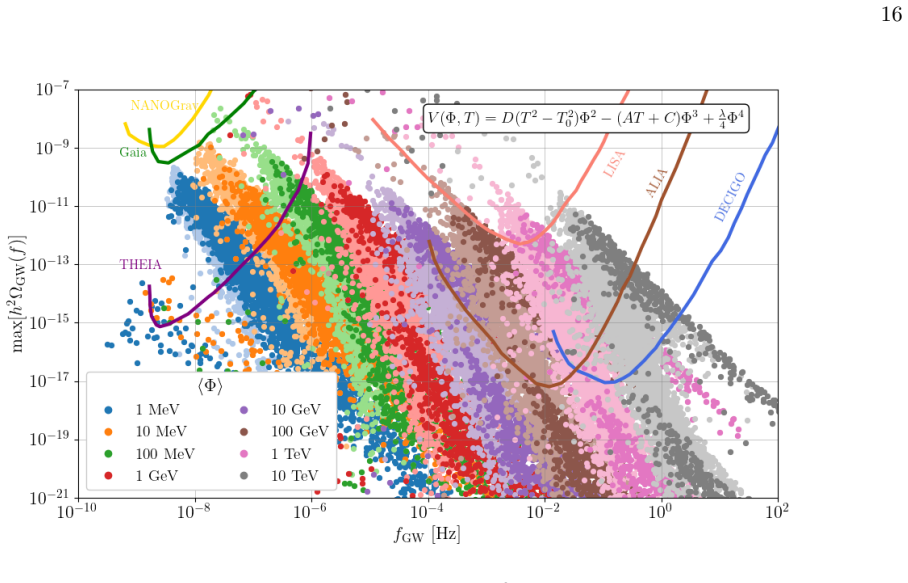
The central claim is that false-vacuum collapse is an efficient and self-contained primordial-black-hole production channel across a broad region of phase-transition parameter space, and that in the classically conformal U(1) B−L benchmark the most promising multi-messenger window sits at 1 MeV ≲ ⟨Φ⟩ ≲ 10 MeV. There the phase transition yields observable gravity-wave signals and asteroid-mass black holes with f_PBH ~ 1, including benchmark points in which black holes account for all of the dark matter. The paper also charts the correlated GW–PBH parameter space for a generic polynomial potential, showing that the abundance and mass of the black holes track the phase-transition strength and t
What carries the argument
The thin-shell junction formalism of classical general relativity: a false-vacuum patch is treated as a spherical thin wall separating a false-vacuum interior from a true-vacuum exterior, and the junction condition gives an equation of motion for the wall radius plus a turning-point criterion. When the patch's radius passes the turning point and the collapse time is shorter than the nucleation and Hubble times, the enclosed vacuum energy meets the black-hole horizon condition and a black hole forms. The abundance computation uses false-vacuum percolation at a 29% remaining fraction and a geometric nucleation rate for shrinking patches, together with a vacuum-domination condition requiring th
Load-bearing premise
The collapse criterion derived for spherical vacuum-dominated bubbles is assumed to hold for shrinking false-vacuum patches immersed in a radiation-filled expanding universe; if radiation or plasma back-reaction prevents a patch from reaching the turning point and horizon, the predicted PBH masses and abundances—half of the multi-messenger claim—are unsupported.
What would settle it
A numerical-relativity run of a false-vacuum sphere in a radiation-dominated expanding background, initialized with the paper's all-dark-matter benchmark parameters: if the patch does not form an apparent horizon when the turning-point condition is satisfied, the central claim collapses. An observational alternative: finding f_PBH ≈ 1 asteroid-mass black holes with no gravity-wave background in the 10^-8 to 10^-6 Hz band from a classically conformal transition, or a strong GW signal with no PBHs, would refute the predicted correlation.
If this is right
- A single MeV-scale phase transition can simultaneously produce a detectable gravity-wave background and a primordial-black-hole population that could be all of the dark matter, giving two independent channels to the same microphysics.
- Because the mechanism needs no dark sector, PBH searches become a generic probe of first-order phase transitions rather than a probe of exotic trapping scenarios.
- Gravity-wave observations would reach small gauge couplings and high symmetry-breaking scales that colliders cannot, since smaller couplings delay the transition and increase the wave amplitude.
- PBH searches are not redundant with gravity-wave searches: some model regions yield weaker waves yet observable black holes, so the combined coverage exceeds either probe alone.
- The multi-messenger region is insensitive to order-one choices of percolation threshold, so the identified window is not a numerical artifact of that convention.
Where Pith is reading between the lines
- The same vacuum-collapse argument should extend to any strongly supercooled or strongly first-order transition beyond U(1) B−L; the paper gestures at this but does not scan other models.
- A dedicated numerical-relativity simulation of a false-vacuum patch immersed in radiation would settle the weakest link; if back-reaction prevents collapse, the all-dark-matter region would shift to stronger transitions or higher VEVs—a testable remapping of the GW–PBH correlation.
- The preferred 1–10 MeV window sits close to Big Bang nucleosynthesis constraints on extra relativistic species; combining those bounds with the GW and PBH predictions could sharpen or exclude the window, which the paper does not quantify.
- An observational cross-check: detection of asteroid-mass PBHs at f_PBH ≈ 1 without a corresponding low-frequency gravity-wave signal (or a GW signal without PBHs) would distinguish this collapse mechanism from competing PBH-production channels.
Editorial analysis
A structured set of objections, weighed in public.
Referee Report
Summary. The paper studies PBH formation via the collapse of false-vacuum domains during cosmological first-order phase transitions, using the Israel junction-condition formalism of Blau-Guendelman-Guth and its recent application by Flores-Kusenko-Sasaki, instead of the critical-overdensity criterion. It applies this mechanism to two classes of models — a generic polynomial scalar potential and a classically conformal U(1)_{B-L} model — scans their parameter space, and computes the correlated gravitational-wave spectra and PBH masses/abundances. The headline claim is that classically conformal symmetry breaking at scales 1 MeV ≲ ⟨Φ⟩ ≲ 10 MeV can simultaneously produce observable GWs (THEIA/LISA) and asteroid-mass PBHs with f_PBH ~ 1, with benchmark points BM8 and BM9 giving PBHs as all of the dark matter.
Significance. If the collapse formalism is valid in the regimes considered, the paper would establish a concrete, predictive multi-messenger target for MeV-scale classically conformal symmetry breaking, and it usefully charts the correlated GW/PBH parameter space for two benchmark potentials. The numerical workflow is transparent in structure: the scans are clearly defined, the ELENA package is used for phase-transition quantities, and the benchmark table gives explicit observable predictions. The GW calculation follows standard fits and is largely self-contained. The PBH predictions, however, rest on an unverified applicability condition for the vacuum-only collapse formalism in a radiation-filled FLRW universe and on an unspecified wall tension. These are load-bearing assumptions for the central claim, so the paper is not yet at the level where f_PBH ~ 1 benchmarks can be accepted as established.
major comments (3)
- [Appendix B; §4.3, Eq. (40)] The validity of applying the vacuum-dominated collapse formalism to false-vacuum patches in a radiation-filled FLRW universe is not quantitatively established. Eq. (B12) requires H_R^2 r^2 ≪ |dot r^2 + 1 − H_V^2 r^2|, and the text then takes the right-hand side to be 'of order 1' to obtain r ≪ 1/H_R. This is not guaranteed: at the turning point dot r = 0, the right-hand side becomes |1 − H_V^2 r^2|, which can be small if the patch radius approaches the vacuum de Sitter scale. No numerical evaluation of this combination is reported for any benchmark. The assertion in §4.3 that Eq. (40), R(T_f) ≪ (8πG ρ_R/3)^{-1/2}, is 'easily satisfied' is also unsupported by reported values. Since Eqs. (29)–(36) are the origin of all PBH masses and abundances, the manuscript should directly evaluate Eq. (B12) and Eq. (40) for the benchmark points and for the scanned regions producing f_PBH ~ 1.
- [§4.2, Eqs. (29)–(32)] The domain-wall tension σ enters the mass formula Eq. (29), the effective potential of Eq. (31), and the scaled radius Eq. (32), yet it is never specified, computed, or varied in the scans of §5. If the intended treatment is σ = 0, this should be stated explicitly and its validity justified; if not, σ must be derived from the scalar potential. The turning-point condition that decides whether a false-vacuum domain collapses depends on σ through U(z), so the PBH benchmarks in Table I are not reproducible as written.
- [§4.3, Eq. (37); §5.4] The abundance calculation assumes a monochromatic PBH mass M obtained from the volume term of Eq. (29) with the mean patch radius ar R of Eq. (33). The manuscript acknowledges in §6 that the size distribution is non-uniform and that non-sphericity could modify the collapse efficiency, but no estimate is given for how these effects shift f_PBH. Given that the headline result is f_PBH ~ 1 for BM8/BM9, a quantitative or at least parametric estimate of the sensitivity of f_PBH to the patch-radius distribution width and to deviations from sphericity is needed before those benchmark values can be taken at face value.
minor comments (4)
- [§6; heading] Typos: 'false-vaccum' in the concluding section and 'Acknowledegments' before the references. Please correct.
- [Table I] The BM7 row appears as '10 3 0.0054 ...' in the arXiv text. If the intended VEV is 10³ MeV, it should be typeset as a superscript; if α_B−L(0) = 3 is intended, it conflicts with the perturbativity bound α_B−L(0) < 1 stated in §5.2.
- [§4.2–4.3] The proper time τ' in Eq. (36) and the relation between the nucleation-time variable t_i and the integration variables in Eqs. (33)–(35) are not defined with enough precision. A short notational clarification would improve reproducibility.
- [§4.3] The claim that 'O(1) variation in P_f results in shifts to observables at the percent level' would be more convincing if accompanied by a small numerical demonstration, since PBH abundances are often exponentially sensitive to thresholds.
Circularity Check
No significant circularity: the PBH and GW predictions are computed outputs of an externally sourced collapse formalism, not fits to data or self-referential constructions.
full rationale
The central derivation chain is not circular. The PBH formation formalism is imported from external references: Eq. (29) comes from Blau, Guendelman, and Guth (ref. [16]), with recent variants from ref. [14]; neither is authored by the present authors. The paper's scanned predictions for M_PBH, f_PBH, and GW spectra are computed outputs of the phase-transition parameters, with no parameters fitted to PBH or GW observations. The only author-overlap citation is ref. [15] (Dent, Dutta, Rai), used in the Introduction as one of two references supporting the general possibility of vacuum-driven collapse; it is not load-bearing because the actual machinery relies on refs. [16] and [14]. Appendix B's step taking the right-hand side of Eq. (B12) 'of order 1' to obtain r << 1/H_R is an explicit regime assumption about the neglected radiation contribution, and Eq. (40) is asserted as 'easily satisfied' without tabulated values; these are potential validity gaps or correctness risks, not circular reductions of an output to an input. No equation is shown to equal its own input by construction, and no fitted parameter is renamed as a prediction. The paper is self-contained against external benchmarks and the correlation relation Eq. (42) is an explanatory scaling derived from shared R_sep, not a disguised input.
Axiom & Free-Parameter Ledger
free parameters (4)
- D (quadratic thermal coefficient, polynomial potential) =
0.1
- Domain-wall tension σ entering the collapse EOM (Eqs. 31–32)
- Percolation / PBH-formation thresholds P_f =
0.71 (true-vacuum percolation), 0.29 (PBH formation)
- Order-one right-hand side in Eq. (B12) =
1
axioms (7)
- domain assumption Israel junction-condition mass formula Eq. (29) (BGG) describes false-vacuum patches at the end of a FOPT
- domain assumption Collapse criterion of ref. [14]: collapse occurs if the domain passes the turning point beyond the potential barrier U(z) and if the collapse time is shorter than both the Hubble time and the nucleation timescale
- domain assumption PBH mass is the constant volume term M = (4/3)πρ_V R̅³ with a monochromatic mass spectrum
- domain assumption Vacuum-energy-only collapse: no particle or domain-wall interactions inside the false vacuum; radiation back-reaction neglected
- domain assumption The false-vacuum nucleation rate Γ_f of Eq. (34) (geometric approach of ref. [73]) governs the number of collapsing patches
- domain assumption GW spectral fits of refs. [63,69] (Appendix A) with v_w = 1 and standard redshift factors
- standard math Standard FLRW cosmology with entropy conservation and P_f(T_p) = 0.71 percolation threshold
read the original abstract
The collapse of false-vacuum domains during first-order phase transitions in the early Universe may lead to primordial black hole (PBH) formation whose signatures form a multimessenger complement to gravitational wave (GW) production. We focus on PBH formation through the gravitational collapse of false-vacuum domains, described using a junction condition formalism. This formalism develops the Schwarzschild collapse criterion dynamically, avoiding the usage of critical overdensity thresholds in a post-inflationary Universe, and is driven solely by the vacuum energy enclosed within shrinking false-vacuum domains without the assistance of particle or domain wall interactions in the false vacuum. We study the parameter space of phase transitions and identify regions producing observable GWs, observable PBHs, or both simultaneously. We investigate this phenomenology in polynomial and classically conformal scalar field potentials as model benchmarks. We find that the scalar fields with vacuum expectation values in the range of 1-100 MeV have the largest model parameter space available for these multi-messenger signals, which are testable with upcoming GW observatories, searches for Hawking radiation, and gravitational lensing surveys.
Figures




Reference graph
Works this paper leans on
-
[1]
D. N. Page and S. W. Hawking,Gamma rays from primordial black holes,Astrophys. J.206(1976) 1
1976
-
[2]
B. J. Carr and J. H. MacGibbon,Cosmic rays from primordial black holes and constraints on the early universe,Phys. Rept.307(1998) 141
1998
-
[3]
B. Carr, K. Kohri, Y. Sendouda and J. Yokoyama,Constraints on primordial black holes,Rept. Prog. Phys. 84(2021) 116902 [2002.12778]
Pith/arXiv arXiv 2021
-
[4]
K. Kawana, T. Kim and P. Lu,PBH formation from overdensities in delayed vacuum transitions,Phys. Rev. D108(2023) 103531 [2212.14037]
Pith/arXiv arXiv 2023
-
[5]
Y. Gouttenoire and T. Volansky,Primordial black holes from supercooled phase transitions,Phys. Rev. D110 (2024) 043514 [2305.04942]
Pith/arXiv arXiv 2024
-
[6]
T. H. Jung and T. Okui,Primordial black holes from bubble collisions during a first-order phase transition, Phys. Rev. D110(2024) 115014 [2110.04271]
Pith/arXiv arXiv 2024
-
[7]
C. Gross, G. Landini, A. Strumia and D. Teresi,Dark Matter as dark dwarfs and other macroscopic objects: multiverse relics?,JHEP09(2021) 033 [2105.02840]
Pith/arXiv arXiv 2021
-
[8]
M. J. Baker, M. Breitbach, J. Kopp and L. Mittnacht,Primordial Black Holes from First-Order Cosmological Phase Transitions,2105.07481
-
[9]
M. J. Baker, M. Breitbach, J. Kopp and L. Mittnacht,Detailed Calculation of Primordial Black Hole Formation During First-Order Cosmological Phase Transitions,2110.00005
-
[10]
K. Kawana and K.-P. Xie,Primordial black holes from a cosmic phase transition: The collapse of Fermi-balls, Phys. Lett. B824(2022) 136791 [2106.00111]
Pith/arXiv arXiv 2022
-
[11]
J.-P. Hong, S. Jung and K.-P. Xie,Fermi-ball dark matter from a first-order phase transition,Phys. Rev. D 102(2020) 075028 [2008.04430]
Pith/arXiv arXiv 2020
-
[12]
P. Huang and K.-P. Xie,Primordial black holes from an electroweak phase transition,Phys. Rev. D105 (2022) 115033 [2201.07243]
Pith/arXiv arXiv 2022
-
[13]
J. B. Dent, B. Dutta, J. Kumar and D. Marfatia,Primordial black holes from Q-balls produced in a first-order phase transition,2505.21830
-
[14]
M. M. Flores, A. Kusenko and M. Sasaki,Revisiting formation of primordial black holes in a supercooled first-order phase transition,Phys. Rev. D110(2024) 015005 [2402.13341]
Pith/arXiv arXiv 2024
-
[15]
J. B. Dent, B. Dutta and M. Rai,Primordial black holes at the junction,JHEP05(2026) 279 [2510.05236]
arXiv 2026
-
[16]
S. K. Blau, E. I. Guendelman and A. H. Guth,The Dynamics of False Vacuum Bubbles,Phys. Rev. D35 (1987) 1747
1987
-
[17]
B. J. Carr,The Primordial black hole mass spectrum,Astrophys. J.201(1975) 1
1975
-
[18]
T. Harada, C.-M. Yoo and K. Kohri,Threshold of primordial black hole formation,Phys. Rev. D88(2013) 084051 [1309.4201]. [Erratum: Phys.Rev.D 89, 029903 (2014)]
Pith/arXiv arXiv 2013
-
[19]
A. Escriv` a,PBH Formation from Spherically Symmetric Hydrodynamical Perturbations: A Review,Universe 8(2022) 66 [2111.12693]
Pith/arXiv arXiv 2022
-
[20]
D. Marfatia and P.-Y. Tseng,Correlated signals of first-order phase transitions and primordial black hole evaporation,JHEP08(2022) 001 [2112.14588]. [Erratum: JHEP 08, 249 (2022)]
Pith/arXiv arXiv 2022
-
[21]
K.-P. Xie,Pinning down the primordial black hole formation mechanism with gamma-rays and gravitational waves,JCAP06(2023) 008 [2301.02352]. 29
Pith/arXiv arXiv 2023
-
[22]
T. C. Gehrman, B. Shams Es Haghi, K. Sinha and T. Xu,The primordial black holes that disappeared: connections to dark matter and MHz-GHz gravitational Waves,JCAP10(2023) 001 [2304.09194]
Pith/arXiv arXiv 2023
-
[23]
F. P. Huang, C. Idegawa and A. Yang,Primordial black hole formation and multimessenger signals in a complex singlet extension of the standard model,Phys. Rev. D113(2026) 055013 [2510.24007]
arXiv 2026
-
[24]
M. Lewicki, P. Toczek and V. Vaskonen,Black Holes and Gravitational Waves from Slow First-Order Phase Transitions,Phys. Rev. Lett.133(2024) 221003 [2402.04158]
Pith/arXiv arXiv 2024
-
[25]
M. Arteaga, A. Ghoshal and A. Strumia,Gravitational waves and black holes from the phase transition in models of dynamical symmetry breaking,JCAP05(2025) 029 [2409.04545]
Pith/arXiv arXiv 2025
-
[26]
Buchmuller, C
W. Buchmuller, C. Greub and P. Minkowski,Neutrino masses, neutral vector bosons and the scale of B-L breaking,Phys. Lett. B267(1991) 395
1991
-
[27]
K. S. Babu and R. N. Mohapatra,Quantization of Electric Charge From Anomaly Constraints and a Majorana Neutrino,Phys. Rev. D41(1990) 271
1990
-
[28]
M. Gell-Mann, P. Ramond and R. Slansky,Complex Spinors and Unified Theories,Conf. Proc. C790927 (1979) 315 [1306.4669]
Pith/arXiv arXiv 1979
-
[29]
R. N. Mohapatra and G. Senjanovic,Neutrino Mass and Spontaneous Parity Nonconservation,Phys. Rev. Lett.44(1980) 912
1980
-
[30]
Minkowski,µ→eγat a Rate of One Out of10 9 Muon Decays?,Phys
P. Minkowski,µ→eγat a Rate of One Out of10 9 Muon Decays?,Phys. Lett. B67(1977) 421
1977
-
[31]
Yanagida,Horizontal gauge symmetry and masses of neutrinos,Conf
T. Yanagida,Horizontal gauge symmetry and masses of neutrinos,Conf. Proc. C7902131(1979) 95
1979
-
[32]
S. Iso, N. Okada and Y. Orikasa,Classically conformalB − L extended Standard Model,Phys. Lett. B676 (2009) 81 [0902.4050]
Pith/arXiv arXiv 2009
-
[33]
S. Iso, N. Okada and Y. Orikasa,The minimal B-L model naturally realized at TeV scale,Phys. Rev. D80 (2009) 115007 [0909.0128]
Pith/arXiv arXiv 2009
-
[34]
R. Jinno and M. Takimoto,Probing a classically conformal B-L model with gravitational waves,Phys. Rev. D 95(2017) 015020 [1604.05035]
Pith/arXiv arXiv 2017
-
[35]
C. Marzo, L. Marzola and V. Vaskonen,Phase transition and vacuum stability in the classically conformal B–L model,Eur. Phys. J. C79(2019) 601 [1811.11169]
Pith/arXiv arXiv 2019
-
[36]
J. Ellis, M. Lewicki and V. Vaskonen,Updated predictions for gravitational waves produced in a strongly supercooled phase transition,JCAP11(2020) 020 [2007.15586]
Pith/arXiv arXiv 2020
-
[37]
S. R. Coleman and E. J. Weinberg,Radiative Corrections as the Origin of Spontaneous Symmetry Breaking, Phys. Rev. D7(1973) 1888
1973
-
[38]
Sher,Electroweak Higgs Potentials and Vacuum Stability,Phys
M. Sher,Electroweak Higgs Potentials and Vacuum Stability,Phys. Rept.179(1989) 273
1989
-
[39]
K. A. Meissner and H. Nicolai,Renormalization Group and Effective Potential in Classically Conformal Theories,Acta Phys. Polon. B40(2009) 2737 [0809.1338]
Pith/arXiv arXiv 2009
-
[40]
M. Quiros,Finite temperature field theory and phase transitions, inICTP Summer School in High-Energy Physics and Cosmology, pp. 187–259, 1, 1999,hep-ph/9901312
Pith/arXiv arXiv 1999
-
[41]
M. B. Einhorn and D. R. T. Jones,A NEW RENORMALIZATION GROUP APPROACH TO MULTISCALE PROBLEMS,Nucl. Phys. B230(1984) 261
1984
-
[42]
C. Ford, D. R. T. Jones, P. W. Stephenson and M. B. Einhorn,The Effective potential and the renormalization group,Nucl. Phys. B395(1993) 17 [hep-lat/9210033]
Pith/arXiv arXiv 1993
-
[43]
M. Bando, T. Kugo, N. Maekawa and H. Nakano,Improving the effective potential: Multimass scale case, Prog. Theor. Phys.90(1993) 405 [hep-ph/9210229]
Pith/arXiv arXiv 1993
-
[44]
Ford,Multiscale renormalization group improvement of the effective potential,Phys
C. Ford,Multiscale renormalization group improvement of the effective potential,Phys. Rev. D50(1994) 7531 [hep-th/9404085]
Pith/arXiv arXiv 1994
-
[45]
C. Ford and C. Wiesendanger,A Multiscale subtraction scheme and partial renormalization group equations in the O(N) symmetric phi**4 theory,Phys. Rev. D55(1997) 2202 [hep-ph/9604392]
Pith/arXiv arXiv 1997
-
[46]
J. A. Casas, V. Di Clemente and M. Quiros,The Effective potential in the presence of several mass scales, Nucl. Phys. B553(1999) 511 [hep-ph/9809275]
Pith/arXiv arXiv 1999
-
[47]
T. G. Steele, Z.-W. Wang and D. G. C. McKeon,Multiscale renormalization group methods for effective potentials with multiple scalar fields,Phys. Rev. D90(2014) 105012 [1409.3489]
Pith/arXiv arXiv 2014
-
[48]
L. Chataignier, T. Prokopec, M. G. Schmidt and B. Swiezewska,Single-scale Renormalisation Group Improvement of Multi-scale Effective Potentials,JHEP03(2018) 014 [1801.05258]
Pith/arXiv arXiv 2018
-
[49]
P. Athron, C. Bal´ azs, A. Fowlie, L. Morris and L. Wu,Cosmological phase transitions: From perturbative particle physics to gravitational waves,Prog. Part. Nucl. Phys.135(2024) 104094 [2305.02357]
Pith/arXiv arXiv 2024
-
[50]
S. R. Coleman,The Fate of the False Vacuum. 1. Semiclassical Theory,Phys. Rev. D15(1977) 2929. 30 [Erratum: Phys.Rev.D 16, 1248 (1977)]
1977
-
[51]
Linde,Fate of the false vacuum at finite temperature: Theory and applications,Physics Letters B100 (1981) 37
A. Linde,Fate of the false vacuum at finite temperature: Theory and applications,Physics Letters B100 (1981) 37
1981
-
[52]
A. D. Linde,Decay of the False Vacuum at Finite Temperature,Nucl. Phys. B216(1983) 421. [Erratum: Nucl.Phys.B 223, 544 (1983)]
1983
-
[53]
Enqvist, J
K. Enqvist, J. Ignatius, K. Kajantie and K. Rummukainen,Nucleation and bubble growth in a first order cosmological electroweak phase transition,Phys. Rev. D45(1992) 3415
1992
-
[54]
M. Kierkla, A. Karam and B. Swiezewska,Conformal model for gravitational waves and dark matter: a status update,JHEP03(2023) 007 [2210.07075]
Pith/arXiv arXiv 2023
-
[55]
A. D. Linde,On the Vacuum Instability and the Higgs Meson Mass,Phys. Lett. B70(1977) 306
1977
- [56]
-
[57]
J. R. Espinosa,A Fresh Look at the Calculation of Tunneling Actions,JCAP07(2018) 036 [1805.03680]
Pith/arXiv arXiv 2018
-
[58]
swiss cheese
C. D. Lorenz and R. M. Ziff,Precise determination of the critical percolation threshold for the three-dimensional “swiss cheese” model using a growth algorithm,The Journal of Chemical Physics114 (2001) 3659
2001
-
[59]
Lin and H
J. Lin and H. Chen,Continuum percolation of porous media via random packing of overlapping cube-like particles,Theoretical and Applied Mechanics Letters8(2018) 299
2018
-
[60]
M. Li, H. Chen and J. Lin,Numerical study for the percolation threshold and transport properties of porous composites comprising non-centrosymmetrical superovoidal pores,Computer Methods in Applied Mechanics and Engineering361(2020) 112815
2020
-
[61]
A. H. Guth and S. H. H. Tye,Phase Transitions and Magnetic Monopole Production in the Very Early Universe,Phys. Rev. Lett.44(1980) 631. [Erratum: Phys.Rev.Lett. 44, 963 (1980)]
1980
-
[62]
A. H. Guth and E. J. Weinberg,Cosmological Consequences of a First Order Phase Transition in the SU(5) Grand Unified Model,Phys. Rev. D23(1981) 876
1981
-
[63]
J. Ellis, M. Lewicki, J. M. No and V. Vaskonen,Gravitational wave energy budget in strongly supercooled phase transitions,JCAP06(2019) 024 [1903.09642]
Pith/arXiv arXiv 2019
-
[64]
S. Borsanyi et al.,Calculation of the axion mass based on high-temperature lattice quantum chromodynamics, Nature539(2016) 69 [1606.07494]
Pith/arXiv arXiv 2016
-
[65]
F. Giese, T. Konstandin and J. van de Vis,Model-independent energy budget of cosmological first-order phase transitions—A sound argument to go beyond the bag model,JCAP07(2020) 057 [2004.06995]
Pith/arXiv arXiv 2020
-
[66]
Caprini et al.,Science with the space-based interferometer eLISA
C. Caprini et al.,Science with the space-based interferometer eLISA. II: Gravitational waves from cosmological phase transitions,JCAP04(2016) 001 [1512.06239]
Pith/arXiv arXiv 2016
-
[67]
Maggiore,Gravitational wave experiments and early universe cosmology,Phys
M. Maggiore,Gravitational wave experiments and early universe cosmology,Phys. Rept.331(2000) 283 [gr-qc/9909001]
Pith/arXiv arXiv 2000
-
[68]
Allen and J
B. Allen and J. D. Romano,Detecting a stochastic background of gravitational radiation: Signal processing strategies and sensitivities,Phys. Rev. D59(1999) 102001
1999
-
[69]
C. Caprini et al.,Detecting gravitational waves from cosmological phase transitions with LISA: an update, JCAP03(2020) 024 [1910.13125]
Pith/arXiv arXiv 2020
-
[70]
M. Lewicki, P. Toczek and V. Vaskonen,Primordial black holes from strong first-order phase transitions, JHEP09(2023) 092 [2305.04924]
Pith/arXiv arXiv 2023
-
[71]
K. Murai, K. Sakurai and F. Takahashi,Primordial black hole formation via inverted bubble collapse,JHEP 07(2025) 065 [2502.02291]
Pith/arXiv arXiv 2025
-
[72]
K. Hashino, S. Kanemura, T. Takahashi, M. Tanaka and C.-M. Yoo,Super-critical primordial black hole formation via delayed first-order electroweak phase transition,JCAP09(2025) 006 [2501.11040]
Pith/arXiv arXiv 2025
-
[73]
P. Lu, K. Kawana and K.-P. Xie,Old phase remnants in first-order phase transitions,Phys. Rev. D105 (2022) 123503 [2202.03439]. [74]PlanckCollaboration, N. Aghanim et al.,Planck 2018 results. VI. Cosmological parameters,Astron. Astrophys.641(2020) A6 [1807.06209]. [Erratum: Astron.Astrophys. 652, C4 (2021)]. [75]Particle Data GroupCollaboration, S. Navas e...
Pith/arXiv arXiv 2022
-
[76]
L. Leitao and A. Megevand,Gravitational waves from a very strong electroweak phase transition,JCAP05 (2016) 037 [1512.08962]. 31
Pith/arXiv arXiv 2016
-
[77]
S. W. Hawking,Particle Creation by Black Holes,Commun. Math. Phys.43(1975) 199. [Erratum: Commun.Math.Phys. 46, 206 (1976)]
1975
-
[78]
M. Graham, C. Hearty and M. Williams,Searches for Dark Photons at Accelerators,Ann. Rev. Nucl. Part. Sci.71(2021) 37 [2104.10280]. [79]NANOGravCollaboration, Z. Arzoumanian et al.,The NANOGrav 12.5 yr Data Set: Search for an Isotropic Stochastic Gravitational-wave Background,Astrophys. J. Lett.905(2020) L34 [2009.04496]
Pith/arXiv arXiv 2021
-
[80]
T. J. W. Lazio, S. Bhaskaran, C. Cutler, W. M. Folkner, R. S. Park, J. A. Ellis, T. Ely, S. R. Taylor and M. Vallisneri,Solar System Ephemerides, Pulsar Timing, Gravitational Waves,\& Navigation,IAU Symp. 337(2017) 150 [1801.02898]
Pith/arXiv arXiv 2017
-
[81]
Brown, A
A. Brown, A. Vallenari, T. Prusti, J. De Bruijne, C. Babusiaux, C. Bailer-Jones, M. Biermann, D. W. Evans, L. Eyer, F. Jansen et al.,Gaia data release 2-summary of the contents and survey properties,Astronomy & astrophysics616(2018) A1
2018
-
[82]
Vallenari,The Future of Astrometry in Space,Frontiers in Astronomy and Space Sciences5(2018) 11
A. Vallenari,The Future of Astrometry in Space,Frontiers in Astronomy and Space Sciences5(2018) 11
2018
-
[83]
P. Amaro-Seoane, H. Audley, S. Babak, J. Baker, E. Barausse, P. Bender, E. Berti, P. Binetruy, M. Born, D. Bortoluzzi et al.,Laser interferometer space antenna,arXiv preprint arXiv:1702.00786(2017)
Pith/arXiv arXiv 2017
discussion (0)
Sign in with ORCID, Apple, or X to comment. Anyone can read and Pith papers without signing in.