REVIEW 3 major objections 6 minor 1 cited by
Keeping only four reusable context types—and throwing away session traces—raises agentic LLM task completion to 96 percent, while saving full history actually hurts.
Reviewed by Pith at T0; open to challenge. T0 means a machine referee read the full paper against a public rubric. the ladder, T0–T4 →
T0 review · grok-4.5
2026-07-13 02:37 UTC pith:BGWXPUPG
load-bearing objection Selective memory beats both cold start and full history on agentic artifact tasks, and full history actively hurts—the useful finding is the ordering, not a new science of memory. the 3 major comments →
Shared Selective Persistent Memory for Agentic LLM Systems
The pith
A machine-rendered reading of the paper's core claim, the machinery that carries it, and where it could break.
Core claim
Shared selective persistent memory—retaining task specifications, data schemas, tool configurations, and output constraints while discarding session-specific reasoning traces—achieves 96 percent task completion on recurring agentic artifact-generation tasks versus 79 percent with no memory and 71 percent with full history; a complementary zero-token data-refresh contract then eliminates LLM re-invocation for schema-compatible updates.
What carries the argument
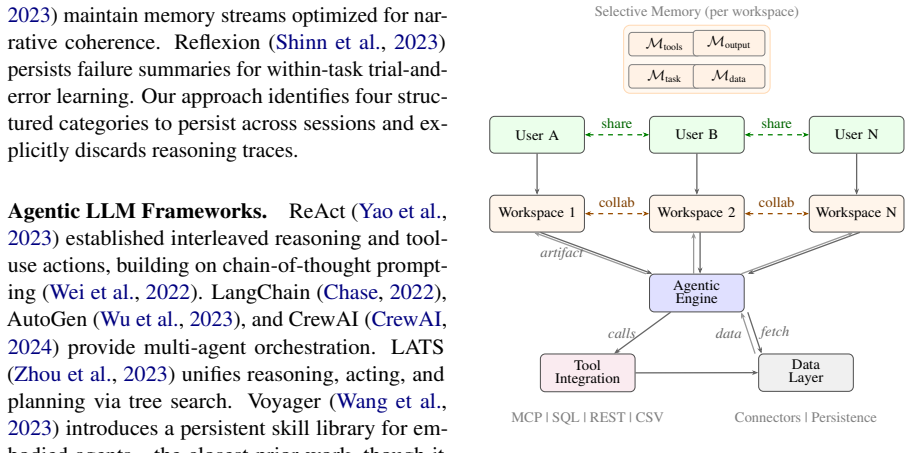
Shared selective persistent memory: a four-category workspace store (M_task, M_data, M_tools, M_output) composed into the next session’s prompt, plus a runtime data-injection contract that lets generated programs re-render on new data without any model call.
Load-bearing premise
A hand-designed four-category split plus a simple “new columns may be added, none may be missing” schema check is enough to capture reusable context and keep zero-token refresh correct across artifact types and data sources.
What would settle it
Run the same 24 recurring enterprise tasks (and the four public-dataset replications) under three conditions—no memory, full history, selective memory—and measure blinded pass/fail completion; if selective memory no longer outperforms both baselines, or if zero-token refresh fails on schema-compatible data in more than a negligible fraction of trials, the central claim fails.
If this is right
- Recurring enterprise dashboards and reports can be refreshed with one click and zero LLM tokens whenever schemas stay compatible.
- Workspaces become shareable templates: a colleague loads the selective memory, swaps in their own data, and the artifact renders immediately under role-based access.
- Full conversation history should be treated as harmful default context for agentic code generation rather than a free continuity boost.
- Token cost of data representation can drop two orders of magnitude by injecting statistical schemas instead of raw tables.
- Git-backed draft isolation plus selective memory lets teams iterate risk-free and roll back without re-invoking the model.
Where Pith is reading between the lines
- The same four-category cut could be applied to agentic coding assistants and multi-agent orchestrators that currently keep full threads, potentially reducing both cost and path-dependence.
- Automatic classifiers that label which spans of a session belong to the four reusable categories would remove the manual-design bottleneck the authors flag as a limitation.
- If agent-level private memory (successful tool sequences, error heuristics) were added on top of workspace memory, multi-session planning quality might improve without re-introducing the stale-trace problem.
- Schema-compatibility checking could be relaxed to support streaming or semi-structured sources by adding light structural embeddings rather than exact column subsets.
Editorial analysis
A structured set of objections, weighed in public.
Referee Report
Summary. The paper proposes shared selective persistent memory for agentic LLM systems that generate code via multi-turn tool use. It retains four structured categories of reusable context—task specifications (Mtask), data schemas (Mdata), tool configurations (Mtools), and output constraints (Moutput)—while discarding session-specific reasoning traces, tool logs, and intermediate files. Memory is packaged in shareable workspaces with role-based access control. A complementary data-injection contract enables zero-token refresh of generated artifacts when new data is schema-compatible. The architecture is implemented in a deployed collaborative platform with multi-connector data access (CSV, SQL, REST, MCP), git-versioned artifacts, and draft isolation. Across 24 enterprise recurring-generation tasks, selective memory reports 96% completion versus 79% with no memory and 71% with full history (Table 1); zero-token refresh yields large task-time reductions; a public-dataset replication reports 12/12 zero-token successes (Table 2).
Significance. If the central ordering and efficiency claims hold, the work is a useful systems contribution: it treats context management—not model scale—as the primary lever for recurring enterprise agentic workflows, and it documents that naive full-history persistence can actively harm completion (consistent with lost-in-the-middle). Strengths include a clear four-category decomposition with explicit selective forgetting, a practical zero-token data-injection contract, a deployed multi-connector platform with git versioning, a blinded dual-rater protocol (κ=0.91) with Fisher’s exact tests, failure-mode analysis (format non-compliance vs. trace anchoring), and a public-dataset check of zero-token refresh. These are concrete, falsifiable systems results rather than purely conceptual claims.
major comments (3)
- §6.2 and Table 1: The headline result (selective 96% > no-memory 79% > full-history 71%, n=24) is the load-bearing empirical claim, but it rests entirely on proprietary enterprise files, a single model (Claude Opus 4), and a four-criterion pass/fail rubric. The public replication (Table 2, §6.3) validates zero-token refresh under schema-compatible V2 data (12/12, 0 LLM tokens) and shows full history again underperforming no-memory, yet it does not re-run multi-turn initial/recurring generation under the three memory conditions with the same task families and human rubric. Independent verification of the generation-quality ordering therefore remains limited. A public multi-turn ablation (even on the four public datasets with fixed task specs) or multi-model re-runs would substantially strengthen the central claim.
- §3.2–3.5 and Limitations: The architecture’s sufficiency axiom—that reusable agentic context decomposes into exactly the four manual categories, with a simple column-subset compatibility check for zero-token refresh—is already strained by the paper’s own evidence. The single selective-memory enterprise failure is a cross-file join missed by the Mdata summary (§6.2); Limitations state the decomposition is manually designed and that zero-token refresh is limited to structured tabular data with stable schemas. Without an ablation of which categories drive the gains (e.g., Mtask-only vs. Mdata-only vs. full selective) or a clearer failure taxonomy (joins, schema drift, multi-source semantics), the claim that selective memory is the right intermediate between no memory and full history remains only partially tested.
- §6.1–6.2 protocol: Completion is defined as dual-rater pass on render correctness, data fidelity, format compliance, and completeness. That is appropriate for a systems paper, but the enterprise tasks are drawn from three use-case families with uneven n (UC1=10, UC2=8, UC3=6), and UC3 shows equal completion (83%) with only turn reduction. The paper should report per-use-case confidence intervals or exact counts, and clarify how many of the 24 selective successes were pure zero-token re-renders (stated as 18/24 schema-compatible) versus actual LLM re-generation under selective memory, so readers can separate architectural reuse from generation-quality gains.
minor comments (6)
- §6.5 / Limitations: The user study (N=12) is correctly flagged as underpowered for item-level Likert inference; move any strong usability claims to exploratory language and report effect sizes or raw distributions if space allows.
- Figure 1 and Eq. (1)–(3): The composition operators ⊕ and workspace tuple W are clear, but a short note on token budgets for Mdata (~500 tokens claimed) versus actual measured prompt sizes in Table 1 (3.4K input) would help readers reconcile summary size with full composed prompts.
- §2 Related Work: Voyager, MemGPT, and Assistants API are appropriately positioned; a one-sentence contrast with recent agent memory work that persists skills or trajectories (beyond the cited set) would sharpen novelty without lengthening the section much.
- Table 3 / Figure 2: Token reductions (97× enterprise, 946× public) are striking; state the tokenizer used for enterprise counts as well (public uses cl100k_base) and whether tool-call overhead is included.
- Appendix A: The composed-prompt example is helpful; ensure it is referenced from §3.4 so readers find it.
- Minor consistency: abstract and §6 report 14× task-time reduction and 97× token reduction; keep units (wall-clock vs. tokens; enterprise vs. public) aligned in every restatement.
Circularity Check
No circularity: empirical systems paper whose completion rates, token counts, and zero-token successes are measured outcomes of an implemented architecture, not quantities forced by definition or self-citation.
full rationale
The paper proposes a manually designed four-category memory decomposition (Mtask, Mdata, Mtools, Moutput) plus a data-injection contract, implements it in a platform, and reports ablation results (96 % / 79 % / 71 % completion, 14× time reduction, 97× token reduction, 12/12 public zero-token successes). These numbers are obtained by running the agent on held-out tasks and counting passes under a blinded rubric; they are not algebraically identical to any fitted parameter or definitional identity. Zero-token refresh succeeds by construction once the contract is enforced and schemas are compatible, but the paper presents this as an engineering consequence rather than a first-principles prediction of an independent quantity. Related-work citations (lost-in-the-middle, MemGPT, ReAct, etc.) supply motivation only; none is a load-bearing uniqueness theorem authored by the present team that forces the reported percentages. The single selective-memory failure (cross-file join missed by the schema summary) and the Limitations section’s admission that the decomposition is manual further demonstrate that the claims are falsifiable empirical observations, not tautologies. Hence the derivation chain contains no self-definitional, fitted-as-prediction, or self-citation circular steps.
Axiom & Free-Parameter Ledger
free parameters (2)
- schema_summary_token_budget =
~500 tokens (enterprise mean 0.5K)
- in_session_undo_stack_depth =
10
axioms (4)
- ad hoc to paper Reusable agentic context decomposes into exactly four categories: task specifications, data schemas, tool configurations, and output constraints.
- domain assumption Session-specific reasoning traces, tool logs, and error-recovery paths are harmful when injected into new sessions (bias toward stale paths).
- domain assumption Schema compatibility defined as original column set ⊆ new source columns is sufficient for correct zero-token re-render of generated artifacts.
- domain assumption Generated programs can be forced to consume data only via a runtime injection point (data-injection contract).
invented entities (3)
-
shared selective persistent memory
no independent evidence
-
zero-token data refresh / data-injection contract
no independent evidence
-
workspace W = (Mtask, Mdata, Mtools, Moutput, a, V)
no independent evidence
read the original abstract
Agentic LLM systems that generate code through multi-turn tool use face a fundamental context problem: each session starts from zero, discarding the configuration choices, domain constraints, data schemas, and tool-use patterns that made previous sessions productive. Naively persisting entire conversation histories is token-inefficient and counterproductive: irrelevant context degrades generation quality. We introduce shared selective persistent memory, an architecture that identifies and retains four categories of reusable context (task specifications, data schemas, tool configurations, and output constraints) while discarding session-specific reasoning traces. Crucially, this memory is shared: workspaces encapsulating selective memory can be transferred across users with role-based access control, enabling collaborative reuse without redundant specification. We implement it in a deployed collaborative workspace platform where LLM agents produce, edit, and maintain git-versioned artifacts (dashboards, reports, and data-driven documents) from heterogeneous sources (CSV, SQL, REST APIs, and MCP servers). A complementary zero-token data refresh mechanism decouples generated programs from runtime data, enabling artifact reuse without re-invocation. Across three enterprise scenarios, shared selective persistent memory achieves 96% task completion (vs. 79% without memory and 71% with full history). Zero-token refresh eliminates LLM re-invocation for recurring updates (14x task-time reduction), while summary-driven generation cuts per-invocation token cost by 97x versus raw data injection. A replication on four public datasets confirms generalizability, with zero-token refresh succeeding in 12/12 trials. Notably, naive full-history persistence actively degrades completion by biasing the agent with stale traces, while selective memory outperforms both extremes.
Figures

Forward citations
Cited by 1 Pith paper
-
Why Git Is the Memory Solution for the Agentic Development Lifecycle
Git-bound, routed memory for coding agents, with retrieval and answer-assembly evaluations, achieves ~0.31 MRR on seed retrieval and up to 0.83 answer-sufficiency on rationale questions, at token costs three orders of...
Reference graph
Works this paper leans on
-
[1]
2021 , howpublished=
GitHub Copilot: Your AI Pair Programmer , author=. 2021 , howpublished=
2021
-
[2]
2025 , howpublished=
Claude Code: An Agentic Coding Tool , author=. 2025 , howpublished=
2025
-
[3]
2023 , howpublished=
ChatGPT Code Interpreter , author=. 2023 , howpublished=
2023
-
[4]
2024 , howpublished=
Cursor: The AI Code Editor , author=. 2024 , howpublished=
2024
-
[5]
Wu, Qingyun and Bansal, Gagan and Zhang, Jieyu and Wu, Yiran and Li, Beibin and Zhu, Erkang and Jiang, Li and Zhang, Xiaoyun and Wang, Shaokun and Zhang, Ce and others , journal=. Auto
-
[6]
Chase, Harrison , year=. Lang
-
[7]
2024 , howpublished=
Crew. 2024 , howpublished=
2024
-
[8]
Advances in Neural Information Processing Systems , volume=
Toolformer: Language Models Can Teach Themselves to Use Tools , author=. Advances in Neural Information Processing Systems , volume=
-
[9]
Gorilla: Large Language Model Connected with Massive
Patil, Shishir G and Zhang, Tianjun and Wang, Xin and Gonzalez, Joseph E , journal=. Gorilla: Large Language Model Connected with Massive
-
[10]
2024 , howpublished=
Model Context Protocol Specification , author=. 2024 , howpublished=
2024
-
[11]
Shen, Yongliang and Song, Kaitao and Tan, Xu and Li, Dongsheng and Lu, Weiming and Zhuang, Yueting , journal=. Hugging
-
[12]
Transactions of the Association for Computational Linguistics , volume=
Lost in the Middle: How Language Models Use Long Contexts , author=. Transactions of the Association for Computational Linguistics , volume=
-
[13]
Retrieval-Augmented Generation for Knowledge-Intensive
Lewis, Patrick and Perez, Ethan and Piktus, Aleksandra and Petroni, Fabio and Karpukhin, Vladimir and Goyal, Naman and K. Retrieval-Augmented Generation for Knowledge-Intensive. Advances in Neural Information Processing Systems , volume=
-
[14]
International Conference on Learning Representations , year=
Train Short, Test Long: Attention with Linear Biases Enables Input Length Generalization , author=. International Conference on Learning Representations , year=
-
[15]
arXiv preprint arXiv:2306.15595 , year=
Extending Context Window of Large Language Models via Positional Interpolation , author=. arXiv preprint arXiv:2306.15595 , year=
-
[16]
Beyond Summarization: Designing
Xu, Frank F and Alon, Uri and Neubig, Graham and Hellendoorn, Vincent Josua , journal=. Beyond Summarization: Designing
-
[17]
Packer, Charles and Wooders, Sarah and Lin, Kevin and Fang, Vivian and Patil, Shishir G and Stoica, Ion and Gonzalez, Joseph E , journal=. Mem
-
[18]
2025 , howpublished=
The Claude Model Family: Claude Opus 4 and Claude Sonnet 4 , author=. 2025 , howpublished=
2025
-
[19]
Yao, Shunyu and Zhao, Jeffrey and Yu, Dian and Du, Nan and Shafran, Izhak and Narasimhan, Karthik and Cao, Yuan , journal=. Re
-
[20]
Advances in Neural Information Processing Systems , volume=
Reflexion: Language Agents with Verbal Reinforcement Learning , author=. Advances in Neural Information Processing Systems , volume=
-
[21]
arXiv preprint arXiv:2305.16291 , year=
Voyager: An Open-Ended Embodied Agent with Large Language Models , author=. arXiv preprint arXiv:2305.16291 , year=
-
[22]
Proceedings of the 36th Annual ACM Symposium on User Interface Software and Technology , year=
Generative Agents: Interactive Simulacra of Human Behavior , author=. Proceedings of the 36th Annual ACM Symposium on User Interface Software and Technology , year=
-
[23]
arXiv preprint arXiv:2310.04406 , year=
Language Agent Tree Search Unifies Reasoning Acting and Planning in Language Models , author=. arXiv preprint arXiv:2310.04406 , year=
-
[24]
Advances in Neural Information Processing Systems , volume=
Chain-of-Thought Prompting Elicits Reasoning in Large Language Models , author=. Advances in Neural Information Processing Systems , volume=
-
[25]
2023 , howpublished=
Assistants. 2023 , howpublished=
2023
-
[26]
2025 , howpublished=
Claude Agent. 2025 , howpublished=
2025
discussion (0)
Sign in with ORCID, Apple, or X to comment. Anyone can read and Pith papers without signing in.