REVIEW 1 major objections 6 minor 1 cited by
Anomalous supercurrents in the presence of particle losses
T0 review · 1 major / 6 minor · reviewed 2026-08-07 · deepseek-v4-flash
Pith's one-line read Single-particle losses at a quantum dot can reverse a Josephson supercurrent, reverse a dissipation-induced spin supercurrent, and in a narrow regime increase the critical current.
desk verdict A clearly formulated GKSL treatment of a lossy Josephson junction with novel predictions, but the strong-dissipation regime where the anomalies appear sits where the Markovian assumption starts to creak. read the letter →
The pith
A machine-rendered reading of the paper's core claim, the machinery that carries it, and where it could break.
The reading
What carries the argument
The mechanism is a decomposition of the Keldysh current into conventional and unconventional parts, where the unconventional part is exactly the term generated by the quantum-jump component of the Gorini-Kossakowski-Sudarshan-Lindblad master equation. In the dot's inverse Keldysh Green's function, single-particle loss appears as diag(2 i γ↑, −2 i γ↓); this is what feeds I_N,uc and I_S,uc. A trace identity forces the conventional spin-current contribution I_S,c to vanish, so the spin supercurrent exists only because of the loss term. In the clean limit the formulas reproduce the standard Andreev bound-state current I_ABS with Andreev energy E_ABS = Δ sqrt(1 − T sin²(φ/2)).
What would settle it
In a single-channel lossy junction with Γ/Δ < 1 and transmission around 0.5, plot I_N(φ) as the loss rate γ/Δ is swept from 0 to 2: the prediction is that the current acquires a node in 0 < φ < π and turns negative, while the critical current is non-monotonic with a maximum near γ/Δ = 1; for spin-selective loss, a spin supercurrent with a reversed phase relation should appear. An experiment or exact quantum-trajectory simulation that finds no such node and no non-monotonic critical current would settle the claim negatively.
Extended reading notes
Core claim
The paper's central claim is that Markovian single-particle loss in the conduction channel of a Josephson junction changes the supercurrent in ways that go beyond simple suppression. Splitting the current into a conventional part I_{N,c} and a loss-induced part I_{N,uc}, the authors find that at weakly transmitting junctions (Γ/Δ < 1) the two contributions have opposite signs, so I_N(φ) acquires a node inside 0 < φ < π and the current reverses direction, giving a pi-junction. In a narrow window around Γ/Δ ≈ 1, the loss-induced part is non-monotonic and can push the critical current above its clean value. For spin-selective loss, the conventional spin current vanishes identically, so the entire spin supercurrent is generated by dissipation and can itself reverse as a function of phase.
Load-bearing premise
The whole prediction rests on the loss at the dot being memory-free and describable by a Lindblad master equation with a non-interacting dot, with both reservoirs remaining in equilibrium; strong interactions or non-Markovian loss could modify or erase the anomalous node, the critical-current enhancement, and the spin supercurrent.
Editorial extensions
If this is right
- Tuning a loss rate provides a dissipation knob for the current-phase relation, converting a 0-junction into a pi-junction without magnetic fields or ferromagnetic layers.
- In the weak-tunneling regime the critical current is predicted to grow with the loss rate up to γ/Δ ≈ 1, so moderate dissipation can improve, not merely degrade, superfluid phase coherence.
- Spin-selective particle loss acts as a switchable source of pure spin supercurrent, with its sign controlled by Γ/Δ and the phase bias.
- Because the non-dissipative limit reproduces the conventional Andreev bound-state result, the calculation sets a baseline for detecting the predicted anomalous terms in existing lossy point-contact experiments.
Reading between the lines
- The same current-phase anomalies should appear for any environment that yields a Keldysh inverse dot Green's function of the form diag(2 i γ, −2 i γ), so a tunnel-coupled normal drain in a three-terminal superconductor device is a plausible solid-state test of the pi-junction prediction.
- Adding a Hubbard interaction U to the dot would test how fragile the effect is: as U broadens or shifts the dot spectral function, the node in I_N(φ) should move or disappear, which directly probes whether the non-interacting model is essential.
- In the spin-selective case, the spin-current reversal implies a dissipation-tunable spin polarization of the reservoirs; measuring the accumulated spin imbalance versus phase bias would test the prediction without requiring direct spin-current read-out.
- The distinction between the jump term and a non-Hermitian effective Hamiltonian could be tested by recomputing the current with the Keldysh term set to zero: the pi-junction and spin supercurrent should vanish, confirming that full Lindblad dynamics, not just complex energy levels, drive the effect.
Editorial analysis
A structured set of objections, weighed in public.
Referee Report
Summary. The manuscript studies a Josephson junction consisting of two superconducting or superfluid reservoirs coupled through a non-interacting quantum dot subject to single-particle losses. Using a Keldysh field-theory formulation of the GKSL master equation, the authors derive current formulas and report that spin-independent losses can produce a supercurrent that vanishes at a phase between 0 and pi and reverses sign (pi-junction), additional nodes in the current-phase relation, and, in a narrow parameter window, a dissipation-enhanced critical current. For spin-selective losses, they find a dissipation-induced spin supercurrent and its reversal. The analytical expressions are checked against the known Andreev limit in Eq. (C4).
Significance. The paper's main strength is a parameter-free (within the model) Keldysh-Dyson calculation with detailed appendices, and the reduction to the standard Andreev current is a useful consistency check. If the predictions survive a more microscopic treatment of the dissipation, the results establish a new route to controlling Josephson junctions via particle losses, with direct relevance to ultracold-atom experiments and three-terminal solid-state setups. The spin-supercurrent result is particularly novel because it includes the quantum-jump contribution of the Lindblad evolution rather than only the non-Hermitian part. The main technical risk is the validity of the Markovian master equation in the parameter regime where the anomalies appear, which the manuscript does not yet address.
major comments (1)
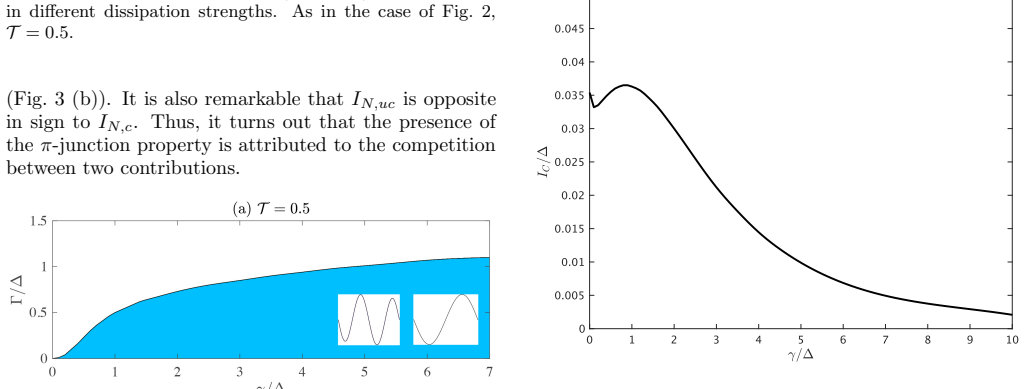
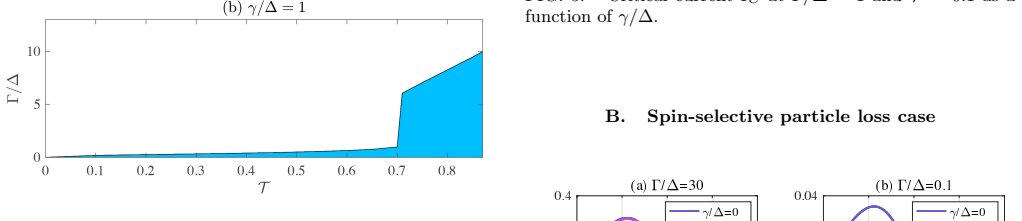
- [II (Eq. 5 and Eq. A10), III.A (Fig. 2b, Fig. 5)] The anomalous phenomena are obtained in the regime where both the loss rate and the tunneling-induced broadening are comparable to the superconducting gap: the pi-junction appears at gamma/Delta=1 with Gamma/Delta=0.1 (Fig. 2b), and the critical-current enhancement is found at Gamma/Delta=1 and T=0.1 (Fig. 5). The paper starts from the Lindblad master equation (Eq. 5) and the corresponding Keldysh inverse dot Green's functions (Eq. A10), but it does not state the Born-Markov and weak-coupling conditions under which such a master equation is a controlled microscopic description of single-particle losses. For a loss process arising from, for example, coupling to a normal reservoir or to photoassociation products, the dissipative self-energy replacing the simple constants +/-i gamma and +/-2i gamma in Eq. (A10) would generally become frequency-dependent (non-Markovian), and the jump operator may not remain the bare dot operator d_sigma once the dot is strongly hybridized with the reservoirs. Because the unconventional contribution I_N,uc in Eq. (C3) is built from these self-energies, the sign reversal and the enhancement could be modified or absent under a more microscopic treatment. The authors should either provide a derivation of Eq. (5) valid at gamma/Delta ~ 1 and Gamma/Delta ~ 1, or add an explicit discussion of the model's range of validity and soften the physical claims accordingly. Section IV mentions correlation effects but does not address this Markovian breakdown, which is the load-bearing assumption for the central predictions.
minor comments (6)
- [Appendix C (Eqs. C3, C8)] In Eqs. (C3) and (C8), the term beginning with "-1/2 Tr[...]" appears outside the frequency integral even though it contains the Fermi function n(omega); it should be placed inside the integral over omega, or the parentheses should be corrected.
- [Eq. (10) and Eq. (C1)] The signs of the right-reservoir terms in Eq. (10) differ from those in the trace in Eq. (C1); the overall minus sign before the integral makes the final current consistent, but the two formulas should be aligned or a sentence should explain the sign convention to avoid confusion.
- [Abstract and Section III.A] The abstract states that the current "takes zero at a position in between phi=0 and phi=pi," which suggests a single extra node, while the text also describes multi-node current-phase relations and pi-junction behavior; please clarify which case the abstract refers to.
- [Figures 4, 7, 9] The phase diagrams label regions as "anomalous" without stating the quantitative criterion used to distinguish a pi-junction from a multi-node current-phase relation; please define the criterion in the text or caption.
- [Throughout] The symbol T is used both for transmission (Eq. 16) and for temperature (Section III), which is a source of confusion; consider using tau or D for transmission.
- [Abstract] The name "Gorini-Kossakowski-Sudershan-Lindblad" contains a typo; it should be "Gorini-Kossakowski-Sudarshan-Lindblad."
Circularity Check
No significant circularity: the anomalous currents are computed outputs of the explicitly stated GKSL-Keldysh model, with self-citations that are not load-bearing.
full rationale
The derivation is self-contained within the stated GKSL-Keldysh model. The current formulas (C1)-(C8) are obtained by substituting the explicitly stated Hamiltonian (2)-(4), master equation (5), and uncoupled Green's functions (A8)-(A13) into the Langreth/Keldysh Dyson equations (B1)-(B7); no parameter is fitted to the anomalous zero-crossing, pi-junction, critical-current enhancement, or spin-current reversal. The 'unconventional' contribution I_N,uc in Eq. (C3) is not defined to produce the reversal but is the explicit [g_d^{-1}]^K term that follows from the dissipative part of Eq. (5) via Eq. (A10); its competition with I_N,c is an output. The same holds for I_S,uc, whose conventional counterpart vanishes by the trace identities (C9)-(C10). The main self-citations ([24,37] for Eq. A10 and Eq. (6), [39] for the current expression) are not load-bearing in a circular sense: the dissipative inverse Green's function and current operator are stateable directly from the paper's own Eqs. (5) and (6), and no uniqueness theorem or fitted benchmark is imported. The Section IV caveat about correlations and the inserted skeptic concern about Markovian validity at gamma/Delta ~ 1 are physical-validity limitations, not circularity. Score 1 reflects only the presence of non-load-bearing self-citations.
Assumptions & free parameters
free parameters (3)
- Gamma/Delta (tunneling broadening to superconducting gap ratio) =
0.1, 1, 30 (scanned in phase diagrams)
- T (channel transmission at Fermi energy) =
0.5, 0.1 (scanned)
- gamma/Delta (particle loss rate to gap ratio) =
0 to 2 (scanned)
assumptions (6)
- standard math Keldysh formalism and Dyson equation correctly compute non-equilibrium Green's functions for the GKSL master equation
- domain assumption Single-particle loss is Markovian and described by the Lindblad jump operators d_sigma
- domain assumption The reservoirs are described by mean-field BCS theory with a uniform gap Delta
- domain assumption The quantum dot is non-interacting
- domain assumption The phase bias is imposed as a gauge phase on the tunneling amplitudes
- standard math Wide-band limit with constant density of states in the reservoirs
Cite this review
Pith. "Pith review of Anomalous supercurrents in the presence of particle losses." pith.science (2026). https://pith.science/paper/BGZ4YSGM
@misc{pith2026250521085,
  author       = {Pith},
  title        = {Pith review of: Anomalous supercurrents in the presence of particle losses},
  year         = {2026},
  howpublished = {\url{https://pith.science/paper/BGZ4YSGM}},
  note         = {Machine review of arXiv:2505.21085}
}
abstract
We show that supercurrent properties in a superfluid or superconducting junction are significantly modified due to single-particle losses present in a conduction channel. In the presence of a spin-independent particle loss, we find regimes where the Josephson current $I_N(\phi)$ takes zero at a position in between $\phi= 0$ and $\phi=\pi$, and the direction of the supercurrent is reversed. Although the region is narrow, we also find a regime in which the critical current is enhanced by dissipation. Such anomalous behaviors in the Josephson current are attributed to a subtle interplay between the contribution that is present regardless of dissipation and the unconventional one that is absent without dissipation. In the presence of a spin-selective particle loss, it is shown that a dissipation-induced spin supercurrent and its reversal occur. The proposed system is analyzed by means of the Keldysh field theory approach based on the Gorini-Kossakowski-Sudershan-Lindblad master equation and may be realized in ultracold atomic gases and solid-state systems.
Figures


Figures from the paper (5 more)


Forward citations
Cited by 1 Pith paper
-
Nonlocal Majorana polarization in non-Hermitian topological superconductors
Nonlocal Majorana polarization is generalized to non-Hermitian superconductors with biorthogonal states and separates Majorana zero modes from trivial states and exceptional points.
Reference graph
Works this paper leans on
-
[1]
Particle current Figure 6 shows the current-phase relation in different dissipation strengths at (a) Γ/∆≫1 and at (b) Γ/∆≲1. The overall tendencies are similar to those inγ↑ =γ ↓ case 5 in the sense that for Γ/∆≫1 the supercurrent mono- tonically decreases with increasingγwhile the anomalous supercurrent behaviors are obtained for Γ/∆≲1. FIG. 7. Phase dia...
-
[2]
Spin current Owing to the spin asymmetric dissipation, one can ob- tain a nonzero spin current by introducing a phase bias. As shown in Eq. (15), such a dissipation-induced spin supercurrent originates from the unconventional contri- bution. ✵ ✴ ✸ ✴ ✲ ✁ ✲ ✵ ✁ ✶✵ ✂ ✄ ✭ ☎ ✆ ✝ ❂ ✞✟ ✠ ✡ ☛☞ ☛ ✌ ✠ ✡ ☛☞ ✌ ✠ ✡ ✌ ✵ ✴ ✸ ✴ ✲ ✲ ✶ ✵ ✶ ✶✵ ✂ ✄ ✭ ✍ ✆ ✝ ❂ ✟✎ ✏ ✠ ✡ ☛☞ ✌ ✠ ...
-
[3]
A. Barone and G. Paterno,Physics and applications of the Josephson effect(Wiley, 1982)
work page 1982
-
[4]
Vollhardt and P
D. Vollhardt and P. Wolfle,The superfluid phases of he- lium 3(Courier Corporation, 2013)
2013
-
[5]
M. Nitta, Josephson junction of non-abelian supercon- ductors and non-abelian josephson vortices, Nuclear Physics B899, 78 (2015)
work page 2015
-
[6]
C. J. Pethick and H. Smith,Bose–Einstein condensation in dilute gases(Cambridge university press, 2008)
2008
-
[7]
R. Fagaly, Superconducting quantum interference device instruments and applications, Review of scientific instru- ments77(2006)
work page 2006
-
[8]
Kjaergaard, M
M. Kjaergaard, M. E. Schwartz, J. Braum¨ uller, P. Krantz, J. I.-J. Wang, S. Gustavsson, and W. D. Oliver, Superconducting qubits: Current state of play, Annual Review of Condensed Matter Physics11, 369 (2020)
2020
Show all 52 references
-
[9]
A. A. Golubov, M. Y. Kupriyanov, and E. Il’ichev, The current-phase relation in josephson junctions, Rev. Mod. Phys.76, 411 (2004)
2004
-
[10]
A. O. Caldeira and A. J. Leggett, Influence of dissipa- tion on quantum tunneling in macroscopic systems, Phys. Rev. Lett.46, 211 (1981)
1981
-
[11]
Baselmans, A
J. Baselmans, A. Morpurgo, B. Van Wees, and T. Klap- wijk, Reversing the direction of the supercurrent in a controllable josephson junction, Nature397, 43 (1999)
1999
-
[12]
Bulaevskii, V
L. Bulaevskii, V. Kuzii, and A. Sobyanin, Superconduct- ing system with weak coupling to the current in the ground state, JETP Lett.(USSR)(Engl. Transl.);(United States)25(1977)
1977
-
[13]
heavy-fermion
V. B. Geshkenbein, A. I. Larkin, and A. Barone, Vor- tices with half magnetic flux quanta in “heavy-fermion” superconductors, Phys. Rev. B36, 235 (1987)
1987
-
[14]
V. V. Ryazanov, V. A. Oboznov, A. Y. Rusanov, A. V. Veretennikov, A. A. Golubov, and J. Aarts, Coupling of two superconductors through a ferromagnet: Evidence for aπjunction, Phys. Rev. Lett.86, 2427 (2001)
2001
-
[15]
D. J. Van Harlingen, Phase-sensitive tests of the sym- metry of the pairing state in the high-temperature superconductors—evidence ford x2−y2 symmetry, Rev. Mod. Phys.67, 515 (1995)
1995
-
[16]
Cleuziou, W
J.-P. Cleuziou, W. Wernsdorfer, V. Bouchiat, T. On- dar¸ cuhu, and M. Monthioux, Carbon nanotube supercon- ducting quantum interference device, Nature nanotech- nology1, 53 (2006)
2006
-
[17]
Yamashita, K
T. Yamashita, K. Tanikawa, S. Takahashi, and S. Maekawa, Superconductingπqubit with a ferromag- netic josephson junction, Phys. Rev. Lett.95, 097001 (2005)
2005
-
[18]
Krinner, T
S. Krinner, T. Esslinger, and J.-P. Brantut, Two-terminal transport measurements with cold atoms, Journal of Physics: Condensed Matter29, 343003 (2017)
2017
-
[19]
Husmann, S
D. Husmann, S. Uchino, S. Krinner, M. Lebrat, T. Gi- amarchi, T. Esslinger, and J.-P. Brantut, Connecting strongly correlated superfluids by a quantum point con- tact, Science350, 1498 (2015)
2015
-
[20]
Valtolina, A
G. Valtolina, A. Burchianti, A. Amico, E. Neri, K. Xhani, J. A. Seman, A. Trombettoni, A. Smerzi, M. Zaccanti, M. Inguscio,et al., Josephson effect in fermionic super- fluids across the bec-bcs crossover, Science350, 1505 (2015)
2015
-
[21]
S. Levy, S. levy, e. lahoud, i. shomroni, and j. steinhauer, nature (london) 449, 579 (2007)., Nature (London)449, 579 (2007)
2007
-
[22]
W. Kwon, G. Del Pace, R. Panza, M. Inguscio, W. Zw- erger, M. Zaccanti, F. Scazza, and G. Roati, Strongly correlated superfluid order parameters from dc joseph- son supercurrents, Science369, 84 (2020)
2020
-
[23]
Del Pace, W
G. Del Pace, W. J. Kwon, M. Zaccanti, G. Roati, and F. Scazza, Tunneling transport of unitary fermions across the superfluid transition, Phys. Rev. Lett.126, 055301 (2021)
2021
-
[24]
Sch¨ afer, T
F. Sch¨ afer, T. Fukuhara, S. Sugawa, Y. Takasu, and Y. Takahashi, Tools for quantum simulation with ultra- cold atoms in optical lattices, Nature Reviews Physics2, 411 (2020)
2020
-
[25]
Corman, P
L. Corman, P. Fabritius, S. H¨ ausler, J. Mohan, L. H. Dogra, D. Husmann, M. Lebrat, and T. Esslinger, Quan- tized conductance through a dissipative atomic point contact, Phys. Rev. A100, 053605 (2019)
2019
-
[26]
Huang, J
M.-Z. Huang, J. Mohan, A.-M. Visuri, P. Fabritius, M. Talebi, S. Wili, S. Uchino, T. Giamarchi, and T. Esslinger, Superfluid signatures in a dissipative quan- tum point contact, Phys. Rev. Lett.130, 200404 (2023)
2023
-
[27]
Ashida, Z
Y. Ashida, Z. Gong, and M. Ueda, Non-hermitian physics, Advances in Physics69, 249 (2020)
2020
-
[28]
Li, H.-P
C.-A. Li, H.-P. Sun, and B. Trauzettel, Anomalous an- dreev spectrum and transport in non-hermitian joseph- son junctions, Phys. Rev. B109, 214514 (2024)
2024
-
[29]
Cayao and M
J. Cayao and M. Sato, Non-hermitian phase-biased josephson junctions, Phys. Rev. B110, L201403 (2024)
2024
-
[30]
P.-X. Shen, Z. Lu, J. L. Lado, and M. Trif, Non-hermitian 10 fermi-dirac distribution in persistent current transport, Phys. Rev. Lett.133, 086301 (2024)
2024
-
[31]
D. M. Pino, Y. Meir, and R. Aguado, Thermodynam- ics of non-hermitian josephson junctions with exceptional points, arXiv preprint arXiv:2405.02387 (2024)
2024 arXiv
-
[32]
C. W. J. Beenakker, Josephson effect in a junction coupled to an electron reser- voir, Applied Physics Letters125, 122601 (2024), https://pubs.aip.org/aip/apl/article- pdf/doi/10.1063/5.0215522/20158679/122601 1 5.0215522.pdf
2024 doi
-
[33]
Cayao and M
J. Cayao and M. Sato, Non-hermitian multiterminal phase-biased josephson junctions, Phys. Rev. B110, 235426 (2024)
2024
-
[34]
Capecelatro, M
R. Capecelatro, M. Marciani, G. Campagnano, and P. Lucignano, Andreev non-hermitian hamiltonian for open josephson junctions from green’s functions, Phys. Rev. B111, 064517 (2025)
2025
-
[35]
D. C. Ohnmacht, V. Wilhelm, H. Weisbrich, and W. Belzig, Non-hermitian topology in multiterminal su- perconducting junctions, Phys. Rev. Lett.134, 156601 (2025)
2025
-
[36]
A. Sten, P. Dutta, and S. K. Ghosh, Angle-dependent dis- sipation effects in topological insulator-based josephson junctions, arXiv preprint arXiv:2502.09397 (2025)
2025 arXiv
-
[37]
Breuer and F
H.-P. Breuer and F. Petruccione,The theory of open quantum systems(Oxford University Press, USA, 2002)
2002
-
[38]
A. J. Daley, Quantum trajectories and open many-body quantum systems, Advances in Physics63, 77 (2014)
2014
-
[39]
Visuri, J
A.-M. Visuri, J. Mohan, S. Uchino, M.-Z. Huang, T. Esslinger, and T. Giamarchi, Dc transport in a dis- sipative superconducting quantum point contact, Phys. Rev. Res.5, 033095 (2023)
2023
-
[40]
Therefore, ψL(R)σ is the shorthand notation ofψ L(R)σ(0)
We assume that tunneling occurs between the position r=0in each reservoir and the quantum dot. Therefore, ψL(R)σ is the shorthand notation ofψ L(R)σ(0)
-
[41]
Uchino, Comparative study for two-terminal transport through a lossy one-dimensional quantum wire, Phys
S. Uchino, Comparative study for two-terminal transport through a lossy one-dimensional quantum wire, Phys. Rev. A106, 053320 (2022)
2022
-
[42]
Kamenev,Field theory of non-equilibrium systems (Cambridge University Press, 2011)
A. Kamenev,Field theory of non-equilibrium systems (Cambridge University Press, 2011)
2011
-
[43]
L. M. Sieberer, M. Buchhold, and S. Diehl, Keldysh field theory for driven open quantum systems, Reports on Progress in Physics79, 096001 (2016)
2016
-
[44]
J. C. Cuevas, A. Mart ´ ın-Rodero, and A. L. Yeyati, Hamil- tonian approach to the transport properties of supercon- ducting quantum point contacts, Phys. Rev. B54, 7366 (1996)
1996
-
[45]
Mart ´ ın-Rodero and A
A. Mart ´ ın-Rodero and A. Levy Yeyati, Josephson and andreev transport through quantum dots, Advances in Physics60, 899 (2011)
2011
-
[46]
B. J. van Wees, K.-M. H. Lenssen, and C. J. P. M. Harmans, Transmission formalism for supercur- rent flow in multiprobe superconductor-semiconductor- superconductor devices, Phys. Rev. B44, 470 (1991)
1991
-
[47]
Samuelsson, J
P. Samuelsson, J. Lantz, V. S. Shumeiko, and G. Wendin, Nonequilibrium josephson effect in mesoscopic ballis- tic multiterminal sns junctions, Phys. Rev. B62, 1319 (2000)
2000
-
[48]
Martın-Rodero, A
A. Martın-Rodero, A. L. Yeyati, and J. Cuevas, Trans- port properties of normal and ferromagnetic atomic-size constrictions with superconducting electrodes, Physica C: Superconductivity352, 67 (2001)
2001
-
[49]
Kohda, S
M. Kohda, S. Nakamura, Y. Nishihara, K. Kobayashi, T. Ono, J.-i. Ohe, Y. Tokura, T. Mineno, and J. Nitta, Spin–orbit induced electronic spin separation in semi- conductor nanostructures, Nature communications3, 1 (2012)
2012
-
[50]
Labouvie, B
R. Labouvie, B. Santra, S. Heun, and H. Ott, Bistability in a driven-dissipative superfluid, Phys. Rev. Lett.116, 235302 (2016)
2016
-
[51]
Rammer,Quantum field theory of non-equilibrium states(Cambridge University Press, 2007)
J. Rammer,Quantum field theory of non-equilibrium states(Cambridge University Press, 2007)
2007
-
[52]
Haug, A.-P
H. Haug, A.-P. Jauho,et al.,Quantum kinetics in trans- port and optics of semiconductors, Vol. 2 (Springer, 2008)
2008
Reviewed August 7, 2026 · model on record in the stance chip above.
Discussion (0). Sign in to comment.