REVIEW 2 major objections 4 minor 1 cited by
Semiclassical analysis of the quantum instanton approximation
T0 review · 2 major / 4 minor · reviewed 2026-08-14 · deepseek-v4-flash
Pith's one-line read The quantum instanton approximation is only a semiclassical limit of instanton theory for symmetric barriers; for asymmetric barriers a spurious low-energy path dominates and no choice of dividing surfaces can remove it.
desk verdict The QI method's semiclassical limit is not SCI except for symmetric barriers, and this paper shows why; the universal 'no dividing surface' claim is the one soft spot. read the letter →
The pith
A machine-rendered reading of the paper's core claim, the machinery that carries it, and where it could break.
The reading
What carries the argument
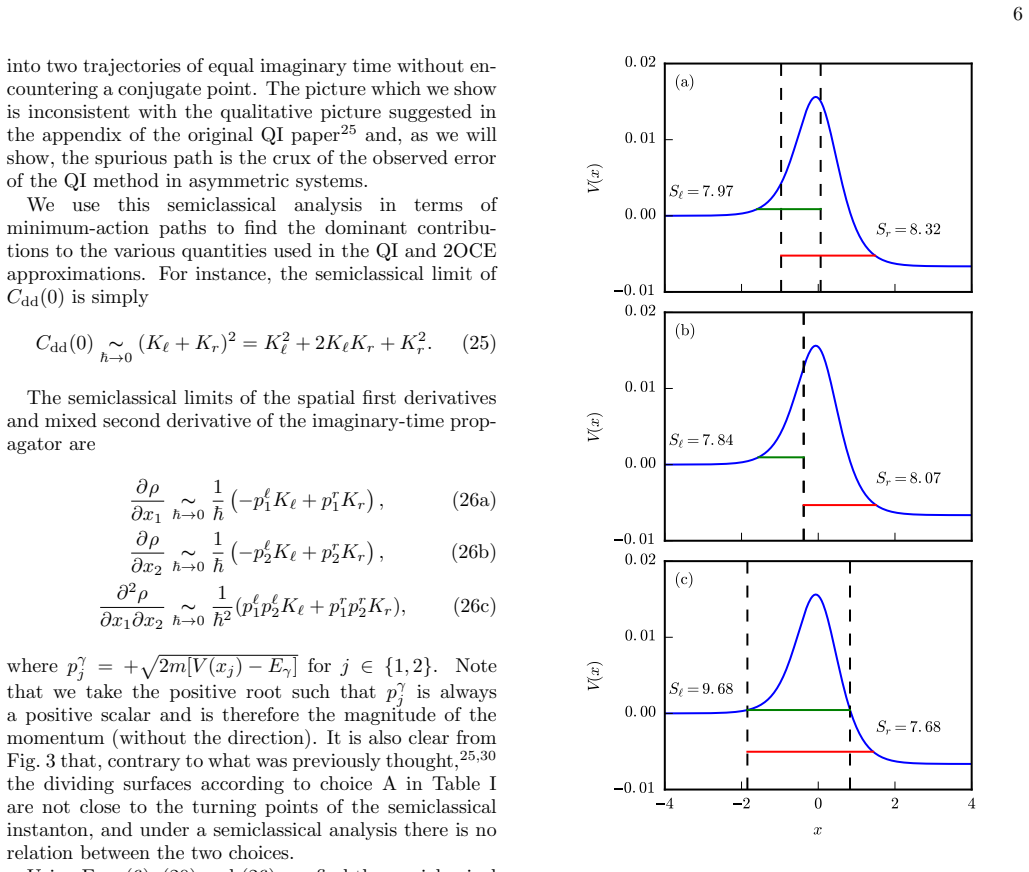
The machinery is a semiclassical steepest-descent treatment of the imaginary-time propagator $\rho(x_1,x_2,0)\sim K_{\ell}+K_r$, where $\gamma\in\{\ell,r\}$ labels the left- and right-bouncing minimum-action paths, each with action $S_\gamma$ and energy $E_\gamma$. The QI and 2OCE rate formulas are built from this propagator and its derivatives at zero time, and the paper evaluates those quantities asymptotically to identify which path controls the rate. In the asymmetric case the right-bouncing path has a much lower energy and dominates; the spurious path is the mechanism of failure. The proposed fix inserts projection operators $\hat P_{\ell}$ and $\hat P_r$ that split paths by whether they bounce to the left or right, and allows the two imaginary-time lengths $\tau_{\ell},\tau_r$ to differ, so that the two dominant paths join into the instanton periodic orbit.
What would settle it
Locate all stationary points of the Euclidean action between the two dividing surfaces for an asymmetric one-dimensional barrier at low temperature and compare their actions. If a third path contributes comparably to $K_{\ell}$ or $K_r$, or if the instanton can be split into two equal-imaginary-time minimum-action segments without passing through a conjugate point, the paper's account of the QI breakdown would not hold.
Extended reading notes
Core claim
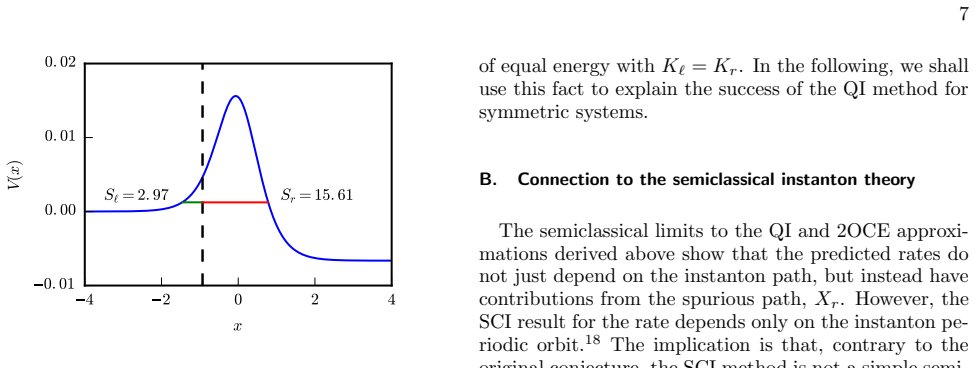
The central claim is that the SCI rate is the semiclassical limit of the QI rate only when the two minimum-action paths contributing to the imaginary-time propagator, $K_{\ell}$ and $K_r$, combine into the instanton periodic orbit, which occurs generically only for symmetric barriers. For an asymmetric barrier, the right-bouncing path has an unphysically low energy and dominates, so the semiclassical limit of the QI expression contains a spurious contribution that no choice of dividing surfaces removes. The paper derives explicit semiclassical limits for the correlation functions and shows that if the two paths did form the periodic orbit, the QI expression would reduce exactly to the standard SCI formula. This justifies the proposed projected quantum instanton (PQI) method, in which projection operators restrict paths to left- or right-bouncing classes with different imaginary times, ensuring the instanton orbit is sampled.
Load-bearing premise
The analysis assumes the imaginary-time propagator is dominated by exactly two stationary-action paths, one bouncing left and one bouncing right, and that for an asymmetric barrier below about 142 K no division of the instanton into two equal-imaginary-time minimum-action halves avoids a conjugate point; if a third stationary path contributed, or such a split existed, the identification of the spurious path as the cause of QI's failure would break down.
Editorial extensions
If this is right
- For symmetric barriers, QI and 2OCE are semiclassically consistent with SCI and remain a viable path-sampling improvement.
- For asymmetric barriers, QI and 2OCE rate constants can be wrong by orders of magnitude, and no relocation of dividing surfaces can fix it.
- The PQI variant should give accurate rates in the deep-tunneling regime even for strongly asymmetric systems, while retaining anharmonic sampling beyond SCI.
- Because PQI's semiclassical limit reproduces the SCI formula, PQI is a natural replacement for QI in asymmetric multidimensional systems.
- Integrating the projected correlation function directly gives the exact free-particle rate, so the small residual error in the simple PQI formula comes from the Gaussian steepest-descent approximation.
Reading between the lines
- A testable extension is an efficient path-integral Monte Carlo implementation of PQI using the central bead as the projection coordinate, which the paper outlines but does not fully benchmark.
- The left/right projection strategy resembles nonadiabatic rate theories that split forward and backward paths by electronic state, so PQI may inform new nonadiabatic deep-tunneling methods.
- Near and above the crossover temperature, PQI's Gaussian truncation of the projected correlation function will need systematic corrections analogous to those developed for QI; the free-particle calculation already quantifies the resulting bias.
- Any quantum transition-state method that samples paths without explicitly projecting onto instanton segments is predicted to inherit QI's spurious-path error on asymmetric surfaces, so method validation should monitor the right-bounce contribution.
Signed reviews
Editorial analysis
A structured set of objections, weighed in public.
Referee Report
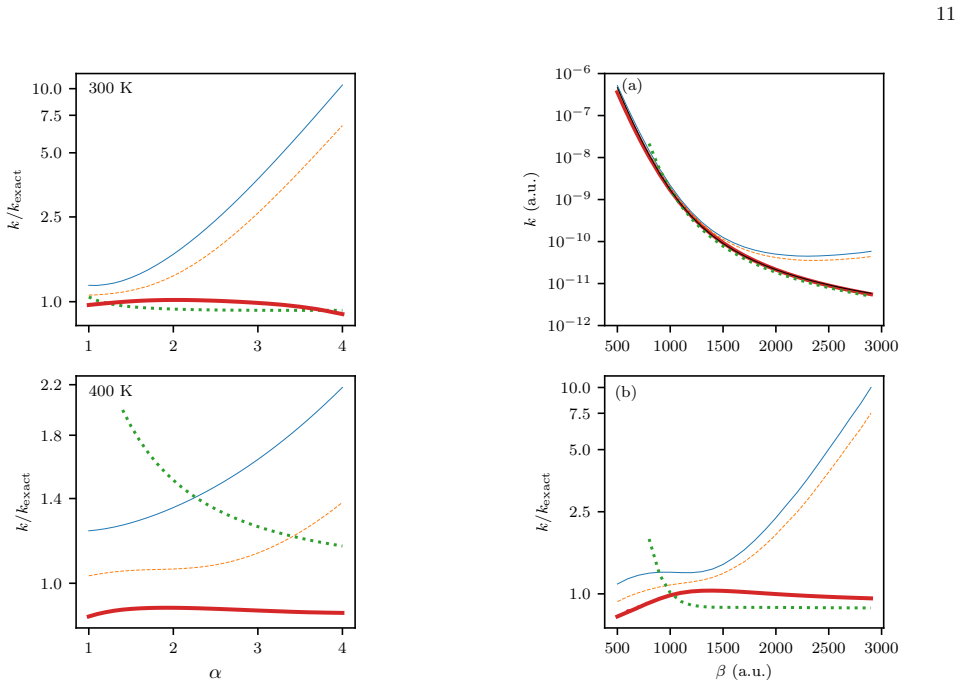
Summary. The paper reexamines the quantum instanton (QI) and second-order cumulant expansion (2OCE) rate theories. It derives the semiclassical (ℏ→0) limit of the quantities entering these theories using imaginary-time van Vleck propagators, assuming the propagator is dominated by two minimum-action paths (left- and right-bouncing). For a one-dimensional asymmetric Eckart barrier, it shows that one of the two paths is a spurious low-energy path, leading to order-of-magnitude errors in QI/2OCE rates at low temperatures, while semiclassical instanton (SCI) theory remains accurate. The paper verifies numerically that the semiclassical evaluation of the relevant quantities matches exact quantum values within a factor of two, justifying the analysis. It concludes that SCI is the semiclassical limit of QI only for symmetric barriers, and it proposes a projected QI (PQI) method that projects onto left/right paths with independent imaginary times, restoring the instanton and giving accurate rates for asymmetric systems.
Significance. If the claims hold, this is an important clarification of the relationship between QI and SCI, disproving the common conjecture that SCI is the semiclassical limit of QI and identifying the spurious low-energy path as the source of the known failure of QI for asymmetric barriers. The proposed PQI method is a valuable new contribution with promising numerical results. The paper's strengths include careful steepest-descent and van Vleck derivations, explicit semiclassical expressions for C_ff(0), ΔH_dd, and ΔH_ff, and validation against exact quantum-mechanical results in Tables II and III. The numerics convincingly support the more limited claim that the standard QI and 2OCE surface prescriptions fail for asymmetric barriers. However, the paper's strongest universal claim about no dividing surface fixing the problem requires additional support, as detailed below.
major comments (2)
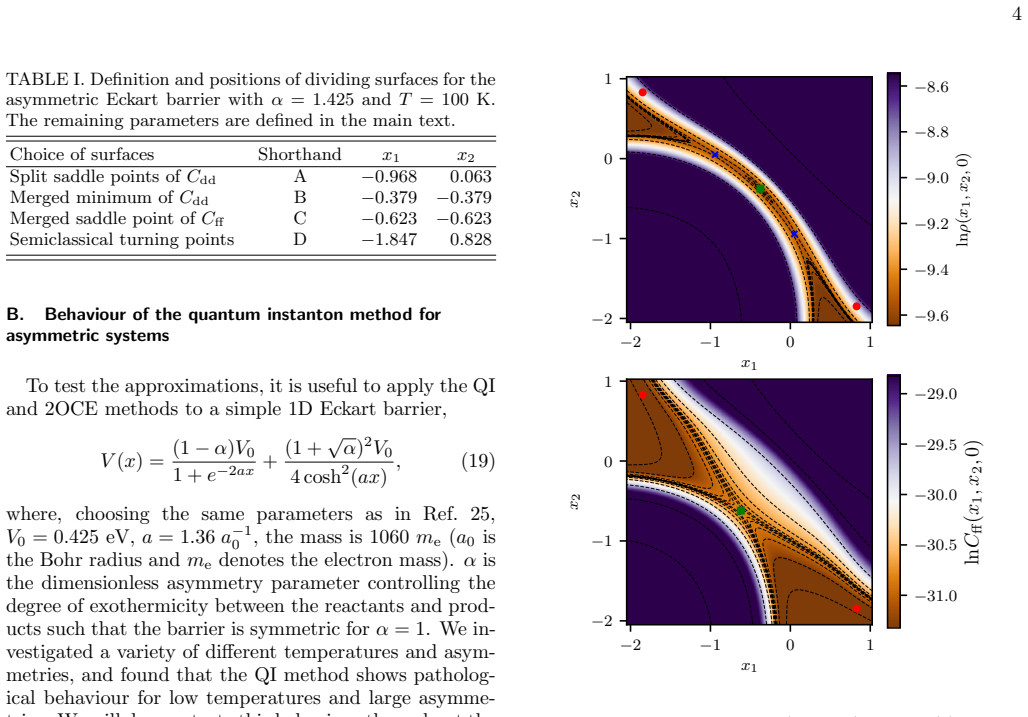
- [Secs. III A and VI] The universal negative claim that no choice of dividing surfaces can fix QI for asymmetric barriers, and the corresponding abstract statement that SCI follows only for symmetric systems, rest on an unproved assertion in Sec. III A: the paper states that 'we found that for this system below about 142 K there is no way to split the instanton into two trajectories of equal imaginary time without encountering a conjugate point,' but it demonstrates this only for the representative surfaces A-D in Table I and provides neither a proof nor an exhaustive (x1,x2) search. Because Eqs. (32)-(38) show that a single surface pair with E_l=E_r and nonsingular van Vleck prefactors would make QI reduce to SCI in the semiclassical limit, the existence of any such pair would invalidate the strong 'only symmetric systems' conclusion. Please either supply a proof or an exhaustive numerical search, or explicitly qualify the abstract and Conclusions.
- [Sec. II A (paragraph after Eq. (3))] The statement that 'our conclusions remain valid for these multidimensional cases' is asserted without analysis. The semiclassical decomposition into left- and right-bouncing paths, the conjugate-point discussion, and the numerical validation are all one-dimensional; in multidimensional systems the instanton is a periodic orbit with transverse fluctuation modes, and the spurious-path mechanism is not demonstrated. Please either provide a multidimensional version of the argument or explicitly restrict the conclusions to one-dimensional systems.
minor comments (4)
- [Sec. III A] The threshold temperature of 142 K below which no equal-time split exists is not derived; please state how this value was obtained (e.g., by numerical solution of the conjugate-point condition) so that readers can reproduce it.
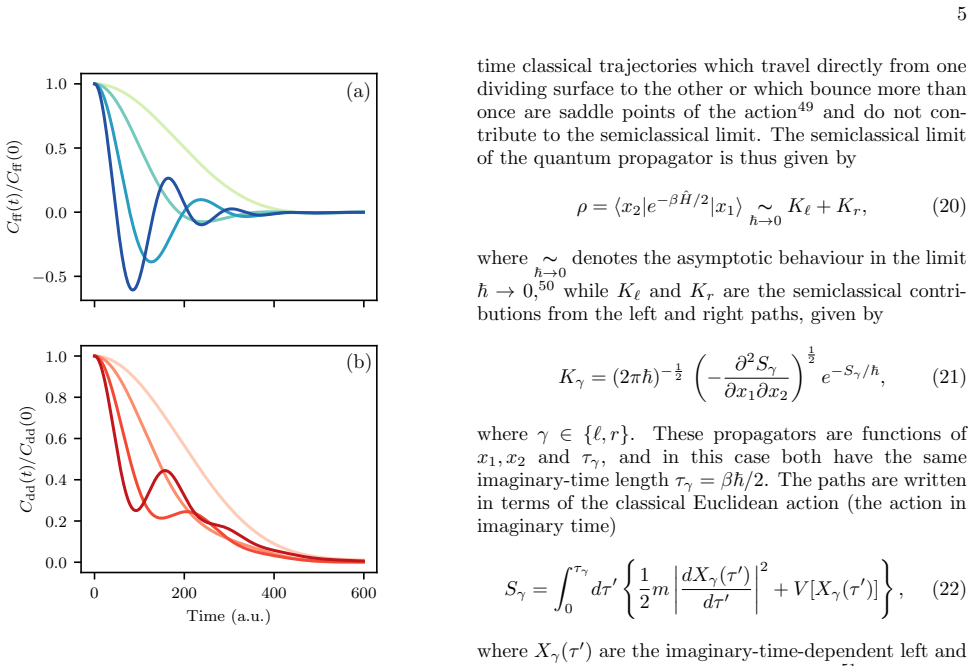
- [Fig. 2 caption] The caption says darker lines indicate larger asymmetry, but it does not list the actual values; adding the α values (α=1, 2, 3, 4) to the caption would improve readability.
- [Eq. (14)] The left-hand side 'k_QI Q_r' might be misread as a product of two quantities; consider adding a brief parenthetical noting that Q_r is the reactant partition function appearing in Eq. (1), as is done later in the text.
- [Ref. 45] The footnote 'We were unable to locate an asymmetric system with split saddle points of C_ff(0)' is informative; a one-sentence explanation for why this is expected would be helpful.
Circularity Check
No significant circularity: the central negative result is derived from an independent steepest-descent analysis, and the PQI's semiclassical limit is openly by construction rather than used as evidence for accuracy.
full rationale
The paper's central claim—that the semiclassical limit of the quantum instanton (QI) and 2OCE rates reduces to semiclassical instanton (SCI) theory only for symmetric barriers—is obtained from a standard van Vleck/stationary-phase analysis of the imaginary-time propagator, not from fitting or from assuming the conclusion. Equations (20) and (21) are standard semiclassical propagators; Eqs. (25)–(31) then evaluate Cdd, Cff, and the energy variances in the hbar→0 limit; inserting these into the previously defined QI and 2OCE expressions (Eqs. 14, 15, 18) yields the semiclassical QI and 2OCE rates. The comparison with SCI uses Miller's original one-dimensional instanton expression and the ImF form, which are external published results (Refs. 15, 19), so the negative result does not reduce to a self-citation. Tables II and III check the semiclassical quantities against exact quantum-mechanical values for the Eckart barrier, so the analysis is validated against an independent benchmark rather than renamed input. The projected quantum instanton (PQI) is indeed constructed so that the two projected propagators describe the two halves of the instanton periodic orbit; consequently, the statement that its semiclassical limit reduces to SCI is a designed property. The paper says this is 'actually unsurprising' and cites a parallel derivation in Ref. 18. This is not a hidden prediction: it is an acknowledged consistency check, and the actual predictive claim—that PQI gives numerically accurate rates—is tested against exact rates in Table III and Figs. 5 and 6. The universal assertion that 'no choice of dividing surface can remove this problem' rests on the authors' unproved claim that below about 142 K one cannot split the instanton into two equal-imaginary-time halves without a conjugate point; this is a correctness/rigor risk, not a constructional circularity. No fitted parameter is renamed as a prediction, and no load-bearing premise is justified only by self-citation.
Assumptions & free parameters
assumptions (4)
- standard math The time integral in the flux-flux correlation function can be approximated by a steepest-descent (Gaussian) integral around t=0 (Eq. 4).
- domain assumption In the semiclassical limit, the imaginary-time propagator ρ(x1,x2,0) is dominated by exactly two minimum-action paths, bouncing left or right (Eq. 20), with direct and multi-bounce paths contributing only as saddle points.
- standard math Real-time derivatives of the semiclassical propagator can be obtained from imaginary-time derivatives via the Cauchy-Riemann equations (Eqs. 28 and 29).
- domain assumption For the asymmetric barrier below about 142 K, no choice of dividing surfaces splits the instanton trajectory into two minimum-action paths of equal imaginary time without encountering a conjugate point (reported in Sec. III A).
Cite this review
Pith. "Pith review of Semiclassical analysis of the quantum instanton approximation." pith.science (2026). https://pith.science/paper/BHFWFE3O
@misc{pith2026190803419,
  author       = {Pith},
  title        = {Pith review of: Semiclassical analysis of the quantum instanton approximation},
  year         = {2026},
  howpublished = {\url{https://pith.science/paper/BHFWFE3O}},
  note         = {Machine review of arXiv:1908.03419}
}
read the original abstract
We explore the relation between the quantum and semiclassical instanton approximations for the reaction rate constant. From the quantum instanton expression, we analyze the contributions to the rate constant in terms of minimum-action paths and find that two such paths dominate the expression. For symmetric barriers, these two paths join together to describe the semiclassical instanton periodic orbit. However, for asymmetric barriers, one of the two paths takes an unphysically low energy and dominates the expression, leading to order-of-magnitude errors in the rate predictions. Nevertheless, semiclassical instanton theory remains accurate. We conclude that semiclassical instanton theory can only be obtained directly from the semiclassical limit of the quantum instanton for symmetric systems. We suggest a modification of the quantum instanton approach which avoids sampling the spurious path and thus has a stronger connection to semiclassical instanton theory, giving numerically accurate predictions even for very asymmetric systems in the low temperature limit.
Figures
Figures from the paper (2 more)
Forward citations
Cited by 1 Pith paper
-
Nonadiabatic ring-polymer instanton rate theory: a generalised dividing-surface approach
A generalised nonadiabatic ring-polymer instanton rate theory bridges the Born-Oppenheimer and golden-rule limits and matches exact quantum rates to about 5-10% on the studied model.
Reference graph
Works this paper leans on
-
[1]
author author W. H. \ Miller , author S. D. \ Schwartz , \ and\ author J. W. \ Tromp ,\ @noop journal journal J. Chem. Phys. \ volume 79 ,\ pages 4889 ( year 1983 ) NoStop
1983
-
[2]
author author W. H. \ Miller ,\ @noop journal journal J. Phys. Chem. A \ volume 105 ,\ pages 2942 ( year 2001 a ) NoStop
work page 2001
-
[3]
author author J. Cao \ and\ author G. A. \ Voth ,\ @noop journal journal J. Chem. Phys. \ volume 100 ,\ pages 5106 ( year 1994 ) NoStop
work page 1994
-
[4]
author author S. Jang \ and\ author G. A. \ Voth ,\ @noop journal journal J. Chem. Phys. \ volume 111 ,\ pages 2371 ( year 1999 ) NoStop
work page 1999
-
[5]
author author I. R. \ Craig \ and\ author D. E. \ Manolopoulos ,\ @noop journal journal J. Chem. Phys. \ volume 121 ,\ pages 3368 ( year 2004 ) NoStop
work page 2004
-
[6]
author author I. R. \ Craig \ and\ author D. E. \ Manolopoulos ,\ @noop journal journal J. Chem. Phys. \ volume 122 ,\ pages 084106 ( year 2005 a ) NoStop
work page 2005
-
[7]
author author I. R. \ Craig \ and\ author D. E. \ Manolopoulos ,\ @noop journal journal J. Chem. Phys. \ volume 123 ,\ pages 034102 ( year 2005 b ) NoStop
work page 2005
-
[8]
author author T. J. H. \ Hele , author M. J. \ Willatt , author A. Muolo , \ and\ author S. C. \ Althorpe ,\ @noop journal journal J. Chem. Phys. \ volume 142 ,\ pages 134103 ( year 2015 a ) NoStop
work page 2015
Show all 64 references
-
[9]
author author T. J. H. \ Hele , author M. J. \ Willatt , author A. Muolo , \ and\ author S. C. \ Althorpe ,\ @noop journal journal J. Chem. Phys. \ volume 142 ,\ pages 191101 ( year 2015 b ) NoStop
2015
-
[10]
author author M. J. \ Willatt , author M. Ceriotti , \ and\ author S. C. \ Althorpe ,\ @noop journal journal J. Chem. Phys. \ volume 148 ,\ pages 102336 ( year 2018 ) NoStop
2018
-
[11]
Trenins \ and\ author S
author author G. Trenins \ and\ author S. C. \ Althorpe ,\ @noop journal journal J. Chem. Phys. \ volume 149 ,\ pages 014102 ( year 2018 ) NoStop
2018
-
[12]
author author W. H. \ Miller ,\ 10.1021/jp003712k journal journal J. Phys. Chem. A \ volume 105 ,\ pages 2942 ( year 2001 b ) NoStop
2001 doi
-
[13]
author author W. H. \ Miller ,\ @noop journal journal J. Chem. Phys. \ volume 61 ,\ pages 1823 ( year 1974 ) NoStop
1974
-
[14]
Pollak \ and\ author J
author author E. Pollak \ and\ author J. L. \ Liao ,\ @noop journal journal J. Chem. Phys. \ volume 108 ,\ pages 2733 ( year 1998 ) NoStop
1998
-
[15]
author author W. H. \ Miller ,\ @noop journal journal J. Chem. Phys. \ volume 62 ,\ pages 1899 ( year 1975 ) NoStop
1975
-
[16]
author author J. O. \ Richardson ,\ 10.1063/1.5028352 journal journal J. Chem. Phys. \ volume 148 ,\ pages 200901 ( year 2018 a ) NoStop
2018 doi
-
[17]
author author J. O. \ Richardson ,\ @noop journal journal J. Chem. Phys. \ volume 144 ,\ pages 114106 ( year 2016 a ) NoStop
2016
-
[18]
author author J. O. \ Richardson ,\ 10.1080/0144235X.2018.1472353 journal journal Int. Rev. Phys. Chem. \ volume 37 ,\ pages 171 ( year 2018 b ) NoStop
2018
-
[19]
Affleck ,\ @noop journal journal Phys
author author I. Affleck ,\ @noop journal journal Phys. Rev. Lett. \ volume 46 ,\ pages 388 ( year 1981 ) NoStop
1981
-
[20]
author author S. C. \ Althorpe ,\ @noop journal journal J. Chem. Phys. \ volume 134 ,\ pages 114104 ( year 2011 ) NoStop
2011
-
[21]
Andersson , author G
author author S. Andersson , author G. Nyman , author A. Arnaldsson , author U. Manthe , \ and\ author H. J \'o nsson ,\ 10.1021/jp811070w journal journal J. Phys. Chem. A \ volume 113 ,\ pages 4468 ( year 2009 ) NoStop
2009 doi
-
[22]
author author J. O. \ Richardson \ and\ author S. C. \ Althorpe ,\ @noop journal journal J. Chem. Phys. \ volume 131 ,\ pages 214106 ( year 2009 ) NoStop
2009
-
[23]
author author J. B. \ Rommel , author T. P. M. \ Goumans , \ and\ author J. K\"astner ,\ 10.1021/ct100658y journal journal J. Chem. Theory Comput. \ volume 7 ,\ pages 690 ( year 2011 ) NoStop
2011 doi
-
[24]
author author C. L. \ Vaillant , author S. C. \ Althorpe , \ and\ author D. J. \ Wales ,\ @noop journal journal J. Chem. Theory Comput. \ volume 15 ,\ pages 33 ( year 2019 ) NoStop
2019
-
[25]
author author W. H. \ Miller , author Y. Zhao , author M. Ceotto , \ and\ author S. Yang ,\ @noop journal journal J. Chem. Phys. \ volume 119 ,\ pages 1329 ( year 2003 a ) NoStop
2003
-
[26]
Yamamoto \ and\ author W
author author T. Yamamoto \ and\ author W. H. \ Miller ,\ @noop journal journal J. Chem. Phys. \ volume 120 ,\ pages 3086 ( year 2004 ) NoStop
2004
-
[27]
Zhao , author T
author author Y. Zhao , author T. Yamamoto , \ and\ author W. H. \ Miller ,\ @noop journal journal J. Chem. Phys. \ volume 120 ,\ pages 3100 ( year 2004 ) NoStop
2004
-
[28]
Wang \ and\ author Y
author author W. Wang \ and\ author Y. Zhao ,\ @noop journal journal J. Chem. Phys. \ volume 130 ,\ pages 114708 ( year 2009 ) NoStop
2009
-
[29]
Yamamoto \ and\ author W
author author T. Yamamoto \ and\ author W. H. \ Miller ,\ @noop journal journal J. Chem. Phys. \ volume 122 ,\ pages 044106 ( year 2005 ) NoStop
2005
-
[30]
Van\' c ek , author W
author author J. Van\' c ek , author W. H. \ Miller , author J. F. \ Castillo , \ and\ author F. J. \ Aoiz ,\ @noop journal journal J. Chem. Phys. \ volume 123 ,\ pages 054108 ( year 2005 ) NoStop
2005
-
[31]
Karandashev , author Z
author author K. Karandashev , author Z. H. \ Xu , author M. Meuwly , author J. Van\' c ek , \ and\ author J. O. \ Richardson ,\ @noop journal journal Struct. Dyn. \ volume 4 ,\ pages 061501 ( year 2017 ) NoStop
2017
-
[32]
Karandashev \ and\ author J
author author K. Karandashev \ and\ author J. Van\' c ek ,\ @noop journal journal J. Chem. Phys. \ volume 143 ,\ pages 194104 ( year 2015 ) NoStop
2015
-
[33]
Karandashev \ and\ author J
author author K. Karandashev \ and\ author J. Van\' c ek ,\ @noop journal journal J. Chem. Phys. \ volume 146 ,\ pages 184102 ( year 2017 ) NoStop
2017
-
[34]
Karandashev ,\ title Accelerating path integral evaluation of equilibrium and kinetic isotope effects ,\ @noop Ph.D
author author K. Karandashev ,\ title Accelerating path integral evaluation of equilibrium and kinetic isotope effects ,\ @noop Ph.D. thesis ,\ school \'Ecole Polytechnique F\'ed\'erale de Lausanne ( year 2017 ) NoStop
2017
-
[35]
Chandler ,\ 10.1063/1.436049 journal journal J
author author D. Chandler ,\ 10.1063/1.436049 journal journal J. Chem. Phys. \ volume 68 ,\ pages 2959 ( year 1978 ) NoStop
1978 doi
-
[36]
Mills , author G
author author G. Mills , author G. K. \ Schenter , author D. E. \ Makarov , \ and\ author H. J \'o nsson ,\ 10.1016/S0009-2614(97)00886-5 journal journal Chem. Phys. Lett. \ volume 278 ,\ pages 91 ( year 1997 ) NoStop
1997 doi
-
[37]
author author T. J. H. \ Hele \ and\ author S. C. \ Althorpe ,\ @noop journal journal J. Chem. Phys. \ volume 138 ,\ pages 084108 ( year 2013 ) NoStop
2013
-
[38]
author author S. C. \ Althorpe \ and\ author T. J. H. \ Hele ,\ @noop journal journal J. Chem. Phys. \ volume 139 ,\ pages 084115 ( year 2013 ) NoStop
2013
-
[39]
author author G. A. \ Voth , author D. Chandler , \ and\ author W. H. \ Miller ,\ 10.1063/1.457242 journal journal J. Chem. Phys. \ volume 91 ,\ pages 7749 ( year 1989 ) NoStop
1989 doi
-
[40]
author author D. E. \ Makarov \ and\ author M. Topaler ,\ 10.1103/PhysRevE.52.178 journal journal Phys. Rev. E \ volume 52 ,\ pages 178 ( year 1995 ) NoStop
1995 doi
-
[41]
Aieta \ and\ author M
author author C. Aieta \ and\ author M. Ceotto ,\ @noop journal journal J. Chem. Phys. \ volume 146 ,\ pages 214115 ( year 2017 ) NoStop
2017
-
[42]
Ceotto , author S
author author M. Ceotto , author S. Yang , \ and\ author W. H. \ Miller ,\ @noop journal journal J. Chem. Phys. \ volume 122 ,\ pages 044109 ( year 2005 ) NoStop
2005
-
[43]
Yang , author T
author author S. Yang , author T. Yamamoto , \ and\ author W. H. \ Miller ,\ @noop journal journal J. Chem. Phys. \ volume 124 ,\ pages 084102 ( year 2006 ) NoStop
2006
-
[44]
Predescu ,\ @noop journal journal Phys
author author C. Predescu ,\ @noop journal journal Phys. Rev. E \ volume 70 ,\ pages 066705 ( year 2004 ) NoStop
2004
-
[45]
note We were unable to locate an asymmetric system with split saddle points of C_ ff (0) . Stop
-
[46]
Huo , author T
author author P. Huo , author T. F. \ Miller III , \ and\ author D. F. \ Coker ,\ 10.1063/1.4826163 journal journal J. Chem. Phys. \ volume 139 ,\ pages 151103 ( year 2013 ) NoStop
2013 doi
-
[47]
author author J. O. \ Richardson \ and\ author M. Thoss ,\ 10.1063/1.4892865 journal journal J. Chem. Phys. \ volume 141 ,\ pages 074106 ( year 2014 ) NoStop
2014 doi
-
[48]
author author W. H. \ Miller ,\ 10.1063/1.1676560 journal journal J. Chem. Phys. \ volume 55 ,\ pages 3146 ( year 1971 ) NoStop
1971 doi
-
[49]
author author M. C. \ Gutzwiller ,\ @noop title Chaos in Classical and Quantum Mechanics \ ( publisher Springer-Verlag: New York ,\ year 1990 ) NoStop
1990
-
[50]
author author C. M. \ Bender \ and\ author S. A. \ Orszag ,\ @noop title Advanced Mathematical Methods for Scientists and Engineers \ ( publisher McGraw-Hill ,\ address New York ,\ year 1978 ) NoStop
1978
-
[51]
author author J. O. \ Richardson , author R. Bauer , \ and\ author M. Thoss ,\ @noop journal journal J. Chem. Phys. \ volume 143 ,\ pages 134115 ( year 2015 ) NoStop
2015
-
[52]
author author P. G. \ Wolynes ,\ 10.1063/1.453440 journal journal J. Chem. Phys. \ volume 87 ,\ pages 6559 ( year 1987 ) NoStop
1987 doi
-
[53]
author author M. J. \ Thapa , author W. Fang , \ and\ author J. O. \ Richardson ,\ 10.1063/1.5081108 journal journal J. Chem. Phys. \ volume 150 ,\ pages 104107 ( year 2019 ) NoStop
2019 doi
-
[54]
@citealpnum Miller2003 because they used an ad hoc correction to the energy variance for their calculations, but this does not affect our conclusions
note The error in the QI rates is slightly larger than those reported in Ref. @citealpnum Miller2003 because they used an ad hoc correction to the energy variance for their calculations, but this does not affect our conclusions. Stop
-
[55]
author author J. O. \ Richardson ,\ 10.1039/C6FD00119J journal journal Faraday Discuss. \ volume 195 ,\ pages 49 ( year 2016 b ) NoStop
2016 doi
-
[56]
Habershon , author D
author author S. Habershon , author D. E. \ Manolopoulos , author T. E. \ Markland , \ and\ author T. F. \ Miller III ,\ 10.1146/annurev-physchem-040412-110122 journal journal Annu. Rev. Phys. Chem. \ volume 64 ,\ pages 387 ( year 2013 ) NoStop
-
[57]
author author R. P. \ Feynman \ and\ author A. R. \ Hibbs ,\ @noop title Quantum Mechanics and Path Integrals \ ( publisher McGraw-Hill: New York ,\ year 1965 ) NoStop
1965
-
[58]
author author I. S. \ Gradshteyn \ and\ author I. M. \ Ryzhik ,\ @noop title Tables of Integrals, Series and Products ,\ edition 6th \ ed.\ ( publisher Academic Press ,\ address San Diego ,\ year 2000 ) NoStop
2000
-
[59]
author author W. H. \ Miller , author Y. Zhao , author M. Ceotto , \ and\ author S. Yang ,\ 10.1063/1.1580110 journal journal J. Chem. Phys. \ volume 119 ,\ pages 1329 ( year 2003 b ) NoStop
2003 doi
-
[60]
author author N. F. \ Hansen \ and\ author H. C. \ Andersen ,\ @noop journal journal J. Phys. Chem. \ volume 100 ,\ pages 1137 ( year 1996 ) NoStop
1996
-
[61]
Eckart ,\ @noop journal journal Phys
author author C. Eckart ,\ @noop journal journal Phys. Rev. \ volume 35 ,\ pages 1303 ( year 1930 ) NoStop
1930
-
[62]
Klein ,\ @noop title Vorlesungen \"u ber die hypergeometrische Funktion \ ( publisher Springer-Verlag ,\ year 1933 )\ pp.\ pages 3--4 NoStop
author author F. Klein ,\ @noop title Vorlesungen \"u ber die hypergeometrische Funktion \ ( publisher Springer-Verlag ,\ year 1933 )\ pp.\ pages 3--4 NoStop
1933
-
[63]
author author A. R. \ Forsyth ,\ @noop title A treatise on differential equations ,\ edition 6th \ ed.\ ( publisher Macmillan ,\ year 1948 )\ pp.\ pages 214--215 NoStop
1948
-
[64]
Abramowitz \ and\ author I
author author M. Abramowitz \ and\ author I. A. \ Stegun ,\ @noop title Handbook of Mathematical Functions \ ( publisher U.S. Government Printing Office ,\ year 1972 ) NoStop
1972
Reviewed August 14, 2026 · model on record in the stance chip above.
Discussion (0). Continue with ORCID to comment.