REVIEW 3 major objections 2 minor 2 cited by
Less is More: Efficient Black-box Attribution via Minimal Interpretable Subset Selection
T0 review · 3 major / 2 minor · reviewed 2026-05-22 · grok-4.3
Pith's one-line read Reformulating black-box attribution as submodular subset selection identifies key input regions more faithfully using fewer samples.
desk verdict LiMA recasts attribution as submodular selection with bidirectional greedy, delivering empirical gains but needing checks on the function's properties. read the letter →
The pith
A machine-rendered reading of the paper's core claim, the machinery that carries it, and where it could break.
The reading
What carries the argument
The submodular function that quantifies subset importance together with the bidirectional greedy search algorithm for ranking and selecting minimal interpretable input regions.
What would settle it
On a new set of foundation models or image datasets, the insertion and deletion faithfulness scores of LiMA would fail to exceed those of prior attribution methods while using fewer regions.
Extended reading notes
Core claim
LiMA reformulates the attribution of important regions as an optimization problem for submodular subset selection. First, a submodular function is designed to quantify subset importance and capture their impact on decision outcomes. Then, a bidirectional greedy search algorithm efficiently ranks input sub-regions by importance, identifying both the most and least important samples while ensuring an optimal attribution boundary that minimizes errors.
Load-bearing premise
The submodular function designed to quantify subset importance accurately captures the true impact on decision outcomes without requiring post-hoc tuning or data-specific adjustments.
Editorial extensions
If this is right
- Provides faithful interpretations with fewer regions across eight foundation models.
- Achieves an average 36.3 percent improvement in Insertion and 39.6 percent in Deletion metrics.
- Runs 1.6 times faster than naive greedy search for attribution.
- Yields 86.1 percent higher average highest confidence when explaining reasons for model prediction errors.
Reading between the lines
- The bidirectional search might be adapted to locate minimal subsets that preserve or remove specific model behaviors for targeted debugging.
- If the submodular scoring generalizes, the same machinery could apply to other discrete inputs such as tokenized text sequences.
- Identifying least-important regions could support data pruning experiments that test whether removing them leaves model accuracy intact.
Editorial analysis
A structured set of objections, weighed in public.
Referee Report
Summary. The paper proposes LiMA, a black-box attribution method that reformulates identifying influential input regions as a submodular subset selection optimization problem. It introduces a custom submodular function to quantify subset importance for model decisions and a bidirectional greedy search algorithm to efficiently find both most- and least-important regions while defining an optimal attribution boundary. Experiments on eight foundation models report average gains of 36.3% on Insertion and 39.6% on Deletion metrics versus baselines, 1.6x speedup over naive greedy search, and 86.1% higher confidence on error explanations, with code released.
Significance. If the submodular function is verifiably monotone submodular and the empirical gains are robust, the approach could advance efficient, faithful black-box explanations for discrete inputs like images by using fewer regions and providing both positive and negative attributions. The code release and multi-model evaluation are positive factors supporting reproducibility and generalization claims.
major comments (3)
- [§3 (submodular function definition)] The design of the submodular function (abstract and §3) is asserted to quantify subset importance and capture decision impact, yet no formal proof of monotonicity or the diminishing-returns property is supplied, nor is there empirical verification on the model output surface. This is load-bearing because the bidirectional greedy algorithm's (1-1/e) approximation guarantee depends on it; without verification the reported metric gains and 'optimal attribution boundary' become purely empirical rather than theoretically supported.
- [§4 (experiments)] Experimental results (abstract and §4) report average improvements of 36.3% Insertion / 39.6% Deletion and 1.6x speedup without error bars, standard deviations, or statistical significance tests across the eight models. This weakens the strength of the generalization and efficiency claims.
- [§4 (experiments and algorithm)] No ablation is presented on the bidirectional search versus standard greedy or on how parameters of the submodular function were selected (abstract states 'design a submodular function' but provides no tuning details or sensitivity analysis). This leaves open whether the gains are driven by the specific search procedure or by implicit data-specific adjustments.
minor comments (2)
- [Abstract] Abstract contains grammatical issues ('which aim to identify' should be 'which aims to identify'; repeated 'on average' in the error-explanation sentence).
- [§3] Notation for the submodular function and the bidirectional search steps could be clarified with explicit pseudocode or a small worked example to improve readability.
Simulated Author's Rebuttal
We appreciate the referee's thorough review and valuable suggestions for improving the theoretical and empirical aspects of our work. Below, we provide point-by-point responses to the major comments.
read point-by-point responses
-
Referee: [§3 (submodular function definition)] The design of the submodular function (abstract and §3) is asserted to quantify subset importance and capture decision impact, yet no formal proof of monotonicity or the diminishing-returns property is supplied, nor is there empirical verification on the model output surface. This is load-bearing because the bidirectional greedy algorithm's (1-1/e) approximation guarantee depends on it; without verification the reported metric gains and 'optimal attribution boundary' become purely empirical rather than theoretically supported.
Authors: We recognize that the absence of a formal proof for the monotonicity and diminishing returns properties of our submodular function, as well as empirical verification, limits the theoretical support for the approximation guarantee. We will revise Section 3 to include a formal mathematical proof establishing these properties and add empirical analysis verifying the submodular behavior on the model outputs. This will strengthen the connection between the algorithm's guarantees and the reported performance improvements. revision: yes
-
Referee: [§4 (experiments)] Experimental results (abstract and §4) report average improvements of 36.3% Insertion / 39.6% Deletion and 1.6x speedup without error bars, standard deviations, or statistical significance tests across the eight models. This weakens the strength of the generalization and efficiency claims.
Authors: We agree that reporting without error bars or statistical tests reduces the robustness of our claims. In the revised version, we will update the experimental results in Section 4 to include error bars, standard deviations across the eight models, and statistical significance tests to validate the average improvements of 36.3% on Insertion and 39.6% on Deletion, as well as the speedup. revision: yes
-
Referee: [§4 (experiments and algorithm)] No ablation is presented on the bidirectional search versus standard greedy or on how parameters of the submodular function were selected (abstract states 'design a submodular function' but provides no tuning details or sensitivity analysis). This leaves open whether the gains are driven by the specific search procedure or by implicit data-specific adjustments.
Authors: We will incorporate ablations in the revised manuscript to compare the bidirectional greedy search against the standard greedy algorithm, quantifying the efficiency benefits. Additionally, we will provide details on the selection of parameters for the submodular function and include a sensitivity analysis to demonstrate that the performance gains are not due to data-specific tuning. revision: yes
Circularity Check
No significant circularity in derivation chain
full rationale
The paper reformulates black-box attribution as a submodular subset selection optimization problem and introduces a custom submodular function plus bidirectional greedy search as explicit algorithmic contributions. Performance claims (36.3% Insertion / 39.6% Deletion gains, 1.6x speed-up) are obtained by direct comparison against external baselines on eight foundation models rather than by algebraic reduction of fitted parameters or self-citations. No load-bearing step equates a derived quantity to its own inputs by construction, and the central optimization framework remains independent of the reported empirical outcomes.
Assumptions & free parameters
assumptions (1)
- domain assumption A submodular function can be defined that accurately quantifies the importance of input subsets for model decisions.
Cite this review
Pith. "Pith review of Less is More: Efficient Black-box Attribution via Minimal Interpretable Subset Selection." pith.science (2026). https://pith.science/paper/BIDSTQQX
@misc{pith2026250400470,
  author       = {Pith},
  title        = {Pith review of: Less is More: Efficient Black-box Attribution via Minimal Interpretable Subset Selection},
  year         = {2026},
  howpublished = {\url{https://pith.science/paper/BIDSTQQX}},
  note         = {Machine review of arXiv:2504.00470}
}
read the original abstract
To develop a trustworthy AI system, which aim to identify the input regions that most influence the models decisions. The primary task of existing attribution methods lies in efficiently and accurately identifying the relationships among input-prediction interactions. Particularly when the input data is discrete, such as images, analyzing the relationship between inputs and outputs poses a significant challenge due to the combinatorial explosion. In this paper, we propose a novel and efficient black-box attribution mechanism, LiMA (Less input is More faithful for Attribution), which reformulates the attribution of important regions as an optimization problem for submodular subset selection. First, to accurately assess interactions, we design a submodular function that quantifies subset importance and effectively captures their impact on decision outcomes. Then, efficiently ranking input sub-regions by their importance for attribution, we improve optimization efficiency through a novel bidirectional greedy search algorithm. LiMA identifies both the most and least important samples while ensuring an optimal attribution boundary that minimizes errors. Extensive experiments on eight foundation models demonstrate that our method provides faithful interpretations with fewer regions and exhibits strong generalization, shows an average improvement of 36.3% in Insertion and 39.6% in Deletion. Our method also outperforms the naive greedy search in attribution efficiency, being 1.6 times faster. Furthermore, when explaining the reasons behind model prediction errors, the average highest confidence achieved by our method is, on average, 86.1% higher than that of state-of-the-art attribution algorithms. The code is available at https://github.com/RuoyuChen10/LIMA.
Figures


Figures from the paper (12 more)



Lean theorems connected to this paper
-
IndisputableMonolith/Cost/FunctionalEquation.leanwashburn_uniqueness_aczel echoes?
echoesECHOES: this paper passage has the same mathematical shape or conceptual pattern as the Recognition theorem, but is not a direct formal dependency.
We construct our objective function ... F(S) = λ1 scons + λ2 scolla + λ3 sconf + λ4 seff (Eq. 8). Lemma 1 (Diminishing returns) ... Lemma 2 (Monotonically non-decreasing).
-
IndisputableMonolith/Foundation/BranchSelection.leanbranch_selection unclear?
unclearRelation between the paper passage and the cited Recognition theorem.
Bidirectional greedy search algorithm ... optimality bound F(S) ≥ (1-1/e-ε) F(S*) (Theorem 1)
What do these tags mean?
- matches
- The paper's claim is directly supported by a theorem in the formal canon.
- supports
- The theorem supports part of the paper's argument, but the paper may add assumptions or extra steps.
- extends
- The paper goes beyond the formal theorem; the theorem is a base layer rather than the whole result.
- uses
- The paper appears to rely on the theorem as machinery.
- contradicts
- The paper's claim conflicts with a theorem or certificate in the canon.
- unclear
- Pith found a possible connection, but the passage is too broad, indirect, or ambiguous to say the theorem truly supports the claim.
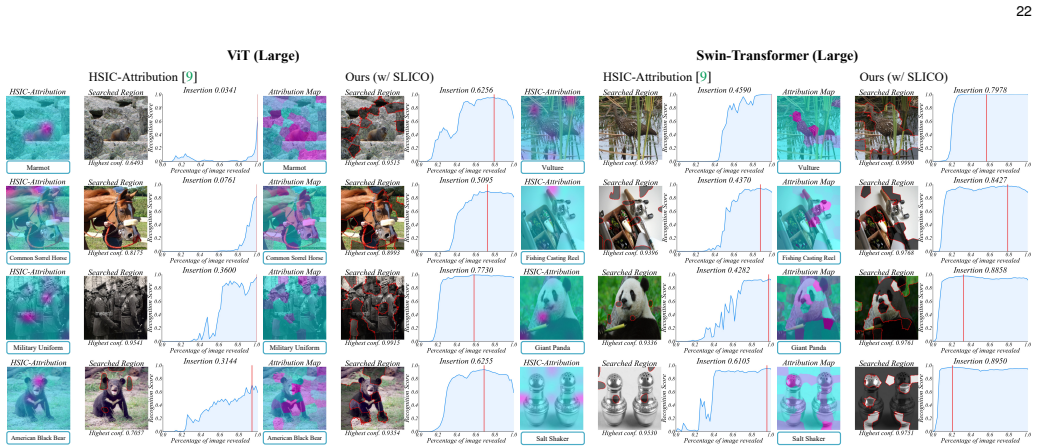
Forward citations
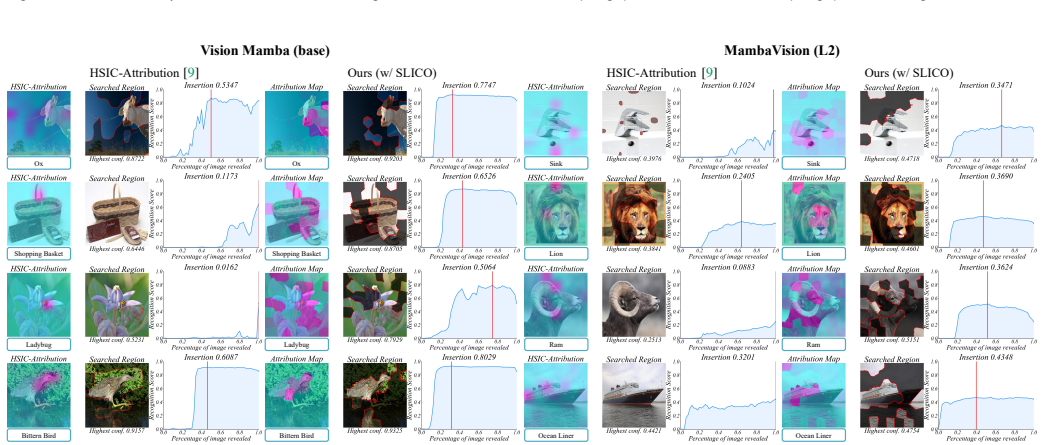
Cited by 2 Pith papers
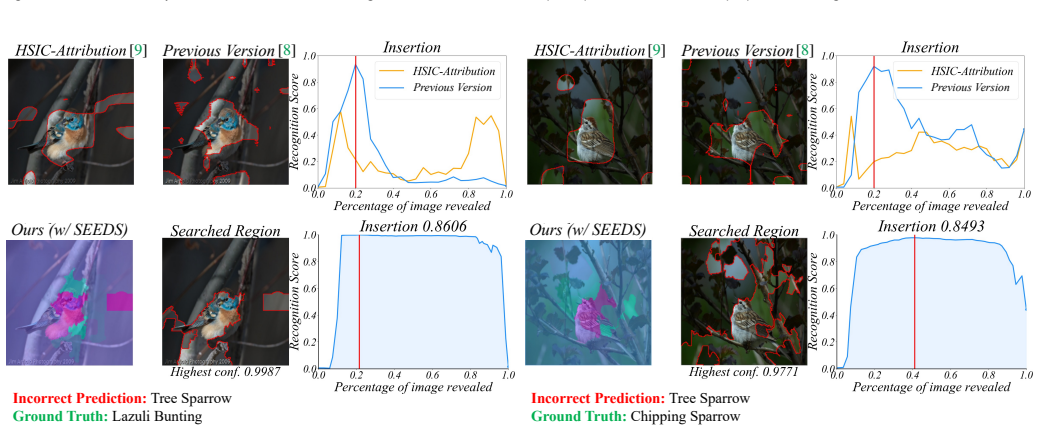
-
Consistent Evidence, Robust Recognition: Faithful Attribution Regularization under Geometric Transformations
Submodular region-search attributions plus a ranking/truncation loss regularize models toward spatially corresponding evidence under geometric transforms, improving attribution metrics and transformed accuracy with sm...
-
PhaseWin: An Efficient Search Algorithm for Faithful Visual Attribution
PhaseWin is a phased window-search algorithm for faithful visual attribution that achieves linear evaluation complexity with near-greedy faithfulness under monotone evidence-accumulation and feature-level structural a...
Reference graph
Works this paper leans on
-
[1]
A. Troncoso-Garc ´ıa, M. Mart´ınez-Ballesteros, F. Mart´ınez-´Alvarez, and A. Troncoso, “A new metric based on association rules to assess feature- attribution explainability techniques for time series forecasting,” IEEE Transactions on Pattern Analysis and Machine Intelligence, 2025. 1
work page 2025
-
[2]
Towards human-centered ex- plainable ai: A survey of user studies for model explanations,
Y . Rong, T. Leemann, T.-T. Nguyen, L. Fiedler, P. Qian, V . Unhelkar, T. Seidel, G. Kasneci, and E. Kasneci, “Towards human-centered ex- plainable ai: A survey of user studies for model explanations,” IEEE Transactions on Pattern Analysis and Machine Intelligence , vol. 46, no. 4, pp. 2104–2122, 2024. 1
work page 2024
-
[3]
Explainable deep learning methods in medical image classification: A survey,
C. Patr ´ıcio, J. C. Neves, and L. F. Teixeira, “Explainable deep learning methods in medical image classification: A survey,” ACM Computing Surveys, vol. 56, no. 4, pp. 1–41, 2023. 1
work page 2023
-
[4]
A. B. Arrieta, N. D ´ıaz-Rodr´ıguez, J. Del Ser, A. Bennetot, S. Tabik, A. Barbado, S. Garc ´ıa, S. Gil-L ´opez, D. Molina, R. Benjamins et al. , “Explainable Artificial Intelligence (XAI): Concepts, taxonomies, op- portunities and challenges toward responsible ai,” Information fusion , vol. 58, pp. 82–115, 2020. 1 16
work page 2020
-
[5]
R. Chen, J. Li, H. Zhang, C. Sheng, L. Liu, and X. Cao, “Sim2Word: Explaining similarity with representative attribute words via counter- factual explanations,” ACM Transactions on Multimedia Computing, Communications and Applications, vol. 19, no. 6, pp. 1–22, 2023. 1
work page 2023
-
[6]
Going beyond XAI: A systematic survey for explanation-guided learning,
Y . Gao, S. Gu, J. Jiang, S. R. Hong, D. Yu, and L. Zhao, “Going beyond XAI: A systematic survey for explanation-guided learning,”ACM Computing Surveys, vol. 56, no. 7, pp. 1–39, 2024. 1
work page 2024
-
[7]
End-to-end autonomous driving: Challenges and frontiers,
L. Chen, P. Wu, K. Chitta, B. Jaeger, A. Geiger, and H. Li, “End-to-end autonomous driving: Challenges and frontiers,” IEEE Transactions on Pattern Analysis and Machine Intelligence , vol. 46, no. 12, pp. 10 164– 10 183, 2024. 1
work page 2024
-
[8]
Less is more: Fewer interpretable region via submodular subset selection,
R. Chen, H. Zhang, S. Liang, J. Li, and X. Cao, “Less is more: Fewer interpretable region via submodular subset selection,” in ICLR, 2024. 1, 2, 3, 4, 5, 9, 10, 11, 12, 14, 19, 22
work page 2024
Show all 97 references
-
[9]
Making sense of dependence: Ef- ficient black-box explanations using dependence measure,
P. Novello, T. Fel, and D. Vigouroux, “Making sense of dependence: Ef- ficient black-box explanations using dependence measure,” in NeurIPS, 2022, pp. 4344–4357. 1, 3, 9, 10, 11, 12, 13, 14, 19, 21, 22, 23
2022
-
[10]
Unifying fourteen post-hoc attribution methods with tay- lor interactions,
H. Deng, N. Zou, M. Du, W. Chen, G. Feng, Z. Yang, Z. Li, and Q. Zhang, “Unifying fourteen post-hoc attribution methods with tay- lor interactions,” IEEE Transactions on Pattern Analysis and Machine Intelligence, 2024. 1, 7
2024
-
[11]
Interpreting object-level foundation models via visual precision search,
R. Chen, S. Liang, J. Li, S. Liu, M. Li, Z. Huang, H. Zhang, and X. Cao, “Interpreting object-level foundation models via visual precision search,” arXiv preprint arXiv:2411.16198, 2024. 1
2024
-
[12]
Illuminating salient contributions in neuron activation with attribution equilibrium,
W.-J. Nam and S.-W. Lee, “Illuminating salient contributions in neuron activation with attribution equilibrium,” IEEE Transactions on Pattern Analysis and Machine Intelligence, vol. 47, no. 2, pp. 1120–1131, 2025. 1
2025
-
[13]
Local interpretations for explainable natural language processing: A survey,
S. Luo, H. Ivison, S. C. Han, and J. Poon, “Local interpretations for explainable natural language processing: A survey,” ACM Computing Surveys, vol. 56, no. 9, pp. 1–36, 2024. 1
2024
-
[14]
A review and benchmark of feature importance methods for neural networks,
H. Mandler and B. Weigand, “A review and benchmark of feature importance methods for neural networks,” ACM Computing Surveys , vol. 56, no. 12, pp. 1–30, 2024. 1
2024
-
[15]
Explainable ai (xai): Core ideas, techniques, and solutions,
R. Dwivedi, D. Dave, H. Naik, S. Singhal, R. Omer, P. Patel, B. Qian, Z. Wen, T. Shah, G. Morgan et al. , “Explainable ai (xai): Core ideas, techniques, and solutions,” ACM Computing Surveys, vol. 55, no. 9, pp. 1–33, 2023. 1
2023
-
[16]
On pixel-wise explanations for non-linear classifier decisions by layer-wise relevance propagation,
S. Bach, A. Binder, G. Montavon, F. Klauschen, K.-R. M ¨uller, and W. Samek, “On pixel-wise explanations for non-linear classifier decisions by layer-wise relevance propagation,” PloS One , vol. 10, no. 7, p. e0130140, 2015. 1, 3
2015
-
[17]
Axiomatic attribution for deep networks,
M. Sundararajan, A. Taly, and Q. Yan, “Axiomatic attribution for deep networks,” in ICML, 2017, pp. 3319–3328. 1, 3, 9, 10, 11, 12, 13, 18
2017
-
[18]
Grad-CAM: Visual explanations from deep networks via gradient-based localization,
R. R. Selvaraju, M. Cogswell, A. Das, R. Vedantam, D. Parikh, and D. Batra, “Grad-CAM: Visual explanations from deep networks via gradient-based localization,” International Journal of Computer Vision , vol. 128, no. 2, pp. 336–359, 2020. 1, 3, 11, 12
2020
-
[19]
iGOS++: integrated gradient optimized saliency by bilateral perturbations,
S. Khorram, T. Lawson, and L. Fuxin, “iGOS++: integrated gradient optimized saliency by bilateral perturbations,” in CHIL, 2021, pp. 174–
2021
-
[20]
Gradient- based visual explanation for transformer-based clip,
C. Zhao, K. Wang, X. Zeng, R. Zhao, and A. B. Chan, “Gradient- based visual explanation for transformer-based clip,” in ICML, 2024, pp. 61 072–61 091. 1, 3, 9, 10, 12, 13
2024
-
[21]
A unified approach to interpreting model predictions,
S. M. Lundberg and S.-I. Lee, “A unified approach to interpreting model predictions,” in NeurIPS, 2017, pp. 4765–4774. 1, 3, 10, 11, 12, 13, 14
2017
-
[22]
Explain any concept: Segment anything meets concept-based explanation,
A. Sun, P. Ma, Y . Yuan, and S. Wang, “Explain any concept: Segment anything meets concept-based explanation,” in NeurIPS, 2023. 1, 3, 10, 11, 12, 13
2023
-
[23]
RISE: Randomized input sampling for explanation of black-box models,
V . Petsiuk, A. Das, and K. Saenko, “RISE: Randomized input sampling for explanation of black-box models,” in BMVC, 2018, p. 151. 1, 3, 5, 9, 10, 11, 12, 13, 14, 19, 21
2018
-
[24]
Defining and extracting generalizable interaction primitives from dnns,
L. Chen, S. Lou, B. Huang, and Q. Zhang, “Defining and extracting generalizable interaction primitives from dnns,” in ICLR, 2024. 1, 6, 7
2024
-
[25]
Towards the difficulty for a deep neural network to learn concepts of different complexities,
D. Liu, H. Deng, X. Cheng, Q. Ren, K. Wang, and Q. Zhang, “Towards the difficulty for a deep neural network to learn concepts of different complexities,” in NeurIPS, 2023, pp. 41 283–41 304. 1
2023
-
[26]
Fujishige, Submodular functions and optimization
S. Fujishige, Submodular functions and optimization. Elsevier, 2005. 1, 4, 6
2005
-
[27]
Learning transferable visual models from natural language supervision,
A. Radford, J. W. Kim, C. Hallacy, A. Ramesh, G. Goh, S. Agarwal, G. Sastry, A. Askell, P. Mishkin, J. Clark et al., “Learning transferable visual models from natural language supervision,” in ICML, 2021, pp. 8748–8763. 2, 8, 9, 10, 11, 12, 19
2021
-
[28]
ImageBind: One embedding space to bind them all,
R. Girdhar, A. El-Nouby, Z. Liu, M. Singh, K. V . Alwala, A. Joulin, and I. Misra, “ImageBind: One embedding space to bind them all,” in CVPR, 2023, pp. 15 180–15 190. 2, 8, 9, 10, 12, 13, 19
2023
-
[29]
LanguageBind: Extending video-language pre- training to n-modality by language-based semantic alignment,
B. Zhu, B. Lin, M. Ning, Y . Yan, J. Cui, W. HongFa, Y . Pang, W. Jiang, J. Zhang, Z. Li et al. , “LanguageBind: Extending video-language pre- training to n-modality by language-based semantic alignment,” in ICLR,
-
[30]
2, 8, 9, 10, 12, 13, 19
-
[31]
Quilt-1M: One million image- text pairs for histopathology,
W. Ikezogwo, S. Seyfioglu, F. Ghezloo, D. Geva, F. Sheikh Mohammed, P. K. Anand, R. Krishna, and L. Shapiro, “Quilt-1M: One million image- text pairs for histopathology,” in NeurIPS, 2024, pp. 37 995–38 017. 2, 8, 13
2024
-
[32]
ImageNet: A large-scale hierarchical image database,
J. Deng, W. Dong, R. Socher, L.-J. Li, K. Li, and L. Fei-Fei, “ImageNet: A large-scale hierarchical image database,” inCVPR, 2009, pp. 248–255. 2, 8, 12
2009
-
[33]
VGGSound: A large- scale audio-visual dataset,
H. Chen, W. Xie, A. Vedaldi, and A. Zisserman, “VGGSound: A large- scale audio-visual dataset,” in ICASSP, 2020, pp. 721–725. 2, 8, 12
2020
-
[34]
Caltech-UCSD Birds 200. Technical Report CNS-TR- 2010–001,
P. Welinder, S. Branson, T. Mita, C. Wah, F. Schroff, S. Be-longie, and P. Perona, “Caltech-UCSD Birds 200. Technical Report CNS-TR- 2010–001,” Technical Report CNS-TR-2010–001, California Institute of Technology, 2010. 1, Tech. Rep., 2010. 2, 8, 12, 14
2010
-
[35]
Deep learning face attributes in the wild,
Z. Liu, P. Luo, X. Wang, and X. Tang, “Deep learning face attributes in the wild,” in ICCV, 2015, pp. 3730–3738. 2, 8
2015
-
[36]
VGGFace2: A dataset for recognising faces across pose and age,
Q. Cao, L. Shen, W. Xie, O. M. Parkhi, and A. Zisserman, “VGGFace2: A dataset for recognising faces across pose and age,” in IEEE International Conference on Automatic Face and Gesture Recognition (FG), 2018, pp. 67–74. 2, 8
2018
-
[37]
Lung and colon cancer histopathological image dataset (LC25000),
A. A. Borkowski, M. M. Bui, L. B. Thomas, C. P. Wilson, L. A. DeLand, and S. M. Mastorides, “Lung and colon cancer histopathological image dataset (LC25000),” arXiv preprint arXiv:1912.12142, 2019. 2, 8, 12
1912
-
[38]
Deep inside convolutional networks: visualising image classification models and saliency maps,
K. Simonyan, A. Vedaldi, and A. Zisserman, “Deep inside convolutional networks: visualising image classification models and saliency maps,” in ICLR (Workshop Poster), 2014. 3, 10, 11, 12
2014
-
[39]
Defining and extracting generalizable interaction primitives from dnns,
L. Chen, S. Lou, B. Huang, and Q. Zhang, “Defining and extracting generalizable interaction primitives from dnns,” in ICLR, 2024. 3
2024
-
[40]
Grad-CAM++: Generalized gradient-based visual explanations for deep convolutional networks,
A. Chattopadhay, A. Sarkar, P. Howlader, and V . N. Balasubramanian, “Grad-CAM++: Generalized gradient-based visual explanations for deep convolutional networks,” in WACV, 2018, pp. 839–847. 3, 14, 23
2018
-
[41]
Score-CAM: Score-weighted visual explanations for con- volutional neural networks,
H. Wang, Z. Wang, M. Du, F. Yang, Z. Zhang, S. Ding, P. Mardziel, and X. Hu, “Score-CAM: Score-weighted visual explanations for con- volutional neural networks,” in CVPR Workshops, 2020, pp. 24–25. 3, 14
2020
-
[42]
ViT-CX: causal explanation of vision transformers,
W. Xie, X.-H. Li, C. C. Cao, and N. L. Zhang, “ViT-CX: causal explanation of vision transformers,” in IJCAI, 2023, pp. 1569–1577. 3, 10, 12, 13
2023
-
[43]
A value for n-person games,
L. S. Shapley, “A value for n-person games,” Annals of Mathematics Studies, vol. 28, pp. 307–318, 1953. 3
1953
-
[44]
Harsanyinet: Computing accurate shapley values in a single forward propagation,
L. Chen, S. Lou, K. Zhang, J. Huang, and Q. Zhang, “Harsanyinet: Computing accurate shapley values in a single forward propagation,” in ICML, 2023, pp. 4804–4825. 3
2023
-
[45]
Problems with shapley-value-based explanations as feature importance measures,
I. E. Kumar, S. Venkatasubramanian, C. Scheidegger, and S. Friedler, “Problems with shapley-value-based explanations as feature importance measures,” in ICML, 2020, pp. 5491–5500. 3, 7
2020
-
[46]
”why should i trust you?
M. T. Ribeiro, S. Singh, and C. Guestrin, “”why should i trust you?” explaining the predictions of any classifier,” inSIGKDD, 2016, pp. 1135–
2016
-
[47]
One explanation is not enough: structured attention graphs for image classification,
V . Shitole, F. Li, M. Kahng, P. Tadepalli, and A. Fern, “One explanation is not enough: structured attention graphs for image classification,” in NeurIPS, 2021, pp. 11 352–11 363. 3
2021
-
[48]
Transformer interpretability beyond attention visualization,
H. Chefer, S. Gur, and L. Wolf, “Transformer interpretability beyond attention visualization,” in CVPR, 2021, pp. 782–791. 3
2021
-
[49]
Vision transformers need registers,
T. Darcet, M. Oquab, J. Mairal, and P. Bojanowski, “Vision transformers need registers,” in ICLR, 2024. 3
2024
-
[50]
Interpreting clip’s image representation via text-based decomposition,
Y . Gandelsman, A. A. Efros, and J. Steinhardt, “Interpreting clip’s image representation via text-based decomposition,” in ICLR, 2024. 3
2024
-
[51]
Discover and cure: Concept-aware mitigation of spurious correlation,
S. Wu, M. Yuksekgonul, L. Zhang, and J. Zou, “Discover and cure: Concept-aware mitigation of spurious correlation,” in ICML, 2023, pp. 37 765–37 786. 4
2023
-
[52]
Meaningfully debugging model mistakes using conceptual counterfactual explanations,
A. Abid, M. Yuksekgonul, and J. Zou, “Meaningfully debugging model mistakes using conceptual counterfactual explanations,” in ICML, 2022, pp. 66–88. 4
2022
-
[53]
Over- looked factors in concept-based explanations: Dataset choice, concept learnability, and human capability,
V . V . Ramaswamy, S. S. Kim, R. Fong, and O. Russakovsky, “Over- looked factors in concept-based explanations: Dataset choice, concept learnability, and human capability,” in CVPR, 2023, pp. 10 932–10 941. 4
2023
-
[54]
Talisman: targeted active learning for object detection with rare classes and slices using submodular mutual information,
S. Kothawade, S. Ghosh, S. Shekhar, Y . Xiang, and R. Iyer, “Talisman: targeted active learning for object detection with rare classes and slices using submodular mutual information,” in ECCV, 2022, pp. 1–16. 4
2022
-
[55]
Ef- ficient modality selection in multimodal learning,
Y . He, R. Cheng, G. Balasubramaniam, Y .-H. H. Tsai, and H. Zhao, “Ef- ficient modality selection in multimodal learning,” Journal of Machine Learning Research, vol. 25, no. 47, pp. 1–39, 2024. 4 17
2024
-
[56]
Marginal contribution feature importance-an axiomatic approach for explaining data,
A. Catav, B. Fu, Y . Zoabi, A. L. W. Meilik, N. Shomron, J. Ernst, S. Sankararaman, and R. Gilad-Bachrach, “Marginal contribution feature importance-an axiomatic approach for explaining data,” in ICML, 2021, pp. 1324–1335. 4
2021
-
[57]
Stream- ing weak submodularity: Interpreting neural networks on the fly,
E. Elenberg, A. G. Dimakis, M. Feldman, and A. Karbasi, “Stream- ing weak submodularity: Interpreting neural networks on the fly,” in NeurIPS, 2017, pp. 4044–4054. 4
2017
-
[58]
Learning to explain: An information-theoretic perspective on model interpretation,
J. Chen, L. Song, M. Wainwright, and M. Jordan, “Learning to explain: An information-theoretic perspective on model interpretation,” in ICML, 2018, pp. 883–892. 4
2018
-
[59]
Scalable subset sampling with neural conditional poisson networks,
A. Pervez, P. Lippe, and E. Gavves, “Scalable subset sampling with neural conditional poisson networks,” in ICLR, 2023, pp. 1–21. 4
2023
-
[60]
”what data benefits my classifier?
A. Chhabra, P. Li, P. Mohapatra, and H. Liu, “”what data benefits my classifier?” enhancing model performance and interpretability through influence-based data selection,” in ICLR, 2024. 4
2024
-
[61]
An analysis of approximations for maximizing submodular set functions—i,
G. L. Nemhauser, L. A. Wolsey, and M. L. Fisher, “An analysis of approximations for maximizing submodular set functions—i,” Mathe- matical programming, vol. 14, pp. 265–294, 1978. 4
1978
-
[62]
Lazier than lazy greedy,
B. Mirzasoleiman, A. Badanidiyuru, A. Karbasi, J. V ondr ´ak, and A. Krause, “Lazier than lazy greedy,” in AAAI, 2015, pp. 1812–1818. 4, 6, 19
2015
-
[63]
Submodular batch selection for training deep neural networks,
K. Joseph, K. Singh, and V . N. Balasubramanian, “Submodular batch selection for training deep neural networks,” in IJCAI, 2019, pp. 2677–
2019
-
[64]
Submodular functions, matroids, and certain polyhedra,
J. Edmonds, “Submodular functions, matroids, and certain polyhedra,” Combinatorial Structures and Their Applications, pp. 69–87, 1970. 4
1970
-
[65]
SLIC superpixels compared to state-of-the-art superpixel methods,
R. Achanta, A. Shaji, K. Smith, A. Lucchi, P. Fua, and S. S ¨usstrunk, “SLIC superpixels compared to state-of-the-art superpixel methods,” IEEE Transactions on Pattern Analysis and Machine Intelligence, vol. 34, no. 11, pp. 2274–2282, 2012. 5, 8
2012
-
[66]
Segment anything,
A. Kirillov, E. Mintun, N. Ravi, H. Mao, C. Rolland, L. Gustafson, T. Xiao, S. Whitehead, A. C. Berg, W.-Y . Lo, P. Dollar, and R. Girshick, “Segment anything,” in ICCV, 2023, pp. 4015–4026. 5, 8, 12, 23
2023
-
[67]
Unsupervised learning of visual representa- tions by solving jigsaw puzzles,
M. Noroozi and P. Favaro, “Unsupervised learning of visual representa- tions by solving jigsaw puzzles,” in ECCV, 2016, pp. 69–84. 5
2016
-
[68]
Learn to threshold: Thresholdnet with confidence-guided manifold mixup for polyp segmentation,
X. Guo, C. Yang, Y . Liu, and Y . Yuan, “Learn to threshold: Thresholdnet with confidence-guided manifold mixup for polyp segmentation,” IEEE Transactions on Medical Imaging , vol. 40, no. 4, pp. 1134–1146, 2020. 5
2020
-
[69]
Test-time prompt tuning for zero-shot generalization in vision-language models,
M. Shu, W. Nie, D.-A. Huang, Z. Yu, T. Goldstein, A. Anandkumar, and C. Xiao, “Test-time prompt tuning for zero-shot generalization in vision-language models,” in NeurIPS, 2022, pp. 14 274–14 289. 5
2022
-
[70]
Handling open-set noise and novel target recognition in domain adaptive semantic segmentation,
X. Guo, J. Liu, T. Liu, and Y . Yuan, “Handling open-set noise and novel target recognition in domain adaptive semantic segmentation,” IEEE Transactions on Pattern Analysis and Machine Intelligence, vol. 45, no. 8, pp. 9846–9861, 2023. 5
2023
-
[71]
Cosface: Large margin cosine loss for deep face recognition,
H. Wang, Y . Wang, Z. Zhou, X. Ji, D. Gong, J. Zhou, Z. Li, and W. Liu, “Cosface: Large margin cosine loss for deep face recognition,” in CVPR, 2018, pp. 5265–5274. 6
2018
-
[72]
Arcface: Additive angular margin loss for deep face recognition,
J. Deng, J. Guo, N. Xue, and S. Zafeiriou, “Arcface: Additive angular margin loss for deep face recognition,” in CVPR, 2019, pp. 4690–4699. 6, 8
2019
-
[73]
Submodularity in data subset selection and active learning,
K. Wei, R. Iyer, and J. Bilmes, “Submodularity in data subset selection and active learning,” in ICML, 2015, pp. 1954–1963. 6
2015
-
[74]
Deep residual learning for image recognition,
K. He, X. Zhang, S. Ren, and J. Sun, “Deep residual learning for image recognition,” in CVPR, 2016, pp. 770–778. 8, 10, 11, 14, 19
2016
-
[75]
An image is worth 16x16 words: Transformers for image recognition at scale,
A. Dosovitskiy, L. Beyer, A. Kolesnikov, D. Weissenborn, X. Zhai, T. Unterthiner, M. Dehghani, M. Minderer, G. Heigold, S. Gelly et al., “An image is worth 16x16 words: Transformers for image recognition at scale,” in ICLR, 2021. 8, 11
2021
-
[76]
Swin transformer: Hierarchical vision transformer using shifted win- dows,
Z. Liu, Y . Lin, Y . Cao, H. Hu, Y . Wei, Z. Zhang, S. Lin, and B. Guo, “Swin transformer: Hierarchical vision transformer using shifted win- dows,” in ICCV, 2021, pp. 10 012–10 022. 8, 11, 19
2021
-
[77]
Vision mamba: Efficient visual representation learning with bidirectional state space model,
L. Zhu, B. Liao, Q. Zhang, X. Wang, W. Liu, and X. Wang, “Vision mamba: Efficient visual representation learning with bidirectional state space model,” in ICML, 2024. 8, 11, 19
2024
-
[78]
MambaVision: A hybrid mamba- transformer vision backbone,
A. Hatamizadeh and J. Kautz, “MambaVision: A hybrid mamba- transformer vision backbone,” arXiv preprint arXiv:2407.08083 , 2024. 8, 11, 19
2024
-
[79]
MobileNetV2: Inverted residuals and linear bottlenecks,
M. Sandler, A. Howard, M. Zhu, A. Zhmoginov, and L.-C. Chen, “MobileNetV2: Inverted residuals and linear bottlenecks,” in CVPR, 2018, pp. 4510–4520. 8, 14
2018
-
[80]
EfficientNetV2: Smaller models and faster training,
M. Tan and Q. Le, “EfficientNetV2: Smaller models and faster training,” in ICML, 2021, pp. 10 096–10 106. 8, 14
2021
-
[81]
Evaluating and aggregating feature-based model explanations,
U. Bhatt, A. Weller, and J. M. Moura, “Evaluating and aggregating feature-based model explanations,” in IJCAI, 2021, pp. 3016–3022. 9
2021
-
[82]
Instance-wise or class-wise? a tale of neighbor shapley for concept- based explanation,
J. Li, K. Kuang, L. Li, L. Chen, S. Zhang, J. Shao, and J. Xiao, “Instance-wise or class-wise? a tale of neighbor shapley for concept- based explanation,” in ACM MM, 2021, pp. 3664–3672. 9
2021
-
[83]
Foundation models for music: A survey,
Y . Ma, A. Øland, A. Ragni, B. M. Del Sette, C. Saitis, C. Donahue, C. Lin, C. Plachouras, E. Benetos, E. Quinton et al., “Foundation models for music: A survey,” arXiv preprint arXiv:2408.14340, 2024. 12
2024
-
[84]
A benchmark for interpretability methods in deep neural networks,
S. Hooker, D. Erhan, P.-J. Kindermans, and B. Kim, “A benchmark for interpretability methods in deep neural networks,” in NeurIPS, 2019, pp. 9734–9745. 12
2019
-
[85]
Not just a black box: Learning important features through propagating activation differences,
A. Shrikumar, P. Greenside, A. Shcherbina, and A. Kundaje, “Not just a black box: Learning important features through propagating activation differences,” arXiv preprint arXiv:1605.01713, 2016. 12
2016 arXiv
-
[86]
SmoothGrad: removing noise by adding noise,
D. Smilkov, N. Thorat, B. Kim, F. Vi ´egas, and M. Wattenberg, “SmoothGrad: removing noise by adding noise,” arXiv preprint arXiv:1706.03825, 2017. 12
2017 arXiv
-
[87]
Noise-adding methods of saliency map as series of higher order partial derivative,
J. Seo, J. Choe, J. Koo, S. Jeon, B. Kim, and T. Jeon, “Noise-adding methods of saliency map as series of higher order partial derivative,” arXiv preprint arXiv:1806.03000, 2018. 12
2018 arXiv
-
[88]
Towards better understanding of gradient-based attribution methods for deep neural networks,
M. Ancona, E. Ceolini, C. ¨Oztireli, and M. Gross, “Towards better understanding of gradient-based attribution methods for deep neural networks,” in ICLR, 2018. 12
2018
-
[89]
Look at the variance! efficient black-box explanations with sobol-based sensitivity analysis,
T. Fel, R. Cad `ene, M. Chalvidal, M. Cord, D. Vigouroux, and T. Serre, “Look at the variance! efficient black-box explanations with sobol-based sensitivity analysis,” in NeurIPS, 2021, pp. 26 005–26 014. 12
2021
-
[90]
Explaining nonlinear classification decisions with deep taylor decom- position,
G. Montavon, S. Lapuschkin, A. Binder, W. Samek, and K.-R. M ¨uller, “Explaining nonlinear classification decisions with deep taylor decom- position,” Pattern recognition, vol. 65, pp. 211–222, 2017. 18 Ruoyu Chen is currently working toward the Ph.D. degree in the School of C...
2017
-
[91]
We compare with RISE [23] and HSIC- Attribution [9] methods, showing the advantages of our method
[27] on the ImageNet dataset. We compare with RISE [23] and HSIC- Attribution [9] methods, showing the advantages of our method. B.2 Visualization on ResNet-101 Fig. 13 presents interpretable attribution results for single-modal ResNet- 101 [73] on the ImageNet dataset. We com...
2011
-
[92]
[9] Fig. 12. Additional interpretation visualization for CLIP (ResNet-101) on the ImageNet dataset. Half-track Half-track Monastery Monastery Jacamar Jacamar Yorkshire TerrierYorkshire Terrier Half-track Yorkshire Terrier Jacamar Monastery HSIC-AttributionOurs (w/ SEEDS)RISE R...
-
[93]
[9] Fig. 13. Additional interpretation visualization for single-modal ResNet-101 on the ImageNet dataset. 22 ViT(Large)HSIC-Attribution Ours (w/ SLICO)Swin-Transformer (Large) HSIC-Attribution Ours (w/ SLICO) Vulture Vulture Marmot Marmot Common Sorrel HorseCommon Sorrel Horse...
-
[94]
[9] Fig. 14. Additional interpretation visualization for single-modal vision transformer (Large) and swin-transformer (Large) on the ImageNet dataset. Vision Mamba(base)HSIC-AttributionOurs (w/ SLICO)MambaVision(L2)HSIC-AttributionOurs (w/ SLICO) Ox Ox Shopping BasketShopping ...
-
[95]
[9] Fig. 15. Additional interpretation visualization for single-modal vision mamba (base) and mambavision (L2) on the ImageNet dataset. Incorrect Prediction: Tree SparrowGround Truth: Lazuli Bunting Previous VersionPrevious Version Ours (w/ SEEDS) Previous VersionPrevious Vers...
-
[96]
[8] [9] [8] Fig. 16. Visualization of the method for discovering what causes model prediction errors on the CUB-200-2011 dataset. The first row shows the results of the HSIC-Attribution method and the previous version method, and the second row shows the results of the current...
2011
-
[97]
[39] [9] Fig. 17. Visualization of the method for discovering what causes model prediction errors on the CUB-200-2011 dataset. The first row shows the results of the HSIC-Attribution method and the previous version method, and the second row shows the results of the current ve...
2011
Reviewed May 22, 2026 · model on record in the stance chip above.
Discussion (0). Continue with ORCID to comment.