REVIEW 3 major objections 4 minor 42 references
Development of Radar and Optical Tracking of Near-Earth Asteroids at the University of Tasmania
T0 review · 3 major / 4 minor · reviewed 2026-08-09 · deepseek-v4-flash
Pith's one-line read Small 12–30 metre radio telescopes can receive bistatic radar echoes from near-Earth asteroids, as shown by confirmed detections of 1994 PC1, 2003 UC20 and 2024 MK.
desk verdict A useful, transferable small-antenna bistatic radar feasibility study whose low-SNR detections need re-reporting before the 12 m claim is fully convincing. read the letter →
The pith
A machine-rendered reading of the paper's core claim, the machinery that carries it, and where it could break.
The reading
What carries the argument
The mechanism that carries the argument is bistatic Doppler compensation: the transmitted frequency is shifted by the radial velocities of the transmitter–asteroid and asteroid–receiver paths, roughly $f_D = (v_{\rm tx\to a}+v_{\rm a\to rx})f_{\rm tx}/c_0$, and the data-processing pipeline applies a time-varying polynomial phase model to collapse the moving echo into a single spectral line. For short scans the polynomial is built from an instantaneous radial-velocity approximation, while for longer scans it is built from precise ephemeris predictions supplied by the transmitting station's orbit-determination tool. The detection statistics are computed from the radar range equation, which gives the expected signal-to-noise ratio from transmitted power, antenna gains, wavelength, radar cross-section, range, system temperature, and integration time; the paper uses this equation both to predict detectability and to explain why most small-antenna targets were non-detections.
What would settle it
Reprocess the raw recorded data for 1994 PC1 and 2003 UC20 without subtracting the noise floor or smoothing, with a matched-filter search over the expected Doppler drift; if the peaks do not exceed a 5-sigma threshold against the raw noise distribution, the central feasibility claim fails. A complementary check is to observe 2003 UC20 at a second epoch with the same antenna and see whether the echo reappears at the ephemeris-predicted frequency.
Extended reading notes
Core claim
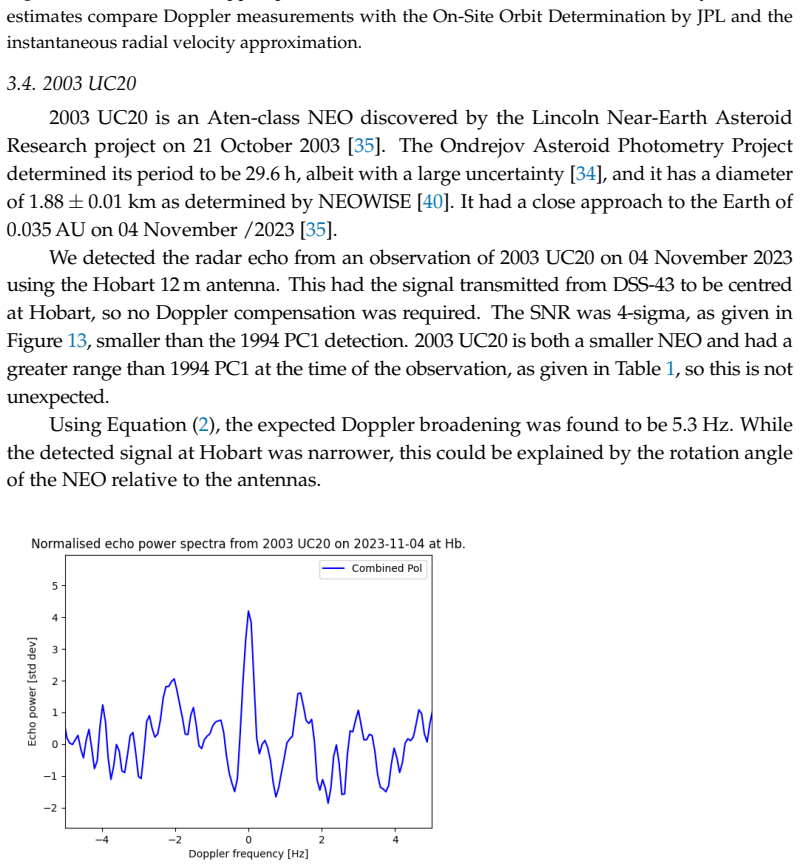
The central claim is that a 12-metre antenna, receiving a C-band continuous wave transmitted at about 7159 MHz by a deep-space station, can pick out the radar echo from a strong near-Earth asteroid. Concretely, the paper reports 7-sigma and 6-sigma detections of 1994 PC1 on two 12-metre antennas, a 4-sigma detection of 2003 UC20 on a 12-metre antenna, and a 35-sigma detection of 2024 MK on a 30-metre antenna, with the echo appearing at the frequency predicted from the relative radial velocities. The authors use these observations to argue that small radio telescopes are feasible bistatic receivers for strong targets, and that the main limitation is sensitivity, not Doppler-compensation accuracy. They also show that a 30-metre antenna upgraded with a wide-band receiver reaches much higher signal-to-noise ratios, and that the Moon's echo is strong enough to calibrate the method.
Load-bearing premise
The detections stand on the assumption that the reported signal-to-noise ratios, computed after noise-floor subtraction and, in one case, smoothing of the spectra, are genuine measures of detection significance, and that the predicted Doppler frequency keeps the echo inside the search band.
Editorial extensions
If this is right
- A network of 12–30 m antennas could add southern-hemisphere and longitudinal coverage for asteroid radar, catching objects that are weak, invisible, or schedulable only from the south.
- Small antennas must integrate for roughly 180 minutes to match the sensitivity of a 70 m dish, so practical detections will be limited to large or close-approaching asteroids.
- The Doppler-compensation pipelines described here can be reproduced on any radio telescope with a suitable receiver, lowering the entry barrier for new bistatic radar stations.
- Upgraded 30 m and 26 m antennas with wide-band C-band receivers should reach much stronger detections than the 12 m dishes, as demonstrated by the 35-sigma 2024 MK result.
Reading between the lines
- The 4-sigma 2003 UC20 detection, presented without a noise-distribution analysis or waterfall plot, is better viewed as a candidate detection until independently confirmed.
- The quoted 7-sigma and 6-sigma values for 1994 PC1 were computed after polynomial smoothing of the spectra, so the raw, unsmoothed significance is likely lower than reported.
- The same Doppler-compensation method applies to any moving reflector, so the pipeline could also serve space-surveillance radar for artificial satellites and debris.
- If several small sites record the same echo coherently, the network could move beyond detection to interferometric spin-axis and shape measurements of asteroids.
Editorial analysis
A structured set of objections, weighed in public.
Referee Report
Summary. This paper reports on the University of Tasmania's participation in the Southern Hemisphere Asteroid Research Program from 2021 to 2024, using small radio telescopes (12 m Hobart and Katherine, 30 m Ceduna) as bistatic radar receivers for near-Earth asteroids. The authors describe the transmission setup, Doppler-compensation methods (instantaneous radial velocity approximation versus JPL OSOD predict files), data processing with the SDtracker/SCtracker software, and results including detections of the Moon, 1994 PC1, 2003 UC20, and 2024 MK, plus a table of many non-detections. They conclude that small radio telescopes can effectively receive bistatic radar echoes from strong asteroid targets.
Significance. The claimed result is potentially valuable: demonstrating that 12 m class antennas can detect bistatic radar echoes from near-Earth asteroids would expand the southern-hemisphere radar coverage and provide additional astrometric and characterization opportunities. The paper has several concrete strengths: it presents a detailed, reproducible signal-processing pipeline based on open-source software; it uses independent external ephemerides (JPL Horizons/OSOD) rather than fitting to the UTAS data; it validates the pipeline with a strong Moon detection; and it reports independent ATCA detections that corroborate the reality of the asteroid echoes. If the detection statistics are confirmed, the paper would be a useful reference for groups considering small-telescope participation in planetary radar. However, the central feasibility claim for the 12 m antennas rests on the quoted signal-to-noise ratios, and the manuscript currently provides insufficient statistical evidence to support those detections as rigorously as the wording 'confirmed detections' implies.
major comments (3)
- [§2.3, Figures 10 and 11] The reported 7-sigma (Hobart) and 6-sigma (Katherine) detections of 1994 PC1 are measured after Savitzky-Golay smoothing with window size 10 and polynomial order 3, as stated in the figure captions, and after noise-floor subtraction. Smoothing reduces the noise rms, so the quoted sigmas do not represent the significance of the unsmoothed spectra. Because the central conclusion that 12 m antennas can detect asteroid echoes depends directly on these numbers, the authors should report the pre-smoothing SNR, the noise statistics of the unsmoothed spectra, and a false-alarm probability or an equivalent number of independent trials. Without this, the 12 m detection claim is not quantitatively supported.
- [§3.4, Figure 13] The 2003 UC20 detection is a single 4-sigma peak at 0.15 Hz resolution after a 201-minute integration, with no noise distribution, no waterfall plot, and no trials factor for the number of independent frequency bins or the two combined linear polarisations. A 4-sigma maximum over a spectrum with hundreds or thousands of independent bins is not by itself a statistically significant detection. The authors should provide the raw (un-smoothed or equivalently trial-corrected) significance, a noise histogram or N-sigma map, and ideally show the echo in sub-integrations or in the two polarisations independently. This is load-bearing because, if the 2003 UC20 detection is not significant, the small-antenna feasibility conclusion rests on the single 1994 PC1 event.
- [Abstract and §4.2 (Table 1)] The abstract and conclusions describe the 12 m detections as 'confirmed detections' and the paper states 'there have been over 40 separate observation sessions but only three confirmed detections for the small antennas'. Given the statistical issues above, the term 'confirmed' is stronger than the evidence presented. The authors should define a quantitative detection criterion (e.g., a trial-corrected significance threshold or a requirement of corroborating sub-bands/polarisations) and apply it uniformly to all reported detections. This would also clarify why, for example, the strong 2024 MK Ceduna detection and the Moon detection are robust while the 12 m detections require additional scrutiny.
minor comments (4)
- [Table 1 caption] The caption contains a duplicated phrase: 'between between 2021 and 2024' should be 'between 2021 and 2024'.
- [§3.1] The phrase 'In principal, the output of this has less drift' should read 'In principle'.
- [§3.4] The date '04 November /2023' contains a stray slash; it should be '04 November 2023'.
- [§4.1] The statement that a small antenna needs 'at least 180 minutes of integrated spectra' to emulate a 70 m antenna would benefit from a brief derivation or a reference, since it is not immediately obvious from Equation (4) and the stated 0.003 relative sensitivity.
Circularity Check
No circularity: Doppler predictions come from external JPL ephemerides, detections are benchmarked against independent ATCA echoes and a Moon calibration, and no fitted parameter is relabeled as a prediction.
full rationale
The claimed derivation chain is observational rather than deductive. Expected echo frequencies are obtained from JPL Horizons and OSOD ephemerides that are built from prior astrometry and orbital fits, not from the UTAS observations whose detections are being reported (Sections 2.3, 3.3-3.5). The Doppler-compensation polynomials are fits to those external predictions and are applied before the spectra are examined; they are not free parameters adjusted to maximize the reported peaks. The 1994 PC1 result is cross-checked by two independent compensation methods and corroborated by ATCA detection in the same session; the Moon provides an external calibration of the Doppler method; 2024 MK has a robust 35-sigma Ceduna detection. No equation in the paper defines the detected SNR in terms of the ephemeris prediction, and no fitted quantity is renamed as a detection. The smoothing and noise-floor treatment of the 12 m SNRs is a statistical-evidence concern, but it is not circularity; it does not make the detections equivalent to their inputs by construction. No load-bearing argument reduces to a self-citation; the cited SHARP and SDtracker work supplies tools and conventions, not the conclusion that small antennas detected echoes.
Assumptions & free parameters
free parameters (1)
- Doppler compensation polynomial coefficients =
not reported; order 4-6; residual below 0.5 Hz for 2014 HK129
assumptions (5)
- standard math The bistatic radar range equation (Equations 3 and 4) and the radiometer noise formula describe the received echo power and SNR.
- domain assumption The Doppler shift can be approximated by fD = (vtx-a + va-rx) ftx / c0, accurate to tens of hertz for these targets.
- domain assumption JPL Horizons or OSOD ephemerides predict the received echo frequency accurately enough that the echo falls inside the processed search band.
- domain assumption The noise in the integrated spectra is stationary and Gaussian, so peak-over-noise-sigma is a valid detection statistic, even after Savitzky-Golay smoothing.
- domain assumption The linearly polarized 12 m receivers capture a sufficient fraction of the circularly polarized echo that combining horizontal and vertical channels yields a detectable signal.
Cite this review
Pith. "Pith review of Development of Radar and Optical Tracking of Near-Earth Asteroids at the University of Tasmania." pith.science (2026). https://pith.science/paper/BJTGXFJS
@misc{pith2026250202890,
  author       = {Pith},
  title        = {Pith review of: Development of Radar and Optical Tracking of Near-Earth Asteroids at the University of Tasmania},
  year         = {2026},
  howpublished = {\url{https://pith.science/paper/BJTGXFJS}},
  note         = {Machine review of arXiv:2502.02890}
}
read the original abstract
We detail the use of the University of Tasmania's (UTAS) optical and radio telescopes to conduct observations of near-Earth asteroids from 2021 to 2024. The Canberra Deep Space Communication Complex transmitted a radio signal at 7159.45 MHz, with the radar echo detected by the UTAS radio telescopes. The method of accounting for the Doppler shift between the stations and the near-Earth object is described so that others can implement a similar program. We present our results, with confirmed detections of 1994 PC1 and 2003 UC20 asteroids using the Hobart and Katherine 12-m antennas, demonstrating the feasibility of using small radio telescopes for these observations. Additionally, the recently upgraded Ceduna 30 m antenna was used to detect 2024 MK. Data collected from other observatories, such as Tidbinbilla, as well as the UTAS radar tracking of the moon are also presented in the context of demonstrating the means of applying these Doppler corrections and the accuracy of each method. Optical observations conducted in this period are also detailed as they complement radar observations and aid in refining the orbit parameters.
Figures


Figures from the paper (13 more)




Reference graph
Works this paper leans on
-
[1]
Ostro, S.J. Planetary radar astronomy. Rev. Mod. Phys. 1993, 65, 1235–1279. https://doi.org/10.1103/RevModPhys.65.1235
-
[2]
Planetary Radar—State-of-the-Art Review
Virkki, A.; Neish, C.; Rivera-Valentín, E.; Bhiravarasu, S.; Hickson, D.; Nolan, M.; Orosei, R. Planetary Radar—State-of-the-Art Review. Remote Sens. 2023, 15, 5605. https://doi.org/10.3390/rs15235605
-
[3]
Goldstein, R.M. Radar Observations of Icarus. Science 1968, 162, 903–904. https://doi.org/10.1126/science.162.3856.903
-
[4]
Geophysical and orbital environments of asteroid 469219 2016 HO3
Li, X.; Scheeres, D.; Qiao, D.; Liu, Z. Geophysical and orbital environments of asteroid 469219 2016 HO3. Astrodynamics 2022, 7, 7. https://doi.org/10.1007/s42064-022-0131-7
-
[5]
The role of radar in predicting and preventing asteroid and comet collisions with Earth
Ostro, S.J.; Giorgini, J.D. The role of radar in predicting and preventing asteroid and comet collisions with Earth. In Mitigation of Hazardous Comets and Asteroids, 1 ed.; Belton, M.J.S.; Morgan, T.H.; Samarasinha, N.H.; Yeomans, D.K., Eds.; Cambridge University Press: Cambridge, UK, 2004; pp. 38–65. https://doi.org/10.1017/CBO9780511525049.005
-
[6]
Predicting the Earth encounters of (99942) Apophis
Giorgini, J.D.; Benner, L.A.; Ostro, S.J.; Nolan, M.C.; Busch, M.W. Predicting the Earth encounters of (99942) Apophis. ICARUS 2008, 193, 1–19. https://doi.org/10.1016/j.icarus.2007.09.012
-
[7]
Bistatic radar observations of near-earth asteroid (163899) 2003 SD220 from the southern hemisphere
Horiuchi, S.; Molyneux, B.; Stevens, J.B.; Baines, G.; Benson, C.; Abu-Shaban, Z.; Giorgini, J.D.; Benner, L.A.M.; Naidu, S.P .; Phillips, C.J.; et al. Bistatic radar observations of near-earth asteroid (163899) 2003 SD220 from the southern hemisphere. ICARUS 2021, 357, 114250. https://doi.org/10.1016/j.icarus.2020.114250
-
[8]
Near-earth asteroid lightcurve analysis at CS3-palmer divide station: 2015 october–december
Warner, B.D. Near-earth asteroid lightcurve analysis at CS3-palmer divide station: 2015 october–december. Minor Planet Bull. 2016, 43, 143–154
work page 2015
Show all 42 references
-
[9]
Radar and Near-Infrared Characterization of Near-Earth Asteroid (163899) 2003 SD220
Rivera-Valentín, E.G.; Taylor, P .A.; Reddy, V .; Jao, J.S.; Benner, L.A.M.; Brozovic, M.; Naidu, S.P .; Virkki, A.K.; Marshall, S.E.; Sanchez, J.A.; et al. Radar and Near-Infrared Characterization of Near-Earth Asteroid (163899) 2003 SD220. In Proceedings of the 50th Annual L...
2003
-
[10]
Radar observations of near-Earth asteroid 2003 SD220
Bondarenko, Y.; Marshalov, D.; Vavilov, D.; Medvedev, Y. Radar observations of near-Earth asteroid 2003 SD220. In Proceedings of the EPSC-DPS Joint Meeting 2019, Granada, Spain, 27 September–2 October 2019; Volume 13
2003
-
[11]
Binary Asteroids in the Near-Earth Object Population
Margot, J.L.; Nolan, M.C.; Benner, L.A.M.; Ostro, S.J.; Jurgens, R.F.; Giorgini, J.D.; Slade, M.A.; Campbell, D.B. Binary Asteroids in the Near-Earth Object Population. Science 2002, 296, 1445–1448. https://doi.org/10.1126/science.1072094
2002 doi
-
[12]
Direct Detection of the Yarkovsky Effect by Radar Ranging to Asteroid 6489 Golevka
Chesley, S.R.; Ostro, S.J.; Vokrouhlický, D.; ˇCapek, D.; Giorgini, J.D.; Nolan, M.C.; Margot, J.L.; Hine, A.A.; Benner, L.A.M.; Chamberlin, A.B. Direct Detection of the Yarkovsky Effect by Radar Ranging to Asteroid 6489 Golevka. Science 2003, 302, 1739–
2003
-
[13]
Capabilities of Earth-based radar facilities for near-Earth asteroid observations
Naidu, S.P .; Benner, L.A.M.; Margot, J.L.; Busch, M.W.; Taylor, P .A. Capabilities of Earth-based radar facilities for near-Earth asteroid observations. Astron. J. 2016, 152, 99. https://doi.org/10.3847/0004-6256/152/4/99
2016 doi
-
[14]
Toward a European Facility for Ground-Based Radar Observations of Near-Earth Objects
Pupillo, G.; Righini, S.; Orosei, R.; Bortolotti, C.; Maccaferri, G.; Roma, M.; Mastrogiuseppe, M.; Pisanu, T.; Schirru, L.; Cicalò, S.; et al. Toward a European Facility for Ground-Based Radar Observations of Near-Earth Objects. Remote Sens. 2023, 16, 38. https://doi.org/10.3...
2023 doi
-
[15]
Improved impact hazard assessment with existing radar sites and a new 70-m southern hemisphere radar installation
Giorgini, J.; Slade, M.; Silva, A.; Preston, R.; Brozovic, M.; Taylor, P .; Magri, C. Improved impact hazard assessment with existing radar sites and a new 70-m southern hemisphere radar installation. Available online: https://ntrs.nasa.gov/citations/20150009 165 (accessed on ...
2024
-
[16]
First Detection of Two Near-Earth Asteroids With a Southern Hemisphere Planetary Radar System
Benson, C.; Reynolds, J.; Stacy, N.J.S.; Benner, L.A.M.; Edwards, P .G.; Baines, G.; Boyce, R.; Giorgini, J.D.; Jao, J.S.; Martinez, G.; et al. First Detection of Two Near-Earth Asteroids With a Southern Hemisphere Planetary Radar System. Radio Sci. 2017, 52, 1344–1351. https:...
2017 doi
-
[17]
Detection of three near-earth asteroids with a southern hemisphere planetary radar system
Benson, C.; Stacy, N.; Benner, L.A.; Baines, G.; Boyce, R.; Giorgini, J.D.; Jao, J.; Martinez, G.; Slade, M.A.; Teitelbaum, L.P .; et al. Detection of three near-earth asteroids with a southern hemisphere planetary radar system. In Proceedings of the Proceedings of the Interna...
2017
-
[18]
Asteroids observation from the southern hemisphere using planetary radar
Abu-Shaban, Z.; Benner, L.A.M.; Edwards, P .; Lazio, J.; Stevens, J.; Boyce, R.; Horiuchi, S.; Slade, M.A.; Benson, C.; Stacy, N.; et al. Asteroids observation from the southern hemisphere using planetary radar. In Proceedings of the 42nd COSPAR Scientific Assembly, Pasadena, ...
2018
-
[19]
Southern Hemisphere Asteroid Radar Program (SHARP): Targets of Opportunity Observations for Near Earth Asteroids, 2019 EA2, 2019 GC6, and 2019 SP3
Molyneux, B.; Naidu, S.; Benner, L.A.M.; Edwards, P .; Lazio, J.; Stevens, J.; Horiuchi, S.; Slade, M.A.; Benson, C.; Stacy, N.; et al. Southern Hemisphere Asteroid Radar Program (SHARP): Targets of Opportunity Observations for Near Earth Asteroids, 2019 EA2, 2019 GC6, and 201...
2019
-
[20]
Deep space debris—Detection of potentially hazardous asteroids and objects from the southern hemisphere
Kruzins, E.; Benner, L.; Boyce, R.; Brown, M.; Coward, D.; Darwell, S.; Edwards, P .; Elizabeth-Glina, L.; Giorgini, J.; Horiuchi, S.; et al. Deep space debris—Detection of potentially hazardous asteroids and objects from the southern hemisphere. Front. Space T echnol.2023, 4,...
2023
-
[21]
The AuScope geodetic VLBI array
Lovell, J.E.J.; McCallum, J.N.; Reid, P .B.; McCulloch, P .M.; Baynes, B.E.; Dickey, J.M.; Shabala, S.S.; Watson, C.S.; Titov, O.; Ruddick, R.; et al. The AuScope geodetic VLBI array. J. Geod. 2013, 87, 527–538. https://doi.org/10.1007/s00190-013-0626-3. Remote Sens. 2025, 17,...
2013 doi
-
[22]
COSMIC: Microarcsecond Resolution with a 30 Meter Radio Telescope
McCulloch, P .M.; Ellingsen, S.P .; Jauncey, D.L.; Carter, S.J.B.; Cimò, G.; Lovell, J.E.J.; Dodson, R.G. COSMIC: Microarcsecond Resolution with a 30 Meter Radio Telescope. Astron. J. 2005, 129, 2034–2040. https://doi.org/10.1086/428374
2005 doi
-
[23]
2023 DZ2 Planetary Defense Campaign
Reddy, V .; Kelley, M.S.; Benner, L.; Dotson, J.; Erasmus, N.; Farnocchia, D.; Linder, T.; Masiero, J.R.; Thomas, C.; Bauer, J.; et al. 2023 DZ2 Planetary Defense Campaign. Planet. Sci. J. 2024, 5, 141. https://doi.org/10.3847/PSJ/ad4a6d
2023 doi
-
[24]
Spacecraft VLBI and Doppler tracking: algorithms and implementation
Duev, D.A.; Molera Calvés, G.; Pogrebenko, S.V .; Gurvits, L.I.; Cimó, G.; Bocanegra Bahamon, T. Spacecraft VLBI and Doppler tracking: algorithms and implementation. Astron. Astrophys. 2012, 541, A43. https://doi.org/10.1051/0004-6361/201218885
2012 doi
-
[25]
On-Site Orbit Determination (OSOD): Past, Present, and Future ; Jet Propulsion Laboratory, National Aeronautics and Space Administration: Pasadena, CA, USA, 2019
Giorgini, J. On-Site Orbit Determination (OSOD): Past, Present, and Future ; Jet Propulsion Laboratory, National Aeronautics and Space Administration: Pasadena, CA, USA, 2019. https://doi.org/2014/51614
2019
-
[26]
Low-Frequency Gravitational Wave Searches Using Spacecraft Doppler Tracking
Armstrong, J.W. Low-Frequency Gravitational Wave Searches Using Spacecraft Doppler Tracking. Living Rev. Relativ. 2006, 9, 1. https://doi.org/10.12942/lrr-2006-1
2006 doi
-
[27]
High spectral resolution multi-tone Spacecraft Doppler tracking software: Algorithms and implementations
Molera Calvés, G.; Pogrebenko, S.V .; Wagner, J.F.; Cimò, G.; Gurvits, L.I.; Bocanegra-Bahamón, T.M.; Duev, D.A.; Nunes, N.V . High spectral resolution multi-tone Spacecraft Doppler tracking software: Algorithms and implementations. P ASA2021, 38, e065. https://doi.org/10.1017...
-
[28]
Determining asteroid spin states using radar speckles
Busch, M.W.; Kulkarni, S.R.; Brisken, W.; Ostro, S.J.; Benner, L.A.M.; Giorgini, J.D.; Nolan, M.C. Determining asteroid spin states using radar speckles. ICARUS 2010, 209, 535–541. https://doi.org/10.1016/j.icarus.2010.05.002
2010 doi
-
[29]
Observations and analysis of phase scintillation of spacecraft signal on the interplanetary plasma
Molera Calvés, G.; Pogrebenko, S.V .; Cimò, G.; Duev, D.A.; Bocanegra-Bahamón, T.M.; Wagner, J.F.; Kallunki, J.; Vicente, P .D.; Kronschnabl, G.; Haas, R.; et al. Observations and analysis of phase scintillation of spacecraft signal on the interplanetary plasma. Astron. Astrop...
2014 doi
-
[30]
VLBI Data Interchange Format (VDIF) (invited)
Whitney, A.; Kettenis, M.; Phillips, C.; Sekido, M. VLBI Data Interchange Format (VDIF) (invited). In Proceedings of the 8th International e-VLBI Workshop, Madrid, Spain, 22–26 June 2009; p. 42. https://doi.org/10.22323/1.082.0042
2009 doi
-
[31]
astroquery: An Astronomical Web-querying Package in Python
Ginsburg, A.; Sip˝ ocz, B.M.; Brasseur, C.E.; Cowperthwaite, P .S.; Craig, M.W.; Deil, C.; Guillochon, J.; Guzman, G.; Liedtke, S.; Lian Lim, P .; et al. astroquery: An Astronomical Web-querying Package in Python. Astron. J. 2019, 157, 98. https: //doi.org/10.3847/1538-3881/aafc33
2019 doi
-
[32]
An Introduction to JPL’s Orbit Determination Program ; Jet Propulsion Lab., California Inst
Panagiotacopulos, N.D.; Zielenbach, J.W.; Duesing, R.W. An Introduction to JPL’s Orbit Determination Program ; Jet Propulsion Lab., California Inst. of Tech.: La Cañada Flintridge, CA, USA, 1974
1974
-
[33]
2014 HK129
Sarneczky, K.; Kowalski, R.A.; Christensen, E.J.; Gibbs, A.R.; Grauer, A.D.; Hill, R.E.; Johnson, J.A.; Larson, S.M.; Sanders, R.J.; Shelly, F.C.; et al. 2014 HK129. Minor Planet Electron. Circ. 2014, 2014, 2014-H75
2014
-
[34]
Ondrejov Asteroid Photometry Project
Pravec, P .; Wolf, M.; Sarounova, L. Ondrejov Asteroid Photometry Project. 2022. Available online: https://www.asu.cas.cz/ ~ppravec/neo.htm (accessed on 4 June 2024)
2022
-
[35]
Small-Body Database Lookup
NASA. Small-Body Database Lookup. 2024. Available online: https://ssd.jpl.nasa.gov/tools/sbdb_lookup.html (accessed on 4 June 2024)
2024
-
[36]
1994 PC1
McNaught, R.H.; Drinkwater, M.J.; Garradd, G.J.; Williams, G.V . 1994 PC1. Minor Planet Electron. Circ. 1994, 1994, Q03
1994
-
[37]
Collaborative asteroid photometry from UAI: 2022 january–march
Franco, L.; Observatory, B.; Marchini, A.; Papini, R.; Iozzi, M.; Scarfi, G.; Mortari, F.; Gabellini, D.; Bacci, P .; Maestripieri, M.; et al. Collaborative asteroid photometry from UAI: 2022 january–march. Minor Planet Bull. 2022, 49, 200–204
2022
-
[38]
Physical Parameters of Asteroids Estimated from the WISE 3-Band Data and NEOWISE Post-Cryogenic Survey
Mainzer, A.; Grav, T.; Masiero, J.; Bauer, J.; Cutri, R.M.; McMillan, R.S.; Nugent, C.R.; Tholen, D.; Walker, R.; Wright, E.L. Physical Parameters of Asteroids Estimated from the WISE 3-Band Data and NEOWISE Post-Cryogenic Survey. APJL 2012, 760, L12. https://doi.org/10.1088/2...
2012 doi
-
[39]
Smoothing and Differentiation of Data by Simplified Least Squares Procedures
Savitzky, A.; Golay, M.J.E. Smoothing and Differentiation of Data by Simplified Least Squares Procedures. Anal. Chem. 1964, 36, 1627–1639. https://doi.org/10.1021/ac60214a047
1964 doi
-
[40]
NEOWISE Reactivation Mission Year Two: Asteroid Diameters and Albedos
Nugent, C.R.; Mainzer, A.; Bauer, J.; Cutri, R.M.; Kramer, E.A.; Grav, T.; Masiero, J.; Sonnett, S.; Wright, E.L. NEOWISE Reactivation Mission Year Two: Asteroid Diameters and Albedos. Astron. J. 2016, 152, 63. https://doi.org/10.3847/0004-6256/15 2/3/63
2016 doi
-
[41]
Radar observations and a physical model of Asteroid 4660 Nereus, a prime space mission target
Brozovic, M.; Ostro, S.; Benner, L.; Giorgini, J.; Jurgens, R.; Rosea, R.; Nolan, M.; Hineb, A.; Magri, C.; Scheeres, D.; et al. Radar observations and a physical model of Asteroid 4660 Nereus, a prime space mission target. ICARUS 2009, 201, 153–166. Disclaimer/Publisher’s Not...
2009
-
[1742]
Publisher: American Association for the Advancement of Science, https://doi.org/10.1126/science.1091452
Reviewed August 9, 2026 · model on record in the stance chip above.
Discussion (0). Continue with ORCID to comment.