Landau's Leviathans
Pith reviewed 2026-06-30 01:47 UTC · model grok-4.3
The pith
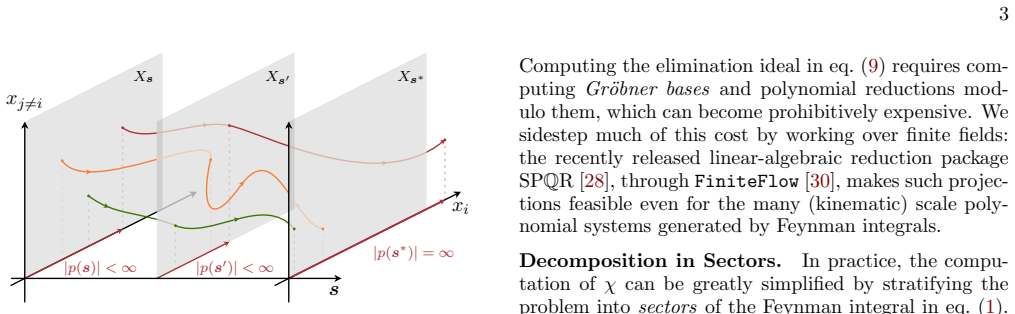
Landau singularities of Feynman integrals are located by drops in the associated Euler characteristic.
A machine-rendered reading of the paper's core claim, the machinery that carries it, and where it could break.
Core claim
The central claim is that Landau singularities can be read off directly from the locations where the Euler characteristic of the Feynman integral drops, and that a finite-field implementation yields the genuine and complete set for examples beyond the reach of prior techniques.
What carries the argument
The Euler characteristic of the integral, whose drop signals the presence of a Landau singularity.
If this is right
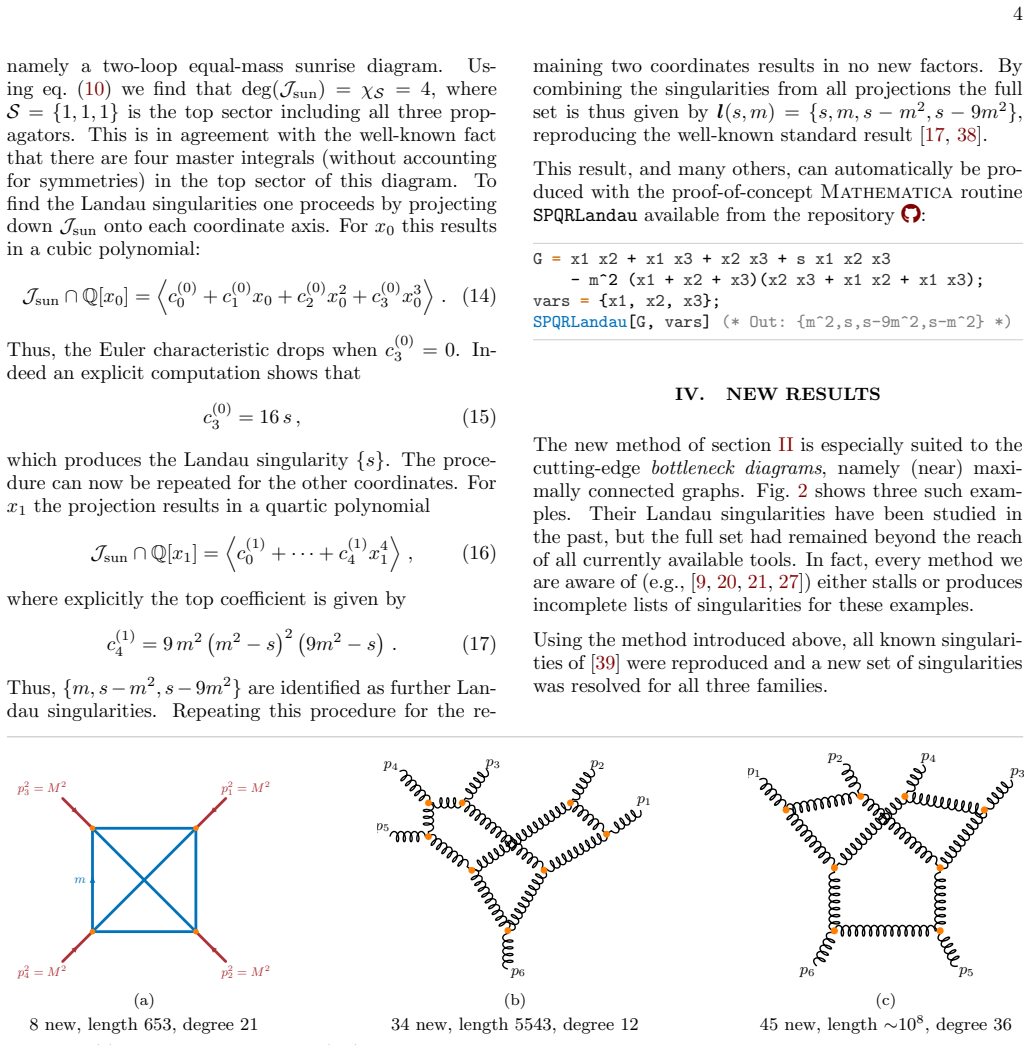
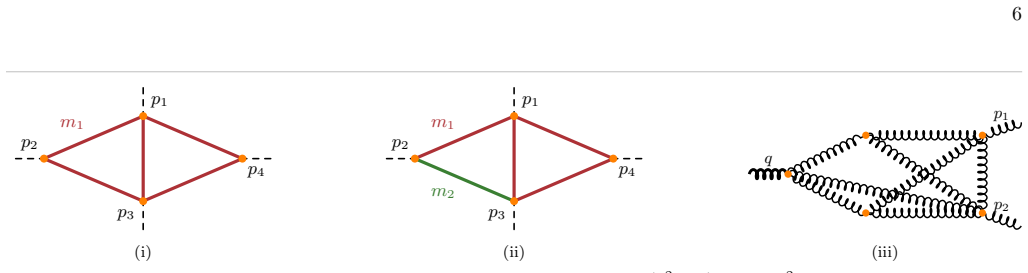
- Non-planar six-point two-loop integrals possess additional singularities not previously catalogued.
- A fully massive three-loop envelope graph has singularities of higher algebraic degree than earlier examples.
- Finite-field elimination renders the computation tractable at the current multi-loop frontier.
- The output set is complete once the practical test conditions hold.
Where Pith is reading between the lines
- The same drop-detection approach might be tested on four-loop or higher topologies to map singularity loci systematically.
- Algebraic complexity of the new singularities suggests that closed-form expressions for multi-loop amplitudes will require more general function classes than currently assumed.
- Direct comparison of Euler-characteristic results with known symbol alphabets could provide an independent cross-check on both methods.
Load-bearing premise
A drop in Euler characteristic exactly marks every genuine Landau singularity and none that are spurious, once the listed practical conditions are satisfied.
What would settle it
An explicit counter-example in which the Euler characteristic drops at a kinematic point that is not a Landau singularity, or fails to drop at a known Landau singularity, for one of the tested diagram classes.
Figures
read the original abstract
We present a new method together with a proof-of-concept implementation for determining the Landau singularities of Feynman integrals, read off directly from where the Euler characteristic of the associated integral drops. Working over finite fields makes the requisite elimination tractable for multi-scale integrals at the multi-loop frontier. The algorithm returns the genuine and complete set of singularities, subject to a set of conditions which are practically testable. We apply these methods to classes of Feynman integrals beyond the reach of current methods, including non-planar six-point diagrams at two loops, as well as a fully massive three-loop envelope graph. Several of the newly found singularities, both in $d$- and 4-dimensional external kinematics, are of unexpected complexity when compared to previously known singularities for these examples.
Editorial analysis
A structured set of objections, weighed in public.
Referee Report
Summary. The manuscript presents a new method for determining the Landau singularities of Feynman integrals by directly reading them off from drops in the Euler characteristic of the associated integral. The approach uses finite-field elimination to make computations tractable for multi-scale, multi-loop integrals, with a proof-of-concept implementation. It is applied to non-planar two-loop six-point diagrams and a fully massive three-loop envelope graph, yielding the complete set of genuine singularities (subject to practically testable conditions) including several of unexpected complexity in both d- and 4-dimensional external kinematics.
Significance. If validated, the method could provide a practical route to Landau singularities for integrals at the multi-loop frontier where existing techniques are intractable, with the finite-field strategy and explicit applications to non-planar and three-loop cases as clear strengths. The claim of returning the genuine and complete set under testable conditions, if substantiated, would represent a notable advance in the analytic structure of Feynman integrals.
major comments (2)
- [Abstract and three-loop envelope graph section] Abstract and the section on the three-loop envelope graph: the central claim that Euler-characteristic drops (computed via finite-field elimination) locate precisely the genuine Landau singularities, with no spurious or missing ones, rests on 'practically testable conditions' whose explicit verification for the new multi-loop examples is not demonstrated; without this check or a general theorem, the reported new singularities cannot be confirmed as complete.
- [Non-planar two-loop six-point diagrams section] The section describing the non-planar two-loop six-point diagrams: the equivalence between the observed Euler-characteristic drops and the full set of Landau singularities must be cross-checked against at least one simpler case using characteristic-zero methods to rule out artifacts from the finite-field reduction, as this is the least secure link for the frontier examples.
minor comments (2)
- [Abstract] The abstract would benefit from a one-sentence statement of the specific practically testable conditions referenced.
- [Methods section] Notation for the Euler characteristic and the elimination procedure should be introduced with a brief equation or definition in the methods section for clarity.
Simulated Author's Rebuttal
We thank the referee for their careful reading of the manuscript and for the constructive comments. We address each major comment below.
read point-by-point responses
-
Referee: [Abstract and three-loop envelope graph section] Abstract and the section on the three-loop envelope graph: the central claim that Euler-characteristic drops (computed via finite-field elimination) locate precisely the genuine Landau singularities, with no spurious or missing ones, rests on 'practically testable conditions' whose explicit verification for the new multi-loop examples is not demonstrated; without this check or a general theorem, the reported new singularities cannot be confirmed as complete.
Authors: We agree that the manuscript does not explicitly demonstrate verification of the practically testable conditions for the three-loop envelope graph. In the revised version we will add a dedicated subsection that performs and reports these checks for the new examples, confirming the absence of spurious singularities and the completeness of the reported set under the stated conditions. revision: yes
-
Referee: [Non-planar two-loop six-point diagrams section] The section describing the non-planar two-loop six-point diagrams: the equivalence between the observed Euler-characteristic drops and the full set of Landau singularities must be cross-checked against at least one simpler case using characteristic-zero methods to rule out artifacts from the finite-field reduction, as this is the least secure link for the frontier examples.
Authors: We accept that a cross-check on a simpler case with characteristic-zero methods would strengthen the validation of the finite-field approach. We will include such a validation in the revised manuscript by applying the algorithm to a known simpler integral whose Landau singularities are independently established in characteristic zero, thereby confirming consistency before presenting the non-planar results. revision: yes
Circularity Check
No significant circularity; method is a self-contained computational procedure
full rationale
The paper introduces a new finite-field elimination algorithm that identifies candidate Landau singularities via drops in Euler characteristic, subject to explicitly stated and practically testable conditions on the input graph and kinematics. No load-bearing step equates the output singularities to a fitted parameter, a self-citation chain, or a redefinition of the input; the central equivalence is asserted conditionally rather than by construction, and the manuscript applies the procedure to previously inaccessible examples without presupposing their singularity lists. The derivation chain therefore remains independent of its own outputs.
Axiom & Free-Parameter Ledger
Reference graph
Works this paper leans on
-
[1]
Landau, On analytic properties of vertex parts in quantum field theory, Nucl
L. Landau, On analytic properties of vertex parts in quantum field theory, Nucl. Phys.13, 181 (1960)
1960
-
[2]
Nakanishi, Ordinary and Anomalous Thresholds in Perturbation Theory, Prog
N. Nakanishi, Ordinary and Anomalous Thresholds in Perturbation Theory, Prog. Theor. Phys.22, 128 (1959)
1959
-
[3]
R. E. Cutkosky, Singularities and discontinuities of Feyn- man amplitudes, J. Math. Phys.1, 429 (1960)
1960
-
[4]
J. Collins, A new and complete proof of the Landau condition for pinch singularities of Feynman graphs and other integrals, arXiv preprint (2020), arXiv:2007.04085 [hep-ph]
- [5]
-
[6]
Landau Singularities and Symbology: One- and Two-loop MHV Amplitudes in SYM Theory
T. Dennen, M. Spradlin, and A. Volovich, Landau Singularities and Symbology: One- and Two-loop MHV Amplitudes in SYM Theory, JHEP03(3), 069, arXiv:1512.07909 [hep-th]
work page internal anchor Pith review Pith/arXiv arXiv
- [7]
- [8]
-
[9]
M. Correia, M. Giroux, and S. Mizera, SOF A (1.1) SOF A v1.0.0 (1.2) dIi = ε(dAij)Ij d = X z dz∂z (1.3) Aij = log(aij) (1.4) M 4 1 − 2M 2 1 M 2 2 − 2M 2 1 s + M 4 2 − 2M 2 2 s + s2 M 4 3 − 2M 2 3 M 2 4 − 2M 2 3 s + M 4 4 − 2M 2 4 s + s2 M 4 2 − 2M 2 2 M 2 3 − 2M 2 2 t + M 4 3 − 2M 2 3 t + t2 M 4 1 − 2M 2 1 M 2 4 − 2M 2 1 t + M 4 4 − 2M 2 4 t + t2 M 4 1 M ...
-
[10]
Algorithms for the symbolic integration of hyperlogarithms with applications to Feynman integrals
E. Panzer, Algorithms for the symbolic integration of hyperlogarithms with applications to Feynman in- tegrals, Comput. Phys. Commun.188, 148 (2015), arXiv:1403.3385 [hep-th]
work page internal anchor Pith review Pith/arXiv arXiv 2015
-
[11]
M. Giroux, S. Mizera, and G. Salvatori,SubTropica, arXiv preprint (2026), arXiv:2604.20954 [hep-th]
work page internal anchor Pith review Pith/arXiv arXiv 2026
- [12]
-
[13]
O. Barrera, A. Dersy, R. Husain, M. D. Schwartz, and X. Zhang, Analytic regression of Feynman integrals from high-precision numerical sampling, JHEP01(1), 014, arXiv:2507.17815 [hep-th]
- [14]
-
[15]
S. Caron-Huot, L. J. Dixon, J. M. Drummond, F. Dulat, J. Foster, ¨O. G¨ urdo˘ gan, M. von Hippel, A. J. McLeod, and G. Papathanasiou, The Steinmann Cluster Boot- strap forN= 4 Super Yang-Mills Amplitudes, PoS CORFU2019, 003 (2020), arXiv:2005.06735 [hep-th]
-
[16]
S. Carrˆ olo, D. Chicherin, J. Henn, Q. Yang, and Y. Zhang, Bootstrapping Six-Gluon QCD Amplitudes, Phys. Rev. Lett.136, 181602 (2026), arXiv:2510.20565 [hep-th]
-
[17]
S. Mizera and S. Telen, Landau discriminants, JHEP08 (8), 200, arXiv:2109.08036 [math-ph]
- [18]
- [19]
- [20]
-
[21]
Landau Singularities from Whitney Stratifications
M. Helmer, G. Papathanasiou, and F. Tellander, Lan- dau Singularities from Whitney Stratifications, arXiv preprint (2024), arXiv:2402.14787 [hep-th]
work page internal anchor Pith review Pith/arXiv arXiv 2024
-
[22]
M. Helmer and F. Tellander, Geometric singularities of Feynman integrals, Phys. Rev. D112, 065019 (2025), arXiv:2506.05042 [hep-th]
-
[23]
S. Caron-Huot, M. Correia, and M. Giroux, Recursive Landau Analysis, Phys. Rev. Lett.135, 131603 (2025), arXiv:2406.05241 [hep-th]
-
[24]
R. N. Lee and A. A. Pomeransky, Critical points and number of master integrals, JHEP11(11), 165, arXiv:1308.6676 [hep-ph]
work page internal anchor Pith review Pith/arXiv arXiv
-
[25]
Decomposition of Feynman Integrals on the Maximal Cut by Intersection Numbers
H. Frellesvig, F. Gasparotto, S. Laporta, M. K. Mandal, P. Mastrolia, L. Mattiazzi, and S. Mizera, Decomposition of Feynman Integrals on the Maximal Cut by Intersection Numbers, JHEP05(5), 153, arXiv:1901.11510 [hep-ph]
work page internal anchor Pith review Pith/arXiv arXiv 1901
-
[26]
Matsubara-Heo, Hypergeometric Discriminants (2025), arXiv:2505.13163 [math.AG]
S.-J. Matsubara-Heo, Hypergeometric Discriminants (2025), arXiv:2505.13163 [math.AG]
-
[27]
S. Telen and M. Wiesmann, Euler Stratifications of Hypersurface Families, arXiv preprint (2024), arXiv:2407.18176 [math.AG]
-
[28]
V. Chestnov and G. Crisanti, Sampling Polyno- mial Rational Remainders with SPQR: A new Pack- age for Polynomial Division and Elimination (2025), arXiv:2511.14875 [hep-th]
-
[29]
Scattering amplitudes over finite fields and multivariate functional reconstruction
T. Peraro, Scattering amplitudes over finite fields and multivariate functional reconstruction, JHEP12(12), 030, arXiv:1608.01902 [hep-ph]
work page internal anchor Pith review Pith/arXiv arXiv
-
[30]
FiniteFlow: multivariate functional reconstruction using finite fields and dataflow graphs
T. Peraro, FiniteFlow: multivariate functional recon- struction using finite fields and dataflow graphs, JHEP 07(7), 031, arXiv:1905.08019 [hep-ph]
work page internal anchor Pith review Pith/arXiv arXiv 1905
- [31]
-
[32]
P. A. Baikov, A Practical criterion of irreducibility of multi-loop Feynman integrals, Phys. Lett. B634, 325 (2006), arXiv:hep-ph/0507053
work page internal anchor Pith review Pith/arXiv arXiv 2006
-
[33]
H. Frellesvig, The loop-by-loop Baikov representation — Strategies and implementation, JHEP04(04), 111, arXiv:2412.01804 [hep-th]
-
[34]
S.-J. Matsubara-Heo, S. Mizera, and S. Telen, Four lec- tures on Euler integrals, SciPost Phys. Lect. Notes75, 1 (2023), arXiv:2306.13578 [math-ph]
-
[35]
H. Frellesvig, F. Gasparotto, M. K. Mandal, P. Mastrolia, 9 L. Mattiazzi, and S. Mizera, Vector Space of Feynman Integrals and Multivariate Intersection Numbers, Phys. Rev. Lett.123, 201602 (2019), arXiv:1907.02000 [hep- th]
-
[36]
J. Franecki and M. Kapranov, The Gauss map and a noncompact Riemann-Roch formula for constructible sheaves on semiabelian varieties, arXiv preprint (1999), arXiv:math/9909088 [math.AG]
work page internal anchor Pith review Pith/arXiv arXiv 1999
-
[37]
The maximum likelihood degree of a very affine variety
J. Huh, The maximum likelihood degree of a very affine variety, Compositio Mathematica149, 1245 (2013), arXiv:1207.0553 [math.AG]
work page internal anchor Pith review Pith/arXiv arXiv 2013
-
[38]
Analytic treatment of the two loop equal mass sunrise graph
S. Laporta and E. Remiddi, Analytic treatment of the two loop equal mass sunrise graph, Nucl. Phys. B704, 349 (2005), arXiv:hep-ph/0406160 [hep-ph]
work page internal anchor Pith review Pith/arXiv arXiv 2005
-
[39]
Fevola, S
C. Fevola, S. Mizera, and S. Telen, Principal Landau Determinants: accompanying data, MathRepo, Max Planck Institute for Mathematics in the Sciences (2023), landau singularity data for the envelope (a) and non- planar double-pentagon (b,c) diagrams: https://mathrepo.mis.mpg.de/_downloads/ 88c0f5a43ba3daaccdd9c05510d7ee4d/env_equal_ equal.txt, https://math...
2023
-
[40]
We furthermore independently verified the drop in the number of master integrals near these singularities using IBP identities [54, 55] on fully numerical slices, generated with the privateMathematicapackageFFIntRedby Tiziano Peraro and solved by a variant of the Laporta al- gorithm [56] based on the finite-field arithmetic and func- tional reconstruction...
-
[41]
’t Hooft and M
G. ’t Hooft and M. J. G. Veltman, Regularization and Renormalization of Gauge Fields, Nucl. Phys. B44, 189 (1972)
1972
-
[42]
We also cross-checked the corresponding Euler character- istics for each sector using IBP identities, following the strategy of [57]
-
[43]
Effortless GitHub repository (2025), gitHub repository, accessed: 2025-02-24
2025
- [44]
- [45]
- [46]
-
[47]
Berthomieu, C
J. Berthomieu, C. Eder, and M. Safey El Din,msolve: A Library for Solving Polynomial Systems, in2021 Inter- national Symposium on Symbolic and Algebraic Compu- tation, 46th International Symposium on Symbolic and Algebraic Computation (ACM, Saint Petersburg, Russia,
-
[48]
Cuts of Feynman Integrals in Baikov representation
H. Frellesvig and C. G. Papadopoulos, Cuts of Feynman Integrals in Baikov representation, JHEP04(83), 083, arXiv:1701.07356 [hep-ph]
work page internal anchor Pith review Pith/arXiv arXiv
-
[49]
Crisanti, L
G. Crisanti, L. Lippstreu, A. J. McLeod, and M. Polack- ova, Genealogical constraints from master integral count- ing, to appear soon (2026)
2026
-
[50]
Giu989, DiscKosky, GitHub repository (2026), accessed: 2026-06-27
2026
-
[51]
Magic Relations and Critical Varieties of Feynman Integrals
G. Crisanti, H. Frellesvig, A. Pokraka, and S. Smith, Magic Relations and Critical Varieties of Feynman Inte- grals, arXiv preprint (2026), arXiv:2605.29789 [hep-th]
work page internal anchor Pith review Pith/arXiv arXiv 2026
-
[52]
Feynman integral relations from parametric annihilators
T. Bitoun, C. Bogner, R. P. Klausen, and E. Panzer, Feynman integral relations from parametric annihilators, Lett. Math. Phys.109, 497 (2019), arXiv:1712.09215 [hep-th]
work page internal anchor Pith review Pith/arXiv arXiv 2019
-
[53]
Master integrals for the four-loop Sudakov form factor
R. Boels, B. A. Kniehl, and G. Yang, Master integrals for the four-loop Sudakov form factor, Nucl. Phys. B902, 387 (2016), arXiv:1508.03717 [hep-th]
work page internal anchor Pith review Pith/arXiv arXiv 2016
-
[54]
F. V. Tkachov, A Theorem on Analytical Calculability of Four Loop Renormalization Group Functions, Phys. Lett.100B, 65 (1981)
1981
-
[55]
K. G. Chetyrkin and F. V. Tkachov, Integration by Parts: The Algorithm to Calculate beta Functions in 4 Loops, Nucl. Phys. B192, 159 (1981)
1981
-
[56]
High-precision calculation of multi-loop Feynman integrals by difference equations
S. Laporta, High precision calculation of multiloop Feyn- man integrals by difference equations, Int. J. Mod. Phys. A15, 5087 (2000), arXiv:hep-ph/0102033 [hep-ph]
work page internal anchor Pith review Pith/arXiv arXiv 2000
- [57]
discussion (0)
Sign in with ORCID, Apple, or X to comment. Anyone can read and Pith papers without signing in.