REVIEW 4 major objections 5 minor 40 references
A Vehicle-in-the-Loop Simulator with AI-Powered Digital Twins for Testing Automated Driving Controllers
T0 review · 4 major / 5 minor · reviewed 2026-08-06 · deepseek-v4-flash
Pith's one-line read Scaled cars and neural digital twins can replace full-size test vehicles for automated driving validation.
desk verdict A useful integrated scaled ViL/DT platform whose central fidelity claims are illustrated more than measured; worth serious refereeing if quantitative and scoping fixes are made. read the letter →
The pith
A machine-rendered reading of the paper's core claim, the machinery that carries it, and where it could break.
The reading
What carries the argument
The load-bearing mechanism is the data-sequence-driven RNN velocity predictor, a neural model $f'(u,v)$ that consumes a history of control commands and velocities and outputs the next velocity, trained on 92,077 real F1tenth samples augmented with 92,077 zero samples. It carries the fidelity claim because it absorbs the vehicle dynamics, frictions, dead-zone effects, and uncertain sampling interval that the kinematic model misses. The other load-bearing mechanism is the assume-guarantee GR(1) safety filter, synthesized from LTL formulas over the atomic propositions MOV, DCL, and STP together with environment signals URG and WRN; it carries the formal-guarantee claim by enforcing the traffic rules as a state-transition contract.
What would settle it
Run a fresh hardware trial with a different F1tenth car or a speed profile outside the 0–4 m/s training range, feed the same control commands to the RNN twin and the kinematic baseline, and compare predicted to measured velocities; if the RNN's mean squared error matches or exceeds the kinematic model's, the claimed superior fidelity does not generalize.
Extended reading notes
Core claim
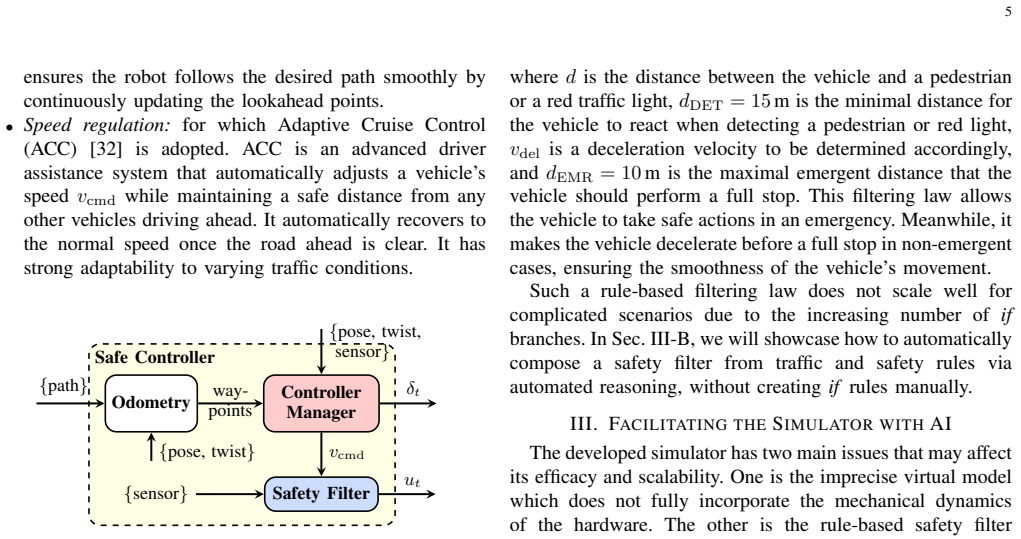
The paper's central discovery is a working integration, not a new control law: a distributed vehicle-in-the-loop simulator in which 1/10-scale F1tenth cars act as physical targets, RNN-based digital twins act as virtual targets, and both can be mixed in the same ROS-connected Prescan scenario. For the digital twin, the paper replaces the unknown acceleration term in the kinematic update with a learned data-sequence-driven function $v_T = f'(u,v)$ that maps the history of velocity commands and measured velocities to the next velocity; against a real car, this RNN model tracks velocity more closely than the kinematic baseline. For safety, the paper expresses stop-on-red, pedestrian-yielding, and emergency-stopping rules as a GR(1) temporal-logic contract $\varphi_e \to \varphi_v$ and synthesizes a filter that transitions the vehicle among moving, decelerating, and stopped states. The experiments show both a real scaled car and a virtual car completing the same traffic scenario while obeying the synthesized safety filter.
Load-bearing premise
The whole approach hinges on the RNN digital twin remaining accurate in scenarios beyond its training data, which in turn assumes the car's response dynamics and the average sampling interval are stable between training and deployment.
Editorial extensions
If this is right
- Three operating modes follow: physical-only ViL tests, virtual-only DT tests, and a mixed mode where one physical car can interact with many virtual cars, so scenario size is not limited by the number of vehicles in the lab.
- Because the RNN twin tracks the physical car's velocity more closely than the kinematic model, controller behavior observed in DT mode should transfer better to the real platform.
- The synthesized safety filter scales by adding knowledge items to the temporal-logic knowledge base rather than by writing new if-then branches, which is what makes complex traffic scenarios tractable.
- The simulator's ROS-based design lets users swap in custom controllers, so it functions as a benchmark harness rather than a fixed test.
- The same digital-twin modeling recipe can be applied to other autonomous systems, including robots and industrial processes.
Reading between the lines
- A stress test the paper does not run would be to train the RNN on one F1tenth car and evaluate it on a second, untrained car; showing the velocity-error advantage over the kinematic model survives across units would make the fidelity claim much stronger.
- The GR(1) contract assumes the environment repeatedly clears urgent and warning conditions, so a permanently red light would stall the vehicle; checking recovery under bounded waiting would pin down the formal guarantee's practical scope.
- The mixed mode is a natural testbed for interaction-heavy driving—merging, roundabouts, dense traffic—where one physical ego car faces many digital opponents; the paper demonstrates only a single opponent.
- Since the training data top out at 4 m/s, logging higher-speed runs and retraining would show whether the data-sequence model keeps its advantage outside the current envelope.
Signed reviews
Editorial analysis
A structured set of objections, weighed in public.
Referee Report
Summary. The paper presents a distributed vehicle-in-the-loop (ViL) simulator that combines a Prescan virtual environment, scaled F1tenth hardware, and an RNN-based digital twin (DT) model, together with a safety filter synthesized from traffic rules using GR(1) temporal logic synthesis. The authors claim that the AI-powered DT provides superior simulation fidelity, that the simulator supports flexible mode switching (ViL, DT, mixed), and that the synthesized safety filter provides formal safety guarantees. The experimental sections compare the RNN DT against a kinematic model and a real vehicle, and demonstrate traffic-rule compliance in scenarios with pedestrians, traffic lights, and interactive vehicles.
Significance. If substantiated, this system would be a useful low-cost testing platform for automated driving controllers, with the open-source code and publicly released training data being concrete strengths. The integration of commercial simulation software, scaled hardware, and a learned vehicle model is a practical engineering contribution. However, the central quantitative claims about DT fidelity and the formal safety guarantee are not supported by the evidence as presented, so the current significance is conditional on additional validation.
major comments (4)
- [Sec. IV-A, Figs. 12–13] The central claim that the RNN-based DT achieves 'superior simulation fidelity' and is 'more precise than the kinematic-based model' is not quantitatively supported. No error metrics (MSE, RMSE, maximum error) or error bars are reported for either model, and the conclusion rests on visual inspection of the plotted trajectories and velocity profiles. Please provide quantitative prediction-error statistics for both models over multiple runs, with confidence intervals, and report the error on the final test set used for the RNN.
- [Abstract and Sec. III-B] The abstract's claim of 'formal safety guarantees' overstates what is demonstrated. The GR(1) synthesis certifies the discrete sequence of states (MOV/DCL/STP) under the assumptions on the environment propositions URG and WRN; it does not certify the continuous braking behavior, stopping distances, or collision-freedom, because the mapping from measured distances to the discrete propositions is not verified against the vehicle's dynamics. Please either temper the wording to 'formal guarantees at the discrete decision level' or provide a formal bridge between the discrete synthesis and the continuous vehicle model.
- [Sec. III-A, Eqs. (4)–(5)] The derivation leading to Eq. (5) introduces per-step parameters ι_t and assumes they can be chosen so that all f_{ι_t}(u_t,v_t) are equal; this is unjustified and not necessary for the final RNN model. Moreover, the assumption that Δt is a stationary stochastic process with constant mean is questionable given the acknowledged non-real-time nature of ROS and network delays (Sec. II-C). Since f' in Eq. (5) absorbs the average sampling interval, a load-dependent shift in Δt would change the effective input–output mapping. Please clarify the derivation, or remove it and present the RNN as a learned autoregressive model, and report sensitivity of the model to sampling-interval variability.
- [Sec. III-A, training data and Sec. IV-A] The RNN is trained on data from a student high-speed navigation course with velocities 0–4 m/s, augmented with an equal number of zero samples, and no out-of-distribution or generalization test is reported. Because DT mode substitutes the RNN for the physical hardware, the validity of DT-mode testing depends on the model's accuracy across the intended operating envelope. Please report the test error on the non-augmented real samples separately, compare against the kinematic baseline on the same test data, and include at least one scenario outside the training distribution (e.g., a different track or a different velocity range) to substantiate the fidelity claim.
minor comments (5)
- [Sec. III-B, Fig. 10 caption text] In the text describing Fig. 10, 'URN' appears where the atomic proposition is 'URG'; please correct this typo.
- [Sec. IV-A, first paragraph] The sentence 'compares a kinematic-based model, an RNN-based model, and a real scaled vehicle of Car 1, and set a dummy virtual model as Car 2' is unclear. Please specify which entity is Car 2 and what role it plays in the comparison shown in Figs. 12–13.
- [Sec. II-F, Eq. (1)] The PD acceleration law uses ˙v_t = (v_t − v_{t−1})/Δt, which is a backward difference estimate; please define this consistently and note that it introduces a one-step delay relative to the commanded velocity.
- [Fig. 9] The scatter plot in Fig. 9 should include axis labels and a reported correlation coefficient or a numeric error metric in the caption to support the claim of 'high prediction precision'.
- [References] Reference [39] contains the typo 'reponsitory' (should be 'repository'), and the term 'Generative Reaction' for GR(1) is nonstandard; the usual expansion is 'General(ized) Reactivity' or 'General Reactivity'. Please check.
Circularity Check
No significant circularity; DT fidelity is externally validated against hardware, and the GR(1) filter is an explicitly acknowledged re-encoding of the authors' own rule-based law rather than a hidden derivation.
full rationale
The paper's central claimed derivation—the AI-powered digital twin—is an externally validated learning loop: an RNN is trained on 92,077 real F1tenth samples (Sec. III-A), augmented with zeros, and then evaluated against held-out hardware measurements in Sec. IV-A (Figs. 9, 12, 13). This is system identification with a held-out test, not a fitted parameter renamed as a prediction; the lack of reported MSE and out-of-distribution tests is a correctness/reporting weakness, not circularity. The safety-filter synthesis in Sec. III-B is transparent: the GR(1) formula φ is explicitly stated to be 'consistent with the rule-based law in Sec. 2,' so the TuLiP-synthesized controller is a formal re-encoding of Eq. (2) rather than an independently discovered safety mechanism. Because the paper discloses this equivalence and uses the filter only as a benchmark of the simulator, this is an acknowledged encoding, not a hidden circular derivation. The only self-citation that informs a design choice is Ref. [34] for the RNN structure ('has proved effective'); however, the DT's fidelity is re-validated in this paper against hardware, so the self-citation is not load-bearing. Overall, the simulator claims rest on external hardware comparison and do not reduce by construction to their inputs.
Assumptions & free parameters
free parameters (5)
- RNN model weights =
trained on 92,077 hardware samples plus 92,077 zero samples
- d_DET =
15 m
- d_EMR =
10 m
- PD gains Kp, Kd =
not specified
- Pure pursuit lookahead distance =
not specified
assumptions (5)
- domain assumption The discrete sampling interval Δt is a stationary stochastic process with constant mean Δbar.
- domain assumption The unknown vehicle dynamics f(u_t, v_t) are time-invariant.
- domain assumption The environment satisfies the GR(1) fairness conditions □♢¬URG and □♢¬WRN.
- domain assumption The distance-to-atomic-proposition mapping (d <= d_EMR to URG, etc.) correctly represents collision risk.
- ad hoc to paper The per-step parameters ι_t can be chosen so that f_ι0(u0,v0)=...=f_ι(T-1)(u(T-1),v(T-1)).
Cite this review
Pith. "Pith review of A Vehicle-in-the-Loop Simulator with AI-Powered Digital Twins for Testing Automated Driving Controllers." pith.science (2026). https://pith.science/paper/BLY5NFK5
@misc{pith2026250702313,
  author       = {Pith},
  title        = {Pith review of: A Vehicle-in-the-Loop Simulator with AI-Powered Digital Twins for Testing Automated Driving Controllers},
  year         = {2026},
  howpublished = {\url{https://pith.science/paper/BLY5NFK5}},
  note         = {Machine review of arXiv:2507.02313}
}
read the original abstract
Simulators are useful tools for testing automated driving controllers. Vehicle-in-the-loop (ViL) tests and digital twins (DTs) are widely used simulation technologies to facilitate the smooth deployment of controllers to physical vehicles. However, conventional ViL tests rely on full-size vehicles, requiring large space and high expenses. Also, physical-model-based DT suffers from the reality gap caused by modeling imprecision. This paper develops a comprehensive and practical simulator for testing automated driving controllers enhanced by scaled physical cars and AI-powered DT models. The scaled cars allow for saving space and expenses of simulation tests. The AI-powered DT models ensure superior simulation fidelity. Moreover, the simulator integrates well with off-the-shelf software and control algorithms, making it easy to extend. We use a filtered control benchmark with formal safety guarantees to showcase the capability of the simulator in validating automated driving controllers. Experimental studies are performed to showcase the efficacy of the simulator, implying its great potential in validating control solutions for autonomous vehicles and intelligent traffic.
Figures


Figures from the paper (8 more)




Reference graph
Works this paper leans on
-
[1]
A survey of autonomous driving: Common practices and emerging technologies,
E. Yurtsever, J. Lambert, A. Carballo, and K. Takeda, “A survey of autonomous driving: Common practices and emerging technologies,” IEEE access, vol. 8, pp. 58 443–58 469, 2020
2020
-
[2]
Deep reinforcement learning on autonomous driving policy with auxiliary critic network,
Y . Wu, S. Liao, X. Liu, Z. Li, and R. Lu, “Deep reinforcement learning on autonomous driving policy with auxiliary critic network,”IEEE transactions on neural networks and learning systems, vol. 34, no. 7, pp. 3680–3690, 2021. 9
work page 2021
-
[3]
Risk of stochastic systems for temporal logic specifications,
L. Lindemann, L. Jiang, N. Matni, and G. J. Pappas, “Risk of stochastic systems for temporal logic specifications,”ACM Transactions on Em- bedded Computing Systems, vol. 22, no. 3, pp. 1–31, 2023
work page 2023
-
[4]
Drivellm: Charting the path toward full autonomous driving with large language models,
Y . Cui, S. Huang, J. Zhong, Z. Liu, Y . Wang, C. Sun, B. Li, X. Wang, and A. Khajepour, “Drivellm: Charting the path toward full autonomous driving with large language models,”IEEE Transactions on Intelligent Vehicles, 2023
work page 2023
-
[5]
A. Ngo, M. P. Bauer, and M. Resch, “A multi-layered approach for mea- suring the simulation-to-reality gap of radar perception for autonomous driving,” in2021 IEEE International Intelligent Transportation Systems Conference (ITSC). IEEE, 2021, pp. 4008–4014
work page 2021
-
[6]
X. Hu, S. Li, T. Huang, B. Tang, R. Huai, and L. Chen, “How simulation helps autonomous driving: A survey of sim2real, digital twins, and parallel intelligence,”IEEE Transactions on Intelligent Vehicles, 2023
work page 2023
-
[7]
Z. Zhang, R. Dershan, A. M. S. Enayati, M. Yaghoubi, D. Richert, and H. Najjaran, “A high-fidelity simulation platform for industrial manufacturing by incorporating robotic dynamics into an industrial simulation tool,”IEEE Robotics and Automation Letters, vol. 7, no. 4, pp. 9123–9128, 2022
work page 2022
-
[8]
A survey of deep learning techniques for autonomous driving,
S. Grigorescu, B. Trasnea, T. Cocias, and G. Macesanu, “A survey of deep learning techniques for autonomous driving,”Journal of field robotics, vol. 37, no. 3, pp. 362–386, 2020
work page 2020
Show all 40 references
-
[9]
Enhancing sumo simulator for simulation based testing and validation of autonomous vehicles,
A. Kusari, P. Li, H. Yang, N. Punshi, M. Rasulis, S. Bogard, and D. J. LeBlanc, “Enhancing sumo simulator for simulation based testing and validation of autonomous vehicles,” in2022 ieee intelligent vehicles symposium (IV). IEEE, 2022, pp. 829–835
2022
-
[10]
Carla: An open urban driving simulator,
A. Dosovitskiy, G. Ros, F. Codevilla, A. Lopez, and V . Koltun, “Carla: An open urban driving simulator,” inConference on robot learning. PMLR, 2017, pp. 1–16
2017
-
[11]
Stabilization approaches for reinforcement learning-based end-to-end autonomous driving,
S. Chen, M. Wang, W. Song, Y . Yang, Y . Li, and M. Fu, “Stabilization approaches for reinforcement learning-based end-to-end autonomous driving,”IEEE Transactions on Vehicular Technology, vol. 69, no. 5, pp. 4740–4750, 2020
2020
-
[12]
Overtaking maneuver scenario building for autonomous vehicles with prescan software,
J. Ortega, H. Lengyel, and Z. Szalay, “Overtaking maneuver scenario building for autonomous vehicles with prescan software,”Transportation Engineering, vol. 2, p. 100029, 2020
2020
-
[13]
Choose your simulator wisely: A review on open-source simulators for autonomous driving,
Y . Li, W. Yuan, S. Zhang, W. Yan, Q. Shen, C. Wang, and M. Yang, “Choose your simulator wisely: A review on open-source simulators for autonomous driving,”IEEE Transactions on Intelligent Vehicles, 2024
2024
-
[14]
Hardware- in-the-loop simulation,
D. Bullock, B. Johnson, R. B. Wells, M. Kyte, and Z. Li, “Hardware- in-the-loop simulation,”Transportation Research Part C: Emerging Technologies, vol. 12, no. 1, pp. 73–89, 2004
2004
-
[15]
Hardware-in-the- loop validation of an adaptive model predictive control on a connected and automated vehicle,
E. Landolfi, A. Salvi, A. Troiano, and C. Natale, “Hardware-in-the- loop validation of an adaptive model predictive control on a connected and automated vehicle,”International Journal of Adaptive Control and Signal Processing, vol. 37, no. 6, pp. 1459–1491, 2023
2023
-
[16]
Implementation of a vehicle-in-the-loop devel- opment and validation platform,
A. Albers and T. D ¨user, “Implementation of a vehicle-in-the-loop devel- opment and validation platform,” inFISITA World automotive congress, vol. 2010, 2010
2010
-
[17]
Mixed test environment-based vehicle-in-the-loop validation-a new testing approach for autonomous vehicles,
Y . Chen, S. Chen, T. Xiao, S. Zhang, Q. Hou, and N. Zheng, “Mixed test environment-based vehicle-in-the-loop validation-a new testing approach for autonomous vehicles,” in2020 IEEE intelligent vehicles symposium (IV). IEEE, 2020, pp. 1283–1289
2020
-
[18]
5g-enabled autonomous driving demonstration with a v2x scenario-in- the-loop approach,
Z. Szalay, D. Ficzere, V . Tihanyi, F. Magyar, G. So ´os, and P. Varga, “5g-enabled autonomous driving demonstration with a v2x scenario-in- the-loop approach,”Sensors, vol. 20, no. 24, p. 7344, 2020
2020
-
[19]
Control strategy and simulation verification of hardware- in-the-loop system of automotive steering device,
Y . Zhen, Z. Wang, J. Liu, T. Guan, Y . Zhang, M. Wang, X. Song, and D. Zhang, “Control strategy and simulation verification of hardware- in-the-loop system of automotive steering device,” inIOP Conference Series: Materials Science and Engineering, vol. 892, no. 1. IOP Publish...
2020
-
[20]
The role of ai, machine learning, and big data in digital twinning: A systematic literature review, challenges, and opportunities,
M. M. Rathore, S. A. Shah, D. Shukla, E. Bentafat, and S. Bakiras, “The role of ai, machine learning, and big data in digital twinning: A systematic literature review, challenges, and opportunities,”IEEE Access, vol. 9, pp. 32 030–32 052, 2021
2021
-
[21]
Digital twin paradigm: A systematic literature review,
C. Semeraro, M. Lezoche, H. Panetto, and M. Dassisti, “Digital twin paradigm: A systematic literature review,”Computers in Industry, vol. 130, p. 103469, 2021
2021
-
[22]
Automatic traffic modelling for creating digital twins to facilitate autonomous vehicle development,
S.-H. Wang, C.-H. Tu, and J.-C. Juang, “Automatic traffic modelling for creating digital twins to facilitate autonomous vehicle development,” Connection Science, vol. 34, no. 1, pp. 1018–1037, 2022
2022
-
[23]
Virtualization of self-driving algorithms by interoperating embedded controllers on a game engine for a digital twining autonomous vehicle,
H. Yun and D. Park, “Virtualization of self-driving algorithms by interoperating embedded controllers on a game engine for a digital twining autonomous vehicle,”Electronics, vol. 10, no. 17, p. 2102, 2021
2021
-
[24]
Digital twins: artificial intelligence and the iot cyber-physical systems in industry 4.0,
P. Radanliev, D. De Roure, R. Nicolescu, M. Huth, and O. Santos, “Digital twins: artificial intelligence and the iot cyber-physical systems in industry 4.0,”International Journal of Intelligent Robotics and Applications, vol. 6, no. 1, pp. 171–185, 2022
2022
-
[25]
Digital twins and artificial intelligence in transportation infrastructure: Classification, application, and future research directions,
J. Wu, X. Wang, Y . Dang, and Z. Lv, “Digital twins and artificial intelligence in transportation infrastructure: Classification, application, and future research directions,”Computers and Electrical Engineering, vol. 101, p. 107983, 2022
2022
-
[26]
Digital twins for dependability improvement of autonomous driving,
O. Veledar, V . Damjanovic-Behrendt, and G. Macher, “Digital twins for dependability improvement of autonomous driving,” inEuropean conference on software process improvement. Springer, 2019, pp. 415– 426
2019
-
[27]
Artificial intelligence in the digital twins: State of the art, challenges, and future research topics,
Z. Lv and S. Xie, “Artificial intelligence in the digital twins: State of the art, challenges, and future research topics,”Digital Twin, vol. 1, p. 12, 2022
2022
-
[28]
Prescan simulation demonstra- tion,
G. Badakis, M. Galanis, and A. Baversi, “Prescan simulation demonstra- tion,” https://github.com/zhang-zengjie/prescan-sim-demo, 2024, gitHub repository
2024
-
[29]
Data management in digital twins: a systematic literature review,
J. B. Correia, M. Abel, and K. Becker, “Data management in digital twins: a systematic literature review,”Knowledge and Information Systems, vol. 65, no. 8, pp. 3165–3196, 2023
2023
-
[30]
Structures of small database management systems,
Z. Akhmedova, “Structures of small database management systems,” Solution of social problems in management and economy, vol. 3, no. 1, pp. 97–107, 2024
2024
-
[31]
A novel pure pursuit algorithm for autonomous vehicles based on salp swarm algorithm and velocity controller,
R. Wang, Y . Li, J. Fan, T. Wang, and X. Chen, “A novel pure pursuit algorithm for autonomous vehicles based on salp swarm algorithm and velocity controller,”IEEE Access, vol. 8, pp. 166 525–166 540, 2020
2020
-
[32]
Towards an under- standing of adaptive cruise control,
G. Marsden, M. McDonald, and M. Brackstone, “Towards an under- standing of adaptive cruise control,”Transportation Research Part C: Emerging Technologies, vol. 9, no. 1, pp. 33–51, 2001
2001
-
[33]
Collision warning with full auto brake and pedestrian detection-a practical example of auto- matic emergency braking,
E. Coelingh, A. Eidehall, and M. Bengtsson, “Collision warning with full auto brake and pedestrian detection-a practical example of auto- matic emergency braking,” in13th International IEEE Conference on Intelligent Transportation Systems. IEEE, 2010, pp. 155–160
2010
-
[34]
Incorporating tar- get vehicle trajectories predicted by deep learning into model predictive controlled vehicles,
N. Dang, Z. Zhang, J. Liu, M. Leibold, and M. Buss, “Incorporating tar- get vehicle trajectories predicted by deep learning into model predictive controlled vehicles,”arXiv preprint arXiv:2310.02843, 2023
2023 arXiv
-
[35]
Driving data of a real f1tenth car,
Z. Zhang, G. Badakis, and M. Galanis, “Driving data of a real f1tenth car,” 2024. [Online]. Available: https://doi.org/10.5281/zenodo. 12536535
2024 doi
-
[36]
Modeling and motion prediction of autonomous vehicles us- ing deep learning,
Z. Zhang, “Modeling and motion prediction of autonomous vehicles us- ing deep learning,” https://github.com/zhang-zengjie/dl-vehicle-model, 2024, gitHub repository
2024
-
[37]
Belta, B
C. Belta, B. Yordanov, and E. Gol,Formal Methods for Discrete-Time Dynamical Systems. Springer, 01 2017, vol. 89
2017
-
[38]
Control design for hybrid systems with tulip: The temporal logic planning toolbox,
I. Filippidis, S. Dathathri, S. C. Livingston, N. Ozay, and R. M. Murray, “Control design for hybrid systems with tulip: The temporal logic planning toolbox,” in2016 IEEE Conference on Control Applications (CCA). IEEE, 2016, pp. 1030–1041
2016
-
[39]
State machine generation for autonomous driving,
Z. Zhang, “State machine generation for autonomous driving,” https: //github.com/zhang-zengjie/sm-for-driving, 2024, gitHub repository
2024
-
[40]
Formalization of intersection traffic rules in temporal logic,
S. Maierhofer, P. Moosbrugger, and M. Althoff, “Formalization of intersection traffic rules in temporal logic,” in2022 IEEE Intelligent Vehicles Symposium (IV). IEEE, 2022, pp. 1135–1144
2022
Reviewed August 6, 2026 · model on record in the stance chip above.
Discussion (0). Continue with ORCID to comment.