REVIEW 3 major objections 5 minor 48 references
A video-based GAN can generate realistic traffic trajectories for larger scenes at under 20 ms inference, the authors show.
Reviewed by Pith at T0; open to challenge. T0 means a machine referee read the full paper against a public rubric. the ladder, T0–T4 →
T0 review · deepseek-v4-flash
2026-08-04 09:52 UTC pith:BMIUQHEF
load-bearing objection A useful incremental extension of the authors' videoGAN trajectory pipeline, but the central scalability claim is undercut by boundary-excluded disappearing rates in Table 1 that the paper never addresses. the 3 major comments →
Extended Field of View Analysis for VideoGAN-based Trajectory Generation
The pith
A machine-rendered reading of the paper's core claim, the machinery that carries it, and where it could break.
Core claim
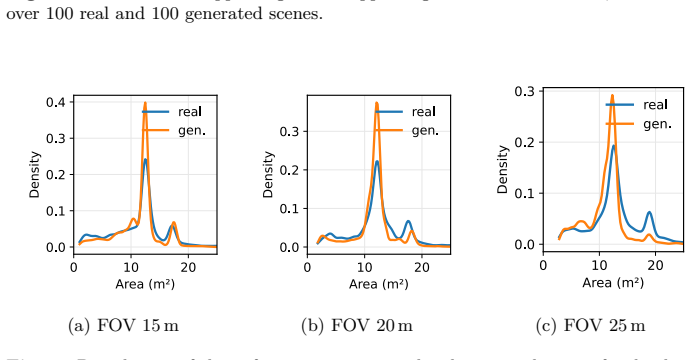
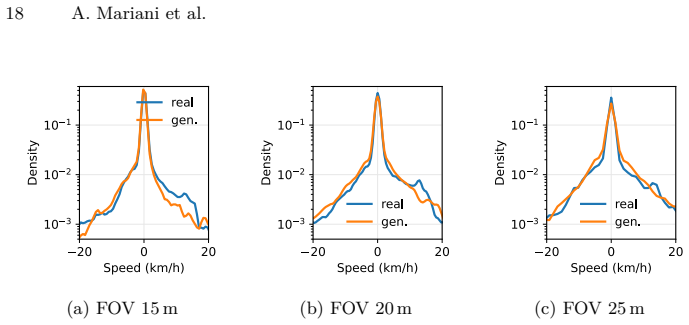
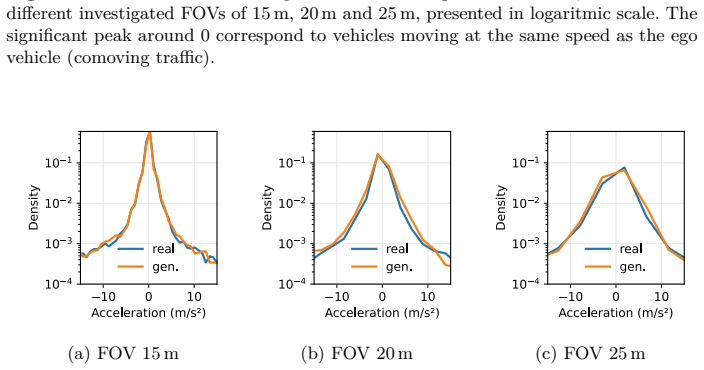
On the paper's own terms, the central discovery is that the extended pipeline—Lab-color semantic rasterization, a low-resolution video GAN, and graph-based trajectory extraction—generalizes from the previously studied small field of view to longitudinal ranges of 15 m, 20 m, and 25 m. Over 200 generated and 200 real scenes, the model produces vehicle counts, object sizes, nearest-neighbor distances, relative speed and acceleration distributions, and time-to-collision statistics that match the training data closely; generated videos rarely show merging or splitting vehicles, and most appearing/disappearing events occur at frame boundaries. Inference stays below 20 ms for 20-second scenes. The
What carries the argument
The load-bearing objects are: (1) a Lab color-space encoding that separates empty space, road markings, traffic-light states, ego vehicle, and other vehicles into distinct, easily filterable color ranges; (2) the low-resolution branch of a long-video GAN, which generates dynamically coherent semantic videos in a single forward pass; and (3) a graph-based trajectory extractor in which each detected object is a node and edges connect overlapping same-type objects in adjacent frames, with node in/out degree anomalies used to count appearing, disappearing, merging, and splitting hallucinations. The graph carries the argument because every trajectory statistic—speeds, accelerations, spacings, tim
Load-bearing premise
The paper assumes the hand-chosen Lab color ranges used to rasterize training videos will still cleanly identify vehicles and traffic lights in generated videos, even though the authors observe traffic-light morphing and vehicle color shifts in generated frames—if that color code drifts, every trajectory statistic inherits detection errors.
What would settle it
Manually annotate vehicle bounding boxes in a sample of generated 25 m-FOV videos, run the paper's Lab-threshold and graph-association pipeline, and compare the resulting speed, acceleration, and time-to-collision distributions to those computed from the manual boxes; a material divergence—especially around the color-shifted vehicles the authors report—would show the reported realism is an artifact of the extraction pipeline rather than the generator.
If this is right
- If the central claim holds, video-GAN scene generation is a viable low-latency alternative to diffusion-based world models for trajectory proposal: roughly 20 ms per 20-second scene versus seconds to tens of seconds.
- The graph-based extraction and hallucination metrics give a concrete way to audit object permanence in generated traffic videos, not just visual fidelity.
- The statistical alignment of speed, acceleration, and time-to-collision distributions suggests the generated scenes can serve as training or testing data for downstream prediction and planning modules without introducing systematic unsafe-biased trajectories.
- Scaling from 15 m to 25 m fields of view works with only mildly degraded statistics, indicating that larger-context modeling is within reach of the same architecture.
- Traffic-light interactions—stopping at red, crossing green—are reproduced well enough that generated scenes preserve rule-relevant behavior.
Where Pith is reading between the lines
- A testable extension of the paper's logic: because the trajectory statistics are extracted by color thresholding, the reported distributional matches upper-bound the generator's realism; a more robust instance-aware detector could either confirm or raise the current numbers.
- The same graph-based hallucination accounting could be applied to other generative world models, giving a common yardstick for object permanence across video-generation paradigms.
- The authors' observation that parked-car scenes are never generated hints at a mode-coverage limitation; conditioning the generator on map or scenario context is a natural next step suggested by, but not tested in, this paper.
- If the approach transfers to denser urban datasets beyond the one studied here, it would strengthen the scalability claim; that transfer is an open empirical question rather than a demonstrated result.
Editorial analysis
A structured set of objections, weighed in public.
Referee Report
Summary. The paper extends a videoGAN-based trajectory proposal framework to larger bird's-eye-view fields of view (15 m, 20 m, 25 m) using Waymo Open Motion Dataset. It introduces a Lab color-space semantic representation, a graph-based trajectory extraction method, and a quantitative hallucination metric measuring appearing, disappearing, merging, and splitting events. The authors claim that the framework generalizes to larger scenes while maintaining statistically realistic trajectories and coherent spatial relationships, with inference times below 20 ms. The evaluation compares distributions of object sizes, counts, distances, speeds, accelerations, trajectory lengths, and time-to-collision between real and generated videos.
Significance. If the central claim holds, this is a useful demonstration that lightweight video GANs can generate scalable, semantically grounded traffic scenes for AD simulation and prediction. The paper's strengths include public release of code and trained models, low-latency inference, and a concrete evaluation framework for object permanence. However, the quantitative evaluation is built entirely on a color-threshold detection pipeline whose reliability on generated frames is not established, and the reported hallucination numbers contain internal inconsistencies. The paper is therefore a promising empirical contribution but currently does not fully support its headline claims of statistically realistic and scalable trajectory generation.
major comments (3)
- [§4.3, Table 1] The text states that splitting/merging rates are 'lower than 1% at FOV 15m and 20m, and marginally higher rates for FOV 25m', but Table 1 lists Merging rates of 0%, 1%, 4% and Splitting rates of 0%, 1%, 6% for generated videos. More seriously, the boundary-excluded Disappearing rates are 33%, 45.5%, and 55% for generated videos versus 2%, 1%, and 0% for real videos. The authors attribute disappearing events to agents leaving the FOV, but the boundary-excluded column is specifically designed to remove that explanation. These numbers are not consistent with the claim that object permanence is maintained, and they indicate that the tracker loses objects inside the scene, most plausibly due to color drift in generated frames. Because all trajectory statistics in §4.4–§4.6 are computed from this tracker, the reported distributions may be based on incomplete object sets.
- [§3.3, §4.2] The object detector uses the same hand-chosen Lab color ranges that were used to rasterize the training data. The paper itself acknowledges that non-ego vehicles exhibit occasional color shifts and that traffic lights morph when vehicles pass under them. No quantitative validation of detection accuracy on generated frames is provided; Figure 5 shows only hand-picked examples. The boundary-excluded disappearing behavior in Table 1 is consistent with generated objects drifting outside the detection thresholds, which would make the trajectory statistics in §4.4–§4.6 artifacts of the extraction pipeline rather than properties of the generator. The authors should demonstrate detection reliability on generated frames—for example, by comparing extracted trajectories from real videos against ground-truth object lists, or by using a held-out detection method—or substantially soften claims about t
- [§4.4–§4.6] The central claim of 'statistically realistic trajectories' is supported only by visual overlap of histograms. No distributional distance (e.g., KL or Wasserstein), confidence interval, significance test, or error bar is reported. The paper uses 100–200 scenes per condition but does not state variance across model checkpoints or seeds. Given that the abstract and conclusions make explicit statistical claims, the authors should add quantitative distributional comparisons and uncertainty estimates. This is especially important because the detection-pipeline issues above could differentially affect the generated and real distributions.
minor comments (5)
- [§1] Typo: 'could could not guarantee' should be 'could not guarantee'.
- [§4.5] Typos: 'logaritmic' should be 'logarithmic', and 'A verage' in §2.4 should be 'Average'.
- [Abstract vs. §4.1] The abstract reports '150 GPU hours' of training while §4.1 reports '140 GPU hours'; these should be reconciled.
- [References] References [34] and [35] appear to be the same paper by Saxena and Cao; duplicate references should be removed or distinguished.
- [§4.3] The term 'rates' is ambiguous: Table 1 reports the percentage of videos containing at least one event, while the text speaks of rates as if they were per-frame or per-trajectory frequencies. Please define the denominator explicitly.
Circularity Check
No significant circularity: the central claims are supported by distributional comparisons against external Waymo data, not by self-referential construction.
full rationale
The paper's central claim is that a videoGAN-based BEV trajectory generation framework generalizes to larger fields of view while maintaining statistically realistic trajectories and coherent spatial relationships. The support for this claim consists of distributional comparisons of speeds, accelerations, inter-vehicle distances, time-to-collision, and traffic-light-relative speeds between generated videos and real videos rasterized from the external Waymo Open Motion Dataset. No parameter is fitted to a target metric and then re-reported as a prediction: the quantitative evaluation is a standard generative-model fidelity check against an external dataset. The use of the same Lab color ranges for rasterization (Sec. 3.1) and object detection (Sec. 3.3) is a shared encoding choice, not a definitional reduction; it could affect evidence quality if generated colors drift, but that is a robustness/correctness concern, not circularity. The self-citation of prior work [28] supplies the baseline pipeline and training recipe, but the new contributions—larger FOVs, Lab encoding, graph-based trajectory extraction, and hallucination metrics—are evaluated independently against real data and against the externally developed LongVideoGAN backbone [3]. No uniqueness theorem is imported from the authors, no ansatz is smuggled in via citation, and no known result is merely renamed. The paper even discloses its own limitations, such as occasional color shifts and traffic-light morphing (Sec. 4.2), and Table 1's elevated boundary-excluded disappearing rates are an empirical evidence concern rather than a case of conclusions being assumed in the inputs. I find no step in the derivation chain that reduces by definition or by self-citation to its own inputs.
Axiom & Free-Parameter Ledger
free parameters (4)
- Semantic Lab color ranges per category =
L∈[30,90] centerline; black ego; blue-pink others; ellipsoidal light ranges
- Centerline thickness and traffic light size =
1.5 m; 2×2 m
- Boundary-exclusion fraction =
outer 10%
- Checkpoint selection epoch =
20/23/24 epochs (per FOV)
axioms (5)
- domain assumption Waymo Open Motion Dataset is representative of real traffic for the purpose of trajectory realism.
- domain assumption Low-resolution semantic BEV videos (54×96 px, up to 25 m) retain enough information for realistic trajectory extraction.
- domain assumption Graph association via reciprocal bounding-box overlap in adjacent frames recovers true object identities.
- domain assumption Traffic lights are static reference points in generated videos.
- ad hoc to paper Histogram matching of marginal distributions is sufficient evidence of statistical realism.
Cite this review
Pith. "Pith review of Extended Field of View Analysis for VideoGAN-based Trajectory Generation." pith.science (2026). https://pith.science/paper/BMIUQHEF
@misc{pith2026260802289,
  author       = {Pith},
  title        = {Pith review of: Extended Field of View Analysis for VideoGAN-based Trajectory Generation},
  year         = {2026},
  howpublished = {\url{https://pith.science/paper/BMIUQHEF}},
  note         = {Machine review of arXiv:2608.02289}
}
read the original abstract
Realistic and diverse trajectory generation is central to enabling higher levels of vehicle automation. While rule-based and classical learning-based methods may struggle to capture the complexity of traffic behavior, generative models have already demonstrated in other fields that they can handle a comparable level of complexity. In this paper, we build upon previous work on generative adversarial network (GAN)-based semantic bird's-eye-view traffic generation and extend the proposed framework in several key aspects. We improve the semantic representation, replace the trajectory extraction procedure with a graph-based association method, and systematically investigate increasingly larger fields of view. In addition, we introduce a quantitative evaluation framework to assess hallucinations and object permanence in generated videos. Our experiments demonstrate that the framework generalizes to larger and more complex traffic scenes while maintaining statistically realistic trajectories and coherent spatial relationships between traffic participants. Within 150GPU hours of training and with inference times below 20ms for scenes of up to 20s, our results demonstrate that video-based GANs remain an efficient and scalable approach for realistic trajectory generation, even in substantially larger traffic scenes, making them well suited for downstream tasks such as prediction, planning, and simulation in automated driving.
Figures






Reference graph
Works this paper leans on
-
[1]
https://doi.org/10.48550/arXiv.2307.07527
Bharilya, V., Kumar, N.: Machine Learning for Autonomous Vehicle’s Trajectory Prediction: A comprehensive survey, Challenges, and Future Research Directions (Jul 2023). https://doi.org/10.48550/arXiv.2307.07527
-
[2]
arXiv preprint arXiv:2311.15127 (2023)
Blattmann, A., Dockhorn, T., Kulal, S., Mendelevitch, D., Kilian, M., Lorenz, D., Levi, Y., English, Z., Voleti, V., Letts, A., et al.: Stable video diffusion: Scaling latent video diffusion models to large datasets. arXiv preprint arXiv:2311.15127 (2023)
Pith/arXiv arXiv 2023
-
[3]
In: 36th Conference on Neural Information Processing Systems (2022)
Brooks, T., Hellsten, J., Aittala, M., Wang, T.C., Aila, T., Lehtinen, J., Liu, M.Y., Efros, A.A., Karras, T.: Generating Long Videos of Dynamic Scenes. In: 36th Conference on Neural Information Processing Systems (2022)
2022
-
[4]
Geoinformatica (Apr 2025)
Chen, X., Huang, C., Wang, C., Chen, L.: Trajectory generation: A survey on methods and techniques. Geoinformatica (Apr 2025). https://doi.org/10.1007/ s10707-025-00545-z
2025
-
[5]
Clark, A., Donahue, J., Simonyan, K.: Adversarial video generation on complex datasets (2019), https://arxiv.org/abs/1907.06571
Pith/arXiv arXiv 2019
-
[6]
In: Proceedings of the IEEE/CVF International Conference on Computer Vision
Cui, A., Casas, S., Sadat, A., Liao, R., Urtasun, R.: LookOut: Diverse Multi- Future Prediction and Planning for Self-Driving. In: Proceedings of the IEEE/CVF International Conference on Computer Vision. pp. 16107–16116 (2021)
2021
-
[7]
In: Proceedings of the IEEE/CVF Conference on Computer Vision and Pattern Recognition (2020)
Fang, L., Jiang, Q., Shi, J., Zhou, B.: TPNet: Trajectory Proposal Network for Motion Prediction. In: Proceedings of the IEEE/CVF Conference on Computer Vision and Pattern Recognition (2020)
2020
-
[8]
Gilles, T., Sabatini, S., Tsishkou, D., Stanciulescu, B., Moutarde, F.: HOME: Heatmap Output for future Motion Estimation. In: IEEE Int. Intell. Transp. Syst. Conf. pp. 500–507 (2021). https://doi.org/10.1109/ITSC48978.2021.9564944
arXiv 2021
-
[9]
Journal of Field Robotics 37(3), 362–386 (Apr 2020)
Grigorescu, S., Trasnea, B., Cocias, T., Macesanu, G.: A Survey of Deep Learning Techniques for Autonomous Driving. Journal of Field Robotics 37(3), 362–386 (Apr 2020). https://doi.org/10.1002/rob.21918
-
[10]
In: Proceedings of the IEEE/CVF Conference on Computer Vision and Pattern Recognition
Gu, T., Chen, G., Li, J., Lin, C., Rao, Y., Zhou, J., Lu, J.: Stochastic Trajectory Prediction via Motion Indeterminacy Diffusion. In: Proceedings of the IEEE/CVF Conference on Computer Vision and Pattern Recognition. pp. 17113–17122 (2022)
2022
-
[11]
In: Proceedings of 22 A
Gupta, A., Johnson, J., Fei-Fei, L., Savarese, S., Alahi, A.: Social GAN: Socially Acceptable Trajectories With Generative Adversarial Networks. In: Proceedings of 22 A. Mariani et al. the IEEE Conference on Computer Vision and Pattern Recognition. pp. 2255–2264 (2018)
2018
-
[12]
In: Proceedings of the 2015 IEEE 18th International Conference on Intelligent Transportation Systems
Horgan, J., Hughes, C., McDonald, J., Yogamani, S.: Vision-Based Driver As- sistance Systems: Survey, Taxonomy and Advances. In: Proceedings of the 2015 IEEE 18th International Conference on Intelligent Transportation Systems. pp. 2032–2039. ITSC ’15, IEEE Computer Society, USA (Sep 2015). https://doi.org/ 10.1109/ITSC.2015.329
-
[13]
In: 2021 IEEE/CVF International Conference on Com- puter Vision (ICCV)
Hu, A., Murez, Z., Mohan, N., Dudas, S., Hawke, J., Badrinarayanan, V., Cipolla, R., Kendall, A.: FIERY: Future Instance Prediction in Bird’s-Eye View from Sur- round Monocular Cameras. In: 2021 IEEE/CVF International Conference on Com- puter Vision (ICCV). pp. 15253–15262. IEEE, Montreal, QC, Canada (Oct 2021). https://doi.org/10.1109/ICCV48922.2021.01499
arXiv 2021
-
[14]
In: A vidan, S., Brostow, G., Cissé, M., Farinella, G.M., Hassner, T
Hu, S., Chen, L., Wu, P., Li, H., Yan, J., Tao, D.: ST-P3: End-to-End Vision- Based Autonomous Driving via Spatial-Temporal Feature Learning. In: A vidan, S., Brostow, G., Cissé, M., Farinella, G.M., Hassner, T. (eds.) Computer Vision – ECCV 2022. pp. 533–549. Springer Nature Switzerland, Cham (2022). https: //doi.org/10.1007/978-3-031-19839-7_31
-
[15]
Sustainability 15(20), 14716 (Oct 2023)
Huang, R., Zhuo, G., Xiong, L., Lu, S., Tian, W.: A Review of Deep Learning- Based Vehicle Motion Prediction for Autonomous Driving. Sustainability 15(20), 14716 (Oct 2023). https://doi.org/10.3390/su152014716
-
[16]
Vision-based Multi-future Trajectory Prediction: A Survey
Huang, R., Xue, H., Pagnucco, M., Salim, F., Song, Y.: Multimodal Trajectory Prediction: A Survey (Feb 2023). https://doi.org/10.48550/arXiv.2302.10463
work page internal anchor Pith review Pith/arXiv arXiv doi:10.48550/arxiv.2302.10463 2023
-
[17]
Huang, Z., He, Y., Yu, J., Zhang, F., Si, C., Jiang, Y., Zhang, Y., Wu, T., Jin, Q., Chanpaisit, N., Wang, Y., Chen, X., Wang, L., Lin, D., Qiao, Y., Liu, Z.: Vbench: Comprehensive benchmark suite for video generative models (2023), https: //arxiv.org/abs/2311.17982
Pith/arXiv arXiv 2023
-
[18]
In: Proceedings of the IEEE/CVF Conference on Computer Vision and Pattern Recognition (CVPR)
Huang, Z., He, Y., Yu, J., Zhang, F., Si, C., Jiang, Y., Zhang, Y., Wu, T., Jin, Q., Chanpaisit, N., Wang, Y., Chen, X., Wang, L., Lin, D., Qiao, Y., Liu, Z.: Vbench: Comprehensive benchmark suite for video generative models. In: Proceedings of the IEEE/CVF Conference on Computer Vision and Pattern Recognition (CVPR). pp. 21807–21818 (June 2024)
2024
-
[19]
Jia, X., Wu, P., Chen, L., Liu, Y., Li, H., Yan, J.: HDGT: Heterogeneous Driving Graph Transformer for Multi-Agent Trajectory Prediction via Scene Encoding. IEEE Trans. Pattern Anal. Mach. Intell. 45(11), 13860–13875 (Nov 2023). https: //doi.org/10.1109/TPAMI.2023.3298301
arXiv 2023
-
[20]
In: Proceedings of the IEEE/CVF Conference on Computer Vision and Pattern Recognition (2023)
Jiang, C.M., Cornman, A., Park, C., Sapp, B., Zhou, Y., Anguelov, D.: MotionDif- fuser: Controllable Multi-Agent Motion Prediction Using Diffusion. In: Proceedings of the IEEE/CVF Conference on Computer Vision and Pattern Recognition (2023)
2023
-
[21]
In: 2024 IEEE/RSJ International Conference on Intelligent Robots and Systems
Jiao, R., Wang, Y., Liu, X., Zhan, S.S., Huang, C., Zhu, Q.: Kinematics-aware Trajectory Generation and Prediction with Latent Stochastic Differential Mod- eling. In: 2024 IEEE/RSJ International Conference on Intelligent Robots and Systems. pp. 565–572. IEEE, Abu Dhabi, United Arab Emirates (Oct 2024). https://doi.org/10.1109/IROS58592.2024.10802438
arXiv 2024
-
[22]
ACM Comput
Khan, M.A., Sayed, H.E., Malik, S., Zia, T., Khan, J., Alkaabi, N., Ignatious, H.: Level-5 Autonomous Driving—Are We There Yet? A Review of Research Lit- erature. ACM Comput. Surv. 55(2), 1–38 (Feb 2023). https://doi.org/10.1145/ 3485767
2023
-
[23]
Mathematics 9(6), 660 (Jan 2021)
Leon, F., Gavrilescu, M.: A Review of Tracking and Trajectory Prediction Methods for Autonomous Driving. Mathematics 9(6), 660 (Jan 2021). https://doi.org/10. 3390/math9060660 Extended Field of View Analysis for VideoGAN-based Trajectory Generation 23
2021
-
[24]
Accident Analysis and Prevention 204, 107649 (2024)
Li, S., Anis, M., Lord, D., Zhang, H., Zhou, Y., Ye, X.: Beyond 1d and over- simplified kinematics: A generic analytical framework for surrogate safety mea- sures. Accident Analysis and Prevention 204, 107649 (2024). https://doi.org/https: //doi.org/10.1016/j.aap.2024.107649
arXiv 2024
-
[25]
https://doi.org/10.48550/arXiv.2502.17100
Li, Y., Shao, X., Zhang, J., Wang, H., Brunswic, L.M., Zhou, K., Dong, J., Guo, K., Li, X., Chen, Z., Wang, J., Hao, J.: Generative Models in Decision Making: A Survey (Mar 2025). https://doi.org/10.48550/arXiv.2502.17100
-
[26]
In: Yue, Y., Garg, A., Peng, N., Sha, F., Yu, R
Lyu, Z., Si, C., Song, J., Yang, Z., Qiao, Y., Liu, Z., Wong, K.Y.K.: Fastercache: Training-free video diffusion model acceleration with high quality. In: Yue, Y., Garg, A., Peng, N., Sha, F., Yu, R. (eds.) International Conference on Learning Representations. vol. 2025, pp. 33132–33156 (2025)
2025
-
[27]
Mahjourian, R., Kim, J., Chai, Y., Tan, M., Sapp, B., Anguelov, D.: Occupancy Flow Fields for Motion Forecasting in Autonomous Driving. IEEE Robot. Autom. Lett. 7(2), 5639–5646 (Apr 2022). https://doi.org/10.1109/LRA.2022.3151613
arXiv 2022
-
[28]
Mariani, A., Maag, K., Gottschalk, H.: Videogan-based trajectory proposal for automated vehicles. In: Proceedings of the 18th International Conference on Agents and Artificial Intelligence - Volume 2: ICAART. pp. 1149–1156. INSTICC, SciTePress (2026). https://doi.org/10.5220/0014229000004052
-
[29]
In: International Conference on Learning Representations (Oct 2021)
Ngiam, J., Vasudevan, V., Caine, B., Zhang, Z., Chiang, H.T.L., Ling, J., Roelofs, R., Bewley, A., Liu, C., Venugopal, A., Weiss, D.J., Sapp, B., Chen, Z., Shlens, J.: Scene Transformer: A unified architecture for predicting future trajectories of multiple agents. In: International Conference on Learning Representations (Oct 2021)
2021
-
[30]
In: International Conference on Learning Representations (2023)
Park, D., Ryu, H., Yang, Y., Cho, J., Kim, J., Yoon, K.J.: Leveraging Future Rela- tionship Reasoning for Vehicle Trajectory Prediction. In: International Conference on Learning Representations (2023)
2023
-
[31]
In: International Conference on Learning Repre- sentations (Sep 2019)
Rhinehart, N., McAllister, R., Levine, S.: Deep Imitative Models for Flexible In- ference, Planning, and Control. In: International Conference on Learning Repre- sentations (Sep 2019)
2019
-
[32]
IEEE Robotics and Automation Let- ters 5(2), 2816–2823 (Apr 2020)
Ridel, D., Deo, N., Wolf, D., Trivedi, M.: Scene Compliant Trajectory Forecast With Agent-Centric Spatio-Temporal Grids. IEEE Robotics and Automation Let- ters 5(2), 2816–2823 (Apr 2020). https://doi.org/10.1109/LRA.2020.2974393
arXiv 2020
-
[33]
In: Proceedings of the IEEE/CVF conference on computer vision and pattern recognition
Rombach, R., Blattmann, A., Lorenz, D., Esser, P., Ommer, B.: High-resolution image synthesis with latent diffusion models. In: Proceedings of the IEEE/CVF conference on computer vision and pattern recognition. pp. 10684–10695 (2022)
2022
-
[35]
ACM Computing Surveys 54(3), 1–42 (2022)
Saxena, D., Cao, J.: Generative Adversarial Networks (GANs): Challenges, So- lutions, and Future Directions. ACM Computing Surveys 54(3), 1–42 (2022). https://doi.org/10.1145/3446374
doi:10.1145/3446374 2022
-
[36]
Advances in Neural Information Processing Systems 35, 6531–6543 (Dec 2022)
Shi, S., Jiang, L., Dai, D., Schiele, B.: Motion Transformer with Global Intention Localization and Local Movement Refinement. Advances in Neural Information Processing Systems 35, 6531–6543 (Dec 2022)
2022
-
[37]
Singer, U., Polyak, A., Hayes, T., Yin, X., An, J., Zhang, S., Hu, Q., Yang, H., Ashual, O., Gafni, O., Parikh, D., Gupta, S., Taigman, Y.: Make-a-video: Text-to- video generation without text-video data (2022), https://arxiv.org/abs/2209.14792
Pith/arXiv arXiv 2022
-
[38]
Mariani et al
Sun, P., Kretzschmar, H., Dotiwalla, X., Chouard, A., Patnaik, V., Tsui, P., Guo, J., Zhou, Y., Chai, Y., Caine, B., Vasudevan, V., Han, W., Ngiam, J., Zhao, H., Timofeev, A., Ettinger, S., Krivokon, M., Gao, A., Joshi, A., Zhang, Y., Shlens, J., 24 A. Mariani et al. Chen, Z., Anguelov, D.: Scalability in perception for autonomous driving: Waymo open data...
2020
-
[40]
Unterthiner, T., van Steenkiste, S., Kurach, K., Marinier, R., Michalski, M., Gelly, S.: Towards accurate generative models of video: A new metric and challenges (2019), https://arxiv.org/abs/1812.01717
Pith/arXiv arXiv 2019
-
[41]
IEEE Transactions on Image Processing 35, 4947–4960 (2026)
Wang, L., Zheng, W., Ren, Y., Jiang, H., Cui, Z., Yu, H., Lu, J.: Occsora: 4d occupancy generation models as world simulators for autonomous driving. IEEE Transactions on Image Processing 35, 4947–4960 (2026). https://doi.org/10.1109/ TIP.2026.3687468
arXiv 2026
-
[42]
arXiv preprint arXiv:2505.15863 (2025)
Winter, K., Vivekanandan, A., Polley, R., Shen, Y., Schlauch, C., Bouzidi, M.K., Derajic, B., Grabowsky, N., Mariani, A., Rochau, D., et al.: Generative ai for autonomous driving: A review. arXiv preprint arXiv:2505.15863 (2025)
Pith/arXiv arXiv 2025
-
[43]
In: 2020 IEEE/CVF Conference on Computer Vision and Pattern Recognition
Wu, P., Chen, S., Metaxas, D.N.: MotionNet: Joint Perception and Motion Predic- tion for Autonomous Driving Based on Bird’s Eye View Maps. In: 2020 IEEE/CVF Conference on Computer Vision and Pattern Recognition. pp. 11382–11392. IEEE, Seattle, W A, USA (Jun 2020). https://doi.org/10.1109/CVPR42600.2020.01140
arXiv 2020
-
[44]
Xing, Z., Feng, Q., Chen, H., Dai, Q., Hu, H., Xu, H., Wu, Z., Jiang, Y.G.: A Survey on Video Diffusion Models. ACM Comput. Surv. 57(2), 1–42 (Feb 2025). https://doi.org/10.1145/3696415
doi:10.1145/3696415 2025
-
[45]
https://doi.org/10.48550/arXiv.2503
Xiong, W., Chen, J., Qi, Z.: Fine-Grained Behavior and Lane Constraints Guided Trajectory Prediction Method (Apr 2025). https://doi.org/10.48550/arXiv.2503. 21477
-
[46]
In: Kim, B., Yue, Y., Chaudhuri, S., Fragkiadaki, K., Khan, M., Sun, Y
Yu, S., Nie, W., Huang, D.A., Li, B., Shin, J., anandkumar, a.: Efficient video diffu- sion models via content-frame motion-latent decomposition. In: Kim, B., Yue, Y., Chaudhuri, S., Fragkiadaki, K., Khan, M., Sun, Y. (eds.) International Conference on Learning Representations. vol. 2024, pp. 9642–9670 (2024)
2024
-
[47]
In: Belgrave, D., Zhang, C., Lin, H., Pascanu, R., Koniusz, P., Ghassemi, M., Chen, N
Zhang, P., Chen, Y., Huang, H., Lin, W., Liu, Z., Stoica, I., Xing, E., Zhang, H.: Faster video diffusion with trainable sparse attention. In: Belgrave, D., Zhang, C., Lin, H., Pascanu, R., Koniusz, P., Ghassemi, M., Chen, N. (eds.) Advances in Neural Information Processing Systems. vol. 38, pp. 152509–152534. Curran Associates, Inc. (2025)
2025
-
[48]
Zhao, C., Zhu, Y., Du, Y., Liao, F., Chan, C.Y.: A Novel Direct Trajectory Planning Approach Based on Generative Adversarial Networks and Rapidly-Exploring Ran- dom Tree. IEEE Trans. Intell. Transport. Syst. 23(10), 17910–17921 (Oct 2022). https://doi.org/10.1109/TITS.2022.3164391
arXiv 2022
-
[49]
Zheng, Z., Peng, X., Yang, T., Shen, C., Li, S., Liu, H., Zhou, Y., Li, T., You, Y.: Open-sora: Democratizing efficient video production for all (2024), https://arxiv. org/abs/2412.20404
Pith/arXiv arXiv 2024
-
[50]
In: Proceedings of the IEEE/CVF Conference on Computer Vision and Pattern Recognition (2022)
Zhou, Z., Ye, L., Wang, J., Wu, K., Lu, K.: HiVT: Hierarchical Vector Transformer for Multi-Agent Motion Prediction. In: Proceedings of the IEEE/CVF Conference on Computer Vision and Pattern Recognition (2022)
2022
discussion (0)
Sign in with ORCID, Apple, or X to comment. Anyone can read and Pith papers without signing in.