REVIEW 1 major objections 3 minor 1 cited by
Monte Carlo event generators serve as the central interface between theoretical calculations and experimental measurements in collider physics.
Reviewed by Pith at T0; open to challenge. T0 means a machine referee read the full paper against a public rubric. the ladder, T0–T4 →
T0 review · grok-4.3
2026-05-20 16:29 UTC pith:BQ2MHBUI
load-bearing objection This is a clear, expert-written primer on the Monte Carlo ecosystem that helps new students navigate the tools but introduces no new methods or results. the 1 major comments →
The Monte Carlo Ecosystem in High-Energy Physics: A Primer
The pith
A machine-rendered reading of the paper's core claim, the machinery that carries it, and where it could break.
Core claim
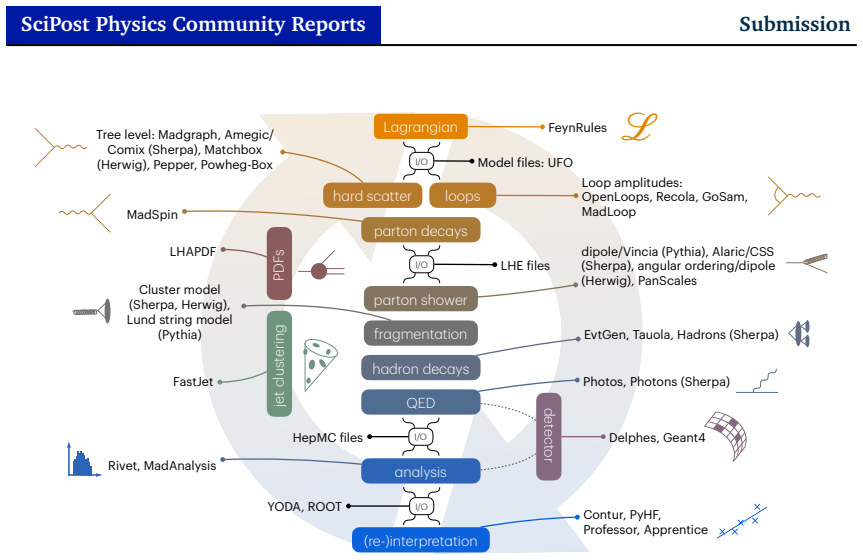
Monte Carlo event generators are the central interface between theoretical calculations and experimental measurements in collider physics. Over several decades a comprehensive and highly modular ecosystem has developed around them, encompassing matrix-element calculations, parton showers, hadronisation models, and integration with detector simulation, event-level analysis and statistical inference. The primer supplies a structured overview of their conceptual foundations, the challenges of large-scale simulations, and the principles that enable interoperability and reproducibility across theory and experiment.
What carries the argument
The Monte Carlo event generator simulation chain, which converts theoretical matrix elements into observable events through successive modules of parton showers, hadronisation, and detector response.
Load-bearing premise
The conceptual scope and technical structure of the Monte Carlo simulation chain remain stable enough that one structured primer can clarify the architecture and long-term trajectory without rapid obsolescence.
What would settle it
Publication of a major new generator framework or dominant algorithm that replaces the current modular stages of matrix elements, showers, and hadronisation would show whether the described ecosystem has shifted beyond the primer's account.
If this is right
- Large-scale collider simulations become practical through the modular separation of theoretical and simulation stages.
- Shared principles allow different tools to interoperate while preserving reproducibility between theory predictions and experimental data.
- Awareness of computational and sustainability issues guides efficient use and future maintenance of the ecosystem.
- Early-career researchers gain a clearer path into the workflow that underpins most collider analyses.
Where Pith is reading between the lines
- Widespread use of the primer could shorten the time needed for new researchers to produce reliable simulation results.
- The described foundations offer a natural base for testing whether machine-learning replacements for individual modules improve speed without loss of accuracy.
- Similar structured guides could be written for simulation chains in adjacent areas such as neutrino or astroparticle experiments.
Editorial analysis
A structured set of objections, weighed in public.
Referee Report
Summary. The manuscript is a primer on the Monte Carlo event generator ecosystem in high-energy physics. It positions these generators as the central modular interface between theoretical calculations (matrix elements, parton showers, hadronisation) and experimental measurements (detector simulation, event analysis, statistical inference). The text provides a structured overview of conceptual foundations, computational and organisational challenges in large-scale simulations, interoperability and reproducibility principles, and evolving computing and sustainability considerations, aimed primarily at early-stage doctoral researchers.
Significance. If the overview is accurate and current, the primer fills a genuine pedagogical gap by clarifying the architecture of a complex, long-developed ecosystem without advancing new derivations or predictions. Its expository approach, drawing on established literature, supports better navigation for newcomers and could improve reproducibility across theory-experiment workflows. The emphasis on modularity and future sustainability is a constructive contribution to community training resources.
major comments (1)
- [Abstract and concluding sections] The central claim that a single structured primer can usefully clarify the full simulation chain without rapid obsolescence (as stated in the abstract) would benefit from an explicit discussion of update mechanisms or version-specific caveats, since the field evolves with new generators and computing paradigms.
minor comments (3)
- [Conceptual foundations] Notation for generator components (e.g., ME, PS, hadronisation) should be introduced consistently with a short glossary or table to aid readers new to the terminology.
- [Interoperability and reproducibility] References to specific interoperability standards or common data formats (e.g., HepMC, LHE) would strengthen the discussion of reproducibility principles.
- [Throughout] Figure captions could more explicitly link visual elements to the modular workflow described in the text for improved clarity.
Simulated Author's Rebuttal
We thank the referee for their positive assessment of the manuscript and for the constructive recommendation for minor revision. We address the single major comment below.
read point-by-point responses
-
Referee: [Abstract and concluding sections] The central claim that a single structured primer can usefully clarify the full simulation chain without rapid obsolescence (as stated in the abstract) would benefit from an explicit discussion of update mechanisms or version-specific caveats, since the field evolves with new generators and computing paradigms.
Authors: We agree that an explicit discussion of maintenance and versioning would strengthen the manuscript. While the primer focuses on stable conceptual foundations, architectural principles, and long-term trajectories rather than transient implementation details, we will add a concise paragraph in the concluding section. This will outline community-driven update practices, the role of versioned repositories and documentation, and the value of consulting current tool releases for specific applications. The addition will be limited in scope to preserve the primer's pedagogical emphasis. revision: yes
Circularity Check
No significant circularity in this expository primer
full rationale
This paper is a descriptive primer and overview of the Monte Carlo event generator ecosystem in collider physics. It summarizes established components (matrix elements, parton showers, hadronisation, detector simulation) and interoperability principles without presenting any novel derivations, predictions, equations, or quantitative results. The central claim is expository rather than deductive, drawing on community literature for context but advancing no load-bearing technical assumption or fitted input that could reduce to self-reference by construction. As a reference for early-stage researchers, the text is self-contained against external benchmarks with no circular steps.
Axiom & Free-Parameter Ledger
read the original abstract
Monte Carlo event generators are the central interface between theoretical calculations and experimental measurements in collider physics. Over several decades, a comprehensive and highly modular ecosystem of tools has developed around them, encompassing matrix-element calculations, parton showers, hadronisation models, and their integration with detector simulation, event-level analysis and statistical inference. While these tools are ubiquitous in modern research, the conceptual scope and technical structure of the full simulation chain can be challenging to navigate, particularly for researchers entering the field. In this primer, we provide a structured and up-to-date overview of the high-energy physics Monte Carlo ecosystem, focusing primarily on event-generator methodologies and their role within the broader collider workflow. We discuss the conceptual foundations of modern generators, the computational and organisational challenges of large-scale simulations, and the principles that enable interoperability and reproducibility across theory and experiment. We also examine the evolving computing landscape and sustainability considerations that will shape the future development of these tools. Aimed primarily at early-stage doctoral researchers while serving as a reference for the broader community, this article seeks to clarify architecture, methodology, and long-term trajectory of Monte Carlo event generation in collider physics.
Figures




Lean theorems connected to this paper
-
IndisputableMonolith/Foundation/RealityFromDistinction.leanreality_from_one_distinction unclear?
unclearRelation between the paper passage and the cited Recognition theorem.
Monte Carlo event generators are the central interface between theoretical calculations and experimental measurements in collider physics... encompassing matrix-element calculations, parton showers, hadronisation models...
-
IndisputableMonolith/Cost/FunctionalEquation.leanwashburn_uniqueness_aczel unclear?
unclearRelation between the paper passage and the cited Recognition theorem.
The Sudakov form factor... parton showers... matching and merging schemes
What do these tags mean?
- matches
- The paper's claim is directly supported by a theorem in the formal canon.
- supports
- The theorem supports part of the paper's argument, but the paper may add assumptions or extra steps.
- extends
- The paper goes beyond the formal theorem; the theorem is a base layer rather than the whole result.
- uses
- The paper appears to rely on the theorem as machinery.
- contradicts
- The paper's claim conflicts with a theorem or certificate in the canon.
- unclear
- Pith found a possible connection, but the passage is too broad, indirect, or ambiguous to say the theorem truly supports the claim.
Forward citations
Cited by 1 Pith paper
-
Optimal-Transport-Based Cell Resampling for Negative and Pathological Event Weights
IRC-safe optimal-transport metrics (EMD, sEMD) enable lower-bias cell resampling of negative-weight NLO Monte Carlo events without intermediate jet clustering.
Reference graph
Works this paper leans on
-
[1]
Azimov, Yakov I. and Dokshitzer, Yuri L. and Khoze, Valery A. and Troian, S. I. The String Effect and QCD Coherence. Phys. Lett. B. 1985. doi:10.1016/0370-2693(85)90709-9
-
[2]
Cabouat, Baptiste and Gaunt, Jonathan R. and Ostrolenk, Kiran. A Monte-Carlo Simulation of Double Parton Scattering. JHEP. 2019. doi:10.1007/JHEP11(2019)061. arXiv:1906.04669
-
[3]
The role of multi-parton interactions in doubly-heavy hadron production
Egede, Ulrik and Hadavizadeh, Tom and Singla, Minni and Skands, Peter and Vesterinen, Mika. The role of multi-parton interactions in doubly-heavy hadron production. Eur. Phys. J. C. 2022. doi:10.1140/epjc/s10052-022-10710-5. arXiv:2205.15681
-
[4]
Alexopoulos, T. and others. Multiplicity dependence of transverse momentum spectra of centrally produced hadrons in anti-p p collisions at 0.3-TeV, 0.54-TeV, 0.9-TeV, and 1.8-TeV center-of-mass energy. Phys. Lett. B. 1994. doi:10.1016/0370-2693(94)90578-9
-
[5]
Breakstone, A. and others. Multiplicity Dependence of the Average Transverse Momentum and of the Particle Source Size in p p Interactions at s =62 GeV , 44 GeV and 31 GeV. Z. Phys. C. 1987. doi:10.1007/BF01552538
-
[6]
Alexopoulos, T. and others. Multiplicity Dependence of the Transverse Momentum Spectrum for Centrally Produced Hadrons in Anti-proton -- Proton Collisions at s =1 .8 TeV. Phys. Rev. Lett. 1988. doi:10.1103/PhysRevLett.60.1622
-
[7]
Abelev, Betty Bezverkhny and others. Multiplicity dependence of the average transverse momentum in pp, p-Pb, and Pb-Pb collisions at the LHC. Phys. Lett. B. 2013. doi:10.1016/j.physletb.2013.10.054. arXiv:1307.1094
work page internal anchor Pith review Pith/arXiv arXiv doi:10.1016/j.physletb.2013.10.054 2013
-
[8]
Multiplicity dependence of light-flavor hadron production in pp collisions at $\sqrt{s}$ = 7 TeV
Acharya, Shreyasi and others. Multiplicity dependence of light-flavor hadron production in pp collisions at s = 7 TeV. Phys. Rev. C. 2019. doi:10.1103/PhysRevC.99.024906. arXiv:1807.11321
work page internal anchor Pith review Pith/arXiv arXiv doi:10.1103/physrevc.99.024906 2019
-
[9]
Bartel, W. and others. Experimental Study of Jets in electron - Positron Annihilation. Phys. Lett. B. 1981. doi:10.1016/0370-2693(81)90505-0
-
[10]
Bartel, W. and others. Particle Distribution in Three Jet Events Produced by e+ e- Annihilation. Z. Phys. C. 1983. doi:10.1007/BF01648774
-
[11]
Tuning Monte Carlo Generators: The Perugia Tunes
Skands, Peter Zeiler. Tuning Monte Carlo Generators: The Perugia Tunes. Phys. Rev. D. 2010. doi:10.1103/PhysRevD.82.074018. arXiv:1005.3457
work page internal anchor Pith review Pith/arXiv arXiv doi:10.1103/physrevd.82.074018 2010
-
[12]
Tuning PYTHIA 8.1: the Monash 2013 Tune
Skands, Peter and Carrazza, Stefano and Rojo, Juan. Tuning PYTHIA 8.1: the Monash 2013 Tune. Eur. Phys. J. C. 2014. doi:10.1140/epjc/s10052-014-3024-y. arXiv:1404.5630
work page internal anchor Pith review Pith/arXiv arXiv doi:10.1140/epjc/s10052-014-3024-y 2013
-
[13]
Kerbizi, A. and L. Quark spin effects in e+e- annihilation: A Monte Carlo event generator study. Phys. Rev. D. 2024. doi:10.1103/PhysRevD.110.074029. arXiv:2407.07706
-
[14]
Kerbizi, Albi and L. Extending StringSpinner to handle vector-meson spin. Comput. Phys. Commun. 2023. doi:10.1016/j.cpc.2023.108886. arXiv:2305.05058
-
[15]
Kerbizi, Albi and L. StringSpinner - adding spin to the PYTHIA string fragmentation. Comput. Phys. Commun. 2022. doi:10.1016/j.cpc.2021.108234. arXiv:2105.09730
-
[16]
Antropov, S. and Banerjee, Sw. and Was, Z. and Zaremba, J. TAUOLA update for decay channels with e^+e^- pairs in the final state. Comput. Phys. Commun. 2023. doi:10.1016/j.cpc.2022.108592. arXiv:1912.11376
-
[17]
TAUOLA of tau lepton decays-- framework for hadronic currens, matrix elements and anomalous decays
Chrzaszcz, M. and Przedzinski, T. and Was, Z. and Zaremba, J. TAUOLA of lepton decays framework for hadronic currents, matrix elements and anomalous decays. Comput. Phys. Commun. 2018. doi:10.1016/j.cpc.2018.05.017. arXiv:1609.04617
work page internal anchor Pith review Pith/arXiv arXiv doi:10.1016/j.cpc.2018.05.017 2018
-
[18]
Jadach, Stanislaw and Kuhn, Johann H. and Was, Zbigniew. TAUOLA: A Library of Monte Carlo programs to simulate decays of polarized tau leptons. Comput. Phys. Commun. 1990. doi:10.1016/0010-4655(91)90038-M
-
[19]
Madgraph5\_aMC@NLO on GPUs and vector CPUs Experience with the first alpha release
Abudin \'e n, Fernando and Back, John and Kreps, Michal and Latham, Thomas. EvtGen recent developments and prospects. EPJ Web Conf. 2024. doi:10.1051/epjconf/202429503012
-
[20]
Curcio, F. Update of the EvtGen decay models and branching ratios, together with mass tables for heavy flavour hadrons decay. Nuovo Cim. C. 2022. doi:10.1393/ncc/i2022-22100-2
-
[21]
Lange, D. J. The EvtGen particle decay simulation package. Nucl. Instrum. Meth. A. 2001. doi:10.1016/S0168-9002(01)00089-4
-
[22]
How to Trust Learned Loop Amplitudes
Bahl, Henning and Braun, Jens and Heinrich, Gudrun and Plehn, Tilman and Revelli, Rebecca. How to Trust Learned Loop Amplitudes. 2026. arXiv:2601.00950
work page internal anchor Pith review arXiv 2026
-
[23]
Scaling laws for amplitude surrogates.arXiv preprint arXiv:2601.13308, 2026
Bahl, Henning and Bres \'o -Pla, Victor and Butter, Anja and Ramirez, Joaqu \' n Iturriza. Scaling laws for amplitude surrogates. 2026. arXiv:2601.13308
-
[24]
and Lippmann, Peter and Pitz, Sebastian and Plehn, Tilman and Qu, Huilin and Spinner, Jonas
Favaro, Luigi and Gerhartz, Gerrit and Hamprecht, Fred A. and Lippmann, Peter and Pitz, Sebastian and Plehn, Tilman and Qu, Huilin and Spinner, Jonas. Lorentz-Equivariance without Limitations. 2025. arXiv:2508.14898
-
[25]
i-flow: High-dimensional Integration and Sampling with Normalizing Flows
Gao, Christina and Isaacson, Joshua and Krause, Claudius. i-flow: High-dimensional Integration and Sampling with Normalizing Flows. Mach. Learn. Sci. Tech. 2020. doi:10.1088/2632-2153/abab62. arXiv:2001.05486
-
[26]
Deutschmann, Nicolas and G\"otz, Niklas , title = ". JHEP. 2024. doi:10.1007/JHEP03(2024)083. arXiv:2401.09069
-
[27]
De Crescenzo, Giovanni and Villadamigo, Javier Mari \ n o and Elmer, Nina and Heimel, Theo and Plehn, Tilman and Winterhalder, Ramon and Zaro, Marco. MadNIS at NLO. 2026. arXiv:2603.22407
work page internal anchor Pith review Pith/arXiv arXiv 2026
-
[28]
Gribov, V. N. and Lipatov, L. N. Deep inelastic ep scattering in perturbation theory. Sov. J. Nucl. Phys. 1972
work page 1972
-
[29]
Asymptotic Freedom in Parton Language,
Altarelli, Guido and Parisi, G. Asymptotic Freedom in Parton Language. Nucl. Phys. B. 1977. doi:10.1016/0550-3213(77)90384-4
-
[30]
Dokshitzer, Yuri L. Calculation of the Structure Functions for Deep Inelastic Scattering and e+ e- Annihilation by Perturbation Theory in Quantum Chromodynamics. Sov. Phys. JETP. 1977
work page 1977
-
[31]
Shtabovenko, Vladyslav and Mertig, Rolf and Orellana, Frederik. FeynCalc 10: Do multiloop integrals dream of computer codes?. Comput. Phys. Commun. 2025. doi:10.1016/j.cpc.2024.109357. arXiv:2312.14089
-
[32]
Mertig, R. and Bohm, M. and Denner, Ansgar. FEYN CALC: Computer algebraic calculation of Feynman amplitudes. Comput. Phys. Commun. 1991. doi:10.1016/0010-4655(91)90130-D
-
[33]
Automatized One-Loop Calculations in 4 and D dimensions
Hahn, T. and Perez-Victoria, M. Automatized one loop calculations in four-dimensions and D-dimensions. Comput. Phys. Commun. 1999. doi:10.1016/S0010-4655(98)00173-8. arXiv:hep-ph/9807565
work page internal anchor Pith review Pith/arXiv arXiv doi:10.1016/s0010-4655(98)00173-8 1999
-
[34]
Generating Feynman Diagrams and Amplitudes with FeynArts 3
Hahn, Thomas. Generating Feynman diagrams and amplitudes with FeynArts 3. Comput. Phys. Commun. 2001. doi:10.1016/S0010-4655(01)00290-9. arXiv:hep-ph/0012260
work page internal anchor Pith review Pith/arXiv arXiv doi:10.1016/s0010-4655(01)00290-9 2001
-
[35]
Feynman graph generation and propagator mixing, I
Nogueira, P. Feynman graph generation and propagator mixing, I. Comput. Phys. Commun. 2021. doi:10.1016/j.cpc.2021.108103
-
[36]
Automatic Feynman Graph Generation
Nogueira, Paulo. Automatic Feynman Graph Generation. J. Comput. Phys. 1993. doi:10.1006/jcph.1993.1074
-
[37]
Data-parallel leading-order event generation in MadGraph5aMC@NLO
Hageb. Data-parallel leading-order event generation in MadGraph5 \_ aMC@NLO. 2025. arXiv:2507.21039
-
[38]
MadSpace -- Event Generation for the Era of GPUs and ML
Heimel, Theo and Mattelaer, Olivier and Winterhalder, Ramon. MadSpace -- Event Generation for the Era of GPUs and ML. 2026. arXiv:2602.06895
-
[39]
Next-to-leading order calculation of four-jet observables in electron-positron annihilation
Nagy, Zoltan and Trocsanyi, Zoltan. Next-to-leading order calculation of four jet observables in electron positron annihilation. Phys. Rev. D. 1999. doi:10.1103/PhysRevD.62.099902. arXiv:hep-ph/9806317
work page internal anchor Pith review Pith/arXiv arXiv doi:10.1103/physrevd.62.099902 1999
-
[40]
$W$-boson production in association with a jet at next-to-next-to-leading order in perturbative QCD
Boughezal, Radja and Focke, Christfried and Liu, Xiaohui and Petriello, Frank. W -boson production in association with a jet at next-to-next-to-leading order in perturbative QCD. Phys. Rev. Lett. 2015. doi:10.1103/PhysRevLett.115.062002. arXiv:1504.02131
work page internal anchor Pith review Pith/arXiv arXiv doi:10.1103/physrevlett.115.062002 2015
-
[41]
Precision phenomenology with MCFM
Campbell, John and Neumann, Tobias. Precision Phenomenology with MCFM. JHEP. 2019. doi:10.1007/JHEP12(2019)034. arXiv:1909.09117
-
[42]
Catani, Stefano and Grazzini, Massimiliano. An NNLO subtraction formalism in hadron collisions and its application to Higgs boson production at the LHC. Phys. Rev. Lett. 2007. doi:10.1103/PhysRevLett.98.222002. arXiv:hep-ph/0703012
work page internal anchor Pith review Pith/arXiv arXiv doi:10.1103/physrevlett.98.222002 2007
-
[43]
A novel subtraction scheme for double-real radiation at NNLO
Czakon, M. A novel subtraction scheme for double-real radiation at NNLO. Phys. Lett. B. 2010. doi:10.1016/j.physletb.2010.08.036. arXiv:1005.0274
work page internal anchor Pith review Pith/arXiv arXiv doi:10.1016/j.physletb.2010.08.036 2010
-
[44]
Gehrmann-De Ridder, A. and Gehrmann, T. and Glover, E. W. Nigel. Antenna subtraction at NNLO. JHEP. 2005. doi:10.1088/1126-6708/2005/09/056. arXiv:hep-ph/0505111
work page internal anchor Pith review Pith/arXiv arXiv doi:10.1088/1126-6708/2005/09/056 2005
-
[45]
Vector boson pair production at the LHC
Campbell, John M. and Ellis, R. Keith and Williams, Ciaran. Vector Boson Pair Production at the LHC. JHEP. 2011. doi:10.1007/JHEP07(2011)018. arXiv:1105.0020
work page internal anchor Pith review Pith/arXiv arXiv doi:10.1007/jhep07(2011)018 2011
-
[46]
A Multi-Threaded Version of MCFM
Campbell, John M. and Ellis, R. Keith and Giele, Walter T. A Multi-Threaded Version of MCFM. Eur. Phys. J. C. 2015. doi:10.1140/epjc/s10052-015-3461-2. arXiv:1503.06182
work page internal anchor Pith review Pith/arXiv arXiv doi:10.1140/epjc/s10052-015-3461-2 2015
-
[47]
NNLOJET: a parton-level event generator for jet cross sections at NNLO QCD accuracy
Huss, Alexander and others. NNLOJET: A parton-level event generator for jet cross sections at NNLO QCD accuracy. SciPost Phys. Codeb. 2026. doi:10.21468/SciPostPhysCodeb.69. arXiv:2503.22804
work page internal anchor Pith review Pith/arXiv arXiv doi:10.21468/scipostphyscodeb.69 2026
-
[48]
Mattelaer, O. and Ostrolenk, K. Speeding up MadGraph5 \_ aMC@NLO. Eur. Phys. J. C. 2021. doi:10.1140/epjc/s10052-021-09204-7. arXiv:2102.00773
-
[49]
MadEvent: Automatic Event Generation with MadGraph
Maltoni, Fabio and Stelzer, Tim. MadEvent: Automatic event generation with MadGraph. JHEP. 2003. doi:10.1088/1126-6708/2003/02/027. arXiv:hep-ph/0208156
work page internal anchor Pith review Pith/arXiv arXiv doi:10.1088/1126-6708/2003/02/027 2003
-
[50]
Introduction to Monte Carlo methods
Weinzierl, Stefan. Introduction to Monte Carlo methods. 2000. arXiv:hep-ph/0006269
work page internal anchor Pith review Pith/arXiv arXiv 2000
-
[51]
Weight optimization in multichannel Monte Carlo
Kleiss, Ronald and Pittau, Roberto. Weight optimization in multichannel Monte Carlo. Comput. Phys. Commun. 1994. doi:10.1016/0010-4655(94)90043-4. arXiv:hep-ph/9405257
work page internal anchor Pith review Pith/arXiv arXiv doi:10.1016/0010-4655(94)90043-4 1994
-
[52]
Automatic Generation of Tree Level Helicity Amplitudes
Stelzer, T. and Long, W. F. Automatic generation of tree level helicity amplitudes. Comput. Phys. Commun. 1994. doi:10.1016/0010-4655(94)90084-1. arXiv:hep-ph/9401258
work page internal anchor Pith review Pith/arXiv arXiv doi:10.1016/0010-4655(94)90084-1 1994
-
[53]
Murayama, H. and Watanabe, I. and Hagiwara, Kaoru. HELAS: HELicity amplitude subroutines for Feynman diagram evaluations. 1992
work page 1992
-
[54]
Abreu, S. and Dormans, J. and Febres Cordero, F. and Ita, H. and Kraus, M. and Page, B. and Pascual, E. and Ruf, M. S. and Sotnikov, V. Caravel: A C++ framework for the computation of multi-loop amplitudes with numerical unitarity. Comput. Phys. Commun. 2021. doi:10.1016/j.cpc.2021.108069. arXiv:2009.11957
-
[55]
Smirnov, A. V. and Shapurov, N. D. and Vysotsky, L. I. FIESTA5: Numerical high-performance Feynman integral evaluation. Comput. Phys. Commun. 2022. doi:10.1016/j.cpc.2022.108386. arXiv:2110.11660
-
[56]
Heinrich, G. and Jones, S. P. and Kerner, M. and Magerya, V. and Olsson, A. and Schlenk, J. Numerical scattering amplitudes with pySecDec. Comput. Phys. Commun. 2024. doi:10.1016/j.cpc.2023.108956. arXiv:2305.19768
-
[57]
Numerical evaluation of multi-loop integrals for arbitrary kinematics with SecDec 2.0
Borowka, Sophia and Carter, Jonathon and Heinrich, Gudrun. Numerical Evaluation of Multi-Loop Integrals for Arbitrary Kinematics with SecDec 2.0. Comput. Phys. Commun. 2013. doi:10.1016/j.cpc.2012.09.020. arXiv:1204.4152
work page internal anchor Pith review Pith/arXiv arXiv doi:10.1016/j.cpc.2012.09.020 2013
-
[58]
Scattering Amplitudes with Open Loops
Cascioli, Fabio and Maierhofer, Philipp and Pozzorini, Stefano. Scattering Amplitudes with Open Loops. Phys. Rev. Lett. 2012. doi:10.1103/PhysRevLett.108.111601. arXiv:1111.5206
work page internal anchor Pith review Pith/arXiv arXiv doi:10.1103/physrevlett.108.111601 2012
-
[59]
Kira 3: integral reduction with efficient seeding and optimized equation selection
Lange, Fabian and Usovitsch, Johann and Wu, Zihao. Kira 3: integral reduction with efficient seeding and optimized equation selection. 2025. arXiv:2505.20197
work page Pith review arXiv 2025
-
[60]
Integral reduction with Kira 2.0 and finite field methods
Klappert, Jonas and Lange, Fabian and Maierh. Integral reduction with Kira 2.0 and finite field methods. Comput. Phys. Commun. 2021. doi:10.1016/j.cpc.2021.108024. arXiv:2008.06494
-
[61]
Non-perturbative QCD Effects and the Top Mass at the Tevatron
Skands, Peter Z. and Wicke, Daniel. Non-perturbative QCD effects and the top mass at the Tevatron. Eur. Phys. J. C. 2007. doi:10.1140/epjc/s10052-007-0352-1. arXiv:hep-ph/0703081
work page internal anchor Pith review Pith/arXiv arXiv doi:10.1140/epjc/s10052-007-0352-1 2007
-
[62]
Effects of color reconnection on $t\bar{t}$ final states at the LHC
Argyropoulos, Spyros and Sj. Effects of color reconnection on t t final states at the LHC. JHEP. 2014. doi:10.1007/JHEP11(2014)043. arXiv:1407.6653
work page internal anchor Pith review Pith/arXiv arXiv doi:10.1007/jhep11(2014)043 2014
-
[63]
Summations by parton showers of large logarithms in electron-positron annihilation
Nagy, Zolt \'a n and Soper, Davison E. Summations by parton showers of large logarithms in electron-positron annihilation. 2020. arXiv:2011.04777
-
[64]
Forshaw, Jeffrey R. and Holguin, Jack and Pl. Building a consistent parton shower. JHEP. 2020. doi:10.1007/JHEP09(2020)014. arXiv:2003.06400
-
[65]
and Soto-Ontoso, Alba and Soyez, Gregory and Verheyen, Rob
van Beekveld, Melissa and Ferrario Ravasio, Silvia and Hamilton, Keith and Salam, Gavin P. and Soto-Ontoso, Alba and Soyez, Gregory and Verheyen, Rob. PanScales showers for hadron collisions: all-order validation. JHEP. 2022. doi:10.1007/JHEP11(2022)020. arXiv:2207.09467
-
[66]
and Soto-Ontoso, Alba and Soyez, Gregory and Verheyen, Rob
van Beekveld, Melissa and Ferrario Ravasio, Silvia and Salam, Gavin P. and Soto-Ontoso, Alba and Soyez, Gregory and Verheyen, Rob. PanScales parton showers for hadron collisions: formulation and fixed-order studies. JHEP. 2022. doi:10.1007/JHEP11(2022)019. arXiv:2205.02237
-
[67]
Herren, Florian and H. A new approach to color-coherent parton evolution. JHEP. 2023. doi:10.1007/JHEP10(2023)091. arXiv:2208.06057
-
[68]
and Scyboz, Ludovic and Soyez, Gregory
Ferrario Ravasio, Silvia and Hamilton, Keith and Karlberg, Alexander and Salam, Gavin P. and Scyboz, Ludovic and Soyez, Gregory. Parton Showering with Higher Logarithmic Accuracy for Soft Emissions. Phys. Rev. Lett. 2023. doi:10.1103/PhysRevLett.131.161906. arXiv:2307.11142
-
[69]
A partitioned dipole-antenna shower with improved transverse recoil
Preuss, Christian T. A partitioned dipole-antenna shower with improved transverse recoil. JHEP. 2024. doi:10.1007/JHEP07(2024)161. arXiv:2403.19452
-
[70]
alaric parton shower for hadron colliders
H. alaric parton shower for hadron colliders. Phys. Rev. D. 2025. doi:10.1103/PhysRevD.111.094032. arXiv:2404.14360
-
[71]
New Standard for the Logarithmic Accuracy of Parton Showers
van Beekveld, Melissa and others. New Standard for the Logarithmic Accuracy of Parton Showers. Phys. Rev. Lett. 2025. doi:10.1103/PhysRevLett.134.011901. arXiv:2406.02661
-
[72]
Dasgupta, Mrinal and Dreyer, Fr \'e d \'e ric A. and Hamilton, Keith and Monni, Pier Francesco and Salam, Gavin P. and Soyez, Gregory. Parton showers beyond leading logarithmic accuracy. Phys. Rev. Lett. 2020. doi:10.1103/PhysRevLett.125.052002. arXiv:2002.11114
-
[73]
and Hamilton, Keith and Monni, Pier Francesco and Salam, Gavin P
Dasgupta, Mrinal and Dreyer, Fr \'e d \'e ric A. and Hamilton, Keith and Monni, Pier Francesco and Salam, Gavin P. Logarithmic accuracy of parton showers: a fixed-order study. JHEP. 2018. doi:10.1007/JHEP09(2018)033. arXiv:1805.09327
-
[74]
LiteRed 1.4: a powerful tool for the reduction of the multiloop integrals
Lee, Roman N. LiteRed 1.4: a powerful tool for reduction of multiloop integrals. J. Phys. Conf. Ser. 2014. doi:10.1088/1742-6596/523/1/012059. arXiv:1310.1145
work page internal anchor Pith review Pith/arXiv arXiv doi:10.1088/1742-6596/523/1/012059 2014
-
[75]
Reduze 2 - Distributed Feynman Integral Reduction
von Manteuffel, A. and Studerus, C. Reduze 2 - Distributed Feynman Integral Reduction. 2012. arXiv:1201.4330
work page internal anchor Pith review Pith/arXiv arXiv 2012
-
[76]
Smirnov, A. V. and Chukharev, F. S. FIRE6: Feynman Integral REduction with modular arithmetic. Comput. Phys. Commun. 2020. doi:10.1016/j.cpc.2019.106877. arXiv:1901.07808
-
[77]
Vegas Revisited: Adaptive Monte Carlo Integration Beyond Factorization
Ohl, Thorsten. Vegas revisited: Adaptive Monte Carlo integration beyond factorization. Comput. Phys. Commun. 1999. doi:10.1016/S0010-4655(99)00209-X. arXiv:hep-ph/9806432
work page internal anchor Pith review Pith/arXiv arXiv doi:10.1016/s0010-4655(99)00209-x 1999
-
[78]
WHIZARD: Simulating Multi-Particle Processes at LHC and ILC
Kilian, Wolfgang and Ohl, Thorsten and Reuter, Jurgen. WHIZARD: Simulating Multi-Particle Processes at LHC and ILC. Eur. Phys. J. C. 2011. doi:10.1140/epjc/s10052-011-1742-y. arXiv:0708.4233
work page internal anchor Pith review Pith/arXiv arXiv doi:10.1140/epjc/s10052-011-1742-y 2011
-
[79]
O'Mega: An Optimizing Matrix Element Generator
Moretti, Mauro and Ohl, Thorsten and Reuter, Jurgen. O'Mega: An Optimizing matrix element generator. 2001. arXiv:hep-ph/0102195
work page internal anchor Pith review Pith/arXiv arXiv 2001
-
[80]
CalcHEP 3.4 for collider physics within and beyond the Standard Model
Belyaev, Alexander and Christensen, Neil D. and Pukhov, Alexander. CalcHEP 3.4 for collider physics within and beyond the Standard Model. Comput. Phys. Commun. 2013. doi:10.1016/j.cpc.2013.01.014. arXiv:1207.6082
work page internal anchor Pith review Pith/arXiv arXiv doi:10.1016/j.cpc.2013.01.014 2013
discussion (0)
Sign in with ORCID, Apple, or X to comment. Anyone can read and Pith papers without signing in.