REVIEW 3 major objections 6 minor 19 references
For amplitude-embedded quantum classifiers, input gradients reduce to overlaps that a Hadamard-test circuit can measure directly, enabling integrated-gradients attribution on quantum hardware.
Reviewed by Pith at T0; open to challenge. T0 means a machine referee read the full paper against a public rubric. the ladder, T0–T4 →
HattriQ computes input-feature attributions for amplitude-encoded quantum classifiers by estimating amplitude gradients with Hadamard-test circuits and integrating them from a baseline image.
T0 review reviewed 2026-08-04 challenge →
load-bearing objection A useful Hadamard-test gradient circuit for amplitude-embedded QML, but the pixel-level attribution claims don't follow from the equations because the chain rule through normalization and overflow encoding is never derived. the 3 major comments →
HattriQ: Designing Integrated Gradients for Feature Attribution in Quantum Machine Learning
The pith
A machine-rendered reading of the paper's core claim, the machinery that carries it, and where it could break.
The reading
Core claim
The central claim is that, for a quantum model F(x;θ)=⟨x|U†(θ)OU(θ)|x⟩ with amplitude-embedded input |x⟩=∑ x_k |b_k⟩, the input gradient takes the closed form ∂F/∂c_k = 2 Re[⟨b_k|U†OU|x⟩] (and similarly for imaginary parts). Because this is an overlap between a computational basis state and the evolved input state, it can be evaluated by a Hadamard-test circuit: prepare a controlled superposition of |x⟩ and |b_k⟩, apply U†OU under control, and measure the ancilla. The paper further shows how to parallelize across features using multiple ancilla qubits and applies the construction to compute integrated-gradients attributions on standard handwritten-digit and fashion benchmarks. The authors fr
What carries the argument
The load-bearing object is the Hadamard-test gradient circuit. It entangles an ancilla with the data register in a superposition of the encoded input V(x)|0⟩ and a basis state V(b_k)|0⟩, then applies U†OU conditioned on the ancilla. The probability of measuring the ancilla in |0⟩ is 1/2(1+Re[⟨b_k|U†OU|x⟩]), which, by Lemma 3.1, is an affine rescaling of the k-th feature gradient. A multi-ancilla generalization encodes several gradients into the joint ancilla measurement probabilities, which are then recovered by solving a linear system; this is the paper's parallelization mechanism.
Load-bearing premise
The pixel-level attributions shown assume that the gradients computed for normalized amplitudes are also the gradients with respect to the raw pixel values, even though the overflow-encoding map between them is nonlinear and its chain rule is never derived.
What would settle it
Run the method on a trained amplitude-embedded model with overflow encoding, then independently perturb a single raw pixel by a small ε and measure the change in the model output; if (F(x+εe_i)−F(x))/ε does not match the attribution gradient the method assigns to that pixel (up to shot noise), the pixel-level attribution claim fails. Equivalently, check whether the attributions satisfy the integrated-gradients completeness identity, sum_i IG_i(x)=F(x)−F(x′), on the actual encoding used; a violation would falsify the 'provably faithful' claim.
If this is right
- Amplitude-embedded QML classifiers can be explained with per-feature attribution scores using only circuit evaluations, not classical state-vector simulation.
- The same Hadamard-test construction works for any state-preparation circuit V(x), since the gradient identity is independent of how |x⟩ is prepared.
- Attribution cost scales linearly with the number of features and can be reduced by a factor of 2^m−1 using m ancilla qubits.
- Because the gradient is exact up to shot noise, attributions remain stable at very low shot counts (the paper reports 10 shots), making the method usable on near-term hardware.
- The parameter-shift rule covers angle-encoded models, so HattriQ provides a unified attribution scheme for both common encoding strategies.
Where Pith is reading between the lines
- If the missing chain-rule link between normalized amplitudes and raw pixel values is supplied, the same inner-product identity would extend to any differentiable normalization, making HattriQ a general quantum attribution primitive rather than a dataset-specific recipe.
- The integrated-gradients completeness property could be turned into an on-device sanity check: sum the attributions and compare to F(x)−F(x′); a mismatch would flag shot-noise bias or implementation errors without any classical simulation. The paper does not propose this test.
- The multi-ancilla parallelization trades qubit count for circuit depth; on devices with limited connectivity, the controlled preparations may dominate the overhead, so a depth–qubit tradeoff analysis would be a natural next step.
- The same Hadamard-test formalism might apply to parameter gradients, which would connect attribution to training dynamics and could yield a hardware-native version of parameter-shift rules for non-rotation gates.
Editorial analysis
A structured set of objections, weighed in public.
Referee Report
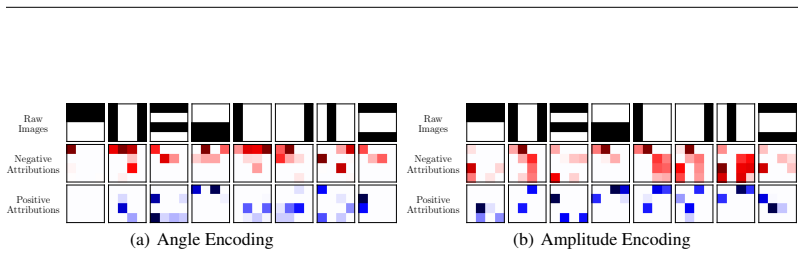
Summary. This paper proposes HattriQ, a method for computing integrated-gradients feature attributions for quantum machine learning models with amplitude embedding. The authors derive a closed-form expression for the gradient of the expectation value F(x)=⟨x|U†(θ)OU(θ)|x⟩ with respect to the real and imaginary parts of the amplitude-encoding coefficients (Lemma 3.1), and show that each gradient component can be estimated by a Hadamard-test circuit whose ancilla measurement probability encodes Re[⟨b_k|U†OU|x⟩] (Theorem 4.2). A multi-ancilla extension is proposed to compute several gradient components in parallel. The method is evaluated on binary classification tasks on Bars and Stripes, NIST, MNIST, and FashionMNIST, with attributions visualized for amplitude- and angle-encoded models and a shot-noise study.
Significance. The core idea—computing amplitude-coordinate gradients via a Hadamard test rather than via parameter-shift or state tomography—is appealing, and the algebra in Lemma 3.1 and Theorem 4.2 is correct for the unnormalized amplitude coordinates. If the gap described below is closed, the resulting tool would be a useful interpretability primitive for QML: it is hardware-compatible, avoids accessing internal quantum states, and the parallelization proposal is a reasonable resource-optimization idea. The manuscript also ships open-source code and gives detailed circuit constructions. However, the paper's advertised 'provably faithful' pixel-level attributions are not supported by the equations as written.
major comments (3)
- [§5.2, Eq. (2), Lemma 3.1] The paper's headline claim is 'provably faithful' attributions for input features (pixels). Lemma 3.1 gives the gradient with respect to amplitude coordinates c_k of a unit-norm state, not with respect to raw pixel values p_i. In §5.2 the pixels are mapped to amplitudes by the overflow encoding a_i = p_i/s and a_overflow = sqrt(1−Σ a_i^2); this map is nonlinear, and every pixel affects the overflow amplitude. The Jacobian ∂a/∂p is never written down; the sentence 'All of our discussion from before still applies upon simple modification using the chain rule' is not a derivation. Hence the quantities in Figs. 1–3 are not shown to be the integrated gradients of Eq. (2), and the completeness axiom need not hold. The same applies to the tanh output composition in §5.2.
- [Def. 2.2, §3.2] The IG path x′+α(x−x′) lies in raw feature space. For an amplitude-encoded model, the intermediate states are generally not normalized; the circuit model F in Eq. (1) is only defined for unit-norm states. The paper does not specify how to evaluate the model at non-normalized points (renormalization? overflow encoding applied at each α?), and Lemma 3.1's derivative is for the homogeneous extension F(c)=⟨c|O|c⟩, not the physical normalized expectation. The integral in Eq. (2) is therefore not formally defined for the amplitude-embedded model as described.
- [§5.4] The shot-noise study compares the sampled Hadamard-test estimates to exact evaluation of the same inner-product formula; this demonstrates sampling convergence, not attribution correctness. Because of the missing chain rule, the pixel-level attributions are never checked against the completeness axiom Σ_i IG_i = F(x)−F(x′) or any other ground truth. A direct completeness check on the actual encoded model would be a meaningful validation.
minor comments (6)
- [Abstract] The abstract mentions validation on 'TFIM quantum data', but no TFIM experiment appears anywhere in the paper.
- [Table 1] The class-pair lists include entries such as '(0,0)' that are not binary classification tasks, and the number of accuracy entries does not match the number of listed pairs for MNIST and NIST. Please correct.
- [Appendix A] The notation in the rewritten F(x) uses '⟨bi|x∗i⟩' in a confusing way; it should be x_i^* ⟨b_i|.
- [Appendix B] The expression for P(A=0) mixes vector norm and absolute value ('| 1/2 (|bk⟩+U†OU|x⟩)|^2'); clarify that this is the squared norm of the data-register component.
- [§4.3 / Appendix C] The control conditions for the parallel multi-ancilla circuit are not shown in the circuit diagram, and the general claim of 2^m−1 gradient components is only illustrated for m=2 without a proof for general m.
- [References] The reference for the COBYLA optimizer (page 10) is incomplete; author names are missing.
Circularity Check
No significant circularity: HattriQ's gradient and Hadamard-test derivations are self-contained; the overflow-encoding chain-rule gap is an omitted derivation, not a circular reduction.
full rationale
The central derivation is self-contained. Lemma 3.1 (Sec. 3.2, App. A) differentiates F(x)=⟨x|U†OU|x⟩ with the product rule and obtains ∂F/∂c_k = 2Re[⟨b_k|U†OU|x⟩]; this is a direct calculation from the definition of F, not an assumption of the result. Theorem 4.2 (Sec. 4.2, App. B) derives the ancilla probability P(A=0)=1/2(1+Re[⟨b_k|U†OU|x⟩]) from the Hadamard-test circuit; the circuit construction and proof are standard and do not invoke fitting or self-citation. The multi-ancilla extension is likewise derived by explicit calculation (App. C). Integrated gradients are then the integral of these gradients along the path of Eq. 2, following Sundararajan et al.; no parameter is fitted and then renamed as a prediction. Self-citations (DiBrita et al. 2024; Han et al. 2025; Luo et al. 2024; Cho et al. 2025) appear in the introduction/related work and are not load-bearing for Lemma 3.1 or Theorem 4.2; there is no imported uniqueness theorem and no ansatz smuggled through a self-citation. The real weakness is not circularity: Sec. 5.2 introduces the overflow amplitude encoding (and a tanh output) and asserts "All of our discussion from before still applies upon simple modification using the chain rule," but the Jacobian connecting raw pixel features to the overflow-normalized amplitudes is never written down. This is an omitted derivation in the path from amplitude gradients to the pixel attributions of Figs. 1–3; it undermines the empirical claim but is not an equivalence-by-construction of the kind counted as circular. For the mathematical object actually treated in the paper's lemmas (the homogeneous quadratic function of the amplitude vector), the derivation does not reduce to its inputs.
Axiom & Free-Parameter Ledger
free parameters (4)
- IG baseline =
all-zero (blank) image
- Pixel scaling factor for amplitude encoding =
features scaled into [0, (2^n−1)^(-1/2)]
- Number of measurement shots =
10, 100, 500, and exact simulation
- Ansatz depth =
1–2× qubit count per dataset
axioms (4)
- domain assumption Model output has the form F(x;θ) = ⟨x|U†(θ)OU(θ)|x⟩, with U unitary and O Hermitian.
- domain assumption The amplitude-encoded input state must have unit norm; the overflow encoding x → (x_i, sqrt(1−Σ|x_i|²)) maps pixel features to normalized states.
- ad hoc to paper The integrated-gradients path x′ + α(x−x′) is a valid domain for the model, and the amplitude-gradient formula ∂F/∂x_k = 2Re⟨b_k|U†OU|x⟩ applies along it.
- domain assumption The observable O must be both Hermitian and unitary so that U†OU can be implemented as a controlled gate.
Cite this review
Pith. "Pith review of HattriQ: Designing Integrated Gradients for Feature Attribution in Quantum Machine Learning." pith.science (2026). https://pith.science/paper/BQBIEPQQ
@misc{pith2026251002497,
  author       = {Pith},
  title        = {Pith review of: HattriQ: Designing Integrated Gradients for Feature Attribution in Quantum Machine Learning},
  year         = {2026},
  howpublished = {\url{https://pith.science/paper/BQBIEPQQ}},
  note         = {Machine review of arXiv:2510.02497}
}
read the original abstract
Quantum machine learning (QML) algorithms have demonstrated early promise across hardware platforms, but remain difficult to interpret due to the inherent opacity of quantum state evolution. Widely used classical interpretability methods, such as integrated gradients and surrogate-based sensitivity analysis, are not directly compatible with quantum circuits due to measurement collapse and the exponential complexity of simulating state evolution. In this work, we introduce HattriQ, a general-purpose framework for computing amplitude-based input-attribution scores in circuit-based QML models. HattriQ supports the widely-used input amplitude embedding feature encoding scheme and uses a Hadamard test-based construction to compute input gradients directly on quantum hardware to compute integrated gradient attributions. We validate HattriQ on classification tasks across several datasets (Bars and Stripes, MNIST, FashionMNIST, and TFIM quantum data).
Figures




Reference graph
Works this paper leans on
-
[2]
URL https://link.aps.org/doi/10.1103/RevModPhys.94.015004
doi: 10.1103/RevModPhys.94.015004. URL https://link.aps.org/doi/10.1103/RevModPhys.94.015004. Joseph Bowles, Shahnawaz Ahmed, and Maria Schuld. Better than classical? the subtle art of benchmarking quantum machine learning models.arXiv preprint arXiv:2403.07059,
-
[5]
Tiffany Duneau, Saskia Bruhn, Gabriel Matos, Tuomas Laakkonen, Katerina Saiti, Anna Pearson, Konstantinos Meichanetzidis, and Bob Coecke. Scalable and interpretable quantum natural language processing: an implementation on trapped ions.arXiv preprint arXiv:2409.08777,
-
[6]
11 Jason Han, Nicholas S DiBrita, Younghyun Cho, Hengrui Luo, and Tirthak Patel. Enqode: Fast amplitude embedding for quantum machine learning using classical data.arXiv preprint arXiv:2503.14473,
-
[8]
Satyapriya Krishna, Tessa Han, Alex Gu, Steven Wu, Shahin Jabbari, and Himabindu Lakkaraju. The disagreement problem in explainable machine learning: A practitioner’s perspective.arXiv preprint arXiv:2202.01602,
-
[9]
Quantum embeddings for machine learning.arXiv preprint arXiv:2001.03622,
Seth Lloyd, Maria Schuld, Aroosa Ijaz, Josh Izaac, and Nathan Killoran. Quantum embeddings for machine learning.arXiv preprint arXiv:2001.03622,
Pith/arXiv arXiv 2001
-
[12]
Association for Computational Linguistics. doi: 10.18653/v1/P18-1176. URL https://aclanthology.org/P18-1176/. Kim Nicoli, Christopher J Anders, Lena Funcke, Tobias Hartung, Karl Jansen, Stefan Kühn, Klaus- Robert Müller, Paolo Stornati, Pan Kessel, and Shinichi Nakajima. Physics-informed bayesian optimization of variational quantum circuits.Advances in Ne...
-
[13]
Maria Schuld and Nathan Killoran
URL https://proceedings.neurips.cc/ paper_files/paper/2024/file/386432c7534eec9a1cd7cbeea90d7e9f-Paper-Conference.pdf. Maria Schuld and Nathan Killoran. Quantum machine learning in feature hilbert spaces.Physical review letters, 122(4):040504,
2024
-
[14]
Supervised learning with quantum computers.Quantum science and technology (Springer, 2018),
Maria Schuld and Francesco Petruccione. Supervised learning with quantum computers.Quantum science and technology (Springer, 2018),
2018
-
[15]
URL https://link.aps.org/doi/10.1103/PhysRevA.99.032331
doi: 10.1103/ PhysRevA.99.032331. URL https://link.aps.org/doi/10.1103/PhysRevA.99.032331. 13 Maria Schuld, Alex Bocharov, Krysta M. Svore, and Nathan Wiebe. Circuit-centric quantum classifiers.Phys. Rev. A, 101:032308, Mar
-
[17]
Andrew G White, DFV James, William J Munro, and PG Kwiat
doi: 10.1038/s41592-019-0686-2. Andrew G White, DFV James, William J Munro, and PG Kwiat. Exploring hilbert space: Accurate characterization of quantum information.Physical Review A, 65(1):012301,
-
[18]
Yusen Wu, Bujiao Wu, Yanqi Song, Xiao Yuan, and Jingbo Wang
doi: 10.22331/q-2022-03-30-677. Yusen Wu, Bujiao Wu, Yanqi Song, Xiao Yuan, and Jingbo Wang. Learning the complexity of weakly noisy quantum states. InThe Thirteenth International Conference on Learning Representations,
-
[2013]
Pramod Kaushik Mudrakarta, Ankur Taly, Mukund Sundararajan, and Kedar Dhamdhere. Did the model understand the question? In Iryna Gurevych and Yusuke Miyao (eds.),Proceedings of the 56th Annual Meeting of the Association for Computational Linguistics (Volume 1: Long Papers), pp. 1896–1906, Melbourne, Australia, July
1906
-
[2018]
URL https://link.aps.org/doi/10.1103/ PhysRevA.98.032309
doi: 10.1103/PhysRevA.98.032309. URL https://link.aps.org/doi/10.1103/ PhysRevA.98.032309. 12 Ashley Montanaro and Ronald de Wolf. A survey of quantum property testing.arXiv preprint arXiv:1310.2035,
Pith/arXiv arXiv 2035
-
[2019]
Daniel Hothem, Ashe Miller, and Timothy Proctor. What is my quantum computer good for? quantum capability learning with physics-aware neural networks.arXiv preprint arXiv:2406.05636,
-
[2020]
URL https://link.aps.org/doi/10.1103/PhysRevA.101.032308
doi: 10.1103/PhysRevA.101.032308. URL https://link.aps.org/doi/10.1103/PhysRevA.101.032308. Daniel Silver, Tirthak Patel, William Cutler, Aditya Ranjan, Harshitta Gandhi, and Devesh Tiwari. Mosaiq: Quantum generative adversarial networks for image generation on nisq computers. In Proceedings of the IEEE/CVF International Conference on Computer Vision, pp....
-
[2022]
URL https://arxiv.org/abs/1811.04968. Kishor Bharti, Alba Cervera-Lierta, Thi Ha Kyaw, Tobias Haug, Sumner Alperin-Lea, Abhinav Anand, Matthias Degroote, Hermanni Heimonen, Jakob S. Kottmann, Tim Menke, Wai-Keong Mok, Sukin Sim, Leong-Chuan Kwek, and Alán Aspuru-Guzik. Noisy intermediate-scale quantum algorithms.Rev. Mod. Phys., 94:015004, Feb
-
[2023]
Multi-qubit rydberg gates between distant atoms.arXiv preprint arXiv:2507.16602,
Antonis Delakouras, Georgios Doultsinos, and David Petrosyan. Multi-qubit rydberg gates between distant atoms.arXiv preprint arXiv:2507.16602,
-
[2024]
Efficiently manipulating pauli strings with pauliarray.arXiv preprint arXiv:2405.19287,
Maxime Dion, Tania Belabbas, and Nolan Bastien. Efficiently manipulating pauli strings with pauliarray.arXiv preprint arXiv:2405.19287,
-
[2025]
Han Xiao, Kashif Rasul, and Roland V ollgraf. Fashion-mnist: a novel image dataset for benchmarking machine learning algorithms.arXiv preprint arXiv:1708.07747,
This paper was first reviewed by deepseek-v4-flash on August 4, 2026.
discussion (0)
Sign in with ORCID, Apple, or X to comment. Anyone can read and Pith papers without signing in.