REVIEW 3 major objections 5 minor 1 cited by
SADA: Stability-guided Adaptive Diffusion Acceleration
T0 review · 3 major / 5 minor · reviewed 2026-08-06 · deepseek-v4-flash
Pith's one-line read SADA claims a single stability sign, computed from the ODE velocity's second-order difference, decides between step-wise and token-wise pruning at each denoising step, giving ≥1.8× speedups at LPIPS ≤ 0.10 across SD-2, SDXL, and Flux.
desk verdict Practical training-free acceleration with broad experiments and public code, but the central stability criterion is asserted, not proved, and the paper's theoretical claims overreach. read the letter →
The pith
A machine-rendered reading of the paper's core claim, the machinery that carries it, and where it could break.
The reading
What carries the argument
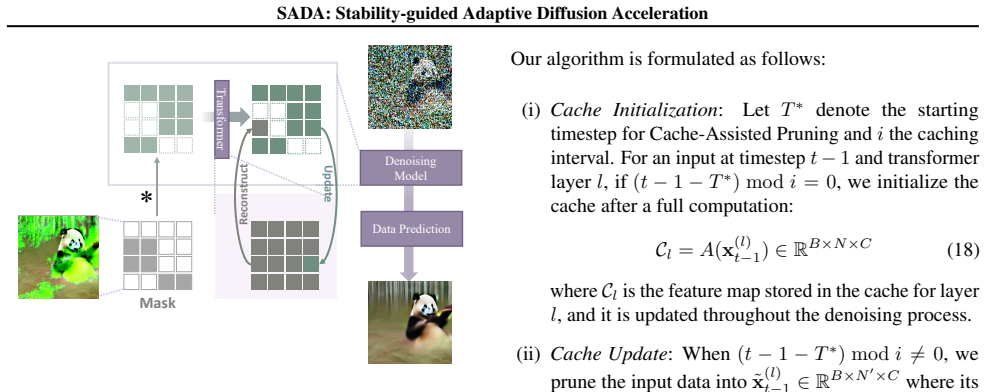
The load-bearing object is the velocity field $y_t = dx_t/dt$ supplied by the ODE solver—the probability-flow ODE right-hand side for diffusion models, or the learned vector field for flow-matching models—together with its second-order backward difference $\Delta^{(2)}y_t$, which measures local trajectory curvature. The argument runs through three linked mechanisms: (1) the claimed identity $\Delta^{(2)}y_t \cdot \Delta^{(3)}x_t < 0$, asserted to hold 'by construction' in Section 3.3, which converts a curvature sign into a statement about the extrapolation error $x_{t-1} - \hat{x}_{t-1} = \Delta^{(3)}x_{t-1}$; (2) the assumption that the sign of $\Delta^{(3)}x_t$ is consistent between consecutive steps in stable regimes, so the criterion can be evaluated from past and current values alone; and (3) two approximation schemes—the third-order Adams–Moulton estimator $\hat{x}_{t-1} = x_t - (5\Delta t/6)y_t - (5\Delta t/6)y_{t+1} + (2\Delta t/3)y_{t+2}$, whose output feeds the clean-sample estimate $\hat{x}^0_t$ used by DPM-Solver++ or EDM, and Lagrange interpolation over cached $x^{t_i}_0$ values for skipped steps in the stable phase. This machinery converts one Boolean sign into a per-timestep mode decision: step-wise pruning when the sign is negative, token-wise pruning when it is not.
What would settle it
On real sampling trajectories of SD-2, SDXL, or Flux, compute $\Delta^{(2)}y_t \cdot \Delta^{(3)}x_t$ at every timestep over many prompts: the 'always-hold' identity predicts the product is never positive, so any positive value—or any step where Criterion 3.4 returns 'stable' yet the Adams–Moulton extrapolation error $\|\hat{x}_{t-1} - x_{t-1}\|$ is large relative to neighboring steps—contradicts the safety guarantee. A second check targets the sign-consistency premise: count how often $\operatorname{sign}(\Delta^{(3)}x_t)$ flips between consecutive steps in the stable regime; a material flip rate would mean the criterion's sign is tracking noise rather than trajectory curvature.
Extended reading notes
Core claim
On the paper's own terms, the discovery is that local stability of the denoising trajectory is a sufficient per-step decision signal for choosing between two complementary sparsity mechanisms. Criterion 3.4 evaluates the sign of $(x_{t-1} - \hat{x}_{t-1}) \cdot \Delta^{(2)}y_t$, where $y_t = dx_t/dt$ is the velocity supplied by the ODE solver and $\hat{x}_{t-1}$ is a third-order extrapolation of the latent state; a negative sign declares the step stable and enables step-wise cache-assisted pruning, while a non-negative sign sends the computation into token-wise cache-assisted pruning. The framework pairs the criterion with two error-bounded approximations: a third-order Adams–Moulton extrapolation that feeds the clean-sample estimate $\hat{x}^0_t$ into the solver, and Lagrange interpolation over cached $x^{t_i}_0$ values once the trajectory enters the fidelity-improving regime. The paper further claims SADA is the first training-free framework to bridge numerical ODE solvers with sparsity-aware architecture optimizations, and supports the claim with consistent $\ge 1.8\times$ speedups at LPIPS $\le 0.10$ across SD-2, SDXL, and Flux.
Load-bearing premise
The safety of every pruning decision rests on the sign-alignment identity asserted without proof in Section 3.3—that the second-order difference of the ODE velocity and the third-order difference of the latent state always have opposite signs ($\Delta^{(2)}y_t \cdot \Delta^{(3)}x_t < 0$)—combined with the assumption that this sign stays consistent across consecutive steps in stable regimes; if either link fails, the criterion can mark a step as safe to prune when the extrapolated state is actually wrong.
Editorial extensions
If this is right
- Every tested configuration—SD-2, SDXL, and Flux, each with Euler/EDM and DPM-Solver++ at 50 steps—achieves $\ge 1.8\times$ end-to-end speedup relative to the unmodified pipeline, the paper's headline result.
- Fidelity relative to the unmodified baseline stays within LPIPS $\le 0.10$ and FID $\le 4.5$ in all tested configurations, which the paper characterizes as negligible perceptual deviation.
- Because the criterion consumes only solver-supplied gradients and cached features, the framework needs no training, no per-prompt search, and minimal hyperparameter tuning, making it a plug-in for ODE-based samplers.
- The stability signal transfers across pipelines and modalities: ControlNet is accelerated without any modification and MusicLDM reaches roughly $1.81\times$ speedup at about 0.01 spectrogram LPIPS.
- The speedup persists under few-step sampling—about $1.5\times$ at 25 steps and $1.25\times$ at 15 steps—with improved relative fidelity as error accumulation shrinks.
Reading between the lines
- The asserted identity $\Delta^{(2)}y_t \cdot \Delta^{(3)}x_t < 0$ can be checked directly on real diffusion runs; counting how often the product is positive across timesteps and prompts, and correlating violations with extrapolation-error spikes, would provide a quick robustness audit that the paper's experiments do not isolate.
- The two-phase trajectory split (semantic-planning, then fidelity-improving) is inherited from prior work rather than derived from the criterion; letting the stability signal itself locate the phase boundary would remove a hidden tuning assumption and might improve few-step regimes.
- Because the criterion's informativeness depends on how well third-order differences track the local trajectory, its safety margin is likely thinner with higher-order solvers that already produce very smooth trajectories and fatter with first-order Euler steps—a testable prediction that SADA's quality advantage concentrates in the Euler setting.
- The token-wise branch reconstructs pruned tokens from cached attention outputs, so per-layer cache staleness—how fast attention outputs drift between cache updates—is the natural quantity to measure for setting per-layer prune ratios instead of a single global mask.
Editorial analysis
A structured set of objections, weighed in public.
Referee Report
Summary. The paper proposes SADA, a training-free framework that accelerates ODE-based diffusion and flow-matching sampling by adaptively choosing between step-wise and token-wise sparsity at every timestep. The mode is selected by a stability criterion (Criterion 3.4, Eq. 13) that compares the extrapolation error with the second-order difference of the ODE velocity. Step-wise pruning uses a third-order extrapolation / Adams-Moulton estimator and, in stable regimes, Lagrange interpolation over cached clean estimates; token-wise pruning uses cached attention outputs. Experiments on SD-2, SDXL, and Flux with EDM and DPM++ solvers report 1.8--2.0x speedups with LPIPS <= 0.10, plus ControlNet and MusicLDM results.
Significance. If the stability criterion and the error bounds were valid, SADA would be a practically valuable training-free plug-in that unifies step-wise and token-wise sparsity using numerical solver information. The empirical evaluation is a genuine strength: it covers multiple architectures, schedulers, and modalities, is grounded in external prompts (MS-COCO), and the code is released. However, the theoretical core that distinguishes SADA from a well-tuned heuristic is not established. The central safety guarantee rests on an asserted sign identity that is not an identity and on a sign-consistency assumption that is not proven; the cited error bounds are not actually derived. The empirical results are plausible evidence of heuristic effectiveness, but the paper's claim of a 'principled' mechanism overreaches what is shown.
major comments (3)
- [Section 3.3, Eq. (13), Criterion 3.4] The sentence 'we leverage the always-hold identity Delta^(2)y_t . Delta^(3)x_t < 0 by construction' is not correct for general trajectories. For a constant-velocity trajectory x_t = c t (hence y_t = c), both Delta^(2)y_t and Delta^(3)x_t vanish, so the product is 0, not <0, and Criterion 3.4 classifies a perfectly stable step as unstable. For a general smooth trajectory, a Taylor expansion gives Delta^(2)y_t = h^2 x'''_t + O(h^3) and Delta^(3)x_t = -h^3 x'''_t + O(h^4), so the leading product is -h^5 (x''')^2 plus higher-order terms; when x''' is small relative to higher derivatives, or where x''' changes sign, the product can be zero or positive. The non-uniform EDM and DPM++ schedules used in the experiments do not exclude these cases. Since this single Boolean routes every timestep into step-wise or token-wise pruning, the claimed safety guarantee is unsupported without a genuine proof or an explicit relaxation to a heuristic.
- [Section 3.3, paragraph after Theorem 3.3] The sign-consistency assumption 'sign(Delta^(3)x_t) = sign(Delta^(3)x_{t-1}) in a stable regime' is asserted without proof, and Theorems 3.2 and 3.3 do not supply it. Theorem 3.2 is a statement about the expectation E[x_t] over x0, epsilon, and t; it says nothing about the sign of third-order finite differences along an individual sample path even if corrected (as written, it also mishandles the expectation over t: E_t[sqrt(alpha_t)] E[x0] is the correct form when t is random). Theorem 3.3 is a consistency property in expectation; it does not imply pointwise sign relations. A pointwise sign relation would require uniform bounds on the relevant derivatives with controlled remainder terms, which are absent. This assumption is load-bearing because the criterion substitutes Delta^(3)x_{t-1}, which is computable, for Delta^(3)x_t, which appears in the asserted identity.
- [Section 3.4, Theorem 3.6 and Appendix B.2] Theorem 3.6 is presented in the main text as the reconstruction error bound for the step-wise scheme, but it is not derived. The 'proof' in Appendix B.2 consists of one inequality with unspecified constants and identifies ||hat(x)_t - x_t|| with O(Delta t), whereas Theorem 3.5 states that the extrapolated state has error O(Delta t^2). The term O(Delta x_t) is not defined: it is not clear whether Delta x_t means ||x_t - x_{t-1}||, ||hat(x)_t - x_t||, or the variation of the clean estimate, and no derivation is given for how the scheduler step size enters the final bound. As written, this theorem cannot be used to claim that the approximation is 'error-bounded' in any quantitative sense.
minor comments (5)
- [Section 3.3] The finite-difference operators Delta^(2)y_t and Delta^(3)x_t are used in Criterion 3.4 and the preceding text, but only Delta^(1)x_t is defined in Section 3.1. Please define all operators used, including the sign/index convention.
- [Equation (13)] The index convention is inconsistent: the criterion tests (x_{t-1} - hat(x)_{t-1}) . Delta^(2)y_t < 0, while the derivation concerns Delta^(3)x_t and Delta^(2)y_t at the same index. Make the index shift explicit and verify that the sign convention in Eq. (13) matches the backward-difference definitions.
- [Theorem 3.5 and Appendix B.2] The theorem says 'using the second- and third-order Adams-Moulton method' but only one estimator is given. The reverse-time Adams-Moulton formula in Eq. (A.43) appears to have a sign inconsistency relative to the standard AM3 coefficients; please state precisely which method is used and how the coefficients are derived.
- [Section 4.1 and Table 1] The FID numbers are described as being computed 'between original generated and accelerated samples.' This is a distributional distance between two generated sets, not the standard FID between generated and real images, and the absolute values are therefore not comparable to FID numbers reported elsewhere. The text should state this explicitly to avoid misleading readers.
- [Table 2 and Figure 3] The few-step ablation reports speedups of about 1.25--1.5x, so the abstract's 'consistent >=1.8x speedups' is only true for the 50-step setting; please qualify this claim in the abstract and conclusion. Also, Figure 3's right panel would benefit from a precise statement of what is averaged and over which steps.
Circularity Check
The stability criterion is defined via the same extrapolation error it is supposed to certify; the empirical results remain external and not fitted.
-
self definitional
[Section 3.3, Criterion 3.4 / Eq. (13)]
"To incorporate precise gradient information, we leverage the always-hold identity ∆(2)yt · ∆(3)xt < 0 by construction. Combining the sign measure with the identity, we substitute ∆(3)xt with ∆(3)xt−1 = xt−1 − ˆxt−1 and yield the following criterion: Criterion 3.4. A timestep t is considered stable and eligible for acceleration if the extrapolation error is anti-aligned with the local curvature of velocity: (xt−1 − ˆxt−1) · ∆(2)yt < 0."
By the paper's own definition, ˆxt−1 = 3xt − 3xt+1 + xt+2 and xt−1 − ˆxt−1 = ∆(3)xt−1. Hence Eq. (13) is exactly sign(∆(3)xt−1 · ∆(2)yt) < 0. The 'always-hold identity' is not proven; at leading order it is the Taylor product −h^5(x''')^2, and for linear/quadratic trajectories the product is 0, so the identity is not universal. The criterion restates the sign of the same third-order term that defines the step-wise extrapolation error it is supposed to certify. Since the identity is claimed for every t, the criterion's False (token-wise) branch is excluded by the paper's own premise, so the Boolean cannot independently discriminate stable from unstable steps.
full rationale
The main empirical contribution is self-contained: SADA is benchmarked against external baselines (DeepCache, AdaptiveDiffusion, TeaCache) on MS-COCO-2017, so the reported speedup/fidelity numbers are not fitted to the data. The theoretical safety argument, however, contains one partial circularity: Criterion 3.4 is defined through the same third-order extrapolation error that step-wise pruning uses, and its 'always-hold identity' is asserted by construction rather than proved. This makes the decision rule and the proof of safety rest on the same finite-difference term, and the paper's own premise excludes the False (token-wise) branch. The unproven identity and the additional sign-consistency assumption in Section 3.3 are the load-bearing weak points; the identity is a correctness risk even if the heuristic works in practice. Self-citations (e.g., Yang et al. 2023 for boundary Lipschitz continuity) are not load-bearing. Score 3 reflects partial theoretical circularity with independent empirical content.
Assumptions & free parameters
free parameters (3)
- Multistep-wise Lagrange interpolation interval =
4 (50-step); adjusted for 15/25-step
- Token cache refresh interval i =
not reported
- Cache start timestep T* =
not reported
assumptions (4)
- domain assumption Assumption 1: the network output e_theta(x_t,t) is jointly Lipschitz continuous in x_t and t.
- ad hoc to paper Sign-consistency assumption: in a stable regime, sign of third-order difference is consistent between consecutive steps.
- ad hoc to paper Always-hold identity: second-order difference of velocity times third-order difference of state is always negative.
- standard math The clean-sample trajectory x_t^0 is (k+1)-times continuously differentiable in t over the interpolation interval.
Cite this review
Pith. "Pith review of SADA: Stability-guided Adaptive Diffusion Acceleration." pith.science (2026). https://pith.science/paper/BRXWPVLT
@misc{pith2026250717135,
  author       = {Pith},
  title        = {Pith review of: SADA: Stability-guided Adaptive Diffusion Acceleration},
  year         = {2026},
  howpublished = {\url{https://pith.science/paper/BRXWPVLT}},
  note         = {Machine review of arXiv:2507.17135}
}
abstract
Diffusion models have achieved remarkable success in generative tasks but suffer from high computational costs due to their iterative sampling process and quadratic attention costs. Existing training-free acceleration strategies that reduce per-step computation cost, while effectively reducing sampling time, demonstrate low faithfulness compared to the original baseline. We hypothesize that this fidelity gap arises because (a) different prompts correspond to varying denoising trajectory, and (b) such methods do not consider the underlying ODE formulation and its numerical solution. In this paper, we propose Stability-guided Adaptive Diffusion Acceleration (SADA), a novel paradigm that unifies step-wise and token-wise sparsity decisions via a single stability criterion to accelerate sampling of ODE-based generative models (Diffusion and Flow-matching). For (a), SADA adaptively allocates sparsity based on the sampling trajectory. For (b), SADA introduces principled approximation schemes that leverage the precise gradient information from the numerical ODE solver. Comprehensive evaluations on SD-2, SDXL, and Flux using both EDM and DPM++ solvers reveal consistent $\ge 1.8\times$ speedups with minimal fidelity degradation (LPIPS $\leq 0.10$ and FID $\leq 4.5$) compared to unmodified baselines, significantly outperforming prior methods. Moreover, SADA adapts seamlessly to other pipelines and modalities: It accelerates ControlNet without any modifications and speeds up MusicLDM by $1.8\times$ with $\sim 0.01$ spectrogram LPIPS.
Figures


Figures from the paper (4 more)



Forward citations
Cited by 1 Pith paper
-
Seeing the End at Step Zero: Accelerating Diffusion MLLMs via MLP Sparsity-Aware Truncation
A diffusion multimodal LLM's early-layer MLP sparsity at denoising step 0 pinpoints the semantic boundary, enabling one-shot suffix truncation that raises throughput up to ~31x.
Reference graph
Works this paper leans on
-
[1]
Albergo, M. S. and Vanden-Eijnden, E. Building normal- izing flows with stochastic interpolants. arXiv preprint arXiv:2209.15571,
-
[2]
Z., Perez-Rua, J.-M., and Schmid- huber, J
Liu, H., Zhang, W., Xie, J., Faccio, F., Xu, M., Xi- ang, T., Shou, M. Z., Perez-Rua, J.-M., and Schmid- huber, J. Faster diffusion through temporal attention 10 SADA: Stability-guided Adaptive Diffusion Acceleration decomposition. Transactions on Machine Learning Re- search, 2025b. ISSN 2835-8856. URL https:// openreview.net/forum?id=xXs2GKXPnH. Liu, X.,...
-
[5]
Timestep embedding tells: It’s time to cache for video diffusion model
Liu, F., Zhang, S., Wang, X., Wei, Y ., Qiu, H., Zhao, Y ., Zhang, Y ., Ye, Q., and Wan, F. Timestep embedding tells: It’s time to cache for video diffusion model. arXiv preprint arXiv:2411.19108,
-
[9]
Dpm-solver: A fast ode solver for diffusion probabilistic model sampling in around 10 steps
Lu, C., Zhou, Y ., Bao, F., Chen, J., Li, C., and Zhu, J. Dpm-solver: A fast ode solver for diffusion probabilistic model sampling in around 10 steps. Advances in Neural Information Processing Systems, 35:5775–5787, 2022a. Lu, C., Zhou, Y ., Bao, F., Chen, J., Li, C., and Zhu, J. Dpm- solver++: Fast solver for guided sampling of diffusion probabilistic mo...
-
[10]
U-net: Con- volutional networks for biomedical image segmenta- tion
Ronneberger, O., Fischer, P., and Brox, T. U-net: Con- volutional networks for biomedical image segmenta- tion. In Medical image computing and computer-assisted intervention–MICCAI 2015: 18th international confer- ence, Munich, Germany, October 5-9, 2015, proceedings, part III 18, pp. 234–241. Springer,
work page 2015
-
[12]
Training-Free Adaptive Diffusion with Bounded Difference Approximation Strategy
Ye, H., Yuan, J., Xia, R., Yan, X., Chen, T., Yan, J., Shi, B., and Zhang, B. Training-free adaptive diffusion with bounded difference approximation strategy. arXiv preprint arXiv:2410.09873,
-
[13]
Ditfastattn: Attention compression for diffusion transformer models
Yuan, Z., Zhang, H., Lu, P., Ning, X., Zhang, L., Zhao, T., Yan, S., Dai, G., and Wang, Y . Ditfastattn: Attention compression for diffusion transformer models. arXiv preprint arXiv:2406.08552,
-
[14]
Token pruning for caching better: 9 times acceleration on stable diffusion for free
Zhang, E., Xiao, B., Tang, J., Ma, Q., Zou, C., Ning, X., Hu, X., and Zhang, L. Token pruning for caching better: 9 times acceleration on stable diffusion for free. arXiv preprint arXiv:2501.00375,
Show all 15 references
-
[15]
Ac- celerating diffusion transformers with token-wise feature caching
Zou, C., Liu, X., Liu, T., Huang, S., and Zhang, L. Ac- celerating diffusion transformers with token-wise feature caching. arXiv preprint arXiv:2410.05317,
-
[1971]
Lumina-t2x: Transforming text into any modality, resolution, and du- ration via flow-based large diffusion transformers
Gao, P., Zhuo, L., Liu, D., Du, R., Luo, X., Qiu, L., Zhang, Y ., Lin, C., Huang, R., Geng, S., et al. Lumina-t2x: Transforming text into any modality, resolution, and du- ration via flow-based large diffusion transformers. arXiv preprint arXiv:2405.05945,
-
[2015]
G., and Nickabadi, A
Saghatchian, O., Moghadam, A. G., and Nickabadi, A. Cached adaptive token merging: Dynamic token reduc- tion and redundant computation elimination in diffusion model. arXiv preprint arXiv:2501.00946,
-
[2017]
and Salimans, T
Ho, J. and Salimans, T. Classifier-free diffusion guidance. arXiv preprint arXiv:2207.12598,
-
[2022]
and Song, Y
Lu, C. and Song, Y . Simplifying, stabilizing and scal- ing continuous-time consistency models. arXiv preprint arXiv:2410.11081,
-
[2023]
Pixart-σ: Weak-to-strong training of diffusion transformer for 4k text-to-image generation
Chen, J., Ge, C., Xie, E., Wu, Y ., Yao, L., Ren, X., Wang, 9 SADA: Stability-guided Adaptive Diffusion Acceleration Z., Luo, P., Lu, H., and Li, Z. Pixart-σ: Weak-to-strong training of diffusion transformer for 4k text-to-image generation. In European Conference on Computer V...
2024 arXiv
-
[2024]
Timestep embedding tells: It’s time to cache for video diffusion model
Liu, F., Zhang, S., Wang, X., Wei, Y ., Qiu, H., Zhao, Y ., Zhang, Y ., Ye, Q., and Wan, F. Timestep embedding tells: It’s time to cache for video diffusion model. In Proceedings of the IEEE/CVF Conference on Computer Vision and Pattern Recognition (CVPR), Nashville, TN, USA, ...
2025
Reviewed August 6, 2026 · model on record in the stance chip above.
Discussion (0). Sign in to comment.