REVIEW 4 major objections 6 minor 15 references
This paper claims that label noise in graphs can be reliably detected by measuring influence contradiction—diffusion-weighted influence from other classes—and corrected with a soft neighbor-aware scheme, yielding top node-classification acc
Reviewed by Pith at T0; open to challenge. T0 means a machine referee read the full paper against a public rubric. the ladder, T0–T4 →
T0 review · deepseek-v4-flash
2026-08-03 08:16 UTC pith:BSPGHUIO
load-bearing objection ICGNN is a practical, well-tested noise-robust GNN pipeline with a genuinely new ICS detector; the 'consistent SOTA' claim is a bit ahead of its own significance tests, but the paper deserves serious review. the 4 major comments →
Identifying and Correcting Label Noise for Robust GNNs via Influence Contradiction
The pith
A machine-rendered reading of the paper's core claim, the machinery that carries it, and where it could break.
Core claim
The central claim is that a graph-structure-aware noise indicator—the influence contradiction score (ICS)—can separate clean from noisy labeled nodes more reliably than loss-based criteria. ICS aggregates, for each labeled node, the diffusion-weighted influence arriving from nodes annotated with other classes, using a personalized PageRank diffusion matrix over the original graph and over a K-nearest-neighbor graph built from node representations. A Gaussian mixture model turns these scores into per-node confidence of being clean; noisy labels are then corrected by a convex combination of the original label and a soft neighbor-aggregated prediction, and pseudo-labels from unlabeled nodes add
What carries the argument
The influence contradiction score (ICS), Eqs. (3)–(5), is the central object: for each labeled node i it sums the normalized diffusion influence arriving from all nodes annotated with other classes, at both the structure level (graph diffusion matrix T) and attribute level (diffusion on a KNN affinity graph R). High ICS signals a label that conflicts with the node's neighborhood. A two-component Gaussian mixture model with expectation-maximization assigns a clean-label confidence β̂_i; the label update in Eq. (6) uses β̂_i to interpolate between the original label and h(z_i), a softmax over diffusion-weighted neighbor predictions (Eq. 7); Eq. (8) adds pseudo-label supervision from unlabeled
Load-bearing premise
The method assumes connected nodes tend to share the same class, so a labeled node that receives strong influence from other classes must have a wrong label; on heterophilic graphs or with class-correlated noise, that premise fails and high contradiction can simply reflect structural position.
What would settle it
Take a heterophilic two-class graph (e.g., an alternating ring or bipartite core) and inject 20% uniform label noise. Compute ICS for all labeled nodes and measure the clean/noisy separation (e.g., AUROC against ground-truth noise flags). If ICS's AUROC is statistically indistinguishable from chance while a feature-only classifier's is not, the central detection claim fails. Alternatively, on any of the paper's datasets, raise pair noise to 60%: the paper already reports accuracy falling to 20–47%; if a trivial baseline that ignores labels achieves comparable accuracy on the same noise, the la
If this is right
- If the homophily assumption holds, ICS separates clean from noisy labeled nodes more cleanly than the small-loss criterion, as supported by the paper's confidence-distribution plots.
- Soft correction—mixing the original label with neighbor-averaged predictions—reduces confirmation bias compared with hard neighbor voting; the ablation study shows a clear drop in accuracy when noise cleaning is removed.
- Fusing structure- and attribute-level ICS (α = 0.5) outperforms either alone, with the optimal blend depending on graph density; sparse graphs favor attribute information.
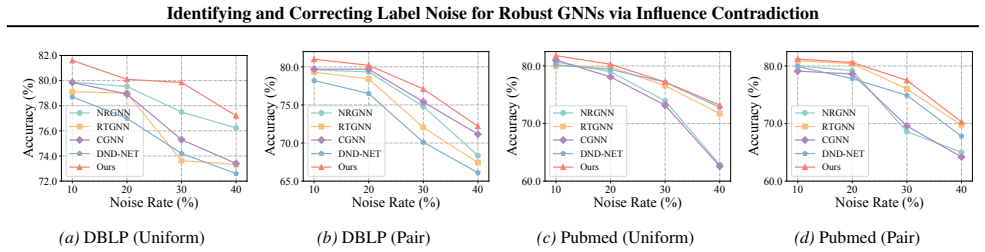
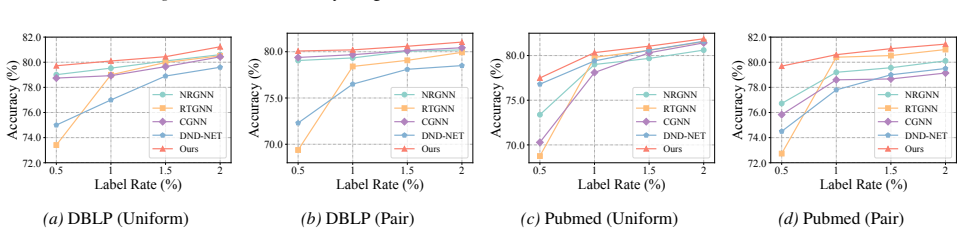
- Pseudo-labeling unlabeled nodes via diffusion-weighted neighbor predictions helps at both low label rates and high noise rates; removing it degrades accuracy even at 60–80% noise.
- The method is GNN-agnostic and scales to OGBN-arxiv, where some baselines run out of memory.
Where Pith is reading between the lines
- Because ICS is a sum of diffusion influence, it conflates 'boundary position' with 'wrong label': on heterophilic graphs or when noise is class-correlated, clean boundary nodes may receive high contradiction. A testable extension is to calibrate ICS against a structural-role baseline before trusting it in such regimes.
- The GMM's two-component assumption presumes a bimodal ICS distribution; under intermediate noise rates the modes may merge. A natural extension is to make the number of components adaptive or use a continuous confidence regression.
- The correction in Eq. (6) trusts the classifier's own neighbor predictions, which can propagate early errors; an ensemble or a smaller held-out clean set for computing h(z_i) could harden the method when the classifier is weak or noise is high.
- The paper tests a learnable α and finds it worse than the fixed 0.5, suggesting that an effective adaptive fusion of structure and attribute information remains an open problem worth exploring.
Editorial analysis
A structured set of objections, weighed in public.
Referee Report
Summary. The paper proposes ICGNN, a method for semi-supervised node classification on graphs with noisy labels. It introduces an Influence Contradiction Score (ICS) computed from graph diffusion (structure level) and from a KNN graph built on learned representations (attribute level), fuses the two scores, and fits a two-component Gaussian mixture model to assign each labeled node a clean-label confidence. Noisy labels are then corrected by a soft convex combination of the original label and neighbor predictions, and pseudo-labels for unlabeled nodes are generated in the same way. The method is evaluated on six benchmark datasets under 20% uniform and pair noise, with additional robustness sweeps, ablations, and large-scale/heterophilous tests (OGBN-arxiv, Cornell). The central claim is that ICGNN consistently achieves the highest accuracy across all datasets and noise types in Table 1.
Significance. If the empirical claim is sustained, ICGNN would be a practically attractive addition to the noisy-label GNN literature: it combines a graph-structure-aware detector with a soft correction scheme and pseudo-labeling, and the paper provides broad comparisons against strong baselines, ablations, robustness curves, a large-scale test, and a code link. The diagnostic evidence in Figure 5 (ICS/GMM confidence separation versus small-loss overlap) is a useful contribution if it holds across datasets. However, the paper's main claim is explicitly empirical, and the statistical support reported in Table 2 is not strong enough to support the 'consistently highest' wording. The significance of the work therefore depends on whether the authors can either provide stronger statistical evidence or appropriately hedge the claim.
major comments (4)
- [§4.2, Table 2, Observation (iii)] The central claim 'Across all datasets and noise types, our ICGNN consistently attains the highest performance' is stronger than the paper's own significance tests. For Pubmed, the margins over the runner-up are only 0.2–0.3 percentage points (80.3 vs 80.1 uniform; 80.6 vs 80.4 pair) and the reported Wilcoxon p-values are 0.1474 and 0.1050, which are not significant even at the 0.1 level used by the authors. With five runs per method, the rank-sum test cannot reliably resolve such small differences. Moreover, no multiple-comparison correction is applied across the 12 dataset/noise-type comparisons; at a Bonferroni-corrected threshold of about 0.0083, only the Amazon Photo uniform comparison would remain significant. Please report effect sizes/confidence intervals, use more seeds or a paired test, or restrict the claim to datasets where significance is established.
- [§3.1, Eqs. (3)–(5), (7); §4.8; Appendix D.4, Table 7] The detection and correction logic depends on the homophily premise that connected nodes tend to share the same class. On heterophilous graphs, a high ICS can indicate a node's genuine structural position rather than a wrong label. The Cornell experiment is only a single dataset with no significance test, and Appendix D.4 shows that at 60%/80% uniform noise, ICGNN accuracy drops to 47.0/26.0, while the text concedes that 'when the noise ratio becomes excessively high, utilizing these incorrect label information may do more harm than good.' This limitation should be stated in the main robustness discussion, and the claim of 'consistently greater resilience' should be qualified.
- [§3.3 and §4.7, Eq. (2)] The complexity analysis is not reconciled with Eq. (2), which defines T as the inverse of an N×N matrix. Computing T exactly would require O(N^3) time and O(N^2) memory, making the OGBN-arxiv result in Table 5 infeasible. The method must therefore be using an approximate diffusion (e.g., power iteration), but the approximation is not specified, and its computational cost and accuracy are not analyzed. Please state the algorithm used to compute T and R, and revise the complexity analysis accordingly.
- [Algorithm 1, step 6; §3.1; Appendix C.2] The attribute-level ICS is recomputed each epoch from the current encoder's representations, and those representations are trained with the GMM-corrected labels. Although Appendix C.2 correctly notes that no gradients flow through the ICS/GMM operations, the loop still feeds corrected labels back into the encoder, which in turn affects future attribute-level ICS values. The two-component GMM split is therefore not an independent assessment of clean versus noisy labels; it is an identifiability assumption that is not proven. Please validate the detector against the known noise mask on the benchmark datasets (e.g., precision and recall of detected noisy nodes), or discuss why this feedback cannot converge to a self-confirming but incorrect split.
minor comments (6)
- [Figure 1] The caption contains the placeholder text '在此处键入公式' ('insert formula here'), which should be removed.
- [Eqs. (3)–(4)] The index convention is unclear. The text says each row of T is an outward influence distribution, but Eq. (3) sums T_{ki} over k for a fixed i, which is a column operation. Also define whether the class-index sets C_j refer to labeled nodes only or to all nodes.
- [§4.4] The sentence 'CRGNN and ProCon is excluded from the comparison due to its relatively weak performance' contains a subject–verb agreement error and should specify which comparison and what threshold defines 'weak.'
- [§4.1 / §4.5] Sensitivity for the two other hyperparameters, the teleport probability ε and the number of nearest neighbors K, is not reported. Please either include a sensitivity table or state explicitly that Table 1 is conditional on these defaults.
- [Appendix D.4, Table 7] The observation that very high noise rates make the label information harmful is an important limitation. It should appear in the main text's robustness discussion rather than only in an appendix, since it bounds the meaning of 'robust.'
- [§3.1, GMM paragraph] The statement that the EM algorithm 'will converge eventually with theoretical guarantees' should cite the standard EM convergence theorem or be softened, since local convergence is what is guaranteed.
Circularity Check
No significant circularity; the load-bearing empirical claim is measured against clean test labels and external baselines, and no fitted quantity is renamed as a prediction.
full rationale
The paper's central claim is the test-set accuracy in Table 1, evaluated on clean test labels and compared with external baselines. None of the reported accuracies are defined by the method's own fitted values. ICS (Eq. 3) is a graph-diffusion statistic computed from the noisy labels and graph structure, used as a heuristic noise indicator under an explicit homophily assumption; it is not a derived prediction that reduces to its inputs. The GMM (Section 3.1) is fit to ICS values, and its posterior is used as a soft weight in label correction (Eq. 6), but the final classification accuracy is not the GMM's cluster assignment, so this is a clustering/self-training loop rather than a tautology. The pseudo-labeling loss (Eqs. 7-8) trains the model to match neighbor-aggregated predictions, a standard self-training technique; the paper does not claim a first-principles derivation whose conclusion is equivalent to its premise. Self-citations (Ju et al. 2024a/b, Yuan et al. 2023) appear only in related work and baseline comparisons and are not load-bearing. The statistical significance of the 'consistently highest' claim is weak in places (e.g., Pubmed p=0.1474/0.1050 in Table 2, with no multiple-comparison correction), and the homophily assumption and high-noise degradation (Table 7) are real limitations, but these are correctness/robustness concerns, not circularity under the definitions used here.
Axiom & Free-Parameter Ledger
free parameters (4)
- α (ICS fusion weight) =
0.5
- ε (teleport probability) =
0.85
- K (KNN neighbors for representation affinity graph) =
5
- GMM component parameters (μ_q, σ_q, π_q) =
estimated by EM on per-node ICS values
axioms (5)
- domain assumption Homophily: connected nodes tend to belong to the same class (Section 3.1).
- standard math Personalized PageRank diffusion matrix T is a valid global influence measure (Eq. (2)).
- ad hoc to paper EM on a two-component GMM converges to a useful clean/noisy separation of ICS values (Section 3.1).
- domain assumption KNN graph in representation space approximates attribute-level influence (Eq. (4)).
- domain assumption Soft labels from neighbor predictions are a reliable correction signal (Eqs. (6)-(7)).
read the original abstract
Graph Neural Networks (GNNs) have shown remarkable capabilities in learning from graph-structured data with various applications such as social analysis and bioinformatics. However, the presence of label noise in real scenarios poses a significant challenge in learning robust GNNs, and their effectiveness can be severely impacted when dealing with noisy labels on graphs, often stemming from annotation errors or inconsistencies. To address this, in this paper we propose a novel approach called ICGNN that harnesses the structure information of the graph to effectively alleviate the challenges posed by noisy labels. Specifically, we first design a novel noise indicator that measures the influence contradiction score (ICS) based on the graph diffusion matrix to quantify the credibility of nodes with clean labels, such that nodes with higher ICS values are more likely to be detected as having noisy labels. Then we leverage the Gaussian mixture model to precisely detect whether the label of a node is noisy or not. Additionally, we develop a soft strategy to combine the predictions from neighboring nodes on the graph to correct the detected noisy labels. At last, pseudo-labeling for abundant unlabeled nodes is incorporated to provide auxiliary supervision signals and guide the model optimization. Experiments on benchmark datasets show the superiority of our approach over competitive baselines in noisy label scenarios.
Figures



Reference graph
Works this paper leans on
-
[2]
A comprehensive survey on deep graph representation learning.Neural Networks, 173:106207, 2024a
Ju, W., Fang, Z., Gu, Y ., Liu, Z., Long, Q., Qiao, Z., Qin, Y ., Shen, J., Sun, F., Xiao, Z., et al. A comprehensive survey on deep graph representation learning.Neural Networks, 173:106207, 2024a. Ju, W., Mao, Z., Yi, S., Qin, Y ., Gu, Y ., Xiao, Z., Wang, Y ., Luo, X., and Zhang, M. Hypergraph-enhanced dual semi-supervised graph classification.arXiv pr...
-
[7]
It demonstrates the effectiveness of our pseudo-labeling approach
When the noise ratio becomes too high, although the pseudo-labeling technique inevitably generates incorrect labels, we observed that removing the pseudo-label loss results in even worse performance. It demonstrates the effectiveness of our pseudo-labeling approach. Furthermore, our proposed pseudo-labeling technique relies on predictions from neighboring...
2017
-
[9]
Learning on graphs under label noise
Yuan, J., Luo, X., Qin, Y ., Zhao, Y ., Ju, W., and Zhang, M. Learning on graphs under label noise. InICASSP 2023-2023 IEEE International Conference on Acoustics, Speech and Signal Processing (ICASSP), pp. 1–5. IEEE,
2023
-
[13]
and GIN (Xu et al., 2018)) under uniform noise for comparison, shown in Table
2018
-
[15]
From the above tables, it can be clearly observed that our method consistently outperforms both categories (LLN methods and GLN methods) across all datasets, which demonstrates its effectiveness in handling noisy labels in graph data. By detecting noisy labels through the influence contradiction score and GMM, and further applying a neighbor-based soft co...
2018
-
[1998]
NT, H., Jin, C. J., and Murata, T. Learning graph neural networks with noisy labels.arXiv preprint arXiv:1905.01591,
Pith/arXiv arXiv 1905
-
[2008]
Pitfalls of graph neural network evaluation.arXiv preprint arXiv:1811.05868,
Shchur, O., Mumme, M., Bojchevski, A., and G¨unnemann, S. Pitfalls of graph neural network evaluation.arXiv preprint arXiv:1811.05868,
-
[2016]
In contrast, spatial-based methods involve GNNs that directly process node feature representations and their neighbors, enabling localized message passing (Gilmer et al., 2017)
utilizes Chebyshev polynomials to efficiently approximate graph convolutions and capture spectral information, enabling the model to learn meaningful representations of nodes in the graph. In contrast, spatial-based methods involve GNNs that directly process node feature representations and their neighbors, enabling localized message passing (Gilmer et al...
2017
-
[2017]
Diffusion improves graph learning.arXiv preprint arXiv:1911.05485,
Klicpera, J., Weißenberger, S., and G ¨unnemann, S. Diffusion improves graph learning.arXiv preprint arXiv:1911.05485,
Pith/arXiv arXiv 1911
-
[2018]
Nagaraj et al
employs two networks that are trained to identify clean samples, and iteratively exchange and refine each other. Nagaraj et al. (2025) introduce the problem of temporal label noise in time series classification and develop methods that estimate time-dependent noise functions to train more robust classifiers. However, these methods encounter obstacles when...
2025
-
[2019]
Li, J., Socher, R., and Hoi, S. C. Dividemix: Learning with noisy labels as semi-supervised learning.arXiv preprint arXiv:2002.07394,
Pith/arXiv arXiv 2002
-
[2020]
Chen, L.-H., Zhang, Y ., Huang, T., Su, L., Lin, Z., Xiao, X., Xia, X., and Liu, T. Erase: Error-resilient representa- tion learning on graphs for label noise tolerance.arXiv preprint arXiv:2312.08852,
-
[2022]
Subramonian, A., Sagun, L., and Sun, Y . Networked inequal- ity: Preferential attachment bias in graph neural network link prediction.arXiv preprint arXiv:2309.17417,
-
[2024]
Wu et al
introduces a noise-robust GNN that avoids label noise propagation and a reliable pseudo-labeling algorithm to leverage unlabeled nodes while mitigating noise effects. Wu et al. (2024) and Cheng et al. (2024) further extend learning against label noise to heterophilic graphs, demonstrating their effectiveness under challenging graph structures. However, th...
2024
-
[2025]
Making deep neural networks robust to label noise: A loss correction approach
Patrini, G., Rozza, A., Krishna Menon, A., Nock, R., and Qu, L. Making deep neural networks robust to label noise: A loss correction approach. InProceedings of the IEEE Conference on Computer Vision and Pattern Recognition, pp. 1944–1952,
1944
discussion (0)
Sign in with ORCID, Apple, or X to comment. Anyone can read and Pith papers without signing in.