REVIEW 5 major objections 7 minor 27 references
General Autonomous Cybersecurity Defense: Learning Robust Policies for Dynamic Topologies and Diverse Attackers
T0 review · 5 major / 7 minor · reviewed 2026-08-06 · deepseek-v4-flash
Pith's one-line read A single cyber-defense agent, trained once on procedurally generated network variants, retains its defensive skill across reordered nodes, larger networks, and mid-episode topology changes.
desk verdict Plausible architecture for cross-topology cyber defense, but the generalization evidence stays on the training distribution; needs a proper OOD test before the headline claim can be believed. read the letter →
The pith
A machine-rendered reading of the paper's core claim, the machinery that carries it, and where it could break.
The reading
What carries the argument
The load-bearing object is the semi-discrete optimal transport map $\tilde{T}$, a continuous piecewise-linear extension of the discrete optimal transport plan $\tau^*$ that maps uniform noise $\mu$ on $\Omega=[0,1]^d$ onto the empirical distribution of graph latent codes $\hat{\nu}_{GT}$. The transport cost is the Fused Gromov-Wasserstein distance, which compares two attributed graphs by jointly measuring node-feature distance and structural dissimilarity. The map decomposes the noise space into cells assigned to latent topology modes and then fills the gaps between cells, so the latent space has no discontinuities; the policy consumes embeddings transported into this filled noise space. The intended effect is that any action by the red or green agents moves the state within the known operating region, so the blue agent can always respond with a valid defensive action.
What would settle it
Train on PSG-generated CC2-like networks, then evaluate the same trained agent on a set of structurally different deployment networks that the PSG cannot generate — for example, hierarchies with firewall-enforced zones, IT/OT gateway topologies, or mesh networks. If the agent's cumulative reward degrades to the level of the flattened baseline on those networks while staying high on PSG-like samples, the generalization is to a training distribution rather than to networks in general.
Extended reading notes
Core claim
The paper's central claim is that a single autonomous defensive agent achieves topology-robust behavior by acting on transport-regularized graph embeddings rather than on flattened observations. Concretely, the best variant, M3, produces the same mean cumulative reward on the CC2 scenario with and without randomization of the node sequence (-41.78 for B-Line and -20.49 for Meander), while the flattened-observation PPO baseline collapses from -13.23 to -699.13 against B-Line and from -16.28 to -520.54 against Meander. When the network topology is swapped at step 50 of an episode, the GACD agent's step reward degrades only mildly, whereas the baseline becomes ineffective. The paper further reports that M3 outperforms the message-passing baseline on seven subnet-size variants, and that removing the optimal-transport layer degrades its score from -28.78 to -69.20. The author's fair summary would be that a policy trained once on a procedurally generated family of CC2-like networks can generalize to unobserved topologies and dynamic changes because the latent state space is continuous and policy-relevant.
Load-bearing premise
The paper's load-bearing premise is that the procedural scenario generator's random CC2-like network family matches the distribution of topologies the agent will actually face; if real-world network changes take structurally different forms, the policy learned on PSG samples will not transfer to them.
Editorial extensions
If this is right
- A GACD agent trained once on PSG-generated topologies can be deployed on a network whose node ordering differs from training, because the graph representation plus permutation-invariant embedding removes the ordering sensitivity that breaks flattened PPO agents.
- The same trained policy survives a topology change in mid-episode with only mild reward degradation, so an operator does not need to detect the change or retrain when infrastructure is reconfigured.
- One agent can be responsible for defending against multiple attacker strategies (B-Line and Meander) simultaneously, and it retains cross-attacker competence even when trained against only one attacker type.
- Scaling evidence suggests the approach extends to much larger networks (1000 hosts) and up to 1024 training topologies, with graceful rather than catastrophic degradation.
- Removing the optimal-transport layer degrades performance substantially, so the continuity of the latent space is claimed to be what lets the policy generalize rather than the graph encoder alone.
Reading between the lines
- Editorial inference: if this works, the practical recipe is transferable — an organization would only need a distribution of plausible network variants at training time, not a separate policy per deployed network.
- Editorial inference: the most likely failure mode is distribution mismatch; a deployment network with a structure the procedural sampler never produces (e.g., hierarchical enclaves or OT zones) may land in an untrained region of latent space, so testing on such out-of-distribution structures would be the natural next experiment.
- Editorial inference: the mid-episode swap result suggests the policy may not need an explicit topology-change detection module; a gradual topology drift test would clarify whether continuity in latent space degrades smoothly as graph edit distance grows.
- Editorial inference: the reward normalization step is doing important work — the claim that one agent can handle many topologies depends on all rewards being scaled to a common range, and deployment would need a principled way to choose that scale for new environments.
Editorial analysis
A structured set of objections, weighed in public.
Referee Report
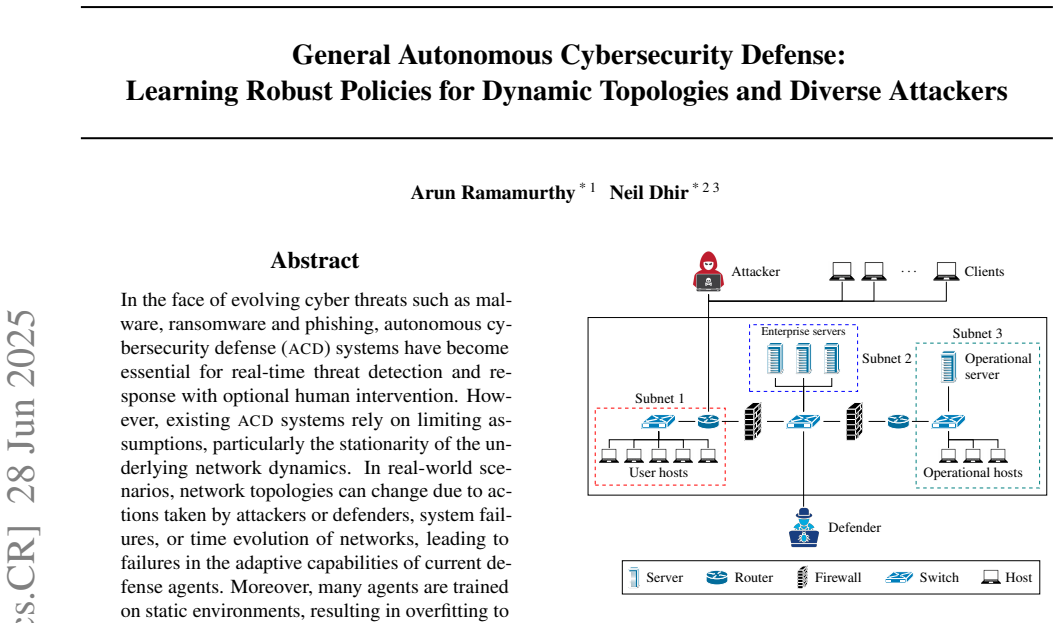
Summary. The paper proposes GACD, a single-agent reinforcement learning framework for autonomous cyber defense that combines graph encoders (GCN/Graphormer variants), semi-discrete optimal transport (AE-OT), and PPO to learn a policy over a latent manifold of network topologies. Three variants (M1, M2, M3) are trained on procedurally generated CC2-like topologies and evaluated on scalability, ablation, larger networks, novel attack patterns, baselines, node-sequence randomization, mid-episode topology changes, and the utility of the OT layer. The central claim is that a single GACD agent, trained once, generalizes across dynamic topologies and diverse red agents without retraining.
Significance. If the central generalization claim is upheld, the paper would be a meaningful step toward deployable autonomous cyber defense agents that do not need retraining per network topology. The combination of graph representation learning and OT-based latent-space smoothing is a reasonable direction, and the paper includes several useful baselines and ablations, including comparisons against the Cardiff PPO and Nyberg-Johnson MPNN agents. The authors also honestly report degradation as the number of training topologies grows. However, the load-bearing evidence for out-of-distribution generalization is currently missing or ambiguous: all evaluation environments are drawn from the same PSG family, the main comparative table fine-tunes on the test set, and the node-reordering and mid-episode-change experiments use training topologies only. The significance is therefore conditional on additional held-out-distribution experiments or a careful reframing of the claims.
major comments (5)
- [§5.5, Table 4] The comparison against Nyberg & Johnson is not a generalization test: the manuscript states that the M3 encoder is pre-trained on 256 randomly sampled PSG topologies and then 'fine-tuned on the 7 test environments.' Since the model sees the exact test environments during training, Table 4 measures test-set fit after task-specific fine-tuning, not structural generalization. Please report a GACD variant that is evaluated on these seven environments without fine-tuning (or with a clearly separated few-shot protocol), and adjust the corresponding claims in §5.5 and the conclusion.
- [§5.6, Table 5] The node-reordering experiment is performed only on the vanilla 13-host CC2 topology, which is the training environment for both GACD and Cardiff PPO. Consequently, the result that M3 is unaffected by node-sequence randomization demonstrates permutation invariance of the graph encoder on a known topology, not generalization to unseen topologies. The abstract's 'out-of-distribution network topologies' claim requires evaluation on topologies that are structurally different from the PSG training distribution. Additionally, the identical M3 reward statistics with and without randomization (−41.78±20.17 for B-Line and −20.49±10.48 for Meander) need an explanation, such as whether the evaluation is deterministic or whether the graph encoder canonicalizes the node ordering.
- [§5.7, Figure 8, Table 6] The mid-episode topology-change experiment shifts 'from the vanilla CC2 topology to one of the trained topologies' for an M1 agent trained on exactly eight topologies. This is adaptation to a known reconfiguration, not adaptation to a novel topology structure. To support the claim that the agent 'adapts seamlessly with minimal reward degradation,' please include a condition where the post-change topology is held out from training, and quantify 'minimal' against a no-change baseline. The hybrid PPO-2 comparison is also underspecified, since the switching rule and the pre-training of PPO-2 are not described precisely enough to interpret the blue curve.
- [§5.1, Figure 7, Table 8] The scalability experiment directly undercuts the notion of a topology-agnostic policy: M3 degrades monotonically from −34.16 at 4 topologies to −178.32 at 1024 topologies, and M2 falls from −44.59 to −238.08. The manuscript acknowledges degradation but does not reconcile it with the headline claim that the agent 'learns to generalize across various network topologies.' Please add statistical tests or confidence intervals for the differences across topology counts and discuss the capacity/generalization trade-off explicitly.
- [§4.4 and §5] All training and evaluation environments are generated by the same PSG with uniformly sampled subnet types, host counts, and agent placements. There is no evaluation on a structurally different deployment distribution, such as hierarchical enterprise zones, OT network segments, or firewall-restricted communication patterns, even though the introduction motivates generalization to real-world dynamic systems. The 'out-of-distribution' claim is therefore untested in the strongest sense; at minimum, the paper should restrict its claims to generalization within the PSG topology family and add at least one held-out topology-family experiment.
minor comments (7)
- [Eq. (4)] Equation (4) is malformed: it reads 'LMSE = Σ_{i=1}^n = ||hψ(zi) − xi||²', with a dangling equals sign; the summand and the definition of xi should be written explicitly.
- [§5.5] The phrase 'outperforms the the MPNN agents' contains a doubled article; please proofread.
- [§5.3] The sentence 'Even in the B-Line red agent setting, we only observe 23 impacts' uses 'we' inconsistently and should clarify that the evaluation is over 50 episodes; the connection between impact counts and reward values is not fully explained.
- [Table 5] The GACD(M3) rows show exactly the same mean and standard deviation with and without node-sequence randomization; if this is due to architectural invariance or deterministic evaluation, the caption should state so.
- [§4.5] The statement that 'M1 and M2 share the same training procedure, while M2 and M3 share the same parameter count' is vague; please provide concrete layer counts, hidden dimensions, and parameter counts for all variants.
- [§7/References] The reference to Vyas et al. (2023) is given as a GitHub URL titled 'Automated cyber defence: A review,' but the text refers to the 'Cardiff PPO model'; please identify the correct paper or repository and cite it consistently.
- [Reproducibility] The statement 'A Python implementation is available. Please contact AR for access' is not sufficient for an archival paper; please provide a public anonymized artifact or a detailed appendix with hyperparameters, seeds, and environment configurations.
Circularity Check
No significant circularity: the method's losses and OT construction are externally sourced; the main generalization evidence is in-distribution but not a circular derivation.
full rationale
The paper's derivation chain does not reduce to its inputs. The representation loss (Eq. 4) is an MSE reconstruction of the noise-space projection, Eq. (5) is a Monte-Carlo FGW transport cost, and the policy loss is the standard PPO clipped objective (Schulman et al., 2017); none of these is fitted to the quantities later presented as predictions. The continuous latent map eT is explicitly imported from An et al. (2019, 2020), an external source, and the paper does not derive a new uniqueness or continuity theorem, so no uniqueness is imported from the authors' own prior work. The only self-citation (Dhir et al., 2021) appears in the introduction as background on ACD systems and is not load-bearing. Two evaluation choices are worth noting but do not constitute circularity under the stated definitions: section 5.5 fine-tunes M3 on the seven test environments before comparing with Nyberg & Johnson, and section 5.7 changes the topology to 'one of the trained topologies,' so that experiment measures in-distribution reconfiguration rather than out-of-distribution generalization. Likewise, the node-ordering invariance in section 5.6 is an architectural property of mean-pooled graph encoders, not a parameter fitted to predict that outcome. These are scoping limitations in the empirical support for the headline generalization claim, not a case in which a claimed prediction is equivalent by construction to a fitted input.
Assumptions & free parameters
free parameters (4)
- FGW trade-off parameter alpha =
not reported
- Loss weighting coefficients =
not reported
- Reward normalization scale =
normalized to CC2 range
- Invalid action penalty =
-1500
assumptions (4)
- domain assumption Manifold distribution hypothesis: graph observations lie on a low-dimensional manifold embedded in a high-dimensional space.
- domain assumption The extended semi-discrete optimal transport map eT from An et al. (2019) provides a continuous map from noise to the latent manifold, filling discontinuities while preserving topology.
- domain assumption Topologies sampled by the procedural scenario generator (Algorithm 1) cover the distribution of deployment topologies.
- domain assumption The representation h_psi(zi) in the uniform noise space retains enough information for PPO to select good actions.
Cite this review
Pith. "Pith review of General Autonomous Cybersecurity Defense: Learning Robust Policies for Dynamic Topologies and Diverse Attackers." pith.science (2026). https://pith.science/paper/BUHJLXKG
@misc{pith2026250622706,
  author       = {Pith},
  title        = {Pith review of: General Autonomous Cybersecurity Defense: Learning Robust Policies for Dynamic Topologies and Diverse Attackers},
  year         = {2026},
  howpublished = {\url{https://pith.science/paper/BUHJLXKG}},
  note         = {Machine review of arXiv:2506.22706}
}
read the original abstract
In the face of evolving cyber threats such as malware, ransomware and phishing, autonomous cybersecurity defense (ACD) systems have become essential for real-time threat detection and response with optional human intervention. However, existing ACD systems rely on limiting assumptions, particularly the stationarity of the underlying network dynamics. In real-world scenarios, network topologies can change due to actions taken by attackers or defenders, system failures, or time evolution of networks, leading to failures in the adaptive capabilities of current defense agents. Moreover, many agents are trained on static environments, resulting in overfitting to specific topologies, which hampers their ability to generalize to out-of-distribution network topologies. This work addresses these challenges by exploring methods for developing agents to learn generalizable policies across dynamic network environments -- general ACD (GACD).
Figures


Figures from the paper (5 more)


Reference graph
Works this paper leans on
-
[1]
write newline
" write newline "" before.all 'output.state := FUNCTION n.dashify 't := "" t empty not t #1 #1 substring "-" = t #1 #2 substring "--" = not "--" * t #2 global.max substring 't := t #1 #1 substring "-" = "-" * t #2 global.max substring 't := while if t #1 #1 substring * t #2 global.max substring 't := if while FUNCTION format.date year duplicate empty "emp...
-
[2]
Ae-ot: A new generative model based on extended semi-discrete optimal transport
An, D., Guo, Y., Lei, N., Luo, Z., Yau, S.-T., and Gu, X. Ae-ot: A new generative model based on extended semi-discrete optimal transport. ICLR 2020, 2019
work page 2020
-
[3]
Ae-ot-gan: Training gans from data specific latent distribution
An, D., Guo, Y., Zhang, M., Qi, X., Lei, N., and Gu, X. Ae-ot-gan: Training gans from data specific latent distribution. In Computer Vision--ECCV 2020: 16th European Conference, Glasgow, UK, August 23--28, 2020, Proceedings, Part XXVI 16, pp.\ 548--564. Springer, 2020
work page 2020
-
[4]
str \"o m, K. J. Optimal control of markov processes with incomplete state information i. Journal of mathematical analysis and applications, 10: 0 174--205, 1965
work page 1965
-
[5]
Graph optimal transport for cross-domain alignment
Chen, L., Gan, Z., Cheng, Y., Li, L., Carin, L., and Liu, J. Graph optimal transport for cross-domain alignment. In International Conference on Machine Learning, pp.\ 1542--1553. PMLR, 2020
2020
-
[6]
Prospective Artificial Intelligence Approaches for Active Cyber Defence
Dhir, N., Hoeltgebaum, H., Adams, N., Briers, M., Burke, A., and Jones, P. Prospective artificial intelligence approaches for active cyber defence. arXiv preprint arXiv:2104.09981, 2021
work page Pith review arXiv 2021
-
[7]
On the evolution of random graphs
Erdos, P., R \'e nyi, A., et al. On the evolution of random graphs. Publ. math. inst. hung. acad. sci, 5 0 (1): 0 17--60, 1960
work page 1960
-
[8]
Hammar, K. and Stadler, R. Finding effective security strategies through reinforcement learning and self-play. In 2020 16th International Conference on Network and Service Management (CNSM), pp.\ 1--9. IEEE, 2020
work page 2020
Show all 27 references
-
[9]
Graph convolutional reinforcement learning
Jiang, J., Dun, C., Huang, T., and Lu, Z. Graph convolutional reinforcement learning. arXiv preprint arXiv:1810.09202, 2018
2018 arXiv
-
[10]
On autonomous agents in a cyber defence environment
Kiely, M., Bowman, D., Standen, M., and Moir, C. On autonomous agents in a cyber defence environment. arXiv preprint arXiv:2309.07388, 2023
2023 arXiv
-
[11]
Kipf, T. N. and Welling, M. Variational graph auto-encoders. arXiv preprint arXiv:1611.07308, 2016
2016 arXiv
-
[12]
Lei, N., Su, K., Cui, L., Yau, S.-T., and Gu, X. D. A geometric view of optimal transportation and generative model. Computer Aided Geometric Design, 68: 0 1--21, 2019
2019
-
[13]
McCulloch, W. S. and Pitts, W. A logical calculus of the ideas immanent in nervous activity. The bulletin of mathematical biophysics, 5: 0 115--133, 1943
1943
-
[14]
and Kolter, J
Nagarajan, V. and Kolter, J. Z. Gradient descent gan optimization is locally stable. Advances in neural information processing systems, 30, 2017
2017
-
[15]
and Johnson, P
Nyberg, J. and Johnson, P. Structural generalization in autonomous cyber incident response with message-passing neural networks and reinforcement learning. In 2024 IEEE International Conference on Cyber Security and Resilience (CSR), pp.\ 282--289. IEEE, 2024
2024
-
[16]
Machine learning for autonomous cyber defense
Ridley, A. Machine learning for autonomous cyber defense. The Next Wave, 22 0 (1): 0 7--14, 2018
2018
-
[17]
Optimal transport for applied mathematicians
Santambrogio, F. Optimal transport for applied mathematicians. Birk \"a user, NY , 55 0 (58-63): 0 94, 2015
2015
-
[18]
Proximal policy optimization algorithms
Schulman, J., Wolski, F., Dhariwal, P., Radford, A., and Klimov, O. Proximal policy optimization algorithms. arXiv preprint arXiv:1707.06347, 2017
2017 arXiv
-
[19]
Optimal transport on discrete domains
Solomon, J. Optimal transport on discrete domains. AMS Short Course on Discrete Differential Geometry, 2018
2018
-
[20]
Sutton, R. S. Reinforcement learning: An introduction. A Bradford Book, 2018
2018
-
[21]
B., Silva, V
Tenenbaum, J. B., Silva, V. d., and Langford, J. C. A global geometric framework for nonlinear dimensionality reduction. science, 290 0 (5500): 0 2319--2323, 2000
2000
-
[22]
Introduction to optimal transport
Thorpe, M. Introduction to optimal transport. Notes of Course at University of Cambridge, 2018
2018
-
[23]
Attention is all you need
Vaswani, A. Attention is all you need. Advances in Neural Information Processing Systems, 2017
2017
-
[24]
Optimal transport for structured data with application on graphs
Vayer, T., Chapel, L., Flamary, R., Tavenard, R., and Courty, N. Optimal transport for structured data with application on graphs. arXiv preprint arXiv:1805.09114, 2018
2018 arXiv
-
[25]
Vyas, S., Hannay, J., Bolton, A., and Burnap, P. P. Automated cyber defence: A review . https://github.com/john-cardiff/-cyborg-cage-2, 2023
2023
-
[26]
Z., and Li, L
Wang, Y., Zhao, Y., Wang, D. Z., and Li, L. Galopa: graph transport learning with optimal plan alignment. Advances in Neural Information Processing Systems, 36, 2024
2024
-
[27]
Do transformers really perform badly for graph representation? Advances in neural information processing systems, 34: 0 28877--28888, 2021
Ying, C., Cai, T., Luo, S., Zheng, S., Ke, G., He, D., Shen, Y., and Liu, T.-Y. Do transformers really perform badly for graph representation? Advances in neural information processing systems, 34: 0 28877--28888, 2021
2021
Reviewed August 6, 2026 · model on record in the stance chip above.
Discussion (0). Continue with ORCID to comment.