REVIEW 4 major objections 6 minor 32 references
T2ID-CAS: Diffusion Model and Class Aware Sampling to Mitigate Class Imbalance in Neck Ultrasound Anatomical Landmark Detection
T0 review · 4 major / 6 minor · reviewed 2026-08-16 · deepseek-v4-flash
Pith's one-line read Fine-tuning SDXL on minority-class ultrasound frames and balancing batches with class-aware sampling lifts YOLOv9s neck-landmark mAP50-95 from 66 to 88.2.
desk verdict A plausible but incompletely reported diffusion-plus-class-aware-sampling pipeline for neck-ultrasound landmark detection; the large mAP gain rests on unstated synthetic-image labeling and possible data overlap. read the letter →
The pith
A machine-rendered reading of the paper's core claim, the machinery that carries it, and where it could break.
The reading
What carries the argument
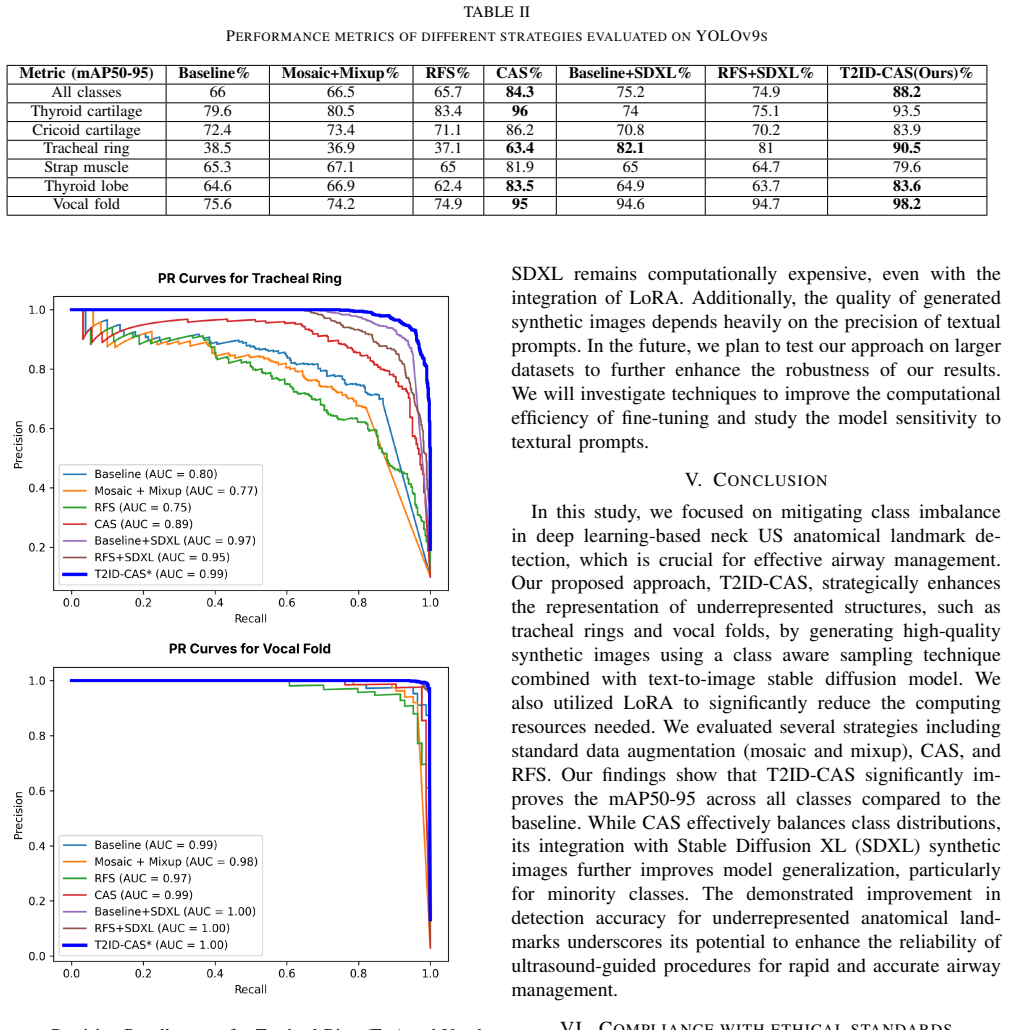
The load-bearing mechanism is the combination of SDXL fine-tuned with LoRA on class-specific ultrasound images to generate high-fidelity synthetic minority-class images, and class-aware sampling, which maintains a list of classes and randomly picks an image containing a selected class per minibatch to guarantee uniform representation of every anatomical class. A YOLOv9s detector, using Programmable Gradient Information and the GELAN backbone, is then trained on the hybrid real-plus-synthetic dataset. The synthetic images supply the underrepresented classes with extra annotated instances, while CAS ensures those instances are actually seen in each batch; together they move tracheal-ring mAP from roughly 38 to 90, whereas either mechanism alone gives far less for that class.
What would settle it
Re-run the experiment with specialist-verified bounding boxes on all 600 synthetic images and with an audit confirming that none of the 840 fine-tuning images overlap the validation folds; if the tracheal-ring mAP gain over CAS alone then collapses below the baseline difference, the central claim is unsupported.
Extended reading notes
Core claim
T2ID-CAS fine-tunes SDXL, a latent text-to-image diffusion model, on 840 real ultrasound images of tracheal rings and vocal folds using Low-Rank Adaptation (LoRA), then generates 600 synthetic images (300 per class) conditioned on anatomical text prompts. These synthetic samples are combined with the real training set, and a class-aware sampler selects images during training so each anatomical class appears in minibatches at a uniform rate. On YOLOv9s with 4-fold cross-validation, the full pipeline achieves an mAP50-95 of 88.2 versus 66 for the baseline, while CAS alone reaches 84.3; per-class gains are largest for the minority classes, and the authors note some well-represented classes such as thyroid and cricoid cartilage show minor regression when synthetic data are added.
Load-bearing premise
The reported mAP gain holds only if the synthetic images are labeled with the same ground-truth boxes as real images and if no image used to tune the diffusion generator appears in the validation folds.
Editorial extensions
If this is right
- If the reported numbers hold, diffusion-based augmentation plus class-aware sampling is an effective remedy for long-tailed medical detection datasets where minority structures are clinically critical.
- Tracheal-ring detection, the weakest class at baseline, gains the most, implying the hybrid approach preferentially benefits classes with the most severe underrepresentation.
- Because CAS alone accounts for most of the overall gain (84.3 of the 88.2 mAP), synthetic data acts as a refinement rather than the sole driver, suggesting both mechanisms should be used together.
- Slight regression on majority classes like thyroid and cricoid cartilage indicates the trade-off of adding synthetic data to already well-sampled classes.
- Comparisons with Repeat Factor Sampling show that not all class-imbalance remedies work equally with synthetic augmentation, since RFS variants stayed below 75 mAP even when combined with SDXL data.
Reading between the lines
- If the synthetic labels were derived by reusing real-image annotations rather than re-annotating each generated image, the generation step could be leaking instance-level information; this is testable by inspecting the labeling pipeline, which the paper does not describe.
- The same pipeline could transfer to other ultrasound tasks, such as fetal or vascular landmark detection, but the prompt sensitivity the authors mention suggests gains may vary with how precisely the text prompt matches the target anatomy.
- A stronger comparison would hold compute constant: the fine-tuning and generation cost of SDXL could instead be spent on more real data or extended training, a trade-off the paper does not quantify.
- An independent replication with strict separation between generator-training images and validation folds would clarify whether the reported gain is due to class balance or to accidental leakage.
Signed reviews
Editorial analysis
A structured set of objections, weighed in public.
Referee Report
Summary. The paper proposes T2ID-CAS, a hybrid approach for mitigating class imbalance in neck ultrasound anatomical landmark detection. The method combines class-aware sampling (CAS) with synthetic image generation from a fine-tuned Stable Diffusion XL (SDXL) model using Low-Rank Adaptation (LoRA). The authors generate 600 synthetic images for the two most underrepresented classes (tracheal rings and vocal folds), augment the real training data with them, and train a YOLOv9s detector. They report a mean Average Precision (mAP50-95) of 88.2 with the proposed approach, compared with a baseline of 66, and substantial per-class gains for the minority classes. The paper also evaluates alternative strategies (mosaic/mixup, repeat factor sampling, and their combinations) and reports generative image quality metrics (FID, IS, CLIP score) for the synthetic images.
Significance. If the reported results are reproducible and the methodology is sound, the paper offers a practical and computationally efficient strategy for handling class imbalance in small medical ultrasound datasets, a setting where standard oversampling and GAN-based approaches often struggle. The integration of parameter-efficient diffusion fine-tuning (LoRA) with class-aware sampling is a reasonable and timely contribution. The paper also provides quantitative evidence that synthetic data can substantially improve minority-class detection, which is clinically relevant for airway management. However, the significance is currently limited by missing methodological details that are essential for reproducing and interpreting the central claim.
major comments (4)
- [III.C] The paper never describes how the 600 synthetic images are annotated with bounding boxes for YOLOv9 training. Section III.A specifies annotation only for real US scans ('annotated by airway specialists using YoloMark'), while Section III.C only states that 600 synthetic images of size 512x512 were generated, 300 per class. Since YOLOv9 training requires per-image bounding-box label files, the reader cannot know whether the synthetic boxes are whole-image boxes, image-level labels, or pseudo-labels from an unstated detector. This detail is load-bearing because the reported mAP improvement for tracheal ring (38.5 to 90.5) and vocal fold (75.6 to 98.2) could be inflated if the synthetic labels do not represent genuine anatomical localization. Please specify the annotation protocol for synthetic images and, if applicable, how box coordinates were assigned.
- [III.B] The paper does not state whether the 840 real images used to fine-tune SDXL-LoRA are disjoint from the validation folds in the 4-fold cross-validation. If the same subjects or images appear both in the diffusion fine-tuning set and in a validation fold, the synthetic images can memorize validation-level anatomy and inflate the reported mAP. The paper only says 'The dataset was split into training and validation sets, with 4-fold cross-validation' but does not describe the split granularity (subject-level versus image-level) or confirm that the fine-tuning set was excluded from validation. Please clarify the exact split and provide a leakage check, such as ensuring no subject overlap between the SDXL fine-tuning set and any validation fold.
- [IV.B] The cross-validation results in Table II are reported only as aggregate mAP50-95, with no per-fold results, standard deviations, or statistical significance tests. Given the small number of subjects (10) and the long-tailed class distribution, the observed differences (e.g., 88.2 for T2ID-CAS versus 84.3 for CAS alone, or 66 for baseline) may not be robust across folds. Without error bars or fold-wise numbers, the reader cannot assess the reliability of the claimed improvement. Please report fold-level mAP for all configurations, or provide confidence intervals and, if feasible, a paired significance test.
- [IV.A / Table I] There is an inconsistency in the reported Inception Score for the SD v1-4 tracheal ring condition: the text in Section IV.A states 'notable improvements in IS (18.184 vs. 17.045)' while Table I lists the SD v1-4 tracheal ring IS as 11.045. This discrepancy affects the interpretation of the generative quality comparison and must be corrected. Please verify all numbers in Table I against the text and any supplementary material.
minor comments (6)
- [III.B] The description of the 4-fold cross-validation split is ambiguous: it should state explicitly whether the split is at the subject level or the image level, since cineloop frames from the same subject are highly correlated and image-level splits can overestimate generalization.
- [Fig. 3 / III.B] The prompts shown in Fig. 3 ('Ultrasound image of human tracheal ring') differ from those reported in Section III.B ('High-resolution ultrasound scan of the human tracheal ring'). Please unify the prompt text across the paper.
- [IV.A] The comparison between SDXL-LoRA and SD v1-4 is not controlled, since SD v1-4 is not fine-tuned on the ultrasound data; please state this explicitly and, if possible, include a fine-tuned SD v1-4 baseline for a fairer comparison of model architectures.
- [Table II] It would be helpful to report the number of synthetic images used per class in the final training set and the resulting class distribution, so that the effect of the augmentation is transparent.
- [General] The paper does not mention code or data availability; providing at least the code for the T2ID-CAS pipeline and the synthetic-data generation process would substantially improve reproducibility.
- [IV.B] There are minor typographical errors, e.g., 'SDXL synthetic image images' in Section IV.B and the rendering of 'Frécet' as 'Fr ´echet'; these should be corrected during revision.
Circularity Check
No significant circularity: the reported mAP gains are empirical train/test measurements, not derived from fitted equations or self-citations.
full rationale
The paper's central claim is that combining SDXL-generated synthetic images with class-aware sampling improves YOLOv9s mAP50-95 on neck ultrasound landmark detection. This is an empirical measurement reported in Table II, not a quantity derived from an equation whose inputs already contain the output. The baseline, CAS-only, SDXL-only, and T2ID-CAS results are separate experimental conditions evaluated on held-out validation folds. There is no fitted parameter that is later renamed as a prediction: the diffusion model is fine-tuned on real images and then used to generate synthetic images, which are simply added to the training set, and the detector is trained and evaluated in the standard way. The paper contains no self-citations at all, so there is no load-bearing self-citation chain or imported uniqueness theorem. The most natural concerns are data-hygiene and reproducibility issues, not circularity: the paper does not specify how the 600 synthetic images were annotated with bounding boxes, nor whether the 840 images used for SDXL fine-tuning overlap the validation folds. However, neither omission means that the improved mAP is equivalent to an input by construction; they are risks of leakage or invalid labels, which would be correctness flaws, not circular reasoning. The quality metrics FID, IS, and CLIP are comparisons of generated images to their training distribution and prompt semantics, and they are presented as quality checks rather than as the claimed detection improvement. Therefore, the derivation chain is self-contained with respect to circularity, and the appropriate score is 0.
Assumptions & free parameters
free parameters (3)
- number of synthetic images =
600 (300 per class)
- CFG scale =
7.5
- SDXL fine-tuning epochs =
100
assumptions (3)
- domain assumption Stable Diffusion XL fine-tuned with LoRA on ultrasound images produces synthetic images that preserve the anatomical structures needed for object detection.
- standard math Class-aware sampling as implemented here matches the prior definitions in [9], [27].
- domain assumption FID, IS, and CLIP Score are valid measures of synthetic image quality for this medical imaging task.
Cite this review
Pith. "Pith review of T2ID-CAS: Diffusion Model and Class Aware Sampling to Mitigate Class Imbalance in Neck Ultrasound Anatomical Landmark Detection." pith.science (2026). https://pith.science/paper/BV4FSXCQ
@misc{pith2026250421231,
  author       = {Pith},
  title        = {Pith review of: T2ID-CAS: Diffusion Model and Class Aware Sampling to Mitigate Class Imbalance in Neck Ultrasound Anatomical Landmark Detection},
  year         = {2026},
  howpublished = {\url{https://pith.science/paper/BV4FSXCQ}},
  note         = {Machine review of arXiv:2504.21231}
}
read the original abstract
Neck ultrasound (US) plays a vital role in airway management by providing non-invasive, real-time imaging that enables rapid and precise interventions. Deep learning-based anatomical landmark detection in neck US can further facilitate procedural efficiency. However, class imbalance within datasets, where key structures like tracheal rings and vocal folds are underrepresented, presents significant challenges for object detection models. To address this, we propose T2ID-CAS, a hybrid approach that combines a text-to-image latent diffusion model with class-aware sampling to generate high-quality synthetic samples for underrepresented classes. This approach, rarely explored in the ultrasound domain, improves the representation of minority classes. Experimental results using YOLOv9 for anatomical landmark detection in neck US demonstrated that T2ID-CAS achieved a mean Average Precision of 88.2, significantly surpassing the baseline of 66. This highlights its potential as a computationally efficient and scalable solution for mitigating class imbalance in AI-assisted ultrasound-guided interventions.
Figures


Figures from the paper (1 more)
Reference graph
Works this paper leans on
-
[1]
Role of upper airway ultrasound in airway management,
Adi Osman and Kok Meng Sum, “Role of upper airway ultrasound in airway management,” Journal of intensive care , vol. 4, no. 1, pp. 52, 2016
work page 2016
-
[2]
Role of ultrasound in the airway management of critically ill patients,
Alan ˇSustic, “Role of ultrasound in the airway management of critically ill patients,” Critical care medicine, vol. 35, no. 5, pp. S173– S177, 2007
work page 2007
-
[3]
Im- balance problems in object detection: A review,
Kemal Oksuz, Baris Can Cam, Sinan Kalkan, and Emre Akbas, “Im- balance problems in object detection: A review,” IEEE Transactions on Pattern Analysis and Machine Intelligence , vol. 43, no. 10, pp. 3388–3415, 2021
work page 2021
-
[4]
Smote: synthetic minority over-sampling technique,
Nitesh V Chawla, Kevin W Bowyer, Lawrence O Hall, and W Philip Kegelmeyer, “Smote: synthetic minority over-sampling technique,” Journal of artificial intelligence research, vol. 16, pp. 321–357, 2002
work page 2002
-
[5]
C4. 5, class imbalance, and cost sensitivity: why under-sampling beats over-sampling,
Chris Drummond, Robert C Holte, et al., “C4. 5, class imbalance, and cost sensitivity: why under-sampling beats over-sampling,” in Workshop on learning from imbalanced datasets II , 2003, vol. 11
work page 2003
-
[6]
Handling class imbalance problem using oversampling techniques: A review,
Anjana Gosain and Saanchi Sardana, “Handling class imbalance problem using oversampling techniques: A review,” in 2017 Interna- tional Conference on Advances in Computing, Communications and Informatics (ICACCI), 2017, pp. 79–85
work page 2017
-
[7]
Yolov4: Optimal speed and accuracy of object detection,
Alexey Bochkovskiy, Chien-Yao Wang, and Hong-Yuan Mark Liao, “Yolov4: Optimal speed and accuracy of object detection,” arXiv preprint arXiv:2004.10934, 2020
arXiv 2004
-
[8]
mixup: Beyond empirical risk minimization,
Hongyi Zhang, “mixup: Beyond empirical risk minimization,” arXiv preprint arXiv:1710.09412, 2017
arXiv 2017
Show all 32 references
-
[9]
Relay backpropa- gation for effective learning of deep convolutional neural networks,
Li Shen, Zhouchen Lin, and Qingming Huang, “Relay backpropa- gation for effective learning of deep convolutional neural networks,” in Computer Vision–ECCV 2016: 14th European Conference, Amster- dam, The Netherlands, October 11–14, 2016, Proceedings, Part VII
2016
-
[10]
Lvis: A dataset for large vocabulary instance segmentation,
Agrim Gupta, Piotr Dollar, and Ross Girshick, “Lvis: A dataset for large vocabulary instance segmentation,” in Proceedings of the IEEE/CVF conference on computer vision and pattern recognition , 2019, pp. 5356–5364
2019
-
[11]
Exploiting synthetic data for data imbal- ance problems: Baselines from a data perspective,
Moon Ye-Bin, Nam Hyeon-Woo, Wonseok Choi, Nayeong Kim, Suha Kwak, and Tae-Hyun Oh, “Exploiting synthetic data for data imbal- ance problems: Baselines from a data perspective,” arXiv preprint arXiv:2308.00994, 2023
2023 arXiv
-
[12]
Generative adversarial nets,
Ian Goodfellow, Jean Pouget-Abadie, Mehdi Mirza, Bing Xu, David Warde-Farley, Sherjil Ozair, Aaron Courville, and Yoshua Bengio, “Generative adversarial nets,” Advances in neural information pro- cessing systems, vol. 27, 2014
2014
-
[13]
Denoising diffusion probabilistic models,
Jonathan Ho, Ajay Jain, and Pieter Abbeel, “Denoising diffusion probabilistic models,” 2020
2020
-
[14]
Springer, 2016, pp. 467–482
2016
-
[15]
Modalities guided latent diffusion model for brain mri synthesis,
Xiaoliang Lei, Xiaosheng Yu, Maocheng Bai, and Chengdong Wu, “Modalities guided latent diffusion model for brain mri synthesis,” in 2024 36th Chinese Control and Decision Conference (CCDC) . IEEE, 2024, pp. 4440–4444
2024
-
[16]
Score-based diffusion models for accelerated mri,
Hyungjin Chung and Jong Chul Ye, “Score-based diffusion models for accelerated mri,” Medical image analysis , vol. 80, pp. 102479, 2022
2022
-
[17]
Medsyn: Text-guided anatomy-aware syn- thesis of high-fidelity 3d ct images,
Yanwu Xu, Li Sun, Wei Peng, Shuyue Jia, Katelyn Morrison, Adam Perer, Afrooz Zandifar, Shyam Visweswaran, Motahhare Eslami, and Kayhan Batmanghelich, “Medsyn: Text-guided anatomy-aware syn- thesis of high-fidelity 3d ct images,” IEEE Transactions on Medical Imaging, 2024
2024
-
[18]
Denoising diffusion probabilistic models,
Jonathan Ho, Ajay Jain, and Pieter Abbeel, “Denoising diffusion probabilistic models,” Advances in neural information processing systems, vol. 33, pp. 6840–6851, 2020
2020
-
[19]
High-resolution image synthesis with latent diffusion models,
Robin Rombach, Andreas Blattmann, Dominik Lorenz, Patrick Esser, and Bj ¨orn Ommer, “High-resolution image synthesis with latent diffusion models,” in Proceedings of the IEEE/CVF conference on computer vision and pattern recognition , 2022, pp. 10684–10695
2022
-
[20]
Auto-encoding variational bayes,
Diederik P Kingma, “Auto-encoding variational bayes,” arXiv preprint arXiv:1312.6114, 2013
2013 arXiv
-
[21]
Learning transferable visual models from natural language supervision,
Alec Radford, Jong Wook Kim, Chris Hallacy, Aditya Ramesh, Gabriel Goh, Sandhini Agarwal, Girish Sastry, Amanda Askell, Pamela Mishkin, Jack Clark, et al., “Learning transferable visual models from natural language supervision,” in International conference on machine learning....
2021
-
[22]
Sdxl: Im- proving latent diffusion models for high-resolution image synthesis,
Dustin Podell, Zion English, Kyle Lacey, Andreas Blattmann, Tim Dockhorn, Jonas M ¨uller, Joe Penna, and Robin Rombach, “Sdxl: Im- proving latent diffusion models for high-resolution image synthesis,” arXiv preprint arXiv:2307.01952 , 2023
2023 arXiv
-
[23]
Lora: Low-rank adap- tation of large language models,
Edward J Hu, Yelong Shen, Phillip Wallis, Zeyuan Allen-Zhu, Yuanzhi Li, Shean Wang, Lu Wang, and Weizhu Chen, “Lora: Low-rank adap- tation of large language models,” arXiv preprint arXiv:2106.09685 , 2021
2021 arXiv
-
[24]
Derm-t2im: Harnessing synthetic skin lesion data via stable diffusion models for enhanced skin disease classification using vit and cnn,
Muhammad Ali Farooq, Wang Yao, Michael Schukat, Mark A Little, and Peter Corcoran, “Derm-t2im: Harnessing synthetic skin lesion data via stable diffusion models for enhanced skin disease classification using vit and cnn,” arXiv preprint arXiv:2401.05159 , 2024
2024 arXiv
-
[25]
Clipscore: A reference-free evaluation metric for image captioning,
Jack Hessel, Ari Holtzman, Maxwell Forbes, Ronan Le Bras, and Yejin Choi, “Clipscore: A reference-free evaluation metric for image captioning,” arXiv preprint arXiv:2104.08718 , 2021
2021 arXiv
-
[26]
Improved techniques for training gans,
Tim Salimans, Ian Goodfellow, Wojciech Zaremba, Vicki Cheung, Alec Radford, and Xi Chen, “Improved techniques for training gans,” Advances in neural information processing systems , vol. 29, 2016
2016
-
[27]
Gans trained by a two time-scale update rule converge to a local nash equilibrium,
Martin Heusel, Hubert Ramsauer, Thomas Unterthiner, Bernhard Nessler, and Sepp Hochreiter, “Gans trained by a two time-scale update rule converge to a local nash equilibrium,” Advances in neural information processing systems , vol. 30, 2017
2017
-
[28]
Cmw-net: Learning a class-aware sample weighting mapping for robust deep learning,
Jun Shu, Xiang Yuan, Deyu Meng, and Zongben Xu, “Cmw-net: Learning a class-aware sample weighting mapping for robust deep learning,” IEEE Transactions on Pattern Analysis and Machine Intelligence, vol. 45, no. 10, pp. 11521–11539, 2023
2023
-
[29]
Faster r-cnn: Towards real-time object detection with region proposal networks,
Shaoqing Ren, “Faster r-cnn: Towards real-time object detection with region proposal networks,” arXiv preprint arXiv:1506.01497 , 2015
2015 arXiv
-
[30]
Ssd: Single shot multibox detector,
Wei Liu, Dragomir Anguelov, Dumitru Erhan, Christian Szegedy, Scott Reed, Cheng-Yang Fu, and Alexander C Berg, “Ssd: Single shot multibox detector,” in Computer Vision–ECCV 2016: 14th European Conference, Amsterdam, The Netherlands, October 11–14, 2016, Proceedings, Part I 14 ...
2016
-
[31]
You only look once: Unified, real-time object detection,
J Redmon, “You only look once: Unified, real-time object detection,” in Proceedings of the IEEE conference on computer vision and pattern recognition, 2016
2016
-
[32]
Yolov9: Learning what you want to learn using programmable gradient infor- mation,
Chien-Yao Wang, I-Hau Yeh, and Hong-Yuan Mark Liao, “Yolov9: Learning what you want to learn using programmable gradient infor- mation,” arXiv preprint arXiv:2402.13616 , 2024
2024 arXiv
Reviewed August 16, 2026 · model on record in the stance chip above.
Discussion (0). Continue with ORCID to comment.