REVIEW 3 major objections 4 minor 4 references
Toward a Scientific Discovery Engine for Weather and Climate Data: A Visual Analytics Workbench for Embedding-Based Exploration
T0 review · 3 major / 4 minor · reviewed 2026-07-14 · grok-4.5
Pith's one-line read An open-source visual workbench turns weather and climate embeddings into provenance-aware scientific search, not just image lookup.
desk verdict Solid open systems workbench for provenance-linked climate embedding search; the scientific-meaning claim is only qualitatively supported by a TC demo. read the letter →
The pith
A machine-rendered reading of the paper's core claim, the machinery that carries it, and where it could break.
The reading
What carries the argument
The provenance-aware visual analytics workbench: a model-agnostic system that links embedding experiments to shared source fields, metadata, spatial contexts, and model configs, then supports interactive image- and patch-level queries, multi-constraint filters, and meteorological inspection of analogs.
What would settle it
In a blinded tropical-cyclone (or similar) retrieval test, measure how often workbench-filtered nearest neighbors fail expert meteorological review or known event catalogs relative to a non-visual baseline; if the workbench does not raise the rate of physically valid analogs, the central claim fails.
Extended reading notes
Core claim
The authors establish that a provenance-aware visual analytics workbench can make embedding-based retrieval scientifically usable for weather and climate data: by binding distinct embedding experiments to shared source data, metadata, spatial context, and model configurations, and by supporting image-level and patch-level queries with multi-constraint filters and meteorological inspection views, it lets researchers separate meaningful analogs from artifacts and run a discovery loop across large archives, with an out-of-core backend that keeps interactive search over tens of millions of embeddings feasible on commodity hardware.
Load-bearing premise
That interactive visual inspection and multi-constraint filters are enough for scientists to reliably tell real meteorological structure from preprocessing, geographic, or model-bias artifacts when using off-the-shelf vision embeddings on reanalysis fields.
Signed reviews
Editorial analysis
A structured set of objections, weighed in public.
Referee Report
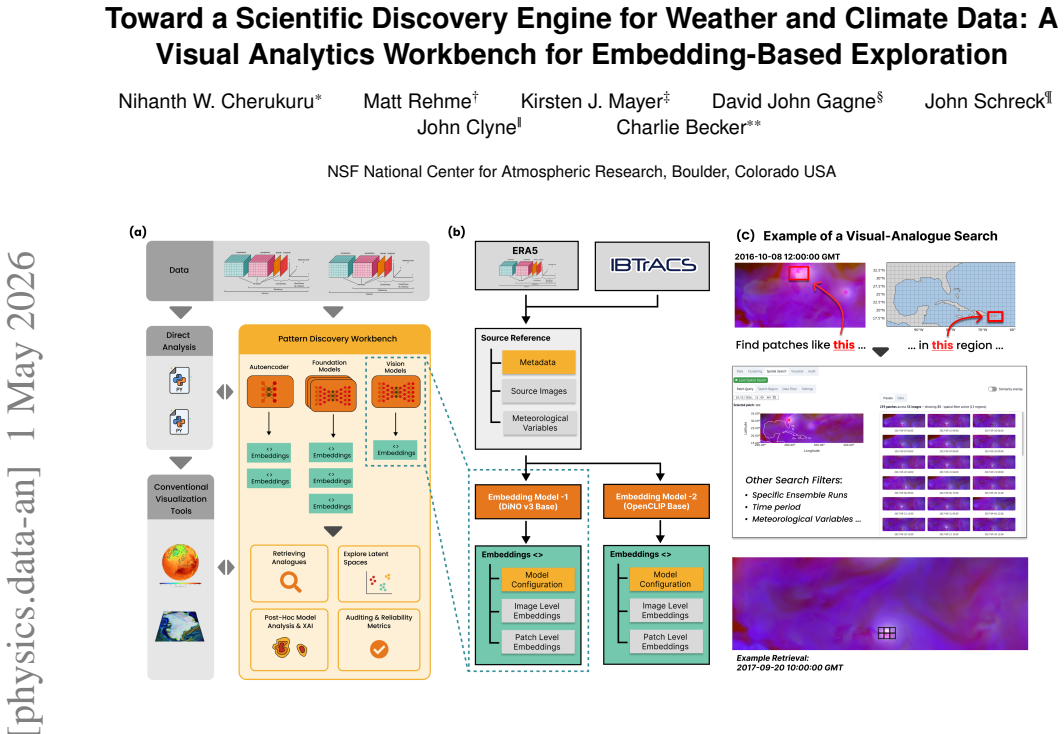
Summary. The manuscript presents an open-source visual analytics workbench for provenance-aware, embedding-based retrieval over weather and climate data. It links distinct embedding experiments to shared source fields, metadata, spatial context, and model configurations; supports image-level and localized patch-level queries with multi-constraint filters; and exposes analogs in familiar meteorological views so that a latent signature characterized on a well-understood dataset can be used to probe larger archives. The system is demonstrated via tropical-cyclone retrieval with DINOv3 embeddings of ERA5, is described as model-agnostic, and is accompanied by an out-of-core retrieval backend claimed to support interactive search over tens of millions of embeddings on commodity hardware.
Significance. If the architectural claims and the scalability result hold, the work fills a practical gap between foundation-model embeddings of Earth-system fields and scientifically usable analog search: nearest neighbors are not automatically meteorological, so a provenance-linked visual workbench is a necessary piece of any embedding-based discovery stack. Strengths that should be credited include the open-source framing, the explicit model-agnostic design, the dual image/patch query model, multi-constraint filtering tied to physical metadata, and an engineering evaluation aimed at tens-of-millions-scale interactive retrieval on commodity hardware. Those contributions would be of clear interest to climate informatics and visual analytics audiences even if the scientific-validation story remains incomplete.
major comments (3)
- [Abstract; TC retrieval demonstration] Abstract and introduction correctly state that nearest neighbors need not be scientifically meaningful (preprocessing, geography, model bias). The central scientific claim—that the workbench’s human-in-the-loop discovery loop actually separates meteorological structure from such artifacts—is supported only by a qualitative tropical-cyclone retrieval scenario with DINOv3 on ERA5. There is no controlled comparison to independent TC track/catalog labels, no reported precision/recall or false-positive rates under geographic/seasonal filters, and no inter-embedding agreement or ablation of the multi-constraint filters. Without at least one such quantitative check, the demonstration shows visual similarity, not validated scientific relevance, and the “discovery engine” framing overreaches the evidence.
- [Backend evaluation / scalability section] The out-of-core backend claim (“interactive visual search over tens of millions of embeddings … highly scalable on commodity hardware”) is load-bearing for the systems contribution, yet the manuscript as provided does not make the evaluation design auditable: index type, embedding dimensionality, batching, hardware, latency/throughput numbers, and comparison baselines (e.g., in-memory FAISS/HNSW vs. the out-of-core path) are not clearly recoverable. The scalability result should be stated with explicit metrics and a minimal reproducible configuration so that the engineering claim can be checked independently of the TC narrative.
- [Full manuscript body] Large contiguous stretches of the body text are corrupted or unreadable (encoding/OCR garbling), including material that appears to cover related work, system architecture, and evaluation. A full technical audit of design choices, figure captions, and quantitative tables is therefore not possible from the submitted manuscript. The authors must supply a clean, complete text before the load-bearing claims can be fairly accepted or rejected on the merits.
minor comments (4)
- [System design / abstract] Clarify early what “model-agnostic” means in practice (embedding API contract, required metadata schema, supported similarity metrics) so that future integration claims are falsifiable.
- [Abstract; conclusion] Distinguish more sharply in the abstract and conclusion between (i) a visual search workbench and (ii) a scientific discovery engine; the former is what is demonstrated, the latter is aspirational until retrieval quality is quantified.
- [TC demonstration figures] When the clean text is restored, ensure figure callouts for the TC scenario explicitly show query, top-k neighbors, applied filters, and the linked physical fields so readers can judge meteorological plausibility without relying on prose alone.
- [Methods / embedding setup] State DINOv3 preprocessing and channel choices (which ERA5 variables, normalization, patch size) in one place; free parameters of the embedding experiment are currently hard to reconstruct.
Circularity Check
No circular derivation: systems paper describing a workbench and measuring retrieval scalability, not a first-principles prediction chain.
full rationale
This manuscript is a visual-analytics / systems paper. Its load-bearing claims are (1) that an open-source, provenance-aware workbench can link embedding experiments to source fields, metadata, spatial context, and model configs and support interactive image- and patch-level retrieval with multi-constraint filters, and (2) that its out-of-core backend supports interactive search over tens of millions of embeddings on commodity hardware, illustrated by a tropical-cyclone scenario with DINOv3 on ERA5. There are no equations that define a quantity in terms of the target it later 'predicts,' no fitted parameters renamed as predictions, no uniqueness theorems imported from the authors' prior work to force the result, and no ansatz smuggled in via self-citation. Evaluating one's own tool on a chosen demonstration scenario is ordinary systems practice and does not reduce the claimed engineering result to its inputs by construction. Large portions of the body text are unreadable in the provided source, but nothing in the abstract or recoverable framing exhibits the circular patterns listed in the analyzer checklist. Score 0 is therefore the correct, proportionate finding.
Assumptions & free parameters
free parameters (3)
- Embedding model and feature configuration (DINOv3 and any preprocessing/channel choices)
- Similarity metric / neighbor count and multi-constraint filter thresholds
- Out-of-core index and batching parameters for tens-of-millions-scale search
assumptions (4)
- domain assumption Latent nearest neighbors of vision-model embeddings of meteorological fields can sometimes reflect real meteorological structure, but may also reflect artifacts; visual provenance inspection is therefore required for scientific use.
- domain assumption ERA5 (and similar reanalysis) fields rendered as images/patches are a valid substrate for vision foundation models such as DINOv3 in a tropical-cyclone retrieval scenario.
- ad hoc to paper Interactive visual analytics with linked metadata and meteorological views can support a human-in-the-loop discovery loop that transfers a latent signature from a well-understood dataset to larger archives.
- standard math Standard nearest-neighbor / out-of-core vector search techniques can deliver interactive latency at tens of millions of embeddings on commodity hardware under the authors' backend design.
invented entities (1)
-
Provenance-aware embedding retrieval workbench (the software system linking embedding experiments to shared source data, metadata, spatial context, and model configs)
Cite this review
Pith. "Pith review of Toward a Scientific Discovery Engine for Weather and Climate Data: A Visual Analytics Workbench for Embedding-Based Exploration." pith.science (2026). https://pith.science/paper/BVCI6KLI
@misc{pith2026260500972,
  author       = {Pith},
  title        = {Pith review of: Toward a Scientific Discovery Engine for Weather and Climate Data: A Visual Analytics Workbench for Embedding-Based Exploration},
  year         = {2026},
  howpublished = {\url{https://pith.science/paper/BVCI6KLI}},
  note         = {Machine review of arXiv:2605.00972}
}
read the original abstract
Earth system science is producing increasingly large, high-dimensional datasets from both physics-based and AI-driven models. While embedding-based representations make these data searchable and serve as foundational building blocks for AI-driven discovery engines, nearest neighbors in latent spaces are not automatically scientifically meaningful. They may reflect real meteorological structures, or simply artifacts of preprocessing, geography, or model bias. Researchers therefore need visual tools to inspect latent space organization, trace search results back to physical evidence, and evaluate candidate representations against one another. We present an open source visual analytics workbench designed to support this provenance-aware scientific retrieval workflow. The system links distinct embedding experiments to shared source data, metadata, spatial contexts, and model configurations. It enables interactive retrieval strategy design by allowing users to issue image-level and localized patch-level queries, apply multi-constraint filters, and inspect analogs through familiar meteorological views. This facilitates a discovery loop where scientists characterize a phenomenon in a well-understood dataset and use its latent signature to probe larger archives. While we demonstrate the workbench through a tropical cyclone retrieval scenario using a vision foundation model (DINOv3) on ERA5 data, the framework is model-agnostic and designed to integrate with other embedding architectures in the future. Finally, we evaluate its out-of-core retrieval backend, demonstrating that interactive visual search over tens of millions of embeddings is highly scalable on commodity hardware.
Figures


Reference graph
Works this paper leans on
-
[1]
write newline
" write newline "" before.all 'output.state := STRINGS d dc pc.str doi.urlstr INTEGERS nth.dash doi.string.pos doilen FUNCTION add.doi doi empty "\ doi 'd := "" 'doi.urlstr := #0 'nth.dash := #1 'doi.string.pos := d text.length 'doilen := nth.dash #3 < d doi.string.pos #1 substring 'dc := #1 doi.string.pos + 'doi.string.pos := dc "/" = #1 nth.dash + 'nth....
-
[2]
write newline
" write newline "" before.all 'output.state := STRINGS d dc pc.str doi.urlstr INTEGERS nth.dash doi.string.pos doilen FUNCTION add.doi doi empty "\ doi 'd := "" 'doi.urlstr := #0 'nth.dash := #1 'doi.string.pos := d text.length 'doilen := nth.dash #3 < d doi.string.pos #1 substring 'dc := #1 doi.string.pos + 'doi.string.pos := dc "/" = #1 nth.dash + 'nth....
-
[3]
write newline
" write newline "" before.all 'output.state := STRINGS d dc pc.str doi.urlstr INTEGERS nth.dash doi.string.pos doilen FUNCTION add.doi doi empty "\ doi 'd := "" 'doi.urlstr := #0 'nth.dash := #1 'doi.string.pos := d text.length 'doilen := nth.dash #3 < d doi.string.pos #1 substring 'dc := #1 doi.string.pos + 'doi.string.pos := dc "/" = #1 nth.dash + 'nth....
-
[4]
write newline
" write newline "" before.all 'output.state := STRINGS d dc pc.str doi.urlstr INTEGERS nth.dash doi.string.pos doilen FUNCTION add.doi doi empty "\ doi 'd := "" 'doi.urlstr := #0 'nth.dash := #1 'doi.string.pos := d text.length 'doilen := nth.dash #3 < d doi.string.pos #1 substring 'dc := #1 doi.string.pos + 'doi.string.pos := dc "/" = #1 nth.dash + 'nth....
Reviewed July 14, 2026 · model on record in the stance chip above.
Discussion (0). Continue with ORCID to comment.