REVIEW 4 major objections 6 minor 26 references
X-SG$^2$S: Safe and Generalizable Gaussian Splatting with X-dimensional Watermarks
T0 review · 4 major / 6 minor · reviewed 2026-08-07 · deepseek-v4-flash
Pith's one-line read X-SG2S claims to embed binary messages, images, and 3D objects simultaneously into a 3D Gaussian Splatting scene without retraining the scene generator, and to recover them later with a lightweight extractor.
desk verdict Multimodal watermarking for 3DGS is genuinely new and the 1D/2D results hold up, but the unspecified point-ordering rule and missing baselines make the 'generalizable' claim unverifiable as written. read the letter →
The pith
A machine-rendered reading of the paper's core claim, the machinery that carries it, and where it could break.
The reading
What carries the argument
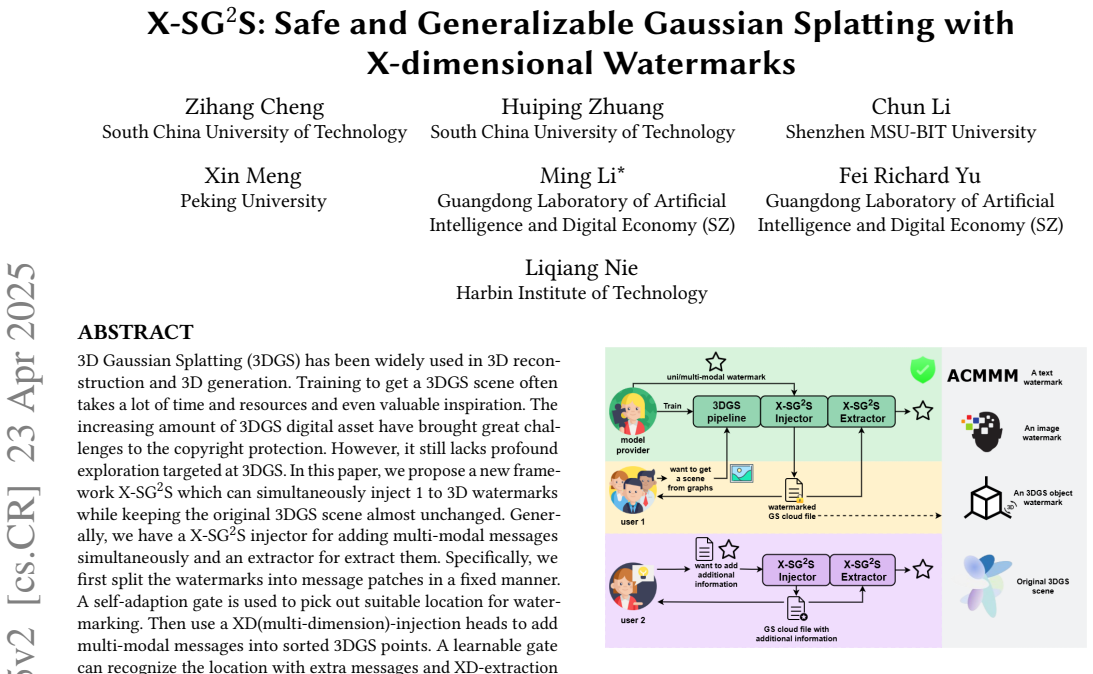
The load-bearing mechanism is the pairing of a self-adaption gate and a learnable selection gate over the sorted Gaussian point set. The self-adaption gate computes two per-point scores—a self-score via permutation-invariant induced set attention with anchor vectors, and a cross-score via efficient linear attention between point embeddings and embedded message patches—then multiplies them and applies top-k to produce a location mask. The learnable selection gate is a four-layer MLP trained to reproduce this mask from the watermarked point set, so at inference the extractor locates modified points without the original mask. The actual payload is stored in the high-order spherical-harmonic coefficients (orders 3 and 4) of the selected points, with each modality assigned its own MLP injection and extraction head.
What would settle it
Render the watermarked scene, then permute the order of the Gaussian points arbitrarily (or re-sort them by a different rule than the one used during injection), run the extractor on the reordered set, and check whether the binary message, image, and 3D object are still recovered; if extraction fails under any such reordering, the framework is not robust to the natural unordered-point-set setting and the unstated sorting rule is load-bearing.
Extended reading notes
Core claim
The central claim is that X-SG2S is the first unified 1D-to-3D watermarking framework for 3D Gaussian Splatting: it simultaneously injects a binary message, an image (compressed and redundantly encoded by a feature-sparse DCAE), and a second 3DGS object into selected high-order spherical-harmonic coefficients of the original Gaussian points. A self-adaption gate scores each point by its visual importance and its fit for carrying the message, then a top-k mask selects the injection locations. A learnable MLP gate, trained offline, recognizes those watermarked locations from the point set alone, and per-modality MLP extractors recover the payloads. The framework is an add-on: no fine-tuning of the pretrained 3DGS pipeline, no change to the Gaussian parameter format, and the same injector/extractor applies to new scenes. Experiments report perfect binary extraction precision and high PSNR/SSIM for recovered images and 3D objects, with degradation resistance up to 25% random pruning.
Load-bearing premise
Both injection and extraction depend on the same deterministic ordering of the unordered Gaussian point set, but the paper never specifies what that ordering is, so any reordering of the points could break the watermark.
Editorial extensions
If this is right
- A single trained injector/extractor pair can watermark any pretrained 3DGS scene, including scenes from feedforward pipelines and multi-step generative models, without retraining the generator.
- Binary messages, images, and 3DGS objects can be embedded simultaneously without confusion, and each modality can be added or extracted independently.
- Watermarking is invisible at the rendered-image level and preserves the GS parameter form, so watermarked scenes remain compatible with standard 3DGS rendering.
- Random pruning of up to 25% of Gaussian points still allows full recovery of binary and image watermarks and near-lossless recovery of the 3D object watermark.
- Training can be done on 3DGS files alone without rendered-image losses, reducing dependence on full pipelines.
Reading between the lines
- A consequence the paper leaves implicit is that practical use requires a canonical, attacker-independent ordering of the Gaussian point set: the paper never specifies the sorting rule, so any reordering (for example, saving and reloading a scene) could desynchronize the injector and extractor.
- The feature-sparse DCAE that reconstructs an image from a subset of redundant features could be reused beyond watermarking, such as robust attribute storage for point clouds generally.
- The same gate-and-head architecture could transfer to other explicit 3D representations, such as meshes or colored point clouds, where parameter ordering is similarly unresolved.
- Because the learnable gate only sees the watermarked point set, an adversary could potentially destroy the watermark by reordering points; testing against adversarial permutations would clarify whether the method holds in hostile settings.
Editorial analysis
A structured set of objections, weighed in public.
Referee Report
Summary. The paper proposes X-SG2S, a watermarking framework for 3D Gaussian Splatting (3DGS) that simultaneously embeds binary (1D), image (2D), and 3D-object (3D) messages into a pretrained 3DGS scene while leaving the original scene parameters and rendering pipeline unchanged. The method sorts the GS points, selects suitable locations via a self-adaption gate, injects messages into high-order spherical harmonic coefficients using multi-head MLPs, and extracts them via a learnable selection gate and extraction heads. A feature-sparse DCAE is introduced to make 2D watermark recovery robust to missing patches. Experiments on MVSplat-generated scenes report near-unchanged scene quality, precision 1.0 for binary extraction, 30.5 dB PSNR for image extraction, and 21.1 dB PSNR for 3D-object extraction, along with robustness to random point pruning and low false-positive detection.
Significance. If the method works as claimed, it would be the first unified 1D-to-3D watermarking framework for 3DGS that requires no fine-tuning of the scene generator, addressing a real and timely copyright-protection need. The paper introduces a useful design: a learned gate that selects watermark locations from the interaction between message and scene, and a DCAE-based redundancy scheme for image payloads. The experiments demonstrate high binary extraction accuracy and acceptable scene preservation under the tested conditions. However, the central generalization claim rests on an unstated and untested ordering premise, and the evaluation lacks comparisons with existing 3DGS watermarking methods, so the significance is currently conditional.
major comments (4)
- [Sec. 3.5, 3.7, Fig. 5] The method depends on a deterministic ordering of the GS point set: Section 3.5 says 'we first ... sort the 3DGS points' and Section 3.7 feeds the 'ordered point set with added messages' to the learnable gate, but no sorting rule is specified anywhere in the paper, and Figure 5 labels the operation only as 'sorting method.' This is load-bearing because Section 3.3 itself states that a GS point set is an unordered set, and the paper never tests whether the injector and extractor produce the same order for a given scene, nor whether watermark extraction survives a permutation of the point list that leaves the rendered scene unchanged. Without a concrete sort rule or a permutation-robustness experiment, the main claim that one injector/extractor pair can watermark any 3DGS scene is not verifiable and is vulnerable to one of the cheapest scene-preserving attacks.
- [Sec. 4.4, Tables 1-3] The introduction and contributions claim the experimental results are 'SOTA,' but no comparison is made with existing 3DGS watermarking methods (GS-Hider, Splat in Splat, GaussianMarker, GaussianStego) in any table. The paper reports standalone metrics only. Since the claimed novelty includes simultaneous multi-modal watermarking, the lack of a baseline table leaves the SOTA claim unsupported and makes it impossible to judge whether the reported image PSNR of about 30.5 dB and 3D-object PSNR of about 21.1 dB represent an improvement over or a regression from prior work.
- [Table 2] The 3D-object watermark extraction quality is substantially lower than the original object quality: PSNR 21.144 dB versus 28.807 dB for the original, with SSIM dropping from 0.942 to 0.843 and LPIPS rising from 0.067 to 0.165. The paper does not discuss whether a 7.7 dB loss is acceptable for watermark recovery, nor does it compare this degradation with the reconstruction fidelity of prior 3D watermarking methods. Given that the abstract promises to 'effectively conceal multi modal messages,' this gap needs either a justification (e.g., perceptual equivalence for watermark recovery) or a baseline comparison to show it is state of the art.
- [Sec. 4.6] The robustness study tests only random pruning of GS points. It never tests point-permutation robustness, even though a reordering of the point list preserves the rendered scene but would break any method that relies on a fixed point order for locating watermarks. It also never tests other common attacks such as Gaussian noise on SH coefficients, quantization, or re-sorting by a different key. Since the paper's extraction mechanism is explicitly location-based (Sec. 3.7), the absence of any permutation test is a serious gap in validating the 'robustness' and 'generalizable' claims.
minor comments (6)
- [Table 1] The header 'presion' is a typo for 'precision'.
- [Sec. 4.4.2] 'adding sigle watermark' should be 'adding a single watermark'.
- [Abstract and Conclusion] The phrase 'pave the wave for later researches' appears to be a typo for 'pave the way for later research.'
- [Sec. 3.5] The feature sparse DCAE section says 'we ramdomly remove some of the patches,' which should be 'randomly.'
- [Sec. 4.2] The paper reports PSNR for original scenes and objects but never reports error bars or standard deviations for any metric across the test set, despite claiming 'extensive experiments'; adding variance information would strengthen the reproducibility.
- [Fig. 5] The figure legend mentions 'purple lines mean the GS cloud is sorted by sorting method,' but the sorting method is never defined; the figure should give the specific rule (e.g., lexicographic order of positions) or refer to a precise definition.
Circularity Check
No significant circularity: X-SG2S is a trained encoder/decoder pair evaluated on held-out scenes and logos.
full rationale
X-SG2S's central claim is that a single injector/extractor pair can embed and recover 1D, 2D, and 3D watermarks in 3DGS scenes without retraining the scene generator. This is an empirical generalization claim: the model is trained on MVSplat/ACID scenes and Logo-2K logos and tested on held-out scenes and logos, with metrics reported in Tables 1-5 and Sections 4.4-4.7. The extraction results are outputs of a trained network on test data, not quantities fitted to those same test data. The learnable selection gate is trained to reproduce masks produced by the self-adaption gate (Sections 3.7 and 3.10), but this is an internal teacher-student consistency requirement rather than a derivation of the reported watermark-recovery metrics from the gate's own parameters. The only self-citation is a background mention of Instant3D [14] in the related-work survey (Section 2.1), which is not load-bearing. The unspecified point-ordering rule (Sections 3.5 and 3.7) is a reproducibility and robustness concern, but it does not make any prediction equivalent to its inputs by construction. No circular step is exhibited.
Assumptions & free parameters
free parameters (5)
- loss weight gamma for SH MSE =
0.2
- loss weight phi for 1D BCE =
0.005
- loss weight theta for 2D MSE =
0.8
- loss weight delta for 3D MSE =
1.5
- optional loss weights =
1.0 and 0.05 for rendered-image MSE and LPIPS
assumptions (3)
- domain assumption High-order SH coefficients, specifically orders 3 and 4, can be modified without perceptible rendering change.
- ad hoc to paper The GS point set admits a deterministic ordering shared by injector and extractor.
- domain assumption 3DGS scenes generated by MVSplat contain enough redundancy that random pruning up to 25% still permits watermark extraction.
Cite this review
Pith. "Pith review of X-SG$^2$S: Safe and Generalizable Gaussian Splatting with X-dimensional Watermarks." pith.science (2026). https://pith.science/paper/BXR563YB
@misc{pith2026250210475,
  author       = {Pith},
  title        = {Pith review of: X-SG$^2$S: Safe and Generalizable Gaussian Splatting with X-dimensional Watermarks},
  year         = {2026},
  howpublished = {\url{https://pith.science/paper/BXR563YB}},
  note         = {Machine review of arXiv:2502.10475}
}
abstract
3D Gaussian Splatting (3DGS) has been widely used in 3D reconstruction and 3D generation. Training to get a 3DGS scene often takes a lot of time and resources and even valuable inspiration. The increasing amount of 3DGS digital asset have brought great challenges to the copyright protection. However, it still lacks profound exploration targeted at 3DGS. In this paper, we propose a new framework X-SG$^2$S which can simultaneously watermark 1 to 3D messages while keeping the original 3DGS scene almost unchanged. Generally, we have a X-SG$^2$S injector for adding multi-modal messages simultaneously and an extractor for extract them. Specifically, we first split the watermarks into message patches in a fixed manner and sort the 3DGS points. A self-adaption gate is used to pick out suitable location for watermarking. Then use a XD(multi-dimension)-injection heads to add multi-modal messages into sorted 3DGS points. A learnable gate can recognize the location with extra messages and XD-extraction heads can restore hidden messages from the location recommended by the learnable gate. Extensive experiments demonstrated that the proposed X-SG$^2$S can effectively conceal multi modal messages without changing pretrained 3DGS pipeline or the original form of 3DGS parameters. Meanwhile, with simple and efficient model structure and high practicality, X-SG$^2$S still shows good performance in hiding and extracting multi-modal inner structured or unstructured messages. X-SG$^2$S is the first to unify 1 to 3D watermarking model for 3DGS and the first framework to add multi-modal watermarks simultaneous in one 3DGS which pave the wave for later researches.
Figures


Figures from the paper (5 more)


Reference graph
Works this paper leans on
-
[1]
Sf3d: Stable fast 3d mesh reconstruction with uv-unwrapping and illumination disentangle- ment
Mark Boss, Zixuan Huang, Aaryaman Vasishta, and Varun Jampani. Sf3d: Stable fast 3d mesh reconstruction with uv-unwrapping and illumination disentangle- ment. arXiv preprint arXiv:2408.00653, 2024
arXiv 2024
-
[2]
pixelsplat: 3d gaussian splats from image pairs for scalable generalizable 3d reconstruction
David Charatan, Sizhe Lester Li, Andrea Tagliasacchi, and Vincent Sitzmann. pixelsplat: 3d gaussian splats from image pairs for scalable generalizable 3d reconstruction. In Proceedings of the IEEE/CVF Conference on Computer Vision and Pattern Recognition, pages 19457–19467, 2024
work page 2024
-
[3]
Deep compression autoencoder for efficient high-resolution diffusion models
Junyu Chen, Han Cai, Junsong Chen, Enze Xie, Shang Yang, Haotian Tang, Muyang Li, Yao Lu, and Song Han. Deep compression autoencoder for efficient high-resolution diffusion models. arXiv preprint arXiv:2410.10733, 2024
arXiv 2024
-
[4]
Mvsplat: Efficient 3d gaussian splatting from sparse multi-view images
Yuedong Chen, Haofei Xu, Chuanxia Zheng, Bohan Zhuang, Marc Pollefeys, Andreas Geiger, Tat-Jen Cham, and Jianfei Cai. Mvsplat: Efficient 3d gaussian splatting from sparse multi-view images. In European Conference on Computer Vision, pages 370–386. Springer, 2025
work page 2025
-
[5]
Objaverse: A universe of annotated 3d objects
Matt Deitke, Dustin Schwenk, Jordi Salvador, Luca Weihs, Oscar Michel, Eli VanderBilt, Ludwig Schmidt, Kiana Ehsani, Aniruddha Kembhavi, and Ali Farhadi. Objaverse: A universe of annotated 3d objects. In Proceedings of the IEEE/CVF Conference on Computer Vision and Pattern Recognition , pages 13142–13153, 2023
2023
-
[6]
The stable signature: Rooting watermarks in latent diffusion models
Pierre Fernandez, Guillaume Couairon, Hervé Jégou, Matthijs Douze, and Teddy Furon. The stable signature: Rooting watermarks in latent diffusion models. In Proceedings of the IEEE/CVF International Conference on Computer Vision , pages 22466–22477, 2023
work page 2023
-
[7]
A robust 3d point cloud watermarking method based on the graph fourier transform
Felipe ABS Ferreira and Juliano B Lima. A robust 3d point cloud watermarking method based on the graph fourier transform. Multimedia Tools and Applications, 79(3):1921–1950, 2020
work page 1921
-
[8]
Splats in splats: Embedding invisible 3d watermark within gaussian splatting
Yijia Guo, Wenkai Huang, Yang Li, Gaolei Li, Hang Zhang, Liwen Hu, Jianhua Li, Tiejun Huang, and Lei Ma. Splats in splats: Embedding invisible 3d watermark within gaussian splatting. arXiv preprint arXiv:2412.03121, 2024
arXiv 2024
Show all 26 references
-
[9]
Gaussianmarker: Uncertainty-aware copyright protection of 3d gaussian splatting
Xiufeng Huang, Ruiqi Li, Yiu-ming Cheung, Ka Chun Cheung, Simon See, and Renjie Wan. Gaussianmarker: Uncertainty-aware copyright protection of 3d gaussian splatting. Advances in Neural Information Processing Systems , 37:33037– 33060, 2024
2024
-
[10]
3d gaussian splatting for real-time radiance field rendering
Bernhard Kerbl, Georgios Kopanas, Thomas Leimkühler, and George Drettakis. 3d gaussian splatting for real-time radiance field rendering. ACM Trans. Graph., 42(4):139–1, 2023
2023
-
[11]
Set transformer: A framework for attention-based permutation- invariant neural networks
Juho Lee, Yoonho Lee, Jungtaek Kim, Adam Kosiorek, Seungjin Choi, and Yee Whye Teh. Set transformer: A framework for attention-based permutation- invariant neural networks. In International conference on machine learning , pages 3744–3753. PMLR, 2019
2019
-
[12]
Steganerf: Embedding invisible information within neural radiance fields
Chenxin Li, Brandon Y Feng, Zhiwen Fan, Panwang Pan, and Zhangyang Wang. Steganerf: Embedding invisible information within neural radiance fields. In Proceedings of the IEEE/CVF International Conference on Computer Vision , pages 441–453, 2023
2023
-
[13]
Gaussianstego: A generalizable stenography pipeline for generative 3d gaussians splatting
Chenxin Li, Hengyu Liu, Zhiwen Fan, Wuyang Li, Yifan Liu, Panwang Pan, and Yixuan Yuan. Gaussianstego: A generalizable stenography pipeline for generative 3d gaussians splatting. arXiv preprint arXiv:2407.01301, 2024
2024 arXiv
-
[14]
Instant3d: Instant text-to-3d generation
Ming Li, Pan Zhou, Jia-Wei Liu, Jussi Keppo, Min Lin, Shuicheng Yan, and Xiangyu Xu. Instant3d: Instant text-to-3d generation. International Journal of Computer Vision, pages 1–17, 2024
2024
-
[15]
Copyrnerf: Protecting the copyright of neural radiance fields
Ziyuan Luo, Qing Guo, Ka Chun Cheung, Simon See, and Renjie Wan. Copyrnerf: Protecting the copyright of neural radiance fields. In Proceedings of the IEEE/CVF International Conference on Computer Vision , pages 22401–22411, 2023
2023
-
[16]
Safe-sd: Safe and traceable stable diffusion with text prompt trigger for invisible generative watermarking
Zhiyuan Ma, Guoli Jia, Biqing Qi, and Bowen Zhou. Safe-sd: Safe and traceable stable diffusion with text prompt trigger for invisible generative watermarking. In Proceedings of the 32nd ACM International Conference on Multimedia , pages 7113–7122, 2024
2024
-
[17]
A frequency- domain approach to watermarking 3d shapes
1 Ryutarou Ohbuchi, 1 Akio Mukaiyama, and 2 Shigeo Takahashi. A frequency- domain approach to watermarking 3d shapes. In Computer graphics forum , volume 21, pages 373–382. Wiley Online Library, 2002
2002
-
[18]
Pointnet: Deep learning on point sets for 3d classification and segmentation
Charles R Qi, Hao Su, Kaichun Mo, and Leonidas J Guibas. Pointnet: Deep learning on point sets for 3d classification and segmentation. In Proceedings of the IEEE conference on computer vision and pattern recognition , pages 652–660, 2017
2017
-
[19]
Gamba: Marry gaussian splatting with mamba for single view 3d reconstruction
Qiuhong Shen, Zike Wu, Xuanyu Yi, Pan Zhou, Hanwang Zhang, Shuicheng Yan, and Xinchao Wang. Gamba: Marry gaussian splatting with mamba for single view 3d reconstruction. arXiv preprint arXiv:2403.18795, 2024
2024 arXiv
-
[20]
Efficient attention: Attention with linear complexities
Zhuoran Shen, Mingyuan Zhang, Haiyu Zhao, Shuai Yi, and Hongsheng Li. Efficient attention: Attention with linear complexities. In Proceedings of the IEEE/CVF winter conference on applications of computer vision , pages 3531–3539, 2021
2021
-
[21]
Splatter image: Ultra-fast single-view 3d reconstruction
Stanislaw Szymanowicz, Chrisitian Rupprecht, and Andrea Vedaldi. Splatter image: Ultra-fast single-view 3d reconstruction. In Proceedings of the IEEE/CVF Conference on Computer Vision and Pattern Recognition , pages 10208–10217, 2024
2024
-
[22]
Logo-2k+: A large-scale logo dataset for scalable logo classification
Jing Wang, Weiqing Min, Sujuan Hou, Shengnan Ma, Yuanjie Zheng, Haishuai Wang, and Shuqiang Jiang. Logo-2k+: A large-scale logo dataset for scalable logo classification. In Proceedings of the AAAI Conference on Artificial Intelligence , volume 34, pages 6194–6201, 2020
2020
-
[23]
Point transformer v3: Simpler faster stronger
Xiaoyang Wu, Li Jiang, Peng-Shuai Wang, Zhijian Liu, Xihui Liu, Yu Qiao, Wanli Ouyang, Tong He, and Hengshuang Zhao. Point transformer v3: Simpler faster stronger. In Proceedings of the IEEE/CVF Conference on Computer Vision and Pattern Recognition, pages 4840–4851, 2024
2024
-
[24]
Deep 3d-to-2d watermarking: Embedding messages in 3d meshes and extracting them from 2d renderings
Innfarn Yoo, Huiwen Chang, Xiyang Luo, Ondrej Stava, Ce Liu, Peyman Milanfar, and Feng Yang. Deep 3d-to-2d watermarking: Embedding messages in 3d meshes and extracting them from 2d renderings. InProceedings of the IEEE/CVF Conference on Computer Vision and Pattern Recognition ...
2022
-
[25]
Gs-hider: Hiding messages into 3d gaussian splatting
Xuanyu Zhang, Jiarui Meng, Runyi Li, Zhipei Xu, Yongbing Zhang, and Jian Zhang. Gs-hider: Hiding messages into 3d gaussian splatting. arXiv preprint arXiv:2405.15118, 2024
2024 arXiv
-
[26]
Rethinking mesh wa- termark: Towards highly robust and adaptable deep 3d mesh watermarking
Xingyu Zhu, Guanhui Ye, Xiapu Luo, and Xuetao Wei. Rethinking mesh wa- termark: Towards highly robust and adaptable deep 3d mesh watermarking. In Proceedings of the AAAI Conference on Artificial Intelligence , volume 38, pages 7784–7792, 2024
2024
Reviewed August 7, 2026 · model on record in the stance chip above.
Discussion (0). Continue with ORCID to comment.