REVIEW 3 major objections 7 minor 55 references
Adding a dimension-six operator to the Higgs potential extends electroweak oscillon lifetimes by orders of magnitude at the physical Higgs-to-W mass ratio.
Reviewed by Pith at T0; open to challenge. T0 means a machine referee read the full paper against a public rubric. the ladder, T0–T4 →
T0 review · grok-4.5
2026-07-30 17:34 UTC pith:C2ALPEKV
load-bearing objection O6 alone gives order-of-magnitude classical lifetime gain for SU(2) oscillons at the physical mass ratio; the result is solid numerics inside a spherical classical truncation. the 3 major comments →
Standard Model Effective Field Theory and Oscillons
The pith
A machine-rendered reading of the paper's core claim, the machinery that carries it, and where it could break.
Core claim
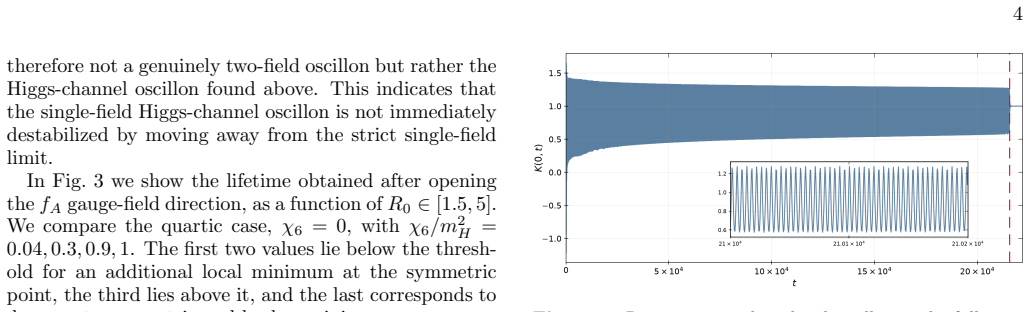
At the physical ratio m_H/m_W = 1.556, including the dimension-six operator O_6 = (Φ†Φ)³ with coupling below the current upper bound increases oscillon lifetime in the SU(2) bosonic sector by orders of magnitude (for example from about 6×10³ to more than 2×10⁵ in units of m_W⁻¹) and enlarges the basin of attraction. The effect holds from the single-field Higgs channel through a gauge perturbation to the full five-field spherical reduction, where the long-lived state remains Higgs-dominated, sits below the Higgs radiation threshold, and forms as an attractor after substantial transient radiation.
What carries the argument
The sextic deformation of the Higgs potential, written as a quartic term plus (c_6/Λ²)(Φ†Φ − v²/2)³ and parameterized by the dimensionless coupling χ_6. This term reshapes the potential (and can create a false vacuum at the origin), which nonlinearly suppresses radiation and stabilizes the oscillon at the physical mass ratio inside the spherical ansatz.
Load-bearing premise
All reported lifetimes come from classical evolution under spherical symmetry with the hypercharge field switched off, so the claim need not survive full three-dimensional dynamics, hypercharge, or quantum radiation.
What would settle it
Re-evolve the same families of initial data at m_H/m_W = 1.556 and χ_6/m_H² ≈ 0.3 with nonzero hypercharge coupling or without spherical symmetry; if the configurations then radiate on timescales comparable to the pure quartic theory, the lifetime claim fails for realistic electroweak fields.
If this is right
- Long-lived electroweak oscillons become accessible at physical masses for experimentally allowed values of the O_6 coupling.
- Reported oscillon energies of about 6–7 TeV lie below the corresponding SMEFT sphaleron mass near 9 TeV, so oscillons could appear as intermediate states in sphaleron decay.
- Oscillon formation remains robust after most of the initial energy is radiated, so the configurations act as classical attractors rather than fine-tuned solutions.
- Lifetime sensitivity to O_6 makes these oscillons a dynamical probe of Higgs-sector SMEFT deformations.
- The same coupling window that stabilizes oscillons is the one that can also drive a first-order electroweak phase transition.
Where Pith is reading between the lines
- If longevity survives hypercharge and non-spherical modes, post-inflationary or phase-transition production could tie observable gravitational-wave or baryogenesis signals to the size of O_6.
- Full 3+1 classical simulations at the physical mass ratio and χ_6 ~ 0.3 are the direct next test of whether the spherical attractor is an artifact of the reduction.
- A dedicated semiclassical quantization of this SMEFT electroweak oscillon would close the gap between the classical lifetime claim and particle-level phenomenology.
- Other derivative-free Higgs-sector SMEFT operators that similarly flatten or double-well the potential may produce comparable lifetime gains.
Editorial analysis
A structured set of objections, weighed in public.
Referee Report
Summary. The manuscript studies oscillons in the SU(2) bosonic sector of the electroweak theory (g'=0, fermions neglected) with the Higgs potential extended by the single dimension-six SMEFT operator O6 = (Phi-dagger Phi)^3. Using the standard spherical ansatz with five radial fields, the authors show via direct numerical evolution that at the physical ratio mH/mW = 1.556 the sextic term extends oscillon lifetimes by orders of magnitude (from tau ~ 6x10^3 to tau > 2x10^5 mW^{-1}) and enlarges the basin of attraction, for coupling values claimed to lie below current experimental bounds. The effect is traced through three levels of truncation: a single-field Higgs channel (sextic scalar theory), a two-field truncation opening the fA gauge component, and the full five-field spherical system with Gauss-constraint monitoring. The long-lived configuration oscillates below the Higgs radiation threshold (omega < mH) but above the gauge threshold (omega > mW), forms from initial data with an order of magnitude more energy than the final oscillon (indicating attractor behavior), and is shown not to depend on one specific initial profile (App. D). The oscillon mass is estimated at 6.3-7.0 TeV, below the SMEFT sphaleron mass, motivating a possible role in sphaleron decay.
Significance. If the results hold, this is the first demonstration that a single experimentally allowed SMEFT dimension-six operator can rescue the electroweak oscillon at the physical mass ratio, changing it from a mathematical curiosity into a candidate long-lived state of the weak-sector classical theory, with an estimated mass (~6-7 TeV) below the sphaleron mass and a concrete motivation (sphaleron decay, early-universe dynamics). The paper's strengths include forward, parameter-scanned classical simulations with no fitted prediction; validation of the code against Honda & Choptuik's fine-structure results in the chi_6=0 limit; an explicit attractor demonstration (E_init ~ 793 radiating down to E_osc ~ 80-90); an alternate-initial-data robustness check (App. D); monitoring and projection of the Gauss constraint (App. C); and a documented numerical implementation (App. F). The work is honest about its limitations (g'=0, spherical reduction, classical dynamics) and opens a well-defined direction: using oscillon longevity as a probe of SMEFT coefficients.
major comments (3)
- [Abstract; §II, definition of χ6; §V] The abstract's phrase "below the current upper bound" is load-bearing for the physical relevance claim, yet the manuscript never gives the explicit conversion from the dimensionless χ6 used in the numerics to c6/Λ² in physical units, nor a numerical comparison with a cited experimental/fit bound (Refs. 41, 42, 52). Using χ6 = 16 c6 mW²/(g⁴Λ²), the working point χ6/mH² ≃ 0.3 should be translated into c6/Λ² (e.g., in TeV⁻² or c6 at Λ=1 TeV) and placed next to the actual bound. As written, a reader cannot verify the abstract's central qualifier. Please add this explicitly, ideally in Sec. II where χ6 is defined.
- [Appendix F; App. C (constraint projection); Figs. 1, 5] The longevity results (τ up to and beyond 2×10⁵ mW⁻¹) rest entirely on long-time numerical integration, but Appendix F gives no quantitative diagnostics: no grid spacing, domain size, time step, convergence study under refinement, or energy-conservation check is reported. This matters specifically because (i) the lifetime is defined by a 90% drop from a moving-average plateau, so slow secular energy drift from discretization error could masquerade as oscillon decay or artificially extend plateaus; and (ii) the Gauss-constraint projection step (App. C) can inject or remove energy, and no bound on the projection-induced energy change is given. The validation against Honda–Choptuik [47] in Fig. 1 is reassuring for the χ6=0 code, but the χ6≠0 runs and the five-field system need at minimum a refinement/convergence statement and a constraint-violation and energy-drift plot for one representati
- [§III–IV; spherical ansatz (5)–(7); Abstract] All simulations are performed within the spherical ansatz (5)–(7). Oscillons in 3+1 dimensions are known to be susceptible to aspherical instabilities, and here the issue is sharpened by the fact that the oscillon frequency sits above the gauge-boson threshold (ω > mW, Fig. 7), so non-spherical gauge modes are kinematically accessible decay channels. The two-field test of Sec. III (opening fA) and the five-field evolution of Sec. IV probe only spherical perturbations. The authors should either (a) provide a linearized non-spherical perturbation analysis or a small set of non-spherical evolution checks for one representative long-lived configuration, or (b) state explicitly in the abstract and conclusions that the lifetime claim is established only for spherically symmetric classical evolution and that aspherical stability is open. Option (b) is acceptable given that the abstract is alrea
minor comments (7)
- [§III; Appendix F] Typographical errors: §III "single real scalar theor" (theory); "units in with c=1" (units in which); "frequency frequency lies below" (duplicated word); "up to to χ6≃0.6" (duplicated 'to'); App. F "outgoing boundary conditions at larger" (at large r).
- [Figure 1] Fig. 1 caption: state the grid resolution in R0 used for the lifetime scan, and mark which points are lower limits (runs terminated at the simulation cutoff) versus measured decays. The text notes τ>2×10⁵ as a lower bound but the figure should distinguish censored points, since this affects the visual comparison of peak heights across χ6 values.
- [§III; Appendix F] The lifetime definition (90% drop from a moving-average plateau) is reasonable but the window size for the moving average is not specified, and it would be useful to confirm that the extracted τ is insensitive to the window and to the choice of enclosing radius for the localized energy. A one-line robustness statement would suffice.
- [§III; Eqs. (B1)–(B5)] §III, gauge-perturbation subsection: the statement that setting fB=fC=H=0 initially is preserved by the EOM is important; a brief explicit reference to the relevant terms in Eqs. (B1)–(B5) that enforce this would help the reader verify the consistent-truncation claim without working through the appendix.
- [Appendix E, Eqs. (E1)–(E5)] Eq. (E2) presents N_CS as a spacetime integral of Tr(W*W), which is a charge difference/integral of the anomaly rather than the charge itself; the subsequent Eqs. (E3)–(E5) then define the charge correctly. The presentation would be clearer if Eq. (E2) were labeled as the integrated anomaly relation, to avoid an apparent dimensional mismatch for the reader.
- [§IV; §V] The comparison m_osc ≈ 6.3–7.0 TeV vs. m_sph ≈ 9 TeV should state the value of g (and hence mW in physical units) used in the conversion, and whether the sphaleron mass quoted is for the same χ6. The suggestion that the oscillon could be an intermediate state in sphaleron decay would also benefit from one sentence clarifying that this is conjectural and not demonstrated by any sphaleron-decay simulation here.
- [§I; Ref. [15]] Reference 15 (arXiv:2606.22680) is cited to support the characterization of an oscillon as a localized non-normalizable resonance; since that work is very recent, a brief self-contained remark on what 'threshold/anti-bound mode' means here would make §I more self-contained.
Circularity Check
No circularity: lifetime enhancement is a measured output of forward classical EOM evolution, not forced by definition or fit.
full rationale
The paper’s central claim is that adding O6=(Φ†Φ)³ at physical mH/mW=1.556 extends SU(2) oscillon lifetime by orders of magnitude. The derivation chain is: write the SMEFT-deformed potential (Eq. 2), reduce to the spherical ansatz (Eqs. 5–7), integrate the classical EOMs (Appendix B) from Gaussian initial data (Eqs. 8–10), and measure lifetime from localized-energy decay. χ6 is an externally bounded free coefficient that is scanned, not fitted to force a target lifetime formula; reported τ values (e.g. >2×10^5 mW⁻¹) are simulation outputs. Validation against the known ϕ⁴ lifetime curve (Ref. [47]) is an external benchmark, not a self-referential definition. Self-citations supply context (prior SM oscillons, SMEFT operator lists, recent quantization arguments) but do not algebraically determine the lifetime result. No uniqueness theorem, ansatz smuggled as theorem, or renamed empirical law underpins the claim. The modeling restrictions (g′=0, spherical ansatz, classical only) are assumptions about scope, not circular reductions of the prediction to its inputs.
Axiom & Free-Parameter Ledger
free parameters (3)
- χ6 (or c6/Λ²) =
scanned; strong effect near χ6/mH² ≃ 0.3
- Initial Gaussian amplitudes/widths (AK, R0, AA, RA, AH, RH) =
e.g. AK=-2, R0~2–6; representative long-lived points listed in figure captions
- Lifetime threshold (90% energy drop from moving-average plateau) =
90% drop criterion
axioms (6)
- domain assumption Classical field equations of the SU(2) gauged Higgs model adequately describe oscillon longevity for this purpose.
- domain assumption Spherical ansatz (5)–(7) with temporal gauge captures the stable channel relevant to the lifetime claim.
- domain assumption g'=0 is a good approximation; U(1) and fermions can be neglected for the qualitative O6 stabilization effect.
- ad hoc to paper Only O6 among dimension-six operators is retained as a pure Higgs-potential deformation.
- domain assumption Quoted experimental upper bounds allow the χ6 values that produce the longest lifetimes.
- standard math Standard calculus/PDE continuum limit and gauge theory identities used to derive Apps. B–E.
invented entities (1)
-
SMEFT oscillon (long-lived O6-stabilized electroweak oscillon at physical mH/mW)
no independent evidence
read the original abstract
We show that the inclusion of a dimension-six operator in the Higgs potential has a dramatic impact on the stability of oscillons in the $SU(2)$ bosonic sector of the Standard Model, extending their lifetime by orders of magnitude. This happens for the physical value of the ratio between the Higgs and W boson masses, $m_H/m_W=1.556$ and for the dimension-six operator $O_6 = (\Phi^\dagger \Phi)^3$ whose coupling constant is below the current upper bound.
Figures




Reference graph
Works this paper leans on
-
[1]
Topology in the Weinberg-Salam The- ory,
N. S. Manton, “Topology in the Weinberg-Salam The- ory,” Phys. Rev. D28, 2019 (1983)
2019
-
[2]
A Saddle Point Solution in the Weinberg-Salam Theory,
Frans R. Klinkhamer and N. S. Manton, “A Saddle Point Solution in the Weinberg-Salam Theory,” Phys. Rev. D 30, 2212 (1984)
1984
-
[3]
On the Pulsed Soliton Lifetime in Two Classical Relativistic Theory Models,
I. L. Bogolyubsky and V. G. Makhankov, “On the Pulsed Soliton Lifetime in Two Classical Relativistic Theory Models,” JETP Lett.24, 12 (1976)
1976
-
[4]
Marcelo Gleiser, “Pseudostable bubbles,” Phys. Rev. D 49, 2978–2981 (1994), arXiv:hep-ph/9308279
Pith/arXiv arXiv 1994
-
[5]
Oscillons: Resonant configurations during bubble col- lapse,
Edmund J. Copeland, M. Gleiser, and H. R. Muller, “Oscillons: Resonant configurations during bubble col- lapse,” Phys. Rev. D52, 1920–1933 (1995), arXiv:hep- ph/9503217
arXiv 1920
-
[6]
Compact oscillons in the signum-Gordon model,
H. Arodz, P. Klimas, and T. Tyranowski, “Compact oscillons in the signum-Gordon model,” Phys. Rev. D 77, 047701 (2008), arXiv:0710.2244 [hep-th]
Pith/arXiv arXiv 2008
-
[7]
Generation of Coherent Structures After Cosmic Inflation,
Marcelo Gleiser, Noah Graham, and Nikitas Stam- atopoulos, “Generation of Coherent Structures After Cosmic Inflation,” Phys. Rev. D83, 096010 (2011), arXiv:1103.1911 [hep-th]
Pith/arXiv arXiv 2011
-
[8]
Mustafa A. Amin, Richard Easther, Hal Finkel, Raphael Flauger, and Mark P. Hertzberg, “Oscillons Af- ter Inflation,” Phys. Rev. Lett.108, 241302 (2012), arXiv:1106.3335 [astro-ph.CO]
Pith/arXiv arXiv 2012
-
[9]
End of infla- tion, oscillons, and matter-antimatter asymmetry,
Kaloian D. Lozanov and Mustafa A. Amin, “End of infla- tion, oscillons, and matter-antimatter asymmetry,” Phys. Rev. D90, 083528 (2014), arXiv:1408.1811 [hep-ph]
Pith/arXiv arXiv 2014
-
[10]
Classi- cal Decay Rates of Oscillons,
Hong-Yi Zhang, Mustafa A. Amin, Edmund J. Copeland, Paul M. Saffin, and Kaloian D. Lozanov, “Classi- cal Decay Rates of Oscillons,” JCAP07, 055 (2020), arXiv:2004.01202 [hep-th]
Pith/arXiv arXiv 2020
-
[11]
Recipes for oscillon longevity,
Jan Olle, Oriol Pujolas, and Fabrizio Rompineve, “Recipes for oscillon longevity,” JCAP09, 015 (2021), arXiv:2012.13409 [hep-ph]
Pith/arXiv arXiv 2021
-
[12]
Non-topological solitons and quasi- solitons,
Shuang-Yong Zhou, “Non-topological solitons and quasi- solitons,” (2024), arXiv:2411.16604 [hep-th]
Pith/arXiv arXiv 2024
-
[13]
Inclusion of radiation in the collective coordinate method approach of theϕ4 model,
S. Navarro-Obreg´ on, L. M. Nieto, and J. M. Queiruga, “Inclusion of radiation in the collective coordinate method approach of theϕ4 model,” Phys. Rev. E108, 044216 (2023), arXiv:2305.00497 [hep-th]
arXiv 2023
-
[14]
Oscillons from Q-Balls through Renormalization,
F. Blaschke, T. Roma´ nczukiewicz, K. S lawi´ nska, and A. Wereszczy´ nski, “Oscillons from Q-Balls through Renormalization,” Phys. Rev. Lett.134, 081601 (2025), arXiv:2410.24109 [hep-th]
Pith/arXiv arXiv 2025
-
[15]
Unified theory of oscillons and modes,
F. Blaschke, T. Romanczukiewicz, K. Slawinska, and A. Wereszczynski, “Unified theory of oscillons and modes,” (2026), arXiv:2606.22680 [hep-th]
Pith/arXiv arXiv 2026
-
[16]
Numerical investi- gations of oscillons in 2 dimensions,
Mark Hindmarsh and Petja Salmi, “Numerical investi- gations of oscillons in 2 dimensions,” Phys. Rev. D74, 105005 (2006), arXiv:hep-th/0606016
Pith/arXiv arXiv 2006
-
[17]
Oscillons in scalar field theories: Appli- cations in higher dimensions and inflation,
Marcelo Gleiser, “Oscillons in scalar field theories: Appli- cations in higher dimensions and inflation,” Int. J. Mod. Phys. D16, 219–229 (2007), arXiv:hep-th/0602187
Pith/arXiv arXiv 2007
-
[18]
Oscillons and quasi-breathers in D+1 dimensions,
Paul M. Saffin and Anders Tranberg, “Oscillons and quasi-breathers in D+1 dimensions,” JHEP01, 030 (2007), arXiv:hep-th/0610191
Pith/arXiv arXiv 2007
-
[19]
Flat-top oscil- lons in an expanding universe,
Mustafa A. Amin and David Shirokoff, “Flat-top oscil- lons in an expanding universe,” Phys. Rev. D81, 085045 (2010), arXiv:1002.3380 [astro-ph.CO]
Pith/arXiv arXiv 2010
-
[20]
Impact of other scalar fields on oscillons after hilltop inflation,
Stefan Antusch and Stefano Orani, “Impact of other scalar fields on oscillons after hilltop inflation,” JCAP 03, 026 (2016), arXiv:1511.02336 [hep-ph]
Pith/arXiv arXiv 2016
-
[21]
Self- resonance after inflation: oscillons, transients and ra- diation domination,
Kaloian D. Lozanov and Mustafa A. Amin, “Self- resonance after inflation: oscillons, transients and ra- diation domination,” Phys. Rev. D97, 023533 (2018), arXiv:1710.06851 [astro-ph.CO]
Pith/arXiv arXiv 2018
-
[22]
Jan Oll´ e, Oriol Pujol` as, and Fabrizio Rompineve, “Oscillons and Dark Matter,” JCAP02, 006 (2020), arXiv:1906.06352 [hep-ph]
Pith/arXiv arXiv 2020
-
[23]
Mustafa A. Amin and Philip Mocz, “Formation, grav- itational clustering, and interactions of nonrelativistic solitons in an expanding universe,” Phys. Rev. D100, 063507 (2019), arXiv:1902.07261 [astro-ph.CO]
Pith/arXiv arXiv 2019
-
[24]
Multi-field inflation and preheating in asymmetricα-attractors,
Oksana Iarygina, Evangelos I. Sfakianakis, Dong-Gang Wang, and Ana Ach´ ucarro, “Multi-field inflation and preheating in asymmetricα-attractors,” (2020), arXiv:2005.00528 [astro-ph.CO]
Pith/arXiv arXiv 2020
-
[25]
Gravitational wave spectra from oscillon formation after inflation,
Takashi Hiramatsu, Evangelos I. Sfakianakis, and Masahide Yamaguchi, “Gravitational wave spectra from oscillon formation after inflation,” JHEP03, 021 (2021), arXiv:2011.12201 [hep-ph]
Pith/arXiv arXiv 2021
-
[26]
Oscillons during Dirac- Born-Infeld preheating,
Yu Sang and Qing-Guo Huang, “Oscillons during Dirac- Born-Infeld preheating,” Phys. Lett. B823, 136781 (2021), arXiv:2012.14697 [hep-th]
Pith/arXiv arXiv 2021
-
[27]
Oscillons of Axion- Like Particle: Mass distribution and power spectrum,
Masahiro Kawasaki, Wakutaka Nakano, Hiromasa Nakatsuka, and Eisuke Sonomoto, “Oscillons of Axion- Like Particle: Mass distribution and power spectrum,” JCAP01, 061 (2021), arXiv:2010.09311 [astro-ph.CO]
Pith/arXiv arXiv 2021
-
[28]
Oscillon formation from preheating in asymmetric inflation- ary potentials,
Rafid Mahbub and Swagat S. Mishra, “Oscillon formation from preheating in asymmetric inflation- ary potentials,” Phys. Rev. D108, 063524 (2023), arXiv:2303.07503 [astro-ph.CO]
Pith/arXiv arXiv 2023
-
[29]
Oscillon formation during inflationary preheat- ing with general relativity,
Josu C. Aurrekoetxea, Katy Clough, and Francesco Muia, “Oscillon formation during inflationary preheat- ing with general relativity,” Phys. Rev. D108, 023501 (2023), arXiv:2304.01673 [gr-qc]
Pith/arXiv arXiv 2023
-
[30]
Mohammed Shafi, Edmund J. Copeland, Rafid Mahbub, Swagat S. Mishra, and Soumen Basak, “Formation and decay of oscillons after inflation in the presence of an external coupling. Part I. Lattice simulations,” JCAP10, 082 (2024), arXiv:2406.00108 [hep-ph]
Pith/arXiv arXiv 2024
-
[31]
Nonlinear dy- namics of oscillons and transients during preheating after single field inflation,
Tianyu Jia, Yu Sang, and Xue Zhang, “Nonlinear dy- namics of oscillons and transients during preheating after single field inflation,” Phys. Rev. D111, 083531 (2025), arXiv:2409.04046 [astro-ph.CO]
Pith/arXiv arXiv 2025
-
[32]
Preheating and oscillon formation in Einstein-scalar-Gauss-Bonnet grav- ity,
Areef Waeming, Josu C. Aurrekoetxea, Katy Clough, Pau Figueras, and ´Aron D. Kov´ acs, “Preheating and oscillon formation in Einstein-scalar-Gauss-Bonnet grav- ity,” (2026), arXiv:2607.01177 [gr-qc]
Pith/arXiv arXiv 2026
-
[33]
An Oscillon in the SU(2) gauged Higgs model,
E. Farhi, N. Graham, V. Khemani, R. Markov, and R. Rosales, “An Oscillon in the SU(2) gauged Higgs model,” Phys. Rev. D72, 101701 (2005), arXiv:hep- th/0505273. 11
arXiv 2005
-
[34]
Analysis of Oscillons in the SU(2) Gauged Higgs Model,
Evangelos I. Sfakianakis, “Analysis of Oscillons in the SU(2) Gauged Higgs Model,” (2012), arXiv:1210.7568 [hep-ph]
Pith/arXiv arXiv 2012
-
[35]
N. Graham, “An Electroweak oscillon,” Phys. Rev. Lett. 98, 101801 (2007), [Erratum: Phys.Rev.Lett. 98, 189904 (2007)], arXiv:hep-th/0610267
Pith/arXiv arXiv 2007
-
[36]
The Standard Model as an Effective Field Theory,
Ilaria Brivio and Michael Trott, “The Standard Model as an Effective Field Theory,” Phys. Rept.793, 1–98 (2019), arXiv:1706.08945 [hep-ph]
Pith/arXiv arXiv 2019
-
[37]
The stan- dard model effective field theory at work,
Gino Isidori, Felix Wilsch, and Daniel Wyler, “The stan- dard model effective field theory at work,” Rev. Mod. Phys.96, 015006 (2024), arXiv:2303.16922 [hep-ph]
Pith/arXiv arXiv 2024
-
[38]
Lectures on SMEFT,
Adam Falkowski, “Lectures on SMEFT,” Eur. Phys. J. C83, 656 (2023)
2023
-
[39]
Effective Lagrangian Analysis of New Interactions and Flavor Conservation,
W. Buchmuller and D. Wyler, “Effective Lagrangian Analysis of New Interactions and Flavor Conservation,” Nucl. Phys. B268, 621–653 (1986)
1986
-
[40]
Dimension-Six Terms in the Standard Model Lagrangian,
B. Grzadkowski, M. Iskrzynski, M. Misiak, and J. Rosiek, “Dimension-Six Terms in the Standard Model Lagrangian,” JHEP10, 085 (2010), arXiv:1008.4884 [hep-ph]
Pith/arXiv arXiv 2010
-
[41]
Higgs windows to new physics through d=6 operators: constraints and one-loop anomalous dimensions,
J. Elias-Miro, J. R. Espinosa, E. Masso, and A. Pomarol, “Higgs windows to new physics through d=6 operators: constraints and one-loop anomalous dimensions,” JHEP 11, 066 (2013), arXiv:1308.1879 [hep-ph]
Pith/arXiv arXiv 2013
-
[42]
Electroweak sphaleron with dimension-six operators,
Xucheng Gan, Andrew J. Long, and Lian-Tao Wang, “Electroweak sphaleron with dimension-six operators,” Phys. Rev. D96, 115018 (2017), arXiv:1708.03061 [hep- ph]
Pith/arXiv arXiv 2017
-
[43]
First-order electroweak phase transition in the standard model with a low cutoff,
Christophe Grojean, Geraldine Servant, and James D. Wells, “First-order electroweak phase transition in the standard model with a low cutoff,” Phys. Rev. D71, 036001 (2005), arXiv:hep-ph/0407019
Pith/arXiv arXiv 2005
-
[44]
Dynamics of Non-renormalizable Elec- troweak Symmetry Breaking,
Cedric Delaunay, Christophe Grojean, and James D. Wells, “Dynamics of Non-renormalizable Elec- troweak Symmetry Breaking,” JHEP04, 029 (2008), arXiv:0711.2511 [hep-ph]
Pith/arXiv arXiv 2008
-
[45]
Radiation of scalar oscillons in 2 and 3 dimensions,
Gyula Fodor, Peter Forgacs, Zalan Horvath, and Mark Mezei, “Radiation of scalar oscillons in 2 and 3 dimensions,” Phys. Lett. B674, 319–324 (2009), arXiv:0903.0953 [hep-th]
Pith/arXiv arXiv 2009
-
[46]
Oscillons in the bro- ken vacuum and global vortex annihilation,
D. Canillas Mart ´ ınez, A. Gonz´ alez-Parra, D. Migu´ elez- Caballero, and A. Wereszczynski, “Oscillons in the bro- ken vacuum and global vortex annihilation,” (2026), arXiv:2603.28298 [hep-th]
arXiv 2026
-
[47]
Fine struc- ture of oscillons in the spherically symmetric phi**4 Klein-Gordon model,
Ethan P. Honda and Matthew W. Choptuik, “Fine struc- ture of oscillons in the spherically symmetric phi**4 Klein-Gordon model,” Phys. Rev. D65, 084037 (2002), arXiv:hep-ph/0110065
Pith/arXiv arXiv 2002
-
[48]
Oscillons and Quasi-breathers in the ϕ4 Klein-Gordon model,
Gyula Fodor, Peter Forgacs, Philippe Grandclement, and Istvan Racz, “Oscillons and Quasi-breathers in the ϕ4 Klein-Gordon model,” Phys. Rev. D74, 124003 (2006), arXiv:hep-th/0609023
Pith/arXiv arXiv 2006
-
[49]
Computation of the radiation amplitude of oscil- lons,
Gyula Fodor, Peter Forgacs, Zalan Horvath, and Mark Mezei, “Computation of the radiation amplitude of oscil- lons,” Phys. Rev. D79, 065002 (2009), arXiv:0812.1919 [hep-th]
Pith/arXiv arXiv 2009
-
[50]
Radiation and Re- laxation of Oscillons,
Petja Salmi and Mark Hindmarsh, “Radiation and Re- laxation of Oscillons,” Phys. Rev. D85, 085033 (2012), arXiv:1201.1934 [hep-th]
Pith/arXiv arXiv 2012
-
[51]
The Decay of the sphalerons,
M. Hellmund and J. Kripfganz, “The Decay of the sphalerons,” Nucl. Phys. B373, 749–758 (1992)
1992
-
[52]
Towards the Ulti- mate SM Fit to Close in on Higgs Physics,
Alex Pomarol and Francesco Riva, “Towards the Ulti- mate SM Fit to Close in on Higgs Physics,” JHEP01, 151 (2014), arXiv:1308.2803 [hep-ph]
Pith/arXiv arXiv 2014
-
[53]
Quantum Radiation of Oscillons,
Mark P. Hertzberg, “Quantum Radiation of Oscillons,” Phys. Rev. D82, 045022 (2010), arXiv:1003.3459 [hep- th]
Pith/arXiv arXiv 2010
-
[54]
Quan- tum Oscillons are Long-Lived,
Jarah Evslin, Katarzyna Slawi´ nska, Tomasz Roma´ nczukiewicz, and Andrzej Wereszczy´ nski, “Quan- tum Oscillons are Long-Lived,” (2025), arXiv:2512.17193 [hep-th]
Pith/arXiv arXiv 2025
-
[55]
Elec- troweak sphaleron revisited. I. Static solutions, energy barrier, and unstable modes,
Konstantin T. Matchev and Sarunas Verner, “Elec- troweak sphaleron revisited. I. Static solutions, energy barrier, and unstable modes,” Phys. Rev. D112, 113009 (2025), arXiv:2505.05607 [hep-ph]
Pith/arXiv arXiv 2025
discussion (0)
Sign in with ORCID, Apple, or X to comment. Anyone can read and Pith papers without signing in.