REVIEW 3 major objections 6 minor 48 references
This paper argues that the identity switches in multi-object tracking of highly similar objects come from a mismatch between instance-level re-ID training and the frame-level global assignment used at inference, and that fixing this by trai
Reviewed by Pith at T0; open to challenge. T0 means a machine referee read the full paper against a public rubric. the ladder, T0–T4 →
Reformulating re-ID as frame-level trajectory-to-detection association with shared-appearance suppression improves identity preservation in dense, visually similar bee tracking (BEE24) by ~1 HOTA and 28% fewer ID switches.
T0 review reviewed 2026-08-01 challenge →
load-bearing objection Worth a careful look, but test-set selection and no error bars mean the reported gains are not yet established; the idea is sound and the ablation is honest. the 3 major comments →
VLA-ReID: Video-Level Association for Re-Identification in Multi-Object Tracking with Highly Similar Objects
The pith
A machine-rendered reading of the paper's core claim, the machinery that carries it, and where it could break.
The reading
Core claim
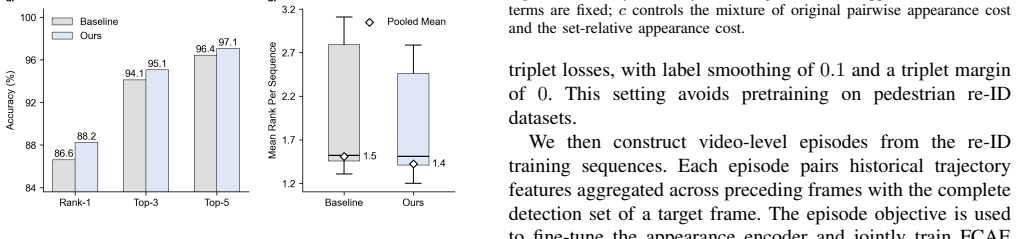
VLA-ReID shows that the standard way of training re-ID for MOT—comparing a query patch to a few positive and negative patches—is misaligned with the inference-time task of jointly matching all trajectories against all detections. Training on video-level episodes that reproduce this global assignment raises association recall (AssR) from 54.9 to 61.9 while cutting fragmentations. Adding frame-common appearance suppression, which estimates a shared direction via attention pooling and subtracts its component from all features, recovers precision and further cuts identity switches. The full method reaches 49.2 HOTA, 67.0 MOTA, 46.6 AssA, 61.7 AssR, and 64.9 IDF1 on BEE24 under shared detections,
What carries the argument
Two modules carry the argument. Frame-Common Appearance Estimation (FCAE) takes all current-frame detection features, lets a learnable query attend to them, and outputs a single unit-norm vector B representing the appearance common to the frame's objects. Common-Appearance Suppression (CAS) applies the same B to both detection and trajectory features by subtracting α⊙(x·B^T)B, where α is a learnable per-dimension sigmoid gate shared across samples, and then re-normalizes. The residual features form a similarity matrix that is min–max normalized within the current trajectory-to-detection block, producing a set-relative appearance cost. The training objective is a row- and column-wise candidat
Load-bearing premise
The method assumes that a single learned direction, computed from the current frame's detections, isolates appearance components shared by all objects, and that removing it from trajectory and detection features does not discard the identity-specific cues needed to tell similar objects apart.
What would settle it
Measure the angle between the learned B and the first principal component of the same-frame detection features on a diverse-appearance tracking set; if they are close, the 'common appearance' interpretation is suspect. A direct falsifier is to fix the suppression gate to α=1 for all dimensions and show that on a heterogeneous benchmark the method performs no better—or worse—than the unmodified baseline, indicating that the learned gate, not the common-appearance prior, is responsible for the gain.
If this is right
- If re-ID for tracking is trained on full candidate sets rather than isolated pairs, identity scores become comparable across frames, so any tracker with a pairwise cosine appearance cost could swap in this set-relative cost without changing its motion model or matching logic.
- The common-appearance suppression is fully self-supervised; it requires no pose, part, or identity annotations beyond what the tracker already has, making it applicable to other species or objects with uniform appearance.
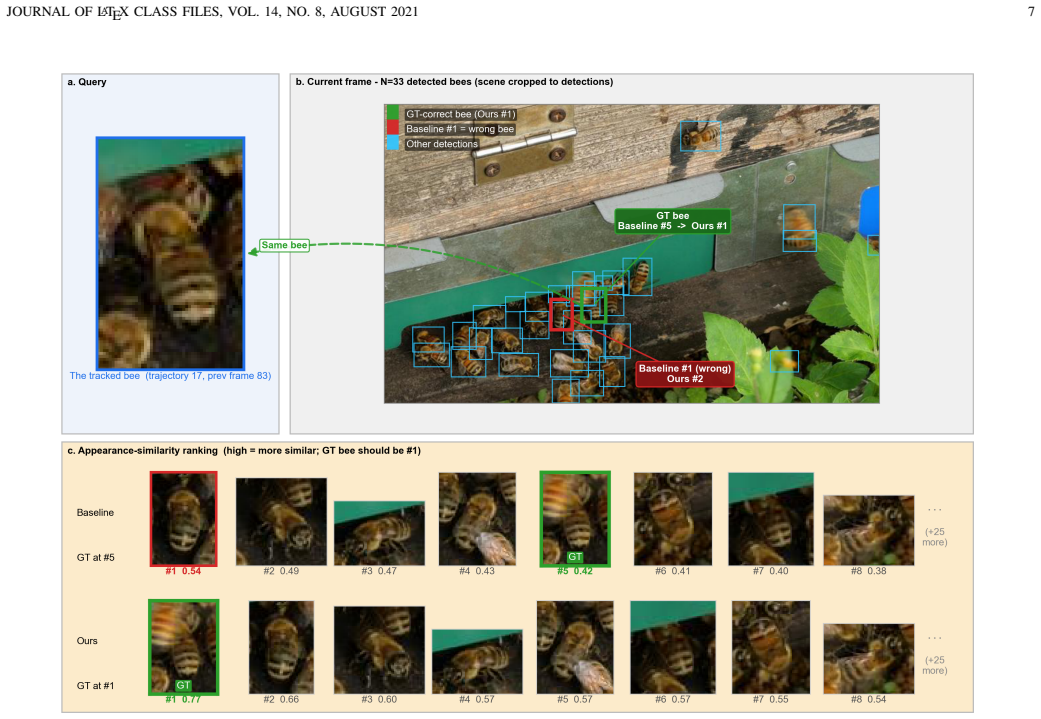
- The paper shows that the training-inference mismatch itself—not just weak features—drives identity switches in dense scenes; this reframes how appearance models for MOT should be evaluated and trained.
- The ablation indicates the two components are complementary: video-level episode training boosts recall of ground-truth associations, while common-appearance suppression restores precision; a future tracker could potentially get the same benefit by tuning the balance between row and column losses differently.
Where Pith is reading between the lines
- The use of a single shared suppression direction is a strong simplifying assumption; in scenes where the 'common' appearance is itself multi-modal (varying lighting, multiple poses, or sub-species markings), a mixture of directions or a per-candidate-set basis might be needed, and the paper's single-direction mechanism may not transfer directly.
- One could test whether the learned B is genuinely capturing common appearance or simply the direction of maximum variance: if B aligns with the first principal component of the detection features, the gain may come from decorrelation rather than from subtracting a semantically shared appearance.
- Because the FCAE attention pool operates on all detections in the frame, it is vulnerable to detector false positives; a robust variant that weights detections by confidence or excludes low-quality boxes might make the mechanism degrade more gracefully in noisier detection regimes.
Editorial analysis
A structured set of objections, weighed in public.
Referee Report
Summary. The paper proposes VLA-ReID, a re-identification method for multi-object tracking in scenes with highly similar objects (e.g., bee swarms). It reformulates re-ID training from instance-level matching to video-level association: historical trajectory features serve as queries and all current-frame detections as candidates, enabling direct optimization of the global trajectory-to-detection association matrix. Two additional modules, FCAE and CAS, estimate a common appearance direction from the current detection set and suppress that component from both trajectory and detection features, with the goal of amplifying identity-discriminative differences without extra annotations. The method is integrated into the TrackTrack tracker by replacing only the pairwise appearance cost. Experiments on the BEE24 dataset report improvements over TrackTrack and other state-of-the-art trackers in HOTA, MOTA, AssR, AssA, IDF1, and identity switches.
Significance. If the empirical claims hold, the video-level training/inference alignment is a conceptually clean and potentially transferable idea for MOT in high-similarity settings, and the annotation-free common-appearance suppression is an attractive alternative to pose/part supervision. The paper includes a systematic ablation, a sensitivity sweep, and ranking/gap diagnostics, and promises source code and dataset release. However, the current experimental protocol — in particular test-set selection of the injection weight and the absence of variance estimates — prevents the headline numbers from being interpreted as a generalizable result. The contribution is therefore significant in potential but not yet established.
major comments (3)
- [§III-D, Eq. (14), Tables I–II] The injection weight c is selected on the BEE24 test set. The text states: 'We selected c=0.50 because it removes the mixing ratio at inference and achieved the lowest IDs while remaining close to the best HOTA value in the sweep.' All final results in Tables I and II are then reported with this c. This is test-set model selection, not independent evaluation. No validation split or nested selection is provided, and no error bars or multiple-seed runs are reported. Given that the main deltas are small (HOTA 48.1→49.2, AssA 45.9→46.6) while FP changes from 6026 to 11956 and FN from 51093 to 43096, the reported gains could lie within run-to-run variation. Please provide a validation-based selection of c (or fix c a priori) and report variance across seeds for the final configuration.
- [Table I] The ablation does not fully support the claim that each component contributes monotonically. 'Baseline + Episode' alone achieves MOTA 67.5, which is higher than the final 'Baseline + Episode + FCAE + CAS' MOTA of 67.0, and FP 14856 vs 11956. The final model improves AssR, AssA, IDF1, and IDs, but the MOTA regression relative to the episode-only variant is not discussed. Since the abstract highlights MOTA gains (+0.3 over TOPICTrack, +1.3 over TrackTrack), the paper should explicitly address this trade-off and clarify why the final model is preferred overall. Without such discussion, the ablation is ambiguous about the contribution of FCAE+CAS.
- [§II-C, §II-D, Eq. (6)–(9)] FCAE and CAS are the only genuinely new modules, and their core assumption is that a single learned linear direction B, obtained via attention pooling over all current detections, captures the dominant common appearance without discarding identity-specific cues. This assumption is weakly constrained: the anti-collapse regularizer anchors B only with weight w_anc=0.1, and no analysis shows what B represents or whether it is contaminated by detector false positives or the direction of largest variance. Please add diagnostics such as (i) alignment of B with the top PCA component of Z, (ii) norm of the suppressed component and per-dimension gate values after training, and (iii) sensitivity of association quality to the choice of w_anc. These would directly address the correctness risk of the central mechanism.
minor comments (6)
- [Abstract] The abstract reports MOTA +0.3, but Table II shows +1.3 over TrackTrack and +0.3 over TOPICTrack. Please state the comparison baseline explicitly to avoid ambiguity.
- [Fig. 5] The caption says 'dashed lines denote the original TrackTrack baseline,' but the text does not refer to the dashed lines in the figure. Add a sentence in §III-D explaining what the dashed lines show.
- [Eq. (6)] The attention temperature τ_f is set to 1, but this is not mentioned in the implementation details. Please state it explicitly alongside the other hyperparameters.
- [§II-D] The initialization 'θ to a positive constant' is vague. Specify the numerical value used (e.g., θ0 = 4.0, giving α ≈ 0.98).
- [§II-B] Minor typo: 'exponentially aggregated historical trajectory features' should likely be 'exponentially weighted' or 'exponential moving average' to match Eq. (2).
- [References] References [18], [32], and [33] appear unrelated to MOT or re-ID (they concern RL, flood modeling, and nowcasting). Please verify whether these citations are necessary or replace them with more relevant work.
Circularity Check
Method derivation is self-contained, but the final c=0.50 model is selected on the BEE24 test set and then evaluated on the same set, making the headline metrics partially in-sample.
specific steps
-
fitted input called prediction
[Section III-D (Sensitivity Analysis), Eq. (14), Fig. 5; Table II]
"We selected c=0.50 because it removes the mixing ratio at inference and achieved the lowest IDs while remaining close to the best HOTA value in the sweep. This full-replacement setting was used for the final model."
The blending coefficient c in Eq. (14) is a free hyperparameter controlling how much of the proposed set-relative cost replaces the original pairwise appearance cost. It is chosen by sweeping over the BEE24 test set (selecting for lowest IDs and near-best HOTA), and the same test set is then used for all reported final metrics in Tables I and II. Thus the headline improvements (e.g., IDs 606->437, a 28% reduction) are the result of selecting the best-looking c on the evaluation set, not an independent out-of-sample prediction. The final reported performance is therefore partly an in-sample selected statistic rather than a predicted result of the method.
full rationale
The core derivation of VLA-ReID is not circular: FCAE estimates a direction B from current-frame detections by attention pooling (Eqs. 6-7), CAS removes a gated projection along B (Eq. 9), the residual similarity matrix S is then a deterministic cosine matrix (Eq. 11), and training uses candidate-set cross-entropy on video-level episodes (Eqs. 15-17). These steps do not reduce to their inputs; the components are optimizable and the training objective is standard supervised ranking. No uniqueness theorem or load-bearing self-citation chain is used; the BEE24 dataset [8] and TrackTrack [29] are concrete external artifacts that others can run against. The one genuine circularity-adjacent flaw is the test-set model selection of c (Section III-D): a hyperparameter is chosen on the BEE24 test set and the same test set is then reported as the evaluation, so the headline numbers are partially in-sample and no confidence intervals or validation split are provided. Because the main mechanism (episode training) already improves over baseline at c=0, the central claim retains independent content; the selection issue makes the exact reported numbers less trustworthy but does not collapse the derivation into a fit. Score 5 reflects this partial empirical circularity.
Axiom & Free-Parameter Ledger
free parameters (7)
- Candidate-set softmax temperature τ_r =
0.1
- Loss weights λ_col, λ_com, w_sep, w_anc =
0.1, 0.5, 1.0, 0.1
- Injection weight c =
0.50
- EMA decay μ =
0.95
- Attention temperature τ_f =
1
- Suppression gate initializer θ =
not specified (chosen so α=σ(θ)≈1)
- AGW encoder + FCAE attention (q, W_K, W_V) + CAS gate θ =
learned on BEE24 training split from random initialization
axioms (5)
- ad hoc to paper One learned linear direction B captures the dominant common appearance of all current-frame detections
- domain assumption Subtracting B from both trajectory and detection features does not remove identity-discriminative information
- domain assumption Current-frame detections are reliable enough that attention pooling over all of them yields a meaningful common direction
- domain assumption Exponential moving average with μ=0.95 is a sufficient trajectory history representation
- domain assumption BEE24 is representative of highly-similar-object MOT and the shared-detection protocol yields fair comparison
invented entities (1)
-
Frame-Common Appearance direction B
no independent evidence
Cite this review
Pith. "Pith review of VLA-ReID: Video-Level Association for Re-Identification in Multi-Object Tracking with Highly Similar Objects." pith.science (2026). https://pith.science/paper/C4MLOXOB
@misc{pith2026260717157,
  author       = {Pith},
  title        = {Pith review of: VLA-ReID: Video-Level Association for Re-Identification in Multi-Object Tracking with Highly Similar Objects},
  year         = {2026},
  howpublished = {\url{https://pith.science/paper/C4MLOXOB}},
  note         = {Machine review of arXiv:2607.17157}
}
read the original abstract
Multi-object tracking (MOT) aims to localize multiple objects in videos while preserving their identities over time. Long-term identity preservation remains difficult when objects are small, densely distributed, and highly similar in appearance, as in bee swarm scenes. Existing trackers rely on re-identification (re-ID) models trained through single-instance assignment (instance-level querying). At inference, however, MOT requires global assignment between multiple trajectories and detections, corresponding to video-level querying. This training-inference mismatch can cause identity switches among visually similar objects. Existing approaches also often require substantial additional annotations to enhance appearance discrimination. We propose Video-Level Association re-ID (VLA-ReID), which reformulates re-ID as video-level association modeling. It uses aggregated historical trajectory features as queries and all current-frame detections as candidates, enabling direct optimization of their global association at each frame. In addition, Frame-Common Appearance Estimation (FCAE) estimates a common appearance direction from current-frame detections, while Common-Appearance Suppression (CAS) removes the corresponding component along this direction from trajectory and detection features. This amplifies discriminative differences among highly similar objects without additional annotations. Experiments on BEE24 show that VLA-ReID improves HOTA by 1.1, MOTA by 0.3, AssR by 2.6, AssA by 0.7, and IDF1 by 0.8 over state-of-the-art trackers, while reducing identity switches by 28%. These results demonstrate the effectiveness of video-level re-ID modeling for appearance-based association in MOT.
Figures




Reference graph
Works this paper leans on
-
[1]
Markerless tracking of an entire honey bee colony,
K. Bozek, L. Hebert, Y . Portugal, A. S. Mikheyev, and G. J. Stephens, “Markerless tracking of an entire honey bee colony,”Nature communi- cations, vol. 12, no. 1, p. 1733, 2021
2021
-
[2]
Idtracker.ai: tracking all individuals in small or large collectives of unmarked animals,
F. Romero-Ferrero, M. G. Bergomi, R. C. Hinz, F. J. Heras, and G. G. De Polavieja, “Idtracker.ai: tracking all individuals in small or large collectives of unmarked animals,”Nature methods, vol. 16, no. 2, pp. 179–182, 2019
2019
-
[3]
Online tracking of ants based on deep association metrics: method, dataset and evaluation,
X. Cao, S. Guo, J. Lin, W. Zhang, and M. Liao, “Online tracking of ants based on deep association metrics: method, dataset and evaluation,” Pattern Recognition, vol. 103, p. 107233, 2020
2020
-
[4]
A dataset of ant colonies’ motion trajectories in indoor and outdoor scenes to study clustering behavior,
M. Wu, X. Cao, M. Yang, X. Cao, and S. Guo, “A dataset of ant colonies’ motion trajectories in indoor and outdoor scenes to study clustering behavior,”GigaScience, vol. 11, p. giac096, 2022
2022
-
[5]
Swarm behavior tracking based on a deep vision algorithm,
M. Wu, X. Cao, and S. Guo, “Swarm behavior tracking based on a deep vision algorithm,”arXiv preprint arXiv:2204.03319, 2022
Pith/arXiv arXiv 2022
-
[6]
Intelligent beehive monitoring system based on internet of things and colony state analysis,
Y . Zheng, X. Cao, S. Xu, S. Guo, R. Huang, Y . Li, Y . Chen, L. Yang, X. Cao, and H. Sun, “Intelligent beehive monitoring system based on internet of things and colony state analysis,”Smart Agricultural Technology, 2024
2024
-
[7]
Dancetrack: Multi-object tracking in uniform appearance and diverse motion,
P. Sun, J. Cao, Y . Jiang, Z. Yuan, S. Bai, K. Kitani, and P. Luo, “Dancetrack: Multi-object tracking in uniform appearance and diverse motion,” inProceedings of the IEEE/CVF conference on computer vision and pattern recognition, 2022, pp. 20 993–21 002
2022
-
[8]
TOPIC: A parallel association paradigm for multi-object tracking under complex motions and diverse scenes,
X. Cao, Y . Zheng, Y . Yao, H. Qin, X. Cao, and S. Guo, “TOPIC: A parallel association paradigm for multi-object tracking under complex motions and diverse scenes,”IEEE Transactions on Image Processing, vol. 34, pp. 743–758, 2025
2025
-
[9]
Simple online and realtime tracking,
A. Bewley, Z. Ge, L. Ott, F. Ramos, and B. Upcroft, “Simple online and realtime tracking,” in2016 IEEE international conference on image processing (ICIP). IEEE, 2016, pp. 3464–3468
2016
-
[10]
Simple online and realtime tracking with a deep association metric,
N. Wojke, A. Bewley, and D. Paulus, “Simple online and realtime tracking with a deep association metric,” in2017 IEEE international conference on image processing (ICIP). IEEE, 2017, pp. 3645–3649
2017
-
[11]
Quasi- dense similarity learning for multiple object tracking,
J. Pang, L. Qiu, X. Li, H. Chen, Q. Li, T. Darrell, and F. Yu, “Quasi- dense similarity learning for multiple object tracking,” inProceedings of the IEEE/CVF conference on computer vision and pattern recognition, 2021, pp. 164–173
2021
-
[12]
Adaptive sparse pairwise loss for object re-identification,
X. Zhou, Y . Zhong, Z. Cheng, F. Liang, and L. Ma, “Adaptive sparse pairwise loss for object re-identification,” inProceedings of the IEEE/CVF conference on computer vision and pattern recognition, 2023, pp. 19 691–19 701
2023
-
[13]
Deep quadruplet appearance learning for vehicle re-identification,
J. Hou, H. Zeng, J. Zhu, J. Hou, J. Chen, and K.-K. Ma, “Deep quadruplet appearance learning for vehicle re-identification,”IEEE Transactions on V ehicular Technology, vol. 68, no. 9, pp. 8512–8522, 2019
2019
-
[14]
In defense of the triplet loss for person re-identification,
A. Hermans, L. Beyer, and B. Leibe, “In defense of the triplet loss for person re-identification,”arXiv preprint arXiv:1703.07737, 2017
Pith/arXiv arXiv 2017
-
[15]
Multiple object tracking as id predic- tion,
R. Gao, J. Qi, and L. Wang, “Multiple object tracking as id predic- tion,” inProceedings of the Computer Vision and Pattern Recognition Conference, 2025, pp. 27 883–27 893
2025
-
[16]
Deconfusetrack: Dealing with confusion for multi-object tracking,
C. Huang, S. Han, M. He, W. Zheng, and Y . Wei, “Deconfusetrack: Dealing with confusion for multi-object tracking,” inProceedings of the IEEE/CVF Conference on Computer Vision and Pattern Recognition, 2024, pp. 19 290–19 299
2024
-
[17]
Towards discriminative representation: Multi- view trajectory contrastive learning for online multi-object tracking,
E. Yu, Z. Li, and S. Han, “Towards discriminative representation: Multi- view trajectory contrastive learning for online multi-object tracking,” inProceedings of the IEEE/CVF conference on computer vision and pattern recognition, 2022, pp. 8834–8843
2022
-
[18]
Sample efficient re- inforcement learning via model-ensemble exploration and exploitation,
Y . Yao, L. Xiao, Z. An, W. Zhang, and D. Luo, “Sample efficient re- inforcement learning via model-ensemble exploration and exploitation,” in2021 IEEE International Conference on Robotics and Automation (ICRA). IEEE, 2021, pp. 4202–4208
2021
-
[19]
Honeybee re-identification in video: New datasets and impact of self- supervision
J. Chan, H. Carri ´on, R. M ´egret, J. L. Agosto-Rivera, and T. Giray, “Honeybee re-identification in video: New datasets and impact of self- supervision.” inVISIGRAPP (5: VISAPP), 2022, pp. 517–525
2022
-
[20]
A purely visual re- id approach for bumblebees (bombus terrestris),
P. Borlinghaus, F. Tausch, and L. Rettenberger, “A purely visual re- id approach for bumblebees (bombus terrestris),”Smart Agricultural Technology, vol. 3, p. 100135, 2023
2023
-
[21]
Openanimals: Revisiting person re-identification for animals towards better generalization,
S. Hou, P. Huang, Z. Wang, Y . Liu, Z. Li, M. Zhang, and Y . Huang, “Openanimals: Revisiting person re-identification for animals towards better generalization,” inProceedings of the IEEE/CVF International Conference on Computer Vision, 2025, pp. 14 369–14 379
2025
-
[22]
Similarity learning net- works for animal individual re-identification: an ecological perspective,
S. Schneider, G. W. Taylor, and S. C. Kremer, “Similarity learning net- works for animal individual re-identification: an ecological perspective,” Mammalian Biology, vol. 102, no. 3, pp. 899–914, 2022
2022
-
[23]
Han- wooreid: Multi-view cattle re-identification with pose-aware transformer enhancements,
J. Liu, A. Fuentes, S. Han, Y . Jeong, S. Yoon, and D. S. Park, “Han- wooreid: Multi-view cattle re-identification with pose-aware transformer enhancements,”Computers and Electronics in Agriculture, vol. 239, p. 111117, 2025
2025
-
[24]
Detail enhancement-based vehicle re-identification with orientation-guided re-ranking,
Z. Sun, X. Nie, X. Bi, S. Wang, and Y . Yin, “Detail enhancement-based vehicle re-identification with orientation-guided re-ranking,”Pattern Recognition, vol. 137, p. 109304, 2023
2023
-
[25]
An improved architecture for part-based animal re- identification through semantic segmentation distillation,
E. D. R. Neto, M. Chaumont, G. Subsol, M. de Garine-Wichatitsky, and H. Guis, “An improved architecture for part-based animal re- identification through semantic segmentation distillation,” inProceed- ings of the IEEE/CVF Winter Conference on Applications of Computer Vision, 2026, pp. 5280–5289
2026
-
[26]
Species-agnostic patterned ani- mal re-identification by aggregating deep local features,
E. Nepovinnykh, I. Chelak, T. Eerola, V . Immonen, H. K ¨alvi¨ainen, M. Kholiavchenko, and C. V . Stewart, “Species-agnostic patterned ani- mal re-identification by aggregating deep local features,”International Journal of Computer Vision, vol. 132, no. 9, pp. 4003–4018, 2024
2024
-
[27]
Multi-branch feature learning network via global-local self-distillation for vehicle re-identification,
X. Chen, H. Yu, C. Hu, and H. Wang, “Multi-branch feature learning network via global-local self-distillation for vehicle re-identification,” IEEE Transactions on V ehicular Technology, vol. 73, no. 9, pp. 12 415– 12 425, 2024
2024
-
[28]
Overcoming fine-grained visual challenges in animal re-identification via semantic feature alignment,
Y . Wu, D. Zhao, Y . Li, M. Alajas, A. S. Glen, J. Zhang, G. Dobbie, D. Wilson, and Y . S. Koh, “Overcoming fine-grained visual challenges in animal re-identification via semantic feature alignment,” inProceedings of the IEEE/CVF Winter Conference on Applications of Computer Vision, 2026, pp. 371–381
2026
-
[29]
Focusing on tracks for online multi-object tracking,
K. Shim, K. Ko, Y . Yang, and C. Kim, “Focusing on tracks for online multi-object tracking,” inProceedings of the Computer Vision and Pattern Recognition Conference, 2025, pp. 11 687–11 696
2025
-
[30]
Fastreid: A pytorch toolbox for general instance re-identification,
L. He, X. Liao, W. Liu, X. Liu, P. Cheng, and T. Mei, “Fastreid: A pytorch toolbox for general instance re-identification,” inProceedings of the 31st ACM international conference on multimedia, 2023, pp. 9664– 9667
2023
-
[31]
Deep learning for person re-identification: A survey and outlook,
M. Ye, J. Shen, G. Lin, T. Xiang, L. Shao, and S. C. Hoi, “Deep learning for person re-identification: A survey and outlook,”IEEE transactions on pattern analysis and machine intelligence, vol. 44, no. 6, pp. 2872– 2893, 2021
2021
-
[32]
Large- scale urban flood modeling and zero-shot high-resolution generalization with larno,
X. Cao, Y . Yao, Z. Wang, Z. Zhao, A. G. Borthwick, and H. Qin, “Large- scale urban flood modeling and zero-shot high-resolution generalization with larno,”Journal of Hydrology, p. 135686, 2026
2026
-
[33]
U-rnn high-resolution spatiotemporal nowcasting of urban flooding,
X. Cao, B. Wang, Y . Yao, L. Zhang, Y . Xing, J. Mao, R. Zhang, G. Fu, A. G. Borthwick, and H. Qin, “U-rnn high-resolution spatiotemporal nowcasting of urban flooding,”Journal of Hydrology, vol. 659, p. 133117, 2025
2025
-
[34]
i-razor: A differentiable neural input razor for feature selection and dimension search in dnn-based recommender systems,
Y . Yao, B. Liu, H. He, D. Sheng, K. Wang, L. Xiao, and H. Cao, “i-razor: A differentiable neural input razor for feature selection and dimension search in dnn-based recommender systems,”IEEE Transactions on Knowledge and Data Engineering, vol. 36, no. 9, pp. 4736–4749, 2023
2023
-
[35]
Chained-tracker: Chaining paired attentive regres- sion results for end-to-end joint multiple-object detection and tracking,
J. Peng, C. Wang, F. Wan, Y . Wu, Y . Wang, Y . Tai, C. Wang, J. Li, F. Huang, and Y . Fu, “Chained-tracker: Chaining paired attentive regres- sion results for end-to-end joint multiple-object detection and tracking,” inEuropean conference on computer vision. Springer, 2020, pp. 145– 161
2020
-
[36]
Fairmot: On the fairness of detection and re-identification in multiple object tracking,
Y . Zhang, C. Wang, X. Wang, W. Zeng, and W. Liu, “Fairmot: On the fairness of detection and re-identification in multiple object tracking,” International journal of computer vision, vol. 129, no. 11, pp. 3069– 3087, 2021
2021
-
[37]
Track to detect and segment: An online multi-object tracker,
J. Wu, J. Cao, L. Song, Y . Wang, M. Yang, and J. Yuan, “Track to detect and segment: An online multi-object tracker,” inProceedings of the IEEE/CVF conference on computer vision and pattern recognition, 2021, pp. 12 352–12 361
2021
-
[38]
Track- former: Multi-object tracking with transformers,
T. Meinhardt, A. Kirillov, L. Leal-Taixe, and C. Feichtenhofer, “Track- former: Multi-object tracking with transformers,” inProceedings of the IEEE/CVF conference on computer vision and pattern recognition, 2022, pp. 8844–8854
2022
-
[39]
Do different tracking tasks require different appearance models?
Z. Wang, H. Zhao, Y .-L. Li, S. Wang, P. Torr, and L. Bertinetto, “Do different tracking tasks require different appearance models?”Advances in neural information processing systems, vol. 34, pp. 726–738, 2021
2021
-
[40]
Bytetrack: Multi-object tracking by associating every detection box,
Y . Zhang, P. Sun, Y . Jiang, D. Yu, F. Weng, Z. Yuan, P. Luo, W. Liu, and X. Wang, “Bytetrack: Multi-object tracking by associating every detection box,” inEuropean conference on computer vision. Springer, 2022, pp. 1–21
2022
-
[41]
Observation- centric sort: Rethinking sort for robust multi-object tracking,
J. Cao, J. Pang, X. Weng, R. Khirodkar, and K. Kitani, “Observation- centric sort: Rethinking sort for robust multi-object tracking,” inPro- ceedings of the IEEE/CVF conference on computer vision and pattern recognition, 2023, pp. 9686–9696
2023
-
[42]
Yolox: Exceeding yolo series in 2021,
Z. Ge, S. Liu, F. Wang, Z. Li, and J. Sun, “Yolox: Exceeding yolo series in 2021,”arXiv preprint arXiv:2107.08430, 2021. JOURNAL OF LATEX CLASS FILES, VOL. 14, NO. 8, AUGUST 2021 11
Pith/arXiv arXiv 2021
-
[43]
Fine-tuning cnn image retrieval with no human annotation,
F. Radenovi ´c, G. Tolias, and O. Chum, “Fine-tuning cnn image retrieval with no human annotation,”IEEE transactions on pattern analysis and machine intelligence, vol. 41, no. 7, pp. 1655–1668, 2018
2018
-
[44]
Decoupled weight decay regularization,
I. Loshchilov and F. Hutter, “Decoupled weight decay regularization,” arXiv preprint arXiv:1711.05101, 2017
Pith/arXiv arXiv 2017
-
[45]
Giaotracker: A comprehensive framework for mcmot with global information and optimizing strategies in visdrone 2021,
Y . Du, J. Wan, Y . Zhao, B. Zhang, Z. Tong, and J. Dong, “Giaotracker: A comprehensive framework for mcmot with global information and optimizing strategies in visdrone 2021,” inProceedings of the IEEE/CVF International conference on computer vision, 2021, pp. 2809–2819
2021
-
[46]
Hota: A higher order metric for evaluating multi-object tracking,
J. Luiten, A. Osep, P. Dendorfer, P. Torr, A. Geiger, L. Leal-Taix ´e, and B. Leibe, “Hota: A higher order metric for evaluating multi-object tracking,”International journal of computer vision, vol. 129, no. 2, pp. 548–578, 2021
2021
-
[47]
Evaluating multiple object tracking performance: the clear mot metrics,
K. Bernardin and R. Stiefelhagen, “Evaluating multiple object tracking performance: the clear mot metrics,”EURASIP Journal on Image and Video Processing, vol. 2008, no. 1, p. 246309, 2008
2008
-
[48]
Performance measures and a data set for multi-target, multi-camera tracking,
E. Ristani, F. Solera, R. Zou, R. Cucchiara, and C. Tomasi, “Performance measures and a data set for multi-target, multi-camera tracking,” in European conference on computer vision. Springer, 2016, pp. 17–35
2016
This paper was first reviewed by deepseek-v4-flash on August 1, 2026.
discussion (0)
Sign in with ORCID, Apple, or X to comment. Anyone can read and Pith papers without signing in.