REVIEW 4 major objections 5 minor 3 cited by
Analytic two-loop QCD amplitude narrows double-charmonium gap
Reviewed by Pith at T0; open to challenge. T0 means a machine referee read the full paper against a public rubric. the ladder, T0–T4 →
The authors present the first analytical two-loop NRQCD amplitude for e+e- to J/psi+eta_c as an expansion in m_c^2/s, with cross-section predictions consistent (within uncertainties) with B-factory data.
T0 review reviewed 2026-08-05 challenge →
load-bearing objection First analytic NNLO amplitude for e+e- -> J/psi+eta_c, with strong internal checks, but the constant-term basis and the 'agreement with data' claim need scrutiny. the 4 major comments →
Analytical two-loop amplitudes of $e^{+} e^{-} \longrightarrow \boldsymbol{J} / \boldsymbol{\psi}+\boldsymbol{\eta}_c$ at $B$ factories
The pith
A machine-rendered reading of the paper's core claim, the machinery that carries it, and where it could break.
The reading
Core claim
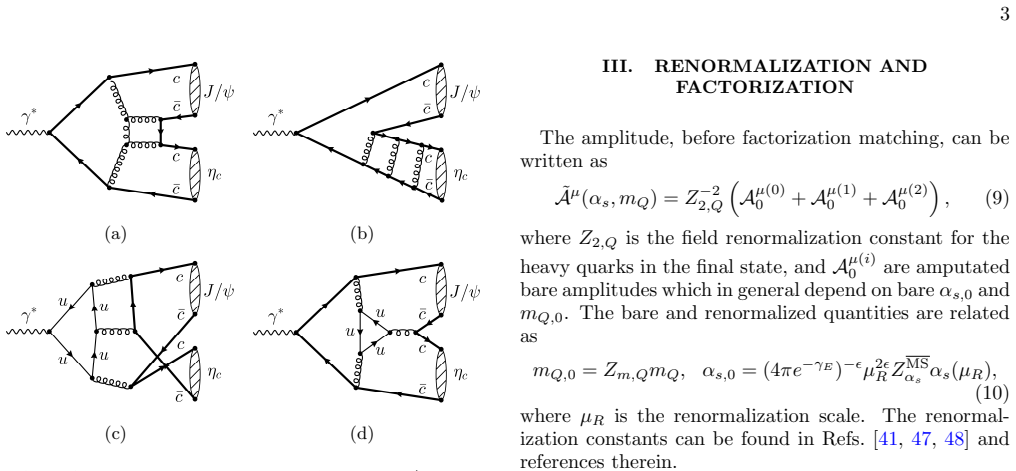
The central claim is that the complete two-loop amplitude for γ* → J/ψ + η_c, after subtracting the 1/ϵ poles fixed by NRQCD anomalous dimensions, has the form h(2)(r) = r^2[L_(2,4) ln^4 r + L_(2,3) ln^3 r + L_(2,2) ln^2 r + L_(2,1) ln r + L_(2,0)] + r^{5/2} L_(5/2,0) + O(r^3), all coefficients analytic. The method: solve differential equations in r numerically to hundreds of digits, then reconstruct coefficients by integer-relation detection over {Li_m(-2), Li_m(-1), Li_m(2), m ≤ 4}. Region analysis traces the leading ln^2 r and ln^3 r terms to soft-quark loops with radiative jet functions; pure soft-gluon double logs cancel because the mesons are color neutral. At √s = 10.58 GeV the NNLO c
What carries the argument
The central object is the dimensionless coefficient h(2)(r) of the two-loop amplitude, expanded in r = m_c^2/s with powers of ln r. The carrying mechanism is a pipeline: reduce 167 integral families to master integrals by integration-by-parts identities; evaluate the master integrals as functions of r through numerical differential equations with boundary conditions fixed by auxiliary mass flow; reconstruct the leading r-coefficients analytically with integer-relation detection over a polylogarithm-constant basis; then solve the differential equations again analytically to obtain the remaining coefficients. For the logarithm structure, the key physics mechanism is a region analysis in which
Load-bearing premise
The analytic form is only as complete as the reconstruction basis: the calculation assumes every finite coefficient can be written using one small family of special constants (polylogarithms at three fixed arguments) through weight four; if a coefficient needed a different constant, the analytic result would miss it.
What would settle it
Take a subleading r-coefficient that was not used in the initial reconstruction, evaluate it numerically to roughly a thousand digits, and test via integer-relation detection whether it lies in the claimed span of Li_m(-2), Li_m(-1), and Li_m(2) for m ≤ 4; if no exact integer relation appears, the analytic basis is incomplete.
If this is right
- The NNLO cross section for e+e− → J/ψ + η_c at 10.52–10.58 GeV is predicted in the 11–14 fb range, within the measured Belle and BaBar bands; Belle II at 10.52 GeV can test this directly.
- The ln^3 r term dominates the NNLO amplitude at B-factory energies, so resummation of leading and next-to-leading logarithms to all orders becomes a concrete next step rather than an abstract one.
- The analytic amplitude carries explicit heavy-quark mass dependence, giving an immediate prediction for Υ + η_b production (about 0.115 fb at 22.5 GeV) for future colliders.
- At high energies the partial O(α_s^4) term exceeds the LO term, signaling that fixed-order perturbation theory there is unreliable and motivating resummation or alternative treatments.
- The r-expansion converges with radius 1/16, and truncating at O(r^35) provides enough precision for phenomenology across the energy range considered.
Where Pith is reading between the lines
- If the polylog basis used here is complete, the same numerical-differential-equation-plus-integer-relation pipeline should convert other exclusive quarkonium NNLO calculations from numerical to analytic, provided their master integrals satisfy similar first-order systems.
- The cancellation of soft-gluon double logarithms and survival of soft-quark double logarithms is likely a general rule for color-singlet final states, so future resummation formalisms should concentrate on soft-fermion loops.
- The appearance of r^{5/2} at two loops means the amplitude has a branch cut in the variable r that Taylor expansions miss; analogous half-integer powers should appear near threshold in other exclusive double-quarkonium processes.
- A Belle II measurement at √s = 10.52 GeV with total uncertainty below about 1 fb would distinguish the µR = √s/2 and µR = √s scale choices and meaningfully constrain the NRQCD long-distance matrix element.
Editorial analysis
A structured set of objections, weighed in public.
Referee Report
Summary. The paper presents the first fully analytical two-loop (NNLO) QCD amplitudes for e+e− → γ* → J/ψ + ηc within NRQCD, expressed as an asymptotic expansion in r = m_c^2/s. The computation uses automated diagram generation, IBP reduction, differential equations with AMFlow boundary conditions, and PSLQ reconstruction to obtain analytic coefficients. The authors give explicit leading logarithmic terms and a non-integer power term r^{5/2}, analyze the origin of leading logarithms with the method of regions, and provide cross-section predictions for J/ψ+ηc and Υ+ηb at B-factory and future-collider energies, claiming agreement with B-factory measurements.
Significance. If correct, this is a substantial step: an analytic NNLO result for a double-charmonium production process, with explicit large-logarithmic structure and a non-integer power correction, plus a nontrivial extension to bottomonium. The computation is internally well checked in several ways: exact cancellation of 1/ε poles, agreement with known NLO logarithms, 600-digit precision in the PSLQ input, convergence tests in r, and a region-based cross-check of leading logarithms for many diagrams. The main unresolved risk is the completeness of the PSLQ reconstruction basis for the constant coefficients, and the absence of a direct comparison with existing numerical NNLO calculations.
major comments (4)
- [§II and §IV, Eqs. (14)–(19)] The 'fully analytical' claim rests on PSLQ reconstruction of finite terms using only the basis {Li_m(-2), Li_m(-1), Li_m(2) | m ≤ 4}. No proof is given that this basis is closed for the integral family, and the constant coefficients L^(2)_{(2,0)} and L^(2)_{(5/2,0)} are not displayed, so the reconstruction cannot be checked by the reader. The checks listed (pole cancellation, NLO logarithms, Fig. 10 convergence, Sec. V region analysis) do not constrain these constants: pole cancellation fixes only divergences; NLO checks fix log terms; Fig. 10 tests truncation in r, not the constants; and Sec. V is explicitly incomplete. Please either prove basis completeness or provide an independent numerical/analytic validation of these constants, e.g., by comparison with the numerical NNLO results of Refs. [20,21].
- [§I/§IV/§VI] Refs. [20,21] computed the same NNLO cross sections numerically, but the paper never reports a direct numerical comparison. This is the most natural and decisive cross-check of the analytic coefficients. Without it, the claim that the asymptotic expansion reproduces the exact two-loop result is not fully established. Please include a table or plot comparing the present cross sections at the same inputs (e.g., √s = 10.58 GeV, μ_R = √s, m_c = 1.5 GeV) with those of Refs. [20,21].
- [§V] The region analysis is presented as a check of the leading logarithms, but the final paragraph states that 'a few diagrams that cannot be computed using the δ-regulators' are left to future work. This makes the statement 'We investigated 80 Feynman diagrams, finding agreement with the direct computation' ambiguous: were the uncomputed diagrams among the 80, and do they contribute at the leading-log level? Please clarify coverage and either complete the analysis or explicitly restrict the claim of having explained all leading logarithms.
- [Abstract and §VI.A, Table II] The abstract states that the predictions 'agree with the experimental results.' At √s = 10.58 GeV the central NNLO cross section is 11.85 fb, compared with Belle 25.6 ± 2.8 ± 3.4 fb and BaBar 17.6 ± 2.8 +1.5 −2.1 fb. Only the upper edge of the scale/mass uncertainty reaches the BaBar result. Please quantify the agreement with a combined uncertainty estimate, or soften the wording to 'consistent within large uncertainties.'
minor comments (5)
- [Ref. [46]] Reference [46] is malformed: 'H. Ferguson and D. H. Bailey, cancer science (1992)' is not a valid citation. Please provide the correct PSLQ reference.
- [Fig. 3] The axis/legend labels 'ln0(r)', 'ln1(r)', etc. should be typeset as ln^0(r), ln^1(r), etc., to avoid confusion with 'ln evaluated at r=0'.
- [Figs. 7 and 8 captions] The phrase 'colliding energy' should be 'center-of-mass energy' in both captions.
- [§VI.A] The sentence 'The cross section at √s = 10.58 GeV changes from 13.87 fb to 11.85 fb when varying μ_R from √s/2 to √s' omits the 2√s endpoint used in Table II; please state the full scale-variation range for completeness.
- [§VI.B] Minor grammatical issue: 'the relative error of J/ψ + ηc are generally larger' should be 'the relative uncertainty of J/ψ + ηc is generally larger'.
Circularity Check
No significant circularity: the two-loop amplitude is obtained from an independent differential-equation/AMFlow computation, not from the experimental cross section or from a self-citation chain.
full rationale
The derivation chain is self-contained and not circular. The two-loop amplitude h(2)(r) is built from Feynman diagrams, IBP reduction to master integrals, and numerical differential equations with boundary conditions at r=1/100 computed by the independent AMFlow/auxiliary-mass-flow method (Sec. II: "The boundary conditions at r = 1/100 are obtained using the auxiliary mass flow method ... implemented in AMFlow"). No parameter is fitted to the Belle/BaBar cross sections; the phenomenological predictions in Tab. II follow from standard inputs (mc, alpha_s, and NRQCD matrix elements from Refs. [14,67,68]) and the computed amplitude. The internal checks are genuine and independent: UV poles cancel against known anomalous dimensions (Eqs. (11)-(13)), NLO logarithmic coefficients are "found to be consistent with Refs. [15,22,23]", and the leading-logarithm region analysis in Sec. V is explicitly presented as a check, with "agreement with the direct computation" for 80 Feynman diagrams. The PSLQ reconstruction basis ({Li_m(-2), Li_m(-1), Li_m(2)}, m<=4) is an assumption about the space of transcendental constants; if incomplete it would make the analytic coefficients wrong, but it does not define the result in terms of the target cross section or of a self-citation. Self-citations (Blade, AMFlow, CalcLoop, the delta-regulator method of Refs. [54,55]) are computational tools or cross-check methods, not unverified authorities used to force the central claim. The explicit limitation "there exist a few diagrams that cannot be computed using the delta-regulators" (Sec. V) is an admitted gap in the region-analysis explanation of leading logarithms, but it does not affect the direct two-loop calculation and does not introduce circularity. Overall, the paper's predictions are compared with experiments, not constructed from them, so no circular step is present.
Axiom & Free-Parameter Ledger
axioms (5)
- domain assumption NRQCD factorization for double quarkonium production
- domain assumption Leptonic/hadronic factorization of the e+e- cross section
- standard math Asymptotic expansion structure I(r) = sum c_{k,n}(epsilon) ln^k(r) r^n for Feynman integrals
- domain assumption Anomalous dimensions gamma_J/psi and gamma_eta_c as given in Eq. (12)
- domain assumption NRQCD matrix elements |R(0)|^2 taken from Refs. [14,67,68]
Cite this review
Pith. "Pith review of Analytical two-loop amplitudes of $e^{+} e^{-} \longrightarrow \boldsymbol{J} / \boldsymbol{\psi}+\boldsymbol{\eta}_c$ at $B$ factories." pith.science (2026). https://pith.science/paper/C5ATLAPC
@misc{pith2026250820777,
  author       = {Pith},
  title        = {Pith review of: Analytical two-loop amplitudes of $e^+ e^- \longrightarrow \boldsymbolJ / \boldsymbol\psi+\boldsymbol\eta_c$ at $B$ factories},
  year         = {2026},
  howpublished = {\url{https://pith.science/paper/C5ATLAPC}},
  note         = {Machine review of arXiv:2508.20777}
}
abstract
In double charmonium production, a long-standing challenge is that the theoretical predictions are not consistent with the measurements at B factories. Within the NRQCD framework, the next-to-leading order (NLO) calculation has proved its power to cut down the discrepancy between theory and experiments. To further clarify this puzzle, we have performed the next-to-next-to-leading order (NNLO) calculation. The amplitude is obtained as an analytical asymptotic expansion in the ratio of the squared charm-quark mass over the squared center-of-mass energy, $m_c^2/s$. We investigate the origin of the leading logarithms by performing a region analysis, revealing the intricate factorization structure in this process. We provide numerical predictions on the total cross sections of $J/\psi+\eta_c$ production, which agree with the experimental results. Extension of our computation to $\Upsilon+\eta_b$ production is also discussed.
Figures



Forward citations
Cited by 3 Pith papers
-
Semi-analytical results for $e^+e^-\to J/\psi + X_{{\rm non\,}c\bar{c}}$ up to $\mathcal{O}(\alpha_s v^2)$ at B factories
NRQCD calculation of O(α_s), O(v²) and first-time O(α_s v²) corrections to e⁺e⁻ → J/ψ + X_non c c̄, with r = m_c/√s expansions to r⁴⁰, yielding cross section 0.530 pb consistent with Belle but angular parameter deviating >2σ.
-
Semi-analytical two-loop QCD corrections to $e^+e^-\to J/\psi+\chi_{cJ}$ at B factories
Semi-analytical NNLO QCD corrections to e+e- -> J/psi + chi_cJ are computed via asymptotic expansions, yielding large corrections that reduce scale dependence for some channels and a discrepancy with Belle data on the...
-
Soft Contributions Stabilize NNLO QCD Corrections to Quarkonium Production and Decay
Soft contributions stabilize NNLO QCD corrections for S-wave color-singlet quarkonium processes, yielding better perturbative convergence and experimental agreement.
Reference graph
Works this paper leans on
-
[1]
Abe et al.(Belle Collaboration), Phys
K. Abe et al.(Belle Collaboration), Phys. Rev. Lett. 89, 142001 (2002)
work page 2002
-
[2]
Study of double charmonium production in e^+ e^- annihilation at \sqrt{s} ~ 10.6 GeV
K. Abe et al. (Belle), Phys. Rev. D 70, 071102 (2004), arXiv:hep-ex/0407009
work page internal anchor Pith review Pith/arXiv arXiv 2004
-
[3]
B. Aubert et al. (BaBar), Phys. Rev. D 72, 031101 (2005), arXiv:hep-ex/0506062
Pith/arXiv arXiv 2005
- [4]
-
[5]
The hard function represents the contribu- tion of all hard propagators with O(1) off-shellness
The whole perturbative amplitude can be considered as a convolution of the hard function, the radiative jet function, and the soft function, which is interfaced with projectors. The hard function represents the contribu- tion of all hard propagators with O(1) off-shellness. It can be considered as the Wilson coefficients of the effec- tive operators, cons...
-
[6]
Fig. 6(a) generalizes Fig. 5(d) to include the case with leading power projector Π (0) 3 but with subleading radiative jet function J (1) c¯c,q. Fig. 6(b) introduces a new type of radiative jet function, Jc¯c,qg , that emits both a soft quark and a soft physical gluon. It can be consid- ered as obtained by inserting in Jc¯c,q a subleading power interactio...
- [7]
-
[8]
J. P. Ma and Z. G. Si, Phys. Rev. D 70, 074007 (2004)
work page 2004
-
[9]
A. E. Bondar and V. L. Chernyak, Phys. Lett. B 612, 215 (2005), arXiv:hep-ph/0412335
Pith/arXiv arXiv 2005
-
[10]
M. Dong et al. (CEPC Study Group), (2018), arXiv:1811.10545 [hep-ex]
Pith/arXiv arXiv 2018
-
[11]
J. H. Yin et al. (Belle), JHEP 08, 121 (2023), arXiv:2305.17947 [hep-ex]
Pith/arXiv arXiv 2023
-
[12]
W. Altmannshofer et al. (Belle-II), PTEP 2019, 123C01 (2019), [Erratum: PTEP 2020, 029201 (2020)], arXiv:1808.10567 [hep-ex]
arXiv 2019
-
[13]
G. T. Bodwin, E. Braaten, and G. P. Lepage, Phys. 11 Rev. D 51, 1125 (1995), [Erratum: Phys.Rev.D 55, 5853 (1997)], arXiv:hep-ph/9407339
Pith/arXiv arXiv 1995
-
[14]
´O. Dur´ an, L. Garc ´ ıa-Tabar´ es, L. A. Gonz´ alez, F. Toral, Y. Arimoto, T. Yamada, and A. Yamamoto, IEEE Trans. Appl. Supercond. 35, 4003605 (2025)
work page 2025
- [15]
-
[16]
E. Braaten and J. Lee, Phys. Rev. D 67, 054007 (2003), [Erratum: Phys.Rev.D 72, 099901 (2005)], arXiv:hep- ph/0211085
-
[17]
Y.-J. Zhang, Y.-j. Gao, and K.-T. Chao, Phys. Rev. Lett. 96, 092001 (2006), arXiv:hep-ph/0506076
Pith/arXiv arXiv 2006
-
[18]
B. Gong and J.-X. Wang, Phys. Rev. D 77, 054028 (2008), arXiv:0712.4220 [hep-ph]
Pith/arXiv arXiv 2008
-
[19]
H.-R. Dong, F. Feng, and Y. Jia, Phys. Rev. D 85, 114018 (2012)
work page 2012
-
[20]
Z.-G. He, Y. Fan, and K.-T. Chao, Phys. Rev. D 75, 074011 (2007), arXiv:hep-ph/0702239
Pith/arXiv arXiv 2007
-
[21]
G. T. Bodwin, J. Lee, and C. Yu, Phys. Rev. D 77, 094018 (2008)
work page 2008
-
[22]
Y. Jia, J.-X. Wang, and D. Yang, JHEP 10, 105 (2011), arXiv:1012.6007 [hep-ph]
Pith/arXiv arXiv 2011
-
[23]
F. Feng, Y. Jia, Z. Mo, W.-L. Sang, and J.-Y. Zhang, (2019), arXiv:1901.08447 [hep-ph]
Pith/arXiv arXiv 2019
-
[24]
X.-D. Huang, B. Gong, and J.-X. Wang, JHEP 02, 049 (2023), arXiv:2212.03631 [hep-ph]
Pith/arXiv arXiv 2023
- [25]
-
[26]
G. T. Bodwin, H. S. Chung, and J. Lee, Phys. Rev. D 90, 074028 (2014), arXiv:1406.1926 [hep-ph]
Pith/arXiv arXiv 2014
-
[27]
Sun, JHEP 09, 073 (2021), arXiv:2107.02047 [hep-ph]
Z. Sun, JHEP 09, 073 (2021), arXiv:2107.02047 [hep-ph]
Pith/arXiv arXiv 2021
-
[28]
X. Guan, X. Liu, Y.-Q. Ma, and W.-H. Wu, Comput. Phys. Commun. 310, 109538 (2025), arXiv:2405.14621 [hep-ph]
Pith/arXiv arXiv 2025
-
[29]
T. Hahn, Comput. Phys. Commun. 140, 418 (2001), arXiv:hep-ph/0012260
Pith/arXiv arXiv 2001
-
[30]
https://e.gitee.com/multiloop-pku/repos/multiloop- pku/calcloop/sources
-
[31]
R. N. Lee, (2012), arXiv:1212.2685 [hep-ph]
Pith/arXiv arXiv 2012
-
[32]
Peraro, JHEP 12, 030 (2016), arXiv:1608.01902 [hep- ph]
T. Peraro, JHEP 12, 030 (2016), arXiv:1608.01902 [hep- ph]
Pith/arXiv arXiv 2016
-
[33]
Peraro, JHEP 07, 031 (2019), arXiv:1905.08019 [hep- ph]
T. Peraro, JHEP 07, 031 (2019), arXiv:1905.08019 [hep- ph]
Pith/arXiv arXiv 2019
-
[34]
S. Laporta, Int. J. Mod. Phys. A15, 5087 (2000), arXiv:hep-ph/0102033 [hep-ph]
Pith/arXiv arXiv 2000
-
[35]
Tkachov, Physics Letters B 100, 65 (1981)
F. Tkachov, Physics Letters B 100, 65 (1981)
work page 1981
- [36]
-
[37]
A. V. Kotikov, Phys. Lett. B254, 158 (1991)
1991
-
[38]
Z.-F. Liu and Y.-Q. Ma, Phys. Rev. Lett. 129, 222001 (2022), arXiv:2201.11637 [hep-ph]
Pith/arXiv arXiv 2022
- [39]
-
[40]
M. Caffo, H. Czyz, M. Gunia, and E. Remiddi, Comput. Phys. Commun. 180, 427 (2009), arXiv:0807.1959 [hep- ph]
work page internal anchor Pith review Pith/arXiv arXiv 2009
-
[41]
X. Liu, Y.-Q. Ma, and C.-Y. Wang, Phys. Lett. B 779, 353 (2018), arXiv:1711.09572 [hep-ph]
Pith/arXiv arXiv 2018
-
[42]
X. Liu and Y.-Q. Ma, Phys. Rev. D 105, L051503 (2022), arXiv:2107.01864 [hep-ph]
Pith/arXiv arXiv 2022
-
[43]
Moriello, JHEP 01, 150 (2020), arXiv:1907.13234 [hep-ph]
F. Moriello, JHEP 01, 150 (2020), arXiv:1907.13234 [hep-ph]
Pith/arXiv arXiv 2020
-
[44]
M. Czakon, Phys. Lett. B664, 307 (2008), arXiv:0803.1400 [hep-ph]
Pith/arXiv arXiv 2008
-
[45]
R. N. Lee, JHEP 04, 108 (2015), arXiv:1411.0911 [hep- ph]
Pith/arXiv arXiv 2015
- [46]
-
[47]
M. Hidding, Comput. Phys. Commun. 269, 108125 (2021), arXiv:2006.05510 [hep-ph]
Pith/arXiv arXiv 2021
-
[48]
T. Armadillo, R. Bonciani, S. Devoto, N. Rana, and A. Vicini, Comput. Phys. Commun. 282, 108545 (2023), arXiv:2205.03345 [hep-ph]
Pith/arXiv arXiv 2023
-
[49]
A. Czarnecki and K. Melnikov, Phys. Lett. B 519, 212 (2001), arXiv:hep-ph/0109054
Pith/arXiv arXiv 2001
-
[50]
M. Czakon, A. Mitov, and S. Moch, Nucl. Phys. B 798, 210 (2008), arXiv:0707.4139 [hep-ph]
Pith/arXiv arXiv 2008
-
[51]
P. B¨ arnreuther, M. Czakon, and P. Fiedler, JHEP 02, 078 (2014), arXiv:1312.6279 [hep-ph]
Pith/arXiv arXiv 2014
- [52]
-
[53]
B. A. Kniehl, A. Onishchenko, J. H. Piclum, and M. Steinhauser, Phys. Lett. B 638, 209 (2006), arXiv:hep-ph/0604072
work page internal anchor Pith review Pith/arXiv arXiv 2006
- [54]
-
[55]
J.-Y. Hou, J. Wang, and D.-J. Zhang, JHEP 06, 164 (2025), arXiv:2501.11824 [hep-ph]
Pith/arXiv arXiv 2025
-
[56]
Z. L. Liu and M. Neubert, JHEP 04, 033 (2020), arXiv:1912.08818 [hep-ph]
Pith/arXiv arXiv 2020
-
[57]
Wang, (2019), arXiv:1912.09920 [hep-ph]
J. Wang, (2019), arXiv:1912.09920 [hep-ph]
Pith/arXiv arXiv 2019
-
[58]
M. Beneke, M. Garny, S. Jaskiewicz, J. Strohm, R. Szafron, L. Vernazza, and J. Wang, JHEP 07, 144 (2022), arXiv:2205.04479 [hep-ph]
Pith/arXiv arXiv 2022
- [59]
-
[60]
Z. L. Liu, M. Neubert, M. Schnubel, and X. Wang, JHEP 06, 183 (2023), arXiv:2212.10447 [hep-ph]
Pith/arXiv arXiv 2023
-
[61]
for the analyses of the massive form factor with the method of regions [62, 63]. This contribution is propor- tional to the color charge of the external collinear particle and thus vanishes after summing over all diagrams, since the mesons are color neutral. The other kind of region that contributes to the double logarithms involves the soft quark. The re...
-
[62]
G. Bell, P. B¨ oer, and T. Feldmann, JHEP09, 183 (2022), arXiv:2205.06021 [hep-ph]
Pith/arXiv arXiv 2022
-
[63]
G. Bell, P. B¨ oer, T. Feldmann, D. Horstmann, and V. Shtabovenko, (2024), arXiv:2412.14149 [hep-ph]
arXiv 2024
-
[64]
J. ter Hoeve, E. Laenen, C. Marinissen, L. Vernazza, and G. Wang, JHEP 02, 024 (2024), arXiv:2311.16215 [hep- ph]
Pith/arXiv arXiv 2024
- [65]
-
[66]
M. Beneke and V. A. Smirnov, Nucl. Phys. B 522, 321 (1998), arXiv:hep-ph/9711391
Pith/arXiv arXiv 1998
-
[67]
A. V. Manohar and I. W. Stewart, Phys. Rev. D 76, 074002 (2007), arXiv:hep-ph/0605001
Pith/arXiv arXiv 2007
-
[68]
M. Beneke, M. Garny, R. Szafron, and J. Wang, JHEP 03, 001 (2018), arXiv:1712.04416 [hep-ph]
Pith/arXiv arXiv 2018
-
[69]
M. Beneke, M. Garny, R. Szafron, and J. Wang, JHEP 11, 112 (2018), arXiv:1808.04742 [hep-ph]
Pith/arXiv arXiv 2018
-
[70]
E. J. Eichten and C. Quigg, Phys. Rev. D 52, 1726 (1995), arXiv:hep-ph/9503356
Pith/arXiv arXiv 1995
-
[71]
N. Brambilla, H. S. Chung, A. Vairo, and X.-P. Wang, JHEP 03, 242 (2023), arXiv:2210.17345 [hep-ph]
Pith/arXiv arXiv 2023
- [72]
-
[73]
L. B¨ undgen, R. V. Harlander, S. Y. Klein, and M. C. Schaaf, (2025), arXiv:2501.04651 [hep-ph]
arXiv 2025
This paper was first reviewed by deepseek-v4-flash on August 5, 2026.
discussion (0)
Sign in with ORCID, Apple, or X to comment. Anyone can read and Pith papers without signing in.