REVIEW 3 major objections 5 minor 53 references
Symbolic Neural Generators learn a logical specification from a few examples, filter AI-proposed molecules through that specification, and on a poorly understood enzyme produce predicted leads on par with clinical candidates.
Reviewed by Pith at T0; open to challenge. T0 means a machine referee read the full paper against a public rubric. the ladder, T0–T4 →
A hybrid system that learns symbolic interval constraints from a few examples and uses an LLM plus rejection filtering to generate new candidate drug molecules.
T0 review reviewed 2026-08-04 challenge →
load-bearing objection The SNG formalization is a real but modest step; the DBH 'on par with clinical candidates' claim is undercut by using GNINA as both the search filter and the evaluation metric, though the core loop is sound. the 3 major comments →
Symbolic Neural Generation with Applications to Lead Discovery in Drug Design
The pith
A machine-rendered reading of the paper's core claim, the machinery that carries it, and where it could break.
The reading
Core claim
An SNG maps background knowledge and examples to (H, X, W): H is a symbolic hypothesis for a predicate, X is a set of neural-generated instances each satisfying B∧H, and W combines the Bayesian posterior of H with the neural sampler's yield. Semantically it is a Grothendieck construction: hypotheses form a base poset by extension inclusion, each carries a fibre poset of generated subsets within its extension, and pairs (H, X) are ordered by specificity and support. GenMol searches downward through nested interval constraints on molecular properties; Proposition 3 proves that descent is a chain in the base poset. The empirical claim is that this symbolic filter, not the LLM alone, makes gener
What carries the argument
The central object is the symbolic hypothesis H and its extension ext(H|B), the set of instances entailed by the hypothesis together with background knowledge. The base poset orders hypotheses by extension inclusion, and each hypothesis carries a fibre poset of neural-generated subsets contained in its extension; the Grothendieck construction glues these into a total poset of candidate (hypothesis, support-set) pairs. The implementation is a two-part loop: Gen, an LLM-driven rejection sampler that keeps a candidate only if it satisfies the symbolic hypothesis, and GenMol, a greedy search over nested hyper-rectangles in molecular factor space (affinity, weight, synthesis steps) scored by a Ba
Load-bearing premise
The load-bearing premise is that docking scores are a faithful proxy for true binding affinity, because those same scores are the affinity factor the generator optimises and the metric used to claim that the generated molecules are on par with clinical candidates.
What would settle it
Synthesise the DBH molecules proposed by SNG, especially the novel out-of-the-box ones, and measure their experimental IC50 or KD against dopamine beta-hydroxylase; if these values are not near or below those of the latest clinical candidate inhibitors, or do not track the docking scores that selected the molecules, the central exploratory claim collapses.
If this is right
- On benchmark kinase problems, SNG reaches predicted-affinity scores statistically comparable to strong existing generators, so the symbolic verification step does not cost performance.
- On the under-studied DBH target, five known inhibitors are enough to propose molecules whose predicted docking affinities match late-generation clinical candidates, including molecules produced without being shown any known inhibitor.
- The symbolic descriptions are human-readable: chemists and structural biologists can inspect the constraints, judge candidate molecules, and edit them, meaning the system supports expert-in-the-loop lead refinement.
- SNG returns only molecules that provably satisfy the learned specification, so accepted outputs are certified against the current hypothesis rather than being unverified sampler outputs.
- The same base-and-fibre poset construction applies beyond molecules, since it only requires a verifiable symbolic hypothesis and any neural generator conditioned on it.
Where Pith is reading between the lines
- An extension the paper leaves implicit: because the symbolic verifier, not the LLM, enforces correctness, the LLM can be treated as a replaceable proposal distribution; future systems could pair the same verifier with any generative model, including one small enough to deploy on-site.
- The strongest exploratory result is measured entirely in docking scores. A natural next experiment is to synthesise the novel out-of-the-box DBH molecules and measure experimental IC50 or KD; if the rankings hold, SNG shifts from a proposal generator to an actual lead generator, and if not, the value shifts to the symbolic hypothesis as a human-readable filter.
- The weighted poset W(H,X), combining hypothesis plausibility with generative yield, suggests a testable active-learning loop: each newly tested molecule could refine the symbolic hypothesis, and the weighted order would rank which hypotheses deserve the next experiment.
Editorial analysis
A structured set of objections, weighed in public.
Referee Report
Summary. The paper introduces Symbolic Neural Generation (SNG), a hybrid neurosymbolic framework in which a symbolic learner proposes logical hypotheses and an LLM-based generator is conditioned on, and verified against, those hypotheses. The authors formalize the output space using a Grothendieck construction over base and fibre posets, add a weighted extension, and give correctness statements: Proposition 2 ensures Gen returns only instances in the symbolic extension, and Proposition 3 ensures GenMol searches a descending chain of hypotheses. The implementation is evaluated on two benchmark kinase tasks (JAK2, DRD2) and on an exploratory DBH inhibitor lead-discovery task with only five known inhibitors, reporting mean docking scores comparable to LMLF++ and molecules whose estimated binding affinities are described as on par with clinical candidates.
Significance. The paper addresses a useful and under-explored design point: combining an ILP-style symbolic learner with an LLM generator through rejection sampling and contextual updating. The poset/Grothendieck semantics, while simple, gives a clean language for correctness of hybrid generators and is a genuine conceptual contribution. Propositions 2 and 3 are stated with proofs, and the implementation is described in enough detail to be reproduced. The benchmark results are suggestive, and the qualitative expert assessments are interesting. However, the headline empirical claims are currently over-stated: the DBH affinity claim is circular with respect to the GNINA filter, and the abstract's 'statistically comparable' is not supported by significance testing. These issues are localizable and fixable, so the paper is best handled by major revision rather than rejection.
major comments (3)
- [§4.2, Figs. 8–10, Appendix C.1, Procedure 1 Step 8] The DBH 'on par with clinical candidates' claim is circular. The factor specification for all experiments includes affinity: [3,10] (Appendix C.1), and Procedure 1 Step 8 rejects any generated molecule unless it lies in nvext(H|B). Since GenMol searches over nested rectangles on this same affinity factor, every reported 'with symbolic learning' molecule is filtered to have a GNINA score inside the selected interval. Figure 8 compares against Nepicastat, Zamicastat, and Etamicastat using the same GNINA docking scores, so both arms share the same proxy. Consequently, Figs. 9 and 10 demonstrate that the search can retrieve high-GNINA molecules after filtering on GNINA scores, but they do not establish that the generated molecules have binding affinities on par with clinical candidates. The paper should either provide independent assay data, or clearly reframe the claim as being about GNINA
- [§4.1, Fig. 6, Abstract] The abstract claims SNG performance is 'statistically comparable to state-of-the-art methods,' but Figure 6 reports only means and standard deviations for GenMol, LMLF++, and VAE-GNN. No sample sizes, confidence intervals, or significance tests are given. For DRD2 the GenMol mean is 7.53 vs LMLF++ 7.66, and without a test the difference may or may not be meaningful. Either add formal comparisons (e.g., Welch's t-test or bootstrap confidence intervals over repeated GenMol runs) or weaken the wording to 'comparable mean docking scores on these benchmarks.'
- [§4.2, Figs. 8–9] Even setting the circularity issue aside, the comparison to clinical candidates is not quantified. Figure 8 shows point affinity values for three clinical candidates with no uncertainty, and Figure 9 is said to show binding scores for the generated molecules, but the actual per-molecule scores are not tabulated in the text. There is no statistical statement about how the generated distribution compares with the clinical-candidate distribution. The claim that generated molecules are 'on par' should be supported by a table of per-molecule GNINA scores, the corresponding clinical-candidate scores, and an appropriate comparison.
minor comments (5)
- [Abstract and §3.1] The abstract says the outcome is a triple (H, X, W), but Section 3.1 and Definition 6 describe the output as a pair (H, X), with W added only in the weighted extension. Please harmonize the notation.
- [Appendix A.2, proof of Proposition 2] The loop invariant has a typo: '|M_{k-1} ∈ [0,1]' should presumably be '|M_{k-1}| ≤ s·(k-1)'. Also, Step 8 checks nvext(H|B) while the proof and statement refer to ext(H|B); please clarify the relationship.
- [§4, Procedure 2] The text refers to 'SearchHyp' in one place, but the procedure is named GenMol. Please unify the terminology.
- [Appendix C.1] The open-ended experiments are described as optimizing synthesis steps and yield, but the reported factor specification and results use SAS (synthesis accessibility score). Please specify which factors were actually used in the DBH experiments.
- [Figures 6 and 9] Figure 6 should state the number of repeated runs for each method. Figure 9 has a typo 'Out-the-Box' for 'Out-of-the-Box'.
Circularity Check
The DBH 'on par with clinical candidates' claim is forced by construction: GNINA affinity is the Affinity factor inside the symbolic hypothesis, and Gen rejects any molecule outside that interval, so the reported high-affinity result is the filter itself.
specific steps
-
self definitional
[Appendix C.1 + Procedure 1 Steps 8/10; Definition 13]
"For all experiments, we use:{affinity: [3,10],molwt: [200,700],SAS: [0,7.0]}, whereaffinityis the predicted affinity from GNINA software ... D_i := {(l, x) : x ∈ S_i and l := (x ∈ nvext(H|B))} // l is True or False ... M_i = {x : (true, x) ∈ D_i} ∪ M_{i−1}"
A hypothesis in GenMol is a clause whose body is a conjunction of interval constraints including Affinity(x)∈[a,b] (Defn. 13, Ex. 1). Gen accepts a molecule only when x∈nvext(H|B), i.e. only when the hypothesis body evaluates true. Therefore every molecule returned for the DBH experiments has a GNINA affinity inside the chosen Affinity interval by construction. The reported 'Mean Affinity' (Fig. 10), the top-5 molecules 'ordered by estimated affinity' (Fig. 9), and the comparison with clinical candidates all use this same GNINA score. The high-affinity result is an output of the rejection filter, not an independent discovery of the SNG.
-
fitted input called prediction
[Sec. 4.2 (DBH results, Fig. 8/9 captions)]
"We focus on obtaining molecules with docking scores at least as good as Nepicastat, a 4th generation drug. ... Molecules 1–5 are the top-5 molecules (ordered by estimated affinity) from 'In-the-Box' exploration. ... 'Affinity' refers to the binding affinity predicted by GNINA software while docking the molecules to the DBH protein, 4zel."
The reported DBH success criterion is a GNINA docking score at least as good as Nepicastat. But GNINA docking score is exactly the Affinity factor that the symbolic hypothesis constrains and that GenMol is searching over (with the lower bound pushed upward for factors to be maximised, App. C.1). The clinical candidates are scored with the same GNINA software, so 'binding affinities on par with leading clinical candidates' restates the filter rather than providing independent evidence about DBH binding.
-
fitted input called prediction
[Sec. 4.3 'Is symbolic learning useful?' / Fig. 10]
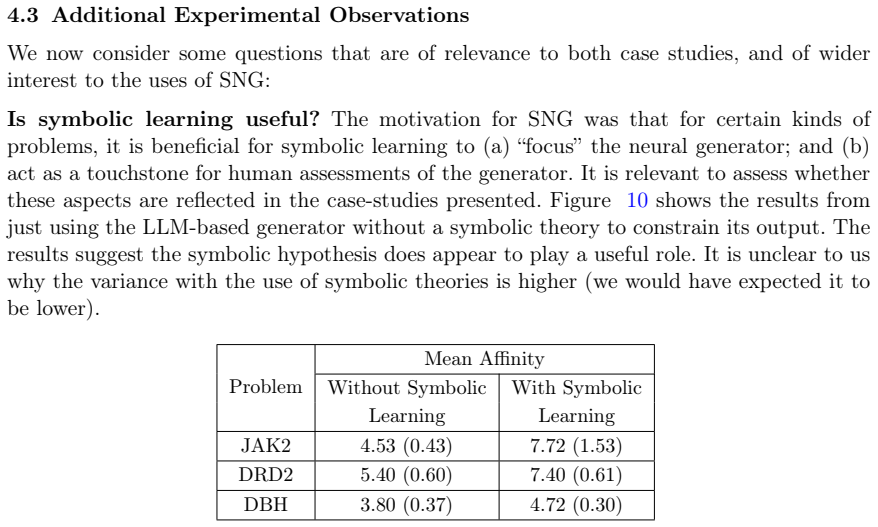
"Figure 10 shows the results from just using the LLM-based generator without a symbolic theory to constrain its output. The results suggest the symbolic hypothesis does appear to play a useful role. ... DBH 3.80 (0.37) 4.72 (0.30)"
The comparison 'without symbolic learning' vs 'with symbolic learning' is confounded by the same construction: the with-symbolic arm filters on the Affinity factor and only returns molecules satisfying nvext(H|B), while the without-symbolic arm applies no such filter. Higher mean GNINA affinity in the with-symbolic arm is therefore guaranteed by the filter, so it cannot be used as evidence that the learned symbolic description improves the chemistry.
full rationale
The formal parts of the paper are self-contained: Proposition 2 is a direct loop-invariant proof that Gen returns a subset of ext(H|B), and Proposition 3 follows from interval containment; neither relies on self-citation. The benchmark JAK2/DRD2 comparison against LMLF++/VAE-GNN is an external, same-metric comparison and is not circular, even though LMLF++ is prior work by overlapping authors. The circularity is concentrated in the exploratory DBH claim. In GenMol, the symbolic hypothesis is a conjunction of interval constraints on factors, and the DBH factor specification includes Affinity (GNINA predicted docking score) as one of the factors. Procedure 1's Step 8 rejects every sampled molecule that is not in nvext(H|B), i.e. every molecule not satisfying the Affinity interval, and then the paper reports the resulting GNINA affinity as evidence that the molecules 'exhibit binding affinities on par with leading clinical candidates'. Because the evaluation metric is the same quantity used as the symbolic filter, the high-affinity result is forced by construction rather than independently verified. The same issue affects Fig. 10's 'symbolic learning is useful' comparison. This does not invalidate the formal correctness results or the benchmark comparison, but it directly undercuts the main exploratory claim. Score 7 rather than 8-10 because the central derivation of H and X is not itself defined in terms of the DBH evaluation; only the exploratory evaluation claim reduces to the filter.
Axiom & Free-Parameter Ledger
free parameters (5)
- Initial factor bounds (Theta) =
[affinity: [3,10], molwt: [200,700], SAS: [0,7.0]]
- GenMol sample size s =
10
- LLM temperature =
0.7 (GPT-4o/Claude), 0.8 (GPT2)
- Gen iterations n and final sample count =
n=10, 100 molecules at final hypothesis
- Scaffold count/length for Molecule-GPT2 =
top 5 scaffolds, max length 8
axioms (4)
- domain assumption The feasible set of inhibitors is well-approximated by axis-parallel interval constraints on a few computed factors
- domain assumption GNINA docking scores are a valid proxy for true binding affinity
- domain assumption The LLM can propose chemically valid, diverse molecules that satisfy symbolic constraints with sufficient frequency for rejection sampling
- standard math Standard poset/Grothendieck construction mathematics
Cite this review
Pith. "Pith review of Symbolic Neural Generation with Applications to Lead Discovery in Drug Design." pith.science (2026). https://pith.science/paper/C5YN7LOQ
@misc{pith2026251023379,
  author       = {Pith},
  title        = {Pith review of: Symbolic Neural Generation with Applications to Lead Discovery in Drug Design},
  year         = {2026},
  howpublished = {\url{https://pith.science/paper/C5YN7LOQ}},
  note         = {Machine review of arXiv:2510.23379}
}
abstract
We investigate a relatively under-explored class of hybrid neurosymbolic models that integrate symbolic learning with neural reasoning to construct data generators meeting formal correctness criteria. In Symbolic Neural Generators (SNGs), symbolic learners examine logical specifications of feasible data from a small set of instances -- sometimes just one. Each specification in turn constrains the conditional information supplied to a neural-based generator, which rejects any instance violating the symbolic specification. Like other neurosymbolic approaches, SNG exploits the complementary strengths of symbolic and neural methods. The outcome of an SNG is a pair $(H, X)$, where $H$ is a symbolic description of feasible instances constructed from data, and $X$ a set of generated new instances that satisfy the description. We introduce a semantics for such systems, based on the construction of appropriate base and fibre partially-ordered sets combined into an overall partial order. We implement an SNG combining a restricted form of Inductive Logic Programming (ILP) with a large language model (LLM) and evaluate it on early-stage drug design. Our main interest is the description and the set of potential inhibitor molecules generated by the SNG. On benchmark problems -- where drug targets are well understood -- SNG performance is statistically comparable to state-of-the-art methods. On exploratory problems with poorly understood targets, generated molecules exhibit binding affinities on par with leading clinical candidates. Experts further find the symbolic specifications useful as preliminary filters, with several generated molecules identified as viable for synthesis and wet-lab testing.
Figures






Reference graph
Works this paper leans on
-
[1]
Collins, Elizabeth Bourne, Gareth W
Abbi Abdel-Rehim, Hector Zenil, Oghenejokpeme Orhobor, Marie Fisher, Ross J. Collins, Elizabeth Bourne, Gareth W. Fearnley, Emma Tate, Holly Smith, Larisa N. Soldatova, and Ross King. Scientific hypothesis generation by large language models: laboratory validation in breast cancer treatment. J. R. Soc. Interface, 22, 2025
2025
-
[2]
Josh Achiam, Steven Adler, Sandhini Agarwal, Lama Ahmad, Ilge Akkaya, Florencia Leoni Aleman, Diogo Almeida, Janko Altenschmidt, Sam Altman, Shyamal Anadkat, et al. GPT-4 technical report. arXiv preprint arXiv:2303.08774, 2023
Pith/arXiv arXiv 2023
-
[3]
Claude 3.5 sonnet: Frontier intelligence at 2× the speed
Anthropic. Claude 3.5 sonnet: Frontier intelligence at 2× the speed. https://www.anthropic.com/news/claude-3-5-sonnet, Jun 2024
2024
-
[4]
Generalising Closed World Specialisation: A Chess End Game Application
Michael Bain, Stephen Muggleton, and Ashwin Srinivasan. Generalising Closed World Specialisation: A Chess End Game Application . Technical report, CiteSeerX / University of New South Wales Technical Report, 2000. URL http://citeseerx.ist.psu.edu/viewdoc/summary?doi=10.1.1.55.5624. Unpublished technical report, available online
2000
-
[5]
An open source chemical structure curation pipeline using rdkit
A Patr \' cia Bento, Anne Hersey, Eloy F \'e lix, Greg Landrum, Anna Gaulton, Francis Atkinson, Louisa J Bellis, Marleen De Veij, and Andrew R Leach. An open source chemical structure curation pipeline using rdkit. Journal of Cheminformatics, 12: 0 1--16, 2020
2020
-
[6]
T. Besold, A. d’Avila Garcez , S. Bader, H. Bowman, P. Domingos, P. Hitzler, K.-U. K \" u hnberger, L. Lamb, D. Lowd, P. Lima, L. de Penning , G. Pinkas, H. Poon, and G. Zaverucha. Neural-Symbolic Learning and Reasoning: A Survey and Interpretation . arXiv preprint arXiv:1711.03902v1, 2017. URL https://arxiv.org/pdf/arXiv:1711.03902v1.pdf
Pith/arXiv arXiv 2017
-
[7]
Generating novel leads for drug discovery using llms with logical feedback
Shreyas Bhat Brahmavar, Ashwin Srinivasan, Tirtharaj Dash, Sowmya Ramaswamy Krishnan, Lovekesh Vig, Arijit Roy, and Raviprasad Aduri. Generating novel leads for drug discovery using llms with logical feedback. In Proceedings of the AAAI Conference on Artificial Intelligence, pages 21--29, 2024
2024
-
[8]
T. Brown, B. Mann, N. Ryder, M. Subbiah, J. Kaplan, et al. Language Models are Few-Shot Learners . arXiv preprint arXiv:2005.14165, 2020 a
Pith/arXiv arXiv 2005
-
[9]
Language models are few-shot learners
Tom Brown, Benjamin Mann, Nick Ryder, Melanie Subbiah, Jared D Kaplan, Prafulla Dhariwal, Arvind Neelakantan, Pranav Shyam, Girish Sastry, Amanda Askell, et al. Language models are few-shot learners. Advances in neural information processing systems, 33: 0 1877--1901, 2020 b
1901
-
[10]
Empowering LLMs with Logical Reasoning: A Comprehensive Survey
Fengxiang Cheng, Haoxuan Li, Fenrong Liu, Robert van Rooij, Kun Zhang, and Zhouchen Lin. Empowering LLMs with Logical Reasoning: A Comprehensive Survey . arXiv preprint arXiv:2502.15652, 2025
Pith/arXiv arXiv 2025
-
[11]
Y. Chervonyi, T. Trinh, M. Ol s \' a k, X. Yang, H. Nguyen, M. Menegali, J. Jung, V. Verma, Q. Le, and T. Luong. Gold-medalist Performance in Solving Olympiad Geometry with AlphaGeometry2 . arXiv preprint arXiv:2502.03544, 2025. URL https://arxiv.org/abs/2502.03544
arXiv 2025
-
[12]
Christopher, Michael Cardei, Jinhao Liang, and Ferdinando Fioretto
Jacob K. Christopher, Michael Cardei, Jinhao Liang, and Ferdinando Fioretto. Neuro-symbolic generative diffusion models for physically grounded, robust, and safe generation, 2025. URL https://arxiv.org/abs/2506.01121
Pith/arXiv arXiv 2025
-
[13]
Wang - Zhou Dai and Stephen H. Muggleton. Abductive knowledge induction from raw data. In Zhi - Hua Zhou, editor, Proceedings of the Thirtieth International Joint Conference on Artificial Intelligence, IJCAI 2021, Virtual Event / Montreal, Canada, 19-27 August 2021 , pages 1845--1851. ijcai.org, 2021. doi:10.24963/ijcai.2021/254. URL https://doi.org/10.24...
-
[14]
Using domain-knowledge to assist lead discovery in early-stage drug design
Tirtharaj Dash, Ashwin Srinivasan, Lovekesh Vig, and Arijit Roy. Using domain-knowledge to assist lead discovery in early-stage drug design. In International Conference on Inductive Logic Programming, pages 78--94. Springer, 2021
2021
-
[15]
d'Avila Garcez , L
A. d'Avila Garcez , L. Lamb, and D. Gabbay. Neural-Symbolic Cognitive Reasoning . Springer, 2009
2009
-
[16]
ProbLog: A probabilistic Prolog and its application in link discovery
Luc De Raedt, Angelika Kimmig, and Hannu Toivonen. ProbLog: A probabilistic Prolog and its application in link discovery . In IJCAI 2007, Proceedings of the 20th International Joint Conference on Artificial Intelligence, pages 2462--2467, 2007
2007
-
[17]
L. De Smet and L. De Raedt . Defining Neurosymbolic AI . arXiv preprint arXiv:2507.11127, 2025. URL https://arxiv.org/abs/2507.11127
Pith/arXiv arXiv 2025
-
[18]
The deeplog neurosymbolic machine, 2025
Vincent Derkinderen, Robin Manhaeve, Rik Adriaensen, Lucas Van Praet, Lennert De Smet, Giuseppe Marra, and Luc De Raedt. The deeplog neurosymbolic machine, 2025. URL https://arxiv.org/abs/2508.13697
arXiv 2025
-
[19]
Doytchinova
I. Doytchinova. Drug design-past, present, future. Molecules, 23:27(5): 0 1496, 2022
2022
-
[20]
A. d’Avila Garcez and L. Lamb. Neurosymbolic AI: The 3rd Wave . Artificial Intelligence Review, 56 0 (11): 0 12387--12406, 2023. doi:10.1007/s10462-023-10448-w
-
[21]
GPT2 Zinc 87M
entropy. GPT2 Zinc 87M . https://huggingface.co/entropy/gpt2_zinc_87m, 2023. GPT-2 model (87M parameters) trained on 480M SMILES from the ZINC database, MIT license
2023
-
[22]
ChEMBL : a large-scale bioactivity database for drug discovery
Anna Gaulton, Louisa J Bellis, A Patricia Bento, Jon Chambers, Mark Davies, Anne Hersey, Yvonne Light, Shaun McGlinchey, David Michalovich, Bissan Al-Lazikani, et al. ChEMBL : a large-scale bioactivity database for drug discovery. Nucleic acids research, 40 0 (D1): 0 D1100--D1107, 2012
2012
-
[23]
M. Guo, V. Thost, B. Li, P. Das, J. Chen, and W. Matusik. Data-efficient Graph Grammar Learning for Molecular Generation . arXiv preprint arXiv:2203.08031, 2022. URL https://arxiv.org/abs/2203.08031
Pith/arXiv arXiv 2022
-
[24]
Hilario, C
M. Hilario, C. Pellegrini, and F. Alexandre. Modular Integration of Connectionist and Symbolic Processing in Knowledge-Based Systems . In International Symposium on Integrating Knowledge and Neural Heuristics, pages 123--132, 1994
1994
-
[25]
An overview of strategies for neurosymbolic integration
Melanie Hilario. An overview of strategies for neurosymbolic integration. Connectionist-Symbolic Integration, pages 13--35, 2013
2013
-
[26]
Zinc20—a free ultralarge-scale chemical database for ligand discovery
John J Irwin, Khanh G Tang, Jennifer Young, Chinzorig Dandarchuluun, Benjamin R Wong, Munkhzul Khurelbaatar, Yurii S Moroz, John Mayfield, and Roger A Sayle. Zinc20—a free ultralarge-scale chemical database for ligand discovery. Journal of chemical information and modeling, 60 0 (12): 0 6065--6073, 2020
2020
-
[27]
Jacobson and Y
M. Jacobson and Y. Xue. Integrating symbolic reasoning into neural generative models for design generation . Artificial Intelligence, 339 0 (104257), 2025
2025
-
[28]
Direct global optimization algorithm
Donald R Jones. Direct global optimization algorithm. Encyclopedia of optimization, pages 431--440, 2001
2001
-
[29]
H. Kautz. Tools Are All You Need . 2024
2024
-
[30]
Kusner, B
M. Kusner, B. Paige, and J. Hern \' a ndez-Lobato. Grammar Variational Autoencoder . In Proc. International Conference on Machine Learning, pages 1945--1954, 2017
1945
-
[31]
Basic Category Theory, volume 143 of Cambridge Studies in Advanced Mathematics
Tom Leinster. Basic Category Theory, volume 143 of Cambridge Studies in Advanced Mathematics. Cambridge University Press, 2014. ISBN 978-1107044241. See Ch. 8 for the Grothendieck construction
2014
-
[32]
Z. Li, Z. Zhou, Y. Yao, Y.-F. Li, C. Cao, F. Yang, X. Zhang, and X. Ma. Neuro-Symbolic Data Generation for Math Reasoning . In Advances in Neural Information Processing Systems, volume 37, pages 23488--23515, 2024
2024
- [33]
-
[34]
Molecular generative model based on conditional variational autoencoder for de novo molecular design
Jaechang Lim, Seongok Ryu, Jin Woo Kim, and Woo Youn Kim. Molecular generative model based on conditional variational autoencoder for de novo molecular design. Journal of cheminformatics, 10: 0 1--9, 2018
2018
-
[35]
Constrained graph variational autoencoders for molecule design
Qi Liu, Miltiadis Allamanis, Marc Brockschmidt, and Alexander Gaunt. Constrained graph variational autoencoders for molecule design. Advances in neural information processing systems, 31, 2018
2018
-
[36]
Marra, S
G. Marra, S. Duman c i \' c , R. Manhaeve, and L. De Raedt . From statistical relational to neurosymbolic artificial intelligence: A survey . Artificial Intelligence, 328 0 (104062), 2024
2024
-
[37]
LIME : A system for learning relations
Eric McCreath and Arun Sharma. LIME : A system for learning relations. In International conference on algorithmic learning theory, pages 336--374. Springer, 1998
1998
-
[38]
McCulloch and W
W. McCulloch and W. Pitts. A Logical Calculus of the Ideas Immanent in Nervous Activity . Bulletin of Mathemetical Biophysics, 5: 0 115--133, 1943
1943
-
[39]
A comparison of three methods for selecting values of input variables in the analysis of output from a computer code
Michael D McKay, Richard J Beckman, and William J Conover. A comparison of three methods for selecting values of input variables in the analysis of output from a computer code. Technometrics, 42 0 (1): 0 55--61, 2000
2000
-
[40]
Gnina 1.0: molecular docking with deep learning
Andrew T McNutt, Paul Francoeur, Rishal Aggarwal, Tomohide Masuda, Rocco Meli, Matthew Ragoza, Jocelyn Sunseri, and David Ryan Koes. Gnina 1.0: molecular docking with deep learning. Journal of cheminformatics, 13 0 (1): 0 43, 2021
2021
-
[41]
Learning from positive data
Stephen Muggleton. Learning from positive data. In International conference on inductive logic programming, pages 358--376. Springer, 1996
1996
-
[42]
Hypothesizing an algorithm from one example: the role of specificity
Stephen Muggleton. Hypothesizing an algorithm from one example: the role of specificity . Philosophical Transactions of the Royal Society A, 381 0 (2251): 0 20220046, 2023
2023
-
[43]
Kevin P. Murphy. Probabilistic Machine Learning: Advanced Topics. The MIT Press, London, 2022. Volume 2
2022
-
[44]
Odense and A
S. Odense and A. d'Avila Garcez . A semantic framework for neurosymbolic computation . Artficial Intelligence, 340 0 (104273), 2025
2025
-
[45]
T. Olausson, A. Gu, B. Lipkin, C. Zhang, A. Solar-Lezama, J. Tenenbaum, and R. Levy. LINC: A Neurosymbolic Approach for Logical Reasoning by Combining Language Models with First-Order Logic Provers . arXiv preprint arXiv:2310.15164v2, 2024. URL https://arxiv.org/abs/2310.15164v2
Pith/arXiv arXiv 2024
-
[46]
C. Qi, R. Ma, B. Li, H. Du, B. Hui, J. Wu, Y. Laili, and C. He. Large Language Models Meet Symbolic Provers for Logical Reasoning Evaluation . arXiv preprint arXiv:2502.06563, 2025. URL https://arxiv.org/abs/2502.06563
Pith/arXiv arXiv 2025
-
[47]
Prism: a language for symbolic-statistical modeling
Taisuke Sato and Yoshitaka Kameya. Prism: a language for symbolic-statistical modeling. In IJCAI, volume 97, pages 1330--1339, 1997
1997
-
[48]
Nested sampling
John Skilling. Nested sampling. Bayesian inference and maximum entropy methods in science and engineering, 735: 0 395--405, 2004
2004
-
[49]
M. Sun, W. Yuan, G. Liu, W. Matusik, and J. Chen. Foundation Molecular Grammar: Multi-Modal Foundation Models Induce Interpretable Molecular Graph Languages . arXiv preprint arXiv:2505.22948, 2025
Pith/arXiv arXiv 2025
-
[50]
The crystal structure of human dopamine -hydroxylase at 2.9 resolution
Trine V Vendelboe, Pernille Harris, Yuguang Zhao, Thomas S Walter, Karl Harlos, Kamel El Omari, and Hans EM Christensen. The crystal structure of human dopamine -hydroxylase at 2.9 resolution. Science advances, 2 0 (4): 0 e1500980, 2016
2016
-
[51]
Probabilistic embedding of knowledge graphs with box lattice measures
Luke Vilnis, Xiang Li, Shikhar Murty, and Andrew Mccallum. Probabilistic embedding of knowledge graphs with box lattice measures. In Proceedings of the 56th Annual Meeting of the Association for Computational Linguistics (Volume 1: Long Papers), pages 263--272, 2018
2018
-
[52]
Scientific Large Language Models: A Survey on Biological & Chemical Domains
Qiang Zhang, Keyan Ding, Tianwen Lv, Xinda Wang, Qingyu Yin, Yiwen Zhang, Jing Yu, Yuhao Wang, Xiaotong Li, Zhuoyi Xiang, et al. Scientific Large Language Models: A Survey on Biological & Chemical Domains . ACM Computing Surveys, 57 0 (6): 0 161, 2025
2025
-
[53]
P. Zhou, J. Wang, C. Li, Z. Wang, Y. Liu, S. Sun, J. Lin, L. Wei, X. Cai, H. Lai, W. Liu, L. Wang, Y. Liu, and X. Zen. Instruction multi-constraint molecular generation using a teacher-student large language model . BMC Biology, 23 0 (105), 2025. doi:10.1186/s12915-025-02200-3. URL https://doi.org/10.1186/s12915-025-02200-3
This paper was first reviewed by deepseek-v4-flash on August 4, 2026.
discussion (0)
Sign in with ORCID, Apple, or X to comment. Anyone can read and Pith papers without signing in.