REVIEW 3 major objections 5 minor 1 cited by
Mamba-FETrack V2: Revisiting State Space Model for Frame-Event based Visual Object Tracking
T0 review · 3 major / 5 minor · reviewed 2026-08-06 · deepseek-v4-flash
Pith's one-line read Prompt-guided fusion inside a Vision Mamba backbone lets Mamba-FETrack V2 beat ViT-based RGB-event trackers on accuracy while cutting parameters roughly by half to two-thirds, reporting 53.8 SR / 68.2 PR on FELT V2 at 30M parameters and…
desk verdict A credible parameter-efficient RGB-Event tracker built on Vision Mamba, with a consistent ablative story and one fixable specification gap in the core fusion equation. read the letter →
The pith
A machine-rendered reading of the paper's core claim, the machinery that carries it, and where it could break.
The reading
What carries the argument
The load-bearing object is the FEMamba block, a Vision Mamba block modified by prompt-guided cross-modal fusion. In the RGB branch, the event prompt $P_e$ is added to the state-space output matrix $C$ before the selective scan, giving $y(t) = (C + P_e)h'(t) + Dx(t)$; the event branch symmetrically adds the RGB prompt $P_r$ to its $C$. The prompts themselves come from a Prompt Generator: two learnable basis matrices are multiplied elementwise into a shared prompt pool, a routing MLP with Gumbel-Softmax selects one basis prompt per token, and the selected prompt is multiplied by the pool to give $P_r$ and $P_e$. This mechanism carries the paper's argument because it lets one modality influence the other's output projection without altering the state-transition matrices $\bar{A}$ and $\bar{B}$, which the authors say avoids gradient instability and adds negligible overhead.
What would settle it
Check the released code for the tensor shapes in Eq. (14): if the prompt dimension d is not equal to the SSM state dimension of C, the addition cannot execute as written and the paper's central fusion mechanism is undefined. Alternatively, freeze or randomize the prompt $P_e$ on FELT V2: if success rate stays near 53.8 instead of dropping toward the 52.2 value of the PCMF-only ablation, the prompt-guided aspect of the fusion is not doing the work claimed.
Extended reading notes
Core claim
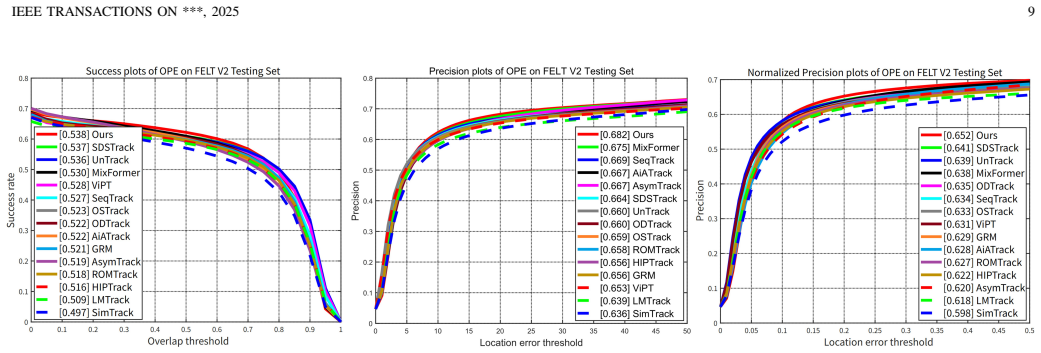
The central claim is that prompt-guided cross-modal fusion inside a Vision Mamba backbone yields a state-of-the-art accuracy-efficiency trade-off for RGB-event tracking. Concretely, on FELT V2 the tracker reports SR/PR/NPR of 53.8/68.2/65.2, above the ViT-B based OSTrack (52.3/65.9/63.3) and the prompt-based ViPT (52.8/65.3/63.1), with 30M parameters and 29 FPS versus 60–97M for the compared Transformer trackers. On FE108 it reports 62.18 SR / 94.74 PR, and on COESOT 62.6 SR / 76.9 PR. The paper argues the gains come from the design: a Prompt Generator routes each token to one of T learnable basis prompts, then the prompt of one modality is added to the output matrix C of the other modality's state-space scan, so the selective-scan dynamics are left untouched and cross-modal information flows through a cheap additive modification. Ablations show both the Prompt Generator and the prompt-guided cross-modal fusion contribute independently, and fusion at C outperforms fusion at y, Δ, or B.
Load-bearing premise
The fusion step adds a prompt tensor of shape B×L×d to the SSM output matrix C, but the paper never states whether d equals the SSM state dimension, so the central addition may not be well-defined as written.
Editorial extensions
If this is right
- If the central claim holds, a linear-complexity SSM backbone can replace a Transformer backbone in multimodal tracking with a roughly 50–70% parameter reduction and a small accuracy gain (e.g., 53.8 versus 52.3 SR on FELT V2), so ViT dependence is not a necessary cost for strong RGB-event tracking.
- The unified single-pass design means feature extraction, cross-modal interaction, and fusion happen inside one backbone, so separate fusion modules or two-stage pipelines are unnecessary; the ablations attribute 3.0 SR over the concatenation baseline to the added modules.
- Prompt injection through the SSM output matrix C is the preferred fusion site: ablations on FELT V2 give 53.8 SR for C versus 52.6, 52.3, and 52.1 for y, Δ, and B, suggesting output-side modulation is the most effective and stable insertion point.
- Dynamic template updating adds further gains (from 53.3 to 53.8 SR), so the framework's long-term tracking robustness depends on the update mechanism as much as on fusion.
- With 30M parameters and 29 FPS, the method establishes that the Mamba-family tracker can be the best accuracy-per-parameter choice on FELT V2, even though its FPS is lower than some lighter ViT trackers (e.g., LMTrack at 47 FPS).
Reading between the lines
- The paper leaves the prompt dimension d unspecified relative to the SSM state dimension; a reader should expect either d equals the state dimension or an unstated projection or broadcast, and the released code will settle which.
- The C-modulation could be interpreted as an input-dependent bias on the output projection rather than a rewrite of the state dynamics; if so, the mechanism might transfer to any SSM-based multimodal architecture, not just Vision Mamba variants.
- Because the prompt routing and C-modulation are modality-agnostic, the same recipe may apply to RGB-depth, RGB-thermal, or frame-flow tracking; this is an extension, not a claim made in the paper.
- The efficiency story is parameter-centric: at 29 FPS the tracker is slower than some ViT baselines (LMTrack at 47 FPS), so the efficiency comparison would look different under a latency-constrained or energy budget; optimizing Mamba kernels could change that comparison.
Editorial analysis
A structured set of objections, weighed in public.
Referee Report
Summary. The manuscript presents Mamba-FETrack V2, an RGB-Event visual object tracker built on a Vision Mamba (Vim) backbone. It introduces a Prompt Generator that creates two modality-specific prompt tensors Pr and Pe from a shared prompt pool (Eqs. 1–7), and a FEMamba block in which these prompts are added to the SSM output matrix C before the selective scan, forming the prompt-guided cross-modal fusion (PCMF) operation (Eq. 14). The tracker is trained with an OSTrack-style multi-task loss plus a score-prediction head for dynamic template update, and evaluated on FE108, FELT V2, and COESOT. The authors report top results on FE108 and FELT V2, a 30M-parameter model, and 29 FPS, and they acknowledge that on COESOT the success rate trails ViPT and CMDTrack.
Significance. The result is potentially significant for multimodal tracking: it suggests that a linear-complexity SSM backbone can replace a ViT backbone with a substantial parameter reduction while remaining competitive on two benchmarks. The paper includes a systematic ablation study (components, input modalities, backbone, fusion strategy, fusion position, prompt generation), evaluates on three public benchmarks, and includes an explicit limitation section. However, the central fusion equation is under-specified, the ablation and comparison results are reported without variance estimates, and the COESOT success-rate gap weakens the unqualified 'superior performance' claim. The architecture's practical value therefore cannot yet be fully assessed.
major comments (3)
- [§III-D, Eq. (14) and Eq. (7)] The addition (C + Pe) in Eq. (14) is not well-defined as written. In a standard Vision Mamba block, C is produced by the linear projection in Eq. (11) and has the SSM state dimension N (shape B×L×N per scan direction), whereas Pe from Eq. (7) has shape B×L×d, with d defined only as “the dimension of each basis prompt.” The paper never states that d = N, nor does it provide a projection, reshaping, or broadcasting rule. The same omission applies to the symmetric event-branch operation C' = C + Pr. Because this addition is the entire cross-modal fusion mechanism, and the reported ablation gain from PCMF (Table IV) depends on it, the central architecture is under-specified. Please state the configuration (T, d, N, number of FEMamba blocks), or explicitly introduce a compatibility projection if d ≠ N, or release the source code so the operation can be verified.
- [§IV-D, Tables IV and V] All ablation results are reported as single-run numbers without error bars or multiple seeds. The differences that justify the central design choices are small: for fusion position, C gives 53.8 SR versus y at 52.6, Δ at 52.3, and B at 52.1; in the component analysis, the combined gain of adding both the Prompt Generator and PCMF over the Prompt Generator alone is +0.9 SR. Without variance estimates or a significance test, the claim that C is the optimal fusion position and that prompt-guided fusion is superior to concatenation is not statistically supported. Please report mean±std over at least three seeds, or provide other evidence that these gaps exceed run-to-run noise.
- [§IV-C, Table III; Abstract and Conclusion] The unqualified claim of “superior performance” on multiple benchmarks is not consistent with the COESOT results. In Table III, the proposed method achieves SR 62.6, which is below ViPT (66.3) and CMDTrack (65.7), although its PR of 76.9 is higher than both. The text in Section IV-C acknowledges this SR disadvantage, but the abstract and conclusion still claim superior performance across the evaluated benchmarks. Please qualify the claim to state that the top success rate is achieved on FE108 and FELT V2, while on COESOT the method leads in precision but lags in success rate behind the strongest Transformer-based baselines.
minor comments (5)
- [§III-D, Eq. (13)] The word “status” should be “state” in the description of h(t) and h'(t); additionally, the text repeatedly calls C the “state matrix,” but C is the output matrix of the SSM, not the state-transition matrix, so please use consistent terminology.
- [Table III] The second row of Table III lists “STRAK,” but the referenced method and citation [69] correspond to STARK; please correct the spelling.
- [§IV-C, FE108 results] The sentence “with significant improvements of 94.74 on PR and 62.18 on SR” reports absolute scores rather than improvements; please rephrase to avoid the implication that these numbers are gains.
- [§III-D, Eq. (15)] Eq. (15) applies the same gate SiLU(z_rgb) to both the forward and backward scan outputs, whereas the original Vision Mamba block uses separate gates for the two scan directions; if this is intentional, it should be stated and justified.
- [§IV-B] The re-detection hyperparameters (the score threshold 0.3 and the values k=8 on FE108/FELT V2 and k=2 on COESOT) are introduced as empirically chosen but are not ablated; a brief justification or an ablation would help substantiate these choices.
Circularity Check
No circularity: benchmark results are external measurements and design choices are ablations, not derivations from fitted inputs.
full rationale
The derivation chain is self-contained and not circular. The prompt vectors Pr/Pe from Eqs. (6)-(7) are learnable intermediate features, but the claimed performance gains come from the full network trained with Eq. (17) and evaluated on external benchmarks (FE108, FELT V2, COESOT); no reported number is algebraically forced by a fitted parameter or by construction equal to an input. Self-citations to the authors' Mamba-FETrack [21] and survey [25] are used as baseline and related-work context; [21] is not invoked as proof of correctness, and the cross-modal fusion design is credited to external MambaIRv2 [20], with losses following OSTrack and STARK. There is one substantive specification gap: Eq. (14) adds Pe in R^(BxLxd) (from Eq. (7)) to the SSM output matrix C produced by Eq. (11), whose last dimension is the SSM state size N in Vision Mamba, and the paper never states d = N; this makes the core addition potentially undefined, but that is a reproducibility/correctness risk, not circularity. Likewise, the fusion-position ablation on FELT V2 (Table V) selects the C-position using the same test set that is later reported as the final result; this is test-set model selection, but the final numbers are still external measurements, not quantities constructed equal to an input. The paper's own limitation section (Sec. IV-G) flags modality imbalance, which is independent of circularity. Therefore no circular step is established.
Assumptions & free parameters
free parameters (5)
- T (number of basis prompts in the prompt pool) =
not reported
- d (dimension of each basis prompt) =
not reported
- lambda_2 (L1 loss weight) =
14
- k (consecutive low-score frames triggering search enlargement) =
8 on FE108 and FELT V2, 2 on COESOT
- confidence threshold for dynamic template update =
0.5
assumptions (4)
- standard math The ZOH discretization and selective-scan equations of the Mamba block (Eqs 12-14) are correct as background.
- domain assumption Stacking events within each RGB exposure time yields an aligned dense event frame that is sufficient for tracking.
- ad hoc to paper Adding the counterpart modality's prompt to the SSM output matrix C (Eq 14) provides effective cross-modal guidance.
- domain assumption The FELT V2 test set can be used for both ablation-based model selection and final evaluation without inflating results.
Cite this review
Pith. "Pith review of Mamba-FETrack V2: Revisiting State Space Model for Frame-Event based Visual Object Tracking." pith.science (2026). https://pith.science/paper/CCH7CXYY
@misc{pith2026250623783,
  author       = {Pith},
  title        = {Pith review of: Mamba-FETrack V2: Revisiting State Space Model for Frame-Event based Visual Object Tracking},
  year         = {2026},
  howpublished = {\url{https://pith.science/paper/CCH7CXYY}},
  note         = {Machine review of arXiv:2506.23783}
}
read the original abstract
Combining traditional RGB cameras with bio-inspired event cameras for robust object tracking has garnered increasing attention in recent years. However, most existing multimodal tracking algorithms depend heavily on high-complexity Vision Transformer architectures for feature extraction and fusion across modalities. This not only leads to substantial computational overhead but also limits the effectiveness of cross-modal interactions. In this paper, we propose an efficient RGB-Event object tracking framework based on the linear-complexity Vision Mamba network, termed Mamba-FETrack V2. Specifically, we first design a lightweight Prompt Generator that utilizes embedded features from each modality, together with a shared prompt pool, to dynamically generate modality-specific learnable prompt vectors. These prompts, along with the modality-specific embedded features, are then fed into a Vision Mamba-based FEMamba backbone, which facilitates prompt-guided feature extraction, cross-modal interaction, and fusion in a unified manner. Finally, the fused representations are passed to the tracking head for accurate target localization. Extensive experimental evaluations on multiple RGB-Event tracking benchmarks, including short-term COESOT dataset and long-term datasets, i.e., FE108 and FELT V2, demonstrate the superior performance and efficiency of the proposed tracking framework. The source code and pre-trained models will be released on https://github.com/Event-AHU/Mamba_FETrack
Figures


Figures from the paper (3 more)


Forward citations
Cited by 1 Pith paper
-
Hyperspectral Mamba for Hyperspectral Object Tracking
HyMamba, a Mamba-based hyperspectral tracker that scans spatial and spectral dimensions and propagates a spectral hidden state across frames and layers, achieves state-of-the-art scores on seven HS tracking benchmarks.
Reference graph
Works this paper leans on
-
[1]
Augment one with others: Gener- alizing to unforeseen variations for visual tracking,
J. Zhang, Z. Li, R. Wei, and Y . Wang, “Augment one with others: Gener- alizing to unforeseen variations for visual tracking,” IEEE Transactions on Multimedia, vol. 27, pp. 1461–1474, 2025
work page 2025
-
[2]
Improving visual object tracking through visual prompting,
S.-F. Chen, J.-C. Chen, I.-H. Jhuo, and Y .-Y . Lin, “Improving visual object tracking through visual prompting,” IEEE Transactions on Mul- timedia, vol. 27, pp. 2682–2694, 2024
work page 2024
-
[3]
Local fine-grained visual tracking,
J. Wu, Y . Sun, and R. Hong, “Local fine-grained visual tracking,” IEEE Transactions on Multimedia , vol. 27, pp. 3426–3436, 2025
work page 2025
-
[4]
Linker: Learning long short-term associations for robust visual tracking,
Z. Xun, S. Di, Y . Gao, Z. Tang, G. Wang, S. Liu, and B. Li, “Linker: Learning long short-term associations for robust visual tracking,” IEEE Transactions on Multimedia , vol. 26, pp. 6228–6237, 2024
work page 2024
-
[5]
Revisiting color-event based tracking: A unified network, dataset, and metric,
C. Tang, X. Wang, J. Huang, B. Jiang, L. Zhu, J. Zhang, Y . Wang, and Y . Tian, “Revisiting color-event based tracking: A unified network, dataset, and metric,” arXiv preprint arXiv:2211.11010 , 2022
arXiv 2022
-
[6]
Frame- event alignment and fusion network for high frame rate tracking,
J. Zhang, Y . Wang, W. Liu, M. Li, J. Bai, B. Yin, and X. Yang, “Frame- event alignment and fusion network for high frame rate tracking,” 2023 IEEE/CVF Conference on Computer Vision and Pattern Recognition (CVPR), pp. 9781–9790, 2023
work page 2023
-
[7]
Gradient-based learning applied to document recognition,
Y . LeCun, L. Bottou, Y . Bengio, and P. Haffner, “Gradient-based learning applied to document recognition,” Proceedings of the IEEE , vol. 86, no. 11, pp. 2278–2324, 1998
1998
-
[8]
Atom: Accurate tracking by overlap maximization,
M. Danelljan, G. Bhat, F. S. Khan, and M. Felsberg, “Atom: Accurate tracking by overlap maximization,” in Proceedings of the IEEE/CVF conference on computer vision and pattern recognition, 2019, pp. 4660– 4669
work page 2019
Show all 75 references
-
[9]
Learning discrim- inative model prediction for tracking,
G. Bhat, M. Danelljan, L. V . Gool, and R. Timofte, “Learning discrim- inative model prediction for tracking,” in Proceedings of the IEEE/CVF international conference on computer vision , 2019, pp. 6182–6191
2019
-
[10]
Ocean: Object-aware anchor-free tracking,
Z. Zhang, H. Peng, J. Fu, B. Li, and W. Hu, “Ocean: Object-aware anchor-free tracking,” in European conference on computer vision . Springer, 2020, pp. 771–787
2020
-
[11]
An image is worth 16x16 words: Transformers for image recognition at scale,
A. Dosovitskiy, L. Beyer, A. Kolesnikov, D. Weissenborn, X. Zhai, T. Unterthiner, M. Dehghani, M. Minderer, G. Heigold, S. Gelly et al., “An image is worth 16x16 words: Transformers for image recognition at scale,” in International Conference on Learning Representations (ICLR), 2020
2020
-
[12]
Learning spatio-temporal transformer for visual tracking,
B. Yan, H. Peng, J. Fu, D. Wang, and H. Lu, “Learning spatio-temporal transformer for visual tracking,” in Proceedings of the IEEE/CVF international conference on computer vision , 2021, pp. 10 448–10 457
2021
-
[13]
Aiatrack: Attention in attention for transformer visual tracking,
S. Gao, C. Zhou, C. Ma, X. Wang, and J. Yuan, “Aiatrack: Attention in attention for transformer visual tracking,” in European Conference on Computer Vision. Springer, 2022, pp. 146–164
2022
-
[14]
Swintrack: A simple and strong baseline for transformer tracking,
L. Lin, H. Fan, Z. Zhang, Y . Xu, and H. Ling, “Swintrack: A simple and strong baseline for transformer tracking,” Advances in Neural Information Processing Systems , vol. 35, pp. 16 743–16 754, 2022
2022
-
[15]
Efficiently modeling long sequences with structured state spaces,
A. Gu, K. Goel, and C. Ré, “Efficiently modeling long sequences with structured state spaces,” in The International Conference on Learning Representations (ICLR), 2022
2022
-
[16]
Vision mamba: Efficient visual representation learning with bidirectional state space model,
L. Zhu, B. Liao, Q. Zhang, X. Wang, W. Liu, and X. Wang, “Vision mamba: Efficient visual representation learning with bidirectional state space model,” in Forty-first International Conference on Machine Learn- ing, 2024
2024
-
[17]
Vmamba: Visual state space model,
Y . Liu, Y . Tian, Y . Zhao, H. Yu, L. Xie, Y . Wang, Q. Ye, J. Jiao, and Y . Liu, “Vmamba: Visual state space model,” Advances in neural information processing systems , vol. 37, pp. 103 031–103 063, 2024
2024
-
[18]
Mambavision: A hybrid mamba- transformer vision backbone,
A. Hatamizadeh and J. Kautz, “Mambavision: A hybrid mamba- transformer vision backbone,” in Proceedings of the Computer Vision and Pattern Recognition Conference , 2025, pp. 25 261–25 270
2025
-
[19]
Pre- train, prompt, and predict: A systematic survey of prompting methods in natural language processing,
P. Liu, W. Yuan, J. Fu, Z. Jiang, H. Hayashi, and G. Neubig, “Pre- train, prompt, and predict: A systematic survey of prompting methods in natural language processing,” ACM computing surveys, vol. 55, no. 9, pp. 1–35, 2023
2023
-
[20]
Mambairv2: Attentive state space restoration,
H. Guo, Y . Guo, Y . Zha, Y . Zhang, W. Li, T. Dai, S.-T. Xia, and Y . Li, “Mambairv2: Attentive state space restoration,” in Proceedings of the Computer Vision and Pattern Recognition Conference, 2025, pp. 28 124– 28 133
2025
-
[21]
Mamba- fetrack: Frame-event tracking via state space model,
J. Huang, S. Wang, S. Wang, Z. Wu, X. Wang, and B. Jiang, “Mamba- fetrack: Frame-event tracking via state space model,” in Chinese Confer- ence on Pattern Recognition and Computer Vision (PRCV) . Springer, 2024, pp. 3–18
2024
-
[22]
Awesome multi- modal object tracking,
C. Zhang, L. Liu, H. Wen, X. Zhou, and Y . Wang, “Awesome multi- modal object tracking,” arXiv preprint arXiv:2405.14200 , 2024
2024 arXiv
-
[23]
A survey on visual mamba,
H. Zhang, Y . Zhu, D. Wang, L. Zhang, T. Chen, Z. Wang, and Z. Ye, “A survey on visual mamba,” Applied Sciences, vol. 14, no. 13, p. 5683, 2024
2024
-
[24]
Prompt learning in computer vision: a survey,
Y . Lei, J. Li, Z. Li, Y . Cao, and H. Shan, “Prompt learning in computer vision: a survey,” Frontiers of Information Technology & Electronic Engineering, vol. 25, no. 1, pp. 42–63, 2024
2024
-
[25]
State space model for new-generation network alternative to transformers: A survey,
X. Wang, S. Wang, Y . Ding, Y . Li, W. Wu, Y . Rong, W. Kong, J. Huang, S. Li, H. Yang et al. , “State space model for new-generation network alternative to transformers: A survey,” arXiv preprint arXiv:2404.09516, 2024
2024 arXiv
-
[26]
Object tracking by jointly exploiting frame and event domain,
J. Zhang, X. Yang, Y . Fu, X. Wei, B. Yin, and B. Dong, “Object tracking by jointly exploiting frame and event domain,” in Proceedings of the IEEE/CVF International Conference on Computer Vision , 2021, pp. 13 043–13 052
2021
-
[27]
Visevent: Reliable object tracking via collaboration of frame and event flows,
X. Wang, J. Li, L. Zhu, Z. Zhang, Z. Chen, X. Li, Y . Wang, Y . Tian, and F. Wu, “Visevent: Reliable object tracking via collaboration of frame and event flows,”IEEE Transactions on Cybernetics, vol. 54, pp. 1997–2010, 2021
1997
-
[28]
Tenet: targetness entanglement incorporating with multi-scale pooling and mutually-guided fusion for rgb-e object tracking,
P. Shao, T. Xu, Z. Tang, L. Li, X.-J. Wu, and J. Kittler, “Tenet: targetness entanglement incorporating with multi-scale pooling and mutually-guided fusion for rgb-e object tracking,” Neural Networks, vol. 183, p. 106948, 2025
2025
-
[29]
Emtrack: Efficient multimodal object tracking,
C. Liu, Z. Guan, S. Lai, Y . Liu, H. Lu, and D. Wang, “Emtrack: Efficient multimodal object tracking,” IEEE Transactions on Circuits and Systems for Video Technology, vol. 35, pp. 2202–2214, 2025
2025
-
[30]
Sdstrack: Self-distillation symmetric adapter learning for multi-modal visual object tracking,
X. Hou, J. Xing, Y . Qian, Y . Guo, S. Xin, J. Chen, K. Tang, M. Wang, Z. Jiang, L. Liu et al. , “Sdstrack: Self-distillation symmetric adapter learning for multi-modal visual object tracking,” in Proceedings of the IEEE/CVF Conference on Computer Vision and Pattern Recognitio...
2024
-
[31]
Exploiting multimodal spatial-temporal patterns for video object tracking,
X. Hu, Y . Tai, X. Zhao, C. Zhao, Z. Zhang, J. Li, B. Zhong, and J. Yang, “Exploiting multimodal spatial-temporal patterns for video object tracking,” in Proceedings of the AAAI Conference on Artificial Intelligence, vol. 39, no. 4, 2025, pp. 3581–3589
2025
-
[32]
Onetracker: Unifying visual object tracking with foundation models and efficient tuning,
L. Hong, S. Yan, R. Zhang, W. Li, X. Zhou, P. Guo, K. Jiang, Y . Chen, J. Li, Z. Chen et al. , “Onetracker: Unifying visual object tracking with foundation models and efficient tuning,” in Proceedings of the IEEE/CVF conference on computer vision and pattern recognition, 2024,...
2024
-
[33]
Cross-modal orthogonal high-rank augmentation for rgb-event transformer-trackers,
Z. Zhu, J. Hou, and D. O. Wu, “Cross-modal orthogonal high-rank augmentation for rgb-event transformer-trackers,” 2023 IEEE/CVF In- ternational Conference on Computer Vision (ICCV) , pp. 21 988–21 998, 2023
2023
-
[34]
Combining recurrent, convolutional, and continuous-time models with linear state space layers,
A. Gu, I. Johnson, K. Goel, K. Saab, T. Dao, A. Rudra, and C. Ré, “Combining recurrent, convolutional, and continuous-time models with linear state space layers,” Advances in neural information processing systems, vol. 34, pp. 572–585, 2021
2021
-
[35]
Hippo: Recurrent memory with optimal polynomial projections,
A. Gu, T. Dao, S. Ermon, A. Rudra, and C. Ré, “Hippo: Recurrent memory with optimal polynomial projections,” Advances in neural information processing systems , vol. 33, pp. 1474–1487, 2020
2020
-
[36]
Mamba: Linear-time sequence modeling with selective state spaces,
A. Gu and T. Dao, “Mamba: Linear-time sequence modeling with selective state spaces,” in The International Conference on Learning Representations (ICLR), 2024
2024
-
[37]
Decision mamba: A multi-grained state space model with self-evolution regularization for offline rl,
Q. Lv, X. Deng, G. Chen, M. Y . Wang, and L. Nie, “Decision mamba: A multi-grained state space model with self-evolution regularization for offline rl,” Advances in Neural Information Processing Systems , vol. 37, pp. 22 827–22 849, 2024
2024
-
[38]
Coupled mamba: Enhanced multimodal fusion with coupled state space model,
X. Li, W. Wang et al., “Coupled mamba: Enhanced multimodal fusion with coupled state space model,” arXiv preprint arXiv:2404.04567 , 2024
2024 arXiv
-
[39]
Fusionmamba: Dynamic feature enhancement for multimodal image fusion with mamba,
X. Xie, Y . Cui, T. Tan, X. Zheng, and Z. Yu, “Fusionmamba: Dynamic feature enhancement for multimodal image fusion with mamba,” Visual Intelligence, vol. 2, no. 1, p. 37, 2024
2024
-
[40]
Visual prompt tuning,
M. Jia, L. Tang, B.-C. Chen, C. Cardie, S. Belongie, B. Hariharan, and S.-N. Lim, “Visual prompt tuning,” in European conference on computer vision. Springer, 2022, pp. 709–727
2022
-
[41]
Learning to prompt for vision- language models,
K. Zhou, J. Yang, C. C. Loy, and Z. Liu, “Learning to prompt for vision- language models,” International Journal of Computer Vision , vol. 130, no. 9, pp. 2337–2348, 2022
2022
-
[42]
Learning transferable visual models from natural language supervision,
A. Radford, J. W. Kim, C. Hallacy, A. Ramesh, G. Goh, S. Agarwal, G. Sastry, A. Askell, P. Mishkin, J. Clark et al., “Learning transferable visual models from natural language supervision,” in International conference on machine learning . PmLR, 2021, pp. 8748–8763
2021
-
[43]
Snnptrack: Spiking neural network based prompt for high-accuracy rgbe tracking,
Y . Ji, Q. Zhao, Y . Liang, and J. Wu, “Snnptrack: Spiking neural network based prompt for high-accuracy rgbe tracking,” in ICASSP 2025-2025 IEEE International Conference on Acoustics, Speech and Signal Processing (ICASSP) . IEEE, 2025, pp. 1–5
2025
-
[44]
Visual prompt multi- modal tracking,
J. Zhu, S. Lai, X. Chen, D. Wang, and H. Lu, “Visual prompt multi- modal tracking,” in Proceedings of the IEEE/CVF conference on com- puter vision and pattern recognition , 2023, pp. 9516–9526
2023
-
[45]
Temporal adaptive rgbt tracking with modality prompt,
H. Wang, X. Liu, Y . Li, M. Sun, D. Yuan, and J. Liu, “Temporal adaptive rgbt tracking with modality prompt,” in Proceedings of the AAAI Conference on Artificial Intelligence , vol. 38, no. 6, 2024, pp. 5436–5444
2024
-
[46]
Explicit visual prompts for visual object tracking,
L. Shi, B. Zhong, Q. Liang, N. Li, S. Zhang, and X. Li, “Explicit visual prompts for visual object tracking,” in Proceedings of the AAAI Conference on Artificial Intelligence , vol. 38, no. 5, 2024, pp. 4838– 4846
2024
-
[47]
Joint feature learning and relation modeling for tracking: A one-stream framework,
B. Ye, H. Chang, B. Ma, S. Shan, and X. Chen, “Joint feature learning and relation modeling for tracking: A one-stream framework,” in European conference on computer vision . Springer, 2022, pp. 341– 357
2022
-
[48]
Rebar: Low-variance, unbiased gradient estimates for discrete latent variable models,
G. Tucker, A. Mnih, C. J. Maddison, J. Lawson, and J. Sohl-Dickstein, “Rebar: Low-variance, unbiased gradient estimates for discrete latent variable models,” Advances in Neural Information Processing Systems , vol. 30, 2017
2017
-
[49]
Decoupled weight decay regularization,
I. Loshchilov and F. Hutter, “Decoupled weight decay regularization,” in International Conference on Learning Representations (ICLR) , 2018
2018
-
[50]
Pytorch: An imperative style, high-performance deep learning library,
A. Paszke, S. Gross, F. Massa, A. Lerer, J. Bradbury, G. Chanan, T. Killeen, Z. Lin, N. Gimelshein, L. Antiga et al. , “Pytorch: An imperative style, high-performance deep learning library,” Advances in neural information processing systems , vol. 32, 2019
2019
-
[51]
High performance visual tracking with siamese region proposal network,
B. Li, J. Yan, W. Wu, Z. Zhu, and X. Hu, “High performance visual tracking with siamese region proposal network,” 2018 IEEE/CVF Con- ference on Computer Vision and Pattern Recognition , pp. 8971–8980, 2018
2018
-
[52]
Siamfc++: Towards robust and accurate visual tracking with target estimation guidelines,
Y . Xu, Z. Wang, Z. Li, Y . Yuan, and G. Yu, “Siamfc++: Towards robust and accurate visual tracking with target estimation guidelines,” in Proceedings of the AAAI conference on artificial intelligence , vol. 34, no. 07, 2020, pp. 12 549–12 556
2020
-
[53]
Know your surroundings: Exploiting scene information for object tracking,
G. Bhat, M. Danelljan, L. Van Gool, and R. Timofte, “Know your surroundings: Exploiting scene information for object tracking,” in European conference on computer vision . Springer, 2020, pp. 205– 221
2020
-
[54]
Clnet: A compact latent network for fast adjusting siamese trackers,
X. Dong, J. Shen, L. Shao, and F. Porikli, “Clnet: A compact latent network for fast adjusting siamese trackers,” in European Conference on Computer Vision . Springer, 2020, pp. 378–395
2020
-
[55]
Atom: Accurate tracking by overlap maximization,
M. Danelljan, G. Bhat, F. S. Khan, and M. Felsberg, “Atom: Accurate tracking by overlap maximization,” 2019 IEEE/CVF Conference on Computer Vision and Pattern Recognition (CVPR) , pp. 4655–4664, 2018
2019
-
[56]
Learning discrim- inative model prediction for tracking,
G. Bhat, M. Danelljan, L. V . Gool, and R. Timofte, “Learning discrim- inative model prediction for tracking,” 2019 IEEE/CVF International Conference on Computer Vision (ICCV) , pp. 6181–6190, 2019
2019
-
[57]
Probabilistic regression for visual tracking,
M. Danelljan, L. V . Gool, and R. Timofte, “Probabilistic regression for visual tracking,” 2020 IEEE/CVF Conference on Computer Vision and Pattern Recognition (CVPR), pp. 7181–7190, 2020
2020
-
[58]
Mixformer: End-to-end tracking with iterative mixed attention,
Y . Cui, J. Cheng, L. Wang, and G. Wu, “Mixformer: End-to-end tracking with iterative mixed attention,” 2022 IEEE/CVF Conference on Computer Vision and Pattern Recognition (CVPR) , pp. 13 598–13 608, 2022
2022
-
[59]
Backbone is all your need: A simplified architecture for visual object tracking,
B. Chen, P. Li, L. Bai, L. Qiao, Q. Shen, B. Li, W. Gan, W. Wu, and W. Ouyang, “Backbone is all your need: A simplified architecture for visual object tracking,” in European conference on computer vision . Springer, 2022, pp. 375–392
2022
-
[60]
Generalized relation modeling for transformer tracking,
S. Gao, C. Zhou, and J. Zhang, “Generalized relation modeling for transformer tracking,” 2023 IEEE/CVF Conference on Computer Vision and Pattern Recognition (CVPR) , pp. 18 686–18 695, 2023
2023
-
[61]
Robust object modeling for visual tracking,
Y . Cai, J. Liu, J. Tang, and G. Wu, “Robust object modeling for visual tracking,” in Proceedings of the IEEE/CVF international conference on computer vision, 2023, pp. 9589–9600
2023
-
[62]
Seqtrack: Sequence to sequence learning for visual object tracking,
X. Chen, H. Peng, D. Wang, H. Lu, and H. Hu, “Seqtrack: Sequence to sequence learning for visual object tracking,” in Proceedings of the IEEE/CVF conference on computer vision and pattern recognition, 2023, pp. 14 572–14 581
2023
-
[63]
Hiptrack: Visual tracking with historical prompts,
W. Cai, Q. Liu, and Y . Wang, “Hiptrack: Visual tracking with historical prompts,” in Proceedings of the IEEE/CVF Conference on Computer Vision and Pattern Recognition , 2024, pp. 19 258–19 267
2024
-
[64]
Odtrack: Online dense temporal token learning for visual tracking,
Y . Zheng, B. Zhong, Q. Liang, Z. Mo, S. Zhang, and X. Li, “Odtrack: Online dense temporal token learning for visual tracking,” in Proceed- ings of the AAAI conference on artificial intelligence , vol. 38, no. 7, 2024, pp. 7588–7596
2024
-
[65]
Single-model and any-modality for video object tracking,
Z. Wu, J. Zheng, X. Ren, F.-A. Vasluianu, C. Ma, D. P. Paudel, L. Van Gool, and R. Timofte, “Single-model and any-modality for video object tracking,” in Proceedings of the IEEE/CVF conference on computer vision and pattern recognition , 2024, pp. 19 156–19 166
2024
-
[66]
Less is more: Token context-aware learning for object tracking,
B. Kang, X. Chen, S. Lai, Y . Liu, Y . Liu, and D. Wang, “Less is more: Token context-aware learning for object tracking,” in Proceedings of the AAAI Conference on Artificial Intelligence , vol. 39, no. 8, 2025, pp. 8824–8832
2025
-
[67]
Two- stream beats one-stream: asymmetric siamese network for efficient visual tracking,
J. Zhu, H. Tang, X. Chen, X. Wang, D. Wang, and H. Lu, “Two- stream beats one-stream: asymmetric siamese network for efficient visual tracking,” in Proceedings of the AAAI Conference on Artificial Intelligence, vol. 39, no. 10, 2025, pp. 10 959–10 967
2025
-
[68]
Transformer tracking,
X. Chen, B. Yan, J. Zhu, D. Wang, X. Yang, and H. Lu, “Transformer tracking,” 2021 IEEE/CVF Conference on Computer Vision and Pattern Recognition (CVPR), pp. 8122–8131, 2021
2021
-
[69]
Learning spatio- temporal transformer for visual tracking,
B. Yan, H. Peng, J. Fu, D. Wang, and H. Lu, “Learning spatio- temporal transformer for visual tracking,” 2021 IEEE/CVF International Conference on Computer Vision (ICCV) , pp. 10 428–10 437, 2021
2021
-
[70]
Siam r-cnn: Visual tracking by re-detection,
P. V oigtlaender, J. Luiten, P. H. Torr, and B. Leibe, “Siam r-cnn: Visual tracking by re-detection,” in Proceedings of the IEEE/CVF conference on computer vision and pattern recognition , 2020, pp. 6578–6588
2020
-
[71]
Transforming model prediction for tracking,
C. Mayer, M. Danelljan, G. Bhat, M. Paul, D. P. Paudel, F. Yu, and L. V . Gool, “Transforming model prediction for tracking,” 2022 IEEE/CVF Conference on Computer Vision and Pattern Recognition (CVPR) , pp. 8721–8730, 2022
2022
-
[72]
Learning target candidate association to keep track of what not to track,
C. Mayer, M. Danelljan, D. P. Paudel, and L. Van Gool, “Learning target candidate association to keep track of what not to track,” in Proceedings of the IEEE/CVF international conference on computer vision, 2021, pp. 13 444–13 454. IEEE TRANSACTIONS ON ***, 2025 13
2021
-
[73]
Probabilistic regression for visual tracking,
M. Danelljan, L. V . Gool, and R. Timofte, “Probabilistic regression for visual tracking,” in Proceedings of the IEEE/CVF conference on computer vision and pattern recognition , 2020, pp. 7183–7192
2020
-
[74]
Transformer meets tracker: Exploiting temporal context for robust visual tracking,
N. Wang, W. Zhou, J. Wang, and H. Li, “Transformer meets tracker: Exploiting temporal context for robust visual tracking,” in Proceedings of the IEEE/CVF conference on computer vision and pattern recognition, 2021, pp. 1571–1580
2021
-
[75]
Cross-modality distilla- tion for multi-modal tracking,
T. Zhang, Q. Zhang, K. Debattista, and J. Han, “Cross-modality distilla- tion for multi-modal tracking,” IEEE Transactions on Pattern Analysis and Machine Intelligence , vol. 47, pp. 5847–5865, 2025
2025
Reviewed August 6, 2026 · model on record in the stance chip above.
Discussion (0). Continue with ORCID to comment.