REVIEW 2 major objections 4 minor 66 references
Chiral kinetic theory from the on-shell effective theory: derivation of collision terms
T0 review · 2 major / 4 minor · reviewed 2026-08-14 · deepseek-v4-flash
Pith's one-line read This paper derives the collision terms of chiral kinetic theory from the on-shell effective field theory, placing the collisional sector on a systematic 1/E expansion.
desk verdict Solid EFT derivation of CKT collision terms with a genuinely new spin-dependent photon coupling, but the load-bearing Dirac algebra is compressed and the integrated cross-check does not fully pin down the angular structure. read the letter →
The pith
A machine-rendered reading of the paper's core claim, the machinery that carries it, and where it could break.
The reading
What carries the argument
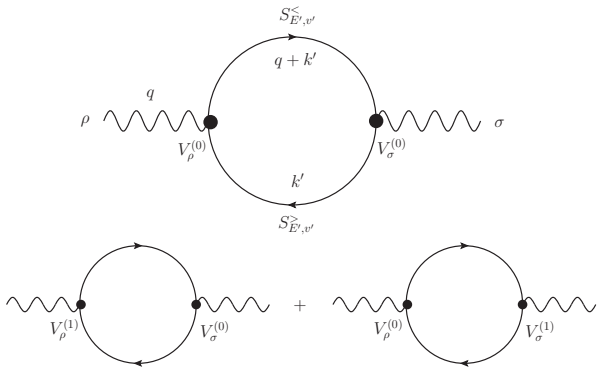
The central object is the OSEFT Lagrangian, obtained by successive Foldy–Wouthuysen canonical transformations—unitary rotations that decouple positive- and negative-energy components—diagonalizing the massless Dirac theory in powers of 1/E. The power-counting assumption is the split K^μ = E v^μ + k^μ with residual momentum k^μ much smaller than E. The order-zero and order-one fermion–photon vertices $V^{{(0)}}$_μ = ie ( /̃v/2 ) v_μ and $V^{{(1)}}$_μ = (ie/E)(/̃v/2)[(k_⊥μ + (1/2)q_⊥μ) − (i/2)σ_⊥^{μα} q_α] carry the interaction; combined with the on-shell Wigner functions and the soft-photon retarded and advanced propagators (longitudinal plus two transverse helicity components), they produce the collision integral. The spin tensor $S^{{μν}}$_χ = (χ/2) $ε^{{αβμν}}$ u_β K_α / (u·K) encodes the chirality-dependent coupling that distinguishes photon helicities.
What would settle it
Compute a transport coefficient, such as the electrical conductivity or the chiral magnetic effect coefficient, from the OSEFT collision integral and compare it with the full QED hard-thermal-loop kinetic theory result in the same chiral plasma; any disagreement at leading order in the coupling beyond the single integrated decay-rate check would falsify the claim that the 1/E collision term captures the collisional dynamics.
Extended reading notes
Core claim
Starting from the massless QED Lagrangian, successive unitary canonical transformations remove the operators that mix the particle and antiparticle sectors, order by order in 1/E, recovering the OSEFT Lagrangian at order 1/$E^{2}$. The authors then feed this Lagrangian into the real-time thermal field theory transport formalism: the left-hand side is the known collisionless chiral transport operator, and the right-hand side is built from fermion self-energy diagrams with OSEFT vertices at order n=0 and n=1. The resulting gain-minus-loss collision term has a scattering amplitude squared that contains spin-tensor-dependent couplings proportional to 1/E. In a plasma with chiral imbalance the photon propagator has distinct longitudinal and two transverse circularly-polarized components, so a right- or left-handed fermion sees different amplitudes for photons of opposite helicity. The paper shows that the OSEFT collision term, evaluated in the local rest frame for a degenerate chiral plasma, reproduces the QED fermion decay rate of Eq. (92).
Load-bearing premise
The argument assumes the fermion energy E is the largest scale in the system, so that every soft photon momentum and every momentum transfer is much smaller than E; if a transport process receives significant contributions from fermion momenta or momentum transfers comparable to E, the 1/E expansion of the collision terms is no longer justified.
Editorial extensions
If this is right
- The collision terms of chiral kinetic theory can be computed systematically to any order in 1/E, so transport coefficients in chiral plasmas inherit a controlled expansion.
- In a chiral-imbalanced plasma, the 1/E correction makes the collision integral sensitive to photon circular polarization, so right- and left-handed fermions acquire different scattering rates off transverse photons.
- The OSEFT decay rate matches the direct QED result at order 1/E in an ultradegenerate plasma, supporting the use of the OSEFT collision term for near-equilibrium chiral transport.
- Because OSEFT is a Foldy–Wouthuysen picture, the resulting kinetic theory describes extended quasiparticles with size of order 1/E, and the side-jump phenomenon emerges as the frame dependence of their mean position.
- Particle–antiparticle annihilation processes are suppressed in this expansion and appear only at order 1/E^4, so at order 1/E the collision term is complete without adding contact interactions.
Reading between the lines
- The fermion distribution function in this kinetic theory refers to Foldy–Wouthuysen quasiparticles, not to Dirac-picture particles; comparisons with kinetic theories derived from the Dirac/Wigner picture must account for this different identification of the degrees of freedom.
- The scale-separation assumption suggests the OSEFT collision term is reliable for hard quasiparticles but should not be applied to soft fermion modes with energy of order the temperature or the chemical potential, which would require a separate soft-sector treatment.
- A next-order (1/E^2) computation of the collision term checked against the full QED self-energy at finite density would delimit the regime of validity and could expose where the Born-type soft-photon approximation underlying the scattering amplitude fails.
Signed reviews
Editorial analysis
A structured set of objections, weighed in public.
Referee Report
Summary. The paper develops the on-shell effective field theory (OSEFT) as the quantum field theory counterpart of a Foldy-Wouthuysen diagonalization for massless fermions, and uses it to derive the collision terms of the chiral kinetic theory (CKT) to first order in the inverse fermion energy 1/E. Sections II and III establish the FW equivalence and discuss the resulting interpretation of spin, position, and side jumps. Section IV reviews the Kadanoff-Baym and Wigner-function formalism. Section V sets up the OSEFT transport equation and the scale separation K = E v + k. Section VI computes the four one-loop contributions to the fermion self-energy and presents the central result: the collision term in Eqs. (65)-(77), with an amplitude squared that depends on the fermion spin tensor and, in a chirally imbalanced medium, distinguishes the two circular photon polarizations. Section VII checks the new collision term by reproducing the fermion decay rate in an ultradegenerate chiral plasma obtained from full QED, Eq. (92). Section VIII summarizes the validity and outlook.
Significance. If the central computation closes, this is a significant and useful contribution: it places the collisional sector of chiral kinetic theory on a systematic 1/E effective-field-theory expansion, extends the earlier collisionless OSEFT program, and gives an explicit spin-dependent scattering amplitude with falsifiable consequences for transport in chirally imbalanced plasmas. The paper's strengths include the explicit order-by-order FW diagonalization in Eqs. (7)-(19), the parameter-free nature of the derivation, and the nontrivial consistency check against a direct QED decay-rate computation in Eq. (92). The main caveat is that the load-bearing algebraic reduction from the four self-energy traces in Eq. (55) to the amplitude in Eq. (66) is not displayed, and the present integrated check alone cannot certify the full angular and spin structure of the collision term.
major comments (2)
- [Sec. VI, Eqs. (55)-(65)] The central result of the paper is the reduction of the four OSEFT self-energy traces in Eq. (55) to the compact amplitude squared in Eq. (66) via the combined LO+NLO photon Wightman function in Eqs. (62)-(63). This step is announced only as 'half dozen steps to combine and simplify terms' (text between Eqs. (64) and (65)), yet it is the point at which the spin-tensor structures in Eq. (66) are generated. Since the only cross-check offered is the integrated decay rate in the ultradegenerate limit, Eq. (92), a term that is odd in the photon direction, or that cancels under the angular averages in Eqs. (87), would leave that check unchanged while altering the collision term's predictions for transport coefficients. I ask the authors to provide the explicit derivation of Eqs. (65)-(66), or an appendix with the intermediate traces, or an independent verification of the spin structure, before the paper can be accepted.
- [Sec. VI, Eqs. (48), (70), and (77)] The on-shell projection used to define the collision-term phase space needs clarification. Equation (48) defines E_K = K·u, which in the local rest frame coincides with K^0; with this definition the factors theta(E_K) delta(K^0 - E_K) in Eqs. (70)-(71) are identities rather than on-shell constraints, and the conversion from the OSEFT constraint K^chi_{E,v} in Eq. (47) to the full-momentum delta functions is not demonstrated. If E_K is instead intended to denote the on-shell energy |K| (or its frame-covariant analogue), this should be stated explicitly and the equivalence of Eq. (70) with Eq. (47) shown, since the phase-space measure in Eq. (77) is part of the claimed 1/E-accurate collision term.
minor comments (4)
- [Sec. VI, Eq. (57)] The symbol sigma^{mu alpha}_perp is used in the NLO vertex (57) but is not defined in the notation appendix; please define it explicitly in terms of sigma^{mu alpha} and the perpendicular projector.
- [Sec. VI, Eqs. (64)-(66)] The notation S^{alpha nu perp}_chi in Eqs. (64)-(66) is not introduced; presumably it is the contraction of the spin tensor with the perpendicular projector, but this should be stated to make the expressions unambiguous.
- [Sec. VII, Eq. (91)] The transverse spectral function in Eq. (91) is written with the prefactor m_D^2 rather than M_h^2, and the replacement is justified only in footnote [63]; because this enters the comparison with Ref. [49], a sentence in the main text stating the accuracy of this replacement would help the reader.
- [Abstract and Sec. I] There are minor grammatical slips, e.g. 'the collision terms depends' in the abstract, and the paper should define E as the on-shell fermion energy upon first use in Sec. I rather than only in Appendix A.
Circularity Check
No significant circularity: the OSEFT collision terms are derived from QED inputs and checked against an independent, parameter-free QED calculation rather than being fitted or defined into existence.
full rationale
The derivation chain is self-contained: the OSEFT Lagrangian is not assumed but is obtained from QED through explicit Foldy-Wouthuysen transformations in Sec. II (Eqs. (7)-(19)), and the collision terms are computed from OSEFT Feynman rules and self-energy traces in Eqs. (55)-(66) without any fitted constant or parameter. The only benchmark, the fermion decay rate in a chiral plasma, is a separate parameter-free QED calculation (Eqs. (79)-(92), from Ref. [49]); reproducing it tests rather than defines the OSEFT amplitude, so the benchmark is not an input renamed as a prediction. Self-citations to Refs. [1,2,24] supply previously derived framework and vertices, but the present paper rederives the relevant Lagrangian and performs the new trace calculation, and these citations are not used as an unverified uniqueness argument. The chiral-imbalanced photon propagator used in App. B is a shared hard-dense-loop input for both the QED benchmark and the OSEFT check, not something manufactured by the present derivation. Two genuine limitations are verification gaps rather than circularity: the 'half dozen steps to combine and simplify terms' between Eqs. (55) and (65) are an omitted algebra check, and the Eq. (92) comparison is an angularly integrated quantity, so it may not uniquely verify the full spin and angular structure of the collision term. Neither limitation makes the central derivation equivalent to its own inputs.
Assumptions & free parameters
assumptions (6)
- standard math The Kadanoff-Baym equations and Wigner transform provide the correct quantum transport framework (Eqs. 20-27).
- domain assumption The fermion full momentum splits into K = E v + k with k << E (Eq. 35).
- domain assumption The OSEFT Lagrangian is equivalent to repeated Foldy-Wouthuysen transformations of QED up to O(1/E^2) (Eq. 19).
- domain assumption The photon propagator in a chiral medium has a longitudinal mode and two helicity-dependent transverse modes (Eq. 88, App. B).
- domain assumption In the ultradegenerate plasma the fermion distributions are step functions, and the rate comparison is valid only for times shorter than the chiral instability time (Sec. VII).
- domain assumption Retarded self-energy terms are negligible as alpha-suppressed corrections to the dispersion relation and LHS (Sec. IV.1).
Cite this review
Pith. "Pith review of Chiral kinetic theory from the on-shell effective theory: derivation of collision terms." pith.science (2026). https://pith.science/paper/CCV3WXH3
@misc{pith2026190800561,
  author       = {Pith},
  title        = {Pith review of: Chiral kinetic theory from the on-shell effective theory: derivation of collision terms},
  year         = {2026},
  howpublished = {\url{https://pith.science/paper/CCV3WXH3}},
  note         = {Machine review of arXiv:1908.00561}
}
read the original abstract
We show that the on-shell effective theory (OSEFT) is the quantum field theory counterpart of a Foldy-Wouthuysen diagonalization of relativistic quantum mechanics for massless fermions. Thus, it is free of the Zitterbewegung oscillations that would yield an ill-defined meaning to the semiclassical transport approach at short distances if derived from the pure Dirac picture. We present a detailed derivation of the collision terms in the chiral kinetic theory using the OSEFT. Collision integrals are derived up to order 1/E, where E is the energy of an on-shell fermion. At this order, the collision terms depends on the spin tensor of the fermion, and in the presence of chiral imbalance, it describes how a massless fermion of a given helicity interacts differently with the transverse photons of different circular polarization. In order to back up our results, we check that they allow us to reproduce the fermion decay rate in an ultradegenerate plasma with a chiral imbalance computed directly from QED.
Figures

Reference graph
Works this paper leans on
-
[1]
Comment on the dispersion relation Before applying Eq. (27) to the OSEFT, we briefly comment on the computation of the fermion dispersion relation, and argue that collisions do not modify it to the order we consider in this work. On one hand the difference between Eqs. (24) and (26) gives the transport equation, on the other hand their sum results in an ind...
-
[2]
in all the preceding equations. In Ref. [1] the OSEFT was derived using the modern language of effective field theories, where to describe on-shell particles one integrates out the off-shell modes. Like in the QED Lagrangian these two set of modes are inherently coupled through the equations of motion. When the off-shell components are integrated out, only pa...
-
[3]
D. T. Son and N. Yamamoto, Phys. Rev. Lett. 109, 181602 (2012) [arXiv:1203.2697 [cond- mat.mes-hall]]
arXiv 2012
-
[4]
The result is a collision term for the on-shell distribution function
(73) We can now integrate over all zero components of momenta dK 0 2,dK 0 3,dK 0 4 as well as overdK 0/2π. The result is a collision term for the on-shell distribution function . CT [fχ,f χ′ ]≡ ∫ dK 0 2π CT [fχ,f χ′ ] (74) where all energies are on shell and are functions of their respective momenta and magnetic field, and we have defined ∫ Ki ≡ ∫ d3Ki (2π)...
-
[5]
(92) We thus reproduce the value of the damping rate of Eq
(91) So we can write Γχ(EK) = ∫ d3q (2π)3 [ 1−nχ F ( EK−q‖ )] × {( 1− q‖ EK ) ρL(q‖, q) + ∑ h ( 1− q‖2 q2 )[ 1− 1 EK ( q‖ +|q|χh )] ρh T (q‖, q) } . (92) We thus reproduce the value of the damping rate of Eq. (23) of Ref. [49], considering that our Γ = 2γ computed there. As in Ref. [49], we see that a fermion of a given chirality interacts differently with...
work page 2017
-
[6]
C. Manuel and J. M. Torres-Rincon, Phys. Rev. D 90, no. 7, 076007 (2014) doi:10.1103/PhysRevD.90.076007 [arXiv:1404.6409 [hep-ph]]
arXiv 2014
-
[7]
Consistent Relativistic Chiral Kinetic Theory: a derivation from OSEFT
S. Carignano, C. Manuel and J. M. Torres-Rincon, Phys. Rev. D 98, no. 7, 076005 (2018) doi:10.1103/PhysRevD.98.076005 [arXiv:1806.01684 [hep-ph]]
work page Pith review arXiv 2018
-
[8]
D. T. Son and N. Yamamoto, Phys. Rev. D 87, no. 8, 085016 (2013) doi:10.1103/PhysRevD.87.085016 [arXiv:1210.8158 [hep-th]]
arXiv 2013
Show all 66 references
-
[9]
M. A. Stephanov and Y. Yin, Phys. Rev. Lett. 109, 162001 (2012) [arXiv:1207.0747 [hep-th]]
2012 arXiv
-
[10]
J. -W. Chen, S. Pu, Q. Wang and X. -N. Wang, Phys. Rev. Lett. 110, 262301 (2013) [arXiv:1210.8312 [hep-th]]
2013 arXiv
-
[11]
Manuel and J
C. Manuel and J. M. Torres-Rincon, Phys. Rev. D 89, no. 9, 096002 (2014) doi:10.1103/PhysRevD.89.096002 [arXiv:1312.1158 [hep-ph]]
2014 arXiv
-
[12]
Hidaka, S
Y. Hidaka, S. Pu and D. L. Yang, Phys. Rev. D 95, no. 9, 091901 (2017) doi:10.1103/PhysRevD.95.091901 [arXiv:1612.04630 [hep-th]]
2017 arXiv
-
[13]
Hidaka, S
Y. Hidaka, S. Pu and D. L. Yang, Phys. Rev. D 97, no. 1, 016004 (2018) doi:10.1103/PhysRevD.97.016004 [arXiv:1710.00278 [hep-th]]
2018 arXiv
-
[14]
Mueller and R
N. Mueller and R. Venugopalan, Phys. Rev. D 97, no. 5, 051901 (2018) doi:10.1103/PhysRevD.97.051901 [arXiv:1701.03331 [hep-ph]]
2018 arXiv
-
[15]
Mueller and R
N. Mueller and R. Venugopalan, Phys. Rev. D 96, no. 1, 016023 (2017) doi:10.1103/PhysRevD.96.016023 [arXiv:1702.01233 [hep-ph]]
2017 arXiv
-
[16]
Hidaka and D
Y. Hidaka and D. L. Yang, Phys. Rev. D 98, no. 1, 016012 (2018) doi:10.1103/PhysRevD.98.016012 [arXiv:1801.08253 [hep-th]]
2018 arXiv
-
[17]
E. V. Gorbar, V. A. Miransky, I. A. Shovkovy and P. O. Sukhachov, Phys. Rev. Lett. 118, no. 12, 127601 (2017) doi:10.1103/PhysRevLett.118.127601 [arXiv:1610.07625 [cond-mat.str-el]]. 33
2017 arXiv
-
[18]
E. V. Gorbar, V. A. Miransky, I. A. Shovkovy and P. O. Sukhachov, JHEP 1708, 103 (2017) doi:10.1007/JHEP08(2017)103 [arXiv:1707.01105 [hep-ph]]
2017 arXiv
-
[19]
Huang, S
A. Huang, S. Shi, Y. Jiang, J. Liao and P. Zhuang, Phys. Rev. D 98, no. 3, 036010 (2018) doi:10.1103/PhysRevD.98.036010 [arXiv:1801.03640 [hep-th]]
2018 arXiv
-
[20]
J. H. Gao, Z. T. Liang, Q. Wang and X. N. Wang, Phys. Rev. D 98, no. 3, 036019 (2018) doi:10.1103/PhysRevD.98.036019 [arXiv:1802.06216 [hep-ph]]
2018 arXiv
-
[21]
L. L. Foldy and S. A. Wouthuysen, Phys. Rev. 78, 29 (1950). doi:10.1103/PhysRev.78.29
1950 doi
-
[22]
The Dirac equation
B. Thaller, “ The Dirac equation”, Springer-Verlag, Berlin-Heidelberg-New York, 1992
1992
-
[23]
Schr¨ odinger, Sitz
E. Schr¨ odinger, Sitz. Preuss. Akad. Wiss. Phys.-Math. Kl. 24, 418-428 (1930)
1930
-
[24]
Bialynicki-Birula, P
I. Bialynicki-Birula, P. Gornicki and J. Rafelski, Phys. Rev. D 44, 1825 (1991). doi:10.1103/PhysRevD.44.1825
1991 doi
-
[25]
Rafelski and G
J. Rafelski and G. R. Shin, Phys. Rev. A 48, 1869 (1993). doi:10.1103/PhysRevA.48.1869
1993 doi
-
[26]
de Groot, W.A
S.R. de Groot, W.A. van Leeuwen and Ch.G. van Weert, Relativistic Kinetic Theory. Princi- ples and Applications , North Holland Publishing Company 1980
1980
-
[28]
Manuel, J
C. Manuel, J. Soto and S. Stetina, Phys. Rev. D 94 (2016) no.2, 025017 Erratum: [Phys. Rev. D 96 (2017) no.12, 129901] doi:10.1103/PhysRevD.94.025017, 10.1103/PhysRevD.96.129901 [arXiv:1603.05514 [hep-ph]]
2016 arXiv
-
[29]
Manuel, J
C. Manuel, J. Soto and S. Stetina, EPJ Web Conf. 137, 07014 (2017) doi:10.1051/epjconf/201713707014 [arXiv:1611.02939 [hep-ph]]
2017
-
[30]
Carignano, C
S. Carignano, C. Manuel and J. Soto, Phys. Lett. B 780, 308 (2018) doi:10.1016/j.physletb.2018.03.012 [arXiv:1712.07949 [hep-ph]]
2018 arXiv
-
[31]
J. P. Costella and B. H. J. McKellar, Am. J. Phys. 63, 1119 (1995) doi:10.1119/1.18017 [hep-ph/9503416]
1995 arXiv
-
[32]
Lin and A
S. Lin and A. Shukla, JHEP 1906, 060 (2019) doi:10.1007/JHEP06(2019)060 [arXiv:1901.01528 [hep-ph]]
2019 arXiv
-
[33]
J. P. Blaizot and E. Iancu, Nucl. Phys. B 557, 183 (1999) doi:10.1016/S0550-3213(99)00341-7 [hep-ph/9903389]
1999 arXiv
-
[34]
J. P. Blaizot and E. Iancu, Phys. Rept. 359, 355 (2002) doi:10.1016/S0370-1573(01)00061-8 [hep-ph/0101103]. 34
2002 arXiv
-
[35]
J. G. Korner and G. Thompson, Phys. Lett. B 264, 185 (1991). doi:10.1016/0370- 2693(91)90725-6
1991 doi
-
[36]
B. R. Holstein, Am. J. Phys. 65, 519 (1997)
1997
-
[37]
J. Y. Chen, D. T. Son, M. A. Stephanov, H. U. Yee and Y. Yin, Phys. Rev. Lett. 113, no. 18, 182302 (2014) doi:10.1103/PhysRevLett.113.182302 [arXiv:1404.5963 [hep-th]]
2014 arXiv
-
[38]
J. Y. Chen, D. T. Son and M. A. Stephanov, Phys. Rev. Lett. 115, no. 2, 021601 (2015) doi:10.1103/PhysRevLett.115.021601 [arXiv:1502.06966 [hep-th]]
2015 arXiv
-
[39]
L. L. Foldy, Rev. Mod. Phys. 30, 471 (1958). doi:10.1103/RevModPhys.30.471
1958 doi
-
[40]
T. D. Newton and E. P. Wigner, Rev. Mod. Phys. 21, 400 (1949). doi:10.1103/RevModPhys.21.400
1949 doi
-
[41]
L. L. Foldy, Phys. Rev. 87, 688 (1952)
1952
-
[42]
Quantum field theory
C. Itzykson and J. B. Zuber,“ Quantum field theory ”, Dover Publications Inc., Mineola-New York, 2005
2005
-
[43]
A. V. Manohar, T. Mehen, D. Pirjol and I. W. Stewart, Phys. Lett. B 539, 59 (2002) doi:10.1016/S0370-2693(02)02029-4 [hep-ph/0204229]
2002 arXiv
-
[44]
Heinonen, R
J. Heinonen, R. J. Hill and M. P. Solon, Phys. Rev. D 86, 094020 (2012) doi:10.1103/PhysRevD.86.094020 [arXiv:1208.0601 [hep-ph]]
2012 arXiv
-
[45]
Costa, C
F. Costa, C. A. R. Herdeiro, J. Natario and M. Zilhao, Phys. Rev. D 85, 024001 (2012) doi:10.1103/PhysRevD.85.024001 [arXiv:1109.1019 [gr-qc]]
2012 arXiv
-
[46]
Botermans and R
W. Botermans and R. Malfliet, Phys. Rept. 198, 115 (1990). doi:10.1016/0370-1573(90)90174- Z
1990 doi
-
[47]
M. E. Carrington and S. Mrowczynski, Phys. Rev. D 71, 065007 (2005) doi:10.1103/PhysRevD.71.065007 [hep-ph/0406097]
2005 arXiv
-
[48]
Danielewicz, Annals Phys
P. Danielewicz, Annals Phys. 152, 239 (1984). doi:10.1016/0003-4916(84)90092-7
1984 doi
-
[49]
Vasak, M
D. Vasak, M. Gyulassy and H. T. Elze, Annals Phys. 173, 462 (1987). doi:10.1016/0003- 4916(87)90169-2
1987 doi
-
[50]
H. T. Elze, M. Gyulassy and D. Vasak, Nucl. Phys. B 276, 706 (1986). doi:10.1016/0550- 3213(86)90072-6
1986 doi
-
[51]
Quantum Statistical Mechanics
L. P. Kadanoff and G. Baym, “ Quantum Statistical Mechanics ”, The Benjamin/Cumming Publishing Company, Inc., Reading-Massachussetts, 1981
1981
-
[52]
J. P. Blaizot and E. Iancu, Phys. Rev. D 55, 973 (1997) doi:10.1103/PhysRevD.55.973 [hep- 35 ph/9607303]
1997
-
[53]
Carignano and C
S. Carignano and C. Manuel, Phys. Rev. D 99, no. 9, 096022 (2019) doi:10.1103/PhysRevD.99.096022 [arXiv:1811.06394 [hep-ph]]
2019 arXiv
-
[54]
Akamatsu and N
Y. Akamatsu and N. Yamamoto, Phys. Rev. Lett. 111, 052002 (2013) doi:10.1103/PhysRevLett.111.052002 [arXiv:1302.2125 [nucl-th]]
2013 arXiv
-
[55]
J. F. Nieves and P. B. Pal, Phys. Rev. D 39, 652 (1989) Erratum: [Phys. Rev. D 40, 2148 (1989)]. doi:10.1103/PhysRevD.39.652, 10.1103/PhysRevD.40.2148
1989 doi
-
[56]
D. F. Litim and C. Manuel, Phys. Rept. 364, 451 (2002) doi:10.1016/S0370-1573(02)00015-7 [hep-ph/0110104]
2002 arXiv
-
[57]
A. H. Hoang, P. Labelle and S. M. Zebarjad, Phys. Rev. A 62, 012109 (2000) doi:10.1103/PhysRevA.62.012109 [hep-ph/9909495]
2000 arXiv
-
[58]
Weickgenannt, X
N. Weickgenannt, X. L. Sheng, E. Speranza, Q. Wang and D. H. Rischke, Phys. Rev. D 100, no. 5, 056018 (2019) doi:10.1103/PhysRevD.100.056018 [arXiv:1902.06513 [hep-ph]]
2019 arXiv
-
[59]
J. H. Gao and Z. T. Liang, Phys. Rev. D 100, no. 5, 056021 (2019) doi:10.1103/PhysRevD.100.056021 [arXiv:1902.06510 [hep-ph]]
2019 arXiv
-
[60]
Hattori, Y
K. Hattori, Y. Hidaka and D. L. Yang, Phys. Rev. D 100, no. 9, 096011 (2019) doi:10.1103/PhysRevD.100.096011 [arXiv:1903.01653 [hep-ph]]
2019 arXiv
-
[61]
D. L. Yang, K. Hattori and Y. Hidaka, arXiv:2002.02612 [hep-ph]
2002 arXiv
-
[62]
Y. C. Liu, K. Mameda and X. G. Huang, arXiv:2002.03753 [hep-ph]
2002 arXiv
-
[63]
Le Bellac and C
M. Le Bellac and C. Manuel, Phys. Rev. D 55, 3215 (1997) doi:10.1103/PhysRevD.55.3215 [hep-ph/9609369]
1997 arXiv
-
[64]
Manuel, Phys
C. Manuel, Phys. Rev. D 62, 076009 (2000) doi:10.1103/PhysRevD.62.076009 [hep- ph/0005040]
2000
-
[65]
Laine, JHEP 0510, 056 (2005) doi:10.1088/1126-6708/2005/10/056 [hep-ph/0508195]
M. Laine, JHEP 0510, 056 (2005) doi:10.1088/1126-6708/2005/10/056 [hep-ph/0508195]
2005 arXiv
-
[66]
[25] were given in the frame associated at rest with the plasma, in Ref
While the Feynman rules in Ref. [25] were given in the frame associated at rest with the plasma, in Ref. [2] it was explained how to generalize those to an arbitrary frame
-
[67]
We write the transverse spectral function as proportional to m2 D rather than M 2 h = m2 D− he2µ5|q|/π2, as the difference can be amounted to the fact that we kept only the leading order in the|q|/EK expansion before doing the radial integral—in other words, the difference is a ...
Reviewed August 14, 2026 · model on record in the stance chip above.
Discussion (0). Continue with ORCID to comment.