REVIEW 3 major objections 4 minor 86 references
A bidirectional diffusion model can rank its own rollout errors at test time using a round-trip consistency signal, achieving Spearman correlations up to 0.98 without any ground truth.
Reviewed by Pith at T0; open to challenge. T0 means a machine referee read the full paper against a public rubric. the ladder, T0–T4 →
T0 review · deepseek-v4-flash
2026-08-04 00:48 UTC pith:CDRL75FQ
load-bearing objection The round-trip error proxy is a genuinely new trick and the numbers are concrete, but the abstract doesn't yet separate the signal from the backward sampler's noise floor. the 3 major comments →
Round-Trip Consistency: Bidirectional Diffusion Models Can Predict Their Own Rollout Errors
The pith
A machine-rendered reading of the paper's core claim, the machinery that carries it, and where it could break.
Core claim
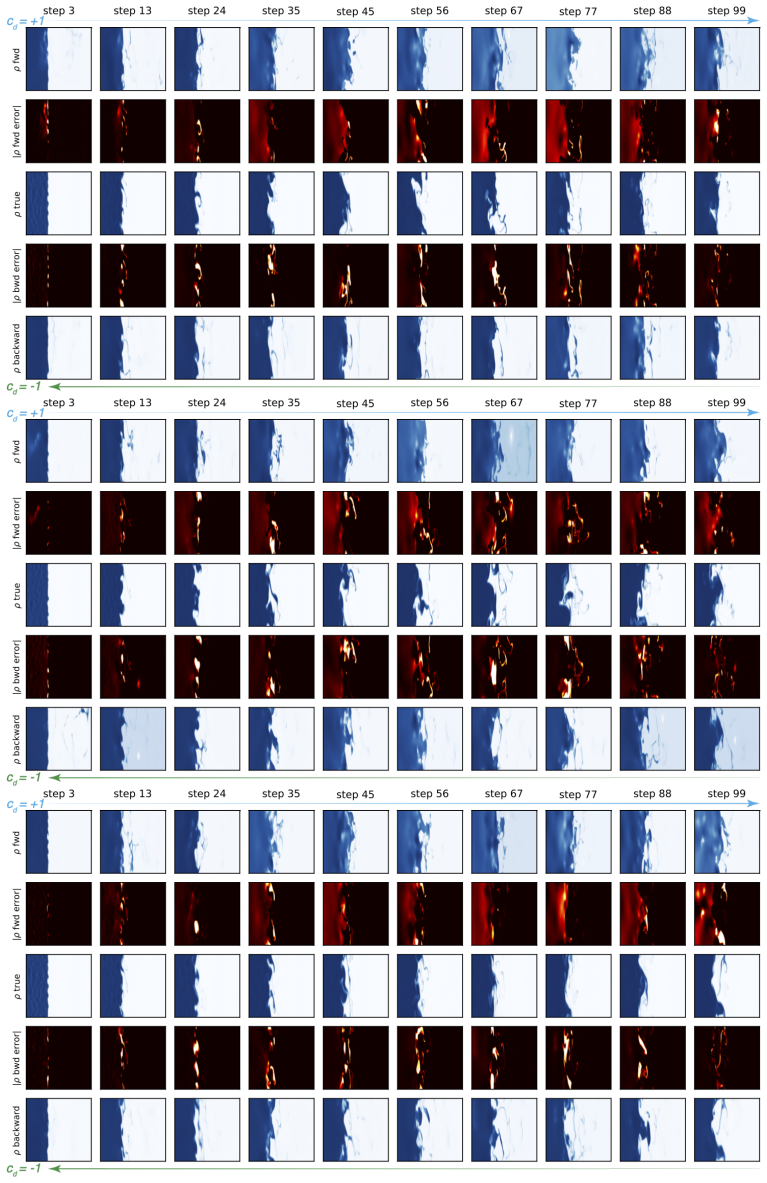
On the paper's own terms, the central discovery is that reversibility is a usable error signal. A single conditional latent diffusion model, flagged by a direction token, learns the approximate flow map of a dynamical system in both directions; the round-trip discrepancy C_i = distance between a starting state and the state recovered after i forward steps followed by i backward steps acts as a measurement-free proxy for the rollout error the model would incur over i steps. The author reports that, on held-out MHD trajectories, C_i ranks rollout error with Spearman correlation 0.91–0.98 at fixed depth (0.69 ± 0.16 within trajectories), that a simple calibrator fit on training rollouts predict
What carries the argument
The round-trip discrepancy C_i, computed by one forward rollout of i steps followed by one backward rollout of i steps under the same direction-flagged latent diffusion model, is the central object. It carries the argument by converting the model's own reversibility failure into a self-supervised error estimate: the size of the miss at the start is treated as the size of the error the model would make on an unseen rollout. A separate calibrator, fit on training rollouts, maps C_i to a magnitude prediction. The direction flag is the enabling mechanism: because one network handles both directions, the discrepancy is measured on the same learned flow map rather than across two independently tra
Load-bearing premise
The load-bearing premise is that the learned latent dynamics are reversible enough, and the diffusion sampler's backward noise is small enough, that the round-trip gap measures rollout error rather than the model's stochasticity or its tendency to collapse toward the training distribution's average state.
What would settle it
Train the same bidirectional latent diffusion model on a system with an exact solution (e.g., linear advection) where the true rollout error can be computed analytically; if the round-trip discrepancy does not track the analytic error across varying initial conditions and step counts, the proxy is measuring something other than rollout error. Alternatively, on the paper's MHD data, resample the backward-pass diffusion noise many times from the same forward endpoint: if the spread of the returned states is comparable to the round-trip gap, the gap is mostly sampler noise, not model error.
If this is right
- Deployed autoregressive surrogates for PDEs and other dynamical systems can be equipped with a test-time error bar—and a stop-rolling-out signal—without ground truth or ensembles.
- Out-of-distribution detection becomes feasible with the same round-trip gap, even in regimes where sampling-dispersion baselines invert (the Orszag-Tang vortex case).
- The backward pass doubles as a fast approximate inverse solver, so forward modeling and inversion become one model rather than two.
- Bidirectional training is a free upgrade: since the round-trip model beats direction specialists in both directions, reversibility can be adopted as a default training objective without accuracy loss.
Where Pith is reading between the lines
- The abstract reports the high Spearman numbers at fixed depth; within a single trajectory the rank is far lower (0.69 ± 0.16). An editor's inference is that C_i indexes error better across initial conditions than across time, so safe deployment likely needs to combine C_i with trajectory length or a time-dependent threshold.
- Because a diffusion sampler injects stochastic noise on every backward step, part of C_i is necessarily noise-floor. The paper does not separate that floor, so a natural test—and possibly a correction—is to subtract the resampling variance of the backward pass and see whether the remaining gap still ranks rollout error.
- The calibrator is fit on training rollouts and transfer is claimed to six decoded physical fields within the same distribution; the abstract makes no OOD calibration claim. An editor would test whether the 1.14× factor holds on the Orszag-Tang vortex before trusting magnitude forecasts in deployment.
- The same reversibility principle might transfer to other generative architectures with approximately invertible dynamics, but the calibration and ranking machinery would need re-deriving for each; the paper's contribution is the idea, not a universal recipe.
Editorial analysis
A structured set of objections, weighed in public.
Referee Report
Summary. The paper proposes a single conditional latent diffusion model that can step a dynamical system forward or backward in time via a direction flag, and uses the round-trip discrepancy C_i (the difference between the original start and the state obtained by rolling forward i steps and then backward i steps) as a test-time, self-supervised proxy for the unobservable rollout error. The abstract reports strong quantitative results on compressible MHD, face videos, and a turbulent Navier-Stokes benchmark: Spearman rank correlations of 0.91–0.98 at fixed depth (0.69±0.16 within trajectories), magnitude calibration to within 1.14×/1.29× at 68%/95% with near-nominal coverage, OOD detection AUROC of 0.98 on the Orszag–Tang vortex, and a 15% reduction in incurred error at 80% coverage. The central assertion is that round-trip consistency requires no ensembles, no held-out data, and no governing equations—only one extra rollout.
Significance. If the central claim holds, this is a practically valuable and conceptually elegant trust signal for autoregressive generative models in scientific and video settings. The paper reports concrete, falsifiable numbers, honestly acknowledges the weaker within-trajectory correlation, and demonstrates transfer to multiple decoded physical fields. The negative training cost and the dual use of the backward direction as a fast inverse solver add practical appeal. However, the load-bearing inference—that C_i is dominated by rollout error rather than backward-pass stochastic noise or mode collapse—is not supported by any diagnostic in the abstract. The calibration claim also relies on a fitted mapping whose OOD transportability is not demonstrated. These gaps must be addressed for the central claim to be secured.
major comments (3)
- [Abstract, central claim] The assertion that C_i is a self-supervised proxy for rollout error because 'rolling forward i steps and then backward i steps must return the model to its start' conflates rollout error with backward-sampling noise. The backward pass is a stochastic diffusion sampler; unless it is a near-deterministic inverse of the forward pass, C_i contains a substantial contribution independent of rollout error. The abstract reports no variance decomposition or repeated-backward-pass experiment separating these components. Without such a diagnostic, the Spearman 0.91–0.98 could be inflated by backward-sampling variability across trajectories. Please add an experiment that isolates this noise floor (e.g., multiple backward passes from the same endpoint, or a comparison of C_i variance with forward-error variance).
- [Abstract, calibration claims] The magnitude calibration ('to within 1.14×/1.29×') is produced by a calibrator fit on training rollouts. The abstract claims transfer to held-out MHD trajectories and all six decoded physical fields, but not to OOD conditions. If the backward-sampling noise floor or the C_i-to-error relationship changes under distribution shift, the calibrated magnitudes are not transportable to OOD inputs—the very setting where trust signals are most needed. The OOD claim (AUROC 0.98) concerns ranking/detection, not calibrated magnitude. Please either report OOD calibration results or explicitly scope the magnitude-calibration claim to in-distribution conditions.
- [Abstract, mode collapse] A second confounding mechanism is that the backward model may map any forward-rolled state to a plausible-looking start, so C_i may reflect distance to the training manifold rather than the true rollout error. The comparison to 'sampling-dispersion baselines' does not rule this out, because those baselines also operate on the learned manifold. The abstract provides no diagnostic distinguishing 'round-trip gap dominated by rollout error' from 'round-trip gap dominated by reconstruction toward the training mean.' A concrete test would be to correlate C_i with rollout error after controlling for the distance of the forward-rolled state to the training manifold, or to compare C_i on clean vs. deliberately perturbed states.
minor comments (4)
- [Abstract, test-time cost] The phrase 'for one extra rollout' should be qualified: the calibrator is fit on training rollouts, so the test-time signal requires one extra rollout plus a precomputed calibrator. This is not a correction to the claim, but clarity would help.
- [Abstract, error-reduction metric] The statement 'cuts incurred error by 15% at 80% coverage—three times the depth-only baseline' should define how the error reduction is measured (e.g., mean squared error on selected vs. random rollouts) and how the baseline is normalized.
- [Abstract, coverage] The abstract says 'near-nominal coverage' but does not state the nominal level or how coverage is computed across trajectories. Please specify the interval construction and the exact coverage values.
- [Abstract, 'negative cost'] The 'negative cost' claim should specify the comparison point: is it wall-clock training time, number of steps, or FLOPs relative to training two direction-specific models? Define the cost metric.
Circularity Check
No circularity: round-trip discrepancy is an empirical proxy, not a refit of the target.
full rationale
The abstract's central move is to define the round-trip discrepancy C_i as a proposed proxy for rollout error, motivated by reversibility ('rolling forward i steps and then backward i steps must return the model to its start'). This is not circular: C_i is measured from model rollouts on the input trajectory, while rollout error is defined against ground truth; the two are different quantities, and the paper's correlation/ranking results on held-out trajectories are an empirical test that they track each other. The proxy is not fitted to the target. The calibrator mentioned ('a simple calibrator fit on training rollouts predicts its magnitude') is a supervised post-hoc mapping from C_i to error magnitude, but it is evaluated on held-out trajectories; a fitted calibration curve does not make the underlying proxy equivalent to the calibration target by construction. The concern that the backward diffusion sampler's stochasticity could contaminate C_i is a validity/correctness risk, not a circularity, because it concerns whether the proxy measures what it claims rather than whether the derivation reduces to its inputs. There is no load-bearing self-citation chain or imported uniqueness theorem in the abstract. The 'no held-out data' slogan is qualified by the later calibration-on-training design; this is a framing tension, not a circular reduction. Therefore no circular step meeting the evidence bar is identified.
Axiom & Free-Parameter Ledger
free parameters (3)
- Calibrator mapping C_i → error magnitude =
not reported (68% within 1.14×, 95% within 1.29×)
- Per-depth treatment of C_i =
unspecified
- Direction-flag conditioning / latent diffusion hyperparameters =
unspecified
axioms (3)
- domain assumption A single direction-flagged conditional latent diffusion model can learn forward and backward latent dynamics that are approximately inverse to each other.
- ad hoc to paper Round-trip discrepancy magnitude is monotonically (rank-)related to rollout error, and the C_i→error relation transfers across states and fields.
- standard math Standard latent diffusion sampling and its stochasticity are acceptable background machinery.
invented entities (1)
-
Round-trip discrepancy C_i as a test-time error proxy
independent evidence
read the original abstract
Autoregressive models accumulate error over long rollouts, yet at deployment there is no ground truth to measure it against. We train a single conditional latent diffusion model that steps a dynamical system forward or backward in time via a direction flag, and show that this bidirectionality supplies a measurement-free test-time error signal: rolling forward $i$ steps and then backward $i$ steps must return the model to its start, so the round-trip discrepancy $\mathcal{C}_i$ is a self-supervised proxy for the unobservable rollout error: no ensembles, no held-out data, no governing equations, for one extra rollout. We validate on compressible magnetohydrodynamics (MHD), an astrophysical turbulent radiative mixing layer, and natural face videos (CelebV-HQ). On held-out MHD trajectories, $\mathcal{C}_i$ ranks rollout error (Spearman $0.91$-$0.98$ at fixed depth; $0.69 \pm 0.16$ within trajectories), and a simple calibrator fit on training rollouts predicts its magnitude to within $1.14\times$ ($68\%$) and $1.29\times$ ($95\%$) with near-nominal coverage - one nat beyond a depth-only predictor, transferring to all six decoded physical fields. The same signal flags the out-of-distribution Orszag-Tang vortex (AUROC $0.98$; $1.0$ by depth $10$) exactly where sampling-dispersion baselines invert, and it cuts incurred error by $15\%$ at $80\%$ coverage - three times the depth-only baseline. Bidirectional training comes at negative cost, beating direction specialists in both directions, and the backward direction doubles as a fast inverse solver. On LE-PDE-UQ's turbulent Navier-Stokes benchmark, a single bidirectional model reaches accuracy within $1.3\times$ of their ten-model ensemble at a tenth of the training cost, with the best training-free pixel-level calibration. Round-trip consistency turns reversibility into a practical trust signal for generative models.
Figures




Reference graph
Works this paper leans on
-
[1]
JAIR , volume =
Baxter, Jonathan , title =. JAIR , volume =
-
[2]
JMLR , volume =
Maurer, Andreas and Pontil, Massimiliano and Romera-Paredes, Bernardino , title =. JMLR , volume =
-
[3]
Proceedings of the IEEE/CVF International Conference on Computer Vision (ICCV) , pages =
Scalable Diffusion Models with Transformers , author =. Proceedings of the IEEE/CVF International Conference on Computer Vision (ICCV) , pages =
-
[4]
Proceedings of the 38th International Conference on Machine Learning (ICML) , volume =
Improved Denoising Diffusion Probabilistic Models , author =. Proceedings of the 38th International Conference on Machine Learning (ICML) , volume =
-
[5]
Efficient Diffusion Training via Min-
Hang, Tiankai and Gu, Shuyang and Li, Chen and Bao, Jianmin and Chen, Dong and Hu, Han and Geng, Xin and Guo, Baining , booktitle =. Efficient Diffusion Training via Min-
-
[6]
9th International Conference on Learning Representations (ICLR) , year =
Denoising Diffusion Implicit Models , author =. 9th International Conference on Learning Representations (ICLR) , year =
-
[7]
Neural Networks , pages =
Benchmarking Autoregressive Conditional Diffusion Models for Turbulent Flow Simulation , author =. Neural Networks , pages =. 2026 , doi =
2026
-
[8]
Advances in Neural Information Processing Systems , volume =
Attention Is All You Need , author =. Advances in Neural Information Processing Systems , volume =
-
[9]
Proceedings of the IEEE/CVF Conference on Computer Vision and Pattern Recognition (CVPR) , year =
Non-local Neural Networks , author =. Proceedings of the IEEE/CVF Conference on Computer Vision and Pattern Recognition (CVPR) , year =
-
[10]
2nd International Conference on Learning Representations (ICLR) , year =
Auto-Encoding Variational Bayes , author =. 2nd International Conference on Learning Representations (ICLR) , year =
-
[11]
Advances in Neural Information Processing Systems (NeurIPS) , volume =
Learning Structured Output Representation using Deep Conditional Generative Models , author =. Advances in Neural Information Processing Systems (NeurIPS) , volume =
-
[12]
GitHub repository , howpublished =
Patrick von Platen and Suraj Patil and Anton Lozhkov and Pedro Cuenca and Nathan Lambert and Kashif Rasul and Mishig Davaadorj and Dhruv Nair and Sayak Paul and William Berman and Yiyi Xu and Steven Liu and Thomas Wolf , title =. GitHub repository , howpublished =. 2022 , publisher =
2022
-
[13]
Proceedings of the IEEE/CVF conference on computer vision and pattern recognition , pages=
High-resolution image synthesis with latent diffusion models , author=. Proceedings of the IEEE/CVF conference on computer vision and pattern recognition , pages=
-
[14]
Proceedings of the IEEE/CVF conference on computer vision and pattern recognition , pages=
Taming transformers for high-resolution image synthesis , author=. Proceedings of the IEEE/CVF conference on computer vision and pattern recognition , pages=
-
[15]
Advances in neural information processing systems , volume=
Diffusion models beat gans on image synthesis , author=. Advances in neural information processing systems , volume=
-
[16]
Proceedings of the AAAI conference on artificial intelligence , volume=
Film: Visual reasoning with a general conditioning layer , author=. Proceedings of the AAAI conference on artificial intelligence , volume=
-
[17]
arXiv preprint arXiv:2109.10254 , year =
Uncertainty Toolbox: an Open-Source Library for Assessing, Visualizing, and Improving Uncertainty Quantification , author =. arXiv preprint arXiv:2109.10254 , year =
-
[18]
Advances in Neural Information Processing Systems , volume =
Denoising Diffusion Probabilistic Models , author =. Advances in Neural Information Processing Systems , volume =
-
[19]
International Conference on Learning Representations , year =
Score-Based Generative Modeling through Stochastic Differential Equations , author =. International Conference on Learning Representations , year =
-
[20]
Stochastic Processes and their Applications , volume =
Reverse-time diffusion equation models , author =. Stochastic Processes and their Applications , volume =
-
[21]
International Conference on Machine Learning , year =
Consistency Models , author =. International Conference on Machine Learning , year =
-
[22]
International Conference on Learning Representations , year =
Flow Matching for Generative Modeling , author =. International Conference on Learning Representations , year =
-
[23]
Proceedings of the IEEE/CVF International Conference on Computer Vision , pages =
Scalable Diffusion Models with Transformers , author =. Proceedings of the IEEE/CVF International Conference on Computer Vision , pages =
-
[24]
Higgins, Irina and Matthey, Loic and Pal, Arka and Burgess, Christopher and Glorot, Xavier and Botvinick, Matthew and Mohamed, Shakir and Lerchner, Alexander , booktitle =. beta-
-
[25]
International Conference on Machine Learning , year =
Learning to Simulate Complex Physics with Graph Networks , author =. International Conference on Machine Learning , year =
-
[26]
Message Passing Neural
Brandstetter, Johannes and Worrall, Daniel and Welling, Max , booktitle =. Message Passing Neural
-
[27]
International Conference on Learning Representations , year =
Fourier Neural Operator for Parametric Partial Differential Equations , author =. International Conference on Learning Representations , year =
-
[28]
Learning nonlinear operators via
Lu, Lu and Jin, Pengzhan and Pang, Guofei and Zhang, Zhongqiang and Karniadakis, George Em , journal =. Learning nonlinear operators via
-
[29]
Solver-in-the-Loop: Learning from Differentiable Physics to Interact with Iterative
Um, Kiwon and Brand, Robert and Fei, Yun and Holl, Philipp and Thuerey, Nils , booktitle =. Solver-in-the-Loop: Learning from Differentiable Physics to Interact with Iterative
-
[30]
Proceedings of the National Academy of Sciences , volume =
Machine learning--accelerated computational fluid dynamics , author =. Proceedings of the National Academy of Sciences , volume =
-
[31]
Journal of Computational Physics , volume =
Physics-informed neural networks: A deep learning framework for solving forward and inverse problems involving nonlinear partial differential equations , author =. Journal of Computational Physics , volume =
-
[32]
Nature Reviews Physics , volume =
Physics-informed machine learning , author =. Nature Reviews Physics , volume =
-
[33]
Science , volume =
Learning skillful medium-range global weather forecasting , author =. Science , volume =
-
[34]
and Perdikaris, Paris and Turner, Richard E
Lippe, Phillip and Veeling, Bastiaan S. and Perdikaris, Paris and Turner, Richard E. and Brandstetter, Johannes , booktitle =
-
[35]
Advances in Neural Information Processing Systems , volume =
Cachay, Salva R. Advances in Neural Information Processing Systems , volume =
-
[36]
arXiv preprint arXiv:2309.01745 , year =
Benchmarking Autoregressive Conditional Diffusion Models for Turbulent Flow Simulation , author =. arXiv preprint arXiv:2309.01745 , year =
-
[37]
Nature , volume =
Probabilistic weather forecasting with machine learning , author =. Nature , volume =
-
[38]
arXiv preprint arXiv:2312.15796 , year=
Gencast: Diffusion-based ensemble forecasting for medium-range weather , author=. arXiv preprint arXiv:2312.15796 , year=
-
[39]
Advances in Neural Information Processing Systems, Datasets and Benchmarks Track , volume =
Takamoto, Makoto and Praditia, Timothy and Leiteritz, Raphael and MacKinlay, Dan and Alesiani, Francesco and Pfl. Advances in Neural Information Processing Systems, Datasets and Benchmarks Track , volume =
-
[40]
Advances in Neural Information Processing Systems, Datasets and Benchmarks Track , volume =
The Well: a Large-Scale Collection of Diverse Physics Simulations for Machine Learning , author =. Advances in Neural Information Processing Systems, Datasets and Benchmarks Track , volume =
-
[41]
Advances in Neural Information Processing Systems , volume =
Simple and Scalable Predictive Uncertainty Estimation using Deep Ensembles , author =. Advances in Neural Information Processing Systems , volume =
-
[42]
Dropout as a
Gal, Yarin and Ghahramani, Zoubin , booktitle =. Dropout as a
-
[43]
Foundations and Trends in Machine Learning , volume =
Conformal Prediction: A Gentle Introduction , author =. Foundations and Trends in Machine Learning , volume =
-
[44]
and Nowozin, Sebastian and Dillon, Joshua and Lakshminarayanan, Balaji and Snoek, Jasper , booktitle =
Ovadia, Yaniv and Fertig, Emily and Ren, Jie and Nado, Zachary and Sculley, D. and Nowozin, Sebastian and Dillon, Joshua and Lakshminarayanan, Balaji and Snoek, Jasper , booktitle =. Can You Trust Your Model's Uncertainty?
-
[45]
Advances in Neural Information Processing Systems , volume =
Selective Classification for Deep Neural Networks , author =. Advances in Neural Information Processing Systems , volume =
-
[46]
International Conference on Learning Representations , year =
A Baseline for Detecting Misclassified and Out-of-Distribution Examples in Neural Networks , author =. International Conference on Learning Representations , year =
-
[47]
arXiv preprint arXiv:2402.08383 , year =
Uncertainty Quantification for Forward and Inverse Problems of. arXiv preprint arXiv:2402.08383 , year =
-
[48]
Time-Reversal Symmetric
Huh, In and others , booktitle =. Time-Reversal Symmetric
-
[49]
International Conference on Machine Learning , year =
Test-Time Training with Self-Supervision for Generalization under Distribution Shifts , author =. International Conference on Machine Learning , year =
-
[50]
International Conference on Learning Representations , year =
Tent: Fully Test-Time Adaptation by Entropy Minimization , author =. International Conference on Learning Representations , year =
-
[51]
Advances in Neural Information Processing Systems , volume =
Test-Time Training with Masked Autoencoders , author =. Advances in Neural Information Processing Systems , volume =
-
[52]
International Journal of Computer Vision , year =
A Comprehensive Survey on Test-Time Adaptation under Distribution Shifts , author =. International Journal of Computer Vision , year =
-
[53]
arXiv preprint arXiv:2202.02403 , year =
Self-Adaptive Forecasting for Improved Deep Learning on Non-Stationary Time-Series , author =. arXiv preprint arXiv:2202.02403 , year =
-
[54]
Proceedings of the IEEE International Conference on Computer Vision , pages =
Unpaired Image-to-Image Translation using Cycle-Consistent Adversarial Networks , author =. Proceedings of the IEEE International Conference on Computer Vision , pages =
-
[55]
Dense Point Trajectories by
Sundaram, Narayanan and Brox, Thomas and Keutzer, Kurt , booktitle =. Dense Point Trajectories by
-
[56]
Meister, Simon and Hur, Junhwa and Roth, Stefan , booktitle =
-
[57]
Proceedings of the IEEE/CVF Conference on Computer Vision and Pattern Recognition , pages =
Learning Correspondence from the Cycle-Consistency of Time , author =. Proceedings of the IEEE/CVF Conference on Computer Vision and Pattern Recognition , pages =
-
[58]
Automatica , volume =
Stability of extremum seeking feedback for general nonlinear dynamic systems , author =. Automatica , volume =
-
[59]
Automatica , volume =
Lie bracket approximation of extremum seeking systems , author =. Automatica , volume =
-
[60]
Proceedings of the 2013 International Particle Accelerator Conference (IPAC), Shanghai, China , year =
Model independent beam tuning , author =. Proceedings of the 2013 International Particle Accelerator Conference (IPAC), Shanghai, China , year =
2013
-
[61]
Automatica , volume =
Bounded extremum seeking with discontinuous dithers , author =. Automatica , volume =
-
[62]
Model-Free Stabilization by Extremum Seeking , author =
-
[63]
Scheinker, Alexander , journal =
-
[64]
Physical Review Accelerators and Beams , volume =
Latent diffusion can map beam loss to two-dimensional phase-space projections , author =. Physical Review Accelerators and Beams , volume =
-
[65]
Scheinker, Alexander and Plastun, Alexander and Ostroumov, Peter , booktitle =
-
[66]
arXiv preprint arXiv:2606.29620 , year =
Bidirectional Autoregressive Latent Diffusion for Forward and Inverse Magnetohydrodynamics , author =. arXiv preprint arXiv:2606.29620 , year =
-
[67]
Physics-constrained
Scheinker, Alexander and Pokharel, Reeju , journal =. Physics-constrained
-
[68]
Nature , volume =
Magnetic control of tokamak plasmas through deep reinforcement learning , author =. Nature , volume =
-
[69]
Journal of Fluid Mechanics , volume =
Small-scale structure of two-dimensional magnetohydrodynamic turbulence , author =. Journal of Fluid Mechanics , volume =
-
[70]
A constrained transport scheme for
Mocz, Philip and Vogelsberger, Mark and Hernquist, Lars , journal =. A constrained transport scheme for
-
[71]
Intelligent Computing , volume =
Cycle Consistency-Based Uncertainty Quantification of Neural Networks in Inverse Imaging Problems , author =. Intelligent Computing , volume =. 2023 , note =
2023
-
[72]
2026 , note =
Yoo, Seungwoo and Koo, Juil and Choi, Daehyeon and Sung, Minhyuk , journal =. 2026 , note =
2026
-
[73]
Huang, Jiahe and Yang, Guandao and Wang, Zichen and Park, Jeong Joon , booktitle =
-
[74]
On Conditional Diffusion Models for
Shysheya, Aliaksandra and Diaconu, Cristiana and Bergamin, Federico and Perdikaris, Paris and Hern. On Conditional Diffusion Models for. Advances in Neural Information Processing Systems , volume =
-
[75]
Advances in Neural Information Processing Systems , volume =
Diffusion Forcing: Next-Token Prediction Meets Full-Sequence Diffusion , author =. Advances in Neural Information Processing Systems , volume =
-
[76]
Generative Latent Neural
Li, Zijie and Zhou, Anthony and Barati Farimani, Amir , journal =. Generative Latent Neural
-
[77]
Machine Learning for Autonomous Driving Workshop, NeurIPS , year =
Improving Motion Forecasting for Autonomous Driving with the Cycle Consistency Loss , author =. Machine Learning for Autonomous Driving Workshop, NeurIPS , year =
-
[78]
Advances in Neural Information Processing Systems , volume =
Lipschitz regularity of deep neural networks: analysis and efficient estimation , author =. Advances in Neural Information Processing Systems , volume =
-
[79]
International Conference on Machine Learning , year =
Invertible Residual Networks , author =. International Conference on Machine Learning , year =
-
[80]
International Conference on Learning Representations , year =
Diffusion Posterior Sampling for General Noisy Inverse Problems , author =. International Conference on Learning Representations , year =
discussion (0)
Sign in with ORCID, Apple, or X to comment. Anyone can read and Pith papers without signing in.