REVIEW 3 major objections 5 minor 1 cited by
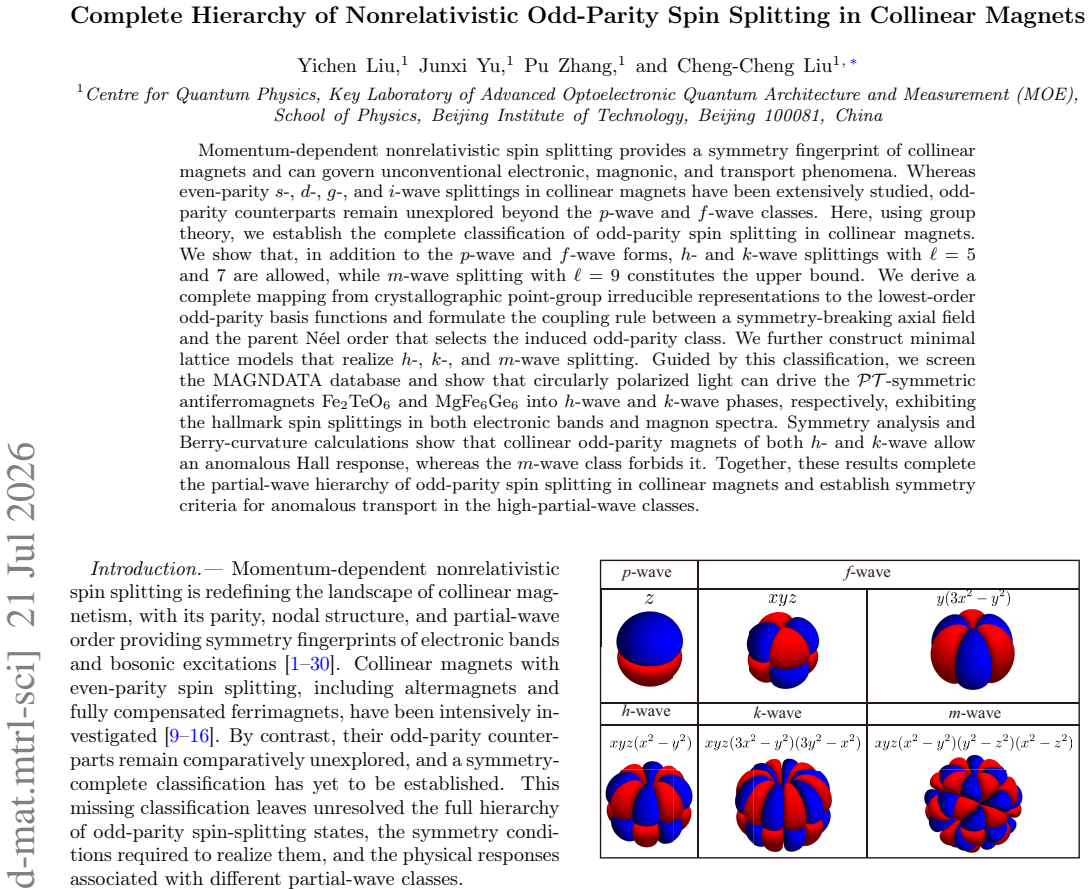
This paper claims that odd-parity spin splitting in collinear magnets is completely classified by five wave classes — p, f, h, k, and m — with ℓ = 9 as the absolute upper bound.
Reviewed by Pith at T0; open to challenge. T0 means a machine referee read the full paper against a public rubric. the ladder, T0–T4 →
T0 review · deepseek-v4-flash
2026-08-01 12:49 UTC pith:CEADOST7
load-bearing objection A useful and mostly convincing classification of odd-parity spin splitting in collinear magnets, with the completeness proof deferred to the SM; referee should verify the enumeration. the 3 major comments →
Complete Hierarchy of Nonrelativistic Odd-Parity Spin Splitting in Collinear Magnets
The pith
A machine-rendered reading of the paper's core claim, the machinery that carries it, and where it could break.
Core claim
The paper's central claim is that nonrelativistic odd-parity spin splitting in collinear magnets is fully classified by one-dimensional representations of the 32 crystallographic point groups, yielding exactly the p-, f-, h-, k-, and m-wave classes (ℓ = 1, 3, 5, 7, 9), with m-wave as the maximum. The engine of the classification is the coupling rule ΓΔ ⊆ ΓA ⊗ ΓN, where ΓN is the representation of the parent Néel order and ΓA the axial-vector representation of an applied time-reversal-odd field such as circularly polarized light; this selects the induced splitting representation, and a table maps each representation to its lowest-order odd polynomial. The paper verifies the scheme with minima
What carries the argument
The key object is the one-dimensional irreducible representation ΓΔ carried by the momentum-dependent spin splitting ΔE(k) = E↑(k) − E↓(k) of a collinear magnet with conserved S_z. The argument rests on the selection rule ΓΔ ⊆ ΓA ⊗ ΓN, combining the Néel-order representation ΓN of the parent collinear spin point group with the axial-vector representation ΓA of the time-reversal-odd perturbation; the partial-wave order ℓ is the degree of the lowest-order odd polynomial in the expansion of ΔE(k) around the Γ point, and Tables I and II convert representations into concrete basis functions such as xyz(x²−y²) for h-wave and the degree-9 product for m-wave.
Load-bearing premise
The load-bearing premise is that the enumeration of the 32 crystallographic point groups is complete and that no one-dimensional odd-parity representation anywhere has a lowest odd polynomial above degree nine; the main text states this but does not prove it, and a counterexample would break the ℓ = 9 upper bound and the 'complete hierarchy' claim.
What would settle it
Compute the lowest odd degree for every one-dimensional odd-parity irreducible representation of all 230 space groups, including non-symmorphic cases; any irrep whose lowest odd polynomial has degree 11 or higher refutes the upper bound. Alternatively, measure the angular dependence of the light-induced spin splitting in a parity-time-symmetric antiferromagnet: an h-wave phase must show five nodal planes, a k-wave phase seven, and an m-wave phase nine, so a different count would falsify the assigned class.
If this is right
- Any collinear odd-parity magnet without spin-orbit coupling must fall into one of the p, f, h, k, or m classes; no higher partial wave is allowed.
- Given a material's Néel order and the direction of an axial perturbation, the product rule immediately predicts which spin-splitting class and lowest-order form factor will appear.
- Both h- and k-wave splitting are compatible with a nonzero anomalous Hall conductivity, while the m-wave class is symmetry-forbidden to give one.
- The same symmetry classification transfers to magnons and other bosonic excitations carrying a two-valued angular-momentum degree, so odd-parity splitting should be observable in bosonic spectra.
- Circularly polarized light can switch spin-degenerate parity-time-symmetric antiferromagnets into odd-parity h- and k-wave phases, making the high-partial-wave classes reachable in pump-probe experiments.
Where Pith is reading between the lines
- If the ℓ = 9 cap survives scrutiny, the collinear odd-parity hierarchy is the odd-parity twin of the known even-parity s-d-g-i sequence; a natural next step is a unified partial-wave table covering both parities.
- The classification assumes S_z conservation, so a direct extension is to ask whether weak spin-orbit coupling lifts the ℓ = 9 cap by allowing higher-order relativistic terms; if so, the 'nonrelativistic' qualifier marks a sharp boundary.
- The m-wave class, which the paper could not place in a known solid, may be within reach of cold-atom optical lattices, where complex long-range hoppings and Peierls phases can be engineered; a Hubbard-model simulation with laser-induced tunneling would be a testable route to the ℓ = 9 form.
- A practical check in existing materials: time-resolved spin- or angle-resolved photoemission on the light-driven compounds should show a spin-splitting angular pattern with nodal lines of the h- or k-wave type; counting those nodal lines distinguishes the classes.
Editorial analysis
A structured set of objections, weighed in public.
Referee Report
Summary. The paper presents a group-theoretic classification of nonrelativistic odd-parity spin splitting in collinear magnets. It claims that, in the absence of spin-orbit coupling, the complete hierarchy consists of exactly five partial-wave classes: p-, f-, h-, k-, and m-wave, with partial-wave orders ℓ=1,3,5,7,9 and with ℓ=9 as the upper bound. The classification is implemented through Table I (lowest-order odd-parity basis functions for all one-dimensional odd-parity irreps of the 32 crystallographic point groups) and Table II (a two-step selection rule Γ∆ ⊆ ΓA⊗ΓN for the coupling of a parent Néel-order irrep and an external axial-vector irrep). The authors construct minimal four-band tight-binding models for all five classes, including previously unexplored h-, k-, and m-wave forms, and verify that the long-wavelength expansions of the model Hamiltonians reproduce the claimed basis functions. They then screen MAGNDATA and propose Fe2TeO6 and MgFe6Ge6 under circularly polarized light as h-wave and k-wave candidates, respectively, showing spin-split electronic bands and magnon spectra. They also analyze the anomalous Hall response, concluding that p-, f-, h-, k-wave classes can support it while the m-wave class forbids it.
Significance. If the central claims are correct, this paper provides a complete symmetry framework for an important class of collinear magnets, filling a gap between even-parity altermagnetism and odd-parity p/f-wave studies. The tables and the selection rule offer a practical 'recipe' for identifying odd-parity spin splitting and for designing materials. The explicit minimal models are a strength, as are the concrete material candidates and the transport analysis. The classification, if exhaustive, would be a landmark result for nonrelativistic magnetism, with implications for spintronics and magnonics. The paper is well structured and the tables are potentially useful references. However, the main text relies heavily on the Supplemental Material for the proof of exhaustiveness and for the derivation of the selection rule, which are load-bearing for the 'complete' and 'upper bound' claims.
major comments (3)
- [Table I and preceding paragraph] The core claim that no one-dimensional odd-parity irrep first appears above degree nine is asserted but not proved in the main text; the reader is referred to SM [40]. Since this assertion underlies the ℓ=9 upper bound and the completeness of the classification, it must be substantiated at least by a precise statement of the enumeration and a proof sketch. Without this, the 'complete hierarchy' advertised in the abstract and conclusion cannot be independently assessed. Please either include the proof in the main text or restate the claim with an explicit theorem and clear scope.
- [Eq. (3) and Table II] The selection rule Γ∆ ⊆ ΓA⊗ΓN is introduced without derivation. Its validity is central to Table II and to the material screening, yet it is not obvious from the text. In particular, the reduction from a collinear spin point group to a crystallographic point group is not defined or justified. For collinear magnets with negligible SOC, the full symmetry is a spin group, and the representation of the induced spin splitting may depend on spin-space operations. The main text should clarify the mapping between spin point groups and point-group irreps, and provide a derivation of Eq. (3) or at least a clear statement of the assumptions under which it holds.
- [Eq. (6) and minimal-model section] The minimal models are constructed by inserting a dz(k) that transforms as the desired partial-wave symmetry. Their ability to produce h-, k-, and m-wave splitting is therefore built in, not a test of the classification. The text says these models 'verify the classification' (third paragraph after Eq. (5)); this overstates their role. The models are useful as explicit lattice realizations, but they do not provide independent evidence for the exhaustiveness of the hierarchy. I recommend rewording to 'illustrate' or 'realize' rather than 'verify'.
minor comments (5)
- [Table I caption] The sentence explaining why point groups 1, 3, 4, 4mm, 23, and ¯43m are omitted is too terse. A brief explanation of what 'admits a symmetry-allowed odd-parity momentum-space basis at leading order' means, or a pointer to the SM, would improve readability.
- [Eq. (6) and Fig. 2] The symmetry-adapted coordinates k1, k2, k3 for the hexagonal model are introduced only in the text; a figure or a definition in the caption would be helpful. Also, the notation in the k-wave expression is hard to parse; please define the sine arguments explicitly.
- [Table II] The notation for spin point groups (e.g., '¯1¯1(Au)', '4/¯1mmm(A2u)') is dense and not defined in the main text. A short explanation of how these entries encode the spin-space and lattice operations would aid the reader, since the table is central to the paper.
- [Materials section] The statement that 'the drive breaks [C2T ∥ E] while preserving [C2 ∥ P]' is clear to specialists, but the symbols [C2T ∥ E] and [C2 ∥ P] are not defined in the main text. They appear in the introduction but with less explanation than needed for a general condensed-matter audience.
- [Anomalous transport] The anomalous Hall conductivity formula uses the standard Berry-curvature expression, but it is not stated whether SOC is included in the F loquet calculations. Since the paper's central theme is nonrelativistic spin splitting, clarifying the role of SOC in the transport calculations would avoid confusion.
Circularity Check
Central group-theoretic classification is self-contained; only the minimal-model 'verification' is by construction, and the ℓ=9 proof is deferred, not circular.
specific steps
-
self definitional
[Minimal symmetry-adapted tight-binding models section, Eq. (6) and following paragraph]
"Constructing a given odd-parity class therefore reduces to identifying a spin-independent sublattice-contrasting hopping d_z(k) that transforms according to the desired Γ∆. ... These long-wavelength limits reproduce the basis functions listed in Table I and confirm the corresponding p-, f-, h-, k-, and m-wave characters."
The d_z(k) terms in Eq. (6) are chosen to transform as the target Γ∆, and the text immediately notes that ∆E is proportional to d_z. Thus the 'realization' of h-, k-, and m-wave splitting is an algebraic consequence of the chosen d_z: the low-order expansions in Eq. (6) are the same monomials that define those partial-wave labels. The models are therefore consistency checks built from the classification, not independent microscopic derivations of it. This by-construction aspect is minor because the classification itself is not derived from the models.
full rationale
The central classification is group-theoretically self-contained: Eq. (3) is a stated selection rule, Tables I and II are enumeration results, and no parameter is fitted to the target spin-splitting classes. The claim that ℓ=9 is the upper bound is asserted in the main text and deferred to SM [40]; this is an omitted proof and a completeness risk, not a circular step. The self-references [26,37] are used for standard or peripheral statements and are not load-bearing justifications for the hierarchy. The only mildly circular element is the minimal-model 'verification,' which is explicitly built by inserting d_z(k) with the desired irrep symmetry; the paper's own wording acknowledges that constructing a class reduces to choosing such a d_z. External Floquet-Wannier calculations for Fe2TeO6 and MgFe6Ge6 provide independent numerical evidence of the predicted h- and k-wave splittings. Overall, no significant circularity is present, so the score is low.
Axiom & Free-Parameter Ledger
free parameters (3)
- Drive amplitude eA0/ℏ =
0.2 Å⁻¹
- Photon energy ℏω =
1 eV
- Minimal-model couplings λ_h, λ_k, λ_m, J =
0.2t, 0.5t, 0.1t, J=t
axioms (5)
- domain assumption S_z is conserved because spin-orbit coupling is negligible; the two spin sectors can be treated independently.
- domain assumption Effective time-reversal [C2T∥E] and spin-flipping inversion [C2∥P] control spin degeneracy, and circular driving breaks one while preserving the other.
- domain assumption The induced spin-splitting representation is contained in Γ_A ⊗ Γ_N (Eq. 3).
- ad hoc to paper Exhaustive enumeration over the 32 crystallographic point groups shows no one-dimensional odd-parity irrep first appears above degree 9.
- domain assumption Fe2TeO6 and MgFe6Ge6 have the stated parent Néel-order representation A_2u and can be treated in the nonrelativistic Floquet-Wannier framework.
read the original abstract
Momentum-dependent nonrelativistic spin splitting provides a symmetry fingerprint of collinear magnets and can govern unconventional electronic, magnonic, and transport phenomena. Whereas even-parity $s$-, $d$-, $g$-, and $i$-wave splittings in collinear magnets have been extensively studied, odd-parity counterparts remain unexplored beyond the $p$-wave and $f$-wave classes. Here, using group theory, we establish the complete classification of odd-parity spin splitting in collinear magnets. We show that, in addition to the $p$-wave and $f$-wave forms, $h$- and $k$-wave splittings with $\ell=5$ and $7$ are allowed, while $m$-wave splitting with $\ell=9$ constitutes the upper bound. We derive a complete mapping from crystallographic point-group irreducible representations to the lowest-order odd-parity basis functions and formulate the coupling rule between a symmetry-breaking axial field and the parent N\'eel order that selects the induced odd-parity class. We further construct minimal lattice models that realize $h$-, $k$-, and $m$-wave splitting. Guided by this classification, we screen the MAGNDATA database and show that circularly polarized light can drive the $\mathcal{PT}$-symmetric antiferromagnets Fe$_2$TeO$_6$ and MgFe$_6$Ge$_6$ into $h$-wave and $k$-wave phases, respectively, exhibiting the hallmark spin splittings in both electronic bands and magnon spectra. Symmetry analysis and Berry-curvature calculations show that collinear odd-parity magnets of both $h$- and $k$-wave allow an anomalous Hall response, whereas the $m$-wave class forbids it. Together, these results complete the partial-wave hierarchy of odd-parity spin splitting in collinear magnets and establish symmetry criteria for anomalous transport in the high-partial-wave classes.
Figures


Forward citations
Cited by 1 Pith paper
-
Floquet spin-group framework and its application to light-tailored spin splitting in collinear magnets
A unified Floquet spin-group framework classifies how different laser polarizations select even-, odd-, or mixed-parity spin-splitting patterns in collinear magnets, including new 3D higher-order 'h-wave' and 'k-wave'...
Reference graph
Works this paper leans on
-
[1]
Yamada, M
R. Yamada, M. T. Birch, P. R. Baral, S. Okumura, R. Nakano, S. Gao, M. Ezawa, T. Nomoto, J. Masell, Y. Ishihara, K. K. Kolincio, I. Belopolski, H. Sagayama, H. Nakao, K. Ohishi, T. Ohhara, R. Kiyanagi, T. Naka- jima, Y. Tokura, T.-h. Arima, Y. Motome, M. M. Hirschmann, and M. Hirschberger, A metallicp-wave magnet with commensurate spin helix, Nature646, 8...
2025
-
[2]
A. B. Hellenes, T. Jungwirth, R. Jaeschke-Ubiergo, A. Chakraborty, J. Sinova, and L. Šmejkal,p-wave mag- nets (2023), arXiv:2309.01607 [cond-mat.mes-hall]
Pith/arXiv arXiv 2023
-
[3]
Y.-P. Lin and M. Vila, Odd-parity altermagnetism through sublattice currents: From Haldane–Hubbard model to general bipartite lattices, Physical Review Let- 6 ters 10.1103/c8pd-2fs4 (2026), accepted 10 June 2026
-
[4]
M. Ezawa, Third-order and fifth-order nonlinear spin- current generation ing-wave andi-wave altermagnets and perfectly nonreciprocal spin current inf-wave mag- nets, Physical Review B111, 125420 (2025)
2025
-
[5]
Brekke, P
B. Brekke, P. Sukhachov, H. G. Giil, A. Brataas, and J. Linder, Minimal models and transport properties of unconventionalp-wave magnets, Physical Review Letters 133, 236703 (2024)
2024
-
[6]
Y. Yu, M. B. Lyngby, T. Shishidou, M. Roig, A. Kreisel, M. Weinert, B. M. Andersen, and D. F. Agterberg, Odd- parity magnetism driven by antiferromagnetic exchange, Physical Review Letters135, 046701 (2025)
2025
-
[7]
Q. Song, S. Stavrić, P. Barone, A. Droghetti, D. S. An- tonenko, J. W. F. Venderbos, C. A. Occhialini, B. Ilyas, E. Ergeçen, N. Gedik, S.-W. Cheong, R. M. Fernandes, S. Picozzi, and R. Comin, Electrical switching of ap-wave magnet, Nature642, 64 (2025)
2025
-
[8]
P. Liu, J. Li, J. Han, X. Wan, and Q. Liu, Spin-Group Symmetry in Magnetic Materials with Negligible Spin- Orbit Coupling, Physical Review X12, 021016 (2022)
2022
-
[9]
Šmejkal, J
L. Šmejkal, J. Sinova, and T. Jungwirth, Beyond conven- tional ferromagnetism and antiferromagnetism: A phase with nonrelativistic spin and crystal rotation symmetry, Physical Review X12, 031042 (2022)
2022
-
[10]
Šmejkal, J
L. Šmejkal, J. Sinova, and T. Jungwirth, Emerging Re- search Landscape of Altermagnetism, Physical Review X 12, 040501 (2022)
2022
-
[11]
C. Wu, K. Sun, E. Fradkin, and S.-C. Zhang, Fermi liquid instabilities in the spin channel, Physical Review B75, 115103 (2007)
2007
-
[12]
Hayami, Y
S. Hayami, Y. Yanagi, and H. Kusunose, Momentum- dependent spin splitting by collinear antiferromagnetic ordering, Journal of the Physical Society of Japan88, 123702 (2019)
2019
-
[13]
L.-D. Yuan, Z. Wang, J.-W. Luo, E. I. Rashba, and A. Zunger, Giant momentum-dependent spin splitting in centrosymmetric low-$z$ antiferromagnets, Physical Re- view B102, 014422 (2020)
2020
-
[14]
H.-Y. Ma, M. Hu, N. Li, J. Liu, W. Yao, J.-F. Jia, and J. Liu, Multifunctional antiferromagnetic materials with giant piezomagnetism and noncollinear spin current, Na- ture Communications12, 2846 (2021)
2021
-
[15]
Kawamura, K
T. Kawamura, K. Yoshimi, K. Hashimoto, A. Kobayashi, and T. Misawa, Compensated ferrimagnets with colos- sal spin splitting in organic compounds, Physical Review Letters132, 156502 (2024)
2024
-
[16]
Liu, S.-D
Y. Liu, S.-D. Guo, Y. Li, and C.-C. Liu, Two-dimensional fully compensated ferrimagnetism, Physical Review Let- ters134, 116703 (2025)
2025
-
[17]
Šmejkal, A
L. Šmejkal, A. Marmodoro, K.-H. Ahn, R. González- Hernández, I. Turek, S. Mankovsky, H. Ebert, S. W. D’Souza, O. Šipr, J. Sinova, and T. Jungwirth, Chiral magnons in altermagneticRuO 2, Physical Review Let- ters131, 256703 (2023)
2023
-
[18]
Q. Cui, B. Zeng, P. Cui, T. Yu, and H. Yang, Efficient spin seebeck and spin nernst effects of magnons in alter- magnets, Physical Review B108, L180401 (2023)
2023
-
[19]
Z. Liu, M. Ozeki, S. Asai, S. Itoh, and T. Masuda, Chi- ral split magnon in altermagnetic mnte, Physical Review Letters133, 156702 (2024)
2024
-
[20]
X. Chen, Y. Liu, P. Liu, Y. Yu, J. Ren, J. Li, A. Zhang, and Q. Liu, Unconventional magnons in collinear mag- nets dictated by spin space groups, Nature640, 349 (2025)
2025
-
[21]
K. Wu, J. Dong, M. Zhu, F. Zheng, and J.-H. Zhang, Magnon splitting and magnon spin transport in alter- magnets, Chinese Physics Letters42, 070702 (2025)
2025
-
[22]
Z. Jin, Z. Zeng, J. Liu, T. Gong, Y. Su, K. Chang, and P. Yan, Interaction-driven altermagnetic magnon chiral splitting, Physical Review Letters136, 086703 (2026)
2026
-
[23]
Sears, V
J. Sears, V. O. Garlea, D. Lederman, J. M. Tranquada, and I. A. Zaliznyak, Altermagnetic and dipolar splitting ofmagnonsinFeF 2,PhysicalReviewLetters136,226701 (2026)
2026
-
[24]
Z. Liu, H. Kikuchi, Z. Wei, S. Asai, M. Enderle, U. B. Hansen, V. O. Garlea, M. D. Le, G. J. Nilsen, I. A. Za- liznyak, and T. Masuda, Observation of Switchable Chi- ral Magnons in an Altermagnet, Physical Review Letters 136, 236705 (2026)
2026
-
[25]
Y. Xie, D. Wang, C. Li, X. Shen, and J. Zhang, A general theory of chiral splitting of magnons in two-dimensional magnets (2026), arXiv:2601.15031 [cond-mat.mtrl-sci]
arXiv 2026
-
[26]
P. Zhang, S.-B. Xie, J. Yu, Y. Liu, and C.-C. Liu, Odd- parity magnons (2026), arXiv:2605.31411
Pith/arXiv arXiv 2026
- [27]
-
[28]
Y. Yang, Z. Xiao, Y. Mao, Z. Li, Z. Wang, T. Deng, Y. Tang, Z.-D. Song, Y. Li, H. Yuan, M. Shi, and Y. Xu, Symmetry-guided catalogue of chiral phonon materials, Nature Physics22, 884 (2026)
2026
-
[29]
H. Bendin, A. Mook, I. Mertig, and R. R. Neumann, D-Wave Phonon Angular Momentum Texture in Al- termagnets by Magnon-Phonon-Hybridization (2026), arXiv:2511.08357 [cond-mat.mes-hall]
Pith/arXiv arXiv 2026
-
[30]
F. Wang, J. Xu, X. Liu, H. Wang, L. Zhang, and H. Zhang, Alteraxial Phonons in Collinear Magnets (2026), arXiv:2512.07518 [cond-mat.mtrl-sci]
arXiv 2026
-
[31]
Huang, Z
S. Huang, Z. Qin, F. Zhan, D.-H. Xu, D.-S. Ma, and R. Wang, Light-induced odd-parity magnetism in con- ventional antiferromagnetism, Physical Review Letters 136, 126703 (2026)
2026
-
[32]
Li, D.-F
B. Li, D.-F. Shao, and A. A. Kovalev, Floquet spin split- ting and spin generation in antiferromagnets, Physical Review Letters136, 166701 (2026)
2026
-
[33]
T. Zhu, D. Zhou, H. Wang, S.-H. Wei, and J. Ruan, Floquet odd-parity collinear magnets, Physical Review Letters136, 126704 (2026)
2026
-
[34]
Liu, Z.-Y
D. Liu, Z.-Y. Zhuang, D. Zhu, Z. Wu, and Z. Yan, Light- induced odd-parity altermagnets on dimerized lattices, Physical Review B113, L060409 (2026)
2026
-
[35]
P. A. McClarty and J. G. Rau, Landau Theory of Alter- magnetism, Physical Review Letters132, 176702 (2024)
2024
-
[36]
Schiff, P
H. Schiff, P. McClarty, J. G. Rau, and J. Romhányi, Collinear altermagnets and their Landau theories, Phys- ical Review Research7, 033301 (2025)
2025
-
[37]
Liu and C.-C
Y. Liu and C.-C. Liu, Antiferroaxial Altermagnetism, Physical Review Letters136, 256709 (2026)
2026
-
[38]
Goldman and J
N. Goldman and J. Dalibard, Periodically driven quan- tum systems: Effective hamiltonians and engineered gauge fields, Physical Review X4, 031027 (2014)
2014
-
[39]
Oka and S
T. Oka and S. Kitamura, Floquet engineering of quantum materials, Annual Review of Condensed Matter Physics 10, 387 (2019)
2019
-
[40]
See Supplemental Material for detailed information on (i) the symmetry analysis establishing the complete clas- sification of nonrelativistic odd-parity spin splitting for 7 all 32 crystallographic point groups and the symmetry constraints on transport properties, (ii) the construction and symmetry analysis of electronic and magnonic mod- els realizing th...
-
[41]
S. V. Gallego, J. M. Perez-Mato, L. Elcoro, E. S. Tasci, R. M. Hanson, K. Momma, M. I. Aroyo, and G. Madariaga, Magndata : Towards a database of mag- netic structures. i. the commensurate case, Journal of Applied Crystallography49, 1750 (2016)
2016
-
[42]
Eckardt, Colloquium: Atomic quantum gases in pe- riodically driven optical lattices, Reviews of Modern Physics89, 011004 (2017)
A. Eckardt, Colloquium: Atomic quantum gases in pe- riodically driven optical lattices, Reviews of Modern Physics89, 011004 (2017)
2017
-
[43]
Kunnmann, S
W. Kunnmann, S. La Placa, L. M. Corliss, J. M. Hast- ings, and E. Banks, Magnetic structures of the ordered trirutiles cr2wo6, cr2teo6 and fe2teo6, Journal of Physics and Chemistry of Solids29, 1359 (1968)
1968
-
[44]
Mazet, V
T. Mazet, V. Ban, R. Sibille, S. Capelli, and B. Malaman, Magnetic properties of mgfe6ge6, Solid State Communi- cations159, 79 (2013)
2013
-
[45]
Y. Yao, L. Kleinman, A. H. MacDonald, J. Sinova, T. Jungwirth, D.-s. Wang, E. Wang, and Q. Niu, First Principles Calculation of Anomalous Hall Conductivity in Ferromagnetic bcc Fe, Physical Review Letters92, 037204 (2004)
2004
-
[46]
de la Torre, D
A. de la Torre, D. M. Kennes, M. Claassen, S. Gerber, J. W. McIver, and M. A. Sentef, Colloquium: Nonther- mal pathways to ultrafast control in quantum materials, Reviews of Modern Physics93, 041002 (2021)
2021
-
[47]
Bloch, J
I. Bloch, J. Dalibard, and W. Zwerger, Many-body physics with ultracold gases, Reviews of Modern Physics 80, 885 (2008)
2008
-
[48]
Miyake, G
H. Miyake, G. A. Siviloglou, C. J. Kennedy, W. C. Bur- ton, and W. Ketterle, Realizing the harper hamiltonian with laser-assisted tunneling in optical lattices, Physical Review Letters111, 185302 (2013)
2013
-
[49]
Jotzu, M
G. Jotzu, M. Messer, R. Desbuquois, M. Lebrat, T. Uehlinger, D. Greif, and T. Esslinger, Experimental realization of the topological haldane model with ultra- cold fermions, Nature515, 237 (2014)
2014
-
[50]
P. Das, V. Leeb, J. Knolle, and M. Knap, Realizing altermagnetism in fermi-hubbard models with ultracold atoms, Physical Review Letters132, 263402 (2024)
2024
-
[51]
L. Elcoro, J. Etxebarria, J. M. Perez-Mato, and E. S. Tasci, Spin point group symmetry and classification of non-relativistic spin splitting in non-collinear magnetic structures: Identification of high-order spin splitting types (ℓ= 5,7,and9) (2026), arXiv:2606.19254 [cond- mat.mtrl-sci]. END MA TTER For a given equilibrium collinear spin point group, the...
Pith/arXiv arXiv 2026
discussion (0)
Sign in with ORCID, Apple, or X to comment. Anyone can read and Pith papers without signing in.