REVIEW 4 major objections 4 minor 34 references
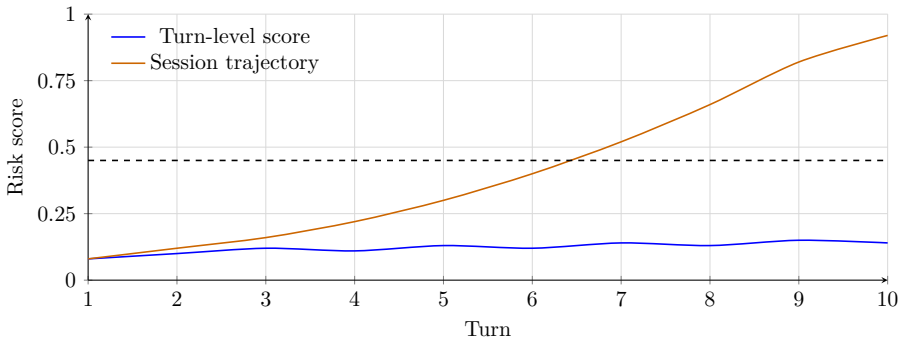
Multi-turn LLM risk accumulates as a trajectory property, and a session-level scorer trained only on synthetic conversations can detect human-authored escalation attacks with AUROC 0.929.
Reviewed by Pith at T0; open to challenge. T0 means a machine referee read the full paper against a public rubric. the ladder, T0–T4 →
T0 review · deepseek-v4-flash
2026-08-02 12:23 UTC pith:CET45QBV
load-bearing objection A genuinely useful taxonomy and benchmark with unusually honest caveats, but the headline transfer claim is provenance-confounded and the code isn't out yet. the 4 major comments →
Stateful Guardrails for Multi-Turn LLM Systems: A Conversational Risk Accumulation Framework
The pith
A machine-rendered reading of the paper's core claim, the machinery that carries it, and where it could break.
Core claim
The central discovery is a demonstration that multi-turn safety failures can be scored as trajectory events rather than single-turn events, using three complementary signals. The paper defines CRA as a session in which every turn passes a turn-level filter but a stateful scoring function can detect accumulated risk, and it operationalizes this with a semantic drift monitor, an information accumulation graph, and a compliance-gradient detector. CRA-Net DA, a roughly 52K-parameter GRU with gradient-reversal heads for session length and threat-family invariance, is the primary fusion model. On CRA-Bench v0.2 — LLM-paraphrased, five threat families, length-matched sessions — it achieves TPR 1.00
What carries the argument
CRA-Net DA: a compact two-layer GRU (hidden width 128, roughly 5.2×10^4 parameters) that consumes per-turn features — normalized semantic drift (S1), an information accumulation index from the sensitivity-weighted entity graph (S2), the negated slope of a windowed refusal trend (S3), plus length and turn-index features — and emits a session risk score. Two gradient-reversal adversarial heads force the encoder representation to be uninformative about session length and threat family, which removes template-memorization and suppresses false alarms on benign chat. A convex fusion of the three normalized signals is retained as an interpretable diagnostic decomposition rather than the primary det
Load-bearing premise
The framework's central claim depends on the engineered trajectory signals — especially the compliance-gradient S3, which is computed from a keyword refusal proxy — measuring genuine conversational risk dynamics rather than artifacts of the synthetic templates; the paper's own audit reports that this proxy agrees with a guard model's labels on only 11.5% of windows (κ = 0.00).
What would settle it
Evaluate CRA-Net DA zero-shot on a length-matched human corpus of fragmentation-style attacks in which the assistant never shows declining refusal behavior; if AUROC drops to about 0.5, the compliance-gradient mechanism is not carrying the transfer claim. Alternatively, replace the keyword-based S3 with a trained refusal classifier and re-run Human-CRA-Transfer; a large score shift would show the reported numbers depend on the unreliable proxy.
If this is right
- Turn-level filters can be complemented by a session layer that scores the trajectory and emits per-turn alerts, giving operators time-to-detection rather than post-hoc transcript review.
- If the synthetic-to-human transfer holds, organizations can bootstrap session-risk detectors from generated benchmarks without large labeled human corpora.
- Benign-anchored calibration — choosing thresholds to constrain false alarms on ordinary chat before measuring detection — becomes a necessary step for deploying such scorers.
- The leave-one-family-out diagnostics imply that detectors trained on a few threat families should not be expected to generalize to unseen accumulation mechanisms; family coverage needs to scale with deployment scope.
- Interpretable decision certificates tied to the three sub-signals can give auditors a policy-safe explanation of why a session was flagged.
Where Pith is reading between the lines
- The S3 compliance-gradient signal is the least trusted leg: the paper's own audit reports that the keyword refusal proxy agrees with a guard model's labels on only 11.5% of windows (κ = 0.00). If a trained refusal classifier replaces the proxy and the results hold, the framework is robust; if they weaken, the headline claims may be carried more by template structure than by genuine compliance dyna
- The same trajectory machinery could be applied to agentic tool-use traces, treating tool calls and data access as first-class turns; the paper sketches this but does not evaluate it, so the benefit is untested.
- A natural next experiment is to generate CRA sessions that hold S1 and S2 constant while varying only S3, and vice versa, to isolate which signal carries each family's signal; the current ablations do not fully separate them.
- The 1% benign-FPR result is measured on a particular open-chat corpus; real RAG or agent traffic may have different score distributions, so the operating point should be recalibrated per deployment, as the paper itself notes.
Editorial analysis
A structured set of objections, weighed in public.
Referee Report
Summary. The paper proposes Conversational Risk Accumulation (CRA) as a failure class in which multi-turn dialogues become unsafe through gradual intent drift, fragmented assembly of prohibited instructions, or sensitivity buildup, even though each turn appears benign. It defines three trajectory signals (semantic drift S1, an Information Accumulation Graph index S2, and a compliance-gradient signal S3), combines them either through convex fusion or through a learned GRU-based CRA-Net with length- and family-adversarial training (CRA-Net DA), and releases CRA-Bench v0.1/v0.2 plus a five-family expansion. The central empirical claims are (i) within-distribution performance on CRA-Bench, culminating in TPR=1.000 at ≤1% benign FPR for CRA-Net DA after benign-anchored calibration (Table 16), and (ii) synthetic-to-human transfer: CRA-Net DA trained only on CRA-Bench reaches AUROC 0.929 on Human-CRA-Transfer (Table 17). The paper is unusually explicit about its limitations, including the CoSafe length confound, the inversion of the IAG signal on public-figure benign twins, and the failure of its S3 keyword proxy validation.
Significance. If the transfer result survives a provenance control, the paper makes a useful contribution: it gives a reproducible session-layer scoring architecture, a public benchmark with session-level splits, per-turn time-to-detection, and an honest evaluation protocol that exposes template memorization and length confounds. The release of code, result JSONs, and fixed-seed generation scripts is a real strength, as are the LOFO diagnostics and the explicit separation of within-distribution, paraphrase-stress, and human-transfer evidence. However, the scientific weight of the paper rests on the Human-CRA-Transfer claim and on the validity of the S3 signal, and both currently have load-bearing gaps. The CRA-Bench numbers alone are self-referential because the labels are produced by the same template machinery that instantiates the authors' definition of CRA; thus the human-transfer result is the main external anchor, and it must be made robust to corpus-provenance confounds.
major comments (4)
- [§8.10, Eq. (6)] The Human-CRA-Transfer result (AUROC 0.919–0.929, Table 17) is confounded by provenance: positives are CoSafe red-team sessions and negatives are ShareGPT organic chats, matched only on length. The per-turn feature vector in Eq. (6) includes response length ℓ_t, refusal probability r_t, and moderation score c_t, any of which can separate CoSafe from ShareGPT independently of accumulation. The paper does not provide a source-matched control or a turn-order-scrambling experiment. Please add controls such as (i) permuting the order of user turns within Human-CRA-Transfer sessions and re-measuring AUROC, and (ii) replacing the ShareGPT negatives with non-escalating multi-turn CoSafe sessions (or vice versa) to show the model is not separating corpora. Without this, the headline synthetic-to-real transfer claim is not established.
- [§4.3, Appendix 13.2] The S3 compliance-gradient signal fails its own validation: Cohen's κ=0.00 and raw agreement 11.5% with Llama Guard 3 on 200 windows. Since S3 is one of the three core mechanisms and is the main driver of the Behavioral Conditioning family results (Tables 11 and 14), the current evidence does not show that S3 measures refusal softening; the conditioning-family AUROC may reflect template-specific keyword behavior rather than genuine compliance dynamics. Re-run the central results with a validated refusal classifier, or at least report all headline tables with S3 ablated and quantify the delta. The manuscript already contains partial ablations (e.g., CRA-convex\S3 and CRA-Net noS2/S3), but the full CRA-Net DA numbers on Human-CRA-Transfer are not reported without S3.
- [§6.2, §8.9, Table 16] CRA-Bench labels are generated by a template generator designed to instantiate the authors' own CRA definition, and the operating thresholds and hyperparameters are tuned on validation splits from the same generator. This creates a self-referential loop for the within-distribution claims, including the TPR=1.000 at ≤1% benign FPR in Table 16. The paraphrase stress test and the human-transfer subset partly break the loop, but the paper should provide either an independent human annotation study on CRA-Bench or another external validation anchor before using the within-distribution operating point as a production recommendation. At minimum, clearly state that Table 16's TPR applies to synthetic template sessions, not to human-authored attacks.
- [§3 footnote, Tables 11 and 14] The IAG/S2 signal inverts on benign public-figure twins: per-family AUROC for Aggregation is near zero for all baseline methods that rely on S2 (Tables 11 and 14), because public historical figures trigger more NER hits than fictional targets. This is acknowledged in the Table 3 footnote, but it means the 'most structurally novel' component S2 does not, by itself, measure sensitivity accumulation. CRA-Net recovers aggregation by learned compensation, but this raises a transfer risk: the compensation may be specific to the benchmark's entity-choice asymmetry. Please provide an IAG-only analysis on a corpus with real sensitive entities, or explicitly reposition S2 as an unvalidated placeholder in the contribution claims.
minor comments (4)
- [§8.5, §9.7] The benign-FPR estimates rely on ShareGPT filtered with unsafe-keyword exclusion. This filter is not a gold-standard benign label; please state the filtering heuristic and its limitations more prominently, since a false-alarm rate on 'benign traffic' is only as good as the benign proxy.
- [Table 10] The row 'CRA-Net noS2/S3 (drift-only)' lists AUROC 1.000 with sFPR 1.000, which is a degenerate saturated ranking. Consider moving this row to a footnote or clearly marking it as a degenerate configuration in the table itself, not only in the table caption.
- [§7 / Figures 2–10] The synthetic signal illustrations are appropriately labeled as non-empirical, but the Figures are low-resolution placeholders in the submitted PDF. Re-render them at publication quality and ensure axis labels are legible.
- [§4.6, §8.8] The default λ_fam changes from 0.3 (three-family) to 0.1 (five-family) with retrospective justification. This is defensible, but the selection of λ_fam should be reported as a hyperparameter sweep over validation, not as a fixed default, to avoid the appearance of post hoc tuning.
Circularity Check
No significant circularity: the benchmark, validation, and human-transfer numbers are held out and no equation reduces to a fitted input.
full rationale
The derivation chain is not circular. The CRA definition (Sec. 3) is an operational taxonomy rather than a fitted quantity, and the benchmark labels are generated from templates, but the model is trained on a 60% split and all headline AUROC/TPR numbers are reported on a held-out 20% test split (Sec. 8.2), with thresholds calibrated either on a mixed validation split or on external ShareGPT sessions (Sec. 8.9, Table 16). No equation in Sec. 4 reduces to a fitted constant: CRA(t) is a fixed convex combination of S1-S3, and CRA-Net parameters are learned by BCE; AUROC is threshold-independent. The synthetic-to-human transfer claim (Sec. 8.10) is an external check: CRA-Net DA is trained only on CRA-Bench v0.2 and evaluated zero-shot on 750 CoSafe positives + 222 ShareGPT negatives with equal user-turn count, with no human-corpus threshold fitting. The disclosed S3 proxy validation (Appendix 13.2, Cohen's kappa=0.00, 11.5% agreement) and the potential provenance confound in Human-CRA-Transfer are validity/correctness concerns, not definitional reductions; they do not make any reported number equal to its input by construction. There are no load-bearing self-citations, and the illustrative Sec. 7 results are explicitly labeled as non-empirical heuristic simulations. Everything load-bearing is either held out or externally sourced, so the central claims have independent empirical content.
Axiom & Free-Parameter Ledger
free parameters (7)
- Fusion weights α,β,γ =
defaults 0.35,0.45,0.20; v0.2 grid peak α=0,β=0.05,γ=0.95
- IAG sensitivity tier increments =
0.05,0.10,0.20,0.35
- IAG coverage exponent p =
p=2
- S3 sliding window width w =
6 turns (cap 32)
- S3 saturation gain κ =
not specified in text
- CRA-Net hyperparameters λ, λ_fam, ρ =
λ=0.05; λ_fam=0.3 (3-family) / 0.1 (5-family); ρ=1
- Operating threshold θ =
e.g., θ=0.492 (CRA-Net DA, benign-anchored, 5-family); θ=0.697 (v0.2 TPR-0.90)
axioms (6)
- domain assumption NIST SP 800-60 confidentiality categorisation is a valid basis for assigning attribute sensitivity weights in the IAG.
- domain assumption Cosine distance in all-MiniLM-L6-v2 embedding space measures semantic drift and opposition of session intent.
- domain assumption spaCy en_core_web_sm named-entity recognition is sufficient for the entity/attribute extraction underlying S2.
- ad hoc to paper Template-generated sessions with labels assigned by the generator constitute ground-truth CRA risk.
- domain assumption CoSafe gradual-escalation sessions are representative human-authored CRA positives, and filtered 3-turn ShareGPT chats are benign negatives.
- standard math The OLS slope estimator of binary refusal indicators is a consistent estimator of compliance trend under linear trend plus bounded noise.
invented entities (4)
-
Conversational Risk Accumulation (CRA) threat taxonomy
no independent evidence
-
Information Accumulation Graph (IAG)
no independent evidence
-
Compliance Gradient Detector (S3)
no independent evidence
-
Semantic Drift Monitor (S1)
no independent evidence
read the original abstract
Most safety guardrails for large language models (LLMs) evaluate each prompt-response pair in isolation, which misses failures that arise only over a dialogue as benign turns compose into harm. We term this Conversational Risk Accumulation (CRA): gradual intent drift, fragmented assembly of prohibited instructions, and sensitivity build-up from repeated disclosures. We propose a session-layer CRA Framework that tracks three trajectory signals: semantic drift from a session anchor, a sensitivity-weighted information accumulation graph over extracted entities, and a compliance-gradient signal capturing increasing willingness to comply. For scoring, we provide (i) an unsupervised convex fusion for attribution and ablations, and (ii) CRA-Net DA, a compact learned trajectory model trained with family-adversarial objectives to reduce length and topic-coverage confounds. To benchmark CRA, we release CRA-Bench v0.1 (1,200 eight-turn sessions across three threat families with topic-matched benign twins), CRA-Bench v0.2 (LLM-paraphrased variants to reduce template artifacts), and an extended 5-family set (2,000 sessions adding persona priming and context stuffing). We introduce a trajectory-native evaluation protocol with session-level splits, mixed-set threshold calibration, Trajectory AUROC, turns-to-detection, calibrated false-positive metrics, bootstrap confidence intervals, leave-one-family-out diagnostic stress tests, and synthetic-to-human transfer checks. Claims focus on within-distribution session scoring on CRA-Bench and human-transfer subsets.
Figures


Reference graph
Works this paper leans on
-
[1]
CoSafe: A collection of multi-turn LLM conversations for safety evaluation
Asap7772. CoSafe: A collection of multi-turn LLM conversations for safety evaluation. Hug- gingFace Dataset, 2024. URLhttps://huggingface.co/datasets/Asap7772/cosafe_all_ rollouts
2024
-
[2]
Guide for mapping types of information and information systems to security categories
National Institute of Standards and Technology. Guide for mapping types of information and information systems to security categories. Technical Report SP 800-60 Vol. 1 Rev. 1, NIST,
-
[3]
HarmBench: A standardized evaluation framework for automated red teaming and robust refusal
Paul Röttger, Hannah Rose Kirk, Bertie Vidgen, Giuseppe Attanasio, Federico Bianchi, and Dirk Hovy. HarmBench: A standardized evaluation framework for automated red teaming and robust refusal. InProceedings of the International Conference on Machine Learning (ICML),
-
[4]
Zico Kolter, and Matt Fredrikson
Andy Zou, Zifan Wang, J. Zico Kolter, and Matt Fredrikson. Universal and transferable adver- sarial attacks on aligned language models. InProceedings of the 41st International Conference on Machine Learning (ICML 2024), volume 235 ofProceedings of Machine Learning Research. PMLR, 2024. arXiv:2307.15043
Pith/arXiv arXiv 2024
-
[5]
Universal adver- sarial triggers for attacking and analyzing NLP
Eric Wallace, Shi Feng, Nikhil Kandpal, Matt Gardner, and Sameer Singh. Universal adver- sarial triggers for attacking and analyzing NLP. InProceedings of the 2019 Conference on Empirical Methods in Natural Language Processing and the 9th International Joint Confer- ence on Natural Language Processing (EMNLP-IJCNLP), pages 2153–2162. Association for Compu...
2019
-
[6]
Xinyue Shen, Zeyuan Chen, Michael Backes, Yun Shen, and Yang Zhang. “Do Anything Now”: Characterizing and evaluating in-the-wild jailbreak prompts on large language models. In Proceedings of the 2024 ACM SIGSAC Conference on Computer and Communications Security (CCS ’24), pages 1–15, New York, NY, USA, 2024. ACM. doi: 10.1145/3658644.3670388
arXiv 2024
-
[7]
Jailbroken: How does LLM safety training fail? InAdvances in Neural Information Processing Systems, volume 36, pages 71988– 72006
Alexander Wei, Nika Haghtalab, and Jacob Steinhardt. Jailbroken: How does LLM safety training fail? InAdvances in Neural Information Processing Systems, volume 36, pages 71988– 72006. Curran Associates, Inc., 2023
2023
-
[8]
Ignore previous prompt: Attack techniques for language mod- els
Fabio Perez and Ian Ribeiro. Ignore previous prompt: Attack techniques for language mod- els. InProceedings of the Workshop on Machine Learning Safety at NeurIPS 2022, 2022. arXiv:2211.09527
Pith/arXiv arXiv 2022
-
[9]
Kai Greshake, Sahar Abdelnabi, Shailesh Mishra, Christoph Endres, Thorsten Holz, and Mario Fritz. Not what you’ve signed up for: Compromising real-world LLM-integrated applications with indirect prompt injection. InProceedings of the 16th ACM Workshop on Artificial In- telligence and Security (AISec ’23), pages 79–90, New York, NY, USA, 2023. ACM. doi: 10...
arXiv 2023
-
[10]
Hakan Inan, Kartikeya Upasani, Jianfeng Chi, Rashi Rungta, Krithika Iyer, Yuning Mao, Michael Tung, et al. Llama Guard: LLM-based input-output safeguard for human-AI conver- sations.arXiv preprint arXiv:2312.06674, 2023. URLhttps://arxiv.org/abs/2312.06674
Pith/arXiv arXiv 2023
-
[11]
Qwen3Guard: A multilingual safety guardrail model for LLM deployments
Qwen Team. Qwen3Guard: A multilingual safety guardrail model for LLM deployments. arXiv preprint arXiv:2510.14276, 2025. URLhttps://arxiv.org/abs/2510.14276
Pith/arXiv arXiv 2025
-
[12]
CoSafe: Evaluating large language model safety in multi-turn dialogue coreference
Erxin Yu, Jing Li, Ming Liao, Siqi Wang, Gao Zuchen, Fei Mi, and Lanqing Hong. CoSafe: Evaluating large language model safety in multi-turn dialogue coreference. InProceedings of the 2024 Conference on Empirical Methods in Natural Language Processing (EMNLP), pages 17494–17508, 2024. URLhttps://aclanthology.org/2024.emnlp-main.968/
2024
-
[13]
AgentDoG: A diagnostic guardrail framework for AI agent safety and security, 2026
Yu Li, Haoyu Luo, Yuejin Xie, Jiapeng Gu, Yuhan Wang, Yanwei Fu, Yujiu Yang, Jing Shao, Xia Hu, and Dongrui Liu. AgentDoG: A diagnostic guardrail framework for AI agent safety and security, 2026. URLhttps://arxiv.org/abs/2601.18491. Code:https: //github.com/AI45Lab/AgentDoG
Pith/arXiv arXiv 2026
-
[14]
TraceSafe: A sys- tematic assessment of LLM guardrails on multi-step tool-calling trajectories, 2026
Yen-Shan Chen, Sian-Yao Huang, Cheng-Lin Yang, and Yun-Nung Chen. TraceSafe: A sys- tematic assessment of LLM guardrails on multi-step tool-calling trajectories, 2026. URL https://arxiv.org/abs/2604.07223
Pith/arXiv arXiv 2026
-
[15]
Unsupervised domain adaptation by backpropagation
Yaroslav Ganin and Victor Lempitsky. Unsupervised domain adaptation by backpropagation. InProceedings of the 32nd International Conference on Machine Learning (ICML), pages 1180–1189, 2015. URLhttps://proceedings.mlr.press/v37/ganin15.html
2015
-
[16]
Deep CORAL: Correlation alignment for deep domain adap- tation
Baochen Sun and Kate Saenko. Deep CORAL: Correlation alignment for deep domain adap- tation. InProceedings of the European Conference on Computer Vision (ECCV) Workshops, pages 443–450, 2016. arXiv:1607.01759
Pith/arXiv arXiv 2016
-
[17]
Artificial intelligence risk management frame- work (AI RMF 1.0)
National Institute of Standards and Technology. Artificial intelligence risk management frame- work (AI RMF 1.0). Technical Report AI 100-1, NIST, 2023. URLhttps://nvlpubs.nist .gov/nistpubs/ai/NIST.AI.100-1.pdf
2023
-
[18]
Long Ouyang, Jeffrey Wu, Xu Jiang, Diogo Almeida, Carroll L. Wainwright, Pamela Mishkin, Chong Zhang, Sandhini Agarwal, Katarina Slama, Alex Ray, John Schulman, Jacob Hilton, Fraser Kelton, Luke Miller, Maddie Simens, Amanda Askell, Peter Welinder, Paul Christiano, Jan Leike, and Ryan Lowe. Training language models to follow instructions with human feedba...
2022
-
[19]
Deep reinforcement learning from human preferences.Advances in Neural Information Processing Systems, 30, 2017
Paul Christiano, Jan Leike, Tom Brown, Miljan Martic, Shane Legg, and Dario Amodei. Deep reinforcement learning from human preferences.Advances in Neural Information Processing Systems, 30, 2017
2017
-
[20]
Claude’s model specification
Anthropic. Claude’s model specification. Technical report, Anthropic, 2024. URLhttps: //www.anthropic.com/research/model-specification
2024
-
[21]
Constitutional AI: Harmlessness from AI feedback.arXiv preprint arXiv:2212.08073, 2022
Yuntao Bai et al. Constitutional AI: Harmlessness from AI feedback.arXiv preprint arXiv:2212.08073, 2022
Pith/arXiv arXiv 2022
-
[22]
Latanya Sweeney.k-anonymity: A model for protecting privacy.International Journal of Uncertainty, Fuzziness and Knowledge-Based Systems, 10(05):557–570, 2002. 44
2002
-
[23]
Ninghui Li, Tiancheng Li, and Suresh Venkatasubramanian.t-closeness: Privacy beyondk- anonymity andl-diversity.IEEE Transactions on Knowledge and Data Engineering, 22(4): 445–456, 2010
2010
-
[24]
Calibrating noise to sen- sitivity in private data analysis
Cynthia Dwork, Frank McSherry, Kobbi Nissim, and Adam Smith. Calibrating noise to sen- sitivity in private data analysis. InTheory of Cryptography: Third Theory of Cryptography Conference (TCC 2006), volume 3876 ofLecture Notes in Computer Science, pages 265–284. Springer, 2006. doi: 10.1007/11681878_14
-
[25]
Now Publishers, 2014
Cynthia Dwork and Aaron Roth.The Algorithmic Foundations of Differential Privacy. Now Publishers, 2014
2014
-
[26]
Pearson, Dietrich A
Nils Homer, Szabolcs Szelinger, Margot Redman, David Duggan, Waibhav Tembe, Jill Muehling, John V. Pearson, Dietrich A. Stephan, Stanley F. Nelson, and David W. Craig. Resolving individuals contributing trace amounts of DNA to highly complex mixtures using high-density SNP genotyping microarrays.PLoS Genetics, 4(8):e1000167, 2008
2008
-
[27]
Robust de-anonymization of large sparse datasets
Arvind Narayanan and Vitaly Shmatikov. Robust de-anonymization of large sparse datasets. InProceedings of the 2008 IEEE Symposium on Security and Privacy, pages 111–125, 2008
2008
-
[28]
Williams and Steve Young
Jason D. Williams and Steve Young. Partially observable Markov decision processes for spoken dialog systems. InComputer Speech & Language, volume 21, pages 393–422. Elsevier, 2007
2007
-
[29]
Williams
Steve Young, Milica Gašić, Blaise Thomson, and Jason D. Williams. POMDP-based statistical spoken dialog systems: A review.Proceedings of the IEEE, 101(5):1160–1179, 2013
2013
-
[30]
Williams
Matthew Henderson, Blaise Thomson, and Jason D. Williams. Word-based dialog state track- ing with recurrent neural networks. InProceedings of the 15th Annual Meeting of the Special Interest Group on Discourse and Dialogue, pages 292–299, 2014
2014
-
[31]
Neural belief tracker: Data-driven dialogue state tracking
Nikola Mrkšić, Diarmuid Ó Séaghdha, Tsung-Hsien Wen, Blaise Thomson, and Steve Young. Neural belief tracker: Data-driven dialogue state tracking. InProceedings of the 55th Annual Meeting of the Association for Computational Linguistics, pages 1777–1788, 2017
2017
-
[32]
Tod-BERT: Pre-trained natural language understanding for task-oriented dialogue
Chien-Sheng Wu, Steven Sohn, Jing Chen, Hongyuan Lee, Semih Zhang, Jason Williams, Wen-tau Wang, and Caiming Yu. Tod-BERT: Pre-trained natural language understanding for task-oriented dialogue. InProceedings of the 2020 Conference on Empirical Methods in Natural Language Processing, pages 917–929, 2020
2020
-
[2008]
URLhttps://nvlpubs.nist.gov/nistpubs/Legacy/SP/nistspecialpublication80 0-60v1r1.pdf
-
[2024]
URLhttps://arxiv.org/abs/2405.01470. 45
discussion (0)
Sign in with ORCID, Apple, or X to comment. Anyone can read and Pith papers without signing in.