REVIEW 4 major objections 4 minor 67 references
Iterative lattice reweighting preserves MWPM's distance guarantee while exploiting X/Z correlations to lower logical error rates.
Reviewed by Pith at T0; open to challenge. T0 means a machine referee read the full paper against a public rubric. the ladder, T0–T4 →
An iterative reweighting decoder for surface codes uses X-Z error correlations from circuit-level noise, improving logical error rates and raising the threshold from about 1% to 1.16%.
T0 review reviewed 2026-08-04 challenge →
load-bearing objection Empirical decoder improvement looks plausible, but the distance-preservation theorem is not proven as written — send to review if the theory is fixable, otherwise treat as a numerical advance. the 4 major comments →
Enhancing Fault-Tolerant Surface Code Decoding with Iterative Lattice Reweighting
The pith
A machine-rendered reading of the paper's core claim, the machinery that carries it, and where it could break.
The reading
Core claim
The central discovery is that surface-code decoding graphs for X and Z errors can be reweighted against each other using conditional fault probabilities, and doing so iteratively does not weaken the MWPM distance guarantee. The paper classifies single-fault correlations into six paired types on the 3D decoding lattices, uses them to compute conditional probabilities (e.g., P(d1|a)=3/31), and alternates MWPM on reweighted lattices. The resulting sequence of joint correction weights is nonincreasing, implying finite-time convergence and, because the initial MWPM estimate is already within the code's correction radius, the algorithm terminates at a correction that differs from MWPM's by a stabi
What carries the argument
The load-bearing object is a pair of dual 3D space-time decoding lattices for X and Z errors, initially weighted by single-fault probabilities. The reweighting uses conditional probabilities (Table III) of a dual-lattice matching given a primal-lattice matching; each edge is replaced by -ln of that conditional probability. The proof machinery is the monotone sequence of total correction weights W_j >= W_j+0.5 >= W_j+1, which yields finite-time convergence, and MWPM optimality plus the code distance yields the decoding-radius guarantee.
Load-bearing premise
The load-bearing premise is that a cheaper matching on the reweighted lattices also means a physically lighter correction; the proof shows the matching cost falls each round but does not show that the actual Pauli error count falls, so if the two ever separate, the distance guarantee would not follow.
What would settle it
Track both the matching cost W_j and the true Pauli weight of the correction at every IRMWPM iteration on injected syndromes. If any run shows W_j decreasing while the actual Pauli weight of the correction increases, the identification used in the convergence and distance proofs fails. A second check is to enumerate all errors of weight at most (d-1)/2 that MWPM corrects and verify that IRMWPM always returns a correction differing from MWPM's by a stabilizer; any counterexample would falsify the radius-preservation claim.
If this is right
- Circuit-level surface-code decoders can exploit X/Z correlations without leaving MWPM's guaranteed decoding radius, so the reweighting strategy can be layered onto existing MWPM decoder implementations.
- A threshold of about 1.16% rather than 1% relaxes the physical error rate required for fault-tolerant operation, easing hardware demands.
- To reach a logical error rate of 10^-16 at p=0.001, IRMWPM needs distance 31 versus 50 for standard MWPM, implying more than 60% fewer physical qubits per logical qubit.
- In practice only two to four iterations are needed at realistic error rates, keeping the runtime overhead modest for real-time decoding.
- Because the conditional-probability tables can be recomputed for other noise models, the decoder becomes noise-aware without per-hardware training.
Where Pith is reading between the lines
- This editor would probe the gap between the matching cost W_j and the actual Pauli weight of the correction: Lemma 3 proves the former is nonincreasing, while Theorem 5 needs the latter. Tracking both quantities in simulation would show whether they can diverge on adversarial syndromes.
- The same reweighting table should transfer to non-depolarizing biased or amplitude-damping noise, where X/Z correlations are stronger; the paper notes this extensibility but does not simulate it.
- An FPGA or ASIC implementation should be straightforward because the added steps are edge-weight updates plus repeated MWPM; each iteration has the same per-round cost as standard MWPM.
- The distance theorem relies on exact MWPM optimality, so replacing the inner decoder with approximate matching methods such as union-find or sparse blossom would require a separate radius analysis.
Editorial analysis
A structured set of objections, weighed in public.
Referee Report
Summary. The paper proposes Iterative Reweighting Minimum-Weight Perfect Matching (IRMWPM), a decoder that alternates between the X and Z decoding lattices of a surface code, reweighting edges by conditional probabilities of correlated X/Z detection events derived from circuit-level depolarizing noise. The authors claim finite-time convergence (Theorem 1), preservation of the MWPM decoding radius (Theorems 2 and 5), and report numerical improvements: an increased threshold (about 1.16% vs. 1%), over 20x logical-error reduction at low physical error rates for d ≥ 17, and an extrapolated resource saving of d = 31 vs. d = 50 at p_L = 10^-16. The central theoretical result is Lemma 3 in Section IV.B.3, which is used to prove convergence and the distance guarantee.
Significance. If the empirical results are reproducible, IRMWPM is a practically valuable enhancement of MWPM for circuit-level noise: it uses a systematic catalog of fault-path correlations (Table III), converges in a few iterations in the simulated regime, and is supported by public code. The improvement in threshold and logical error rate at large distance is interesting and potentially useful for real-time decoding. However, the theoretical guarantees have a load-bearing gap: Lemma 3 conflates lattice matching cost with Pauli correction weight, and Equations (3)-(6) are internally inconsistent. The headline d=31 vs. d=50 qubit-overhead claim is an unvalidated extrapolation of a six-parameter fit. These issues must be repaired before the central claims can be relied upon.
major comments (4)
- [Section IV.B.3, Lemma 3, Eqs. (3)-(6)] The proof defines W_j as a sum of matching costs on reweighted lattices, not as wt(Ê^(j)). Equations (3)-(6) are internally inconsistent: Eq. (3) uses M_Z^(j) on L_Z^(0) while Eq. (4) uses M_Z^(j) on L_Z^(j); Eq. (5) pairs M_Z^(j+1) on L_Z^(0) with M_X^(j) on L_X^(j+1), while Eq. (6) pairs M_X^(j) on L_X^(0) with M_Z^(j+1) on L_Z^(j+1). In circuit-level decoding, edge weights are -ln P, so a minimum-cost matching on a reweighted lattice is not a minimum Pauli-support correction; reweighted correlated edges are cheaper by design. Thus monotonicity of W_j does not imply wt(Ê^(j)) is nonincreasing. Since Theorem 5 requires wt(Ê') ≤ wt(Ê) ≤ wt(E), the distance guarantee is unsupported. The initial inequality wt(Ê) ≤ wt(E) also assumes MWPM minimizes Pauli weight, which is not what the decoder minimizes for logarithmic edge weights.
- [Section II.B, Eq. (1), Figs. 3-5] The headline claim that IRMWPM requires d=31 while MWPM requires d=50 to reach p_L = 10^-16 is obtained by extrapolating a six-parameter fit to logical error rates for L ≤ 17 and p ≥ 0.001, evaluated at p=0.001, L=31 and L=50. This is many orders of magnitude outside the simulated range. No held-out validation at intermediate L (e.g., L=23) or uncertainty quantification is provided. Because the abstract advertises this as a major qubit-overhead reduction, the claim needs either validation with additional data/error bars or an explicit downgrade to a rough, speculative estimate.
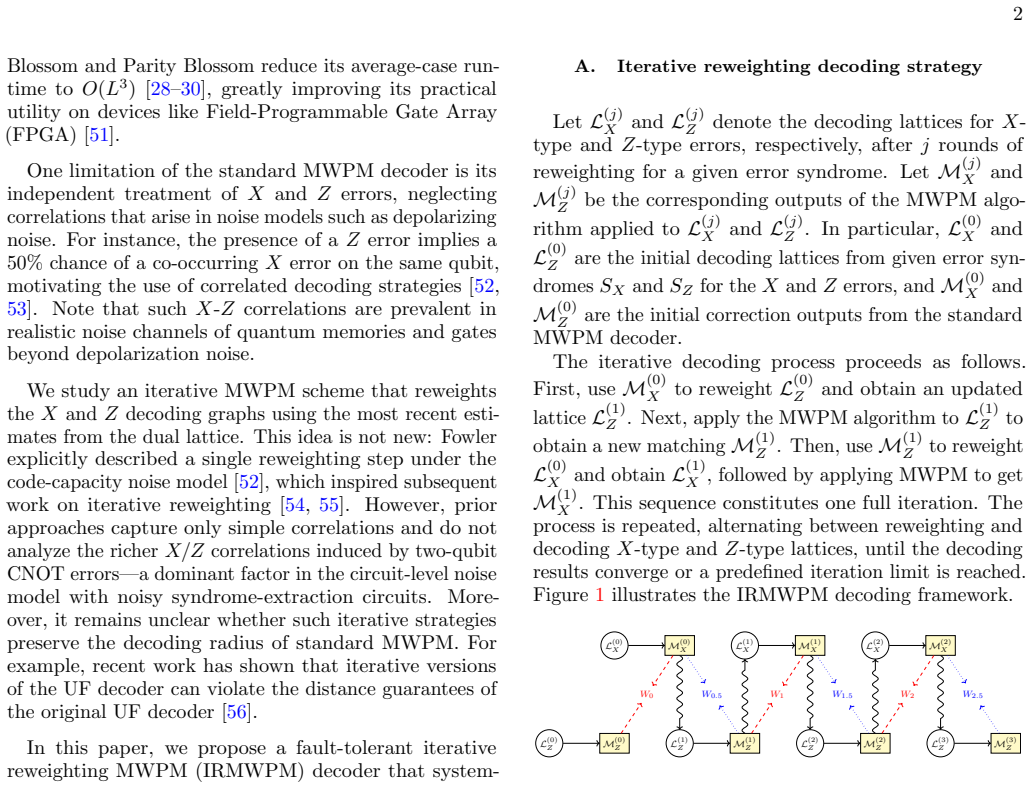
- [Algorithm 1 vs. Section II.A and Fig. 1] The text and Figure 1 define a half-step in which M_X^(j) reweights L_Z to produce M_Z^(j+1), then M_Z^(j+1) reweights L_X to produce M_X^(j+1). Algorithm 1 instead initializes Ê_Z^(0)=∅ and in each loop first runs Reweight(L_X, Ê_Z^(k)), then Reweight(L_Z, Ê_X^(k+1)). Consequently the objects Ê^(j) and Ê^(j+0.5) used in Lemma 3 and Theorem 5 do not correspond to the outputs of Algorithm 1. The theoretical guarantees therefore apply to a different iterative schedule from the one presented in the pseudocode. Please align the pseudocode with the analyzed schedule and state explicitly which schedule was used in the numerical simulations.
- [Section IV.B.3, Lemma 4 and Theorem 5] The manuscript states that the MWPM distance guarantee “is expected to extend to circuit-level noise ... although no formal proof currently exists.” Theorem 5 nevertheless presents a circuit-level decoding-radius result for IRMWPM, conditional on this unproved property of MWPM. In addition, Lemma 4 gives per-component conditions (wt(E_X) ≤ ... and wt(E_Z) ≤ ...), while Theorem 5 assumes only total weight wt(E) ≤ ...; MWPM decodes X and Z separately and does not jointly minimize the total Pauli weight. These statements must be reconciled; as written, the theorem does not establish a circuit-level decoding radius for IRMWPM.
minor comments (4)
- [Abstract and Section II.B] The abstract states “over 20x” improvement for d ≥ 17 and p ≤ 0.001, but Figure 4 shows data up to L=17 and p ≥ 0.001; please specify the exact p range and note that the largest simulated distance is L=17.
- [Section IV.B.1] Typo: “horozontal” should be “horizontal”.
- [Section III, Discussion] The sentence “IRMWPM, which incurs lower overhead than MWPM” appears to contradict the algorithm’s additional iterations; please clarify whether the intended meaning is lower logical qubit overhead or comparable computational overhead.
- [Algorithm 1, stopping criterion] The stopping condition breaks when either the X or Z estimate repeats, not necessarily both; this should be clarified, since convergence of one estimate does not guarantee convergence of the other.
Circularity Check
Distance-guarantee proof equates reweighted lattice matching cost with Pauli weight, so Lemma 3 and Theorem 5 reduce to a definitional identification.
specific steps
-
self definitional
[Section IV.B.3, Lemma 3 proof, Eqs. (3)-(6); used in Theorem 5 proof]
"Let wt(L_X^(j), M_X^(k)) denote the weight of the matching M_X^(k) on the lattice L_X^(j). These quantities can be expressed as: Wj = wt(L(0)_Z, M(j)_Z) + wt(L(j+1)_X, M(j)_X) (3) = wt(L(0)_X, M(j)_X) + wt(L(j)_Z, M(j)_Z) (4)"
W_j was defined as wt(Ê^(j)), the Pauli weight of the joint correction, but Eqs. (3)-(6) redefine it as the sum of MWPM matching costs on the reweighted lattices. Under the paper's own circuit-level model, lattice edge weights are −ln P (Section IV.A.4), not unit Pauli weights, so MWPM optimality (inequalities (a) and (c)) only makes the lattice cost decrease; it says nothing about the Pauli support size. The claimed monotonicity W0 ≥ W0.5 ≥ W1 ≥ ... is therefore a statement about lattice costs, not about wt(Ê^(j)). Theorem 5's distance guarantee needs exactly wt(Ê') ≤ wt(Ê) ≤ wt(E) to conclude ÊÊ' has weight < d and is a stabilizer. That chain is obtained only by the notational identification of W_j with both quantities, i.e., the needed conclusion is inserted by definition rather than de
full rationale
The numerical decoding results and threshold comparison are self-contained simulations under a stated circuit-level depolarizing model; using the same model to set decoder weights is standard decoder design, not circularity. The d=31 vs d=50 overhead comparison is explicitly labeled as an extrapolation from a fitted curve, so it is a weak extrapolation rather than a self-referential prediction. The paper's self-citations ([36], [56]) are motivational or methodological and not load-bearing. However, the theoretical core—finite-time convergence and preservation of MWPM's decoding radius—rests on Lemma 3, whose proof equates the Pauli weight of the correction with the MWPM lattice matching cost via Eqs. (3)-(6). Since circuit-level edge weights are −ln P and a matching edge can correspond to multiple or overlapping physical faults, this equality is not true in general; the proof of Theorem 5 therefore reduces to the unproven identification it needs. That definitional conflation makes the central distance-guarantee claim partially circular (score 6), even though the empirical improvements may well be valid and independently reproducible.
Axiom & Free-Parameter Ledger
free parameters (1)
- six-parameter extrapolation fit (a,b,c,e,f,g) =
not reported
axioms (5)
- standard math MWPM returns a minimum-weight perfect matching on the decoding lattice for the given syndrome.
- domain assumption The fault-path classification of Wang et al. [27] (23 matchings, six types) applies to the reduced-depth syndrome extraction circuit used here.
- domain assumption Low physical error rate permits direct summation over single-fault mechanisms, ignoring multi-fault contributions.
- domain assumption A final round of perfect syndrome measurements is available for the distance guarantee.
- ad hoc to paper The logical error rate follows the analytic form of Eq (1) across distances 5 to 50.
Cite this review
Pith. "Pith review of Enhancing Fault-Tolerant Surface Code Decoding with Iterative Lattice Reweighting." pith.science (2026). https://pith.science/paper/CG3UDVSE
@misc{pith2026250906756,
  author       = {Pith},
  title        = {Pith review of: Enhancing Fault-Tolerant Surface Code Decoding with Iterative Lattice Reweighting},
  year         = {2026},
  howpublished = {\url{https://pith.science/paper/CG3UDVSE}},
  note         = {Machine review of arXiv:2509.06756}
}
abstract
Efficient and realistic error decoding is crucial for fault-tolerant quantum computation (FTQC) on near-term devices. While decoding is a classical post-processing task, its effectiveness depends on accurately modeling quantum noise, which is hardware-dependent. In particular, correlated bit-flip ($X$) and phase-flip ($Z$) errors often arise under circuit-level noise. We introduce the Iterative Reweighting Minimum-Weight Perfect Matching (IRMWPM) decoder, which systematically incorporates such correlations to enhance quantum error correction. Our method leverages fault-detection patterns to guide reweighting: correlated $X$ and $Z$ detection events are identified, and their conditional probabilities update weights on the primal and dual lattices. This iterative procedure improves handling of realistic error propagation in a hardware-agnostic yet noise-aware manner. We prove that IRMWPM converges in finite time while preserving the distance guarantee of MWPM. Numerical results under circuit-level noise show substantial improvements. For distances $\geq 17$ and physical error rates $\leq 0.001$, IRMWPM reduces logical error rates by over 20x with only a few iterations. It also raises the accuracy threshold from 1% to 1.16%, making it practical for near-term real-time decoding. Extrapolated estimates suggest that to reach logical error rate $10^{-16}$, IRMWPM requires distance $d=31$, while standard MWPM needs $d=50$, implying a major reduction in qubit overhead.
Figures


Reference graph
Works this paper leans on
-
[1]
Reweighting strategy The IRMWPM decoder differs from the conventional MWPM decoder by dynamically updating edge weights on the decoding lattice based on dual-lattice matching outcomes, whereas MWPM uses fixed weights throughout decoding. The X and Z decoding lattices are dual to each other. In the iterative reweighting procedure, the edge weights in one l...
-
[2]
Theoretical Guarantees of IRMWPM Define ˆE(j) as the Pauli correction associated with M(j) X and M(j) Z , and let ˆE(j+0.5) denote the correction associated with M(j) X and M(j+1) Z . For each integer j ≥ 0, define Wj = wt ˆE(j) and Wj+0.5 = wt ˆE(j+0.5) as the total weights of the corresponding corrections. These quantities are also illustrated in Fig. 1...
-
[3]
Pauli operators We consider errors that are tensor products of Pauli operators I, X, Y, Z. A single-qubit Pauli operator can be expressed as X aZ b for a, b∈ {0, 1}, up to a global phase, where X 0 = I = Z 0, X 1 = X, and Z 1 = Z. In general, an n-fold Pauli operator can be expressed as X aZ b ≜Nn j=1 X aj Z bj , where a = a1 · · ·an and b = b1 · · ·bn, u...
-
[4]
Surface code The surface code is a quantum error-correcting code implemented on a two-dimensional lattice of physical qubits. We focus on the [[ L2 + (L − 1)2, 1, L]] surface code [20], which encodes a single logical qubit into L2 + (L − 1)2 physical qubits arranged on a lattice of length L, as illustrated in Fig. 7 for the case of L = 3. 0 1 2 3 4 5 6 7 ...
work page 2023
-
[5]
Noise model We define the terminology and noise model as follows. A fault refers to a malfunction or imperfection in a physical operation or process, while an error is the un- intended deviation in the quantum state resulting from such a fault. For example, a single-qubit gate fault may introduce a Pauli error on the affected qubit. In this work, we adopt...
-
[6]
Two separate decoding lattices are used for decoding X-type and Z-type errors, respectively
Decoding lattice and the MWPM decoder In the circuit-level noise model, the decoding lattice for surface codes is a 3D space-time graph that accounts for possible faults across multiple rounds of syndrome extraction [27, 58]. Two separate decoding lattices are used for decoding X-type and Z-type errors, respectively. Each stabilizer measurement at differe...
-
[7]
A single-qubit Pauli error can be expressed as X aZ b for a, b∈ {0, 1}, up to a global phase
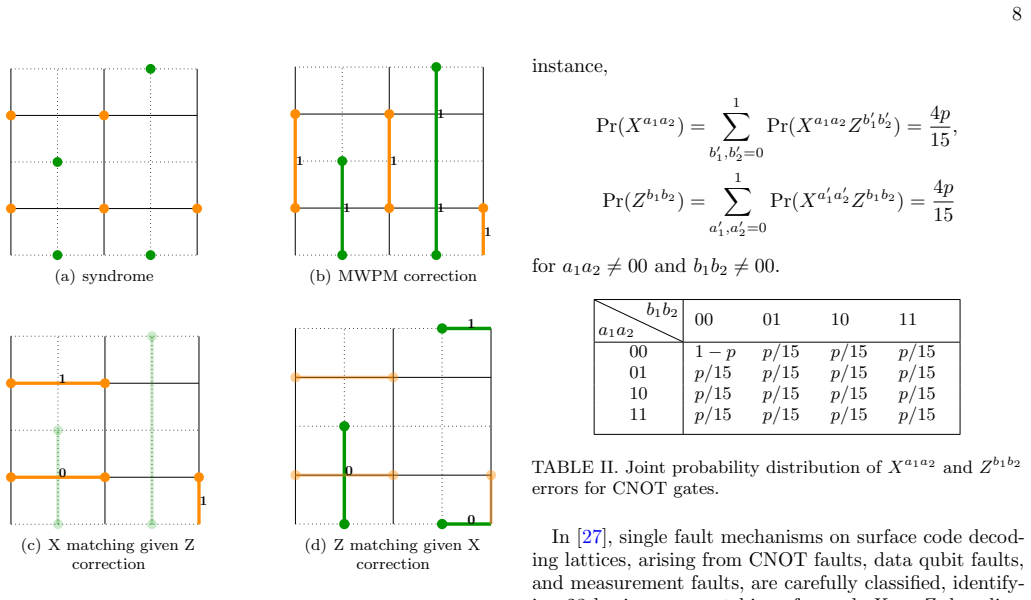
Code capacity noise model We start with the simpler code capacity noise model, where syndrome extraction circuits are perfect and the decoding lattice constitutes a single horozontal layer, and then extend the analysis to the circuit-level noise model. A single-qubit Pauli error can be expressed as X aZ b for a, b∈ {0, 1}, up to a global phase. The joint ...
-
[8]
Circuit-level noise model Next, we extend this iterative reweighting decoding pro- cedure to the circuit-level noise model in FTQC, account- ing for noise correlations from error propagation through noisy CNOT gates, which has been studied in [ 52, 59]. To support reweighting, we propose a systematic method for constructing the conditional probabilities o...
-
[9]
Theoretical guarantees of IRMWPM Yuan et al. [ 54] showed that under the code-capacity noise model, the weight of Pauli correction does not in- crease across IRMWPM iterations. We extend this result to the circuit-level noise model, enabling a proof of con- vergence for IRMWPM. Lemma 3. In IRMWPM decoding under the circuit- level noise model, the weight o...
-
[10]
Aharonov and M
D. Aharonov and M. Ben-Or, Fault-tolerant quantum computation with constant error, in Proceedings of the twenty-ninth annual ACM symposium on Theory of com- puting (1997) pp. 176–188
1997
-
[11]
D. Gottesman, Stabilizer codes and quantum error correc- tion (California Institute of Technology, 1997)
work page 1997
-
[12]
M. A. Nielsen and I. L. Chuang, Quantum computation and quantum information (Cambridge university press, 2010)
2010
-
[13]
D. A. Lidar and T. A. Brun, Quantum error correction (Cambridge university press, 2013)
2013
-
[14]
P. Aliferis, D. Gottesman, and J. Preskill, Quantum accu- racy threshold for concatenated distance-3 codes, arXiv preprint quant-ph/0504218 (2005)
Pith/arXiv arXiv 2005
-
[15]
E. T. Campbell, B. M. Terhal, and C. Vuillot, Roads towards fault-tolerant universal quantum computation, Nature 549, 172 (2017)
2017
-
[16]
S. Krinner, N. Lacroix, A. Remm, A. Di Paolo, E. Genois, C. Leroux, C. Hellings, S. Lazar, F. Swiadek, J. Herrmann, et al., Realizing repeated quantum error correction in a distance-three surface code, Nature 605, 669 (2022)
work page 2022
-
[17]
Y. Zhao, Y. Ye, H.-L. Huang, Y. Zhang, D. Wu, H. Guan, Q. Zhu, Z. Wei, T. He, S. Cao, et al., Realization of an error-correcting surface code with superconducting qubits, Phys. Rev. Lett. 129, 030501 (2022)
work page 2022
-
[18]
R. Acharya, I. Aleiner, R. Allen, T. I. Andersen, M. Ans- mann, F. Arute, K. Arya, A. Asfaw, J. Atalaya, R. Bab- bush, D. Bacon, J. C. Bardin, J. Basso, A. Bengts- son, S. Boixo, G. Bortoli, A. Bourassa, J. Bovaird, L. Brill, M. Broughton, B. B. Buckley, D. A. Buell, T. Burger, B. Burkett, N. Bushnell, Y. Chen, Z. Chen, B. Chiaro, J. Cogan, R. Collins, P....
work page 2023
-
[19]
R. Acharya, D. A. Abanin, L. Aghababaie-Beni, I. Aleiner, T. I. Andersen, M. Ansmann, F. Arute, K. Arya, A. As- faw, N. Astrakhantsev, J. Atalaya, R. Babbush, D. Ba- con, B. Ballard, J. C. Bardin, J. Bausch, A. Bengts- son, A. Bilmes, S. Blackwell, S. Boixo, G. Bortoli, A. Bourassa, J. Bovaird, L. Brill, M. Broughton, D. A. Browne, B. Buchea, B. B. Buckle...
work page 2024
-
[20]
N. Lacroix, A. Bourassa, F. J. H. Heras, L. M. Zhang, J. Bausch, A. W. Senior, T. Edlich, N. Shutty, V. Sivak, A. Bengtsson, M. McEwen, O. Higgott, D. Kafri, J. Claes, A. Morvan, Z. Chen, A. Zalcman, S. Madhuk, R. Acharya, L. Aghababaie Beni, G. Aigeldinger, R. Alcaraz, T. I. Andersen, M. Ansmann, F. Arute, K. Arya, A. As- faw, J. Atalaya, R. Babbush, B. ...
work page 2025
-
[21]
L. Egan, D. M. Debroy, C. Noel, A. Risinger, D. Zhu, D. Biswas, M. Newman, M. Li, K. R. Brown, M. Cetina, et al., Fault-tolerant control of an error-corrected qubit, Nature 598, 281 (2021)
2021
-
[22]
C. Ryan-Anderson, J. G. Bohnet, K. Lee, D. Gresh, A. Hankin, J. Gaebler, D. Francois, A. Chernoguzov, D. Lucchetti, N. C. Brown, et al., Realization of real-time fault-tolerant quantum error correction, Phys. Rev. X 11, 041058 (2021)
work page 2021
-
[23]
Hilder, D
J. Hilder, D. Pijn, O. Onishchenko, A. Stahl, M. Orth, B. Lekitsch, A. Rodriguez-Blanco, M. M¨ uller, F. Schmidt- Kaler, and U. G. Poschinger, Fault-tolerant parity read- out on a shuttling-based trapped-ion quantum computer, Phys. Rev. X 12, 011032 (2022)
2022
-
[24]
Bluvstein, H
D. Bluvstein, H. Levine, G. Semeghini, T. T. Wang, S. Ebadi, M. Kalinowski, A. Keesling, N. Maskara, H. Pichler, M. Greiner, et al., A quantum processor based on coherent transport of entangled atom arrays, Nature 604, 451 (2022)
2022
- [25]
-
[26]
P. S. Rodriguez, J. M. Robinson, P. N. Jepsen, Z. He, C. Duckering, C. Zhao, K.-H. Wu, J. Campo, K. Bag- nall, M. Kwon, T. Karolyshyn, P. Weinberg, M. Cain, S. J. Evered, A. A. Geim, M. Kalinowski, S. H. Li, T. Manovitz, J. Amato-Grill, J. I. Basham, L. Bernstein, B. Braverman, A. Bylinskii, A. Choukri, R. DeAngelo, F. Fang, C. Fieweger, P. Frederick, D. ...
work page 2025
-
[27]
D. Bluvstein, A. A. Geim, S. H. Li, S. J. Evered, J. P. B. Ataides, G. Baranes, A. Gu, T. Manovitz, M. Xu, M. Kali- nowski, S. Majidy, C. Kokail, N. Maskara, E. C. Trapp, L. M. Stewart, S. Hollerith, H. Zhou, M. J. Gullans, S. F. Yelin, M. Greiner, V. Vuletic, M. Cain, and M. D. Lukin, Architectural mechanisms of a universal fault-tolerant quantum compute...
arXiv 2025
-
[28]
A. Y. Kitaev, Fault-tolerant quantum computation by anyons, Annals of Physics 303, 2 (2003)
2003
-
[29]
S. B. Bravyi and A. Y. Kitaev, Quantum codes on a lattice with boundary, arXiv preprint quant-ph/9811052 (1998)
Pith/arXiv arXiv 1998
-
[30]
Dennis, A
E. Dennis, A. Kitaev, A. Landahl, and J. Preskill, Topolog- ical quantum memory, Journal of Mathematical Physics 43, 4452 (2002)
2002
-
[31]
A. G. Fowler, M. Mariantoni, J. M. Martinis, and A. N. Cleland, Surface codes: Towards practical large-scale quantum computation, Phys. Rev. A 86, 032324 (2012)
2012
-
[32]
B. M. Terhal, Quantum error correction for quantum memories, Rev. Mod. Phys. 87, 307 (2015)
2015
- [33]
-
[34]
X. Tan, F. Zhang, R. Chao, Y. Shi, and J. Chen, Scalable surface-code decoders with parallelization in time, PRX Quantum 4, 040344 (2023)
work page 2023
-
[35]
L. Caune, L. Skoric, N. S. Blunt, A. Ruban, J. McDaniel, J. A. Valery, A. D. Patterson, A. V. Gramolin, J. Ma- janiemi, K. M. Barnes, et al., Demonstrating real-time and low-latency quantum error correction with supercon- ducting qubits, arXiv preprint arXiv:2410.05202 (2024)
Pith/arXiv arXiv 2024
-
[36]
D. S. Wang, A. G. Fowler, and L. C. Hollenberg, Surface code quantum computing with error rates over 1%, Phys Rev. A 83, 020302 (2011)
work page 2011
-
[37]
A. G. Fowler, Minimum weight perfect matching of fault- tolerant topological quantum error correction in average o(1) parallel time, arXiv preprint arXiv:1307.1740 (2013)
Pith/arXiv arXiv 2013
- [38]
-
[39]
Higgott and C
O. Higgott and C. Gidney, Sparse blossom: correcting a million errors per core second with minimum-weight matching, Quantum 9, 1600 (2025)
2025
-
[40]
Delfosse and N
N. Delfosse and N. H. Nickerson, Almost-linear time de- coding algorithm for topological codes, Quantum 5, 595 (2021)
2021
- [41]
-
[43]
G. Duclos-Cianci and D. Poulin, Fast decoders for topo- logical quantum codes, Phys. Rev. Lett. 104, 050504 (2010)
work page 2010
-
[44]
K.-Y. Kuo and C.-Y. Lai, Generalized quantum data- syndrome codes and belief propagation decoding for phe- nomenological noise, IEEE Tran. Inf. Theory , 1 (2025)
work page 2025
-
[45]
K.-Y. Kuo and C.-Y. Lai, Fault-tolerant belief propa- gation for practical quantum memory, arXiv preprint arXiv:2409.18689 (2024)
Pith/arXiv arXiv 2024
- [46]
-
[47]
A. S. Darmawan and D. Poulin, Tensor-network simula- tions of the surface code under realistic noise, Phys. Rev. Lett. 119, 040502 (2017)
work page 2017
-
[48]
A. S. Darmawan and D. Poulin, Linear-time general de- coding algorithm for the surface code, Phys. Rev. E 97, 051302 (2018)
work page 2018
-
[49]
S. Varsamopoulos, B. Criger, and K. Bertels, Decoding small surface codes with feedforward neural networks, Quantum Science and Technology 3, 015004 (2017)
work page 2017
-
[50]
Ni, Neural network decoders for large-distance 2d toric codes, Quantum 4, 310 (2020)
X. Ni, Neural network decoders for large-distance 2d toric codes, Quantum 4, 310 (2020)
work page 2020
-
[51]
C. Chamberland and P. Ronagh, Deep neural decoders for near term fault-tolerant experiments, Quantum Science and Technology 3, 044002 (2018)
work page 2018
- [52]
-
[53]
M. Zhang, X. Ren, G. Xi, Z. Zhang, Q. Yu, F. Liu, H. Zhang, S. Zhang, and Y.-C. Zheng, A scalable, fast and programmable neural decoder for fault-tolerant quan- tum computation using surface codes, arXiv preprint arXiv:2305.15767 (2023)
Pith/arXiv arXiv 2023
-
[54]
C. Chamberland, L. Goncalves, P. Sivarajah, E. Peterson, and S. Grimberg, Techniques for combining fast local decoders with global decoders under circuit-level noise, Quantum Science and Technology 8, 045011 (2023)
work page 2023
-
[55]
J. Bausch, A. W. Senior, F. J. Heras, T. Edlich, A. Davies, M. Newman, C. Jones, K. Satzinger, M. Y. Niu, S. Black- well, G. Holland, D. Kafri, J. Atalaya, C. Gidney, D. Has- sabis, S. Boixo, H. Neven, and P. Kohli, Learning high- accuracy error decoding for quantum processors, Nature 635, 834 (2024)
work page 2024
-
[56]
A. deMarti iOlius, P. Fuentes, R. Or´ us, P. M. Crespo, and J. E. Martinez, Decoding algorithms for surface codes, Quantum 8, 1498 (2024)
work page 2024
-
[57]
P. Das, C. A. Pattison, S. Manne, D. M. Carmean, K. M. Svore, M. Qureshi, and N. Delfosse, Afs: Accurate, fast, and scalable error-decoding for fault-tolerant quantum computers, in 2022 IEEE International Symposium on High-Performance Computer Architecture (HPCA)(IEEE,
work page 2022
-
[58]
N. Liyanage, Y. Wu, A. Deters, and L. Zhong, Scalable quantum error correction for surface codes using fpga, in 2023 IEEE International Conference on Quantum Com- puting and Engineering (QCE), Vol. 1 (IEEE, 2023) pp. 916–927
work page 2023
-
[59]
B. Barber, K. M. Barnes, T. Bialas, O. Bu˘ gdaycı, E. T. Campbell, N. I. Gillespie, K. Johar, R. Rajan, A. W. Richardson, L. Skoric, C. Topal, M. L. Turner, and A. B. Ziad, A real-time, scalable, fast and resource-efficient decoder for a quantum computer, Nature Electronics 8, 84 (2025)
work page 2025
-
[60]
Y. Wu, N. Liyanage, and L. Zhong, Micro blossom: Ac- celerated minimum-weight perfect matching decoding for quantum error correction, in Proceedings of the 30th ACM International Conference on Architectural Support for Pro- gramming Languages and Operating Systems (ASPLOS), Volume 2 (ACM, 2025) p. 639–654
work page 2025
-
[61]
A. G. Fowler, Optimal complexity correction of correlated errors in the surface code, arXiv preprint arXiv:1310.0863 (2013)
Pith/arXiv arXiv 2013
-
[62]
N. Delfosse and J.-P. Tillich, A decoding algorithm for CSS codes using the X/Z correlations, in 2014 IEEE International Symposium on Information Theory(2014) pp. 1071–1075
work page 2014
-
[63]
Y. Yuan and C.-C. Lu, A modified mwpm decoding algo- rithm for quantum surface codes over depolarizing chan- nels, in 2022 International Symposium on Information Theory and Its Applications (ISITA)(IEEE, 2022) pp. 204–208
work page 2022
-
[64]
A. d. iOlius, J. E. Martinez, P. Fuentes, and P. M. Crespo, Performance enhancement of surface codes via recursive minimum-weight perfect-match decoding, Phys. Rev. A 108, 022401 (2023)
work page 2023
-
[65]
T.-H. Lin and C.-Y. Lai, Union-intersection union-find for decoding depolarizing errors in topological codes, IEEE Journal on Selected Areas in Information Theory (2025)
work page 2025
-
[66]
IRMWPM:Iterative Reweighting Minimum-Weight Per- fect Matching, https://github.com/kampfen-hub/FTIR (2025), accessed on 8 September 2025
work page 2025
-
[67]
A. G. Fowler, A. C. Whiteside, A. L. McInnes, and A. Rab- bani, Topological code autotune, Phys. Rev. X 2, 041003 (2012)
work page 2012
-
[68]
A. Paler and A. G. Fowler, Pipelined correlated minimum weight perfect matching of the surface code, Quantum 7, 1205 (2023)
work page 2023
This paper was first reviewed by deepseek-v4-flash on August 4, 2026.
discussion (0)
Sign in with ORCID, Apple, or X to comment. Anyone can read and Pith papers without signing in.