Topological Edge States from Molecular Chirality: A General Framework for Dimerized Dipolar Arrays
Pith reviewed 2026-06-28 18:25 UTC · model grok-4.3
The pith
Dimerized chiral dipolar molecule arrays support topological edge states localized according to molecular handedness.
A machine-rendered reading of the paper's core claim, the machinery that carries it, and where it could break.
Core claim
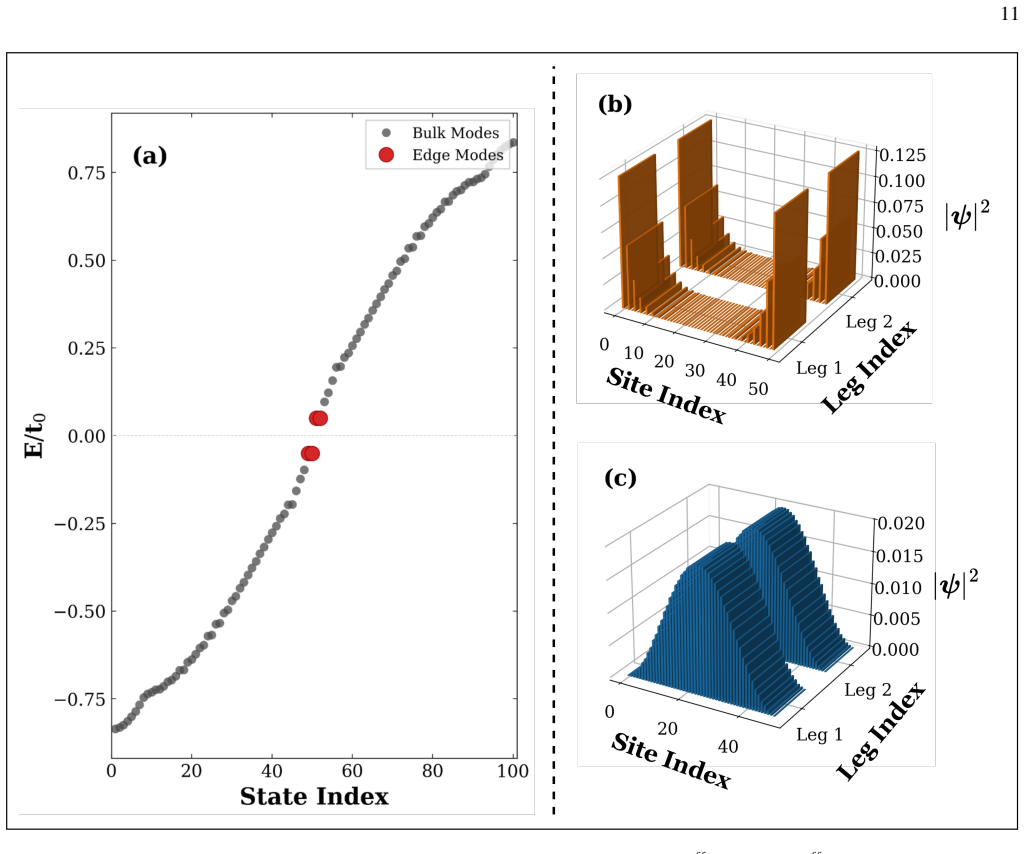
In dimerized arrays of chiral dipolar molecules described by an effective spin-1/2 model, the chirality-induced Dzyaloshinskii-Moriya interaction produces an SSH-like topological phase in which the two in-gap boundary modes carry opposite molecular chirality, with the left edge state localizing on a left-handed molecule and the right edge state on a right-handed molecule.
What carries the argument
Chirality-induced Dzyaloshinskii-Moriya interaction that amplifies effective hopping amplitudes and enlarges the bulk topological gap in the dimerized chain.
If this is right
- The topological gap is larger than in an achiral chain with the same dipole strength.
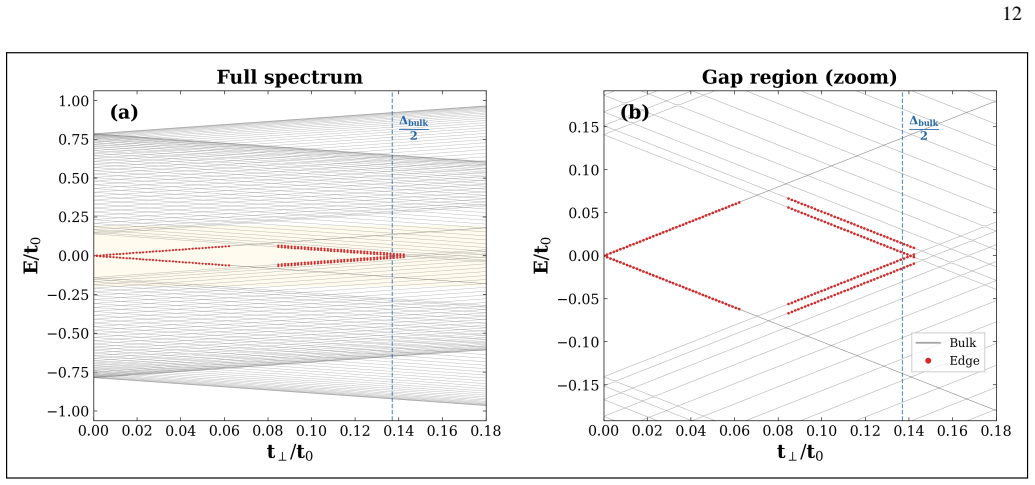
- The two-leg ladder extension yields a four-band bulk spectrum and a rung-split edge sector whose robustness is confirmed by sweeping interchain coupling.
- All results are expressed in units of the reference hopping scale t0 for direct use in experiments with bialkali molecules or ultracold chiral species.
- The boundary modes provide a stereochemical labeling mechanism without analogue in standard SSH implementations.
Where Pith is reading between the lines
- The opposite chirality at the edges may enable selective optical addressing or readout of individual topological states using molecular spectroscopy techniques.
- Varying the proportion of left- and right-handed molecules in the array could provide an additional control parameter for the topological phase diagram.
- The framework's generality suggests it could be adapted to other interacting dipolar systems beyond one dimension.
Load-bearing premise
The effective spin-1/2 model generated by Stark-dressed chiral molecules plus self-consistent mean-field theory accurately captures the interacting dipolar physics and the resulting topological phases.
What would settle it
Preparing an open-boundary dimerized array of chiral molecules and measuring the handedness of the molecules at the sites where the edge-state probability density is highest; observation that the left and right edges do not preferentially host opposite handedness would falsify the central claim.
Figures
read the original abstract
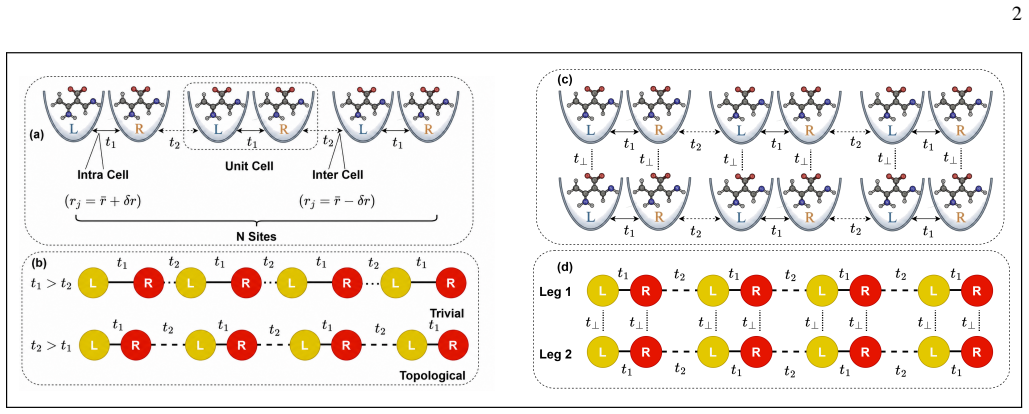
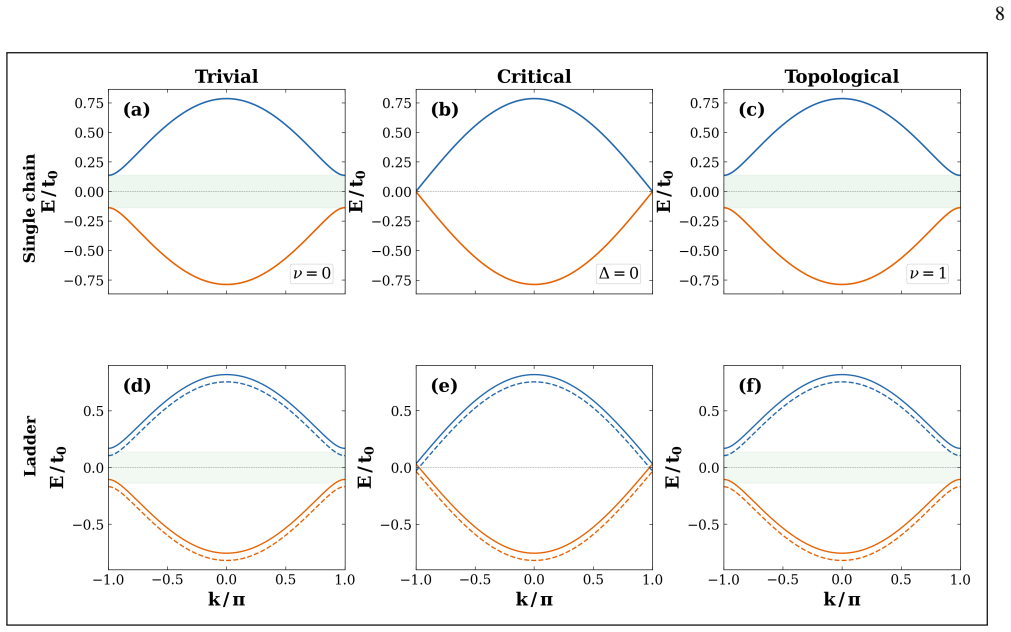
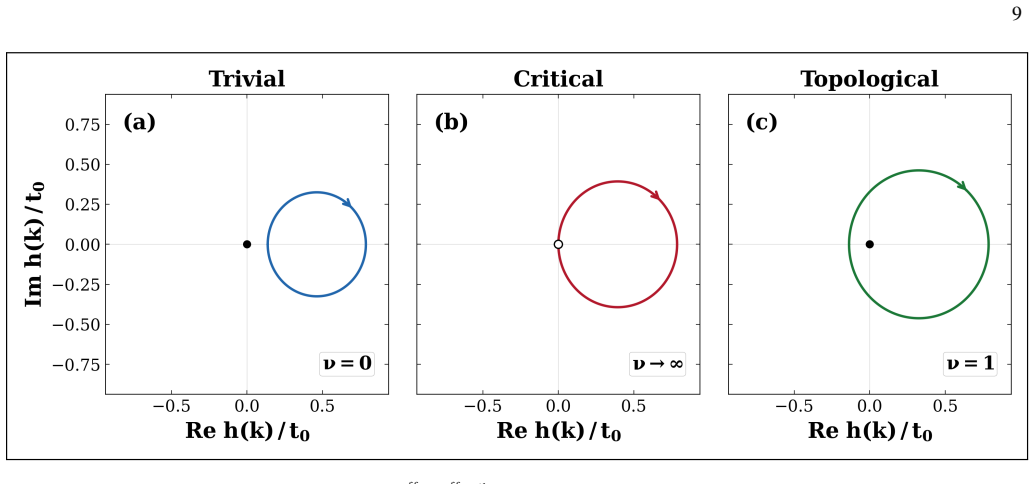
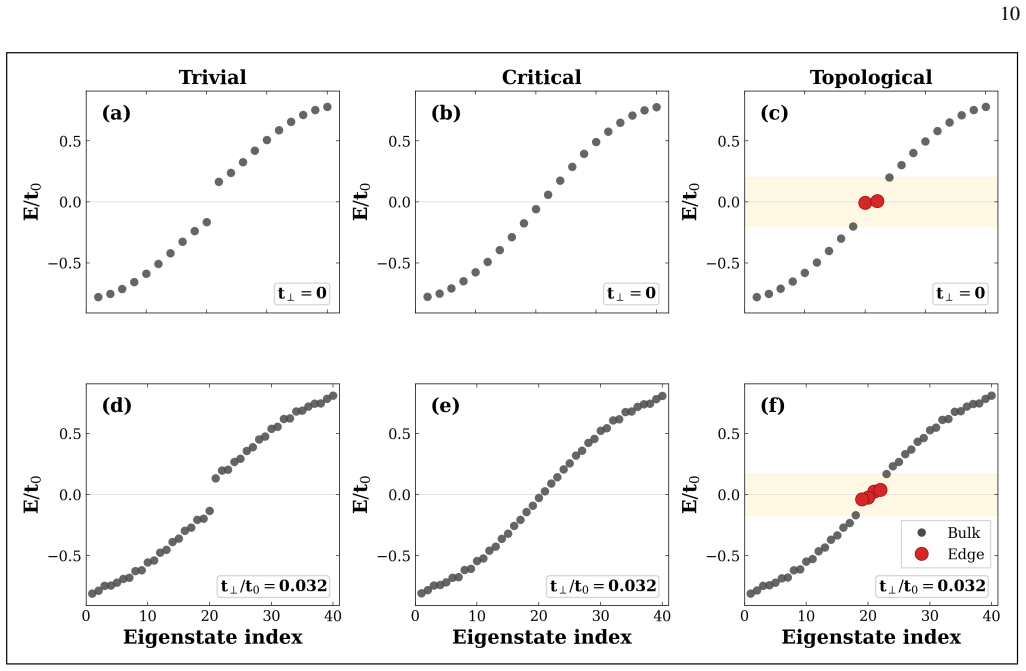
We establish a general theoretical framework for realizing topological edge states in dimerized arrays of chiral dipolar molecules and demonstrate that molecular handedness provides a natural and tunable route to SSH-like topology in an interacting one-dimensional setting. Starting from an effective spin-$\tfrac{1}{2}$ model generated by Stark-dressed chiral molecules, we introduce bond dimerization and show that the chirality-induced Dzyaloshinskii--Moriya interaction amplifies the effective hopping amplitudes and enlarges the bulk topological gap relative to an achiral chain of equivalent dipole strength. Using self-consistent mean-field theory with periodic- and open-boundary calculations, we map out the trivial, critical, and topological regimes through bulk spectra, complex-plane winding, and boundary-localized probability densities. A central result is that the two in-gap boundary modes carry \emph{opposite molecular chirality}: the left edge state localizes on a left-handed molecule and the right edge state on a right-handed molecule, a stereochemical labeling with no analogue in conventional SSH implementations. The two-leg ladder extension supports a richer four-band bulk structure and a rung-split edge sector whose robustness is characterized by a continuous sweep of the interchain coupling. All results are expressed in dimensionless units of the reference hopping scale $t_0$, making the framework directly applicable to any dipolar molecular platform -- from bialkali polar molecules at MHz coupling scales to future arrays of ultracold chiral polyatomic species. These findings establish dimerized chiral molecular arrays as a controllable and chirality-addressable platform for quasi-one-dimensional topological quantum matter.
Editorial analysis
A structured set of objections, weighed in public.
Referee Report
Summary. The manuscript develops a general theoretical framework for topological edge states in dimerized arrays of chiral dipolar molecules. Starting from an effective spin-1/2 model for Stark-dressed chiral molecules, it introduces bond dimerization and incorporates the chirality-induced Dzyaloshinskii-Moriya interaction to amplify effective hoppings and enlarge the topological gap. Self-consistent mean-field theory is used with periodic- and open-boundary calculations to map trivial, critical, and topological regimes via bulk spectra, complex-plane winding numbers, and boundary-localized densities. The central result is that the two in-gap boundary modes carry opposite molecular chirality (left edge localizes on left-handed molecules, right edge on right-handed), with an extension to two-leg ladders and all results in dimensionless units of t0.
Significance. If the central claim holds, the work provides a significant advance by establishing molecular handedness as a tunable, stereochemical handle for SSH-like topology in interacting 1D dipolar systems, with no direct analogue in conventional implementations. The generality in dimensionless units and applicability to platforms ranging from bialkali molecules to ultracold polyatomic species strengthens its potential impact for quasi-1D topological quantum matter.
major comments (2)
- [Numerical results and mean-field implementation sections] The phase mapping, winding numbers, and assignment of opposite chirality to the left and right in-gap boundary modes (abstract and central result) are obtained exclusively within self-consistent mean-field decoupling of the dipolar interactions on the effective spin-1/2 Hamiltonian. In 1D with long-range terms, mean-field is known to overestimate ordering; without benchmarks against DMRG, exact diagonalization, or fluctuation corrections, it is unclear whether the stereochemical labeling of edge states survives beyond the saddle-point approximation.
- [Bulk spectra and winding number calculations] The bulk spectra and complex-plane winding analysis (used to distinguish trivial/topological regimes) are performed on the mean-field Hamiltonian; the manuscript does not address how the winding number remains well-defined or quantized once quantum fluctuations or the full interacting dipolar terms are restored, which is load-bearing for the topological classification claim.
minor comments (2)
- [Introduction and conclusions] The abstract states that 'all results are expressed in dimensionless units of the reference hopping scale t0', but the main text should explicitly tabulate or state the mapping from physical parameters (dipole strength, Stark field, etc.) to t0 for experimental relevance.
- [Two-leg ladder extension] Notation for the two-leg ladder extension (rung-split edge sector) could be clarified with an explicit Hamiltonian or figure label to distinguish interchain coupling from the dimerization parameter.
Simulated Author's Rebuttal
We thank the referee for the careful reading and constructive comments on our manuscript. We address each major comment below, acknowledging the limitations of the mean-field approach while clarifying the scope of our claims.
read point-by-point responses
-
Referee: [Numerical results and mean-field implementation sections] The phase mapping, winding numbers, and assignment of opposite chirality to the left and right in-gap boundary modes (abstract and central result) are obtained exclusively within self-consistent mean-field decoupling of the dipolar interactions on the effective spin-1/2 Hamiltonian. In 1D with long-range terms, mean-field is known to overestimate ordering; without benchmarks against DMRG, exact diagonalization, or fluctuation corrections, it is unclear whether the stereochemical labeling of edge states survives beyond the saddle-point approximation.
Authors: We agree that self-consistent mean-field theory is an approximation whose accuracy in one-dimensional long-range interacting systems requires caution, as it can overestimate ordering. Our work develops a general theoretical framework within this approximation, where the effective single-particle Hamiltonian obtained after decoupling permits standard topological diagnostics. The opposite chirality assignment to the edge modes follows directly from the structure of the chirality-dependent Dzyaloshinskii-Moriya term in the decoupled model. We will revise the manuscript to add an explicit discussion of the mean-field limitations, its regime of applicability to the considered molecular platforms, and the fact that the stereochemical labeling is demonstrated within this controlled approximation. Benchmarks against DMRG or exact methods are computationally demanding for the long-range case and fall outside the present scope focused on the framework. revision: partial
-
Referee: [Bulk spectra and winding number calculations] The bulk spectra and complex-plane winding analysis (used to distinguish trivial/topological regimes) are performed on the mean-field Hamiltonian; the manuscript does not address how the winding number remains well-defined or quantized once quantum fluctuations or the full interacting dipolar terms are restored, which is load-bearing for the topological classification claim.
Authors: The winding number is computed on the mean-field Hamiltonian, which is the effective quadratic model after self-consistent decoupling; within this approximation it is well-defined and quantized following the standard non-interacting classification. The manuscript presents the topological regimes and the chirality-labeled edge states as properties of this mean-field description rather than claiming exact quantization in the full interacting theory. We will add a clarifying statement in the relevant section explaining that the topological classification is performed within the mean-field framework and noting the distinction from the full interacting problem. revision: partial
Circularity Check
No significant circularity; derivation proceeds from effective Hamiltonian via standard mean-field and topological diagnostics
full rationale
The paper begins with an effective spin-1/2 Hamiltonian for Stark-dressed chiral molecules, introduces explicit bond dimerization and chirality-induced DM terms, then applies self-consistent mean-field decoupling followed by direct diagonalization of periodic and open chains to extract spectra, winding numbers, and site-resolved densities. The central observation that left and right edge modes localize on opposite molecular chiralities is obtained by solving the resulting mean-field equations on finite chains; it is not imposed by definition, by parameter fitting, or by a self-citation chain. No equations reduce a claimed prediction to an input by algebraic identity, and no load-bearing uniqueness theorem is imported from prior work by the same authors. The framework therefore remains self-contained against external benchmarks within the stated mean-field approximation.
Axiom & Free-Parameter Ledger
axioms (2)
- domain assumption Effective spin-1/2 model generated by Stark-dressed chiral molecules
- domain assumption Self-consistent mean-field theory sufficient for the interacting one-dimensional setting
Reference graph
Works this paper leans on
-
[1]
M. Z. Hasan and C. L. Kane, Rev. Mod. Phys.82, 3045 (2010)
2010
-
[2]
Qi and S.-C
X.-L. Qi and S.-C. Zhang, Rev. Mod. Phys.83, 1057 (2011)
2011
-
[3]
Phys.88, 035005 (2016)
C.-K.Chiu,J.C.Y.Teo,A.P.Schnyder, andS.Ryu,Rev.Mod. Phys.88, 035005 (2016)
2016
-
[4]
Bansil, H
A. Bansil, H. Lin, and T. Das, Rev. Mod. Phys.88, 021004 (2016)
2016
-
[5]
W.P.Su,J.R.Schrieffer, andA.J.Heeger,Phys.Rev.Lett.42, 1698 (1979)
1979
-
[6]
A. J. Heeger, S. Kivelson, J. R. Schrieffer, and W. P. Su, Rev. Mod. Phys.60, 781 (1988)
1988
-
[7]
J. K. Asbóth, L. Oroszlány, and A. Pályi,A Short Course on Topological Insulators(Springer, Cham, 2016)
2016
-
[8]
Atala, M
M. Atala, M. Aidelsburger, J. T. Barreiro, D. Abanin, T. Kita- gawa, E. Demler, and I. Bloch, Nature Physics9, 795 (2013)
2013
-
[9]
91, 015005 (2019)
N.R.Cooper,J.Dalibard, andI.B.Spielman,Rev.Mod.Phys. 91, 015005 (2019)
2019
-
[10]
T.Ozawa,H.M.Price,A.Amo,N.Goldman,M.Hafezi,L.Lu, M. C. Rechtsman, D. Schuster, J. Simon, O. Zilberberg, and I. Carusotto, Rev. Mod. Phys.91, 015006 (2019)
2019
-
[11]
L. Lu, J. D. Joannopoulos, and M. Soljačić, Nature Photonics 8, 821 (2014)
2014
-
[12]
E.J.Meier,F.A.An, andB.Gadway,NatureCommunications 7, 13986 (2016)
2016
-
[13]
L. D. Carr, D. DeMille, R. V. Krems, and J. Ye, New Journal of Physics11, 055049 (2009)
2009
-
[14]
J. L. Bohn, A. M. Rey, and J. Ye, Science357, 1002 (2017)
2017
-
[15]
Kais, and A
J.D.Weidman,M.Sajjan,C.Mikolas,Z.J.Stewart,J.Pollanen, S. Kais, and A. K. Wilson, Cell Reports Physical Science5, 102105 (2024)
2024
-
[16]
Daskin and S
A. Daskin and S. Kais, J. Chem. Phys.135, 154102 (2011)
2011
-
[17]
J. Zhu, S. Kais, Q. Wei, D. Herschbach, and B. Friedrich, The Journal of Chemical Physics138, 024104 (2013)
2013
-
[18]
A.Micheli,G.K.Brennen, andP.Zoller,NaturePhysics2,341 (2006)
2006
-
[19]
Sawant, J
R. Sawant, J. A. Blackmore, P. D. Gregory, J. Mur-Petit, D.Jaksch,J.Aldegunde,J.M.Hutson,M.R.Tarbutt, andS.L. Cornish, New Journal of Physics22, 013027 (2020)
2020
-
[20]
L.Anderegg,N.B.Vilas,C.Hallas,P.Robichaud,A.Jadbabaie, J. M. Doyle, and N. R. Hutzler, Science382, 665 (2023)
2023
-
[21]
A. M. Kaufman and K.-K. Ni, Nature Physics17, 1324 (2021)
2021
-
[22]
Anderegg, L
L. Anderegg, L. W. Cheuk, Y. Bao, S. Burchesky, W. Ketterle, K.-K. Ni, and J. M. Doyle, Science365, 1156 (2019)
2019
-
[23]
D. K. Ruttley, T. R. Hepworth, A. Guttridge, S. J. Spence, and S. L. Cornish, PRX Quantum5, 020333 (2024)
2024
-
[24]
C. M. Holland, Y. Lu, and L. W. Cheuk, Science382, 1143 (2023)
2023
-
[25]
Ni, and J
Y.Bao,S.Burchesky,S.Yu,L.Anderegg,W.Ketterle,E.Chae, K.-K. Ni, and J. M. Doyle, Science382, 1138 (2023)
2023
-
[26]
D.K.Ruttley,T.R.Hepworth,A.Guttridge, andS.L.Cornish, Nature637, 827 (2025)
2025
- [27]
-
[28]
I.Dzyaloshinsky,JournalofPhysicsandChemistryofSolids4, 241 (1958)
1958
-
[29]
Moriya, Phys
T. Moriya, Phys. Rev.120, 91 (1960)
1960
-
[30]
L. R. Liu, J. D. Hood, Y. Yu, J. T. Zhang, N. R. Hutzler, T. Rosenband, and K.-K. Ni, Science360, 900 (2018)
2018
-
[31]
Fang, and K.-K
J.T.Zhang, L.R.B.Picard, W.B.Cairncross, K.Wang, Y.Yu, F. Fang, and K.-K. Ni, Quantum Science and Technology7, 035006 (2022). 14
2022
-
[32]
Opticaltweezerarraysofpolarmolecules,
CheukLab,“Opticaltweezerarraysofpolarmolecules,”Prince- ton University research group webpage (2024), accessed 2026- 05-19
2024
-
[33]
Ni, Phys
W.B.Cairncross, J.T.Zhang, L.R.B.Picard, Y.Yu, K.Wang, and K.-K. Ni, Phys. Rev. Lett.126, 123402 (2021)
2021
-
[34]
Mitra, N
D. Mitra, N. B. Vilas, C. Hallas, L. Anderegg, B. L. Augen- braun, L. Baum, C. Miller, S. Raval, and J. M. Doyle, Science 369, 1366 (2020)
2020
-
[35]
Fidkowski and A
L. Fidkowski and A. Kitaev, Phys. Rev. B83, 075103 (2011)
2011
-
[36]
Tang and X.-G
E. Tang and X.-G. Wen, Phys. Rev. Lett.109, 096403 (2012)
2012
-
[37]
S. R. Manmana, A. M. Essin, R. M. Noack, and V. Gurarie, Phys. Rev. B86, 205119 (2012)
2012
-
[38]
Di Salvo, A
E. Di Salvo, A. Moustaj, C. Xu, L. Fritz, A. K. Mitchell, C. Morais Smith, and D. Schuricht, Phys. Rev. B110, 165145 (2024). Appendix A: Gauge Transformation, Jordan–Wigner Mapping, and the Interacting SSH Chain This appendix derives the interacting SSH Hamiltonian used in Sec. II. We start from the chiral XXZ spin Hamiltonian, rewrite the transverse part...
2024
-
[39]
Starting spin Hamiltonian In the Pauli-matrix convention, the effective open-chain spin Hamiltonian is ̂𝐻spin = 𝑁−1∑ 𝑗=1 [ 𝐽𝑥𝑦,𝑗(̂ 𝜎𝑥 𝑗 ̂ 𝜎𝑥 𝑗+1 +̂ 𝜎𝑦 𝑗 ̂ 𝜎𝑦 𝑗+1) −𝐷 𝑗(̂ 𝜎𝑥 𝑗 ̂ 𝜎𝑦 𝑗+1 −̂ 𝜎𝑦 𝑗 ̂ 𝜎𝑥 𝑗+1) +𝐽 𝑧,𝑗 ̂ 𝜎𝑧 𝑗 ̂ 𝜎𝑧 𝑗+1 ] +ℎ 𝑁∑ 𝑗=1 ̂ 𝜎𝑧 𝑗 .(A1) Herê 𝜎𝛼 𝑗 are Pauli matrices acting on site𝑗. The coefficient𝐽𝑥𝑦,𝑗 is the symmetric transverse exchange,𝐷𝑗...
-
[40]
Transverse exchange in ladder-operator form We now isolate the transverse part of Eq. (A1). For a single bond(𝑗, 𝑗+ 1), define ̂𝐻 𝑥𝑦+𝐷𝑀 𝑗 =𝐽 𝑥𝑦,𝑗(̂ 𝜎𝑥 𝑗 ̂ 𝜎𝑥 𝑗+1 +̂ 𝜎𝑦 𝑗 ̂ 𝜎𝑦 𝑗+1) −𝐷 𝑗(̂ 𝜎𝑥 𝑗 ̂ 𝜎𝑦 𝑗+1 −̂ 𝜎𝑦 𝑗 ̂ 𝜎𝑥 𝑗+1).(A8) 15 ThisisthepartoftheHamiltoniancontainingthesymmetrictransverseexchangeandtheantisymmetricDMinteractiononbond 𝑗. Introduce the ladde...
-
[41]
(A11) can be removed by a site-dependent rotation about the𝑧-axis
Gauge transformation The complex phase in Eq. (A11) can be removed by a site-dependent rotation about the𝑧-axis. We define 𝑈= 𝑁∏ 𝑗=1 exp [ − 𝑖 2 𝜙𝑗 ̂ 𝜎𝑧 𝑗 ] .(A14) The factor1∕2appears because the generator of a spin rotation iŝ 𝜎𝑧 𝑗 ∕2. Using [̂ 𝜎𝑧 𝑗 , ̂ 𝜎+ 𝑗 ] = 2̂ 𝜎+ 𝑗 ,[̂ 𝜎𝑧 𝑗 , ̂ 𝜎− 𝑗 ] = −2̂ 𝜎− 𝑗 , one obtains 𝑈 ̂ 𝜎+ 𝑗 𝑈 † =𝑒 −𝑖𝜙𝑗 ̂ 𝜎+ 𝑗 , 𝑈 ̂ 𝜎− 𝑗...
-
[42]
(A20) to spinless fermions
Jordan–Wigner transformation We now map Eq. (A20) to spinless fermions. The Jordan–Wigner transformation is ̂ 𝜎+ 𝑗 =̂ 𝑐† 𝑗 ∏ 𝓁<𝑗 (1 − 2̂ 𝑛𝓁),(A21) ̂ 𝜎− 𝑗 = ∏ 𝓁<𝑗 (1 − 2̂ 𝑛𝓁)̂ 𝑐𝑗,(A22) ̂ 𝜎𝑧 𝑗 = 2̂ 𝑛𝑗 − 1, ̂ 𝑛𝑗 =̂ 𝑐† 𝑗 ̂ 𝑐𝑗.(A23) Thestringoperatorsensurethatfermionsondifferentsitesanticommute. Fornearest-neighbortermsonanopenchain,thestrings cancel. Explici...
-
[43]
We use the convention 𝑟𝑗 =̄ 𝑟− (−1)𝑗𝛿𝑟.(A35) Thus 𝑗odd ∶𝑟 𝑗 =̄ 𝑟+𝛿𝑟, 𝑗even ∶𝑟 𝑗 =̄ 𝑟−𝛿𝑟
Dimerization and interacting SSH form The SSH structure is introduced by alternating the molecular spacing along the chain. We use the convention 𝑟𝑗 =̄ 𝑟− (−1)𝑗𝛿𝑟.(A35) Thus 𝑗odd ∶𝑟 𝑗 =̄ 𝑟+𝛿𝑟, 𝑗even ∶𝑟 𝑗 =̄ 𝑟−𝛿𝑟. SinceΩ(𝑟) ∝𝑟 −3, the shorter bond has the larger hopping. Using Eq. (A28), the two alternating hoppings are 𝑡1 = 2 ̃𝐽𝑥𝑦(̄ 𝑟) ( ̄ 𝑟 ̄ 𝑟+𝛿𝑟 )3 , 𝑡...
-
[44]
We take𝑁= 2𝑁 𝑐, where𝑁𝑐 is the number of two-site unit cells
Periodic-boundary formulation After Hartree–Fock decoupling, the reduced mean-field Hamiltonian is ̂𝐻 ′ MF = ∑ 𝑗odd 𝑡ef f 1 (̂ 𝑐† 𝑗 ̂ 𝑐𝑗+1 + h.c.) + ∑ 𝑗even 𝑡ef f 2 (̂ 𝑐† 𝑗 ̂ 𝑐𝑗+1 + h.c.),(C1) where 𝑡ef f 1 =𝑡 1 − 4𝐽𝑧𝜒1, 𝑡 ef f 2 =𝑡 2 − 4𝐽𝑧𝜒2. We take𝑁= 2𝑁 𝑐, where𝑁𝑐 is the number of two-site unit cells. The odd bonds are the intracell bonds and the even ...
-
[45]
(C5) follow from det[(𝑘) −𝐸𝕀 ] = det ( −𝐸 𝑞(𝑘) 𝑞∗(𝑘) −𝐸 ) =𝐸 2 −|𝑞(𝑘)| 2
Bulk spectrum and gap closing The eigenvalues of Eq. (C5) follow from det[(𝑘) −𝐸𝕀 ] = det ( −𝐸 𝑞(𝑘) 𝑞∗(𝑘) −𝐸 ) =𝐸 2 −|𝑞(𝑘)| 2. The characteristic equation is 𝐸2 =|𝑞(𝑘)| 2, so 𝐸±(𝑘) = ±|𝑞(𝑘)|. Now 𝑞(𝑘) =𝑡 ef f 1 +𝑡 ef f 2 (cos𝑘−𝑖sin𝑘), and hence |𝑞(𝑘)|2 = [𝑡ef f 1 +𝑡 ef f 2 cos𝑘 ]2 + [𝑡ef f 2 sin𝑘 ]2 = (𝑡 ef f 1 )2 + 2𝑡ef f 1 𝑡ef f 2 cos𝑘+ (𝑡 ef f 2 )2(co...
-
[46]
Writing 𝑞(𝑘) =𝑢(𝑘) +𝑖𝑣(𝑘), we have 𝑢(𝑘) = Re𝑞(𝑘) =𝑡 ef f 1 +𝑡 ef f 2 cos𝑘, 𝑣(𝑘) = Im𝑞(𝑘) = −𝑡 ef f 2 sin𝑘
Winding number The topological invariant is determined by the phase of the complex function𝑞(𝑘). Writing 𝑞(𝑘) =𝑢(𝑘) +𝑖𝑣(𝑘), we have 𝑢(𝑘) = Re𝑞(𝑘) =𝑡 ef f 1 +𝑡 ef f 2 cos𝑘, 𝑣(𝑘) = Im𝑞(𝑘) = −𝑡 ef f 2 sin𝑘. As𝑘issweptfrom−𝜋to𝜋,thepoint(𝑢(𝑘), 𝑣(𝑘))tracesacircleinthecomplexplane. Thecirclehasradius|𝑡 ef f 2 |andiscentered at(𝑡 ef f 1 ,0). The winding number co...
-
[47]
This is useful for phase diagrams because boundary effects are absent and the finite sums are replaced by smooth momentum-space integrals
Periodic-boundary self-consistency The same periodic-boundary formulation gives a compact self-consistency scheme for the bulk bond-order parameters. This is useful for phase diagrams because boundary effects are absent and the finite sums are replaced by smooth momentum-space integrals. At half filling, the lower band of Eq. (C5) is occupied. Write 𝑞(𝑘) ...
-
[48]
Open-boundary spectrum and edge states Under open boundary conditions, the closing bond is absent. In the site basis Ψ = (̂ 𝑐1, ̂ 𝑐2,…, ̂ 𝑐𝑁 )𝑇 , the reduced mean-field Hamiltonian is represented by the tridiagonal matrix 𝐻OBC = ⎛ ⎜ ⎜ ⎜ ⎜ ⎜ ⎜ ⎜⎝ 0𝑡 ef f 1 0 0⋯0 𝑡ef f 1 0𝑡 ef f 2 0⋯0 0𝑡 ef f 2 0𝑡 ef f 1 ⋯0 0 0𝑡 ef f 1 0⋯0 ⋮ ⋮ ⋮ ⋮ ⋱𝑡 ef f 𝑁−1 0 0 0 0𝑡 ef f ...
-
[49]
Each leg contains𝑁sites
Interacting ladder Hamiltonian We consider two identical dimerized chains labelled by the leg index 𝜆= 1,2. Each leg contains𝑁sites. The fermionic operators are ̂ 𝑐𝜆,𝑗, ̂ 𝑐† 𝜆,𝑗, ̂ 𝑛𝜆,𝑗 =̂ 𝑐† 𝜆,𝑗 ̂ 𝑐𝜆,𝑗, where𝑗= 1,…, 𝑁. Along each leg, the hopping alternates according to 𝑡𝑗 = { 𝑡1, 𝑗odd, 𝑡2, 𝑗even. 31 Odd bonds are the intracell bonds and even bonds are t...
-
[50]
Mean-field reduction of the ladder The intrachain interaction is decoupled exactly as in Appendix B. Since the two legs are identical, the intrachain bond-order parameters are averaged over both legs: 𝜒1 = 1 1 2∑ 𝜆=1 ∑ 𝑗odd ⟨ ̂ 𝑐† 𝜆,𝑗 ̂ 𝑐𝜆,𝑗+1 ⟩ , 𝜒2 = 1 2 2∑ 𝜆=1 ∑ 𝑗even ⟨ ̂ 𝑐† 𝜆,𝑗 ̂ 𝑐𝜆,𝑗+1 ⟩ . Here 1 and 2 are the total numbers of type-1and type-2int...
-
[51]
Weorderthesingle-particlebasisas Ψ = (̂ 𝑐1,1, ̂ 𝑐1,2,…, ̂ 𝑐1,𝑁 , ̂ 𝑐2,1, ̂ 𝑐2,2,…, ̂ 𝑐2,𝑁 )𝑇
Open-boundary matrix representation Underopenboundaryconditions,nobondconnectssite𝑁backtosite1alongeitherleg. Weorderthesingle-particlebasisas Ψ = (̂ 𝑐1,1, ̂ 𝑐1,2,…, ̂ 𝑐1,𝑁 , ̂ 𝑐2,1, ̂ 𝑐2,2,…, ̂ 𝑐2,𝑁 )𝑇 . In this basis, the ladder Hamiltonian takes the block form 𝐻 OBC ladder = (𝐻SSH 𝑡ef f ⟂ 𝕀𝑁 𝑡ef f ⟂ 𝕀𝑁 𝐻SSH ) .(D5) Here𝐻 SSH is the𝑁×𝑁open-boundary SSH ...
-
[52]
As in Appendix C, odd and even sites are Fourier transformed separately on each leg: ̂ 𝑐𝜆,2𝑚−1 = 1√ 𝑁𝑐 ∑ 𝑘 𝑒𝑖𝑘𝑚 ̂ 𝑐𝜆,o,𝑘, ̂ 𝑐𝜆,2𝑚 = 1√ 𝑁𝑐 ∑ 𝑘 𝑒𝑖𝑘𝑚 ̂ 𝑐𝜆,e,𝑘, where𝑁 𝑐 =𝑁∕2
Periodic-boundary Bloch Hamiltonian For the bulk ladder spectrum, we impose periodic boundary conditions along the chains. As in Appendix C, odd and even sites are Fourier transformed separately on each leg: ̂ 𝑐𝜆,2𝑚−1 = 1√ 𝑁𝑐 ∑ 𝑘 𝑒𝑖𝑘𝑚 ̂ 𝑐𝜆,o,𝑘, ̂ 𝑐𝜆,2𝑚 = 1√ 𝑁𝑐 ∑ 𝑘 𝑒𝑖𝑘𝑚 ̂ 𝑐𝜆,e,𝑘, where𝑁 𝑐 =𝑁∕2. The four-component Bloch spinor is Ψ𝑘 = (̂ 𝑐1,o,𝑘, ̂ 𝑐1,e,𝑘, ̂...
-
[53]
Bonding–antibonding block diagonalization Therunghoppingactsonlyinthelegspaceandisproportionaltotheidentityintheodd-evensublatticespace. Therefore, the ladder Hamiltonian can be diagonalized in the leg sector by forming bonding and antibonding combinations: ̂ 𝑐+,o,𝑘 = 1√ 2 (̂ 𝑐1,o,𝑘 +̂ 𝑐2,o,𝑘), ̂ 𝑐−,o,𝑘 = 1√ 2 (̂ 𝑐1,o,𝑘 −̂ 𝑐2,o,𝑘), and ̂ 𝑐+,e,𝑘 = 1√ 2 (̂ ...
-
[54]
Because both sectors contain the same𝑞(𝑘), 𝜈+ =𝜈 − =𝜈 SSH
Ladder winding number The winding number of each bonding sector is determined by the same function𝑞(𝑘)as in the single chain: 𝜈𝜂 = 1 2𝜋 ∫ 𝜋 −𝜋 𝑑𝑘 𝑑 𝑑𝑘 arg𝑞(𝑘), 𝜂= ±1. Because both sectors contain the same𝑞(𝑘), 𝜈+ =𝜈 − =𝜈 SSH. The total ladder winding number is therefore 𝜈ladder =𝜈 + +𝜈 − = 2𝜈 SSH.(D9) In terms of the hopping amplitudes, |𝜈ladder|= { 2,|𝑡 ...
-
[55]
If each leg is in the topological phase, each chain contributes one left edge state and one right edge state
Edge-state splitting and protection condition In the decoupled limit𝑡ef f ⟂ = 0, the ladder is simply two independent SSH chains. If each leg is in the topological phase, each chain contributes one left edge state and one right edge state. The ladder therefore contains four edge states in total. When𝑡 ef f ⟂ ≠0, the two edge states located at the same bou...
-
[56]
Diagonalizing Eq
Ladder self-consistency The open-boundary self-consistency procedure is a direct extension of the single-chain calculation. Diagonalizing Eq. (D5), let 𝜓𝑚(𝜆, 𝑗) 36 betheamplitudeofthe𝑚-theigenstateonleg𝜆andsite𝑗. Theladderhas2𝑁sites,soathalffillingthelowest𝑁single-particle states are occupied. The intrachain bond orders are 𝜒1 = 1 1 ∑ 𝑚∈occ 2∑ 𝜆=1 ∑ 𝑗odd...
discussion (0)
Sign in with ORCID, Apple, or X to comment. Anyone can read and Pith papers without signing in.