REVIEW 3 major objections 4 minor 2 cited by
A Comprehensive Survey of Electronic Health Record Modeling: From Deep Learning Approaches to Large Language Models
T0 review · 3 major / 4 minor · reviewed 2026-08-06 · deepseek-v4-flash
Pith's one-line read This survey claims that EHR modeling research can be organized by five design dimensions, and it supplies a taxonomy, a dataset inventory, and a metric guide to back that claim.
desk verdict A useful taxonomic frame for EHR modeling, but the manuscript is too incomplete to support the 'comprehensive' claim. read the letter →
The pith
A machine-rendered reading of the paper's core claim, the machinery that carries it, and where it could break.
The reading
What carries the argument
The load-bearing object is the taxonomy itself: a coarse-to-fine grid whose top level has five design dimensions and whose lower levels split each dimension into concrete choices, such as sample selection, input-space transformation, tree, graph, and rule architectures, irregular-sampling handling, contrastive and masked objectives, retrieval-augmented generation, and agent planning. It does the work of turning a large citation list into a finite set of design decisions. A secondary organizing device is a three-projection view of EHR data covering $time \times feature$, $feature \times value$, and $time \times value$, which maps components of a record such as workflows, lab results, and longitudinal trends to the modeling challenges they create.
What would settle it
A reader could rerun the stated keyword search on the repositories listed in the paper and count how many EHR modeling papers published since 2020 fall outside the reviewed set; if a substantial method family, such as reinforcement-learning-based treatment policies or privacy-preserving federated EHR models, is absent from the taxonomy, the comprehensive-coverage claim would need revision.
Extended reading notes
Core claim
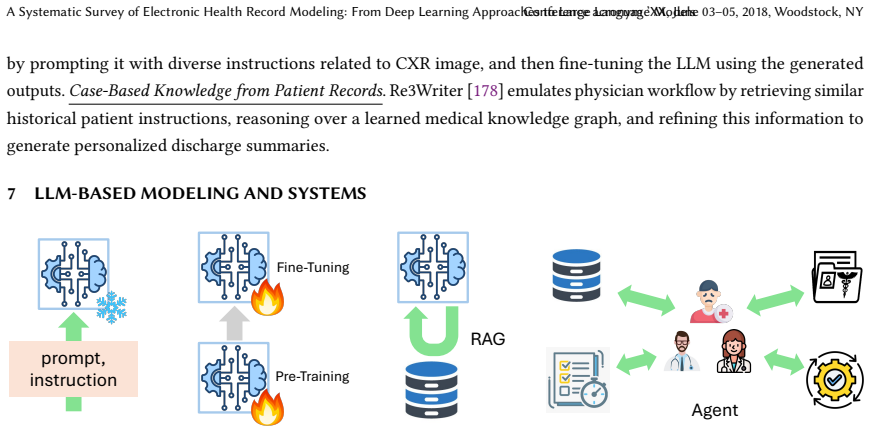
On the paper's own terms, the central claim is that EHR modeling has matured into a design space that can be surveyed as a whole rather than as isolated model families. The authors build a coarse-to-fine taxonomy whose top level spans five design dimensions and use it to place hundreds of methods, from ontology-graph attention models and time-aware recurrent networks to EHR-to-text translation and memory-equipped LLM agents. The taxonomy is paired with an inventory of public datasets and a set of evaluation metrics mapped to downstream tasks, from classification and survival analysis to ranking and generative modeling. If the claim holds, nearly every recent method occupies a recognizable cell in this grid, and the grid itself makes the field's open problems visible as structural gaps.
Load-bearing premise
The survey is comprehensive only if its keyword search and inclusion criteria capture the field, but the paper reports the keywords without screening counts or an exclusion log.
Editorial extensions
If this is right
- A researcher can locate any EHR modeling method by asking which design dimension it modifies, which makes method comparison and reuse more systematic.
- The consolidated dataset and metric inventory lowers the entry barrier for new groups and gives the community a shared evaluation vocabulary.
- The survey's open-problem list becomes a concrete agenda: benchmarking, explainability, clinical alignment, and generalization across settings follow directly from gaps in the taxonomy.
- Emerging families such as foundation models for multimodal clinical data, EHR-to-text translation, and LLM-driven agents appear as natural extensions of the multimodal and LLM dimensions rather than as disconnected outliers.
Reading between the lines
- If the taxonomy is maintained on the companion website the paper points to, it could evolve from a static survey into a living registry that tracks new methods beyond 2025.
- The taxonomy's design-choice framing may transfer to other longitudinal structured data domains, such as wearable-device streams or insurance claims, because it organizes methods by what they change rather than by clinical task; the paper does not make this claim.
- A testable consequence of the taxonomy's completeness is that every recent EHR modeling paper should fit in at least one primary cell; papers that straddle multiple dimensions would expose where the grid needs refinement.
Editorial analysis
A structured set of objections, weighed in public.
Referee Report
Summary. The manuscript is a survey of electronic health record (EHR) modeling that proposes a unified taxonomy spanning data-centric approaches, neural architecture design, learning-focused strategies, multimodal learning, and LLM-based systems. It reviews representative methods in each area, outlines clinical applications, summarizes public datasets and evaluation metrics, and discusses open problems such as benchmarking, explainability, and clinical alignment. The paper claims to be the first comprehensive survey to unify these dimensions and provides a companion website for updates.
Significance. If the survey's coverage and organization are reliable, it would be a useful entry point for researchers: the five-dimension taxonomy is intuitively structured, the consolidated dataset tables (Tables 6 and 7) and metric table (Table 8) are practical resources, and the discussion of LLM-based agents and multimodal clinical AI reflects current trends. The paper also gives credit to a broad range of recent work and explicitly identifies open problems. However, the central 'comprehensive scope' contribution is not currently verifiable because the literature collection protocol is unreproducible and internally inconsistent with the actual reference set. The survey's value as a roadmap depends on fixing this gap.
major comments (3)
- [§1.3 and §1.4] The literature-collection protocol is not reproducible and is internally inconsistent with the reviewed corpus. Section 1.3 restricts inclusion to papers 'Published in or after 2020,' yet the survey discusses and cites foundational pre-2020 works as core methods, including RETAIN [60] (2016), T-LSTM [18] (2017), GRAM [59] (2017), and Neural ODEs [46] (2018), both in the narrative (e.g., §4.3.1, §8.2.2) and in Table 2. Section 1.4 also states 'over *** papers' without a completed count, and no screening counts, exclusion log, or coverage analysis are reported. Because the stated inclusion criteria cannot reproduce the actual reference set, the central 'Comprehensive scope' claim is unsupported as written. Please revise the protocol to explain how pre-2020 foundational works were treated, add screening and exclusion counts, and complete the paper count.
- [Abstract and §1.4] The paper is inconsistent about the number of design dimensions in its central taxonomy. The abstract and §1.1 describe five dimensions, including multimodal learning, and Table 2 contains a Multimodal Learning category, but §1.4 states that the taxonomy spans 'four key design dimensions' and lists only data quantity/quality, neural architecture, learning objectives, and LLM paradigms, omitting multimodal learning from the list. This inconsistency directly affects the claimed contribution of a 'unified taxonomy' and should be reconciled.
- [Table 2 and §1.4] The manuscript contains editorial and placeholder artifacts that undermine its reliability as a survey. Table 2 includes the editorial note 'added [244, 346]' in the Zero/Few-Shot Prompting row and in the Retrieval-Augmented Methods row, and §1.4 contains the placeholder 'over *** papers' for the number of reviewed papers. These are not merely stylistic issues: the paper count is part of the comprehensiveness claim, and the editorial notes suggest the table was assembled from an unfinished draft. Please remove all editorial notes and provide a final, verified count.
minor comments (4)
- [§10.1] The 'Clinical Agent' paragraph is repeated verbatim twice in succession; one copy should be deleted.
- [§1.1] The structure description says 'Section 7 provides a comprehensive overview... Section 6 discusses...' while the actual section order in the text lists Section 5 then Section 7 then Section 6; reordering either the prose or the sections would improve readability.
- [§9.2] The opening sentence contains a typo: 'AA summary of the metrics' should be 'A summary of the metrics.'
- [Title page and front matter] The ACM Reference Format line gives the year 2018, the CCS Concepts block still contains placeholder text such as 'Do Not Use This Code,' and the running header retains 'Trovato and Tobin, et al.' These template artifacts should be cleaned before resubmission.
Circularity Check
No significant circularity: the survey proposes an organizing taxonomy and reviews prior work, with no derivation that reduces to its own inputs or to self-citation.
full rationale
This is a survey paper rather than a paper that derives predictions from fitted parameters or from a formal model. Its central contribution is a five-dimensional taxonomy for organizing EHR modeling methods, and a taxonomy is a categorization chosen by the authors, not a result derived from the reviewed papers in a way that could be circular. The paper does not fit parameters to data and then rename those fits as predictions; it does not invoke a uniqueness theorem from the authors' own prior work to force a modeling choice; and it does not smuggle in an ansatz via self-citation. The main weakness identified by the reviewer is a reproducibility and consistency issue in the literature-collection protocol: Section 1.3 states inclusion requires publication in or after 2020, yet the survey reviews and cites foundational pre-2020 works such as RETAIN [60], T-LSTM [18], GRAM [59], and Neural ODEs [46], and Section 1.4 contains a placeholder ('over *** papers'). That inconsistency undermines the 'comprehensive' claim and the reproducibility of the search, but it is not circularity: the taxonomy and the narrative summaries do not depend on the protocol by definition, and no load-bearing step is equivalent to its own input. The self-citations present (e.g., Ren et al. TabLog [237]) are ordinary citations to the authors' prior work and are not used to justify the survey's organizing framework. Because there is no derivation chain whose conclusions are presupposed by its premises, the appropriate circularity score is 0.
Assumptions & free parameters
assumptions (2)
- ad hoc to paper The five selected design dimensions fully organize EHR modeling research.
- domain assumption The keyword-based search returns the relevant literature.
Cite this review
Pith. "Pith review of A Comprehensive Survey of Electronic Health Record Modeling: From Deep Learning Approaches to Large Language Models." pith.science (2026). https://pith.science/paper/CKCKGU7N
@misc{pith2026250712774,
  author       = {Pith},
  title        = {Pith review of: A Comprehensive Survey of Electronic Health Record Modeling: From Deep Learning Approaches to Large Language Models},
  year         = {2026},
  howpublished = {\url{https://pith.science/paper/CKCKGU7N}},
  note         = {Machine review of arXiv:2507.12774}
}
read the original abstract
Artificial intelligence (AI) has demonstrated significant potential in transforming healthcare through the analysis and modeling of electronic health records (EHRs). However, the inherent heterogeneity, temporal irregularity, and domain-specific nature of EHR data present unique challenges that differ fundamentally from those in vision and natural language tasks. This survey offers a comprehensive overview of recent advancements at the intersection of deep learning, large language models (LLMs), and EHR modeling. We introduce a unified taxonomy that spans five key design dimensions: data-centric approaches, neural architecture design, learning-focused strategies, multimodal learning, and LLM-based modeling systems. Within each dimension, we review representative methods addressing data quality enhancement, structural and temporal representation, self-supervised learning, and integration with clinical knowledge. We further highlight emerging trends such as foundation models, LLM-driven clinical agents, and EHR-to-text translation for downstream reasoning. Finally, we discuss open challenges in benchmarking, explainability, clinical alignment, and generalization across diverse clinical settings. This survey aims to provide a structured roadmap for advancing AI-driven EHR modeling and clinical decision support. For a comprehensive list of EHR-related methods, kindly refer to https://survey-on-tabular-data.github.io/.
Figures


Figures from the paper (4 more)


Forward citations
Cited by 2 Pith papers
-
EHR-RAGp: Retrieval-Augmented Prototype-Guided Foundation Model for Electronic Health Records
EHR-RAGp is a retrieval-augmented EHR foundation model that employs prototype-guided retrieval to dynamically integrate relevant historical patient context, outperforming prior models on clinical prediction tasks.
-
Learning temporal embeddings from electronic health records of chronic kidney disease patients
T-LSTM embeddings on CKD EHR data yield lower DBI (9.91), higher stage classification accuracy (0.74), and better mortality prediction (0.82-0.83) than vanilla LSTM, attention LSTM, or end-to-end baselines.
Reference graph
Works this paper leans on
-
[60]
Edward Choi, Mohammad Taha Bahadori, Jimeng Sun, Joshua Kulas, Andy Schuetz, and Walter Stewart. 2016. Retain: An interpretable predictive model for healthcare using reverse time attention mechanism. Advances in neural information processing systems 29 (2016)
2016
-
[18]
Inci M Baytas, Cao Xiao, Xi Zhang, Fei Wang, Anil K Jain, and Jiayu Zhou. 2017. Patient subtyping via time-aware LSTM networks. In Proceedings of the 23rd ACM SIGKDD international conference on knowledge discovery and data mining . 65–74
2017
-
[59]
Edward Choi, Mohammad Taha Bahadori, Le Song, Walter F Stewart, and Jimeng Sun. 2017. GRAM: graph-based attention model for healthcare representation learning. In Proceedings of the 23rd ACM SIGKDD international conference on knowledge discovery and data mining . 787–795
2017
-
[46]
Ricky TQ Chen, Yulia Rubanova, Jesse Bettencourt, and David K Duvenaud. 2018. Neural ordinary differential equations. Advances in neural information processing systems 31 (2018)
2018
-
[1]
MedPath: Augmenting Health Risk Prediction via Medical Knowledge Paths
2021. MedPath: Augmenting Health Risk Prediction via Medical Knowledge Paths. In The Web Conference (WWW). 44 A Systematic Survey of Electronic Health Record Modeling: From Deep Learning Approaches to Large Language Models Conference acronym ’XX, June 03–05, 2018, Woodstock, NY
2021
-
[2]
SeqCare: Sequential Training with External Medical Knowledge Graph for Diagnosis Prediction in Healthcare Data
2023. SeqCare: Sequential Training with External Medical Knowledge Graph for Diagnosis Prediction in Healthcare Data. In The Web Conference (WWW)
2023
-
[3]
Asma Ben Abacha, Yassine Mrabet, Mark Sharp, Travis R. Goodwin, Sonya E. Shooshan, and Dina Demner-Fushman. 2019. Bridging the Gap Between Consumers’ Medication Questions and Trusted Answers. Studies in Health Technology and Informatics 264 (Aug. 2019), 25–29. https://doi.org/10.3233/SHTI190176
-
[4]
Asma Ben Abacha, Wen wai Yim, Yujuan Fu, Zhaoyi Sun, Meliha Yetisgen, Fei Xia, and Thomas Lin. 2025. MEDEC: A Benchmark for Medical Error Detection and Correction in Clinical Notes. arXiv:2412.19260 [cs.CL] https://arxiv.org/abs/2412.19260
arXiv 2025
Show all 300 references
-
[5]
Rishabh Agarwal, Levi Melnick, Nicholas Frosst, Xuezhou Zhang, Ben Lengerich, Rich Caruana, and Geoffrey E Hinton. 2021. Neural additive models: Interpretable machine learning with neural nets. Advances in neural information processing systems 34 (2021), 4699–4711
2021
-
[6]
Santos, Peter J
Henrique Aguiar, Mauro D. Santos, Peter J. Watkinson, and Tingting Zhu. 2022. Learning of Cluster-based Feature Importance for Electronic Health Record Time-series. In Proceedings of the 39th International Conference on Machine Learning (ICML) . 161–179. https://dblp.org/rec/c...
2022
-
[7]
Zaid Al-Ars, Obinna Agba, Zhuoran Guo, Christiaan Boerkamp, Ziyaad Jaber, and Tareq Jaber. 2023. NLICE: Synthetic Medical Record Generation for Effective Primary Healthcare Differential Diagnosis. In 2023 IEEE 23rd International Conference on Bioinformatics and Bioengineering ...
2023
-
[8]
Nour Alkhoury, Maqsood Shaik, Ricardo Wurmus, and Altuna Akalin. 2025. Enhancing biomarker based oncology trial matching using large language models. NPJ Digital Medicine 8, 1 (2025), 1–10
2025
-
[9]
Emily Alsentzer, Matthew J Rasmussen, Romy Fontoura, Alexis L Cull, Brett Beaulieu-Jones, Kathryn J Gray, David W Bates, and Vesela P Kovacheva
-
[10]
Jacob Armstrong and David A Clifton. 2022. Continual learning of longitudinal health records. In 2022 IEEE-EMBS International Conference on Biomedical and Health Informatics (BHI) . IEEE, 01–06
2022
-
[11]
Alan R Aronson and François-Michel Lang. 2010. An overview of MetaMap: historical perspective and recent advances. Journal of the American Medical Informatics Association 17, 3 (2010), 229–236
2010
-
[12]
Elham Asgari, Nina Montaña-Brown, Magda Dubois, Saleh Khalil, Jasmine Balloch, Joshua Au Yeung, and Dominic Pimenta. 2025. A framework to assess clinical safety and hallucination rates of LLMs for medical text summarisation. npj Digital Medicine 8, 1 (2025), 1–15
2025
-
[13]
Anas Awadalla, Irena Gao, Josh Gardner, Jack Hessel, Yusuf Hanafy, Wanrong Zhu, Kalyani Marathe, Yonatan Bitton, Samir Gadre, Shiori Sagawa, et al. 2023. Openflamingo: An open-source framework for training large autoregressive vision-language models. arXiv preprint arXiv:2308....
2023 arXiv
-
[14]
Fan Bai, Yuxin Du, Tiejun Huang, Max Q. H. Meng, and Bo Zhao. 2024. M3D: Advancing 3D Medical Image Analysis with Multi-Modal Large Language Models. arXiv:2404.00578 [cs.CV]
2024 arXiv
-
[15]
Shruthi Bannur, Kenza Bouzid, Daniel C Castro, Anton Schwaighofer, Anja Thieme, Sam Bond-Taylor, Maximilian Ilse, Fernando Pérez-García, Valentina Salvatelli, Harshita Sharma, et al. 2024. Maira-2: Grounded radiology report generation. arXiv preprint arXiv:2406.04449 (2024)
2024 arXiv
-
[16]
Shruthi Bannur, Stephanie Hyland, Qianchu Liu, Fernando Perez-Garcia, Maximilian Ilse, Daniel C Castro, Benedikt Boecking, Harshita Sharma, Kenza Bouzid, Anja Thieme, et al. 2023. Learning to exploit temporal structure for biomedical vision-language processing. In Proceedings ...
2023
-
[17]
Mrinal Kanti Baowaly, Chia-Ching Lin, Chao-Lin Liu, and Kuan-Ta Chen. 2019. Synthesizing electronic health records using improved generative adversarial networks. Journal of the American Medical Informatics Association 26, 3 (2019), 228–241
2019
-
[19]
Iz Beltagy, Matthew E Peters, and Arman Cohan. 2020. Longformer: The long-document transformer. arXiv preprint arXiv:2004.05150 (2020)
2020 arXiv
-
[20]
Louis Blankemeier, Joseph Paul Cohen, Ashwin Kumar, Dave Van Veen, Syed Jamal Safdar Gardezi, Magdalini Paschali, Zhihong Chen, Jean-Benoit Delbrouck, Eduardo Reis, Cesar Truyts, et al. 2024. Merlin: A Vision Language Foundation Model for 3D Computed Tomography. arXiv preprint...
2024
-
[21]
David A Bloore, Romane Gauriau, Anna L Decker, and Jacob Oppenheim. 2022. Semantic decomposition improves learning of large language models on ehr data. arXiv preprint arXiv:2212.06040 (2022)
2022 arXiv
-
[22]
Benedikt Boecking, Naoto Usuyama, Shruthi Bannur, Daniel C Castro, Anton Schwaighofer, Stephanie Hyland, Maria Wetscherek, Tristan Naumann, Aditya Nori, Javier Alvarez-Valle, et al. 2022. Making the most of text semantics to improve biomedical vision–language processing. In Eu...
2022
-
[23]
Florian Borchert, Paul Wullenweber, Annika Oeser, Nina Kreuzberger, Torsten Karge, Thomas Langer, Nicole Skoetz, Lothar H Wieler, Matthieu-P Schapranow, and Bert Arnrich. 2025. High-precision information retrieval for rapid clinical guideline updates. NPJ Digital Medicine 8, 1...
2025
-
[24]
Tobia Boschi, Francesca Bonin, Rodrigo Ordonez-Hurtado, Cécile Rousseau, Alessandra Pascale, and John Dinsmore. 2024. Functional Graph Convolutional Networks: A unified multi-task and multi-modal learning framework to facilitate health and social-care insights. arXiv preprint ...
2024 arXiv
-
[25]
Sue Bowman. 2013. Impact of electronic health record systems on information integrity: quality and safety implications. Perspectives in health information management 10, Fall (2013), 1c. 45 Conference acronym ’XX, June 03–05, 2018, Woodstock, NY Trovato and Tobin, et al
2013
-
[26]
Kai Cao, Yingda Xia, Jiawen Yao, Xu Han, Lukas Lambert, Tingting Zhang, Wei Tang, Gang Jin, Hui Jiang, Xu Fang, et al . 2023. Large-scale pancreatic cancer detection via non-contrast CT and deep learning. Nature medicine 29, 12 (2023), 3033–3043
2023
-
[27]
Pengfei Cao, Yubo Chen, Kang Liu, Jun Zhao, Shengping Liu, and Weifeng Chong. 2020. HyperCore: Hyperbolic and co-graph representation for automatic ICD coding. In Proceedings of the 58th Annual Meeting of the Association for Computational Linguistics . 3105–3114
2020
-
[28]
Weiwei Cao, Jianpeng Zhang, Yingda Xia, Tony CW Mok, Zi Li, Xianghua Ye, Le Lu, Jian Zheng, Yuxing Tang, and Ling Zhang. 2024. Bootstrapping Chest CT Image Understanding by Distilling Knowledge from X-ray Expert Models. In Proceedings of the IEEE/CVF Conference on Computer Vis...
2024
-
[29]
Oliver Carr, Avelino Javer, Patrick Rockenschaub, Owen Parsons, and Robert Durichen. 2021. Longitudinal Patient Stratification of Electronic Health Records with Flexible Adjustment for Clinical Outcomes. In Proceedings of Machine Learning for Health , Vol. 158. PMLR, 220–238. ...
2021
-
[30]
Aofei Chang, Le Huang, Alex James Boyd, Parminder Bhatia, Taha Kass-Hout, Cao Xiao, and Fenglong Ma. 2025. Focus on What Matters: Enhancing Medical Vision-Language Models with Automatic Attention Alignment Tuning. arXiv preprint arXiv:2505.18503 (2025)
2025 arXiv
-
[31]
Jee Suk Chang, Hyunwook Kim, Eun Sil Baek, Jeong Eun Choi, Joon Seok Lim, Jin Sung Kim, and Sang Joon Shin. 2025. Continuous multimodal data supply chain and expandable clinical decision support for oncology. npj Digital Medicine 8, 1 (2025), 128
2025
-
[32]
Chaudhari, Erik Mittra, Guido A
Akshay S. Chaudhari, Erik Mittra, Guido A. Davidzon, Praveen Gulaka, Harsh Gandhi, Adam Brown, and et al. 2021. Low-count whole-body PET with deep learning in a multicenter and externally validated study. npj Digital Medicine 4, 1 (2021), 127. https://doi.org/10.1038/s41746-02...
2021 doi
-
[33]
Zhengping Che, Sanjay Purushotham, Kyunghyun Cho, David Sontag, and Yan Liu. 2018. Recurrent neural networks for multivariate time series with missing values. Scientific reports 8, 1 (2018), 6085
2018
-
[34]
Chacha Chen, Junjie Liang, Fenglong Ma, Lucas Glass, Jimeng Sun, and Cao Xiao. 2021. Unite: Uncertainty-based health risk prediction leveraging multi-sourced data. In Proceedings of the web conference 2021 . 217–226
2021
-
[35]
Hanjie Chen, Zhouxiang Fang, Yash Singla, and Mark Dredze. 2025. Benchmarking Large Language Models on Answering and Explaining Challenging Medical Questions. https://doi.org/10.48550/arXiv.2402.18060 arXiv:2402.18060 [cs]
2025 doi
-
[36]
Chen, Rahul G
Irene Y. Chen, Rahul G. Krishnan, and David Sontag. 2022. Clustering Interval-Censored Time-Series for Disease Phenotyping. In Proceedings of the 36th AAAI Conference on Artificial Intelligence , Vol. 36. 20570–20578. https://doi.org/10.1609/aaai.v36i6.20570
2022 doi
-
[37]
Jianmin Chen, Robert H Aseltine, Fei Wang, and Kun Chen. 2024. Tree-guided rare feature selection and logic aggregation with electronic health records data. J. Amer. Statist. Assoc. 119, 547 (2024), 1765–1777
2024
-
[38]
Junying Chen, Chi Gui, Anningzhe Gao, Ke Ji, Xidong Wang, Xiang Wan, and Benyou Wang. 2024. CoD, Towards an Interpretable Medical Agent using Chain of Diagnosis. arXiv preprint arXiv:2407.13301 (2024)
2024 arXiv
-
[39]
Junying Chen, Dongfang Li, Qingcai Chen, Wenxiu Zhou, and Xin Liu. 2022. Diaformer: Automatic diagnosis via symptoms sequence generation. In Proceedings of the AAAI Conference on Artificial Intelligence , Vol. 36. 4432–4440
2022
-
[40]
Jiayuan Chen, Changchang Yin, Yuanlong Wang, and Ping Zhang. 2024. Predictive modeling with temporal graphical representation on electronic health records. In IJCAI: proceedings of the conference , Vol. 2024. 5763
2024
-
[41]
Jun Chen, Quan Yuan, Chao Lu, and Haifeng Huang. 2021. A Novel Sequence-to-Subgraph Framework for Diagnosis Classification.. In IJCAI. 3606–3612
2021
-
[42]
Keqin Chen, Zhao Zhang, Weili Zeng, Richong Zhang, Feng Zhu, and Rui Zhao. 2023. Shikra: Unleashing multimodal llm’s referential dialogue magic. arXiv preprint arXiv:2306.15195 (2023)
2023 arXiv
-
[43]
Kuan-Yu Chen, Ping-Han Chiang, Hsin-Rung Chou, Ting-Wei Chen, and Tien-Hao Chang. 2023. Trompt: Towards a Better Deep Neural Network for Tabular Data. In International Conference on Machine Learning . PMLR, 4392–4434
2023
-
[44]
Liuqing Chen, Shuhong Xiao, Shixian Ding, Shanhai Hu, and Lingyun Sun. 2025. Integrating Sequence and Image Modeling in Irregular Medical Time Series Through Self-Supervised Learning. arXiv preprint arXiv:2502.06134 (2025)
2025 arXiv
-
[45]
Richard J Chen, Tong Ding, Ming Y Lu, Drew FK Williamson, Guillaume Jaume, Andrew H Song, Bowen Chen, Andrew Zhang, Daniel Shao, Muhammad Shaban, et al. 2024. Towards a general-purpose foundation model for computational pathology. Nature Medicine 30, 3 (2024), 850–862
2024
-
[47]
Si-An Chen, Lesly Miculicich, Julian Eisenschlos, Zifeng Wang, Zilong Wang, Yanfei Chen, Yasuhisa Fujii, Hsuan-Tien Lin, Chen-Yu Lee, and Tomas Pfister. 2024. Tablerag: Million-token table understanding with language models. Advances in Neural Information Processing Systems 37...
2024
-
[48]
Tianqi Chen and Carlos Guestrin. 2016. Xgboost: A scalable tree boosting system. In Proceedings of the 22nd acm sigkdd international conference on knowledge discovery and data mining . 785–794
2016
-
[49]
Wenting Chen, Linlin Shen, Jingyang Lin, Jiebo Luo, Xiang Li, and Yixuan Yuan. 2023. Fine-grained image-text alignment in medical imaging enables explainable cyclic image-report generation. arXiv preprint arXiv:2312.08078 (2023)
2023 arXiv
-
[50]
Xianlai Chen, Jiamiao Lin, and Ying An. 2022. Dl-bert: a time-aware double-level bert-style model with pre-training for disease prediction. In 2022 IEEE International Conference on Big Data (Big Data) . IEEE, 1801–1808
2022
-
[51]
Xingran Chen, Zhenke Wu, Xu Shi, Hyunghoon Cho, and Bhramar Mukherjee. 2024. Generating Synthetic Electronic Health Record (EHR) Data: A Review with Benchmarking. arXiv preprint arXiv:2411.04281 (2024). 46 A Systematic Survey of Electronic Health Record Modeling: From Deep Lea...
2024 arXiv
-
[52]
Xi Chen, Huahui Yi, Mingke You, WeiZhi Liu, Li Wang, Hairui Li, Xue Zhang, Yingman Guo, Lei Fan, Gang Chen, et al. 2025. Enhancing diagnostic capability with multi-agents conversational large language models. NPJ digital medicine 8, 1 (2025), 159
2025
-
[53]
Yuqi Chen, Kan Ren, Yansen Wang, Yuchen Fang, Weiwei Sun, and Dongsheng Li. 2023. Contiformer: Continuous-time transformer for irregular time series modeling. Advances in Neural Information Processing Systems 36 (2023), 47143–47175
2023
-
[54]
Yongrui Chen, Shenyu Zhang, Guilin Qi, and Xinnan Guo. 2023. Parameterizing context: Unleashing the power of parameter-efficient fine-tuning and in-context tuning for continual table semantic parsing. Advances in neural information processing systems 36 (2023), 17795–17810
2023
-
[55]
Zhihong Chen, Shizhe Diao, Benyou Wang, Guanbin Li, and Xiang Wan. 2023. Towards unifying medical vision-and-language pre-training via soft prompts. In Proceedings of the IEEE/CVF International Conference on Computer Vision . 23403–23413
2023
-
[56]
Zhe Chen, Yusheng Liao, Shuyang Jiang, Pingjie Wang, Yiqiu Guo, Yanfeng Wang, and Yu Wang. 2025. Towards Omni-RAG: Comprehensive Retrieval-Augmented Generation for Large Language Models in Medical Applications. arXiv preprint arXiv:2501.02460 (2025)
2025 arXiv
-
[57]
Pujin Cheng, Li Lin, Junyan Lyu, Yijin Huang, Wenhan Luo, and Xiaoying Tang. 2023. Prior: Prototype representation from medical images and reports. In Proceedings of the IEEE/CVF International Conference on Computer Vision . 21361–21371
2023
-
[58]
Yi Cheng, Renjun Hu, Haochao Ying, Xing Shi, Jian Wu, and Wei Lin. 2024. Arithmetic feature interaction is necessary for deep tabular learning. In Proceedings of the AAAI Conference on Artificial Intelligence , Vol. 38. 11516–11524
2024
-
[61]
Edward Choi, Zhen Xu, Yujia Li, Michael Dusenberry, Gerardo Flores, Emily Xue, and Andrew Dai. 2020. Learning the graphical structure of electronic health records with graph convolutional transformer. In Proceedings of the AAAI conference on artificial intelligence , Vol. 34. 606–613
2020
-
[62]
Sunwoong Choi and Samuel Kim. 2024. Data augmentation method for modeling health records with applications to clopidogrel treatment failure detection. arXiv preprint arXiv:2402.18046 (2024)
2024 arXiv
-
[63]
Akash Choudhuri, Hankyu Jang, Alberto M Segre, Philip M Polgreen, Kishlay Jha, and Bijaya Adhikari. 2023. Continually-adaptive representation learning framework for time-sensitive healthcare applications. In Proceedings of the 32nd ACM International Conference on Information a...
2023
-
[64]
Matthew Christensen, Milos Vukadinovic, Neal Yuan, and David Ouyang. 2024. Vision–language foundation model for echocardiogram interpreta- tion. Nature Medicine (2024), 1–8
2024
-
[65]
Ingyo Chung, Saehoon Kim, Juho Lee, Kwang Joon Kim, Sung Ju Hwang, and Eunho Yang. 2020. Deep mixed effect model using Gaussian processes: a personalized and reliable prediction for healthcare. In Proceedings of the AAAI conference on artificial intelligence , Vol. 34. 3649–3657
2020
-
[66]
Suhan Cui and Prasenjit Mitra. 2024. Automated Multi-Task Learning for Joint Disease Prediction on Electronic Health Records. arXiv preprint arXiv:2403.04086 (2024)
2024 arXiv
-
[67]
Ling Dai, Bin Sheng, Tingli Chen, Qiang Wu, Ruhan Liu, Chun Cai, Liang Wu, Dawei Yang, Haslina Hamzah, Yuexing Liu, et al. 2024. A deep learning system for predicting time to progression of diabetic retinopathy. Nature Medicine 30, 2 (2024), 584–594
2024
-
[68]
Jacob Devlin, Ming-Wei Chang, Kenton Lee, and Kristina Toutanova. 2019. BERT: Pre-training of Deep Bidirectional Transformers for Language Understanding. In Proceedings of the 2019 Conference of the North American Chapter of the Association for Computational Linguistics: Human...
2019
-
[69]
Jay DeYoung, Iz Beltagy, Madeleine van Zuylen, Bailey Kuehl, and Lucy Lu Wang. 2021. Ms2: Multi-document summarization of medical studies. arXiv preprint arXiv:2104.06486 (2021)
2021 arXiv
-
[70]
Hang Dong, Víctor Suárez-Paniagua, Huayu Zhang, Minhong Wang, Emma Whitfield, and Honghan Wu. 2021. Rare disease identification from clinical notes with ontologies and weak supervision. In 2021 43rd Annual International Conference of the IEEE Engineering in Medicine & Biology ...
2021
-
[71]
Xinsong Du, Zhengyang Zhou, Yifei Wang, Ya-Wen Chuang, Richard Yang, Wenyu Zhang, Xinyi Wang, Rui Zhang, Pengyu Hong, David W Bates, et al. 2024. Generative large language models in electronic health records for patient care since 2023: a systematic review. medRxiv (2024)
2024
-
[72]
James Enouen and Yan Liu. 2022. Sparse interaction additive networks via feature interaction detection and sparse selection. Advances in Neural Information Processing Systems 35 (2022), 13908–13920
2022
-
[73]
Hannah Eyre, Alec B Chapman, Kelly S Peterson, Jianlin Shi, Patrick R Alba, Makoto M Jones, Tamara L Box, Scott L DuVall, and Olga V Patterson
-
[74]
Adibvafa Fallahpour, Jun Ma, Alif Munim, Hongwei Lyu, and Bo Wang. 2025. MedRAX: Medical Reasoning Agent for Chest X-ray. In Forty-Second International Conference on Machine Learning
2025
-
[75]
Arsene Fansi Tchango, Rishab Goel, Zhi Wen, Julien Martel, and Joumana Ghosn. 2022. Ddxplus: A New Dataset for Automatic Medical Diagnosis. Advances in neural information processing systems 35 (2022), 31306–31318
2022
-
[76]
Dennis Fast, Lisa C Adams, Felix Busch, Conor Fallon, Marc Huppertz, Robert Siepmann, Philipp Prucker, Nadine Bayerl, Daniel Truhn, Marcus Makowski, et al. 2024. Autonomous medical evaluation for guideline adherence of large language models. NPJ Digital Medicine 7, 1 (2024), 1–14
2024
-
[77]
Martha Dais Ferreira, Michal Malyska, Nicola Sahar, Riccardo Miotto, Fernando Paulovich, and Evangelos Milios. 2021. Active learning for medical code assignment. arXiv preprint arXiv:2104.05741 (2021). 47 Conference acronym ’XX, June 03–05, 2018, Woodstock, NY Trovato and Tobin, et al
2021 arXiv
-
[78]
Fleming, Alejandro Lozano, William J
Scott L. Fleming, Alejandro Lozano, William J. Haberkorn, Jenelle A. Jindal, Eduardo Reis, Rahul Thapa, Louis Blankemeier, Julian Z. Genkins, Ethan Steinberg, and Ashwin Nayak. 2024. Medalign: A Clinician-Generated Dataset for Instruction Following with Electronic Medical Reco...
2024
-
[79]
Carol Friedman, Philip O Alderson, John HM Austin, James J Cimino, and Stephen B Johnson. 1994. A general natural-language text processor for clinical radiology. Journal of the American Medical Informatics Association 1, 2 (1994), 161–174
1994
-
[80]
Farieda Gaber, Maqsood Shaik, Fabio Allega, Agnes Julia Bilecz, Felix Busch, Kelsey Goon, Vedran Franke, and Altuna Akalin. 2025. Evaluating large language model workflows in clinical decision support for triage and referral and diagnosis. npj Digital Medicine 8, 1 (2025), 1–14
2025
-
[81]
Chufan Gao, Mononito Goswami, Jieshi Chen, and Artur Dubrawski. 2022. Classifying unstructured clinical notes via automatic weak supervision. In Machine Learning for Healthcare Conference . PMLR, 673–690
2022
-
[82]
Junyi Gao, Cao Xiao, Yasha Wang, Wen Tang, Lucas M Glass, and Jimeng Sun. 2020. Stagenet: Stage-aware neural networks for health risk prediction. In Proceedings of the web conference 2020 . 530–540
2020
-
[83]
Yue Gao, Yuepeng Chen, Minghao Wang, Jinge Wu, Yunsoo Kim, Kaiyin Zhou, Miao Li, Xien Liu, Xiangling Fu, Ji Wu, et al. 2024. Optimising the paradigms of human AI collaborative clinical coding. npj Digital Medicine 7, 1 (2024), 368
2024
-
[84]
Roger Garriga, Javier Mas, Semhar Abraha, Jon Nolan, Oliver Harrison, George Tadros, and Aleksandar Matic. 2022. Machine learning model to predict mental health crises from electronic health records. Nature medicine 28, 6 (2022), 1240–1248
2022
-
[85]
Akash Ghosh, Mohit Tomar, Abhisek Tiwari, Sriparna Saha, Jatin Salve, and Setu Sinha. 2024. From sights to insights: Towards summarization of multimodal clinical documents. In Proceedings of the 62nd Annual Meeting of the Association for Computational Linguistics (Volume 1: Lo...
2024
-
[86]
Daniel J Goff and Thomas W Loehfelm. 2018. Automated radiology report summarization using an open-source natural language processing pipeline. Journal of digital imaging 31 (2018), 185–192
2018
-
[87]
Ethan Goh, Robert J Gallo, Eric Strong, Yingjie Weng, Hannah Kerman, Jason A Freed, Joséphine A Cool, Zahir Kanjee, Kathleen P Lane, Andrew S Parsons, et al. 2025. GPT-4 assistance for improvement of physician performance on patient care tasks: a randomized controlled trial. N...
2025
-
[88]
Jack Good, Torin Kovach, Kyle Miller, and Artur Dubrawski. 2023. Feature learning for interpretable, performant decision trees. Advances in Neural Information Processing Systems 36 (2023), 66571–66582
2023
-
[89]
Alex J Goodell, Simon N Chu, Dara Rouholiman, and Larry F Chu. 2025. Large language model agents can use tools to perform clinical calculations. npj Digital Medicine 8, 1 (2025), 163
2025
-
[90]
Yury Gorishniy, Ivan Rubachev, and Artem Babenko. 2022. On embeddings for numerical features in tabular deep learning. Advances in Neural Information Processing Systems 35 (2022), 24991–25004
2022
-
[91]
Yury Gorishniy, Ivan Rubachev, Nikolay Kartashev, Daniil Shlenskii, Akim Kotelnikov, and Artem Babenko. 2023. Tabr: Tabular deep learning meets nearest neighbors in 2023. arXiv preprint arXiv:2307.14338 (2023)
2023 arXiv
-
[92]
Matthew Groh, Omar Badri, Roxana Daneshjou, Arash Koochek, Caleb Harris, Luis R Soenksen, P Murali Doraiswamy, and Rosalind Picard. 2024. Deep learning-aided decision support for diagnosis of skin disease across skin tones. Nature Medicine 30, 2 (2024), 573–583
2024
-
[93]
Jiaqi Guan, Runzhe Li, Sheng Yu, and Xuegong Zhang. 2019. A method for generating synthetic electronic medical record text. IEEE/ACM transactions on computational biology and bioinformatics 18, 1 (2019), 173–182
2019
-
[94]
Qiushan Guo, Shalini De Mello, Hongxu Yin, Wonmin Byeon, Ka Chun Cheung, Yizhou Yu, Ping Luo, and Sifei Liu. 2024. Regiongpt: Towards region understanding vision language model. In Proceedings of the IEEE/CVF Conference on Computer Vision and Pattern Recognition . 13796–13806
2024
-
[95]
Shashi Gupta, Aditya Basu, Mauro Nievas, Jerrin Thomas, Nathan Wolfrath, Adhitya Ramamurthi, Bradley Taylor, Anai N Kothari, Regina Schwind, Therica M Miller, et al. 2024. PRISM: Patient Records Interpretation for Semantic clinical trial Matching system using large language mo...
2024
-
[96]
Johanna Habicht, Sruthi Viswanathan, Ben Carrington, Tobias U Hauser, Ross Harper, and Max Rollwage. 2024. Closing the accessibility gap to mental health treatment with a personalized self-referral chatbot. Nature medicine 30, 2 (2024), 595–602
2024
-
[97]
Ibrahim Ethem Hamamci, Sezgin Er, Furkan Almas, Ayse Gulnihan Simsek, Sevval Nil Esirgun, Irem Dogan, Muhammed Furkan Dasdelen, Bastian Wittmann, Enis Simsar, Mehmet Simsar, et al. 2024. A foundation model utilizing chest CT volumes and radiology reports for supervised-level z...
2024
-
[98]
Huan He, Yuanzhe Xi, Yong Chen, Bradley Malin, Joyce Ho, et al. 2024. A flexible generative model for heterogeneous tabular EHR with missing modality. In The Twelfth International Conference on Learning Representations
2024
-
[99]
Huan He, Shifan Zhao, Yuanzhe Xi, and Joyce C Ho. 2023. Meddiff: Generating electronic health records using accelerated denoising diffusion model. arXiv preprint arXiv:2302.04355 (2023)
2023 arXiv
-
[100]
David Hein, Alana Christie, Michael Holcomb, Bingqing Xie, AJ Jain, Joseph Vento, Neil Rakheja, Ameer Hamza Shakur, Scott Christley, Lindsay G Cowell, et al. 2025. Iterative refinement and goal articulation to optimize large language models for clinical information extraction....
2025
-
[101]
Konstantin Hemker, Nikola Simidjievski, and Mateja Jamnik. 2024. Healnet: Multimodal fusion for heterogeneous biomedical data. Advances in Neural Information Processing Systems 37 (2024), 64479–64498
2024
-
[102]
Noah Hollmann, Samuel Müller, and Frank Hutter. 2023. Large language models for automated data science: Introducing caafe for context-aware automated feature engineering. Advances in Neural Information Processing Systems 36 (2023), 44753–44775. 48 A Systematic Survey of Electr...
2023
-
[103]
Max Horn, Michael Moor, Christian Bock, Bastian Rieck, and Karsten Borgwardt. 2020. Set functions for time series. In International Conference on Machine Learning. PMLR, 4353–4363
2020
-
[104]
Chao-Wei Huang, Shang-Chi Tsai, and Yun-Nung Chen. 2022. PLM-ICD: Automatic ICD Coding with Pretrained Language Models. In Proceedings of the 4th Clinical Natural Language Processing Workshop . 10–20
2022
-
[105]
Jianxuan Huang, Baoyao Yang, Kejing Yin, and Jingwen Xu. 2024. Dna-t: Deformable neighborhood attention transformer for irregular medical time series. IEEE Journal of Biomedical and Health Informatics (2024)
2024
-
[106]
Jingwei Huang, Donghan M Yang, Ruichen Rong, Kuroush Nezafati, Colin Treager, Zhikai Chi, Shidan Wang, Xian Cheng, Yujia Guo, Laura J Klesse, et al. 2024. A critical assessment of using ChatGPT for extracting structured data from clinical notes. npj Digital Medicine 7, 1 (2024), 106
2024
-
[107]
Kexin Huang, Jaan Altosaar, and Rajesh Ranganath. 2019. Clinicalbert: Modeling clinical notes and predicting hospital readmission. arXiv preprint arXiv:1904.05342 (2019)
2019 arXiv
-
[108]
Xiaoshuang Huang, Haifeng Huang, Lingdong Shen, Yehui Yang, Fangxin Shang, Junwei Liu, and Jia Liu. 2024. A refer-and-ground multimodal large language model for biomedicine. In International Conference on Medical Image Computing and Computer-Assisted Intervention . Springer, 399–409
2024
-
[109]
Zhi Huang, Federico Bianchi, Mert Yuksekgonul, Thomas J Montine, and James Zou. 2023. A visual–language foundation model for pathology image analysis using medical twitter. Nature Medicine 29, 9 (2023), 2307–2316
2023
-
[110]
Zepeng Huo, Jason Alan Fries, Alejandro Lozano, Jeya Maria Jose Valanarasu, Ethan Steinberg, Louis Blankemeier, Akshay S Chaudhari, Curtis Langlotz, and Nigam H. Shah. 2025. Time-to-Event Pretraining for 3D Medical Imaging. In Proceedings of the Twelfth International Conferenc...
2025
-
[111]
Shibal Ibrahim, Gabriel Afriat, Kayhan Behdin, and Rahul Mazumder. 2023. GRAND-SLAMIN’Interpretable Additive Modeling with Structural Constraints. Advances in Neural Information Processing Systems 36 (2023), 61158–61186
2023
-
[112]
Minbyul Jeong, Jiwoong Sohn, Mujeen Sung, and Jaewoo Kang. 2024. Improving medical reasoning through retrieval and self-reflection with retrieval-augmented large language models. Bioinformatics 40, Supplement_1 (2024), i119–i129
2024
-
[113]
Pengcheng Jiang, Cao Xiao, Adam Richard Cross, and Jimeng Sun. 2024. GraphCare: Enhancing Healthcare Predictions with Personalized Knowledge Graphs. In International Conference on Learning Representations (ICLR) . https://arxiv.org/abs/2305.12788
2024 arXiv
-
[114]
Pengcheng Jiang, Cao Xiao, Minhao Jiang, Parminder Bhatia, Taha Kass-Hout, Jimeng Sun, and Jiawei Han. 2025. Reasoning-Enhanced Healthcare Predictions with Knowledge Graph Community Retrieval. In International Conference on Learning Representations (ICLR) . https://arxiv.org/a...
2025 arXiv
-
[115]
Songtao Jiang, Yan Zhang, Yeying Jin, Zhihang Tang, Yangyang Wu, Yang Feng, Jian Wu, and Zuozhu Liu. 2025. HSCR: Hierarchical Self-Contrastive Rewarding for Aligning Medical Vision Language Models. arXiv preprint arXiv:2506.00805 (2025)
2025 arXiv
-
[116]
Xiangjian Jiang, Andrei Margeloiu, Nikola Simidjievski, and Mateja Jamnik. 2024. ProtoGate: Prototype-based Neural Networks with Global- to-local Feature Selection for Tabular Biomedical Data. In Proceedings of the 41st International Conference on Machine Learning (ICML) , Vol...
2024
-
[117]
Xinke Jiang, Ruizhe Zhang, Yongxin Xu, Rihong Qiu, Yue Fang, Zhiyuan Wang, Jinyi Tang, Hongxin Ding, Xu Chu, Junfeng Zhao, et al. 2023. Hykge: A hypothesis knowledge graph enhanced framework for accurate and reliable medical llms responses. arXiv preprint arXiv:2312.15883 (2023)
2023 arXiv
-
[118]
Yixing Jiang, Kameron C Black, Gloria Geng, Danny Park, Andrew Y Ng, and Jonathan H Chen. 2025. MedAgentBench: Dataset for Benchmarking LLMs as Agents in Medical Applications. arXiv preprint arXiv:2501.14654 (2025)
2025 arXiv
-
[119]
Yankai Jiang, Wenhui Lei, Xiaofan Zhang, and Shaoting Zhang. 2025. Unleashing the Potential of Vision-Language Pre-Training for 3D Zero-Shot Lesion Segmentation via Mask-Attribute Alignment. In The Thirteenth International Conference on Learning Representations
2025
- [120]
-
[121]
Qiao Jin, Bhuwan Dhingra, Zhengping Liu, William W Cohen, and Xinghua Lu. 2019. Pubmedqa: A dataset for biomedical research question answering. arXiv preprint arXiv:1909.06146 (2019)
2019 arXiv
-
[122]
Rihui Jin, Yu Li, Guilin Qi, Nan Hu, Yuan-Fang Li, Jiaoyan Chen, Jianan Wang, Yongrui Chen, Dehai Min, and Sheng Bi. 2025. HeGTa: Leveraging Heterogeneous Graph-enhanced Large Language Models for Few-shot Complex Table Understanding. In Proceedings of the AAAI Conference on Ar...
2025
-
[123]
Ayrton San Joaquin, Bin Wang, Zhengyuan Liu, Nicholas Asher, Brian Lim, Philippe Muller, and Nancy F Chen. 2024. In2Core: Leveraging Influence Functions for Coreset Selection in Instruction Finetuning of Large Language Models. arXiv preprint arXiv:2408.03560 (2024)
2024 arXiv
-
[124]
Alistair EW Johnson, Lucas Bulgarelli, Lu Shen, Alvin Gayles, Ayad Shammout, Steven Horng, Tom J Pollard, Sicheng Hao, Benjamin Moody, Brian Gow, et al. 2023. MIMIC-IV, a freely accessible electronic health record dataset. Scientific data 10, 1 (2023), 1
2023
-
[125]
Alistair EW Johnson, Tom J Pollard, Lu Shen, Li-wei H Lehman, Mengling Feng, Mohammad Ghassemi, Benjamin Moody, Peter Szolovits, Leo Anthony Celi, and Roger G Mark. 2016. MIMIC-III, a freely accessible critical care database. Scientific data 3, 1 (2016), 1–9
2016
-
[126]
Alistair E. W. Johnson, Tom J. Pollard, Steven Horng, Leo Anthony Celi, and Roger G. Mark. 2023. MIMIC-IV-Note: Deidentified free-text clinical notes (version 2.2). https://doi.org/10.13026/cxr1-8v38. PhysioNet
2023 doi
-
[127]
Anirudh Joshi, Namit Katariya, Xavier Amatriain, and Anitha Kannan. 2020. Dr. summarize: Global summarization of medical dialogue by exploiting local structures. arXiv preprint arXiv:2009.08666 (2020). 49 Conference acronym ’XX, June 03–05, 2018, Woodstock, NY Trovato and Tobin, et al
2020 arXiv
-
[128]
Sai Praneeth Karimireddy, Lie He, and Martin Jaggi. 2020. Byzantine-robust learning on heterogeneous datasets via bucketing. arXiv preprint arXiv:2006.09365 (2020)
2020 arXiv
-
[129]
Takayuki Katsuki, Kohei Miyaguchi, Akira Koseki, Toshiya Iwamori, Ryosuke Yanagiya, and Atsushi Suzuki. 2022. Cumulative stay-time representation for electronic health records in medical event time prediction. arXiv preprint arXiv:2204.13451 (2022)
2022 arXiv
-
[130]
Yu He Ke, Liyuan Jin, Kabilan Elangovan, Hairil Rizal Abdullah, Nan Liu, Alex Tiong Heng Sia, Chai Rick Soh, Joshua Yi Min Tung, Jasmine Chiat Ling Ong, Chang-Fu Kuo, et al. 2025. Retrieval augmented generation for 10 large language models and its generalizability in assessing...
2025
-
[131]
Vipina K Keloth, Salih Selek, Qingyu Chen, Christopher Gilman, Sunyang Fu, Yifang Dang, Xinghan Chen, Xinyue Hu, Yujia Zhou, Huan He, et al
-
[132]
Nikhil Khandekar, Qiao Jin, Guangzhi Xiong, Soren Dunn, Serina Applebaum, Zain Anwar, Maame Sarfo-Gyamfi, Conrad Safranek, Abid Anwar, Andrew Zhang, et al. 2024. Medcalc-bench: Evaluating large language models for medical calculations. Advances in Neural Information Processing...
2024
-
[133]
Chanwoo Kim, Soham U Gadgil, Alex J DeGrave, Jesutofunmi A Omiye, Zhuo Ran Cai, Roxana Daneshjou, and Su-In Lee. 2024. Transparent medical image AI via an image–text foundation model grounded in medical literature. Nature Medicine 30, 4 (2024), 1154–1165
2024
-
[134]
Hyunjae Kim, Hyeon Hwang, Jiwoo Lee, Sihyeon Park, Dain Kim, Taewhoo Lee, Chanwoong Yoon, Jiwoong Sohn, Jungwoo Park, Olga Reykhart, et al. 2025. Small language models learn enhanced reasoning skills from medical textbooks. NPJ digital medicine 8, 1 (2025), 240
2025
-
[135]
Taeri Kim, Jiho Heo, Hyunjoon Kim, and Sang-Wook Kim. 2025. HI-DR: Exploiting Health Status-Aware Attention and an EHR Graph+ for Effective Medication Recommendation. In Proceedings of the AAAI Conference on Artificial Intelligence , Vol. 39. 11950–11958
2025
-
[136]
Chan, Xuhai Xu, Daniel McDuff, Hyeonhoon Lee, Marzyeh Ghassemi, Cynthia Breazeal, and Hae W
Yubin Kim, Chanwoo Park, Hyewon Jeong, Yik S. Chan, Xuhai Xu, Daniel McDuff, Hyeonhoon Lee, Marzyeh Ghassemi, Cynthia Breazeal, and Hae W. Park. 2024. Mdagents: An Adaptive Collaboration of Llms for Medical Decision-Making. Advances in Neural Information Processing Systems 37 ...
2024
-
[137]
Dani Kiyasseh, Tingting Zhu, and David Clifton. 2021. A clinical deep learning framework for continually learning from cardiac signals across diseases, time, modalities, and institutions. Nature Communications 12, 1 (2021), 4221
2021
-
[138]
Dani Kiyasseh, Tingting Zhu, and David A. Clifton. 2021. CROCS: Clustering and Retrieval of Cardiac Signals Based on Patient Disease Class, Sex, and Age. In Advances in Neural Information Processing Systems (NeurIPS) , Vol. 34. https://arxiv.org/abs/2011.14230
2021 arXiv
-
[139]
Kezhi Kong, Jiani Zhang, Zhengyuan Shen, Balasubramaniam Srinivasan, Chuan Lei, Christos Faloutsos, Huzefa Rangwala, and George Karypis
-
[140]
Zeljko Kraljevic, Dan Bean, Anthony Shek, Rebecca Bendayan, Harry Hemingway, Joshua Au Yeung, Alexander Deng, Alfred Balston, Jack Ross, Esther Idowu, et al. 2024. Foresight—a generative pretrained transformer for modelling of patient timelines using electronic health records:...
2024
-
[141]
Simone Kresevic, Mauro Giuffrè, Milos Ajcevic, Agostino Accardo, Lory S Crocè, and Dennis L Shung. 2024. Optimization of hepatological clinical guidelines interpretation by large language models: a retrieval augmented generation-based framework. NPJ digital medicine 7, 1 (2024), 102
2024
-
[142]
Taeyoon Kwon, Kai Tzu-iunn Ong, Dongjin Kang, Seungjun Moon, Jeong Ryong Lee, Dosik Hwang, Beomseok Sohn, Yongsik Sim, Dongha Lee, and Jinyoung Yeo. 2024. Large language models are clinical reasoners: Reasoning-aware diagnosis framework with prompt-generated rationales. In Pro...
2024
-
[143]
Songning Lai, Lijie Hu, Junxiao Wang, Laure Berti-Equille, and Di Wang. 2023. Faithful vision-language interpretation via concept bottleneck models. In The Twelfth International Conference on Learning Representations
2023
-
[144]
Glicksberg, Hao-Chih Lee, Sarah Cherng, Giulia Landi, Matteo Danieletto, Joel T
Isotta Landi, Benjamin S. Glicksberg, Hao-Chih Lee, Sarah Cherng, Giulia Landi, Matteo Danieletto, Joel T. Dudley, Cesare Furlanello, and Riccardo Miotto. 2020. Deep Representation Learning of Electronic Health Records to Unlock Patient Stratification at Scale. npj Digital Med...
2020 doi
-
[145]
Changhee Lee and Mihaela Van Der Schaar. 2020. Temporal phenotyping using deep predictive clustering of disease progression. In International conference on machine learning . PMLR, 5767–5777
2020
-
[146]
Changhee Lee, Jinsung Yoon, and Mihaela Van Der Schaar. 2019. Dynamic-deephit: A deep learning approach for dynamic survival analysis with competing risks based on longitudinal data. IEEE Transactions on Biomedical Engineering 67, 1 (2019), 122–133
2019
-
[147]
Dongha Lee, Xiaoqian Jiang, and Hwanjo Yu. 2020. Harmonized representation learning on dynamic EHR graphs. Journal of biomedical informatics 106 (2020), 103426
2020
-
[148]
Kyungeun Lee, Ye Seul Sim, Hye-Seung Cho, Moonjung Eo, Suhee Yoon, Sanghyu Yoon, and Woohyung Lim. 2024. Binning as a pretext task: Improving self-supervised learning in tabular domains. arXiv preprint arXiv:2405.07414 (2024)
2024 arXiv
-
[149]
Suhyeon Lee, Won Jun Kim, Jinho Chang, and Jong Chul Ye. 2024. LLM-CXR: Instruction-Finetuned LLM for CXR Image Understanding and Generation. In International Conference on Learning Representations (ICLR) . https://arxiv.org/abs/2305.11490
2024 arXiv
-
[150]
Wonsung Lee, Sungrae Park, Weonyoung Joo, and Il-Chul Moon. 2018. Diagnosis prediction via medical context attention networks using deep generative modeling. In 2018 IEEE International Conference on Data Mining (ICDM) . IEEE, 1104–1109
2018
-
[151]
Mike Lewis, Yinhan Liu, Naman Goyal, Marjan Ghazvininejad, Abdelrahman Mohamed, Omer Levy, Ves Stoyanov, and Luke Zettlemoyer. 2019. Bart: Denoising sequence-to-sequence pre-training for natural language generation, translation, and comprehension. arXiv preprint arXiv:1910.134...
2019 arXiv
-
[152]
Binxu Li, Tiankai Yan, Yuanting Pan, Jie Luo, Ruiyang Ji, Jiayuan Ding, Zhe Xu, Shilong Liu, Haoyu Dong, Zihao Lin, et al. 2024. Mmedagent: Learning to use medical tools with multi-modal agent. arXiv preprint arXiv:2407.02483 (2024)
2024 arXiv
-
[153]
Chunyuan Li, Cliff Wong, Sheng Zhang, Naoto Usuyama, Haotian Liu, Jianwei Yang, Tristan Naumann, Hoifung Poon, and Jianfeng Gao. 2023. Llava-med: Training a large language-and-vision assistant for biomedicine in one day. Advances in Neural Information Processing Systems 36 (20...
2023
-
[154]
Dingwen Li, Patrick G Lyons, Chenyang Lu, and Marin Kollef. 2020. DeepAlerts: deep learning based multi-horizon alerts for clinical deterioration on oncology hospital wards. In Proceedings of the AAAI Conference on Artificial Intelligence , Vol. 34. 743–750
2020
-
[155]
Fei Li and Hong Yu. 2020. ICD coding from clinical text using multi-filter residual convolutional neural network. In Proceedings of the AAAI conference on artificial intelligence , Vol. 34. 8180–8187. Issue 05
2020
-
[156]
Irene Li, Jessica Pan, Jeremy Goldwasser, Neha Verma, Wai Pan Wong, Muhammed Yavuz Nuzumlalı, Benjamin Rosand, Yixin Li, Matthew Zhang, David Chang, et al. 2022. Neural natural language processing for unstructured data in electronic health records: a review. Computer Science R...
2022
-
[157]
Irene Li, Keen You, Yujie Qiao, Lucas Huang, Chia-Chun Hsieh, Benjamin Rosand, Jeremy Goldwasser, and Dragomir Radev. 2022. Ehrkit: A python natural language processing toolkit for electronic health record texts. arXiv preprint arXiv:2204.06604 (2022)
2022 arXiv
-
[158]
Jin Li, Benjamin J Cairns, Jingsong Li, and Tingting Zhu. 2023. Generating synthetic mixed-type longitudinal electronic health records for artificial intelligent applications. NPJ digital medicine 6, 1 (2023), 98
2023
-
[159]
Jiajia Li, Zhouyu Guan, Jing Wang, Carol Y Cheung, Yingfeng Zheng, Lee-Ling Lim, Cynthia Ciwei Lim, Paisan Ruamviboonsuk, Rajiv Raman, Leonor Corsino, et al. 2024. Integrated image-based deep learning and language models for primary diabetes care. Nature medicine 30, 10 (2024)...
2024
-
[160]
Jiang Li, Xiaowei S Yan, Durgesh Chaudhary, Venkatesh Avula, Satish Mudiganti, Hannah Husby, Shima Shahjouei, Ardavan Afshar, Walter F Stewart, Mohammed Yeasin, et al. 2021. Imputation of missing values for electronic health record laboratory data. 4, 1 (2021), 147
2021
-
[161]
Marinka Li, Kevin Huang, and Marinka Zitnik. 2022. Graph representation learning in biomedicine and healthcare. Nature Biomedical Engineering 6, 12 (2022), 1186–1197. https://doi.org/10.1038/s41551-022-00942-x
2022 doi
-
[162]
Mengyan Li, Xiaoou Li, Kevin Pan, Alon Geva, Doris Yang, Sara Morini Sweet, Clara-Lea Bonzel, Vidul Ayakulangara Panickan, Xin Xiong, Kenneth Mandl, et al. 2024. Multisource representation learning for pediatric knowledge extraction from electronic health records. NPJ Digital ...
2024
-
[163]
Qingqiu Li, Zihang Cui, Seongsu Bae, Runtian Xu, Jilan Mand Yuan, Yuejie Zhang, Rui Feng, Quanli Shen, Xiaobo Zhang, Junjun He, et al. 2025. AOR: Anatomical Ontology-Guided Reasoning for Medical Large Multimodal Model in Chest X-Ray Interpretation. arXiv preprint arXiv:2505.02...
2025 arXiv
-
[164]
Xingxuan Li, Ruochen Zhao, Yew Ken Chia, Bosheng Ding, Shafiq Joty, Soujanya Poria, and Lidong Bing. 2024. Chain-of-Knowledge: Grounding Large Language Models via Dynamic Knowledge Adapting over Heterogeneous Sources. In The Twelfth International Conference on Learning Representations
2024
-
[165]
Yikuan Li, Mohammad Mamouei, Gholamreza Salimi-Khorshidi, Shishir Rao, Abdelaali Hassaine, Dexter Canoy, Thomas Lukasiewicz, and Kazem Rahimi. 2022. Hi-BEHRT: hierarchical transformer-based model for accurate prediction of clinical events using multimodal longitudinal electron...
2022
-
[166]
Yue Li, Pratheeksha Nair, Xing Han Lu, Zhi Wen, Yuening Wang, Amir Ardalan Kalantari Dehaghi, Yan Miao, Weiqi Liu, Tamas Ordog, Joanna M Biernacka, et al. 2020. Inferring multimodal latent topics from electronic health records. Nature communications 11, 1 (2020), 2536
2020
-
[167]
Yikuan Li, Shishir Rao, José Roberto Ayala Solares, Abdelaali Hassaine, Rema Ramakrishnan, Dexter Canoy, Yajie Zhu, Kazem Rahimi, and Gholamreza Salimi-Khorshidi. 2020. BEHRT: transformer for electronic health records. Scientific reports 10, 1 (2020), 7155
2020
-
[168]
Yishuo Li, Qi Zhang, Wenpeng Lu, Xueping Peng, Weiyu Zhang, Jiasheng Si, Yongshun Gong, and Liang Hu. 2025. Time-aware Medication Recommendation via Intervention of Dynamic Treatment Regimes. In Proceedings of the ACM on Web Conference 2025 . 5161–5172
2025
-
[169]
Zekun Li, Shiyang Li, and Xifeng Yan. 2023. Time series as images: Vision transformer for irregularly sampled time series. Advances in Neural Information Processing Systems 36 (2023), 49187–49204
2023
-
[170]
Jiacheng Lin, Zhenbang Wu, and Jimeng Sun. 2025. Training LLMs for EHR-Based Reasoning Tasks via Reinforcement Learning. arXiv preprint arXiv:2505.24105 (2025)
2025 arXiv
-
[171]
Jingyang Lin, Yingda Xia, Jianpeng Zhang, Ke Yan, Le Lu, Jiebo Luo, and Ling Zhang. 2024. CT-GLIP: 3D Grounded Language-Image Pretraining with CT Scans and Radiology Reports for Full-Body Scenarios. arXiv preprint arXiv:2404.15272 (2024)
2024
-
[172]
Tianwei Lin, Wenqiao Zhang, Sijing Li, Yuqian Yuan, Binhe Yu, Haoyuan Li, Wanggui He, Hao Jiang, Mengze Li, Xiaohui Song, et al . 2025. HealthGPT: A Medical Large Vision-Language Model for Unifying Comprehension and Generation via Heterogeneous Knowledge Adaptation. In Proceed...
2025
-
[173]
Weixiong Lin, Ziheng Zhao, Xiaoman Zhang, Chaoyi Wu, Ya Zhang, Yanfeng Wang, and Weidi Xie. 2023. Pmc-clip: Contrastive language-image pre-training using biomedical documents. In International Conference on Medical Image Computing and Computer-Assisted Intervention . Springer, 525–536
2023
-
[174]
Zachary C Lipton, David C Kale, Charles Elkan, and Randall Wetzel. 2015. Learning to diagnose with LSTM recurrent neural networks. arXiv preprint arXiv:1511.03677 (2015). 51 Conference acronym ’XX, June 03–05, 2018, Woodstock, NY Trovato and Tobin, et al
2015 arXiv
-
[175]
Che Liu, Sibo Cheng, Chen Chen, Mengyun Qiao, Weitong Zhang, Anand Shah, Wenjia Bai, and Rossella Arcucci. 2023. M-flag: Medical vision- language pre-training with frozen language models and latent space geometry optimization. InInternational Conference on Medical Image Comput...
2023
-
[176]
Che Liu, Sibo Cheng, Miaojing Shi, Anand Shah, Wenjia Bai, and Rossella Arcucci. 2023. Imitate: Clinical prior guided hierarchical vision-language pre-training. arXiv preprint arXiv:2310.07355 (2023)
2023 arXiv
-
[177]
Che Liu, Zhongwei Wan, Cheng Ouyang, Anand Shah, Wenjia Bai, and Rossella Arcucci. 2024. Zero-Shot ECG Classification with Multimodal Learning and Test-time Clinical Knowledge Enhancement. In International Conference on Machine Learning . PMLR, 31949–31963
2024
-
[178]
Fenglin Liu, Bang Yang, Chenyu You, Xian Wu, Shen Ge, Zhangdaihong Liu, Xu Sun, Yang Yang, and David Clifton. 2022. Retrieve, reason, and refine: Generating accurate and faithful patient instructions. Advances in Neural Information Processing Systems 35 (2022), 18864–18877
2022
-
[179]
Fenglin Liu, Tingting Zhu, Xian Wu, Bang Yang, Chenyu You, Chenyang Wang, Lei Lu, Zhangdaihong Liu, Yefeng Zheng, Xu Sun, et al. 2023. A medical multimodal large language model for future pandemics. NPJ Digital Medicine 6, 1 (2023), 226
2023
-
[180]
Lei Liu, Xiaoyan Yang, Junchi Lei, Xiaoyang Liu, Yue Shen, Zhiqiang Zhang, Peng Wei, Jinjie Gu, Zhixuan Chu, Zhan Qin, et al. 2024. A survey on medical large language models: Technology, application, trustworthiness, and future directions. arXiv preprint arXiv:2406.03712 (2024)
2024 arXiv
-
[181]
Pei Liu, Luping Ji, Jiaxiang Gou, Bo Fu, and Mao Ye. 2025. Interpretable Vision-Language Survival Analysis with Ordinal Inductive Bias for Computational Pathology. In The Thirteenth International Conference on Learning Representations
2025
-
[182]
Xiaohong Liu, Hao Liu, Guoxing Yang, Zeyu Jiang, Shuguang Cui, Zhaoze Zhang, Huan Wang, Liyuan Tao, Yongchang Sun, Zhu Song, et al. 2025. A generalist medical language model for disease diagnosis assistance. Nature Medicine (2025), 1–11
2025
-
[183]
Zichen Liu, Xuyuan Liu, Yanlong Wen, Guoqing Zhao, Fen Xia, and Xiaojie Yuan. 2022. TreeMAN: Tree-enhanced Multimodal Attention Network for ICD Coding. In Proceedings of the 29th International Conference on Computational Linguistics . 3054–3063
2022
-
[184]
Ivan Lopez, Akshay Swaminathan, Karthik Vedula, Sanjana Narayanan, Fateme Nateghi Haredasht, Stephen P Ma, April S Liang, Steven Tate, Manoj Maddali, Robert Joseph Gallo, et al. 2025. Clinical entity augmented retrieval for clinical information extraction. npj Digital Medicine...
2025
-
[185]
Scott Lowe, Robert Earle, Jason d’Eon, Thomas Trappenberg, and Sageev Oore. 2022. Logical activation functions: logit-space equivalents of probabilistic boolean operators. Advances in Neural Information Processing Systems 35 (2022), 29733–29747
2022
-
[186]
Chang Lu, Tian Han, and Yue Ning. 2022. Context-aware health event prediction via transition functions on dynamic disease graphs. InProceedings of the AAAI Conference on Artificial Intelligence , Vol. 36. 4567–4574
2022
-
[187]
Chang Lu, Chandan Reddy, Ping Wang, and Yue Ning. 2023. Towards semi-structured automatic ICD coding via tree-based contrastive learning. Advances in Neural Information Processing Systems 36 (2023), 68300–68315
2023
-
[188]
Chang Lu, Chandan K Reddy, Prithwish Chakraborty, Samantha Kleinberg, and Yue Ning. 2021. Collaborative graph learning with auxiliary text for temporal event prediction in healthcare. arXiv preprint arXiv:2105.07542 (2021)
2021 arXiv
-
[189]
Ming Y Lu, Bowen Chen, Drew FK Williamson, Richard J Chen, Ivy Liang, Tong Ding, Guillaume Jaume, Igor Odintsov, Long Phi Le, Georg Gerber, et al. 2024. A visual-language foundation model for computational pathology. Nature Medicine 30, 3 (2024), 863–874
2024
-
[190]
Ming Y Lu, Bowen Chen, Drew FK Williamson, Richard J Chen, Melissa Zhao, Aaron K Chow, Kenji Ikemura, Ahrong Kim, Dimitra Pouli, Ankush Patel, et al. 2024. A multimodal generative AI copilot for human pathology. Nature 634, 8033 (2024), 466–473
2024
-
[191]
Qiuhao Lu, Dejing Dou, and Thien Nguyen. 2022. ClinicalT5: A generative language model for clinical text. In Findings of the Association for Computational Linguistics: EMNLP 2022 . 5436–5443
2022
-
[192]
Qiuhao Lu, Thien Huu Nguyen, and Dejing Dou. 2021. Predicting Patient Readmission Risk from Medical Text via Knowledge Graph Enhanced Multiview Graph Convolution. In Proceedings of the 44th International ACM SIGIR Conference on Research and Development in Information Retrieval...
2021 arXiv
-
[193]
Junyu Luo, Muchao Ye, Cao Xiao, and Fenglong Ma. 2020. Hitanet: Hierarchical time-aware attention networks for risk prediction on electronic health records. In Proceedings of the 26th ACM SIGKDD international conference on knowledge discovery & data mining . 647–656
2020
-
[194]
Fuyuan Lyu, Xing Tang, Dugang Liu, Chen Ma, Weihong Luo, Liang Chen, Xue Steve Liu, et al. 2023. Towards hybrid-grained feature interaction selection for deep sparse network. Advances in Neural Information Processing Systems 36 (2023), 49325–49340
2023
-
[195]
Chong Ma, Hanqi Jiang, Wenting Chen, Yiwei Li, Zihao Wu, Xiaowei Yu, Zhengliang Liu, Lei Guo, Dajiang Zhu, Tuo Zhang, et al. 2024. Eye-gaze guided multi-modal alignment for medical representation learning. Advances in Neural Information Processing Systems 37 (2024), 6126–6153
2024
-
[196]
Fenglong Ma, Quanzeng You, Houping Xiao, Radha Chitta, Jing Zhou, and Jing Gao. 2018. Kame: Knowledge-based attention model for diagnosis prediction in healthcare. In Proceedings of the 27th ACM international conference on information and knowledge management . 743–752
2018
-
[197]
Liantao Ma, Junyi Gao, Yasha Wang, Chaohe Zhang, Jiangtao Wang, Wenjie Ruan, Wen Tang, Xin Gao, and Xinyu Ma. 2020. Adacare: Explainable clinical health status representation learning via scale-adaptive feature extraction and recalibration. In Proceedings of the AAAI Conferenc...
2020
-
[198]
Liantao Ma, Chaohe Zhang, Yasha Wang, Wenjie Ruan, Jiangtao Wang, Wen Tang, Xinyu Ma, Xin Gao, and Junyi Gao. 2020. Concare: Personalized clinical feature embedding via capturing the healthcare context. In Proceedings of the AAAI conference on artificial intelligence , Vol. 34...
2020
-
[199]
Mingyu Derek Ma, Xiaoxuan Wang, Yijia Xiao, Anthony Cuturrufo, Vijay S Nori, Eran Halperin, and Wei Wang. 2025. Memorize and rank: Elevating large language models for clinical diagnosis prediction. arXiv preprint arXiv:2501.17326 (2025)
2025 arXiv
-
[200]
Xiaohao Mao, Yu Huang, Ye Jin, Lun Wang, Xuanzhong Chen, Honghong Liu, Xinglin Yang, Haopeng Xu, Xiaodong Luan, Ying Xiao, et al. 2025. A phenotype-based AI pipeline outperforms human experts in differentially diagnosing rare diseases using EHRs. npj Digital Medicine 8, 1 (202...
2025
-
[201]
Yuren Mao, Wenyi Xu, Yuyang Qin, and Yunjun Gao. 2025. CT-Agent: A Multimodal-LLM Agent for 3D CT Radiology Question Answering. arXiv preprint arXiv:2505.16229 (2025)
2025 arXiv
-
[202]
Samson J Mataraso, Camilo A Espinosa, David Seong, S Momsen Reincke, Eloise Berson, Jonathan D Reiss, Yeasul Kim, Marc Ghanem, Chi-Hung Shu, Tomin James, et al. 2025. A machine learning approach to leveraging electronic health records for enhanced omics analysis. Nature Machin...
2025
-
[203]
Daniel McDuff, Mike Schaekermann, Tao Tu, Anil Palepu, Amy Wang, Jake Garrison, Karan Singhal, Yash Sharma, Shekoofeh Azizi, Kavita Kulkarni, et al. 2025. Towards accurate differential diagnosis with large language models. Nature (2025), 1–7
2025
-
[204]
Duy MH Nguyen, Hoang Nguyen, Nghiem Diep, Tan Ngoc Pham, Tri Cao, Binh Nguyen, Paul Swoboda, Nhat Ho, Shadi Albarqouni, Pengtao Xie, et al. 2023. Lvm-med: Learning large-scale self-supervised vision models for medical imaging via second-order graph matching. Advances in Neural...
2023
-
[205]
George Michalopoulos, Yuanxin Wang, Hussam Kaka, Helen Chen, and Alexander Wong. 2020. Umlsbert: Clinical domain knowledge augmentation of contextual embeddings using the unified medical language system metathesaurus. arXiv preprint arXiv:2010.10391 (2020)
2020 arXiv
-
[206]
Intae Moon, Stefan Groha, and Alexander Gusev. 2022. SurvLatent ODE: A Neural ODE based time-to-event model with competing risks for longitudinal data improves cancer-associated Venous Thromboembolism (VTE) prediction. In Machine Learning for Healthcare Conference . PMLR, 800–827
2022
-
[207]
Michael Moor, Qian Huang, Shirley Wu, Michihiro Yasunaga, Yash Dalmia, Jure Leskovec, Cyril Zakka, Eduardo Pontes Reis, and Pranav Rajpurkar
-
[208]
MTSamples. n.d.. Medical Transcription Sample Reports. https://mtsamples.com/. Accessed: 2025-07-14
2025
-
[209]
Philip Müller, Georgios Kaissis, Congyu Zou, and Daniel Rueckert. 2022. Joint learning of localized representations from medical images and reports. In European Conference on Computer Vision . Springer, 685–701
2022
-
[210]
Juliette Murris. 2024. Tree-Based Approaches for Interpretable Modeling in Healthcare. In Proceedings of the AAAI/ACM Conference on AI, Ethics, and Society, Vol. 7. 37–39
2024
-
[211]
Aaditya Naik, Yinjun Wu, Mayur Naik, and Eric Wong. 2023. Do machine learning models learn statistical rules inferred from data?. InInternational Conference on Machine Learning . PMLR, 25677–25693
2023
-
[212]
In Machine Learning for Health (ML4H)
Med-flamingo: a multimodal medical few-shot learner. In Machine Learning for Health (ML4H) . PMLR, 353–367
-
[213]
Annie Y Ng, Cary JG Oberije, Éva Ambrózay, Endre Szabó, Orsolya Serfőző, Edit Karpati, Georgia Fox, Ben Glocker, Elizabeth A Morris, Gábor Forrai, et al. 2023. Prospective implementation of AI-assisted screen reading to improve early detection of breast cancer. Nature Medicine...
2023
-
[214]
A Tuan Nguyen, Hyewon Jeong, Eunho Yang, and Sung Ju Hwang. 2021. Clinical risk prediction with temporal probabilistic asymmetric multi-task learning. In Proceedings of the AAAI Conference on Artificial Intelligence , Vol. 35. 9081–9091
2021
-
[215]
Shuai Niu, Jing Ma, Liang Bai, Zhihua Wang, Yida Xu, Yunya Song, and Xian Yang. 2024. Multimodal Clinical Reasoning through Knowledge- augmented Rationale Generation. arXiv preprint arXiv:2411.07611 (2024)
2024 arXiv
-
[216]
Weishen Pan, Deep Hathi, Zhenxing Xu, Qiannan Zhang, Ying Li, and Fei Wang. 2025. Identification of predictive subphenotypes for clinical outcomes using real world data and machine learning. Nature Communications 16, 1 (2025), 1–14
2025
-
[217]
Mark Neumann, Daniel King, Iz Beltagy, and Waleed Ammar. 2019. ScispaCy: fast and robust models for biomedical natural language processing. arXiv preprint arXiv:1902.07669 (2019)
2019 arXiv
-
[218]
Junwoo Park, Youngwoo Cho, Haneol Lee, Jaegul Choo, and Edward Choi. 2021. Knowledge Graph-based Question Answering with Electronic Health Records. In Proceedings of the 6th Machine Learning for Healthcare Conference . 36–53. https://proceedings.mlr.press/v149/park21a.html
2021
-
[219]
Sungjin Park, Seongsu Bae, Jiho Kim, Tackeun Kim, and Edward Choi. 2022. Graph-text multi-modal pre-training for medical representation learning. In Conference on Health, Inference, and Learning . PMLR, 261–281
2022
-
[220]
Damian Pascual, Sandro Luck, and Roger Wattenhofer. 2021. Towards BERT-based Automatic ICD Coding: Limitations and Opportunities. In Proceedings of the 20th Workshop on Biomedical Language Processing . Association for Computational Linguistics, 54–63
2021
-
[221]
Chantal Pellegrini, Ege Özsoy, David Bani-Harouni, Matthias Keicher, and Nassir Navab. 2025. From EHRs to Patient Pathways: Scalable Modeling of Longitudinal Health Trajectories with LLMs. arXiv preprint arXiv:2506.04831 (2025)
2025 arXiv
- [222]
-
[223]
Suresh Pokharel, Guido Zuccon, and Yu Li. 2020. Representing EHRs with temporal tree and sequential pattern mining for similarity computing. In Advanced Data Mining and Applications: 16th International Conference, ADMA 2020, Foshan, China, November 12–14, 2020, Proceedings 16 ...
2020
-
[224]
Pollard, Alistair E
Tom J. Pollard, Alistair E. W. Johnson, Jesse D. Raffa, Leo A. Celi, Roger G. Mark, and Omar Badawi. 2018. The eICU Collaborative Research Database, a Freely Available Multi-Center Database for Critical Care Research. Scientific Data 5, 1 (Sept. 2018), 180178. https://doi.org/...
2018 doi
-
[225]
AS Poornash, Atharva Deshmukh, Archit Sharma, and Sriparna Saha. 2023. Aptsumm at biolaysumm task 1: Biomedical breakdown, improving readability by relevancy based selection. In The 22nd Workshop on Biomedical Natural Language Processing and BioNLP Shared Tasks . 579–585
2023
-
[226]
Raphael Poulain and Rahmatollah Beheshti. 2024. Graph transformers on EHRs: Better representation improves downstream performance. In The Twelfth International Conference on Learning Representations . 53 Conference acronym ’XX, June 03–05, 2018, Woodstock, NY Trovato and Tobin, et al
2024
-
[227]
Davide Placido, Bo Yuan, Jessica X Hjaltelin, Chunlei Zheng, Amalie D Haue, Piotr J Chmura, Chen Yuan, Jihye Kim, Renato Umeton, Gregory Antell, et al. 2023. A deep learning algorithm to predict risk of pancreatic cancer from disease trajectories. Nature medicine 29, 5 (2023),...
2023
-
[228]
Raphael Poulain, Mehak Gupta, Randi Foraker, and Rahmatollah Beheshti. 2021. Transformer-based multi-target regression on electronic health records for primordial prevention of cardiovascular disease. In 2021 IEEE International Conference on Bioinformatics and Biomedicine (BIB...
2021
-
[229]
PKS Prakash, Srinivas Chilukuri, Nikhil Ranade, and Shankar Viswanathan. 2021. RareBERT: transformer architecture for rare disease patient identification using administrative claims. In Proceedings of the AAAI conference on artificial intelligence , Vol. 35. 453–460
2021
-
[230]
Weizhen Qi, Yu Yan, Yeyun Gong, Dayiheng Liu, Nan Duan, Jiusheng Chen, Ruofei Zhang, and Ming Zhou. 2020. Prophetnet: Predicting future n-gram for sequence-to-sequence pre-training. arXiv preprint arXiv:2001.04063 (2020)
2020 arXiv
-
[231]
Jiajun Qiu, Yao Hu, Li Li, Abdullah Mesut Erzurumluoglu, Ingrid Braenne, Charles Whitehurst, Jochen Schmitz, Jatin Arora, Boris Alexander Bartholdy, Shrey Gandhi, et al. 2025. Deep representation learning for clustering longitudinal survival data from electronic health records...
2025
-
[232]
Raphael Poulain, Mehak Gupta, and Rahmatollah Beheshti. 2022. Few-shot learning with semi-supervised transformers for electronic health records. In Machine Learning for Healthcare Conference . PMLR, 853–873
2022
-
[233]
Laila Rasmy, Yang Xiang, Ziqian Xie, Cui Tao, and Degui Zhi. 2021. Med-BERT: pretrained contextualized embeddings on large-scale structured electronic health records for disease prediction. NPJ digital medicine 4, 1 (2021), 86
2021
-
[234]
Violeta Raverdy, Federica Tavaglione, Estelle Chatelain, Guillaume Lassailly, Antonio De Vincentis, Umberto Vespasiani-Gentilucci, Sami F Qadri, Robert Caiazzo, Helene Verkindt, Chiara Saponaro, et al. 2024. Data-driven cluster analysis identifies distinct types of metabolic d...
2024
-
[235]
Houxing Ren, Jingyuan Wang, and Wayne Xin Zhao. 2022. Generative adversarial networks enhanced pre-training for insufficient electronic health records modeling. In Proceedings of the 28th ACM SIGKDD Conference on Knowledge Discovery and Data Mining . 3810–3818
2022
-
[236]
Houxing Ren, Jingyuan Wang, Wayne Xin Zhao, and Ning Wu. 2021. Rapt: Pre-training of time-aware transformer for learning robust healthcare representation. In Proceedings of the 27th ACM SIGKDD conference on knowledge discovery & data mining . 3503–3511
2021
-
[237]
Sivaraman Rajaganapathy, Shaika Chowdhury, Xiaodi Li, Vincent Buchner, Zhe He, Rui Zhang, Xiaoqian Jiang, Ping Yang, James R Cerhan, and Nansu Zong. 2025. Synoptic reporting by summarizing cancer pathology reports using large language models. npj Health Systems 2, 1 (2025), 11
2025
-
[238]
Weijieying Ren, Tianxiang Zhao, Lei Wang, Tianchun Wang, and Vasant Honavar. 2025. DiaLLMs: EHR Enhanced Clinical Conversational System for Clinical Test Recommendation and Diagnosis Prediction. arXiv preprint arXiv:2506.20059 (2025)
2025 arXiv
-
[239]
Ruichen Rong, Zifan Gu, Hongyin Lai, Tanna L Nelson, Tony Keller, Clark Walker, Kevin W Jin, Catherine Chen, Ann Marie Navar, Ferdinand Velasco, et al. 2025. A deep learning model for clinical outcome prediction using longitudinal inpatient electronic health records. JAMIA ope...
2025
-
[240]
Adam Sadilek, Luyang Liu, Dung Nguyen, Methun Kamruzzaman, Sashank Ramaswamy, Sylvester Singh, and et al. 2021. Privacy-first health research with federated learning. npj Digital Medicine 4, 1 (2021), 132. https://doi.org/10.1038/s41746-021-00489-2
2021 doi
-
[241]
Andrew Miller Saba Emrani Udhyakumar Nallasamy Ian Shapiro Salar Abbaspourazad, Oussama Elachqar. 2024. Large-scale Training of Foundation Models for Wearable Biosignals. ICLR 2024 (2024)
2024
-
[242]
Weijieying Ren, Xiaoting Li, Huiyuan Chen, Vineeth Rakesh, Zhuoyi Wang, Mahashweta Das, and Vasant G Honavar. 2024. TabLog: Test-time adaptation for tabular data using logic rules. In Forty-first International Conference on Machine Learning
2024
-
[243]
Guergana K Savova, James J Masanz, Philip V Ogren, Jiaping Zheng, Sunghwan Sohn, Karin C Kipper-Schuler, and Christopher G Chute. 2010. Mayo clinical Text Analysis and Knowledge Extraction System (cTAKES): architecture, component evaluation and applications. Journal of the Ame...
2010
-
[244]
Samuel Schmidgall, Rojin Ziaei, Carl Harris, Eduardo Reis, Jeffrey Jopling, and Michael Moor. 2024. AgentClinic: a multimodal agent benchmark to evaluate AI in simulated clinical environments. arXiv preprint arXiv:2405.07960 (2024)
2024 arXiv
-
[245]
Nabeel Seedat, Jonathan Crabbé, Ioana Bica, and Mihaela van der Schaar. 2022. Data-IQ: Characterizing Subgroups with Heterogeneous Outcomes in Tabular Data. In Proceedings of the 36th Annual Conference on Neural Information Processing Systems (NeurIPS 2022) . https://arxiv.org...
2022 arXiv
-
[246]
Mahesh Shakya and Bishesh Khanal. 2023. Benchmarking encoder-decoder architectures for biplanar X-ray to 3D bone shape reconstruction. Advances in Neural Information Processing Systems 36 (2023), 20469–20481
2023
-
[247]
Mattie Salim, Yue Liu, Moein Sorkhei, Dimitra Ntoula, Theodoros Foukakis, Irma Fredriksson, Yanlu Wang, Martin Eklund, Hossein Azizpour, Kevin Smith, et al. 2024. AI-based selection of individuals for supplemental MRI in population-based breast cancer screening: the randomized...
2024
-
[248]
Ashish Sharma, Inna W Lin, Adam S Miner, David C Atkins, and Tim Althoff. 2023. Human–AI collaboration enables more empathic conversations in text-based peer-to-peer mental health support. Nature Machine Intelligence 5, 1 (2023), 46–57
2023
-
[249]
Bryan E Shepherd, Kyunghee Han, Tong Chen, Aihua Bian, Shannon Pugh, Stephany N Duda, Thomas Lumley, William J Heerman, and Pamela A Shaw. 2023. Multiwave validation sampling for error-prone electronic health records. Biometrics 79, 3 (2023), 2649–2663
2023
-
[250]
Yi-han Sheu, Jaak Simm, Bo Wang, Hyunjoon Lee, and Jordan W Smoller. 2025. Continuous time and dynamic suicide attempt risk prediction with neural ordinary differential equations. npj Digital Medicine 8, 1 (2025), 161
2025
-
[251]
Wenqi Shi, Ran Xu, Yuchen Zhuang, Yue Yu, Jieyu Zhang, Hang Wu, Yuanda Zhu, Joyce Ho, Carl Yang, and May Dongmei Wang. 2024. EHRAgent: Code Empowers Large Language Models for Few-shot Complex Tabular Reasoning on Electronic Health Records. In Proceedings of the 2024 54 A Syste...
2024
-
[252]
Junyuan Shang, Tengfei Ma, Cao Xiao, and Jimeng Sun. 2019. Pre-training of graph augmented transformers for medication recommendation. arXiv preprint arXiv:1906.00346 (2019)
2019 arXiv
-
[253]
Zhongyi Shui, Jianpeng Zhang, Weiwei Cao, Sinuo Wang, Ruizhe Guo, Le Lu, Lin Yang, Xianghua Ye, Tingbo Liang, Qi Zhang, et al. 2025. Large-scale and Fine-grained Vision-language Pre-training for Enhanced CT Image Understanding. arXiv preprint arXiv:2501.14548 (2025)
2025 arXiv
-
[254]
Satya Narayan Shukla and Benjamin M Marlin. 2019. Interpolation-prediction networks for irregularly sampled time series. arXiv preprint arXiv:1909.07782 (2019)
2019 arXiv
-
[255]
Satya Narayan Shukla and Benjamin M Marlin. 2021. Multi-time attention networks for irregularly sampled time series. arXiv preprint arXiv:2101.10318 (2021)
2021 arXiv
-
[256]
Karan Singhal, Tao Tu, Juraj Gottweis, Rory Sayres, Ellery Wulczyn, Mohamed Amin, Le Hou, Kevin Clark, Stephen R Pfohl, Heather Cole-Lewis, et al. 2025. Toward expert-level medical question answering with large language models. Nature Medicine (2025), 1–8
2025
-
[257]
Yong Shi and Linzi Zhang. 2023. Modelling long-and short-term multi-dimensional patterns in predictive maintenance with accumulative attention. Reliability Engineering & System Safety 237 (2023), 109306
2023
-
[258]
Andrew H Song, Richard J Chen, Guillaume Jaume, Anurag Jayant Vaidya, Alexander Baras, and Faisal Mahmood. 2024. Multimodal Prototyping for cancer survival prediction. In International Conference on Machine Learning . PMLR, 46050–46073
2024
-
[259]
Huan Song, Deepta Rajan, Jayaraman Thiagarajan, and Andreas Spanias. 2018. Attend and diagnose: Clinical time series analysis using attention models. In Proceedings of the AAAI conference on artificial intelligence , Vol. 32
2018
-
[260]
Zitao Song, Chao Yang, Chaojie Wang, Bo An, and Shuang Li. 2024. Latent Logic Tree Extraction for Event Sequence Explanation from LLMs. In International Conference on Machine Learning . PMLR, 46238–46258
2024
-
[261]
Ergin Soysal, Jingqi Wang, Min Jiang, Yonghui Wu, Serguei Pakhomov, Hongfang Liu, and Hua Xu. 2018. CLAMP–a toolkit for efficiently building customized clinical natural language processing pipelines. Journal of the American Medical Informatics Association 25, 3 (2018), 331–336
2018
-
[262]
Luis R Soenksen, Yu Ma, Cynthia Zeng, Leonard Boussioux, Kimberly Villalobos Carballo, Liangyuan Na, Holly M Wiberg, Michael L Li, Ignacio Fuentes, and Dimitris Bertsimas. 2022. Integrated multimodal artificial intelligence framework for healthcare applications. NPJ digital me...
2022
-
[263]
Adarsh Subbaswamy, Berkman Sahiner, Nicholas Petrick, Vinay Pai, Roy Adams, Matthew C Diamond, and Suchi Saria. 2024. A data-driven framework for identifying patient subgroups on which an AI/machine learning model may underperform. npj Digital Medicine 7, 1 (2024), 334
2024
-
[264]
Siao Sun, Fusheng Wang, Sina Rashidian, Tahsin Kurc, Kayley Abell-Hart, Janos Hajagos, Wei Zhu, Mary Saltz, and Joel Saltz. 2021. Generating longitudinal synthetic EHR data with recurrent autoencoders and generative adversarial networks. In Heterogeneous Data Management, Polys...
2021
-
[265]
Yuxuan Sun, Chenglu Zhu, Sunyi Zheng, Kai Zhang, Lin Sun, Zhongyi Shui, Yunlong Zhang, Honglin Li, and Lin Yang. 2024. Pathasst: A generative foundation AI assistant towards artificial general intelligence of pathology. In Proceedings of the AAAI Conference on Artificial Intel...
2024
-
[266]
Sercan O Arik Tomas Pfister Sungwon Han, Jinsung Yoon. 2024. Large Language Models Can Automatically Engineer Features for Few-Shot Tabular Learning. ICML 2024 (2024)
2024
-
[267]
Ethan Steinberg, Jason Alan Fries, Yizhe Xu, and Nigam Shah. 2024. MOTOR: A Time-to-Event Foundation Model For Structured Medical Records. In The Twelfth International Conference on Learning Representations
2024
-
[268]
Ryutaro Tanno, David GT Barrett, Andrew Sellergren, Sumedh Ghaisas, Sumanth Dathathri, Abigail See, Johannes Welbl, Charles Lau, Tao Tu, Shekoofeh Azizi, et al. 2025. Collaboration between clinicians and vision–language models in radiology report generation. Nature Medicine 31...
2025
-
[269]
Brandon Theodorou, Shrusti Jain, Cao Xiao, and Jimeng Sun. 2024. ConSequence: synthesizing logically constrained sequences for electronic health record generation. In Proceedings of the AAAI Conference on Artificial Intelligence , Vol. 38. 15355–15363
2024
-
[270]
Brandon Theodorou, Cao Xiao, and Jimeng Sun. 2023. Synthesize high-dimensional longitudinal electronic health records via hierarchical autoregressive language model. Nature communications 14, 1 (2023), 5305
2023
-
[271]
Alexander H Thieme, Yuanning Zheng, Gautam Machiraju, Chris Sadee, Mirja Mittermaier, Maximilian Gertler, Jorge L Salinas, Krithika Srinivasan, Prashnna Gyawali, Francisco Carrillo-Perez, et al. 2023. A deep-learning algorithm to classify skin lesions from mpox virus infection...
2023
-
[272]
Akshay Swaminathan, Iván López, Rafael Antonio Garcia Mar, Tyler Heist, Tom McClintock, Kaitlin Caoili, Madeline Grace, Matthew Rubashkin, Michael N Boggs, Jonathan H Chen, et al. 2023. Natural language processing system for rapid detection and intervention of mental health cr...
2023
-
[273]
Ekin Tiu, Ellie Talius, Pujan Patel, Curtis P Langlotz, Andrew Y Ng, and Pranav Rajpurkar. 2022. Expert-level detection of pathologies from unannotated chest X-ray images via self-supervised learning. Nature Biomedical Engineering 6, 12 (2022), 1399–1406
2022
-
[274]
Sana Tonekaboni, Danny Eytan, and Anna Goldenberg. 2021. Unsupervised representation learning for time series with temporal neighborhood coding. arXiv preprint arXiv:2106.00750 (2021)
2021 arXiv
-
[275]
Tao Tu, Shekoofeh Azizi, Danny Driess, Mike Schaekermann, Mohamed Amin, Pi-Chuan Chang, Andrew Carroll, Charles Lau, Ryutaro Tanno, Ira Ktena, et al. 2024. Towards generalist biomedical AI. Nejm Ai 1, 3 (2024), AIoa2300138. 55 Conference acronym ’XX, June 03–05, 2018, Woodstoc...
2024
-
[276]
National Library of Medicine
U.S. National Library of Medicine. 2020. MedlinePlus [Internet]. https://medlineplus.gov/. Bethesda (MD): National Library of Medicine (US); updated Jun 24; cited 2020 Jul 1
2020
-
[277]
Sindhu Tipirneni and Chandan K Reddy. 2022. Self-supervised transformer for sparse and irregularly sampled multivariate clinical time-series. ACM Transactions on Knowledge Discovery from Data (TKDD) 16, 6 (2022), 1–17
2022
-
[278]
Ashish Vaswani, Noam Shazeer, Niki Parmar, Jakob Uszkoreit, Llion Jones, Aidan N Gomez, Łukasz Kaiser, and Illia Polosukhin. 2017. Attention is all you need. Advances in neural information processing systems 30 (2017)
2017
-
[279]
David Vilares and Carlos Gómez-Rodríguez. 2019. HEAD-QA: A Healthcare Dataset for Complex Reasoning. In Proceedings of the 57th Annual Meeting of the Association for Computational Linguistics , Anna Korhonen, David Traum, and Lluís Màrquez (Eds.). Association for Computational...
2019 doi
-
[280]
Eugene Vorontsov, Alican Bozkurt, Adam Casson, George Shaikovski, Michal Zelechowski, Kristen Severson, Eric Zimmermann, James Hall, Neil Tenenholtz, Nicolo Fusi, et al. 2024. A foundation model for clinical-grade computational pathology and rare cancers detection. Nature medi...
2024
-
[281]
Byron C Wallace, Sayantan Saha, Frank Soboczenski, and Iain J Marshall. 2021. Generating (factual?) narrative summaries of rcts: Experiments with neural multi-document summarization. AMIA Summits on Translational Science Proceedings 2021 (2021), 605
2021
-
[282]
Dave Van Veen, Cara Van Uden, Louis Blankemeier, Jean-Benoit Delbrouck, Asad Aali, Christian Bluethgen, Anuj Pareek, Malgorzata Polacin, Eduardo Pontes Reis, Anna Seehofnerová, et al. 2024. Adapted large language models can outperform medical experts in clinical text summariza...
2024
-
[283]
Li Wang, Xi Chen, XiangWen Deng, Hao Wen, MingKe You, WeiZhi Liu, Qi Li, and Jian Li. 2024. Prompt engineering in consistency and reliability with the evidence-based guideline for LLMs. NPJ digital medicine 7, 1 (2024), 41
2024
-
[284]
Lan Wang, Yonghua Yin, Ben Glampson, Robert Peach, Mauricio Barahona, Brendan C Delaney, and Erik K Mayer. 2024. Transformer-based deep learning model for the diagnosis of suspected lung cancer in primary care based on electronic health record data. Ebiomedicine 110 (2024)
2024
-
[285]
Lucy Lu Wang, Kyle Lo, Yoganand Chandrasekhar, Russell Reas, Jiangjiang Yang, Douglas Burdick, Darrin Eide, Kathryn Funk, Yannis Katsis, Rodney Kinney, et al. 2020. Cord-19: The covid-19 open research dataset. ArXiv (2020), arXiv–2004
2020
-
[286]
Wenxuan Wang, Zizhan Ma, Zheng Wang, Chenghan Wu, Wenting Chen, Xiang Li, and Yixuan Yuan. 2025. A survey of llm-based agents in medicine: How far are we from baymax? arXiv preprint arXiv:2502.11211 (2025)
2025 arXiv
-
[287]
Peixing Wan, Zigeng Huang, Wenjun Tang, Yulan Nie, Dajun Pei, Shaofen Deng, Jing Chen, Yizhi Zhou, Hongru Duan, Qingyu Chen, et al. 2024. Outpatient reception via collaboration between nurses and a large language model: a randomized controlled trial. Nature Medicine 30, 10 (20...
2024
-
[288]
Yuli Wang, Yuwei Dai, Craig Jones, Haris Sair, Jinglai Shen, Nicolas Loizou, Wen-Chi Hsu, Maliha Imami, Zhicheng Jiao, Paul Zhang, et al. 2024. Enhancing vision-language models for medical imaging: bridging the 3D gap with innovative slice selection. Advances in Neural Informa...
2024
-
[289]
Yihe Wang, Yu Han, Haishuai Wang, and Xiang Zhang. 2023. Contrast everything: A hierarchical contrastive framework for medical time-series. Advances in Neural Information Processing Systems 36 (2023), 55694–55717
2023
-
[290]
Ziyue Wang, Junde Wu, Chang Han Low, and Yueming Jin. 2025. Medagent-pro: Towards multi-modal evidence-based medical diagnosis via reasoning agentic workflow. arXiv preprint arXiv:2503.18968 (2025)
2025 arXiv
-
[291]
Zifeng Wang, Zhenbang Wu, Dinesh Agarwal, and Jimeng Sun. 2022. Medclip: Contrastive learning from unpaired medical images and text. arXiv preprint arXiv:2210.10163 (2022)
2022 arXiv
-
[292]
Wenjie Wang, Pengfei Tang, Jian Lou, Yuanming Shao, Lance Waller, Yi-an Ko, and Li Xiong. 2024. Igamt: Privacy-preserving electronic health record synthesization with heterogeneity and irregularity. In Proceedings of the AAAI Conference on Artificial Intelligence , Vol. 38. 15...
2024
-
[293]
Zixiang Wang, Yinghao Zhu, Huiya Zhao, Xiaochen Zheng, Dehao Sui, Tianlong Wang, Wen Tang, Yasha Wang, Ewen Harrison, Chengwei Pan, et al. 2025. Colacare: Enhancing electronic health record modeling through large language model-driven multi-agent collaboration. In Proceedings ...
2025
-
[294]
Michael Wornow, Rahul Thapa, Ethan Steinberg, Jason Fries, and Nigam Shah. 2023. Ehrshot: An Ehr Benchmark for Few-Shot Evaluation of Foundation Models. Advances in Neural Information Processing Systems 36 (2023), 67125–67137
2023
-
[295]
Michael Wornow, Yizhe Xu, Rahul Thapa, Birju Patel, Ethan Steinberg, Scott Fleming, Michael A Pfeffer, Jason Fries, and Nigam H Shah. 2023. The shaky foundations of large language models and foundation models for electronic health records. npj digital medicine 6, 1 (2023), 135
2023
-
[297]
Zilong Wang, Hao Zhang, Chun-Liang Li, Julian Martin Eisenschlos, Vincent Perot, Zifeng Wang, Lesly Miculicich, Yasuhisa Fujii, Jingbo Shang, Chen-Yu Lee, et al. 2024. Chain-of-Table: Evolving Tables in the Reasoning Chain for Table Understanding. In The Twelfth International ...
2024
-
[2022]
In AMIA Annual Symposium Proceedings, Vol
Launching into clinical space with medspaCy: a new clinical text processing toolkit in Python. In AMIA Annual Symposium Proceedings, Vol. 2021. 438
2021
-
[2023]
NPJ digital medicine 6, 1 (2023), 212
Zero-shot interpretable phenotyping of postpartum hemorrhage using large language models. NPJ digital medicine 6, 1 (2023), 212
2023
-
[2024]
In The Twelfth International Conference on Learning Representations
OpenTab: Advancing Large Language Models as Open-domain Table Reasoners. In The Twelfth International Conference on Learning Representations
-
[2025]
npj Digital Medicine 8, 1 (2025), 1–13
Social determinants of health extraction from clinical notes across institutions using large language models. npj Digital Medicine 8, 1 (2025), 1–13
2025
Reviewed August 6, 2026 · model on record in the stance chip above.
Discussion (0). Sign in to comment.