REVIEW 4 major objections 4 minor 42 references
Stereo Hand-Object Reconstruction for Human-to-Robot Handover
T0 review · 4 major / 4 minor · reviewed 2026-08-11 · deepseek-v4-flash
Pith's one-line read StereoHO reconstructs hand and object shape by multiplying two RGB views' probabilistic shape guesses, enough for a robot to receive transparent and thin household objects in handovers.
desk verdict Real stereo RGB handover system with a genuine fusion idea, but the headline CD gains are partly confounded by segmentation-mask inputs; engage with the paper, not with its abstract. read the letter →
The pith
A machine-rendered reading of the paper's core claim, the machinery that carries it, and where it could break.
The reading
What carries the argument
The machinery is a learned shape codebook plus a product fusion rule. A shape codebook is a finite set of quantized 3D patch embeddings learned by a vector-quantized autoencoder from synthetic hand-object data. For each camera view, StereoHO predicts a probability distribution over codebook entries for every voxel in a grid centred on the wrist. The central identity is the fusion rule $P = P_L P_R$ (element-wise multiplication of the left and right per-voxel distributions), which yields a joint stereo distribution that is then decoded to a truncated signed distance field. The same product is computed independently for hand and object, and a projection-based outlier removal step enforces consistency with the observed segmentation masks.
What would settle it
Use a test object visible from both cameras, introduce a shared error by offsetting both predicted wrist poses in the same direction, and compare the product-fused reconstruction with the better of the two single-view reconstructions; if fusion no longer beats the best single view, the independence assumption is falsified. A complementary check is to score the fused probability distribution against ground-truth SDF occupancy: an overconfident product would show systematically lower calibration than either view alone.
Extended reading notes
Core claim
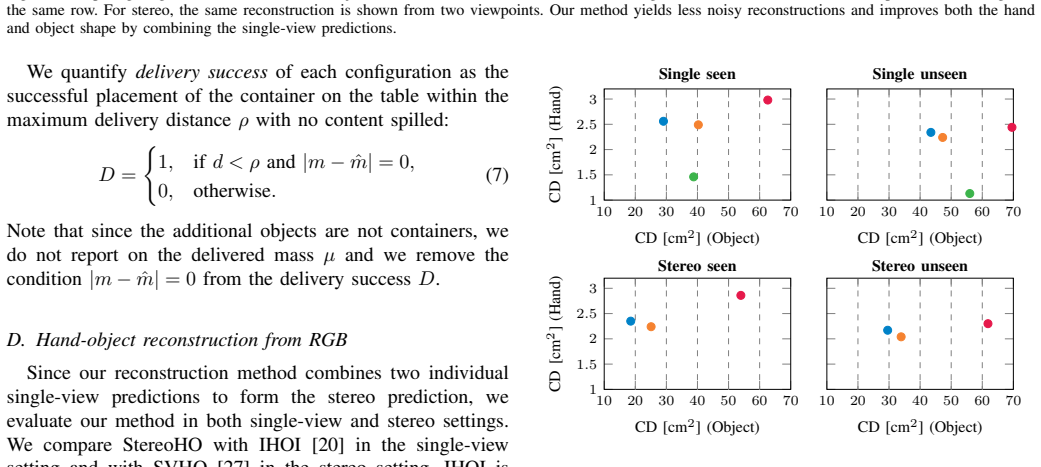
StereoHO jointly reconstructs hand and object geometry from wide-baseline stereo RGB images by treating shape prediction as classification over a learned codebook of 512 discrete 3D shape embeddings. For each view, a convolutional encoder produces a per-voxel probability distribution over this codebook for hand and object separately; the stereo prediction is the element-wise product of the left and right distributions, decoded by SDF decoders into a truncated signed distance field and then a pointcloud. A projection-based outlier removal step filters reconstructed points against segmentation masks in both views. On the DexYCB test set, the method reports object Chamfer distance improvements over IHOI in the single-view setting and over SVHO in the stereo setting, while remaining comparable on hand reconstruction. In the handover pipeline, this reconstruction supports 6-DoF grasp planning and hand-collision avoidance, achieving over 75 percent grasping success on CORSMAL containers, 75 percent on opaque household objects, and 91 percent on transparent containers, outperforming depth-based baselines on transparent objects.
Load-bearing premise
The stereo fusion rule $P = P_L P_R$ assumes that, once the true hand-object shape is fixed, the two camera views' errors are conditionally independent, so multiplying their per-voxel codebook probabilities produces a calibrated joint probability rather than an overconfident one.
Editorial extensions
If this is right
- Ordinary stereo RGB cameras become sufficient for safe human-to-robot handover of unknown objects, including transparent and reflective ones, removing the depth-camera requirement.
- The method transfers from synthetic training data to real, unseen household objects without hand-crafted geometric priors, so non-container objects and arbitrary grasp orientations are handled.
- Multi-view coherence is achieved probabilistically at the shape-code level rather than by merging pointclouds, which naturally gives a per-voxel uncertainty signal.
- Object reconstruction error drops when using two views instead of one, while hand reconstruction stays roughly at the same quality as single-view methods.
- The reconstructed pointcloud can directly drive 6-DoF grasp estimation and hand-collision filtering in a closed-loop robot pipeline.
Reading between the lines
- Editorial inference: what is not tested in the paper is whether three or more views fused by the same product rule would keep reducing reconstruction error, which would confirm the independence assumption rather than just the two-view result.
- Editorial inference: the per-voxel probabilities over codebooks could be read as calibrated confidence, letting the robot ask the human to reposition when the stereo views disagree or when the top codebook probability is low; the paper does not explore this.
- Editorial inference: because the components are trained purely on synthetic data with domain-invariant masks, the same architecture is a candidate for other RGB-only perception tasks such as teleoperated grasping or assistive dressing, where transparent or deformable objects appear.
- Editorial inference: the frame-by-frame reconstruction-quality gating suggested in the pipeline indicates that temporal fusion of the probability distributions across frames could further stabilise handovers; the paper instead replaces rather than accumulates predictions.
Signed reviews
Editorial analysis
A structured set of objections, weighed in public.
Referee Report
Summary. The paper proposes StereoHO, a stereo RGB method for joint hand-object reconstruction that learns discrete codebooks of shape embeddings on synthetic data, predicts per-view probability distributions over these codebooks, and fuses the two views by element-wise multiplication of the distributions before decoding to a truncated signed distance field and pointcloud. The reconstructed hand-object shape is filtered by projecting it against predicted segmentation masks, and the output is used to plan 6-DoF grasps for a UR5 robot in human-to-robot handovers. The authors evaluate reconstruction on DexYCB against IHOI (single-view) and SVHO (stereo), reporting lower object Chamfer distances, and conduct real handover experiments with containers and general household objects, including transparent ones. The central claims are that the probabilistic combination of single-view predictions improves object reconstruction over existing RGB-based single-view and stereo methods, and that the reconstructed shapes enable successful robot handovers.
Significance. If the central claims hold, the paper makes a useful contribution: it is among the first to combine learned codebook priors with a probabilistic multi-view fusion for hand-object reconstruction from RGB only, and it demonstrates a complete handover pipeline with real robot experiments and transparent objects. The use of synthetic-only training with evaluation on real data (DexYCB and physical handovers) is a strength, and the paper ships a reproducible link to code and videos. The reported object Chamfer improvements over IHOI and SVHO are potentially large, and the real-robot success rates (75-91%) for household objects are encouraging. However, the comparison is confounded by the use of segmentation masks as additional input, and the paper provides no statistical uncertainty quantification; these issues currently limit the strength of the claims.
major comments (4)
- [Section III-A and Section IV-D (Fig. 7)] The central quantitative comparison is confounded by an input modality difference. Section III-A states that the model takes the segmentation masks of the object (MO) and hand (MH) as input, and the ablation 'Ours (no segmentation mask)' in Fig. 7 shows that masks improve object reconstruction. The paper does not state whether masks are ground-truth or predicted during DexYCB evaluation, nor whether the baselines IHOI and SVHO received any mask information. Because the abstract claims a reduction in object Chamfer distance compared to 'existing RGB based hand-object reconstruction methods,' the reported gains cannot be attributed to the proposed codebook and probabilistic fusion until the comparison is controlled for the additional mask input. The authors should either report the no-mask variant as the main result, provide baselines augmented with masks, or explicitly justify why mask input is not an unfair advantage in the comparison.
- [Section III-A, equation P = PLPR] The stereo fusion rule assumes that the per-view probability distributions over the codebook are conditionally independent given the true hand-object shape. This assumption is not validated, and the paper provides no alternative fusion rules (e.g., sum, max, or a learned combination) or any calibration analysis. Without such an ablation, the claim that the method combines single-view reconstructions 'probabilistically' to form a coherent stereo reconstruction is not fully supported: the stereo improvement over SVHO could be driven by the additional view, the mask input, or the codebook representation rather than by the product rule. A controlled comparison of fusion rules, or evidence that PL and PR are calibrated for the reported improvement, is needed.
- [Section IV-D and Section IV-E (Table I, Fig. 7)] No error bars, confidence intervals, or significance tests are reported for any reconstruction or handover metric. The reported differences, such as the 9.71 cm^2 object Chamfer improvement over IHOI in the single-view seen category, may be within run-to-run or subject-to-subject variation; the paper does not specify the number of DexYCB frames used or the variance across participants. The handover success rates (e.g., 75% and 91% on household objects) are aggregates over configurations with no per-participant breakdown or interval estimates. The authors should report standard deviations across multiple training runs or test splits, and ideally a paired statistical test, to support the quantitative claims.
- [Section IV-E, comparison with CB] The handover comparison with the CORSMAL baseline (CB) is not apples-to-apples: CB assumes the object starts on the table and remains upright, while StereoHO assumes the object is already held by the human. The text concludes the methods are 'on par' for containers, but the differing assumptions and the lack of statistical testing make this conclusion difficult to interpret. The authors should either align the test conditions or explicitly acknowledge that the comparison is qualitative rather than a controlled benchmark.
minor comments (4)
- [Section II] Typo: 'Signed Distance Dields' should be 'Signed Distance Fields.'
- [Section III-D] The notation 'TW B' is ambiguous; please clarify the subscript/superscript convention for the wrist-to-robot transform, or use a consistent bold/italic format.
- [Section IV-D] The separation of the DexYCB test set into 'seen' and 'unseen' categories is described as based on 'similarity in 3D shape' but no quantitative criterion is given. Please specify the similarity measure or provide a reference for the split.
- [Section IV-A] The paper does not report how many DexYCB frames or subjects are used in the reconstruction evaluation. Adding this information would help reproduce the results.
Circularity Check
No significant circularity: training is on ObMan, evaluation is on external DexYCB and real robot handovers, and no equation reduces to a fitted constant.
full rationale
The central derivations are self-contained with respect to the claimed predictions. The shape codebooks and image-to-shape encoder are trained on the synthetic ObMan dataset, the autoencoder reconstruction quality is reported on ObMan, and the reconstruction comparisons are run on DexYCB, an external benchmark; the handover results come from real robot trials with objects outside the training set. There is no fitted parameter renamed as a prediction and no equation in the paper reduces to its own input. Self-citations appear (SVHO [27], the authors' earlier handover method [6], and the CORSMAL benchmarking protocol [4]), but they are used as comparison baselines, prior context, or evaluation protocol, not as the justification for the proposed fusion. The unvalidated conditional-independence assumption P=PLPR and the fact that segmentation masks are an extra input relative to the RGB baselines are correctness/fairness concerns, not circularity, because the reported Chamfer distance is computed against DexYCB ground truth and still depends on the learned shape decoder. Accordingly, the paper's core claims are not forced by construction or by a self-citation chain.
Assumptions & free parameters
free parameters (8)
- Codebook size C =
512
- Embedding size S =
128
- T-SDF grid dimension D =
128
- Commitment loss weight beta =
1.0
- Cross-entropy weights wc =
0.25 (empty), 0.75 (rest)
- T-SDF sampling threshold =
1 cm
- Number of grasp candidates N =
200
- IoU improvement threshold IoU* =
not specified
assumptions (5)
- domain assumption ObMan synthetic hand-object data provides sufficient 3D shape priors for real-world objects, including transparent and non-container objects.
- domain assumption The two views' predicted probability distributions are conditionally independent given the true shape, so element-wise multiplication P = PL PR is a valid fusion rule.
- domain assumption Segmentation masks are domain-invariant and can bridge the synthetic-to-real gap.
- domain assumption Per-view wrist poses and camera calibration are accurate enough for voxel projection, triangulation, and coordinate transformation.
- domain assumption Sampling the T-SDF at a threshold of 1 cm yields pointclouds sufficient for grasp estimation.
Cite this review
Pith. "Pith review of Stereo Hand-Object Reconstruction for Human-to-Robot Handover." pith.science (2026). https://pith.science/paper/CM7XL724
@misc{pith2026241207487,
  author       = {Pith},
  title        = {Pith review of: Stereo Hand-Object Reconstruction for Human-to-Robot Handover},
  year         = {2026},
  howpublished = {\url{https://pith.science/paper/CM7XL724}},
  note         = {Machine review of arXiv:2412.07487}
}
read the original abstract
Jointly estimating hand and object shape facilitates the grasping task in human-to-robot handovers. However, relying on hand-crafted prior knowledge about the geometric structure of the object fails when generalising to unseen objects, and depth sensors fail to detect transparent objects such as drinking glasses. In this work, we propose a stereo-based method for hand-object reconstruction that combines single-view reconstructions probabilistically to form a coherent stereo reconstruction. We learn 3D shape priors from a large synthetic hand-object dataset to ensure that our method is generalisable, and use RGB inputs to better capture transparent objects. We show that our method reduces the object Chamfer distance compared to existing RGB based hand-object reconstruction methods on single view and stereo settings. We process the reconstructed hand-object shape with a projection-based outlier removal step and use the output to guide a human-to-robot handover pipeline with wide-baseline stereo RGB cameras. Our hand-object reconstruction enables a robot to successfully receive a diverse range of household objects from the human.
Figures


Figures from the paper (6 more)




Reference graph
Works this paper leans on
-
[1]
Survey of human–robot collaboration in industrial settings: Awareness, intelligence, and compliance,
S. Kumar, C. Savur, and F. Sahin, “Survey of human–robot collaboration in industrial settings: Awareness, intelligence, and compliance,” IEEE Trans. Systems, Man, and Cybernetics: Systems, vol. 51, no. 1, pp. 280– 297, 2020
work page 2020
-
[2]
Object handovers: a review for robotics,
V . Ortenzi, A. Cosgun, T. Pardi, W. P. Chan, E. Croft, and D. Kuli ´c, “Object handovers: a review for robotics,”IEEE Trans. Robotics, vol. 37, no. 6, pp. 1855–1873, 2021
work page 2021
-
[3]
Object-independent human-to-robot handovers using real time robotic vision,
P. Rosenberger, A. Cosgun, R. Newbury, J. Kwan, V . Ortenzi, P. Corke, and M. Grafinger, “Object-independent human-to-robot handovers using real time robotic vision,” IEEE Robotics Autom. Lett. , vol. 6, no. 1, pp. 17–23, 2020
work page 2020
-
[4]
Benchmark for human-to-robot handovers of unseen containers with unknown filling,
R. Sanchez-Matilla, K. Chatzilygeroudis, A. Modas, N. F. Duarte, A. Xompero, P. Frossard, A. Billard, and A. Cavallaro, “Benchmark for human-to-robot handovers of unseen containers with unknown filling,” IEEE Robotics Autom. Lett. , vol. 5, no. 2, pp. 1642–1649, 2020
work page 2020
-
[5]
The CORSMAL benchmark for the prediction of the properties of containers,
A. Xompero, S. Donaher, V . Iashin, F. Palermo, G. Solak, C. Coppola, R. Ishikawa, Y . Nagao, R. Hachiuma, Q. Liu, F. Feng, C. Lan, R. H. M. Chan, G. Christmann, J.-T. Song, G. Neeharika, C. K. T. Reddy, D. Jain, B. U. Rehman, and A. Cavallaro, “The CORSMAL benchmark for the prediction of the properties of containers,” IEEE Access , vol. 10, pp. 41 388–41...
work page 2022
-
[6]
Towards safe human- to-robot handovers of unknown containers,
Y . L. Pang, A. Xompero, C. Oh, and A. Cavallaro, “Towards safe human- to-robot handovers of unknown containers,” in IEEE Int. Conf. Robot & Human Interactive Communication , 2021
work page 2021
-
[7]
Human grasp classifica- tion for reactive human-to-robot handovers,
W. Yang, C. Paxton, M. Cakmak, and D. Fox, “Human grasp classifica- tion for reactive human-to-robot handovers,” in IEEE Int. Conf. Intell. Robot Syst., 2020, pp. 11 123–11 130
work page 2020
-
[8]
Reactive human-to-robot handovers of arbitrary objects,
W. Yang, C. Paxton, A. Mousavian, Y .-W. Chao, M. Cakmak, and D. Fox, “Reactive human-to-robot handovers of arbitrary objects,” in IEEE Int. Conf. Robotics Autom. , 2021
work page 2021
Show all 42 references
-
[9]
Model predictive control for fluid human-to-robot handovers,
W. Yang, B. Sundaralingam, C. Paxton, I. Akinola, Y .-W. Chao, M. Cak- mak, and D. Fox, “Model predictive control for fluid human-to-robot handovers,” in IEEE Int. Conf. Robotics Autom. , 2022
2022
-
[10]
Goal-auxiliary actor-critic for 6D robotic grasping with point clouds,
L. Wang, Y . Xiang, W. Yang, A. Mousavian, and D. Fox, “Goal-auxiliary actor-critic for 6D robotic grasping with point clouds,” in Conf. Robot Learning, 2022
2022
-
[11]
ClearGrasp: 3D shape estimation of transparent objects for manipulation,
S. Sajjan, M. Moore, M. Pan, G. Nagaraja, J. Lee, A. Zeng, and S. Song, “ClearGrasp: 3D shape estimation of transparent objects for manipulation,” in IEEE Int. Conf. Robotics Autom. , 2020
2020
-
[12]
Depth restoration of hand-held transparent objects for human-to-robot handover,
R. Yu, H. Yu, H. Yan, Z. Song, S. Li, and W. Ding, “Depth restoration of hand-held transparent objects for human-to-robot handover,” in IEEE Int. Conf. Robotics Autom. , 2025
2025
-
[13]
Learning joint reconstruction of hands and manipulated objects,
Y . Hasson, G. Varol, D. Tzionas, I. Kalevatykh, M. J. Black, I. Laptev, and C. Schmid, “Learning joint reconstruction of hands and manipulated objects,” in Conf. Comput. Vis. Pattern Recognit. , 2019
2019
-
[14]
Closing the loop for robotic grasping: A real-time, generative grasp synthesis approach,
D. Morrison, P. Corke, and J. Leitner, “Closing the loop for robotic grasping: A real-time, generative grasp synthesis approach,” in Robotics: Science and Syst. , 2018
2018
-
[15]
6-DoF GraspNet: Variational grasp generation for object manipulation,
A. Mousavian, C. Eppner, and D. Fox, “6-DoF GraspNet: Variational grasp generation for object manipulation,” in Int. Conf. Comput. Vis. , 2019
2019
-
[16]
Learning implicit fields for generative shape modeling,
Z. Chen and H. Zhang, “Learning implicit fields for generative shape modeling,” in Conf. Comput. Vis. Pattern Recognit. , 2019
2019
-
[17]
Multi-view shape estimation of transparent containers,
A. Xompero, R. Sanchez-Matilla, A. Modas, P. Frossard, and A. Caval- laro, “Multi-view shape estimation of transparent containers,” in Proc. IEEE Int. Conf. Acoustics, Speech Signal Process. , 2020
2020
-
[18]
DexYCB: A benchmark for capturing hand grasping of objects,
Y .-W. Chao, W. Yang, Y . Xiang, P. Molchanov, A. Handa, J. Tremblay, Y . S. Narang, K. Van Wyk, U. Iqbal, S. Birchfield, J. Kautz, and D. Fox, “DexYCB: A benchmark for capturing hand grasping of objects,” in Conf. Comput. Vis. Pattern Recognit. , 2021
2021
-
[19]
OakInk: A large-scale knowledge repository for understanding hand-object interac- tion,
L. Yang, K. Li, X. Zhan, F. Wu, A. Xu, L. Liu, and C. Lu, “OakInk: A large-scale knowledge repository for understanding hand-object interac- tion,” in Conf. Comput. Vis. Pattern Recognit. , 2022
2022
-
[20]
What’s in your hands? 3D recon- struction of generic objects in hands,
Y . Ye, A. Gupta, and S. Tulsiani, “What’s in your hands? 3D recon- struction of generic objects in hands,” in Conf. Comput. Vis. Pattern Recognit., 2022
2022
-
[21]
gSDF: Geometry-driven signed distance functions for 3D hand-object reconstruction,
Z. Chen, S. Chen, C. Schmid, and I. Laptev, “gSDF: Geometry-driven signed distance functions for 3D hand-object reconstruction,” in Conf. Comput. Vis. Pattern Recognit. , 2023
2023
-
[22]
HandNeRF: Learning to reconstruct hand-object interaction scene from a single RGB image,
H. Choi, N. Chavan-Dafle, J. Yuan, V . Isler, and H. Park, “HandNeRF: Learning to reconstruct hand-object interaction scene from a single RGB image,” in IEEE Int. Conf. Robotics Autom. , 2024
2024
-
[23]
In- hand 3D object scanning from an RGB sequence,
S. Hampali, T. Hodan, L. Tran, L. Ma, C. Keskin, and V . Lepetit, “In- hand 3D object scanning from an RGB sequence,” in Conf. Comput. Vis. Pattern Recognit., 2023
2023
-
[24]
SHOWMe: Benchmarking object-agnostic hand-object 3D reconstruction,
A. Swamy, V . Leroy, P. Weinzaepfel, F. Baradel, S. Galaaoui, R. Br´egier, M. Armando, J.-S. Franco, and G. Rogez, “SHOWMe: Benchmarking object-agnostic hand-object 3D reconstruction,” in Int. Conf. Comput. Vis., 2023
2023
-
[25]
Novel-view synthesis and pose estimation for hand-object interaction from sparse views,
W. Qu, Z. Cui, Y . Zhang, C. Meng, C. Ma, X. Deng, and H. Wang, “Novel-view synthesis and pose estimation for hand-object interaction from sparse views,” in Int. Conf. Comput. Vis. , 2023
2023
-
[26]
Diffusion-guided re- construction of everyday hand-object interaction clips,
Y . Ye, P. Hebbar, A. Gupta, and S. Tulsiani, “Diffusion-guided re- construction of everyday hand-object interaction clips,” in Int. Conf. Comput. Vis., 2023
2023
-
[27]
Sparse multi-view hand-object reconstruction for unseen environments,
Y . L. Pang, C. Oh, and A. Cavallaro, “Sparse multi-view hand-object reconstruction for unseen environments,” in Conf. Comput. Vis. Pattern Recognit. Workshops, 2024
2024
-
[28]
Deep residual learning for image recognition,
K. He, X. Zhang, S. Ren, and J. Sun, “Deep residual learning for image recognition,” in Conf. Comput. Vis. Pattern Recognit. , 2016
2016
-
[29]
AutoSDF: Shape priors for 3D completion, reconstruction and generation,
P. Mittal, Y .-C. Cheng, M. Singh, and S. Tulsiani, “AutoSDF: Shape priors for 3D completion, reconstruction and generation,” in Conf. Comput. Vis. Pattern Recognit. , 2022
2022
-
[30]
Neural discrete representation learning,
A. Van Den Oord, O. Vinyals, and K. Kavukcuoglu, “Neural discrete representation learning,” Adv. Neural Inf. Process. Syst. , vol. 30, 2017
2017
-
[31]
ImageNet: A large-scale hierarchical image database,
J. Deng, W. Dong, R. Socher, L.-J. Li, K. Li, and L. Fei-Fei, “ImageNet: A large-scale hierarchical image database,” inConf. Comput. Vis. Pattern Recognit., 2009
2009
-
[32]
Understanding human hands in contact at internet scale,
D. Shan, J. Geng, M. Shu, and D. F. Fouhey, “Understanding human hands in contact at internet scale,” in Conf. Comput. Vis. Pattern Recognit., 2020
2020
-
[33]
Fast segment anything,
X. Zhao, W. Ding, Y . An, Y . Du, T. Yu, M. Li, M. Tang, and J. Wang, “Fast segment anything,” 2023, arXiv:2306.12156v1 [cs.CV]
2023 arXiv
-
[34]
FrankMocap: A monocular 3D whole-body pose estimation system via regression and integration,
Y . Rong, T. Shiratori, and H. Joo, “FrankMocap: A monocular 3D whole-body pose estimation system via regression and integration,” in Int. Conf. Comput. Vis. Workshops , 2021
2021
-
[35]
A new technique for fully autonomous and efficient 3D robotics hand/eye calibration,
R. Y . Tsai and R. K. Lenz, “A new technique for fully autonomous and efficient 3D robotics hand/eye calibration,” IEEE Trans. Robotics Autom., vol. 5, no. 3, pp. 345–358, 1989
1989
-
[36]
ShapeNet: An information-rich 3D model repository,
A. X. Chang, T. Funkhouser, L. Guibas, P. Hanrahan, Q. Huang, Z. Li, S. Savarese, M. Savva, S. Song, H. Su, J. Xiao, L. Yi, and F. Yu, “ShapeNet: An information-rich 3D model repository,” 2015, arXiv:1512.03012v1 [cs.GR]
2015 arXiv
-
[37]
Embodied hands: Modeling and capturing hands and bodies together,
J. Romero, D. Tzionas, and M. J. Black, “Embodied hands: Modeling and capturing hands and bodies together,” ACM Trans. Graph., vol. 36, no. 6, Nov. 2017
2017
-
[38]
PoseCNN: A convolutional neural network for 6D object pose estimation in cluttered scenes,
Y . Xiang, T. Schmidt, V . Narayanan, and D. Fox, “PoseCNN: A convolutional neural network for 6D object pose estimation in cluttered scenes,” in Robotics: Science and Syst. , 2018
2018
-
[39]
Mask R-CNN,
K. He, G. Gkioxari, P. Doll ´ar, and R. B. Girshick, “Mask R-CNN,” in Int. Conf. Comput. Vis. , 2017
2017
-
[40]
Microsoft COCO: Common objects in context,
T.-Y . Lin, M. Maire, S. Belongie, J. Hays, P. Perona, D. Ramanan, P. Doll ´ar, and C. L. Zitnick, “Microsoft COCO: Common objects in context,” in Eur. Conf. Comput. Vis., 2018
2018
-
[41]
Hand keypoint detection in single images using multiview bootstrapping,
T. Simon, H. Joo, I. Matthews, and Y . Sheikh, “Hand keypoint detection in single images using multiview bootstrapping,” in Conf. Comput. Vis. Pattern Recognit., 2017
2017
-
[42]
Fast online object tracking and segmentation: A unifying approach,
Q. Wang, L. Zhang, L. Bertinetto, W. Hu, and P. Torr, “Fast online object tracking and segmentation: A unifying approach,” in Conf. Comput. Vis. Pattern Recognit., 2019
2019
Reviewed August 11, 2026 · model on record in the stance chip above.
Discussion (0). Continue with ORCID to comment.