REVIEW 4 major objections 5 minor 14 references
Online Causal Inference for Advertising in Real-Time Bidding Auctions
T0 review · 4 major / 5 minor · reviewed 2026-08-14 · deepseek-v4-flash
Pith's one-line read This paper shows that in second-price auction advertising, the optimal bid equals the causal effect of the ad, so learning to bid is learning the treatment effect.
desk verdict The SPA bid = CATE identity is correct and citable, but the abstract overpromises (regret bound and real data are absent) and the load-bearing private-values assumption is untested. read the letter →
The pith
A machine-rendered reading of the paper's core claim, the machinery that carries it, and where it could break.
The reading
What carries the argument
The load-bearing object is the auction payoff function rewritten in terms of the treatment effect: $\pi(b,Y(1),Y(0),B_{CP}) = \mathbf{1}\{B_{CP}\le b\}(Y(1)-Y(0)-\text{payment}) + Y(0)$. Under the private-values conditional independence assumption, the expected payoff becomes a function of $\mathrm{CATE}(x)$ plus a truncated payment term, so maximizing it yields the optimal-bid identities in Propositions 1 and 2. The algorithm BITS is a Thompson-sampling contextual bandit whose arms are bid values; each round a Gibbs sampler with data augmentation imputes the missing potential outcomes and the censored or missing highest competing bid, then computes the posterior probability that each bid is optimal, and reads off $\mathrm{CATE}(x)$ as the best bid in a second-price auction or as the adjusted best bid in a first-price auction.
What would settle it
In a data set where the highest competing bid and both potential outcomes are observed for the same impressions, compute the regression of $Y(1)-Y(0)$ on $B_{CP}$ within cells of $x$; a nonzero slope would directly contradict Assumption 1 and invalidate the identity $b^*(x)=\mathrm{CATE}(x)$.
Extended reading notes
Core claim
The paper establishes an identity between what an advertiser should bid and what she wants to measure. In a second-price auction, under conditional independence of potential outcomes and the highest competing bid given context $x$, the optimal bid equals $\mathrm{CATE}(x)$: $b^*(x)=\max\{0, \mathrm{CATE}(x)\}$. In a first-price auction, the optimal bid is $b^*(x)=\max\{0, \chi^{-1}[\mathrm{CATE}(x)]\}$, where $\chi(b)=b+F_{CP}(b|x)/f_{CP}(b|x)$, so the treatment effect is recovered by adding the reversed hazard rate of the competing bid to the winning bid. Therefore the causal effect of advertising is identifiable from the bidder's own optimal bidding behavior, and a multi-armed bandit that learns optimal bids, called BITS, delivers both profit-efficient bidding and treatment-effect estimates in one online procedure.
Load-bearing premise
Everything rests on Assumption 1: after conditioning on the observed context, a user's ad-response outcomes must be independent of the highest competing bid; if unobserved common-value factors move both, the optimal-bid-to-CATE identity and the resulting estimates collapse.
Editorial extensions
If this is right
- In second-price auctions, any bandit procedure that identifies the best bid directly estimates the conditional average treatment effect, because the best bid equals the treatment effect and no separate outcome regression is required.
- In first-price auctions, estimating the treatment effect requires also estimating the reversed hazard rate of competing bids, which is identifiable from the lower and upper bounds on the competing bid observed when losing and winning.
- The BITS algorithm achieves logarithmic regret in the stochastic bandit setting, so it protects the advertiser's profit during the experiment while still collecting the losing-auction observations needed to see the no-ad outcome.
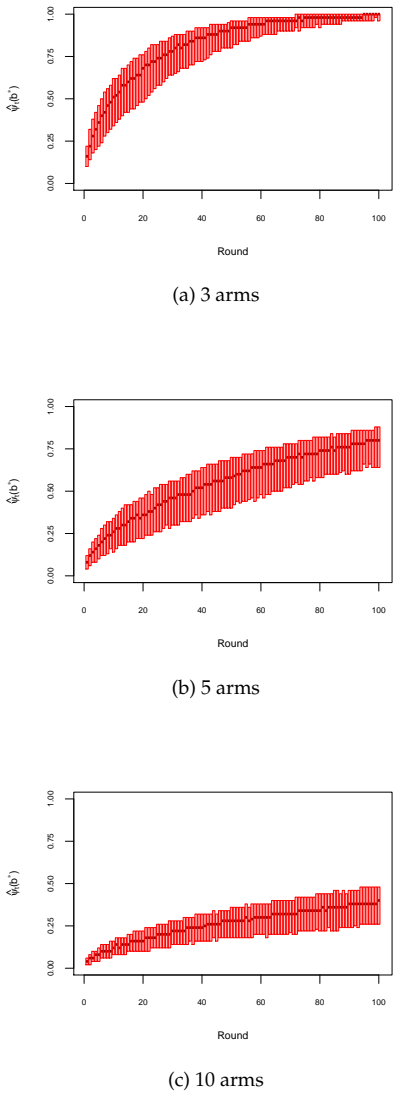
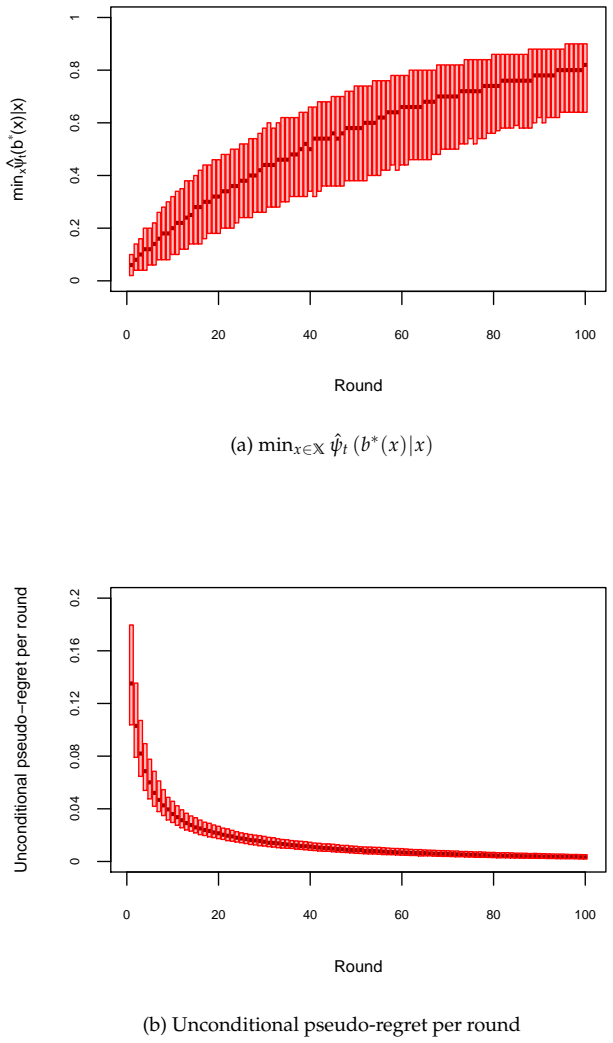
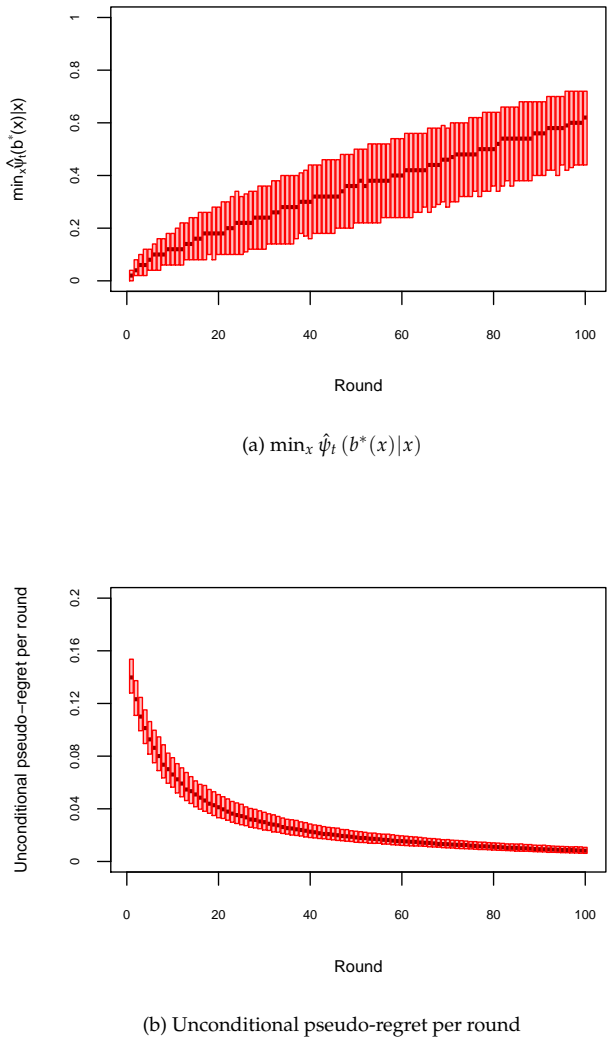
- Simulations under the paper's data-generating process show BITS attains lower cumulative regret than A/B tests, explore-then-commit, and off-the-shelf Thompson sampling in both auction formats, and lower mean squared error for treatment-effect estimation in second-price auctions.
- The experiment can be stopped by a posterior-probability threshold, which gives a Bayes-factor interpretation and lets the advertiser end the test once the best bid, and hence the treatment effect, is learned with a chosen confidence.
Reading between the lines
- An implication the authors leave implicit is that in second-price auctions, bid logs alone may be sufficient for incremental ad measurement: advertisers or platforms could reconstruct treatment effects from the winning bid without serving separate ghost ads.
- A natural extension would be to replace the lognormal parametric assumption for competing bids with a flexible hazard estimator in first-price auctions, since the treatment-effect estimate inherits any misspecification of $F_{CP}$ through the $\chi$ adjustment.
- The private-values assumption could be tested empirically in publisher-side data where both potential outcomes and the highest competing bid are observed; such a test would tell practitioners how much unobserved common-value variation matters in real RTB markets.
- Budget constraints and strategic multi-advertiser learning are left out of the model; incorporating them would make the optimal bid depend on remaining budget and on competitors' learning dynamics, breaking the simple $b^*$-to-CATE link.
Signed reviews
Editorial analysis
A structured set of objections, weighed in public.
Referee Report
Summary. This paper proposes an online experimental design for estimating conditional average treatment effects (CATEs) of advertising bought through real-time bidding, using multi-armed bandit learning over bid arms. The authors show that in second-price auctions the optimal bid equals max{0, CATE(x)} (Proposition 1), and in first-price auctions it equals max{0, chi^{-1}[CATE(x)]} with chi(b)=b+F_CP(b|x)/f_CP(b|x) (Proposition 2). They introduce Bidding Thompson Sampling (BITS), a Thompson-sampling algorithm with a Bayesian Gibbs sampler that augments missing potential outcomes and censored competing bids, and they report simulations for SPA and FPA, contextual and non-contextual versions, comparing BITS with A/B, explore-then-commit, and off-the-shelf TS. The abstract promises an order-optimal regret bound and validation on RTB auction data, but the body contains no regret-bound theorem and no real data analysis; the simulations are the only empirical evidence.
Significance. The central identification idea is attractive and, under Assumptions 1 and 2, the proofs of Propositions 1 and 2 are correct: they justify using a bandit over bids to recover CATEs while controlling experimentation cost. The paper is also transparent about the tension between economic and inference goals, and its simulation comparison is informative for the SPA case. Its strengths are the explicit derivation linking bidding to causal effects and the detailed Bayesian estimation procedure. However, the contribution is narrower than advertised: the order-optimal regret bound and the RTB empirical validation claimed in the abstract are absent, the empirical evaluation sets every true optimum exactly on the bid grid, and the load-bearing conditional-independence assumption (Assumption 1) is not tested or subjected to sensitivity analysis.
major comments (4)
- [Abstract and Section 5.1] The abstract states that the paper derives an order-optimal regret bound and uses data from RTB auctions, but no regret-bound theorem appears anywhere in the manuscript, and Section 6 is entirely simulation-based. Section 5.1 merely cites the logarithmic regret bound of Gopalan et al. (2014). These two advertised contributions must either be supplied or removed from the claims.
- [Section 3, equations (6)-(7) and proofs of Propositions 1 and 2] The second equality in both proofs applies Assumption 1 to replace E[Y(1)-Y(0)|B_CP <= b; x] with CATE(x). This is the load-bearing step that makes the optimal bid a function of CATE alone. If B_CP and the potential outcomes remain dependent conditional on x (e.g., through an unobserved common value such as user purchase propensity), then for an SPA the optimal bid solves b* = E[Y(1)-Y(0)|B_CP <= b*; x], not b* = CATE(x), and the estimators in (27) and (29) are biased. The paper motivates Assumption 1 by arguing that x can be made large, but provides no diagnostic, sensitivity analysis, or real-data check. A formal sensitivity analysis or an empirical test of this assumption is needed before the central claim can be accepted.
- [Section 4 and Section 6] The manuscript assumes the bid grid contains b*(x) for each x, and every simulated design places the true optimum exactly on a grid point (e.g., ATE = 1 with grids containing 1 for SPAs; b* = 0.5, 0.75, 1.00, 1.25, 1.50 in the FPA contextual grids). Because the SPA estimator (27) and the FPA estimator (29) are finite convex combinations of the discrete grid labels, BITS cannot represent a CATE that falls between grid points. The simulation evidence therefore conditions on the favorable grid-containment case. Off-grid experiments (e.g., dropping the true optimal bid from the grid) and a discussion of sensitivity to grid resolution are necessary to support the generality of the recovery claim.
- [Table 3 and abstract] In the FPA simulations, BITS's MSE (0.010, 0.023, 0.011) is larger than that of A/B (0.004, 0.003, 0.003) and ETC (0.007, 0.007, 0.007) for all three grids, so BITS does not outperform the conventional methods on the inference goal in FPAs. The paper acknowledges this in the text. The abstract's unqualified claim that the method outperforms commonly used methods should be restricted to the SPA setting or to the economic (regret) objective.
minor comments (5)
- [Section 6.2.1, paragraph after Table 3] The phrase 'pursuit of the economic goal ... may come at the cost of performance of the economic goal' appears to be a typo; the second occurrence should be 'inference goal'.
- [Section 5.7.2] The claim that the difference between the two stopping rules is 'minimal in simulations' is not supported by any reported results; either present the simulation evidence or remove the statement.
- [References] The reference 'Amemyia' should be 'Amemiya' and 'Sidney' should be 'Sydney'.
- [Title and overall framing] Given the title's promise of causal inference, the paper should discuss how to produce uncertainty quantification (e.g., posterior credible intervals) for the CATE estimates; currently only point estimates and MSE are reported.
- [Assumption 3] The i.i.d. assumption on (Y(1), Y(0), B_CP) is acknowledged to be strong for RTB, but the paper does not discuss possible relaxations or robustness checks for serial dependence; adding such a discussion would help.
Circularity Check
No significant circularity found: the optimal-bid/CATE relationship is derived from auction payoffs under explicit assumptions, and BITS recovers CATE by inverting that derived relationship.
full rationale
The paper's derivation chain is self-contained rather than circular. Expected auction payoffs are written in equations (6) and (7) from the payoff definitions in (2) and (3). Under Assumption 1 (conditional independence of the potential outcomes and the highest competing bid given x), the conditional expectation E[Y(1)-Y(0) | B_CP <= b; x] collapses to CATE(x), which is the step that produces Proposition 1 (b*(x) = max{0, CATE(x)} for SPAs) and Proposition 2 (b*(x) = max{0, chi^{-1}[CATE(x)]} for FPAs). This is a derived identification result with explicitly stated assumptions, not a definition of CATE in terms of bids. The BITS algorithm then learns the best bid arm from realized auction rewards, which include the observed outcome Y, the win/loss indicator D, and censored or missing competing bids; it computes optimality probabilities from the posterior of a parametric model, and it reads off CATE using the inverse of the proven Propositions 1 and 2, as in equations (26)-(29). No parameter is fitted to a subset of the data and then renamed as a prediction: the CATE estimate is a function of the posterior over the model parameters, which is updated from the full observed data. The lognormal model in (11) does impose Assumption 1 by setting the covariance between log B_CP and the potential outcomes to zero, and the simulations use DGPs with the same zero-covariance structure; this is a limitation of the validation evidence and a strong identifying assumption, but it is not circularity in the derivation. Self-citations, such as Geng et al. (2020), are used only as examples of stopping-rule or experimentation practice and are not load-bearing for the central CATE-bid identification. Concerns about Assumption 1 being untested or about the parametric restrictions are robustness and external-validity issues, not evidence that the paper's claimed derivation reduces to its own inputs.
Assumptions & free parameters
free parameters (3)
- Bid grid R_x per context =
e.g., {0.6, 1.0, 1.5}
- Stopping threshold T =
0.95
- Prior hyperparameters (alpha, beta, mu, A) =
0 in simulations
assumptions (7)
- domain assumption Assumption 1: {Y(1), Y(0)} independent of B_CP given x (private values / conditional independence).
- domain assumption Assumption 2: continuous joint density, finite means, overlap f_CP > 0, and decreasing reversed hazard rate.
- domain assumption Assumption 3: {Y_i(1), Y_i(0), B_CP,i} i.i.d. across auctions conditional on x, and x i.i.d.
- ad hoc to paper Lognormal parametric DGP in Eq. (11) for log Y(1), log Y(0), log B_CP.
- ad hoc to paper rho = 0 in the main algorithm.
- domain assumption The bid grid for each context contains the true optimal bid b*(x).
- ad hoc to paper For FPAs, sigma_CP^2 is normalized to 1.
Cite this review
Pith. "Pith review of Online Causal Inference for Advertising in Real-Time Bidding Auctions." pith.science (2026). https://pith.science/paper/CMWFZCUI
@misc{pith2026190808600,
  author       = {Pith},
  title        = {Pith review of: Online Causal Inference for Advertising in Real-Time Bidding Auctions},
  year         = {2026},
  howpublished = {\url{https://pith.science/paper/CMWFZCUI}},
  note         = {Machine review of arXiv:1908.08600}
}
read the original abstract
Real-time bidding (RTB) systems, which utilize auctions to allocate user impressions to competing advertisers, continue to enjoy success in digital advertising. Assessing the effectiveness of such advertising remains a challenge in research and practice. This paper proposes a new approach to perform causal inference on advertising bought through such mechanisms. Leveraging the economic structure of first- and second-price auctions, we first show that the effects of advertising are identified by the optimal bids. Hence, since these optimal bids are the only objects that need to be recovered, we introduce an adapted Thompson sampling (TS) algorithm to solve a multi-armed bandit problem that succeeds in recovering such bids and, consequently, the effects of advertising while minimizing the costs of experimentation. We derive a regret bound for our algorithm which is order optimal and use data from RTB auctions to show that it outperforms commonly used methods that estimate the effects of advertising.
Figures

Figures from the paper (4 more)


Reference graph
Works this paper leans on
-
[1]
Albert, J. H. and Chib, S. (1993). Bayesian analysis of binary and polychotomous response data. Journal of the American Statistical Association, 88(422):669–679. Amemyia, T. (1984). Tobit models: A survey. Journal of Econometrics, 24(1–2):3–61. Athey, S. and Haile, P . A. (2002). Identification of standard auction models. Econometrica, 70(6):2107–2140. Aus...
work page 1993
-
[10]
, pages 1–12, Berlin, Germany. Springer. Nie, X., Tian, X., Taylor, J., and Zou, J. (2018). Why adaptively collected data have negative bias and how to correct for it. In Storkey, A. and Perez-Cruz, F., editors, Proceedings of the Twenty-First International Conference on Artificial Intelligence and Statistics (AISTATS 2018), pages 1261–1269, Lanzarote, Spa...
work page 2018
-
[12]
, pages 5957–5966, New York, USA. Curran Associates, Inc. Yu, E. C., Sprenger, A. M., Thomas, R. P ., and Dougherty, M. R. (2014). When decision heuristics and science collide. Psychonomic Bulletin & Review, 21(2):268–282. 66 Appendix A Full conditional distributions for Gibbs sampling This section outlines the specific full conditional distributions used ...
work page 2014
-
[13]
The estimators ˆδ0 and ˆσ2 0 are analogous to the ones above, withXi0≡ (1− Di)Xi replacing Xi1, so we omit them for brevity. B.2 Highest competing bid for SPAs Even though we maintain the assumption of treatment exogeneity, we still have to ac- count for censoring of the highest competing bid. Given the normality assumption, the censoring characterizes a ...
work page 1978
-
[14]
When ρ⁄= 0, the missing values logYmiss i depend on the observed values log Yi even conditional on Di, which requires us to change the priors and the procedure accordingly. To do so, we combine the Bayesian estimator for the standard Tobit model introduced by Chib (1992) for SPAs or the Bayesian estimator for the Probit model intro- duced by Albert and Ch...
work page 1992
-
[215]
Wagenmakers, E.-J., Gronau, Q. F., and Vandekerckhove, J. (2019). Five Bayesian intuitions for the stopping rule principle. PsyArXiv Preprints. Weed, J., Perchet, V ., and Rigollet, P . (2016). Online learning in repeated auctions. In Feldman, V ., Rakhlin, A., and Shamir, O., editors, 29th Annual Conference on Learning Theory, pages 1562–1583, New York, ...
arXiv 2019
-
[252]
Mohri, M. and Medina, A. M. (2016). Learning algorithms for second-price auctions with reserve. Journal of Machine Learning Research, 17(1):2632–2656. Muthukrishnan, S. (2009). Ad exchanges: Research issues. In Leonardi, S., editor, 5th International Conference on Web and Internet Economics (WINE
work page 2016
-
[884]
Ju, N., Hu, D., Henderson, A., and Hong, L. (2019). A sequential test for selecting the better variant: Online A/B testing, adaptive allocation, and continuous monitoring. In Culpepper, J. S. and Moffat, A., editors, Proceedings of the Twelth ACM International Conference on Web Search and Data Mining (WSDM ’19), pages 492–500, New York, USA. ACM. Kallus, ...
work page 2019
Show all 14 references
-
[2009]
Springer
, pages 23–37, Berlin, Ger- many. Springer. Cai, H., Ren, K., Zhang, W., Malialis, K., Wang, J., Yu, Y., and Guo, D. (2017). Real-time bidding by reinforcement learning in display advertising. In de Rijke, M. and Shokouhi, M., editors, Proceedings of the Tenth ACM Internationa...
2017 arXiv
-
[2015]
Curran Associates, Inc
, pages 1342– 1350, New York, USA. Curran Associates, Inc. Bastani, H. and Bayati, M. (2020). Online decision-making with high-dimensional covari- ates. Operations Research, 68(1):276–294. Bergemann, D. and Välimäki, J. (2008). Bandit problems. In Durlauf, S. N. and Blume, L. ...
2020
-
[2016]
Curran Associates, Inc
, pages 1181–1189, New York, USA. Curran Associates, Inc. Lewis, R. and Wong, J. (2018). Incrementality bidding & attribution. SSRN:3129350. Lindley, D. V . (1957). A statistical paradox.Biometrika, 44(1/2):187–192. McAfee, R. P . (2011). The design of advertising exchanges. R...
2018
-
[2017]
, pages 1156–1164, Sidney, Australia. PMLR. Geng, T., Lin, X., and Nair, H. S. (2020). Online evaluation of audiences for targeted advertising via bandit experiments. In Rossi, F., editor, Proceedings of the Thirty-Fourth AAAI Conference on Artificial Intelligence (AAAI ’20), p...
2020 arXiv
-
[2018]
, pages 529– 546, Lanzarote, Spain. PMLR. Kanoria, Y. and Nazerzadeh, H. (2021). Incentive-compatible learning of reserve prices for repeated auctions. Operations Research, forthcoming. Kasy, M. and Sautmann, A. (2021). Adaptive treatment assignment in experiments for policy c...
2021
-
[2019]
Curran Associates, Inc
, pages 9679–9688, New York, USA. Curran Associates, Inc. Balseiro, S. R. and Gur, Y. (2019). Learning in repeated auctions with budgets: Regret minimization and equilibrium. Management Science, 65(9):3952–3968. Bareinboim, E., Forney, A., and Pearl, J. (2015). Bandits with un...
2019
Reviewed August 14, 2026 · model on record in the stance chip above.
Discussion (0). Continue with ORCID to comment.