REVIEW 3 major objections 6 minor 1 cited by
A JWST Study of the Remarkable Oort Cloud Comet C/2017 K2 (PanSTARRS)
T0 review · 3 major / 6 minor · reviewed 2026-08-16 · deepseek-v4-flash
Pith's one-line read JWST spectroscopy of Oort Cloud comet C/2017 K2 (PanSTARRS) shows a hyperactive nucleus under 4.2 km across, crystalline-silicate-rich dust, and probable PAH emission in the coma.
desk verdict The JWST spectra are a real step forward for cometary science, but the headline 'hyperactive' claim rests on a water production rate that the paper's own MRS data contradict by a factor of 3-8. read the letter →
The pith
A machine-rendered reading of the paper's core claim, the machinery that carries it, and where it could break.
The reading
What carries the argument
The argument is carried by three analytical instruments. First, a nucleus upper-limit procedure: azimuthally averaged radial surface-brightness profiles in dust-continuum windows are fit with power laws, and comparison with a point-spread-function-convolved coma and a combined coma-plus-nucleus model sets a conservative 30/70 nucleus-to-coma flux threshold that translates, through a thermal model of an insolation-heated sphere, into a nucleus radius below 4.2 km. Second, molecular fluorescence modeling: optically thin fluorescence excitation models with a Haser density profile and a 0.52 km/s expansion velocity are fit to the water $\nu_2$ 6.3 $\mu$m band and the 5 $\mu$m hot bands, and a general spectral-fitting tool retrieves production rates and rotational temperatures for the trace volatiles; spaxel-by-spaxel fits show apparent $Q(\mathrm{H_2O})$, rotational temperature, and ortho-to-para ratio all rising with nucleocentric distance. Third, a thermal dust model: radiative-equilibrium temperatures for porous grains of five compositions (amorphous carbon, amorphous olivine, amorphous pyroxene, crystalline olivine, crystalline pyroxene) are summed over a Hanner size distribution and fit to the 7 to 27 $\mu$m spectral energy distribution, with model choice by an information criterion favoring the amorphous-olivine variant; a PAH emission library is then fit to the residual after subtracting scattered light, thermal dust, and molecular lines. The load-bearing step is the selection of the 5 $\mu$m hot-band water rate as the global production rate.
What would settle it
A radiative-transfer calculation of the optically thick H$_2$O 6.3 $\mu$m $\nu_2$ band along the actual JWST lines of sight, using opacity-corrected excitation models, would decide the matter: if the corrected 6.3 $\mu$m rate stays near 1 to 2.6$\times10^{28}$ s$^{-1}$ rather than converging to $7.6\times10^{28}$ s$^{-1}$, the active fraction falls to roughly 10 to 30% and the hyperactivity claim is refuted. A second, independent check is a new JWST observation of the comet at a different heliocentric distance to see whether the hot-band-to-$\nu_2$ ratio persists or whether the discrepancy was an aperture or opacity artifact.
Extended reading notes
Core claim
On the paper's own terms, the discovery is that C/2017 K2 (PanSTARRS) is a hyperactive comet with a small nucleus. Combining the water production rate $Q(\mathrm{H_2O}) = 7.6\times10^{28}\,\mathrm{s^{-1}}$ derived from NIRSpec 5 $\mu$m hot-band lines with an upper-limit nucleus radius of 4.2 km from radial surface-brightness profiles, and dividing by the sublimation rate a bare exposed water-ice surface would supply at 2.35 au, the paper finds that the active water-ice area is at least 86% of the nucleus surface, far above the roughly 10% typical of most comets. The thermal modeling of the 7 to 27 $\mu$m dust spectral energy distribution returns a coma of sub-micron grains dominated by Mg-rich crystalline olivine, with amorphous carbon, amorphous olivine, and amorphous pyroxene contributing the rest and a crystalline mass fraction $f_{\rm cryst} = 0.384 \pm 0.065$; the residual 3 to 8.6 $\mu$m spectrum is fitted by fluorescing PAHs, with small heavily hydrogenated neutral molecules producing the 3.42 $\mu$m feature and small cations producing the 6 to 9 $\mu$m features. The paper also reports that the apparent water production rate increases with projected distance from the nucleus, evidence for an extended source of water released from sublimating icy grains, which is the mechanism invoked to explain the hyperactivity.
Load-bearing premise
The hyperactivity result rests entirely on taking the 5 $\mu$m hot-band water production rate of $7.6\times10^{28}$ s$^{-1}$ as the comet's global water output, while the paper's own fits to the 6.3 $\mu$m band give rates roughly two to eight times lower and the paper states that the discrepancy is not explained.
Editorial extensions
If this is right
- C/2017 K2 joins the small set of hyperactive comets, so any model of its behavior must include a distributed source of water from icy grains in the coma rather than sublimation from the nucleus surface alone.
- The high crystalline mass fraction ($f_{\rm cryst} \simeq 0.384 \pm 0.065$) in a dynamically old Oort Cloud comet becomes a datum for how much crystalline material survives in the outer solar system, bearing on radial-mixing scenarios in the protoplanetary disk.
- The PAH interpretation gives JWST comet spectroscopy a direct link to the organic molecules measured by mass spectrometry in comet 67P and in returned asteroid samples, extending the sample of cometary organic matter to a long-period Oort Cloud object.
- The distinct spatial distributions of water-driven versus CO$_2$-driven volatiles imply separate ice phases in the nucleus, reinforcing the picture from comet 67P that H$_2$O and CO$_2$ ices are not intimately mixed.
- The measured $^{12}$CO$_2$/$^{13}$CO$_2$ ratio, consistent with the terrestrial $^{12}$C/$^{13}$C of 89, adds a comet to the small set with a carbon isotope ratio determined from space-based spectroscopy.
- C/2017 K2 joins the small set of hyperactive comets, so any model of its behavior must include a distributed source of water from icy grains in the coma rather than sublimation from the nucleus surface alone.
- The high crystalline mass fraction ($f_{\rm cryst} \simeq 0.384 \pm 0.065$) in a dynamically old Oort Cloud comet becomes a datum for how much crystalline material survives in the outer solar system, bearing on radial-mixing scenarios in the protoplanetary disk.
- The PAH interpretation gives JWST comet spectroscopy a direct link to the organic molecules measured by mass spectrometry in comet 67P and in returned asteroid samples, extending the sample of cometary organic matter to a long-period Oort Cloud object.
Reading between the lines
- If the lower 6.3 $\mu$m band rates (roughly 1 to 2.6$\times10^{28}$ s$^{-1}$) rather than the 5 $\mu$m hot-band rate turn out to be the true global water output, the active fraction drops to roughly 10 to 30% and the hyperactivity headline result disappears; the two-band discrepancy is therefore the single most decisive open question this paper leaves.
- The rise of apparent $Q(\mathrm{H_2O})$ with nucleocentric distance implies that the largest-beam water measurements should keep climbing, a prediction already gestured at by the radio OH value the paper quotes; comparing a large-beam OH measurement with the JWST apertures is a straightforward test.
- The fitted PAH population is hostage to the spectral library: the paper notes that the next release of the PAH database, with edge-defect spectra, could change the species mix, so re-fitting the same residuals against that library is a cheap, decisive check on whether small hydrogenated neutrals truly dominate the 3.42 $\mu$m emission.
- The 14 $\mu$m residual, tentatively attributed to CAI-like aluminum- and titanium-oxide minerals, could be tested by stacking JWST spectra of the several Spitzer-era comets that show the same residual feature to see whether its position and shape match perovskite or spinel resonances.
Signed reviews
Editorial analysis
A structured set of objections, weighed in public.
Referee Report
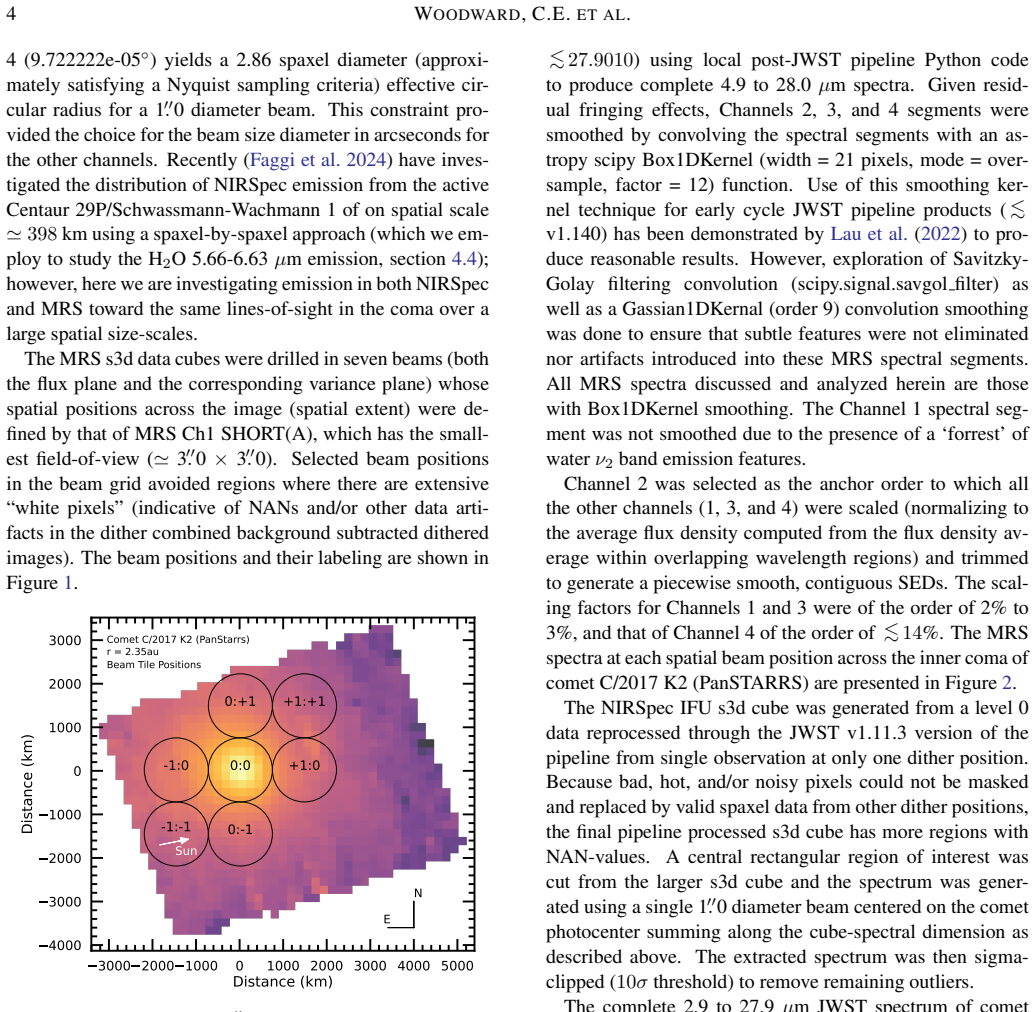
Summary. This paper presents JWST NIRSpec (G395M) and MIRI MRS IFU observations of the Oort Cloud comet C/2017 K2 at a heliocentric distance of 2.35 au, with spectra extracted in a 1-arcsec aperture and in a 3x3 grid of spatial beams. The authors report detections of H2O (both 5 µm hot bands and 6.3 µm nu2 band), 12CO, 13CO, CO2, and numerous trace species (CN, H2CO, CH3OH, CH4, C2H6, HCN, NH2, OH prompt emission), and map their spatial distributions. From radial profiles and WebbPSF models they derive a nucleus radius upper limit of <4.2 km. Using the NIRSpec 5 µm water hot-band production rate Q(H2O)=7.6e28 s^-1, they compute a water ice active fraction >86% and label the comet hyperactive. Thermal modeling of the 7-27 µm MRS SED yields a coma dust composition dominated by amorphous carbon, amorphous olivine and pyroxene, and Mg-rich crystalline olivine, with a crystalline mass fraction fcryst=0.384±0.065. Residuals after subtracting continuum, scattered light, and molecular models exhibit features at 3.42, 6.35, 6.92, and 8.25 µm attributed to PAHs, modeled with the Ames PAH database.
Significance. If the results hold, this is a valuable JWST dataset: it demonstrates the power of IFU spatial-spectral mapping of a comet coma, provides a rich molecular inventory with spatial distributions, constrains the nucleus size, and offers a new data point for comet dust mineralogy. The reductions are detailed and the molecular detections are supported by model fits. The paper is honest about several limitations, notably the unexplained factor 3-8 discrepancy between Q(H2O) values from the 5 µm hot bands and the 6.3 µm nu2 band. However, the abstract's headline claims—hyperactivity and high crystalline dust fraction—are not robust to the model assumptions that the paper itself documents. The hyperactivity claim scales linearly with the adopted Q(H2O); using the MRS values would place the active fraction at 11-30%, below the >50% hyperactivity threshold. The dust composition is derived from one of three thermal model treatments selected by an AIC comparison with inflated uncertainties, and the fcryst value varies from 0.36 to 0.65 depending on position and model case.
major comments (3)
- [§4.4, Figure 8a; §6, Table 3] The hyperactivity claim in the abstract and Section 6 (active fraction >86%) rests entirely on the NIRSpec 5 µm hot-band water production rate Q(H2O)=7.6e28 s^-1 (Table 2), while the MRS 6.3 µm nu2-band fits give Q(H2O)=(0.967 to 2.64)e28 s^-1 (Figure 8a). The paper states that the discrepancy 'is not explained, requiring further investigation which is beyond the scope of this paper.' Because the active fraction f = A/(4πR^2) scales linearly with Q, using the MRS values with the same nucleus radius (4.2 km) gives f ≈ 11-30%, below the >50% hyperactivity threshold. The ground-based IRTF value (3.65e28 s^-1) agrees with the MRS rather than the NIRSpec value. The abstract's first derived result is therefore not supported unless the band discrepancy is resolved by a mechanism that specifically makes the 5 µm hot bands trace the global water production. I recommend that the hyperactivity claim be removed or reframed as a conditional result pending reconciliation of the water bands.
- [§7.3-7.4, Tables 4-5, Figures 16-17] The quoted crystalline mass fraction fcryst=0.384±0.065 is the mean over the seven Case A 'AO50' thermal models, but this value depends strongly on the model treatment. The center position (0:0) gives fcryst=0.52 for Case A and Case B and 0.65 for Case C (Table 5), while the other six positions give 0.361±0.034; the spread between cases is comparable to the quoted uncertainty and is not included in the error budget. The 'AO50' model was selected over 'AP50' and the first-order model by fitting with uncertainties artificially inflated by a factor of 40 in two spectral regions (Section 7.1-7.2). Because the abstract presents fcryst as a single value without these caveats, the authors should either report the model-case dependence explicitly in the abstract or present fcryst as a range.
- [§8, Appendix B, Figure 22] The PAH identification relies on the residual F_PAH = F_obs - F_thermal - F_scattered, where the thermal model was itself refit after subtracting a first estimate of the PAH emission (Appendix B: 'This process is iterative'). This introduces circularity: the residual features are not independent of the model assumptions about the continuum, the scattered-light slope, and the molecular contributions. The paper also notes that the CH3OH nu9 band, which is not in the spectral model, contributes to the 3.42 µm residual (Section 8). To substantiate the 'strongly suggests' claim, the authors should demonstrate the stability of the residual features under plausible variations of the scattered-light slope and thermal model weighting (e.g., using the AP50 model or a different thermal fit), and quantify the CH3OH contribution. Without such tests, the PAH detection should be described as tentative rather than as a strong suggestion.
minor comments (6)
- [Abstract, §6, Table 3] The abstract and Section 6 use 'greater than or equal to 86%' while Table 3 and the text also say '>86%'; please standardize.
- [Figure 3 caption; Section 8] The figure caption spells the comet as 'C/20217 K2 (PanSTARRS)' and Section 8 has 'C.2017 K2'; both are typos.
- [§4.4, Figure 8a] The text states that the 5 µm hot-band values are higher 'by a factor ∼2' than the 6.3 µm band, but the values in Figure 8a differ by factors of about 3 to 8 (7.6e28 vs 2.64e28 and 0.967e28); the text should state the full range.
- [Table 3 note] The note says 'radius of <4.3 km' while the abstract and Section 3 quote <4.2 km; the appropriate value should be used consistently.
- [§5.1] The factor-1000 flux scaling to emulate optically thin conditions is a heuristic; its effect on the retrieved production rates and their uncertainties should be stated explicitly in the text rather than only in the caption of Figure 10.
- [§2] The paper would benefit from a brief discussion of how the single NIRSpec dither position affects the reliability of the NIRSpec spatial maps and the 5 µm water production rate.
Circularity Check
No significant circularity found; central results are independent measurements or fitted model outputs, not predictions forced by construction.
full rationale
The hyperactivity claim derives from Q(H2O)=7.6e28 s^-1 (Table 2, NIRSpec 5 micron hot band) and an upper-limit nucleus radius of 4.2 km through the standard active-fraction definition f=Q/(Z*4*pi*R^2) (Table 3). This is a defined quantity computed from measured inputs, not a prediction equivalent to an input. The paper itself discloses that MRS 6.3 micron nu2-band fits give lower Q values and that the discrepancy 'is not explained' (Section 4.4), and that ground-based IRTF Q is consistent with MIRI rather than NIRSpec (Section 5.3). This is a scientific robustness and systematic-uncertainty concern, and possibly a preferential use of the higher band value, but it does not make the derivation circular: the active fraction is not used to define or fit Q, and the lower values would simply change the conclusion. The dust composition (fcryst=0.384+/-0.065) is a least-squares output of the Harker thermal model fitted to the MRS SED (Section 7), not a quantity predicted from the model's assumptions. The model self-citations (Harker et al. 2002, 2007, 2023) are to a code and optical constants that are externally documented; this is normal tool use, not circularity. The PAH detection is based on residuals F_obs - F_thermal - F_scattered (Appendix B), with an iterative subtraction of an estimated PAH component before refitting the thermal model; this is a disclosed fitting procedure. Because the PAH model is fitted to the residual, the PAH features are not an independent prediction, but the paper does not claim they are derived from first principles, and the residual features are not equal by construction to the model inputs. No step in the paper reduces an output to its input by definition or self-citation chain.
Assumptions & free parameters
free parameters (7)
- Dust composition mass fractions (AC, AO50, AP50, CO, CP) =
AC 0.252, AO50 0.194, AP50 0.163, CO 0.391, CP 0.000 (Case A at tile 0:0); ranges across tiles in Table 5
- Hanner grain size distribution parameters (ap, N, M) and fractal dimension D =
ap 0.5 to 1.0 um, N 13.2 to 38.7, M 3.3 to 4.3, D 2.727 to 2.857 (Table 4)
- Water production rate Q(H2O), rotational temperature, and OPR per pixel/annulus =
Q(H2O) 0.97e28 to 2.6e28 s^-1 (6.3 um band), 7.6e28 s^-1 (5 um NIRSpec); Trot 25 to 64 K; OPR 2.36 to 2.75
- Nucleus beaming parameter eta in NEATM fits =
0.8, 1.0, 1.2
- MRS channel merging flux scaling factors =
Channels 1 and 3 about 2 to 3%; Channel 4 about 14%
- Uncertainty inflation factor for thermal model fitting =
40x in wavelength ranges 8.0 to 10.0 um and 12.5 to 16.5 um
- PAH model search space and membership =
NC <= 100 atoms; 22 of 2550 PAHs selected; best AIC candidate C216H36+ rejected
assumptions (5)
- domain assumption Haser model with constant expansion velocity v = 0.8 r_h^-0.5 describes the coma density profile
- domain assumption Optically thin fluorescence is a valid approximation for the analyzed H2O lines
- domain assumption Harker thermal model with Mie plus effective medium theory for amorphous grains and CDE for crystalline grains reproduces cometary dust emission
- domain assumption Cowan and A'Hearn sublimation model with 5% visual Bond albedo and 95% IR emissivity gives the ice sublimation rate per unit area
- domain assumption A 5770 K blackbody solar radiation field with no absorption drives PAH fluorescence
Cite this review
Pith. "Pith review of A JWST Study of the Remarkable Oort Cloud Comet C/2017 K2 (PanSTARRS)." pith.science (2026). https://pith.science/paper/CNZPLA3Q
@misc{pith2026250419849,
  author       = {Pith},
  title        = {Pith review of: A JWST Study of the Remarkable Oort Cloud Comet C/2017 K2 (PanSTARRS)},
  year         = {2026},
  howpublished = {\url{https://pith.science/paper/CNZPLA3Q}},
  note         = {Machine review of arXiv:2504.19849}
}
abstract
Comets, during their journeys into the inner solar system, deliver volatile gases, organics, and particulates into their comae that provide crucial information for assessing the physico-chemical conditions in the outer disk from which they formed. Here we present observational and modeling results of a JWST NIRSpec and MIRI MRS integral-field-unit (IFU) spatial-spectral study of the inner coma of the Oort Cloud comet C/2017 K2 (PanSTARRS) at a heliocentric distance of 2.35 au. We find the comet is hyperactive (water ice active fraction greater than or equal to 86%), with a nucleus radius of $<$4.2 km, exhibiting strong emission from H$_{2}$O, $^{12}$CO, $^{13}$CO, and CO$_{2}$ as well as CN, H$_2$CO, CH$_3$OH, CH$_4$, C$_2$H$_6$, HCN, NH$_2$, and OH prompt emission. The water ortho-to-para ratio is greater than or equal to 2.75. The modeled dust composition (relative mass fraction of the sub-micron grains) in the coma is dominated by amorphous carbon ($\simeq 25$%), amorphous Mg:Fe olivine ($\simeq 19$%), amorphous Mg:Fe pyroxene ($\simeq 16$%), and Mg-rich crystalline olivine ($\simeq 39$%) and the crystalline mass fraction of the sub-micron grains in the coma is, $f_{cryst} \simeq 0.384 \pm 0.065$. Analysis of residuals in 3 to 8 $\mu$m region of the spectral energy distribution strongly suggests the presence of polycyclic aromatic hydrocarbon (PAHs) species in the coma.
Figures


Figures from the paper (21 more)


Forward citations
Cited by 1 Pith paper
-
Variations in Volatile-Driven Activity of Comet C/2017 K2 (PanSTARRS) Revealed by Long-Term Multi-Wavelength Observations
Long-term TRAPPIST, UVES, and CRIRES+ observations show C/2017 K2's volatile-driven activity transitioning from CO/CO2 to water near 3 au, with typical-to-enriched composition and HCN as the main CN parent.
Reference graph
Works this paper leans on
-
[1]
Birch, P. V . 1995, Icarus, 118, 223, doi: 10.1006/icar.1995.1190
arXiv 1995
-
[2]
Altwegg, K., Balsiger, H., & Fuselier, S. A. 2019, ARA&A, 57, 113, doi: 10.1146/annurev-astro-091918-104409 Astropy Collaboration, Price-Whelan, A. M., Sip˝ocz, B. M., et al. 2018, AJ, 156, 123, doi: 10.3847/1538-3881/aabc4f
-
[3]
Barber, R. J. 2006, PhD thesis, University College London, UK
2006
-
[4]
Barnum, T. J., Siebert, M. A., Lee, K. L. K., et al. 2022, Journal of Physical Chemistry A, 126, 2716, doi: 10.1021/acs.jpca.2c01435
-
[5]
Allamandola, L. J. 2018, ApJS, 234, 32, doi: 10.3847/1538-4365/aaa019
-
[6]
Bergner, J. B., & Ciesla, F. 2021, ApJ, 919, 45, doi: 10.3847/1538-4357/ac0fd7
-
[7]
Bergner, J. B., ¨Oberg, K. I., Bergin, E. A., et al. 2020, ApJ, 898, 97, doi: 10.3847/1538-4357/ab9e71
-
[8]
Chemistry of comet atmospheres
Biver, N., Dello Russo, N., Opitom, C., & Rubin, M. 2022, arXiv e-prints, arXiv:2207.04800, doi: 10.48550/arXiv.2207.04800
work page Pith review arXiv doi:10.48550/arxiv.2207.04800 2022
Show all 137 references
-
[9]
2018, A&A, 619, A127, doi: 10.1051/0004-6361/201833449
Biver, N., Bockel´ee-Morvan, D., Paubert, G., et al. 2018, A&A, 619, A127, doi: 10.1051/0004-6361/201833449
2018 doi
-
[10]
2021, A&A, 648, A49, doi: 10.1051/0004-6361/202040125 Bockel´ee-Morvan, D., & Biver, N
Biver, N., Bockel´ee-Morvan, D., Boissier, J., et al. 2021, A&A, 648, A49, doi: 10.1051/0004-6361/202040125 Bockel´ee-Morvan, D., & Biver, N. 2017, Philosophical Transactions of the Royal Society of London Series A, 375, 20160252, doi: 10.1098/rsta.2016.0252
2021
-
[11]
1994, A&A, 287, 647 Bockel´ee-Morvan, D., Gautier, D., Hersant, F., Hur´e, J
Bockelee-Morvan, D., Crovisier, J., Colom, P., & Despois, D. 1994, A&A, 287, 647 Bockel´ee-Morvan, D., Gautier, D., Hersant, F., Hur´e, J. M., &
1994
-
[12]
2002, A&A, 384, 1107, doi: 10.1051/0004-6361:20020086 Bockel´ee-Morvan, D., Woodward, C
Robert, F. 2002, A&A, 384, 1107, doi: 10.1051/0004-6361:20020086 Bockel´ee-Morvan, D., Woodward, C. E., Kelley, M. S., & Wooden, D. H. 2009, ApJ, 696, 1075, doi: 10.1088/0004-637X/696/2/1075 Bockel´ee-Morvan, D., Calmonte, U., Charnley, S., et al. 2015, SSRv, 197, 47, doi: 10....
2002 doi
-
[13]
Boersma, C., Bregman, J., & Allamandola, L. J. 2018, ApJ, 858, 67, doi: 10.3847/1538-4357/aabcbe
2018 doi
-
[14]
W., J., Ricca, A., et al
Boersma, C., Bauschlicher, C. W., J., Ricca, A., et al. 2014, ApJS, 211, 8, doi: 10.1088/0067-0049/211/1/8
2014 doi
-
[15]
F., & Huffman, D
Bohren, C. F., & Huffman, D. R. 1983, Absorption and scattering of light by small particles (John Wiley and Sons, Inc.) B¨oker, T., Arribas, S., L¨utzgendorf, N., et al. 2022, A&A, 661, A82, doi: 10.1051/0004-6361/202142589
1983 doi
-
[16]
Bonev, B. P. 2005, PhD thesis, University of Toledo, Ohio
2005
-
[17]
2010, A&A, 511, A33, doi: 10.1051/0004-6361/200913291
Linnartz, H. 2010, A&A, 511, A33, doi: 10.1051/0004-6361/200913291
2010 doi
-
[18]
2024, Zendo-online, doi: 10.5281/zenodo.13942182
Bradley, L., Sip˝ocz, B., Robitaille, T., et al. 2024, Zendo-online, doi: 10.5281/zenodo.13942182
2024 doi
-
[19]
2014, Annual Review of Earth and Planetary Sciences, 42, 179, doi: 10.1146/annurev-earth-050212-124203
Brownlee, D. 2014, Annual Review of Earth and Planetary Sciences, 42, 179, doi: 10.1146/annurev-earth-050212-124203
2014 doi
-
[20]
2020, ApJ, 892, 11, doi: 10.3847/1538-4357/ab733a
Buragohain, M., Pathak, A., Sakon, I., & Onaka, T. 2020, ApJ, 892, 11, doi: 10.3847/1538-4357/ab733a
2020 doi
-
[21]
P., & Anderson, D
Burnham, K. P., & Anderson, D. R. 2004, Sociological Methods & Research, 33, 261, doi: 10.1177/0049124104268644
2004 doi
-
[22]
2006, AJ, 132, 1346, doi: 10.1086/506253
Campins, H., Ziffer, J., Licandro, J., et al. 2006, AJ, 132, 1346, doi: 10.1086/506253
2006 doi
-
[23]
C., Bockel´ee-Morvan, D., Roos-Serote, M., et al
Cheng, Y . C., Bockel´ee-Morvan, D., Roos-Serote, M., et al. 2022, A&A, 663, A43, doi: 10.1051/0004-6361/202142494
2022 doi
-
[24]
2024, A&A, 685, A75, doi: 10.1051/0004-6361/202346662
Chown, R., Sidhu, A., Peeters, E., et al. 2024, A&A, 685, A75, doi: 10.1051/0004-6361/202346662
2024 doi
-
[25]
J., Sandford, S
Clemett, S. J., Sandford, S. A., Nakamura-Messenger, K., H¨orz, F., & McKay, D. S. 2010, M&PS, 45, 701, doi: 10.1111/j.1945-5100.2010.01062.x
2010
-
[26]
J., Thomas-Keprta, K
Clemett, S. J., Thomas-Keprta, K. L., Le, L., et al. 2024, in LPI
2024
-
[27]
M., Ricca, A., Mattioda, A
Cook, A. M., Ricca, A., Mattioda, A. L., et al. 2015, ApJ, 799, 14, doi: 10.1088/0004-637X/799/1/14
2015 doi
-
[28]
A., Coulson, I
Cordiner, M. A., Coulson, I. M., Garcia-Berrios, E., et al. 2022, ApJ, 929, 38, doi: 10.3847/1538-4357/ac5893
2022 doi
-
[29]
A., Roth, N
Cordiner, M. A., Roth, N. X., Milam, S. N., et al. 2023, ApJ, 953, 59, doi: 10.3847/1538-4357/ace0bc
2023 doi
-
[30]
J., & A’Hearn, M
Cowan, J. J., & A’Hearn, M. F. 1979, Moon and Planets, 21, 155, doi: 10.1007/BF00897085
1979 doi
-
[31]
2009, in Deep Impact as a World Observatory Event: Synergies in Space, Time, and Wavelength, ed
Crovisier, J. 2009, in Deep Impact as a World Observatory Event: Synergies in Space, Time, and Wavelength, ed. H. U. K¨aufl & C. Sterken, 249, doi: 10.1007/978-3-540-76959-0 33
2009 doi
-
[32]
1997, Science, 275, 1904, doi: 10.1126/science.275.5308.1904
Crovisier, J., Leech, K., Bockelee-Morvan, D., et al. 1997, Science, 275, 1904, doi: 10.1126/science.275.5308.1904
1997
-
[33]
2020, PSJ, 1, 55, doi: 10.3847/PSJ/abb60f
Danger, G., Ruf, A., Maillard, J., et al. 2020, PSJ, 1, 55, doi: 10.3847/PSJ/abb60f
2020 doi
-
[34]
2020, A&A, 637, A82, doi: 10.1051/0004-6361/202037725
Dartois, E., Charon, E., Engrand, C., Pino, T., & Sandt, C. 2020, A&A, 637, A82, doi: 10.1051/0004-6361/202037725
2020 doi
-
[35]
2016, Icarus, 265, 110, doi: 10.1016/j.icarus.2015.10.013 Dello Russo, N., DiSanti, M
Debout, V ., Bockel´ee-Morvan, D., & Zakharov, V . 2016, Icarus, 265, 110, doi: 10.1016/j.icarus.2015.10.013 Dello Russo, N., DiSanti, M. A., Mumma, M. J., Magee-Sauer, K., & Rettig, T. W. 1998, Icarus, 135, 377, doi: 10.1006/icar.1998.5990 Dello Russo, N., Kawakita, H., Verva...
2016
-
[36]
J., Estrada, P
Desch, S. J., Estrada, P. R., Kalyaan, A., & Cuzzi, J. N. 2017, ApJ, 840, 86, doi: 10.3847/1538-4357/aa6bfb
2017 doi
-
[37]
A., Bonev, B
DiSanti, M. A., Bonev, B. P., Dello Russo, N., et al. 2017, AJ, 154, 246
2017
-
[38]
A., Bonev, B
DiSanti, M. A., Bonev, B. P., Gibb, E. L., et al. 2016, ApJ, 820, 34, doi: 10.3847/0004-637X/820/1/34
2016 doi
-
[39]
1995, A&A, 300, 503
Dorschner, J., Begemann, B., Henning, T., Jaeger, C., & Mutschke, H. 1995, A&A, 300, 503
1995
- [40]
-
[41]
W., Scott, A
Duley, W. W., Scott, A. D., Seahra, S., & Dadswell, G. 1998, ApJL, 503, L183, doi: 10.1086/311548 E21 Committe. 2000, Standard Solar Constant and Zero Air Mass Solar Spectral Irradiance Tables (West Conshohocken, PA: ASTM International), doi: 10.1520/E0490-00A
1998 doi
-
[42]
1983, PhD thesis, University of Arizona
Edoh, O. 1983, PhD thesis, University of Arizona
1983
-
[43]
Eistrup, C., Walsh, C., & van Dishoeck, E. F. 2019, A&A, 629, A84, doi: 10.1051/0004-6361/201935812
2019 doi
-
[44]
A., et al
Ejeta, C., Gibb, E., DiSanti, M. A., et al. 2025, AJ, 169, 102, doi: 10.3847/1538-3881/ada154
2025 doi
-
[45]
H., & Zolensky, M
Engrand, C., Lasue, J., Wooden, D. H., & Zolensky, M. E. 2023, arXiv e-prints, arXiv:2305.03417, doi: 10.48550/arXiv.2305.03417 —. 2024, in Comets III, ed. K. J. Meech, M. R. Combi, D. Bockel´ee-Morvan, S. N. Raymodn, & M. E. Zolensky (University of Arizona Press), 577–620
-
[46]
R., & Cuzzi, J
Estrada, P. R., & Cuzzi, J. N. 2022, ApJ, 936, 40, doi: 10.3847/1538-4357/ac81c6
2022 doi
-
[47]
J., & Villanueva, G
Faggi, S., Lippi, M., Mumma, M. J., & Villanueva, G. L. 2023, PSJ, 4, 8, doi: 10.3847/PSJ/aca64c
2023 doi
-
[48]
L., McKay, A., et al
Faggi, S., Villanueva, G. L., McKay, A., et al. 2024, Nature Astronomy, 8, 1237, doi: 10.1038/s41550-024-02319-3
2024 doi
-
[49]
L., Schleicher, D
Farnham, T. L., Schleicher, D. G., & A’Hearn, M. F. 2000, Icarus, 147, 180, doi: 10.1006/icar.2000.6420 Fern´andez, Y . R., Kelley, M. S., Lamy, P. L., et al. 2013, Icarus, 226, 1138, doi: 10.1016/j.icarus.2013.07.021
2000
-
[50]
2016, Icarus, 277, 78, doi: 10.1016/j.icarus.2016.04.040
Fink, U., Doose, L., Rinaldi, G., et al. 2016, Icarus, 277, 78, doi: 10.1016/j.icarus.2016.04.040
2016 doi
-
[51]
R., Tenishev, V ., et al
Fougere, N., Combi, M. R., Tenishev, V ., et al. 2012, Icarus, 221, 174, doi: 10.1016/j.icarus.2012.07.019
2012 doi
-
[52]
L., et al
Frattin, E., Bertini, I., Ivanovski, S. L., et al. 2021, MNRAS, 504, 4687, doi: 10.1093/mnras/stab1152
2021 doi
-
[53]
P., Mather, J
Gardner, J. P., Mather, J. C., Abbott, R., et al. 2023, PASP, 135, 068001, doi: 10.1088/1538-3873/acd1b5
2023 doi
-
[54]
2017, MNRAS, 469, S108, doi: 10.1093/mnras/stx1412
Gasc, S., Altwegg, K., Balsiger, H., et al. 2017, MNRAS, 469, S108, doi: 10.1093/mnras/stx1412
2017 doi
-
[55]
L., Bonev, B
Gibb, E. L., Bonev, B. P., Villanueva, G., et al. 2012, ApJ, 750, 102, doi: 10.1088/0004-637X/750/2/102
2012 doi
-
[56]
1996, Science, 272, 1316, doi: 10.1126/science.272.5266.1316
Greshake, A., Bischoff, A., Putnis, A., & Palme, H. 1996, Science, 272, 1316, doi: 10.1126/science.272.5266.1316
1996
-
[57]
S., & Allamandola, L
Gudipati, M. S., & Allamandola, L. J. 2003, ApJL, 596, L195, doi: 10.1086/379595
2003 doi
-
[58]
S., & Yang, R
Gudipati, M. S., & Yang, R. 2012, ApJL, 756, L24, doi: 10.1088/2041-8205/756/1/L24
2012 doi
-
[59]
S., Lynch, D
Hanner, M. S., Lynch, D. K., & Russell, R. W. 1994, ApJ, 425, 274, doi: 10.1086/173984 H¨anni, N., Altwegg, K., Combi, M., et al. 2022, Nature Communications, 13, 3639, doi: 10.1038/s41467-022-31346-9
1994 doi
-
[60]
E., Gudipati, M
Hardegree-Ullman, E. E., Gudipati, M. S., Boogert, A. C. A., et al. 2014, ApJ, 784, 172, doi: 10.1088/0004-637X/784/2/172
2014 doi
-
[61]
E., Wooden, D
Harker, D. E., Wooden, D. H., Kelley, M. S. P., & Woodward, C. E. 2023, PSJ, 4, 242, doi: 10.3847/PSJ/ad0382
2023 doi
-
[62]
E., Wooden, D
Harker, D. E., Wooden, D. H., Woodward, C. E., & Lisse, C. M. 2002, ApJ, 580, 579, doi: 10.1086/343091
2002 doi
-
[63]
Trujillo, C. A. 2007, Icarus, 190, 432, doi: 10.1016/j.icarus.2007.03.008 Harrington Pinto, O., Womack, M., Fernandez, Y ., & Bauer, J. 2022, PSJ, 3, 247, doi: 10.3847/PSJ/ac960d
2007 doi
-
[64]
Harris, A. W. 1998, Icarus, 131, 291, doi: 10.1006/icar.1997.5865
1998
-
[65]
R., Millman, K
Harris, C. R., Millman, K. J., van der Walt, S. J., et al. 2020, Nature, 585, 357, doi: 10.1038/s41586-020-2649-2
2020 doi
-
[66]
B., Krivova, N
Henning, T., Il’In, V . B., Krivova, N. A., Michel, B., & V oshchinnikov, N. V . 1999, A&AS, 136, 405, doi: 10.1051/aas:1999222 Ivezi´c, ˇZ., Connolly, A. J., VanderPlas, J. T., & Gray, A. 2014,
1999 doi
-
[67]
Statistics, Data Mining, and Machine Learning in Astronomy: A Practical Python Guide for the Analysis of Survey Data (Princeton University Press), doi: 10.1515/9781400848911
-
[68]
N., et al
Izidoro, A., Dasgupta, R., Raymond, S. N., et al. 2022, Nature Astronomy, 6, 357, doi: 10.1038/s41550-021-01557-z
2022 doi
-
[69]
J., Dorschner, J., et al
Jaeger, C., Molster, F. J., Dorschner, J., et al. 1998, A&A, 339, 904
1998
-
[70]
2022, A&A, 661, A80, doi: 10.1051/0004-6361/202142663
Jakobsen, P., Ferruit, P., Alves de Oliveira, C., et al. 2022, A&A, 661, A80, doi: 10.1051/0004-6361/202142663
2022 doi
-
[71]
V ., Manfroid, J., et al
Jehin, E., Donckt, M. V ., Manfroid, J., et al. 2023, The Astronomer’s Telegram, 15973, 1
2023
-
[72]
2017, ApJL, 847, L19, doi: 10.3847/2041-8213/aa88b4
Jewitt, D., Hui, M.-T., Mutchler, M., et al. 2017, ApJL, 847, L19, doi: 10.3847/2041-8213/aa88b4
2017 doi
-
[73]
1997, Planet
Joblin, C., Boissel, P., & de Parseval, P. 1997, Planet. Space Sci., 45, 1539, doi: 10.1016/S0032-0633(97)00107-4
1997 doi
-
[74]
J., & Brownlee, D
Joswiak, D. J., & Brownlee, D. E. 2014, in 45th Annual Lunar and Planetary Science Conference, Lunar and Planetary Science Conference, 2282
2014
-
[75]
J., Brownlee, D
Joswiak, D. J., Brownlee, D. E., Nguyen, A. N., & Messenger, S. 2017, M&PS, 52, 1612, doi: 10.1111/maps.12877
2017 doi
-
[76]
Kebukawa, Y ., Alexander, C. M. O., & Cody, G. D. 2019, M&PS, 54, 1632, doi: 10.1111/maps.13302 36 W OODWARD , C.E. ET AL
2019 doi
-
[77]
Kelley, M. S. P., Hsieh, H. H., Bodewits, D., et al. 2023, Nature, 619, 720, doi: 10.1038/s41586-023-06152-y
2023 doi
-
[78]
Kelley, M. S. P., Woodward, C. E., Bodewits, D., et al. 2016, PASP, 128, 018009, doi: 10.1088/1538-3873/128/959/018009
2016 doi
-
[79]
2024, A&A, 688, A177, doi: 10.1051/0004-6361/202449797 Kr´olikowska, M., & Dybczy´nski, P
Kreuzig, C., Bischoff, D., Meier, G., et al. 2024, A&A, 688, A177, doi: 10.1051/0004-6361/202449797 Kr´olikowska, M., & Dybczy´nski, P. A. 2018, A&A, 615, A170, doi: 10.1051/0004-6361/201832917
2024 doi
-
[80]
G., Opitom, C., & Lippi, M
Kwon, Y . G., Opitom, C., & Lippi, M. 2023, A&A, 674, A206, doi: 10.1051/0004-6361/202345989
2023 doi
-
[81]
2021, A&A, 656, A57, doi: 10.1051/0004-6361/202140614
Labiano, A., Argyriou, I., ´Alvarez-M´arquez, J., et al. 2021, A&A, 656, A57, doi: 10.1051/0004-6361/202140614
2021 doi
-
[82]
M., Hankins, M
Lau, R. M., Hankins, M. J., Han, Y ., et al. 2022, Nature Astronomy, 6, 1308, doi: 10.1038/s41550-022-01812-x
2022 doi
-
[83]
Liddle, A. R. 2007, MNRAS, 377, L74, doi: 10.1111/j.1745-3933.2007.00306.x
2007
-
[84]
Lien, D. J. 1990, ApJ, 355, 680, doi: 10.1086/168801
1990 doi
-
[85]
L., Mumma, M
Lippi, M., Villanueva, G. L., Mumma, M. J., & Faggi, S. 2021, AJ, 162, 74, doi: 10.3847/1538-3881/abfdb7
2021 doi
-
[86]
M., Kraemer, K
Lisse, C. M., Kraemer, K. E., Nuth, J. A., Li, A., & Joswiak, D. 2007, Icarus, 187, 69, doi: 10.1016/j.icarus.2006.11.019
2007 doi
-
[87]
L., Hudgins, D
Mattioda, A. L., Hudgins, D. M., Boersma, C., et al. 2020, ApJS, 251, 22, doi: 10.3847/1538-4365/abc2c8
2020 doi
-
[88]
W., Feinberg, L
McElwain, M. W., Feinberg, L. D., Perrin, M. D., et al. 2023, PASP, 135, 058001, doi: 10.1088/1538-3873/acada0
2023 doi
-
[89]
McGuire, B. A. 2021, Zendo, doi: 10.5281/zenodo.5046939
2021 doi
-
[90]
J., DiSanti, M
McKay, A. J., DiSanti, M. A., Kelley, M. S. P., et al. 2019, AJ, 158, 128, doi: 10.3847/1538-3881/ab32e4
2019 doi
-
[91]
J., Kleyna, J
Meech, K. J., Kleyna, J. T., Hainaut, O., et al. 2017, ApJL, 849, L8, doi: 10.3847/2041-8213/aa921f
2017 doi
-
[92]
2005, Icarus, 179, 158, doi: 10.1016/j.icarus.2005.05.015 M¨uller, D
Dominik, C. 2005, Icarus, 179, 158, doi: 10.1016/j.icarus.2005.05.015 M¨uller, D. R., Altwegg, K., Berthelier, J. J., et al. 2022, A&A, 662, A69, doi: 10.1051/0004-6361/202142922
2005 doi
-
[93]
2002, A&A, 392, 1047, doi: 10.1051/0004-6361:20021072
Mutschke, H., Posch, T., Fabian, D., & Dorschner, J. 2002, A&A, 392, 1047, doi: 10.1051/0004-6361:20021072
2002 doi
-
[94]
C., Huss, G
Ogliore, R. C., Huss, G. R., Nagashima, K., et al. 2012, ApJL, 745, L19, doi: 10.1088/2041-8205/745/2/L19
2012 doi
-
[95]
2024, A&A, 685, A74, doi: 10.1051/0004-6361/202348244
Peeters, E., Habart, E., Bern´e, O., et al. 2024, A&A, 685, A74, doi: 10.1051/0004-6361/202348244
2024 doi
-
[96]
2012, in Society of Photo-Optical Instrumentation Engineers (SPIE) Conference Series, V ol
Sivaramakrishnan, A. 2012, in Society of Photo-Optical Instrumentation Engineers (SPIE) Conference Series, V ol. 8442, Space Telescopes and Instrumentation 2012: Optical, Infrared, and Millimeter Wave, ed. M. C. Clampin, G. G. Fazio, H. A. MacEwen, & J. Oschmann, Jacobus M., 8...
2012 doi
-
[97]
2020, Science, 367, aaw7462, doi: 10.1126/science.aaw7462
Poch, O., Istiqomah, I., Quirico, E., et al. 2020, Science, 367, aaw7462, doi: 10.1126/science.aaw7462
2020 doi
-
[98]
M., Feaga, L
Protopapa, S., Sunshine, J. M., Feaga, L. M., et al. 2014, Icarus, 238, 191, doi: 10.1016/j.icarus.2014.04.008
2014 doi
-
[99]
T., Vaubaillon, J., Kelley, M
Reach, W. T., Vaubaillon, J., Kelley, M. S., Lisse, C. M., & Sykes, M. V . 2009, Icarus, 203, 571, doi: 10.1016/j.icarus.2009.05.027
2009 doi
-
[100]
Ricca, A., Bauschlicher, Charles W., J., Boersma, C., Tielens, A. G. G. M., & Allamandola, L. J. 2012, ApJ, 754, 75, doi: 10.1088/0004-637X/754/1/75
2012 doi
-
[101]
E., Boersma, C., Peeters, E., & Maragkoudakis, A
Ricca, A., Roser, J. E., Boersma, C., Peeters, E., & Maragkoudakis, A. 2024, ApJ, 968, 128, doi: 10.3847/1538-4357/ad4151
2024 doi
-
[102]
H., Wright, G
Rieke, G. H., Wright, G. S., B¨oker, T., et al. 2015, PASP, 127, 584, doi: 10.1086/682252
2015 doi
-
[103]
2023, PASP, 135, 048001, doi: 10.1088/1538-3873/acb293
Rigby, J., Perrin, M., McElwain, M., et al. 2023, PASP, 135, 048001, doi: 10.1088/1538-3873/acb293
2023 doi
-
[104]
X., Gibb, E
Roth, N. X., Gibb, E. L., Bonev, B. P., et al. 2018, AJ, 156, 251, doi: 10.3847/1538-3881/aae0f7
2018 doi
-
[105]
X., Milam, S
Roth, N. X., Milam, S. N., DiSanti, M. A., et al. 2023, PSJ, 4, 172, doi: 10.3847/PSJ/ace1e9
2023 doi
-
[106]
2020, SSRv, 216, 102, doi: 10.1007/s11214-020-00718-2
Rubin, M., Engrand, C., Snodgrass, C., et al. 2020, SSRv, 216, 102, doi: 10.1007/s11214-020-00718-2
2020 doi
-
[107]
2023, MNRAS, 526, 4209, doi: 10.1093/mnras/stad3005
Rubin, M., Altwegg, K., Berthelier, J.-J., et al. 2023, MNRAS, 526, 4209, doi: 10.1093/mnras/stad3005
2023 doi
-
[108]
L., Bonev, B
Saki, M., Gibb, E. L., Bonev, B. P., et al. 2020, AJ, 160, 184, doi: 10.3847/1538-3881/aba522
2020 doi
-
[109]
A., Bernstein, M
Sandford, S. A., Bernstein, M. P., & Materese, C. K. 2013, ApJS, 205, 8, doi: 10.1088/0067-0049/205/1/8
2013 doi
-
[110]
Schneeberger, A., Mousis, O., Aguichine, A., & Lunine, J. I. 2023, A&A, 670, A28, doi: 10.1051/0004-6361/202244670
2023 doi
-
[111]
2019, A&A, 630, A31, doi: 10.1051/0004-6361/201834666
Schuhmann, M., Altwegg, K., Balsiger, H., et al. 2019, A&A, 630, A31, doi: 10.1051/0004-6361/201834666
2019 doi
-
[112]
W., & Partridge, H
Schwenke, D. W., & Partridge, H. 2000, JChPh, 113, 6592, doi: 10.1063/1.1311392
2000 doi
- [113]
-
[114]
2005, Science, 310, 274, doi: 10.1126/science.1119091
Sugita, S., Ootsubo, T., Kadono, T., et al. 2005, Science, 310, 274, doi: 10.1126/science.1119091
2005 doi
-
[115]
M., & Feaga, L
Sunshine, J. M., & Feaga, L. M. 2021, PSJ, 2, 92, doi: 10.3847/PSJ/abf11f van Dishoeck, E. F., Grant, S., Tabone, B., et al. 2023, Faraday Discussions, 245, 52, doi: 10.1039/D3FD00010A
2021 doi
-
[116]
2023, Journal of Astrophysics and Astronomy, 44, 89, doi: 10.1007/s12036-023-09977-1
Venkataraman, V ., Roy, A., Ramachandran, R., et al. 2023, Journal of Astrophysics and Astronomy, 44, 89, doi: 10.1007/s12036-023-09977-1
2023 doi
-
[117]
L., Liuzzi, G., Faggi, S., et al
Villanueva, G. L., Liuzzi, G., Faggi, S., et al. 2022, Fundamentals of the Planetary Spectrum Generator (NASA, Greenbelt,
2022
-
[118]
L., Mumma, M
Villanueva, G. L., Mumma, M. J., Bonev, B. P., et al. 2012, JQSRT, 113, 202, doi: 10.1016/j.jqsrt.2011.11.001
2012 doi
-
[119]
L., Mumma, M
Villanueva, G. L., Mumma, M. J., DiSanti, M. A., et al. 2011a, Icarus, 216, 227, doi: 10.1016/j.icarus.2011.08.024 JWST AND COMET C/2017 K2 PS 37
2011 doi
-
[120]
L., Mumma, M
Villanueva, G. L., Mumma, M. J., & Magee-Sauer, K. 2011b, Journal of Geophysical Research (Planets), 116, E08012, doi: 10.1029/2010JE003794
-
[121]
Mandell, A. M. 2018, JQSRT, 217, 86, doi: 10.1016/j.jqsrt.2018.05.023
2018 doi
-
[122]
E., et al
Virtanen, P., Gommers, R., Oliphant, T. E., et al. 2020, Nature Methods, 17, 261, doi: 10.1038/s41592-019-0686-2 V okrouhlick´y, D., Nesvorn´y, D., & Dones, L. 2019, AJ, 157, 181, doi: 10.3847/1538-3881/ab13aa
2020 doi
-
[123]
J., Wells, L., Micheli, M., & Sato, H
Wainscoat, R. J., Wells, L., Micheli, M., & Sato, H. 2017, Central Bureau Electronic Telegrams, 4393, 1
2017
-
[124]
D., Sanborn, M
Williams, C. D., Sanborn, M. E., Defouilloy, C., et al. 2020, Proceedings of the National Academy of Science, 117, 23426, doi: 10.1073/pnas.2005235117
2020 doi
-
[125]
2024, A&A, 687, A65, doi: 10.1051/0004-6361/202450289
Woitke, P., Dra˙zkowska, J., Lammer, H., Kadam, K., & Marigo, P. 2024, A&A, 687, A65, doi: 10.1051/0004-6361/202450289
2024 doi
-
[126]
Wooden, D. H. 2008, SSRv, 138, 75, doi: 10.1007/s11214-008-9424-2
2008 doi
-
[127]
H., Ishii, H
Wooden, D. H., Ishii, H. A., & Zolensky, M. E. 2017, Philosophical Transactions of the Royal Society of London Series A, 375, 20160260, doi: 10.1098/rsta.2016.0260
2017
-
[128]
E., Wooden, D
Woodward, C. E., Wooden, D. H., Harker, D. E., et al. 2021, PSJ, 2, 25, doi: 10.3847/PSJ/abca3e
2021 doi
-
[129]
E., Kelley, M
Woodward, C. E., Kelley, M. S. P., Harker, D. E., et al. 2015, ApJ, 809, 181, doi: 10.1088/0004-637X/809/2/181
2015 doi
-
[130]
Yang, B., Jewitt, D., & Bus, S. J. 2009, AJ, 137, 4538, doi: 10.1088/0004-6256/137/5/4538
2009 doi
-
[131]
J., Glaser, R., Li, A., & Zhong, J
Yang, X. J., Glaser, R., Li, A., & Zhong, J. X. 2016, MNRAS, 462, 1551, doi: 10.1093/mnras/stw1740
2016 doi
-
[132]
S., Aponte, J
Zeichner, S. S., Aponte, J. C., Bhattacharjee, S., et al. 2023, Science, 382, 1411, doi: 10.1126/science.adg6304
2023 doi
-
[133]
2013, A&A, 553, A81, doi: 10.1051/0004-6361/201220459
Zeidler, S., Posch, T., & Mutschke, H. 2013, A&A, 553, A81, doi: 10.1051/0004-6361/201220459
2013 doi
-
[134]
2011, A&A, 526, A68, doi: 10.1051/0004-6361/201015219
Zeidler, S., Posch, T., Mutschke, H., Richter, H., & Wehrhan, O. 2011, A&A, 526, A68, doi: 10.1051/0004-6361/201015219
2011 doi
-
[135]
2022, PSJ, 3, 135, doi: 10.3847/PSJ/ac6d58
Zhang, Q., Kolokolova, L., Ye, Q., & Vissapragada, S. 2022, PSJ, 3, 135, doi: 10.3847/PSJ/ac6d58
2022 doi
-
[136]
2024, SSRv, 220, 79, doi: 10.1007/s11214-024-01111-z
Zolensky, M., Engrand, C., Nakamura, T., & Ebel, D. 2024, SSRv, 220, 79, doi: 10.1007/s11214-024-01111-z
2024 doi
-
[137]
2008, M&PS, 43, 261, doi: 10.1111/j.1945-5100.2008.tb00621.x
Zolensky, M., Nakamura-Messenger, K., Rietmeijer, F., et al. 2008, M&PS, 43, 261, doi: 10.1111/j.1945-5100.2008.tb00621.x
2008
Reviewed August 16, 2026 · model on record in the stance chip above.
Discussion (0). Continue with ORCID to comment.