REVIEW 3 major objections 4 minor 6 cited by
Higher Structures on Boundary Conformal Manifolds: Higher Berry Phase and Boundary Conformal Field Theory
T0 review · 3 major / 4 minor · reviewed 2026-08-06 · deepseek-v4-flash
Pith's one-line read Boundary conformal manifolds carry a 2-form higher Berry connection, defined by the phase of OPE coefficients of boundary-condition-changing operators, whose curvature reproduces the NS-NS B-field and the Wess-Zumino term.
desk verdict New QFT definition of higher Berry connection from bcc OPE phases, with clean Narain and WZW checks; the main gap is the unproven smooth-phase assumption, but it should be refereed. read the letter →
The pith
A machine-rendered reading of the paper's core claim, the machinery that carries it, and where it could break.
The reading
What carries the argument
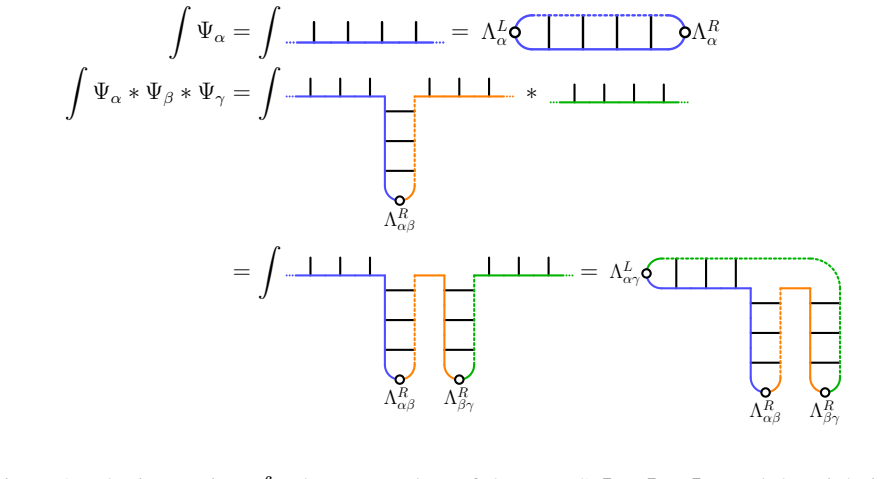
The load-bearing object is the phase $\phi(\alpha,\beta,\gamma)$ of the OPE coefficient of the three lightest boundary-condition-changing operators $\psi_{\alpha\beta},\psi_{\beta\gamma},\psi_{\gamma\alpha}$ in the disk three-point function (2.21). The paper treats this phase as the holonomy of a putative 2-form connection along the small triangle with vertices $\alpha,\beta,\gamma$, and takes the mixed second derivative of $\phi$ at $\beta=\gamma=\alpha$ to define $B$; $H=dB$ is the corresponding 3-form curvature. Computations are organized by the modulated boundary-condition trick, in which the boundary couplings are promoted to $\theta$-dependent functions and then taken to be step functions, so that bcc correlations are extracted from disk partition functions.
What would settle it
Compute the exact disk three-point function of the lightest bcc operators in the $SU(2)_2$ WZW boundary conformal manifold at finite separation on the group manifold and compare the phase with the integral of the claimed connection; any discrepancy that does not vanish as the three points collapse to a point would disprove the identification of the curvature with the Wess-Zumino term.
Extended reading notes
Core claim
The central claim is equation (2.25): on a local patch of the boundary conformal manifold where the lightest bcc operator exists and varies smoothly, the phase $\phi(\alpha,\beta,\gamma)$ of the OPE coefficient in the disk three-point function defines a higher Berry connection $$B = -\frac{i}{2!}\left(\frac{\$partial^{2}$\phi}{\partial\$\beta$^i\partial\gamma^j}-(i\leftrightarrow j)\right)_{\$\beta$=\gamma=\$\alpha$}d\$\alpha$^i\wedge d\$\alpha$^j,$$ with curvature $H=dB$. The paper shows that this object is a 2-form connection under the phase redefinitions of bcc operators, transforming as $B\to B+d\lambda$, and that it is physically realized in examples: in Narain CFTs with Dirichlet boundaries it is $B=\frac{1}{2}\frac{B_{ab}}{2\pi}d\xi^a\wedge d\xi^b$, i.e. the NS-NS B-field, and in WZW models its curvature is the Wess-Zumino term. On a smooth component of the moduli space, the flux of $H$ is quantized; on the orbifold $SU(2)/\mathbb{Z}_N$ arising from non-chiral deformations, the flux is $1/N$, which the paper interprets through the third orbifold cohomology.
Load-bearing premise
Inside a local patch of the boundary conformal manifold, each interval Hilbert space must have a unique ground state and the lightest boundary-condition-changing operator must be well defined and vary smoothly without level crossing, because the phase whose derivatives define the connection is otherwise ill-defined.
Editorial extensions
If this is right
- Boundary conformal manifolds now carry a 2-form connection and a 3-form curvature defined from correlation functions, so families of conformal boundary conditions acquire higher Berry holonomies, not just a Zamolodchikov metric.
- When the boundary conformal manifold describes a D-brane position moduli space, the higher Berry connection is the NS-NS B-field; in WZW models the curvature is the Wess-Zumino term, giving a gerbe interpretation of the moduli space.
- The BCFT construction is a continuum formulation of the MPS higher Berry phase, so higher Berry curvature and related quantized fluxes of gapped (1+1)-dimensional systems can be computed analytically from CFT correlation functions.
- On orbifold points of the moduli space the flux becomes fractional, $1/N$ for $SU(2)/\mathbb{Z}_N$, and the paper argues this is captured by the third orbifold cohomology; this ties the higher Berry structure to singularities of the boundary conformal manifold.
- A transgression formula relates the 2-form connection to a functional Berry connection on loop space, whose holonomy is the WZW action, connecting the construction to anomalies in the space of boundary couplings.
Reading between the lines
- The same construction should extend to conformal interfaces via the folding trick; interface conformal manifolds would then carry an analogous 2-form connection, a direction the paper flags but does not develop.
- If the higher Berry connection really is the B-field, then on any smooth boundary conformal manifold the flux of $H$ should be integrally quantized; the fractional value at orbifold points may indicate that singularities act as sources, giving a boundary analogue of anomaly matching.
- One testable extension is to compute the disk three-point function of lightest bcc operators from an explicit lattice realization of the same boundary conditions and check that its phase converges to (2.25) in the continuum limit.
Signed reviews
Editorial analysis
A structured set of objections, weighed in public.
Referee Report
Summary. The paper introduces a 2-form 'higher Berry connection' B and a 3-form curvature H on the space of conformal boundary conditions of a (1+1)d CFT, defined through the phase of the OPE coefficient of lightest boundary-condition-changing operators at three nearby boundary conditions. After setting up the formalism by analogy with the triple inner product of MPS (Section 2), the paper computes B in several examples: compact bosons with B-field (Narain CFTs), WZW models, free fermions, and a non-chiral deformation at rational radii. In the Narain case B is the constant Kalb-Ramond field; in the WZW case it is the WZ 2-form potential whose curvature is the Wess-Zumino 3-form; the free-fermion case is analogous. The paper also discusses the relation to loop-space connections and to SPT invariants via symmetric boundaries.
Significance. If the central definition is corrected, the paper offers a genuinely new correlation-function-only construction of a 2-form connection on boundary conformal manifolds, going beyond the Zamolodchikov metric and providing an analytic, continuum counterpart to the MPS higher Berry phase. The strength of the paper lies in its concrete computations: the compact-boson result is derived both by path integral and by canonical quantization, and the WZW 2-point function is checked against the known scaling dimension of bcc operators. The identification of the higher Berry connection with the NS-NS B-field in string-theoretic examples is striking and falsifiable. No free parameters are fitted. The main weaknesses are formal: the printed central definition contains a sign/imaginary-unit inconsistency, and the smooth-phase and global-patching assumptions behind the definition are asserted rather than proved.
major comments (3)
- [Section 2.3, Eq. (2.25)] As written, the definition is inconsistent with the rest of the paper. For the real phase phi defined in (2.22), the right-hand side of (2.25) is purely imaginary, while the higher Berry connection B must be real. Applying (2.25) to the Narain phase phi = (B_ab/4pi)(xi1^a xi2^b + xi2^a xi3^b + xi3^a xi1^b) gives B = -i (B_ab/4pi) dxi^a ^ dxi^b, not the quoted result (3.25). The examples and the gauge transformation (2.30)-(2.32) instead correspond to B = (1/2!)[d^2 phi/(dbeta^i dgamma^j) - (i <-> j)] dalpha^i ^ dalpha^j, i.e. the factor -i should be removed, or equivalently the derivative in (2.25) should act on log c(alpha,beta,gamma) rather than on the real phase phi. Since this is the central definition of the paper, it must be corrected and the coordinate-free form should be stated unambiguously.
- [Sections 2.2-2.3 and 3.2] The definition (2.25) requires a smooth logarithm phi of the U(1)-valued OPE coefficient on a neighbourhood of the diagonal, with no branch jumps, and it implicitly requires that the local patches fit together with the cocycle structure described only formally around (2.29). The paper states this smoothness as an assumption but does not prove it for the examples, and no overlap/patching construction is given. For the compact-boson case the phase can be written explicitly and is smooth on local lifts of the torus, but for the WZW model the OPE coefficient is computed only to second order in delta-omega (Eq. (3.69)), so smoothness and the absence of a local obstruction are not verified at finite separation. Since this is load-bearing for the existence of the connection and for the gauge-invariance of H = dB, the authors should either supply a proof or a precise statement of the domain of validity of the assumption for each example, and discuss how the local B fields are patched on overlaps of coordinate charts.
- [Section 3.4, Eqs. (3.107)-(3.110)] The non-chiral deformation example produces a fractional flux (1/2pi) integral_M H_WZ = 1/N on M = SU(2)/Z_N. The authors state that they do not yet have a complete understanding of this phenomenon. This example lies exactly where the assumptions of Section 2.2 fail: at the orbifold singularities the boundary conditions are non-simple, so the unique-ground-state and no-level-crossing premises behind the bcc OPE phase are not satisfied. The paper should clarify whether Eq. (3.108) is a prediction of the framework, an indication that the definition (2.25) must be extended to singular points, or an artifact of computing on a singular quotient. As it stands, the fractional flux is presented as a result but its relation to the stated domain of the definition is unresolved.
minor comments (4)
- [Section 2.3, Eq. (2.28)] The notation <B_alpha, dB_alpha, ^ dB_alpha> is not defined; please specify that the exterior derivative acts on the alpha-dependence of the triple inner product and show explicitly the equivalence with (2.25) once the sign issue in (2.25) is fixed.
- [Section 3.1.1, around Eq. (3.14)] The boundary term (3.14) vanishes for the chosen step configuration, but the values of xi^a(theta) at the discontinuities affect the phase and are related to the gauge freedom (2.20). The precise map between the discontinuity convention and the 1-form gauge parameter lambda of (2.31) would be helpful.
- [Section 4, Eq. (4.12)] The relation (4.12) is central to the loop-space transgression discussion, but no derivation or precise reference for the transgression map in this normalization is given; please provide one or state the conventions explicitly.
- [Throughout] There are several typos and small errors: 'structrues' in Section 5, 'Diriclet' in Appendix A, 'porduct' in Section 3.5, and an inconsistent use of 'higher Berry curvature' versus 'higher Berry connection' in a few places. These should be corrected in a final pass.
Circularity Check
No significant circularity: the higher Berry connection (2.25) is defined from bcc-operator OPE phases, and the Narain B-field and WZW Wess-Zumino coincidences are computed from the path integral and Kac-Moody algebra rather than fitted or assumed.
full rationale
This paper defines a new 2-form connection in Eq. (2.25) from the phase phi(alpha,beta,gamma) of the bcc-operator OPE coefficient c(alpha,beta,gamma) in Eqs. (2.21)-(2.22), a quantity computed entirely from boundary correlation functions. The load-bearing claims — that for Narain CFTs this connection equals the sigma-model B-field (3.25), and for WZW models its curvature is the Wess-Zumino term (3.70)-(3.74) — are derived results, not re-encodings of the inputs. In the Narain case the OPE phase follows from a direct disk path-integral evaluation, exp[i B_ab/4pi (xi^a_(1)xi^b_(2) + cyclic)] in (3.24), from which (3.25) is obtained; in the WZW case the OPE coefficient (3.69) is computed from the Kac-Moody algebra via the Chern-Simons doubling trick (3.37)-(3.53), and dB is explicitly checked against the known H_WZ for su(2)_k in (3.72)-(3.74). No parameter is fitted to the target quantities, and the benchmarks (the known bcc scaling dimensions (3.22) and (3.61)-(3.63), the B-field, and the WZ term) are independent external structures. The self-citations — the MPS framework [50], related MPS higher-Berry works [40, 44, 116, 149, 153], and fusion-category conventions [73, 118] — are motivational or standard background; the derivation chain itself runs through external references for the boundary states and techniques (Cardy [51], Recknagel-Schomerus [21], Gaberdiel-Recknagel [30], Kapustin-Saulina [95]). The paper also explicitly flags its own open points: the smoothness assumption on the OPE coefficient (Section 2.3), the unresolved global gerbe structure (Section 5), and the fractional flux (3.108) at orbifold singularities (Section 3.4), none of which hides a circular step. The only mild caveat is that in the Narain example the B-field is an input of the action (3.1) and the OPE phase is the boundary-localized B-field term (3.4), so the coincidence (3.25) functions as a consistency check rather than an independent derivation; but the definition (2.25) itself is formulated purely from correlation functions without reference to the B-field, so this does not make the central claim circular.
Assumptions & free parameters
assumptions (5)
- domain assumption For nearby boundary conditions B_alpha and B_beta, the interval Hilbert space H_alphabeta has a unique ground state, and the lightest bcc operator psi_alphabeta varies smoothly with no level crossing.
- domain assumption The OPE coefficient c(alpha,beta,gamma) is a smooth function of its arguments and satisfies cyclicity (2.23); its phase defines a 2-form via (2.25).
- standard math Self-local exactly marginal boundary operators produce deformations that are exactly marginal to all orders in conformal perturbation theory.
- standard math The g-function is constant on the boundary conformal manifold and the disk partition function is normalized to it.
- domain assumption The doubled Chern-Simons description: the disk partition function of the WZW model with a modulated boundary condition equals the ball partition function of G_k Chern-Simons theory with a line operator inserted on the equator.
Cite this review
Pith. "Pith review of Higher Structures on Boundary Conformal Manifolds: Higher Berry Phase and Boundary Conformal Field Theory." pith.science (2026). https://pith.science/paper/CO3W56UT
@misc{pith2026250712525,
  author       = {Pith},
  title        = {Pith review of: Higher Structures on Boundary Conformal Manifolds: Higher Berry Phase and Boundary Conformal Field Theory},
  year         = {2026},
  howpublished = {\url{https://pith.science/paper/CO3W56UT}},
  note         = {Machine review of arXiv:2507.12525}
}
abstract
We introduce the notion of higher Berry connection and curvature in the space of conformal boundary conditions in (1+1)d conformal field theories (CFT), related to each other by exactly marginal boundary deformations, forming a "boundary conformal manifold." Our definition builds upon previous works on tensor networks, such as matrix product states (MPS), where the triple inner product or multi-wavefunction overlap plays the key geometric role. On the one hand, our boundary conformal field theory (BCFT) formulation of higher Berry phase provides a new analytic tool to study families of invertible phases in condensed matter systems. On the other hand, it uncovers a new geometric structure on the moduli space of conformal boundary conditions, beyond the usual Riemannian structure defined through the Zamolodchikov metric. When the boundary conformal manifold has an interpretation as the position moduli space of a D-brane, our higher Berry connection coincides with the NS-NS $B$-field in string theory. The general definition does not require such an interpretation and is formulated purely field-theoretically, in terms of correlation functions of boundary-condition-changing (bcc) operators. We also explore a connection between higher Berry connections and functional Berry connections in the loop spaces of boundary conformal manifolds.
Figures


Figures from the paper (4 more)


Forward citations
Cited by 6 Pith papers
-
Chiral Tube Algebras I: Topological Defect Lines, Twisted Modules, and Finite Gauging
Chiral tube algebras unify chiral algebras and TDLs by acting on twisted defect spaces via local and non-local currents, with modules isomorphic to twisted modules of the parent algebras.
-
Complex Conformal Manifolds
Complexified exactly-marginal couplings produce solvable complex CFTs, with the Ising defect verified numerically in non-Hermitian chains.
-
Characterizing gapped phases by smeared boundary conformal field theories: Duality in unusual ordering with spontaneously broken generalized symmetries
Gapped phases dual to massless RG flows in 2D CFTs exhibit unusual ordering via spontaneous breaking of non-group-like symmetries and are characterized using smeared boundary CFTs applied to smeared Ishibashi states.
-
Generalized Families of QFTs
Generalized family anomalies for broken higher-group and non-invertible symmetries constrain RG flows and IR phases of QFT families, with explicit application to deformed 4d QCD.
-
Non-Local Conserved Currents and Continuous Non-Invertible Symmetries
Non-local conserved currents attached to topological lines generate continuous non-invertible symmetries in 1+1d CFTs, with new examples in SU(2)_k WZW and minimal model products.
-
Tilts from 2-Groups
Line operators charged under the 1-form part of a 2-group symmetry must generically break the 0-form part, enforced by a family anomaly derived from Wess-Zumino consistency.
Reference graph
Works this paper leans on
-
[1]
Zamolodchikov, Irreversibility of the Flux of the Renormalization Group in a 2D Field Theory, JETP Lett
A.B. Zamolodchikov, Irreversibility of the Flux of the Renormalization Group in a 2D Field Theory, JETP Lett. 43 (1986) 730
1986
-
[2]
Seiberg, Observations on the Moduli Space of Superconformal Field Theories, Nucl
N. Seiberg, Observations on the Moduli Space of Superconformal Field Theories, Nucl. Phys. B 303 (1988) 286
1988
-
[3]
Kutasov, Geometry on the Space of Conformal Field Theories and Contact Terms, Phys
D. Kutasov, Geometry on the Space of Conformal Field Theories and Contact Terms, Phys. Lett. B 220 (1989) 153
1989
-
[4]
Ranganathan, Nearby CFTs in the operator formalism: The Role of a connection, Nucl
K. Ranganathan, Nearby CFTs in the operator formalism: The Role of a connection, Nucl. Phys. B 408 (1993) 180 [hep-th/9210090]
arXiv 1993
-
[5]
K. Ranganathan, H. Sonoda and B. Zwiebach, Connections on the state space over conformal field theories, Nucl. Phys. B 414 (1994) 405 [hep-th/9304053]
arXiv 1994
-
[6]
D. Friedan and A. Konechny, Curvature formula for the space of 2-d conformal field theories, JHEP 09 (2012) 113 [1206.1749]
arXiv 2012
-
[7]
J. de Boer, J. Manschot, K. Papadodimas and E. Verlinde, The Chiral ring of AdS(3)/CFT(2) and the attractor mechanism, JHEP 03 (2009) 030 [0809.0507]
arXiv 2009
-
[8]
B. Balthazar and C. Cordova, Geometry of conformal manifolds and the inversion formula, JHEP 07 (2023) 205 [2212.11186]
arXiv 2023
Show all 159 references
-
[9]
Ginsparg, Curiosities at c = 1, Nucl
P.H. Ginsparg, Curiosities at c = 1, Nucl. Phys. B 295 (1988) 153
1988
-
[10]
Candelas, X.C
P. Candelas, X.C. De La Ossa, P.S. Green and L. Parkes, A Pair of Calabi-Yau manifolds as an exactly soluble superconformal theory, Nucl. Phys. B 359 (1991) 21
1991
-
[11]
Behan, Conformal manifolds: ODEs from OPEs, JHEP 03 (2018) 127 [1709.03967]
C. Behan, Conformal manifolds: ODEs from OPEs, JHEP 03 (2018) 127 [1709.03967]
2018 arXiv
-
[12]
Hollands, Action principle for OPE, Nucl
S. Hollands, Action principle for OPE, Nucl. Phys. B 926 (2018) 614 [1710.05601]
2018 arXiv
-
[13]
Bashmakov, M
V . Bashmakov, M. Bertolini and H. Raj,On non-supersymmetric conformal manifolds: field theory and holography, JHEP 11 (2017) 167 [1709.01749]
2017 arXiv
-
[14]
Green, Z
D. Green, Z. Komargodski, N. Seiberg, Y . Tachikawa and B. Wecht,Exactly Marginal Deformations and Global Symmetries, JHEP 06 (2010) 106 [1005.3546]
2010 arXiv
-
[15]
Gomis, P.-S
J. Gomis, P.-S. Hsin, Z. Komargodski, A. Schwimmer, N. Seiberg and S. Theisen, Anomalies, Conformal Manifolds, and Spheres, JHEP 03 (2016) 022 [1509.08511]
2016 arXiv
-
[16]
Gomis, Z
J. Gomis, Z. Komargodski, H. Ooguri, N. Seiberg and Y . Wang,Shortening Anomalies in Supersymmetric Theories, JHEP 01 (2017) 067 [1611.03101]
2017 arXiv
-
[17]
Seiberg, Y
N. Seiberg, Y . Tachikawa and K. Yonekura,Anomalies of Duality Groups and Extended Conformal Manifolds, PTEP 2018 (2018) 073B04 [1803.07366]
2018 arXiv
-
[18]
Ooguri and C
H. Ooguri and C. Vafa, On the Geometry of the String Landscape and the Swampland, Nucl. Phys. B 766 (2007) 21 [hep-th/0605264]. 54
2007 arXiv
-
[19]
Perlmutter, L
E. Perlmutter, L. Rastelli, C. Vafa and I. Valenzuela, A CFT distance conjecture, JHEP 10 (2021) 070 [2011.10040]
2021 arXiv
-
[20]
Ooguri and Y
H. Ooguri and Y . Wang,Universal bounds on CFT Distance Conjecture, JHEP 12 (2024) 154 [2405.00674]
2024 arXiv
-
[21]
Recknagel and V
A. Recknagel and V . Schomerus,Boundary deformation theory and moduli spaces of D-branes, Nucl. Phys. B 545 (1999) 233 [hep-th/9811237]
1999 arXiv
-
[22]
Callan, I.R
C.G. Callan, I.R. Klebanov, A.W.W. Ludwig and J.M. Maldacena, Exact solution of a boundary conformal field theory, Nucl. Phys. B 422 (1994) 417 [hep-th/9402113]
1994 arXiv
-
[23]
Gaberdiel, A
M.R. Gaberdiel, A. Konechny and C. Schmidt-Colinet, Conformal perturbation theory beyond the leading order, J. Phys. A 42 (2009) 105402 [0811.3149]
2009 arXiv
-
[24]
Karch and Y
A. Karch and Y . Sato,Conformal Manifolds with Boundaries or Defects, JHEP 07 (2018) 156 [1805.10427]
2018 arXiv
-
[25]
Herzog and V
C.P. Herzog and V . Schaub,Tilting space of boundary conformal field theories, Phys. Rev. D 109 (2024) L061701 [2301.10789]
2024 arXiv
-
[26]
Bartlett-Tisdall, C.P
S. Bartlett-Tisdall, C.P. Herzog and V . Schaub,Bootstrapping boundary QED. Part I, JHEP 05 (2024) 235 [2312.07692]
2024 arXiv
-
[27]
Drukker, Z
N. Drukker, Z. Kong and G. Sakkas, Broken global symmetries and defect conformal manifolds, Phys. Rev. Lett. 129 (2022) 201603
2022
-
[28]
Antinucci, C
A. Antinucci, C. Copetti, G. Galati and G. Rizi, Defect Conformal Manifolds from Phantom (Non-Invertible) Symmetries, 2505.09668
-
[29]
Damia, R
J.A. Damia, R. Argurio and S. Chaudhuri, When the moduli space is an orbifold: spontaneous breaking of continuous non-invertible symmetries, JHEP 03 (2024) 042 [2309.06491]
2024 arXiv
-
[30]
Gaberdiel and A
M.R. Gaberdiel and A. Recknagel, Conformal boundary states for free bosons and fermions, JHEP 11 (2001) 016 [hep-th/0108238]
2001 arXiv
-
[31]
A.Y . Kitaev,Differential forms on the space of statistical mechanical lattice models, talk at Between Topology and Quantum Field Theory: a conference in celebration of Dan Freed’s 60th birthday
-
[32]
Kapustin and L
A. Kapustin and L. Spodyneiko, Higher-dimensional generalizations of Berry curvature, Phys. Rev. B 101 (2020) 235130
2020
-
[33]
Kapustin and L
A. Kapustin and L. Spodyneiko, Higher-dimensional generalizations of the Thouless charge pump, 2003.09519
2003 arXiv
-
[34]
P.-S. Hsin, A. Kapustin and R. Thorngren, Berry phase in quantum field theory: Diabolical points and boundary phenomena, Physical Review B 102 (2020)
2020
-
[35]
Cordova, D
C. Cordova, D. Freed, H.T. Lam and N. Seiberg, Anomalies in the space of coupling constants and their dynamical applications i, SciPost Physics 8 (2020) . 55
2020
-
[36]
Cordova, D
C. Cordova, D. Freed, H.T. Lam and N. Seiberg, Anomalies in the space of coupling constants and their dynamical applications II, SciPost Physics 8 (2020)
2020
-
[37]
Kapustin and N
A. Kapustin and N. Sopenko, Local Noether theorem for quantum lattice systems and topological invariants of gapped states, J. Math. Phys. 63 (2022) 091903 [2201.01327]
2022 arXiv
-
[38]
Choi and K
Y . Choi and K. Ohmori,Higher Berry phase of fermions and index theorem, JHEP 09 (2022) 022 [2205.02188]
2022 arXiv
-
[39]
X. Wen, M. Qi, A. Beaudry, J. Moreno, M.J. Pflaum, D. Spiegel et al., Flow of higher berry curvature and bulk-boundary correspondence in parametrized quantum systems, Physical Review B 108 (2023)
2023
-
[40]
Ohyama, Y
S. Ohyama, Y . Terashima and K. Shiozaki,Discrete higher Berry phases and matrix product states, Physical Review B 110 (2024) 035114 [2303.04252]
2024 arXiv
-
[41]
Beaudry, M
A. Beaudry, M. Hermele, J. Moreno, M.J. Pflaum, M. Qi and D.D. Spiegel, Homotopical foundations of parametrized quantum spin systems, Reviews in Mathematical Physics 36 (2024)
2024
-
[42]
M. Qi, D.T. Stephen, X. Wen, D. Spiegel, M.J. Pflaum, A. Beaudry et al., Charting the space of ground states with tensor networks, 2305.07700
-
[43]
Spiegel, A C ∗-algebraic approach to parametrized quantum spin systems and their phases in one spatial dimension, 2305.07951
D.D. Spiegel, A C ∗-algebraic approach to parametrized quantum spin systems and their phases in one spatial dimension, 2305.07951
-
[44]
Shiozaki, N
K. Shiozaki, N. Heinsdorf and S. Ohyama, Higher Berry curvature from matrix product states, 2305.08109
-
[45]
Sommer, X
O.E. Sommer, X. Wen and A. Vishwanath, Higher Berry curvature from the wave function. i. schmidt decomposition and matrix product states, Physical Review Letters 134 (2025)
2025
-
[46]
Sommer, A
O.E. Sommer, A. Vishwanath and X. Wen, Higher Berry curvature from the wave function. ii. locally parametrized states beyond one dimension, Physical Review B 111 (2025)
2025
-
[47]
Artymowicz, A
A. Artymowicz, A. Kapustin and N. Sopenko, Quantization of the Higher Berry Curvature and the Higher Thouless Pump, Communications in Mathematical Physics 405 (2024) 191 [2305.06399]
2024 arXiv
-
[48]
Geiko, Parametrized topological phases in 1d and T-duality, 2412.20905
R. Geiko, Parametrized topological phases in 1d and T-duality, 2412.20905
-
[49]
Manjunath and D.V
N. Manjunath and D.V . Else,Anomalous continuous symmetries and quantum topology of goldstone modes, Physical Review B 111 (2025)
2025
-
[50]
Ohyama and S
S. Ohyama and S. Ryu, Higher structures in matrix product states, Physical Review B 109 (2024) 115152 [2304.05356]
2024 arXiv
-
[51]
Cardy, Boundary conformal field theory, hep-th/0411189
J.L. Cardy, Boundary conformal field theory, hep-th/0411189
-
[52]
X.-L. Qi, H. Katsura and A.W.W. Ludwig, General relationship between the entanglement spectrum and the edge state spectrum of topological quantum states, Phys. Rev. Lett. 108 (2012) 196402. 56
2012
-
[53]
Miyaji, S
M. Miyaji, S. Ryu, T. Takayanagi and X. Wen, Boundary states as holographic duals of trivial spacetimes, Journal of High Energy Physics 2015 (2015) 152 [1412.6226]
2015 arXiv
-
[54]
G.Y . Cho, K. Shiozaki, S. Ryu and A.W.W. Ludwig,Relationship between symmetry protected topological phases and boundary conformal field theories via the entanglement spectrum, Journal of Physics A: Mathematical and Theoretical 50 (2017) 304002
2017
-
[55]
Cardy, Bulk renormalization group flows and boundary states in conformal field theories, SciPost Physics 3 (2017)
J. Cardy, Bulk renormalization group flows and boundary states in conformal field theories, SciPost Physics 3 (2017)
2017
-
[56]
Witten, Noncommutative Geometry and String Field Theory, Nucl
E. Witten, Noncommutative Geometry and String Field Theory, Nucl. Phys. B 268 (1986) 253
1986
-
[57]
Schomerus,Lectures on branes in curved backgrounds, Class
V . Schomerus,Lectures on branes in curved backgrounds, Class. Quant. Grav. 19 (2002) 5781 [hep-th/0209241]
2002 arXiv
-
[58]
Perez-Garcia, F
D. Perez-Garcia, F. Verstraete, M.M. Wolf and J.I. Cirac, Matrix product state representations, Quant. Inf. Comput. 7 (2007) 401 [quant-ph/0608197]
2007 arXiv
-
[59]
Pérez-García, M.M
D. Pérez-García, M.M. Wolf, M. Sanz, F. Verstraete and J.I. Cirac, String order and symmetries in quantum spin lattices, Physical Review Letters 100 (2008)
2008
-
[60]
Brylinski, Loop spaces, characteristic classes and geometric quantization, Birkhäuser (1993)
J.-L. Brylinski, Loop spaces, characteristic classes and geometric quantization, Birkhäuser (1993)
1993
-
[61]
Beaudry, M
A. Beaudry, M. Hermele, M.J. Pflaum, M. Qi, D.D. Spiegel and D.T. Stephen, A classifying space for phases of matrix product states, 2501.14241
-
[62]
Wu and C.N
T.T. Wu and C.N. Yang, Concept of nonintegrable phase factors and global formulation of gauge fields, Phys. Rev. D 12 (1975) 3845
1975
-
[63]
Fukui, Y
T. Fukui, Y . Hatsugai and H. Suzuki,Chern numbers in discretized brillouin zone: Efficient method of computing (spin) hall conductances, Journal of the Physical Society of Japan 74 (2005) 1674–1677
2005
-
[64]
Cardy, Boundary Conditions in Conformal Field Theory, Adv
J. Cardy, Boundary Conditions in Conformal Field Theory, Adv. Stud. Pure Math. 19 (1989) 127
1989
-
[65]
Cardy, CONFORMAL INVARIANCE AND STATISTICAL MECHANICS, in Les Houches Summer School in Theoretical Physics: Fields, Strings, Critical Phenomena, 1, 1989
J.L. Cardy, CONFORMAL INVARIANCE AND STATISTICAL MECHANICS, in Les Houches Summer School in Theoretical Physics: Fields, Strings, Critical Phenomena, 1, 1989
1989
-
[66]
E. Date, M. Jimbo, T. Miwa and M. Okado, Automorphic properties of local height probabilities for integrable solid-on-solid models, Phys. Rev. B 35 (1987) 2105
1987
-
[67]
Saleur and M
H. Saleur and M. Bauer, On Some Relations Between Local Height Probabilities and Conformal Invariance, Nucl. Phys. B 320 (1989) 591
1989
-
[68]
Calabrese, J
P. Calabrese, J. Cardy and I. Peschel, Corrections to scaling for block entanglement in massive spin chains, Journal of Statistical Mechanics: Theory and Experiment 2010 (2010) P09003. 57
2010
-
[69]
Erler, Four lectures on analytic solutions in open string field theory, Phys
T. Erler, Four lectures on analytic solutions in open string field theory, Phys. Rept. 980 (2022) 1 [1912.00521]
2022 arXiv
-
[70]
Fuchs, I
J. Fuchs, I. Runkel and C. Schweigert, Tft construction of rcft correlators i: partition functions, Nuclear Physics B 646 (2002) 353–497
2002
-
[71]
Cardy, Boundary Conditions, Fusion Rules and the Verlinde Formula, Nucl
J.L. Cardy, Boundary Conditions, Fusion Rules and the Verlinde Formula, Nucl. Phys. B 324 (1989) 581
1989
-
[72]
Lewellen, Sewing constraints for conformal field theories on surfaces with boundaries, Nucl
D.C. Lewellen, Sewing constraints for conformal field theories on surfaces with boundaries, Nucl. Phys. B 372 (1992) 654
1992
-
[73]
Choi, B.C
Y . Choi, B.C. Rayhaun, Y . Sanghavi and S.-H. Shao,Remarks on boundaries, anomalies, and noninvertible symmetries, Phys. Rev. D 108 (2023) 125005 [2305.09713]
2023 arXiv
-
[74]
Janik, Exceptional boundary states at c=1, Nucl
R.A. Janik, Exceptional boundary states at c=1, Nucl. Phys. B 618 (2001) 675 [hep-th/0109021]
2001 arXiv
-
[75]
ground state degeneracy
I. Affleck and A.W.W. Ludwig, Universal noninteger “ground state degeneracy” in critical quantum systems, Phys. Rev. Lett. 67 (1991) 161
1991
-
[76]
Friedan and A
D. Friedan and A. Konechny, On the boundary entropy of one-dimensional quantum systems at low temperature, Phys. Rev. Lett. 93 (2004) 030402 [hep-th/0312197]
2004 arXiv
-
[77]
Casini, I
H. Casini, I. Salazar Landea and G. Torroba, The g-theorem and quantum information theory, JHEP 10 (2016) 140 [1607.00390]
2016 arXiv
-
[78]
Cuomo, Z
G. Cuomo, Z. Komargodski and A. Raviv-Moshe, Renormalization Group Flows on Line Defects, Phys. Rev. Lett. 128 (2022) 021603 [2108.01117]
2022 arXiv
-
[79]
Gaberdiel, A
M.R. Gaberdiel, A. Recknagel and G.M.T. Watts, The Conformal boundary states for SU(2) at level 1, Nucl. Phys. B 626 (2002) 344 [hep-th/0108102]
2002 arXiv
-
[80]
Cardy, Effect of Boundary Conditions on the Operator Content of Two-Dimensional Conformally Invariant Theories, Nucl
J.L. Cardy, Effect of Boundary Conditions on the Operator Content of Two-Dimensional Conformally Invariant Theories, Nucl. Phys. B 275 (1986) 200
1986
-
[81]
Brehm and I
E.M. Brehm and I. Runkel, Lattice models from cft on surfaces with holes: I. torus partition function via two lattice cells, Journal of Physics A: Mathematical and Theoretical 55 (2022) 235001
2022
-
[82]
Brehm and I
E.M. Brehm and I. Runkel, Lattice models from cft on surfaces with holes ii: Cloaking boundary conditions and loop models, 2410.19938
-
[83]
Cheng, L
G. Cheng, L. Chen, Z.-C. Gu and L.-Y . Hung,Precision reconstruction of rational CFT from exact fixed point tensor network, 2311.18005
-
[84]
Bachas and M
C. Bachas and M. Gaberdiel, Loop operators and the kondo problem, Journal of High Energy Physics 2004 (2004) 065–065
2004
-
[85]
Affleck and A.W.W
I. Affleck and A.W.W. Ludwig, The Fermi edge singularity and boundary condition changing operators, Journal of Physics A Mathematical General 27 (1994) 5375 [cond-mat/9405057]. 58
1994 arXiv
-
[86]
Oshikawa and I
M. Oshikawa and I. Affleck, Boundary conformal field theory approach to the critical two-dimensional ising model with a defect line, Nuclear Physics B 495 (1997) 533–582
1997
-
[87]
Affleck and A.W.W
I. Affleck and A.W.W. Ludwig, The fermi edge singularity and boundary condition changing operators, Journal of Physics A: Mathematical and General 27 (1994) 5375–5392
1994
-
[88]
Giveon, M
A. Giveon, M. Porrati and E. Rabinovici, Target space duality in string theory, Physics Reports 244 (1994) 77–202
1994
-
[89]
Affleck, Quantum impurity problems in condensed matter physics, 0809.3474
I. Affleck, Quantum impurity problems in condensed matter physics, 0809.3474
-
[90]
Callan, Jr., C
C.G. Callan, Jr., C. Lovelace, C.R. Nappi and S.A. Yost, Loop Corrections to Superstring Equations of Motion, Nucl. Phys. B 308 (1988) 221
1988
-
[91]
Debray, S.K
A. Debray, S.K. Devalapurkar, C. Krulewski, Y .L. Liu, N. Pacheco-Tallaj and R. Thorngren, A Long Exact Sequence in Symmetry Breaking: order parameter constraints, defect anomaly-matching, and higher Berry phases, 2309.16749
-
[92]
Green and M
M.B. Green and M. Gutperle, Symmetry breaking at enhanced symmetry points, Nucl. Phys. B 460 (1996) 77 [hep-th/9509171]
1996 arXiv
-
[93]
Recknagel and V
A. Recknagel and V . Schomerus,D-branes in Gepner models, Nucl. Phys. B 531 (1998) 185 [hep-th/9712186]
1998 arXiv
-
[94]
Recknagel and V
A. Recknagel and V . Schomerus,Boundary deformation theory and moduli spaces of d-branes, Nuclear Physics B 545 (1999) 233–282
1999
-
[95]
Kapustin and N
A. Kapustin and N. Saulina, Surface operators in 3d Topological Field Theory and 2d Rational Conformal Field Theory, 1012.0911
-
[96]
Elitzur, G.W
S. Elitzur, G.W. Moore, A. Schwimmer and N. Seiberg, Remarks on the Canonical Quantization of the Chern-Simons-Witten Theory, Nucl. Phys. B 326 (1989) 108
1989
-
[97]
Alvarez, Topological Quantization and Cohomology, Commun
O. Alvarez, Topological Quantization and Cohomology, Commun. Math. Phys. 100 (1985) 279
1985
-
[98]
Gaw˛ edzki,Topological actions in two-dimensional quantum field thories, Nonperturbative quantum field theory (1988) 101
K. Gaw˛ edzki,Topological actions in two-dimensional quantum field thories, Nonperturbative quantum field theory (1988) 101
1988
-
[99]
Kapustin, D-branes in a topologically nontrivial B field, Adv
A. Kapustin, D-branes in a topologically nontrivial B field, Adv. Theor. Math. Phys.4 (2000) 127 [hep-th/9909089]
2000 arXiv
-
[100]
Freed and E
D.S. Freed and E. Witten, Anomalies in string theory with D-branes, Asian J. Math. 3 (1999) 819 [hep-th/9907189]
1999 arXiv
- [101]
-
[102]
Carey, S
A.L. Carey, S. Johnson, M.K. Murray, D. Stevenson and B.-L. Wang, Bundle gerbes for Chern-Simons and Wess-Zumino-Witten theories, Commun. Math. Phys. 259 (2005) 577 [math/0410013]. 59
2005 arXiv
-
[103]
Schreiber, C
U. Schreiber, C. Schweigert and K. Waldorf, Unoriented WZW models and holonomy of bundle gerbes, Commun. Math. Phys. 274 (2007) 31 [hep-th/0512283]
2007 arXiv
-
[104]
Waldorf, Gerbes in unoriented WZW models, SFIN A 1 (2006) 423
K. Waldorf, Gerbes in unoriented WZW models, SFIN A 1 (2006) 423
2006
-
[105]
Runkel and R.R
I. Runkel and R.R. Suszek, Gerbe-holonomy for surfaces with defect networks, 0808.1419
-
[106]
Maldacena, G.W
J.M. Maldacena, G.W. Moore and N. Seiberg, Geometrical interpretation of D-branes in gauged WZW models, JHEP 07 (2001) 046 [hep-th/0105038]
2001 arXiv
-
[107]
Blakeley and A
D. Blakeley and A. Recknagel, Symmetry-breaking boundary states for WZW models, Nucl. Phys. B 806 (2009) 636 [0705.1068]
2009 arXiv
-
[108]
Kudrna, Boundary states in the SU(2)k WZW model from open string field theory, JHEP 03 (2023) 228 [2112.12213]
M. Kudrna, Boundary states in the SU(2)k WZW model from open string field theory, JHEP 03 (2023) 228 [2112.12213]
2023 arXiv
-
[109]
Y . Lee, K. Ohmori and Y . Tachikawa,Revisiting Wess-Zumino-Witten terms, SciPost Phys. 10 (2021) 061 [2009.00033]
2021 arXiv
-
[110]
Callan, Jr
C.G. Callan, Jr. and I.R. Klebanov, Exact C = 1 boundary conformal field theories, Phys. Rev. Lett. 72 (1994) 1968 [hep-th/9311092]
1994 arXiv
-
[111]
Collier, D
S. Collier, D. Mazac and Y . Wang,Bootstrapping boundaries and branes, JHEP 02 (2023) 019 [2112.00750]
2023 arXiv
-
[112]
Lupercio and B
E. Lupercio and B. Uribe, An introduction to gerbes on orbifolds, Annales mathématiques Blaise Pascal 11 (2004) 155
2004
-
[113]
Lupercio and B
E. Lupercio and B. Uribe, Deligne cohomology for orbifolds, discrete torsion and B fields, in Summer School 2001 on Geometric and Topological Methods for Quantum Field Theory, pp. 468–482, 1, 2002 [hep-th/0201184]
2001 arXiv
-
[114]
A. Adem, J. Leida and Y . Ruan,Orbifolds and Stringy Topology, vol. 171 of Cambridge Tracts in Mathematics, Cambridge University Press, Cambridge (2009), 10.1017/CBO9780511543081
2009 doi
-
[115]
Kawasaki, Cohomology of twisted projective spaces and lens complexes, Mathematische Annalen 206 (1973) 243
T. Kawasaki, Cohomology of twisted projective spaces and lens complexes, Mathematische Annalen 206 (1973) 243
1973
-
[116]
B. Liu, J. Zhang, S. Ohyama, Y . Kusuki and S. Ryu,Multi wavefunction overlap and multi entropy for topological ground states in (2+1) dimensions, 2410.08284
-
[117]
Chen, Z.-C
X. Chen, Z.-C. Gu, Z.-X. Liu and X.-G. Wen, Symmetry protected topological orders and the group cohomology of their symmetry group, Physical Review B 87 (2013)
2013
-
[118]
Choi, B.C
Y . Choi, B.C. Rayhaun and Y . Zheng,Generalized Tube Algebras, Symmetry-Resolved Partition Functions, and Twisted Boundary States, 2409.02159
-
[119]
Ostrik,Module categories, weak Hopf algebras and modular invariants, Transform
V . Ostrik,Module categories, weak Hopf algebras and modular invariants, Transform. Groups 8 (2003) 177 [math/0111139]. 60
2003 arXiv
-
[120]
Bhardwaj and Y
L. Bhardwaj and Y . Tachikawa,On finite symmetries and their gauging in two dimensions, Journal of High Energy Physics 2018 (2018)
2018
-
[121]
Chang, Y .-H
C.-M. Chang, Y .-H. Lin, S.-H. Shao, Y . Wang and X. Yin,Topological defect lines and renormalization group flows in two dimensions, Journal of High Energy Physics 2019 (2019)
2019
-
[122]
Thorngren and Y
R. Thorngren and Y . Wang,Fusion category symmetry. Part I. Anomaly in-flow and gapped phases, JHEP 04 (2024) 132 [1912.02817]
2024 arXiv
-
[123]
Inamura and S
K. Inamura and S. Ohyama, 1+1d spt phases with fusion category symmetry: interface modes and non-abelian thouless pump, 2408.15960
-
[124]
Mickelsson, Kac-moody Groups, Topology of the Dirac Determinant Bundle and Fermionization, Commun
J. Mickelsson, Kac-moody Groups, Topology of the Dirac Determinant Bundle and Fermionization, Commun. Math. Phys. 110 (1987) 173
1987
-
[125]
Stone, Coherent State Path Integrals for Loop Groups and Nonabelian Bosonization, Nucl
M. Stone, Coherent State Path Integrals for Loop Groups and Nonabelian Bosonization, Nucl. Phys. B 327 (1989) 399
1989
-
[126]
S. Iso, C. Itoi and H. Mukaida, NECESSITY OF A FINITE SIZE TERM IN THE WZW MODEL, Phys. Lett. B 244 (1990) 241
1990
-
[127]
Waldorf, Transgressive loop group extensions, Mathematische Zeitschrift 286 (2016) 325–360
K. Waldorf, Transgressive loop group extensions, Mathematische Zeitschrift 286 (2016) 325–360
2016
-
[128]
Kohno, Conformal Field Theory and Topology, vol
T. Kohno, Conformal Field Theory and Topology, vol. 210 of Iwanami Series in Modern Mathematics, Translations of Mathematical Monographs, American Mathematical Society (2002)
2002
-
[129]
Seiberg and E
N. Seiberg and E. Witten, String theory and noncommutative geometry, JHEP 09 (1999) 032 [hep-th/9908142]
1999 arXiv
-
[130]
Arcioni, M
G. Arcioni, M. Carfora, C. Dappiaggi and A. Marzuoli, The wzw model on random regge triangulations, Journal of Geometry and Physics 52 (2004) 137–173
2004
-
[131]
Hung and Y
L.-Y . Hung and Y . Jiang,Building up quantum spacetimes with bcft legos, 2404.00877
-
[132]
Sopenko, Chiral topologically ordered states on a lattice from vertex operator algebras, 2301.08697
N. Sopenko, Chiral topologically ordered states on a lattice from vertex operator algebras, 2301.08697
-
[133]
Runkel, Boundary structure constants for the a-series virasoro minimal models, Nuclear Physics B 549 (1999) 563–578
I. Runkel, Boundary structure constants for the a-series virasoro minimal models, Nuclear Physics B 549 (1999) 563–578
1999
-
[134]
Moore and N
G.W. Moore and N. Seiberg, Classical and Quantum Conformal Field Theory, Commun. Math. Phys. 123 (1989) 177
1989
-
[135]
S. Iino, S. Morita and N. Kawashima, Boundary tensor renormalization group, Physical Review B 100 (2019)
2019
-
[136]
S. Iino, S. Morita and N. Kawashima, Boundary conformal spectrum and surface critical behavior of classical spin systems: A tensor network renormalization study, Physical Review B 101 (2020) . 61
2020
-
[137]
Iino, Boundary cft and tensor network approach to surface critical phenomena of the tricritical 3-state potts model, Journal of Statistical Physics 182 (2021)
S. Iino, Boundary cft and tensor network approach to surface critical phenomena of the tricritical 3-state potts model, Journal of Statistical Physics 182 (2021)
2021
- [138]
-
[139]
Rastelli and B
L. Rastelli and B. Zwiebach, Tachyon potentials, star products and universality, JHEP 09 (2001) 038 [hep-th/0006240]
2001 arXiv
-
[140]
Schnabl, Analytic solution for tachyon condensation in open string field theory, Adv
M. Schnabl, Analytic solution for tachyon condensation in open string field theory, Adv. Theor. Math. Phys. 10 (2006) 433 [hep-th/0511286]
2006 arXiv
-
[141]
Kiermaier, Y
M. Kiermaier, Y . Okawa and P. Soler,Solutions from boundary condition changing operators in open string field theory, Journal of High Energy Physics 2011 (2011)
2011
-
[142]
Perez-Lona, E
A. Perez-Lona, E. Sharpe and X. Yu, Categorified structures over moduli spaces: Anomalies, non-invertible symmetries, and exceptional holonomy, 2506.19909
-
[143]
Witten and J
E. Witten and J. Bagger, Quantization of Newton’s Constant in Certain Supergravity Theories, Phys. Lett. B 115 (1982) 202
1982
-
[144]
Distler, Notes on N=2 sigma models, hep-th/9212062
J. Distler, Notes on N=2 sigma models, hep-th/9212062
-
[145]
Periwal and A
V . Periwal and A. Strominger,Kahler Geometry of the Space of N = 2 Superconformal Field Theories, Phys. Lett. B 235 (1990) 261
1990
-
[146]
Sharpe, An overview of Bagger-Witten line bundles, 2412.09198
E. Sharpe, An overview of Bagger-Witten line bundles, 2412.09198
-
[147]
Baggio, V
M. Baggio, V . Niarchos and K. Papadodimas,Aspects of Berry phase in QFT, JHEP 04 (2017) 062 [1701.05587]
2017 arXiv
-
[148]
Bachas, J
C. Bachas, J. de Boer, R. Dijkgraaf and H. Ooguri, Permeable conformal walls and holography, JHEP 06 (2002) 027 [hep-th/0111210]
2002 arXiv
-
[149]
Ohyama and S
S. Ohyama and S. Ryu, Higher Berry phase from projected entangled pair states in (2+1) dimensions, Physical Review B 111 (2025) 045112 [2405.05325]
2025 arXiv
-
[150]
Quella, I
T. Quella, I. Runkel and G.M.T. Watts, Reflection and transmission for conformal defects, JHEP 04 (2007) 095 [hep-th/0611296]
2007 arXiv
-
[151]
Sakai and Y
K. Sakai and Y . Satoh,Entanglement through conformal interfaces, JHEP 12 (2008) 001 [0809.4548]
2008 arXiv
-
[152]
Hsin and Z
P.-S. Hsin and Z. Wang, On topology of the moduli space of gapped hamiltonians for topological phases, Journal of Mathematical Physics 64 (2023)
2023
-
[153]
Ohyama and S
S. Ohyama and S. Ryu, Higher Berry connection for matrix product states, Physical Review B 111 (2025) 035121 [2405.05327]
2025 arXiv
-
[154]
Henriques, What chern-simons theory assigns to a point, 1503.06254
A. Henriques, What chern-simons theory assigns to a point, 1503.06254
-
[155]
Wen, Space of conformal boundary conditions from the view of higher Berry phase: Flow of Berry curvature in parametrized BCFTs, to appear
X. Wen, Space of conformal boundary conditions from the view of higher Berry phase: Flow of Berry curvature in parametrized BCFTs, to appear
-
[156]
Thouless, Quantization of particle transport, Phys
D.J. Thouless, Quantization of particle transport, Phys. Rev. B 27 (1983) 6083. 62
1983
-
[157]
Gaiotto, A
D. Gaiotto, A. Kapustin, Z. Komargodski and N. Seiberg, Theta, Time Reversal, and Temperature, JHEP 05 (2017) 091 [1703.00501]
2017 arXiv
-
[158]
Oshikawa, C
M. Oshikawa, C. Chamon and I. Affleck, Junctions of three quantum wires, Journal of Statistical Mechanics: Theory and Experiment 2006 (2006) P02008–P02008
2006
-
[159]
Kac,Infinite dimensional Lie algebras (1990)
V .G. Kac,Infinite dimensional Lie algebras (1990). 63
1990
Reviewed August 6, 2026 · model on record in the stance chip above.
Discussion (0). Continue with ORCID to comment.