REVIEW 2 major objections 5 minor 27 references
The complete quantum stress tensor deep inside a Schwarzschild black hole is a divergent focusing source, not a defocusing one that could smooth the singularity.
Reviewed by Pith at T0; open to challenge. T0 means a machine referee read the full paper against a public rubric. the ladder, T0–T4 →
T0 review · grok-4.5
2026-07-11 19:32 UTC pith:CR3IBBS4
load-bearing objection They finally deliver the full interior RSET on Schwarzschild, and the leading UV piece is a focusing r^{-6} vacuum-polarization tensor, not transported flux. the 2 major comments →
Complete Quantum Stress Tensor Inside a Four Dimensional Schwarzschild Black Hole: A Divergent Focusing Source
The pith
A machine-rendered reading of the paper's core claim, the machinery that carries it, and where it could break.
Core claim
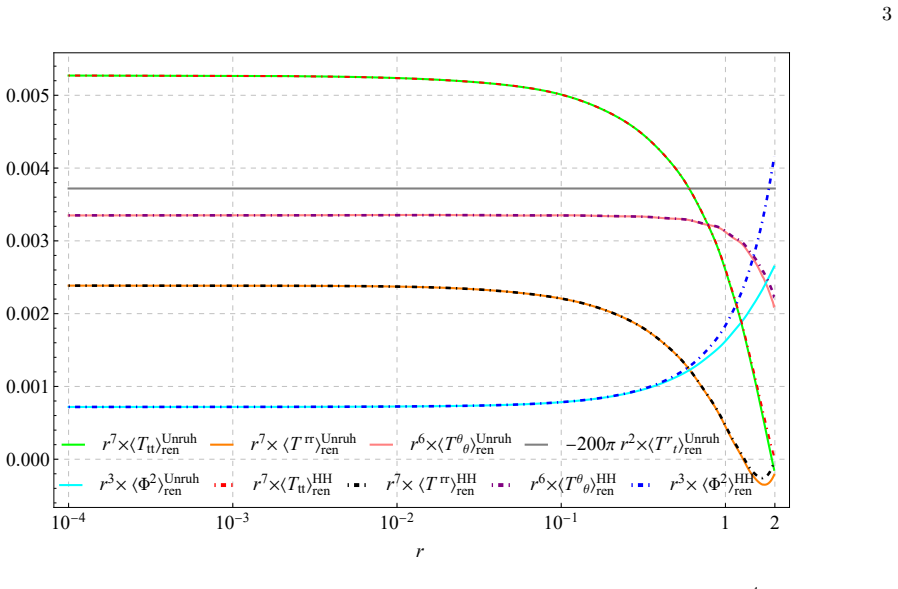
Near the spacelike singularity the Unruh and Hartle–Hawking renormalized stress-energy tensors approach one and the same conserved scaling solution M^4 ⟨T^a_b⟩_ren ≃ (r/M)^{-6} τ^a_b. The state-dependent flux is sub-leading by (r/M)^4, so the dominant ultraviolet source is local vacuum polarization. That limiting tensor violates the dominant energy condition yet satisfies the null energy condition, producing a positive and divergent null projection that enters the Raychaudhuri equation with the focusing sign.
What carries the argument
Angular-splitting renormalization combined with high-order large-ℓ asymptotic subtraction of residual mode tails; this yields all independent mixed components of the complete interior RSET plus ⟨Φ^{2}⟩_ren, validated by integral forms of covariant conservation and the trace identity.
Load-bearing premise
The classical Schwarzschild geometry can still be treated as a fixed background on which the leading ultraviolet quantum stress is evaluated all the way down to r/M ≈ 10^{-4}.
What would settle it
An independent numerical computation of the full interior RSET (or of its leading null projection) that either fails to recover the reported r^{-6} plateau and coefficients, or finds a negative null projection once the same conservation and trace checks are imposed.
If this is right
- Any semiclassical backreaction calculation inside Schwarzschild must now confront a leading local focusing source of order r^{-6} rather than a dominant defocusing term.
- The ultraviolet stress is state-independent at leading order, so both evaporating and equilibrium black holes share the same local source near the singularity.
- Proposed quantum-gravity or effective models that claim singularity resolution by defocusing must overcome this explicit fixed-background RSET.
- The same numerical pipeline can be applied to charged or cosmological interiors to test how universal the vacuum-polarization dominance is.
Where Pith is reading between the lines
- If the focusing source survives even modest backreaction, the classical singularity may be strengthened rather than removed, echoing earlier mass-inflation results for charged holes.
- The strong anisotropy (super-stiff equations of state in both radial and angular directions) suggests that effective-fluid descriptions of the interior must retain at least two independent pressures.
- Matching the present interior RSET to an exterior calculation already performed at the horizon provides a ready initial-value surface for future dynamical semiclassical evolutions.
Editorial analysis
A structured set of objections, weighed in public.
Referee Report
Summary. The paper computes the complete renormalized stress-energy tensor of a massless minimally coupled scalar field throughout the Schwarzschild interior in the Unruh and Hartle–Hawking states, from the event horizon down to r/M ≃ 10^{-4}, together with the vacuum polarization ⟨Φ²⟩_ren. Using angular-splitting renormalization and high-order large-ℓ asymptotic subtraction, the authors obtain all independent components of ⟨T^a_b⟩_ren. Near the spacelike singularity both states approach a common conserved r^{-6} scaling tensor τ^a_b, with the Unruh flux suppressed by (r/M)^4 relative to the diagonal mixed components. The limiting tensor violates the dominant energy condition but satisfies the null energy condition, so that its leading null projection supplies a divergent focusing source in the local Raychaudhuri equation on the fixed Schwarzschild background. The results are cross-checked by covariant conservation and the trace identity (locally to per-mille accuracy on the scaling coefficients, globally via integral reconstructions at the percent level), by exterior flux matching, and by invariance under the usual finite renormalization freedom on Ricci-flat Schwarzschild.
Significance. A controlled complete RSET throughout a four-dimensional black-hole interior, especially into the deep ultraviolet neighborhood of a spacelike singularity, has been a long-standing gap. The work supplies the local tensorial source required for semiclassical backreaction studies and shows that, on the fixed classical background, the leading ultraviolet source is local vacuum polarization rather than transported Hawking flux and is focusing rather than defocusing. The algebraic locking of the scaling coefficients by conservation and the trace identity, the global integral tests, and the renormalization-freedom analysis are concrete strengths that make the fixed-background claim falsifiable and useful as a benchmark for future backreaction calculations and for effective models of singularity resolution.
major comments (2)
- The central claim is carefully scoped to the fixed classical Schwarzschild background (abstract final sentence; §h). That scoping is appropriate, but the manuscript should state more explicitly, already in the introduction and in the caption of Fig. 1, that the reported r^{-6} coefficients and the sign of T_{kk} are not claimed to survive self-consistent backreaction; otherwise readers may over-interpret the Raychaudhuri conclusion as a semiclassical singularity theorem.
- §b and the Supplemental Material description: the high-order large-ℓ asymptotic subtraction after frequency integration is load-bearing for the claimed percent-level accuracy of the plateaus in Fig. 1 and the coefficients in Eq. (7). The main text should give the explicit order of the subtracted asymptotic series and a quantitative residual-error budget (e.g., variation under extraction location and truncation) so that the per-mille locking of λ_⊥ and q can be independently assessed without the Supplemental Material alone.
minor comments (5)
- Eq. (5) writes ⟨T^a_b⟩_ren = r^{-6}[τ^a_b + O(r)], while the abstract and Fig. 1 use M^4⟨T^a_b⟩_ren ≃ (r/M)^{-6} τ^a_b with M = 1. A single consistent nondimensionalization statement early in §b would remove any ambiguity.
- Fig. 1: the vertical scales for the rescaled components differ by orders of magnitude; adding a brief note in the caption that the Unruh flux is plotted with a different prefactor (r^2 rather than r^6) would help readers see the r^4 suppression at a glance.
- Eq. (14): the equation-of-state ratios w_∥ ≃ 2.21 and w_⊥ ≃ 2.808 are useful, but the text should note that they are purely kinematic eigenvalue ratios and not hydrodynamic equations of state, to avoid misreading.
- References [5,6] are cited for exterior flux matching; a short quantitative statement of the relative discrepancy at the horizon (or a pointer to a table in the Supplemental Material) would strengthen the matching claim.
- Typographical: “satisfy the null energy condition” in the abstract should be “satisfies”; “four Dimensional” in the title should be “Four-Dimensional”.
Circularity Check
No significant circularity: RSET coefficients are extracted from mode sums after local subtraction; conservation/trace identities are a-posteriori checks, not inputs that force the focusing sign.
full rationale
The central claim is a numerical computation of the complete interior RSET via angular-splitting renormalization plus high-order large-ℓ asymptotic subtraction of the Hadamard/WKB terms. The near-singularity coefficients λ_t, λ_r, λ_⊥, κ, q are read off from the mode-sum plateaus (Eqs. 5–7), not assumed. Covariant conservation and the trace identity (Eq. 8) are then used only as independent cross-checks: they lock two of the four coefficients algebraically (Eqs. 9–10) and are verified a posteriori at the per-mille level; they do not supply the numerical values or the sign of T_kk. The positive null projection (and therefore the focusing sign in the Raychaudhuri equation) follows directly from the extracted eigenvalues, not from any fitted parameter re-labeled as a prediction. Renormalization-freedom arguments (Eq. 18) show that the leading r^{-6} tensor is invariant on Ricci-flat Schwarzschild, again without circular input. No self-citation is load-bearing for the uniqueness or the sign of the result; the paper is self-contained against its own numerical benchmarks and exterior-flux matching. Score 0 is therefore the honest finding.
Axiom & Free-Parameter Ledger
axioms (4)
- domain assumption Point-splitting renormalization with the Christensen–DeWitt–Schwinger local subtraction yields the physical RSET of a free massless minimally coupled scalar.
- domain assumption The classical Schwarzschild metric remains a valid fixed background for evaluating the leading ultraviolet RSET down to r/M ≃ 10^{-4}.
- domain assumption Unruh and Hartle–Hawking states are the appropriate Hadamard states whose mode decompositions capture the physically relevant interior physics.
- ad hoc to paper High-order large-ℓ asymptotic subtraction after frequency integration removes all residual ultraviolet tails sufficiently for percent-level accuracy.
read the original abstract
We compute the complete renormalized stress-energy tensor (RSET) of a massless minimally coupled scalar field throughout the interior of a four-dimensional Schwarzschild black hole, in both the Unruh and Hartle--Hawking states. The complete RSET inside four-dimensional black holes has long been unavailable, leaving the local source term required for semiclassical backreaction unknown. This gap is even sharper near spacelike singularities. Taking the Schwarzschild interior as a concrete example, we close both gaps for the first time. Using an angular-splitting renormalization scheme together with a high-order large-$\ell$ asymptotic subtraction, we determine all independent components of $\langle T^a{}_{b}\rangle_{\rm ren}$ from the event horizon down to $r/M\simeq10^{-4}$, and simultaneously obtain the corresponding vacuum polarization $\langle\Phi^2\rangle_{\rm ren}$. The tensor passes the cross-checks of the covariant conservation and the trace identity. Near the spacelike singularity, the Unruh and Hartle--Hawking states approach the same conserved scaling solution, \ba M^4\langle T^a{}_{b}\rangle_{\rm ren} \simeq \left(\frac{r}{M}\right)^{-6}\tau^a{}_{b},\nn \ea while the state-dependent Unruh flux is suppressed by $(r/M)^4$ relative to the diagonal mixed components. The leading ultraviolet source is therefore a local vacuum-polarization stress rather than transported Hawking flux. The limiting tensor violates the dominant energy condition but satisfy the null energy condition. Thus, at the level of the complete fixed-background Schwarzschild RSET, the leading semiclassical source does not support the intuition that quantum defocusing smooths the singularity; instead, it supplies a divergent focusing source in the local Raychaudhuri equation. A genuine global conclusion, however, requires solving the backreacted semiclassical geometry.
Figures

Reference graph
Works this paper leans on
-
[1]
P. Candelas, Phys. Rev. D21, 2185-2202 (1980) doi:10.1103/PhysRevD.21.2185
-
[2]
K. W. Howard and P. Candelas, Phys. Rev. Lett.53, 403-406 (1984) doi:10.1103/PhysRevLett.53.403
-
[3]
P. R. Anderson, W. A. Hiscock and D. A. Samuel, Phys. Rev. D51, 4337-4358 (1995) doi:10.1103/PhysRevD.51.4337
-
[4]
A. Levi and A. Ori, Phys. Rev. D91, 104028 (2015) doi:10.1103/PhysRevD.91.104028 [arXiv:1503.02810 [gr- qc]]
-
[5]
A. Levi, Phys. Rev. D95, no.2, 025007 (2017) doi:10.1103/PhysRevD.95.025007 [arXiv:1611.05889 [gr- qc]]
-
[6]
A mode-sum prescription for the renormalized stress energy tensor on black hole spacetimes
P. Taylor, C. Breen and A. Ottewill, Phys. Rev. D106, no.6, 065023 (2022) doi:10.1103/PhysRevD.106.065023 [arXiv:2201.05174 [gr-qc]]
work page internal anchor Pith review Pith/arXiv arXiv doi:10.1103/physrevd.106.065023 2022
-
[7]
P. Candelas and B. P. Jensen, Phys. Rev. D33, 1596 (1986) doi:10.1103/PhysRevD.33.1596
-
[8]
A. Lanir, A. Levi and A. Ori, Phys. Rev. D98, no.8, 084017 (2018) doi:10.1103/PhysRevD.98.084017 [arXiv:1808.06195 [gr-qc]]
-
[9]
Quantum effects near the Cauchy horizon of a Reissner-Nordstrom black hole
O. Sela, Phys. Rev. D98, no.2, 024025 (2018) doi:10.1103/PhysRevD.98.024025 [arXiv:1803.06747 [gr- qc]]
work page internal anchor Pith review Pith/arXiv arXiv doi:10.1103/physrevd.98.024025 2018
-
[10]
Analysis of quantum effects inside spherical charged black holes
A. Lanir, A. Ori, N. Zilberman, O. Sela, A. Maline and A. Levi, Phys. Rev. D99, no.6, 061502 (2019) doi:10.1103/PhysRevD.99.061502 [arXiv:1811.03672 [gr- qc]]
work page internal anchor Pith review Pith/arXiv arXiv doi:10.1103/physrevd.99.061502 2019
-
[11]
Quantum fluxes at the inner horizon of a spherical charged black hole
N. Zilberman, A. Levi and A. Ori, Phys. Rev. Lett.124, no.17, 171302 (2020) doi:10.1103/PhysRevLett.124.171302 [arXiv:1906.11303 [gr-qc]]
work page internal anchor Pith review Pith/arXiv arXiv doi:10.1103/physrevlett.124.171302 2020
-
[12]
Quantum fluxes at the inner horizon of a spinning black hole
N. Zilberman, M. Casals, A. Ori and A. C. Ot- tewill, Phys. Rev. Lett.129, no.26, 261102 (2022) doi:10.1103/PhysRevLett.129.261102 [arXiv:2203.08502 [gr-qc]]
work page internal anchor Pith review Pith/arXiv arXiv doi:10.1103/physrevlett.129.261102 2022
-
[13]
S. M. Christensen, Phys. Rev. D14, 2490-2501 (1976) doi:10.1103/PhysRevD.14.2490
-
[14]
S. M. Christensen, Phys. Rev. D17, 946-963 (1978) doi:10.1103/PhysRevD.17.946
-
[15]
R. M. Wald, Phys. Rev. D17, 1477-1484 (1978) doi:10.1103/PhysRevD.17.1477
-
[16]
M. R. Brown and A. C. Ottewill, Phys. Rev. D34, 1776- 1786 (1986) doi:10.1103/PhysRevD.34.1776
-
[17]
P. Meda, N. Pinamonti and D. Siemssen, An- nales Henri Poincare22, no.12, 3965-4015 (2021) doi:10.1007/s00023-021-01067-8 [arXiv:2007.14665 [math-ph]]
work page internal anchor Pith review Pith/arXiv arXiv doi:10.1007/s00023-021-01067-8 2021
-
[18]
R. Kantowski and R. K. Sachs, J. Math. Phys.7, 443 (1966) doi:10.1063/1.1704952
-
[19]
A. C. Wall, Class. Quant. Grav.30, 165003 (2013) [erratum: Class. Quant. Grav.30, 199501 (2013)] doi:10.1088/0264-9381/30/19/199501 [arXiv:1010.5513 [gr-qc]]
-
[20]
C. J. Fewster and E. A. Kontou, Class. Quant. Grav. 39, no.7, 075028 (2022) doi:10.1088/1361-6382/ac566b [arXiv:2108.12668 [gr-qc]]
-
[21]
R. Bousso, Phys. Rev. Lett.135, no.1, 011501 (2025) doi:10.1103/6f9b-3jmx [arXiv:2501.17910 [hep-th]]
-
[22]
W. G. Anderson, P. R. Brady and R. Camporesi, Class. Quant. Grav.10, 497-504 (1993) doi:10.1088/0264- 9381/10/3/009 [arXiv:gr-qc/9211016 [gr-qc]]
work page internal anchor Pith review Pith/arXiv arXiv doi:10.1088/0264- 1993
-
[23]
K. Blanchette, S. Das, S. Hergott and S. Rast- goo, Phys. Rev. D103, no.8, 084038 (2021) doi:10.1103/PhysRevD.103.084038 [arXiv:2011.11815 [gr-qc]]
-
[24]
K. Blanchette, S. Das and S. Rastgoo, JHEP09, 062 (2021) doi:10.1007/JHEP09(2021)062 [arXiv:2105.11511 [gr-qc]]
-
[25]
R. M. Wald, Commun. Math. Phys.54, 1-19 (1977) doi:10.1007/BF01609833
-
[26]
R. M. Wald, Annals Phys.110, 472-486 (1978) doi:10.1016/0003-4916(78)90040-4
-
[27]
Y. Decanini and A. Folacci, Phys. Rev. D78, 044025 (2008) doi:10.1103/PhysRevD.78.044025 [arXiv:gr- qc/0512118 [gr-qc]]
discussion (0)
Sign in with ORCID, Apple, or X to comment. Anyone can read and Pith papers without signing in.