REVIEW 2 major objections 2 minor 30 references
Preparing a Thermofield Double State with Feedback Quantum Algorithms
T0 review · 2 major / 2 minor · reviewed 2026-07-03 · grok-4.3
Pith's one-line read A hybrid protocol that adds imaginary-time evolution to time-rescaled feedback algorithms prepares the thermofield double ground state of the Maldacena-Qi model with near-unit fidelity from product states.
desk verdict The hybrid ITE-TR-FALQON protocol improves convergence on the Maldacena-Qi TFD ground state in classical simulations, but the non-unitary step remains untested under noise. read the letter →
The pith
A machine-rendered reading of the paper's core claim, the machinery that carries it, and where it could break.
The reading
What carries the argument
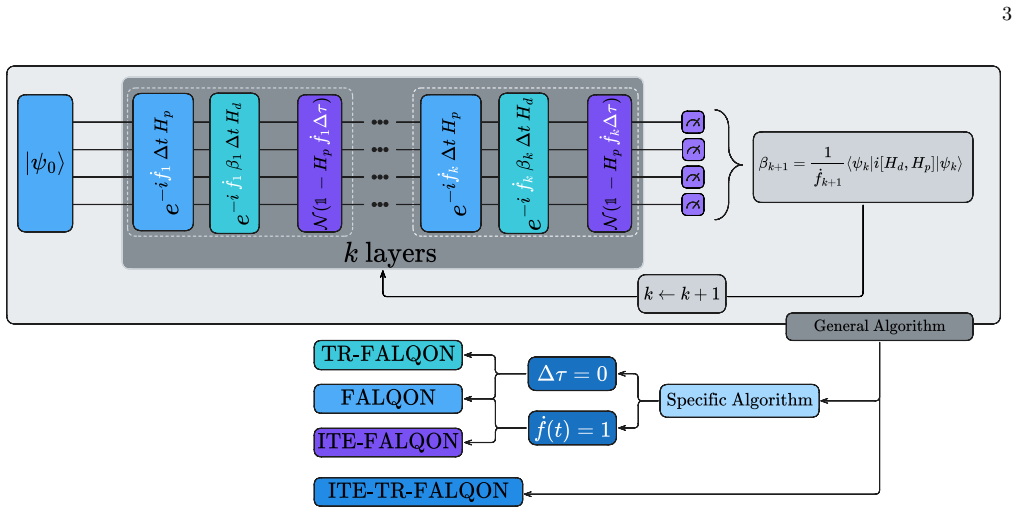
The hybrid ITE-TR-FALQON protocol, which injects non-unitary imaginary-time evolution into a time-rescaled feedback loop to escape symmetry traps and filter excited states during ground-state preparation.
What would settle it
Running the hybrid ITE-TR-FALQON circuit on a physical quantum processor for the Maldacena-Qi Hamiltonian and directly measuring the overlap with the exact thermofield double state.
Extended reading notes
Core claim
The central claim is that the hybrid ITE-TR-FALQON protocol, formed by merging the imaginary-time evolution of ITE-FALQON with the time-rescaling mechanism of TR-FALQON, is both necessary and sufficient to prepare the thermofield double ground state of the Maldacena-Qi model from simple initial states, yielding fidelities near unity and reproducing the exact entropy spectra of the target state.
Load-bearing premise
The numerical evidence that non-unitary dynamics are strictly required and that the hybrid protocol converges will continue to hold when the circuit is executed on real quantum hardware rather than classical simulators.
Editorial extensions
If this is right
- Non-unitary dynamics must be included to break symmetry traps that trap purely unitary feedback algorithms.
- Time rescaling alone is insufficient without the imaginary-time component.
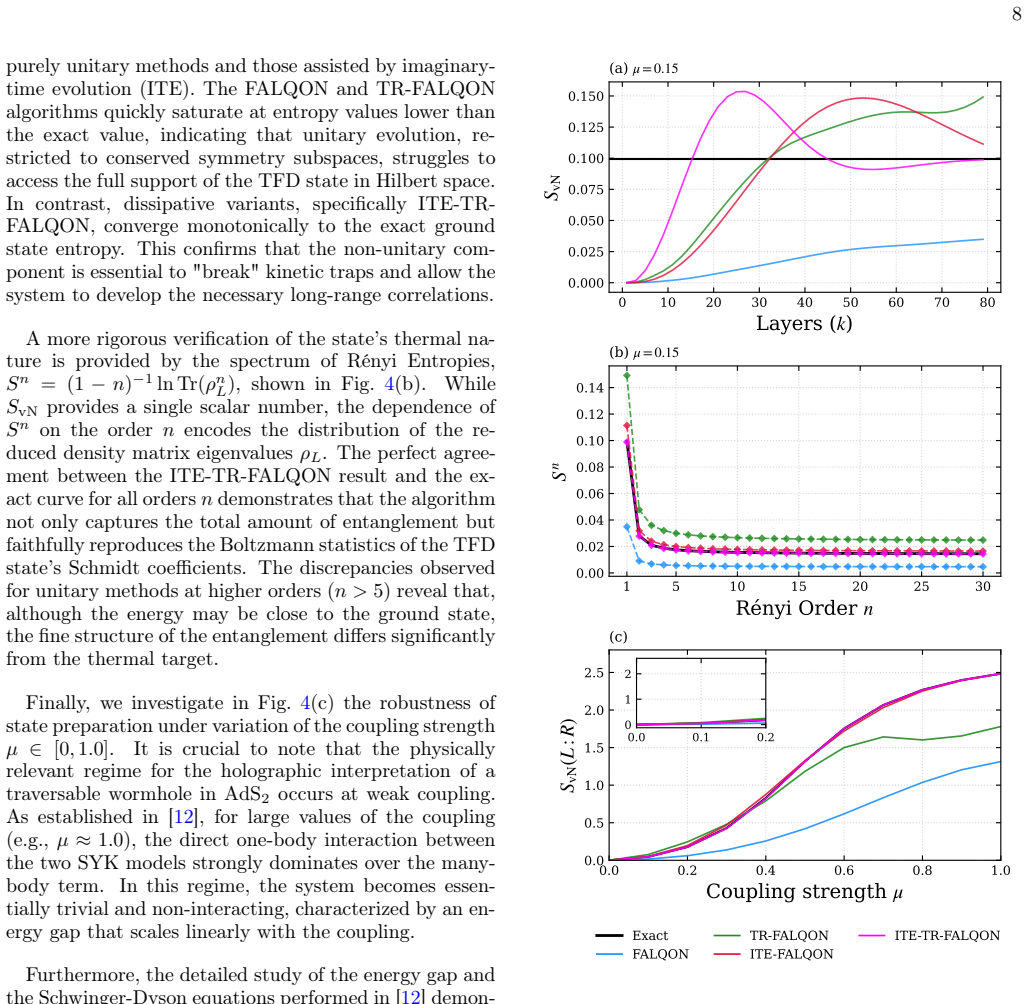
- The prepared state reproduces both von Neumann and Rényi entropy spectra of the exact TFD state.
- The method supplies a practical route to correlated thermal states needed for quantum simulations of AdS2 gravity.
Reading between the lines
- The same hybrid construction may allow feedback algorithms to prepare TFD states in other coupled SYK-like systems where unitary methods fail.
- Implementing the non-unitary step on hardware will require ancillary qubits or measurement-based approximations not tested in the classical simulations.
- Success for this wormhole dual suggests the protocol could be tested on larger lattices to check scaling of convergence time.
Signed reviews
Editorial analysis
A structured set of objections, weighed in public.
Referee Report
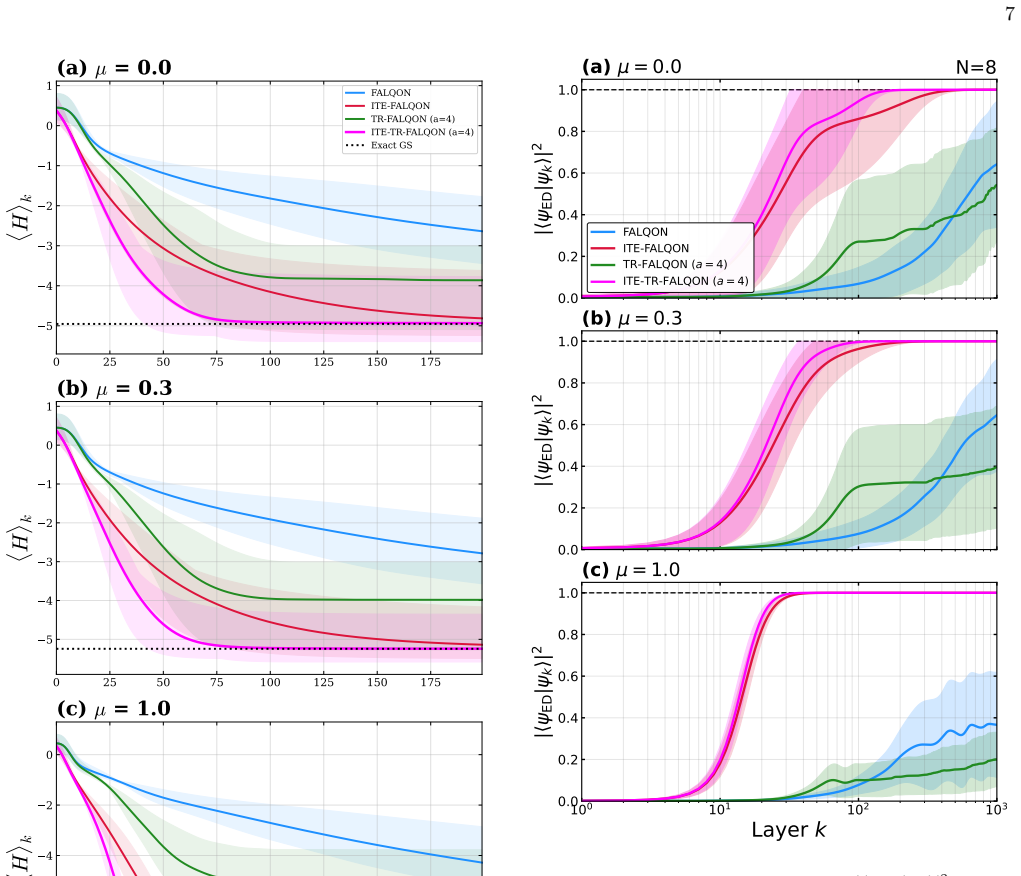
Summary. The paper proposes a hybrid ITE-TR-FALQON protocol that augments time-rescaled feedback-based quantum algorithms with imaginary-time evolution to prepare the thermofield double ground state of the Maldacena-Qi (two coupled SYK) model. Classical numerical simulations are used to show that standard FALQON and TR-FALQON suffer severe kinetic limitations and symmetry traps when started from product states, while the hybrid method converges to near-unit fidelity and accurately reproduces the von Neumann and Rényi entropy spectra of the exact TFD state; non-unitary dynamics are claimed to be strictly necessary for filtering excited states.
Significance. If the reported performance is reproducible and the non-unitary component can be realized on hardware, the work would supply a concrete algorithmic route to preparing highly entangled thermal states relevant to holographic models and many-body thermodynamics on quantum processors. The explicit demonstration that unitary feedback methods are kinetically limited in this system, together with the hybrid fix, offers useful design guidance even if the absolute performance numbers require further validation.
major comments (2)
- [Abstract / Numerical results] Abstract and numerical results: the headline claims of fidelities close to unity and high-precision entropy spectra are stated without any reported system sizes, qubit numbers, convergence thresholds, error bars, or post-selection rules, preventing assessment of whether the evidence supports the superiority of the hybrid protocol over unitary baselines.
- [Protocol description and numerical demonstrations] Discussion of non-unitary steps: the manuscript asserts that imaginary-time evolution is strictly necessary to escape symmetry traps (and that unitary FALQON fails), yet supplies no hardware-level implementation (ancilla-assisted circuits, post-selection overhead) nor any noisy simulation showing that the non-unitary filtering survives realistic error rates; this is load-bearing because the kinetic limitations of the unitary variants are already shown to be severe.
minor comments (2)
- Define all acronyms (FALQON, TR-FALQON, ITE-FALQON, ITE-TR-FALQON) at first use and ensure consistent notation for the hybrid protocol throughout.
- Clarify whether the reported entropy spectra are computed on the full system or reduced density matrix and specify the range of Rényi indices shown.
Simulated Author's Rebuttal
We thank the referee for the careful reading and constructive comments on our manuscript. We address the major comments point by point below, indicating where revisions will be made to strengthen the presentation.
read point-by-point responses
-
Referee: [Abstract / Numerical results] Abstract and numerical results: the headline claims of fidelities close to unity and high-precision entropy spectra are stated without any reported system sizes, qubit numbers, convergence thresholds, error bars, or post-selection rules, preventing assessment of whether the evidence supports the superiority of the hybrid protocol over unitary baselines.
Authors: We agree that explicit reporting of these parameters will improve clarity and allow better evaluation of the results. The classical simulations were performed on finite-size instances of the Maldacena-Qi model with a fixed number of sites (corresponding to a specific qubit count), using defined convergence criteria. In the revised manuscript we will update both the abstract and the numerical results section to state the system sizes, qubit numbers, convergence thresholds, any error bars, and post-selection rules employed. revision: yes
-
Referee: [Protocol description and numerical demonstrations] Discussion of non-unitary steps: the manuscript asserts that imaginary-time evolution is strictly necessary to escape symmetry traps (and that unitary FALQON fails), yet supplies no hardware-level implementation (ancilla-assisted circuits, post-selection overhead) nor any noisy simulation showing that the non-unitary filtering survives realistic error rates; this is load-bearing because the kinetic limitations of the unitary variants are already shown to be severe.
Authors: The current work presents classical numerical evidence that unitary feedback methods encounter severe kinetic limitations and symmetry traps on this model, while the hybrid protocol succeeds. We acknowledge that the manuscript does not contain hardware implementations or noisy simulations. In the revision we will add a dedicated discussion of a possible ancilla-assisted circuit realization of the imaginary-time step, including an estimate of post-selection overhead, and we will comment on the implications for noisy devices. Comprehensive noisy simulations lie outside the scope of the present study but constitute a natural direction for follow-up work. revision: partial
Circularity Check
No circularity; results from independent numerical verification
full rationale
The paper defines the hybrid ITE-TR-FALQON protocol by combining standard components (imaginary-time evolution and time-rescaling) from prior feedback algorithms, then verifies performance via classical simulation by computing fidelities and entropies against the exact TFD ground state of the Maldacena-Qi model. No equations reduce the reported fidelities or spectra to fitted inputs or self-definitions; the non-unitary necessity is shown by explicit failure of unitary variants in the numerics rather than by construction. No self-citation chains or ansatzes are invoked as load-bearing uniqueness theorems. The derivation is self-contained against external benchmarks.
Assumptions & free parameters
Cite this review
Pith. "Pith review of Preparing a Thermofield Double State with Feedback Quantum Algorithms." pith.science (2026). https://pith.science/paper/CRE4MZFT
@misc{pith2026260701653,
  author       = {Pith},
  title        = {Pith review of: Preparing a Thermofield Double State with Feedback Quantum Algorithms},
  year         = {2026},
  howpublished = {\url{https://pith.science/paper/CRE4MZFT}},
  note         = {Machine review of arXiv:2607.01653}
}
abstract
The efficient preparation of correlated thermal states, such as the Thermofield Double (TFD) state, is a fundamental prerequisite for simulating quantum gravity models and many-body thermodynamics on quantum processors. In this work, we investigate the ground state preparation of the Two Coupled Sachdev-Ye-Kitaev model, known as the Maldacena-Qi model, which is dual to a traversable wormhole in $AdS_2$, utilizing feedback-based quantum algorithms. We demonstrate that the standard feedback-based quantum algorithm (FALQON) and its time-rescaled variant (TR-FALQON) face severe kinetic limitations in this system, failing to converge to the highly entangled ground state when initialized in trivial product states. To overcome these barriers, we propose the hybrid ITE-TR-FALQON protocol, which integrates the imaginary-time evolution present in imaginary-time-enhanced FALQON (ITE-FALQON) with the time-rescaling mechanism. Our numerical results indicate that the introduction of non-unitary dynamics is strictly necessary to break symmetry traps and filter out excited states, while time-rescaling drastically accelerates algorithm convergence. The proposed method achieves fidelities close to unity and reproduces the von Neumann and R\'enyi entropy spectra of the exact TFD state with high precision.
Figures

Figures from the paper (1 more)
Reference graph
Works this paper leans on
-
[1]
S. Sachdev and J. Ye, Gapless spin-fluid ground state in a random quantum heisenberg magnet, Phys. Rev. Lett. 70, 3339 (1993)
work page 1993
-
[2]
J. Maldacena and D. Stanford, Remarks on the sachdev- 10 ye-kitaev model, Phys. Rev. D94, 106002 (2016)
work page 2016
-
[3]
S. Sachdev, Bekenstein-hawking entropy and strange metals, Physical Review X5, 10.1103/physrevx.5.041025 (2015)
-
[4]
J. Polchinski and V. Rosenhaus, The spectrum in the sachdev-ye-kitaev model, JHEP2016(4), 001
-
[5]
J. Maldacena, D. Stanford, and Z. Yang, Conformal sym- metry and its breaking in two dimensional nearly anti- de-sitter space, Prog. Theor. Exp. Phys.2016, 12C104 (2016)
work page 2016
-
[6]
A. Kitaev and S. J. Suh, The soft mode in the sachdev- ye-kitaev model and its gravity dual, JHEP2018(5), 183
-
[7]
Y. Gu, A. Lucas, and X.-L. Qi, Spread of entanglement in a sachdev-ye-kitaev chain, JHEP2017(9), 120
-
[8]
V.Rosenhaus,Anintroductiontothesykmodel,J.Phys. A: Math. Theor.52, 323001 (2019)
work page 2019
Show all 30 references
-
[9]
Maldacena, S
J. Maldacena, S. H. Shenker, and D. Stanford, A bound on chaos, Journal of High Energy Physics2016, 10.1007/jhep08(2016)106 (2016)
2016 doi
-
[10]
Chowdhury, A
D. Chowdhury, A. Georges, O. Parcollet, and S. Sachdev, Sachdev-ye-kitaev models and beyond: A window into non-fermi liquids, Rev. Mod. Phys.94, 035004 (2022)
2022
-
[11]
Maldacena and X.-L
J. Maldacena and X.-L. Qi, Eternal traversable wormhole (2018), arXiv:1804.00491 [hep-th]
2018 arXiv
-
[12]
A. M. García-García, T. Nosaka, D. Rosa, and J. J. M. Verbaarschot, Quantum chaos transition in a two-site sachdev-ye-kitaev model dual to an eternal traversable wormhole, Phys. Rev. D100, 026002 (2019)
2019
-
[13]
Preskill, Quantum computing in the nisq era and be- yond, Quantum2, 79 (2018)
J. Preskill, Quantum computing in the nisq era and be- yond, Quantum2, 79 (2018)
2018
-
[14]
Susskind, Computational complexity and black hole horizons (2014), arXiv:1402.5674 [hep-th]
L. Susskind, Computational complexity and black hole horizons (2014), arXiv:1402.5674 [hep-th]
2014 arXiv
-
[15]
J. Liu, Z. Lin, and L. Jiang, Laziness, barren plateau, and noises in machine learning, Machine Learning: Science and Technology5, 015058 (2024)
2024
-
[16]
A. B. Magann, K. M. Rudinger, M. D. Grace, and M. Sarovar, Lyapunov-control-inspired strategies for quantum combinatorial optimization, Phys. Rev. A106, 062414 (2022)
2022
-
[17]
G. E. L. Pexe, L. A. M. Rattighieri, A. L. Malvezzi, and F. F. Fanchini, Using a feedback-based quantum al- gorithm to analyze the critical properties of the annni model without classical optimization, Phys. Rev. B110, 224422 (2024)
2024
-
[18]
L. A. M. Rattighieri, G. E. L. Pexe, B. L. Bernardo, andF.F.Fanchini,Acceleratingfeedback-basedquantum algorithms through time rescaling, Phys. Rev. A112, 042607 (2025)
2025
-
[19]
T. N. V. Long, L. N. Tran, and L. B. Ho, Imaginary-time- enhanced feedback-based quantum algorithms for uni- versal ground-state preparation (2025), arXiv:2512.13044 [quant-ph]
2025
-
[20]
A. B. Magann, K. M. Rudinger, M. D. Grace, and M. Sarovar, Feedback-based quantum optimiza- tion, Physical Review Letters129, 10.1103/phys- revlett.129.250502 (2022)
2022 doi
-
[21]
B. d. L. Bernardo, Time-rescaled quantum dynamics as a shortcut to adiabaticity, Phys. Rev. Res.2, 013133 (2020)
2020
-
[22]
J. L. M. Ferreira, Ângelo F. da Silva França, A. Rosas, and B. de Lima Bernardo, Shortcuts to adiabaticity de- signed via time-rescaling follow the same transitionless route (2024), arXiv:2406.07433 [quant-ph]
2024
-
[23]
McArdle, T
S. McArdle, T. Jones, S. Endo, Y. Li, S. C. Benjamin, and X. Yuan, Variational ansatz-based quantum simula- tion of imaginary time evolution, npj Quantum Informa- tion5, 10.1038/s41534-019-0187-2 (2019)
2019 doi
-
[24]
Motta, C
M. Motta, C. Sun, A. T. K. Tan, M. J. O’Rourke, E. Ye, A. J. Minnich, F. G. S. L. Brandão, and G. K.-L. Chan, Determining eigenstates and thermal states on a quan- tum computer using quantum imaginary time evolution, Nature Physics16, 205–210 (2019)
2019
-
[25]
Gomes, A
N. Gomes, A. Mukherjee, F. Zhang, T. Iadecola, C. Wang, K. Ho, P. P. Orth, and Y. Yao, Adaptive vari- ational quantum imaginary time evolution approach for ground state preparation, Advanced Quantum Technolo- gies4, 10.1002/qute.202100114 (2021)
2021 doi
-
[26]
S.-N. Sun, M. Motta, R. N. Tazhigulov, A. T. Tan, G. K.-L. Chan, and A. J. Minnich, Quantum computa- tion of finite-temperature static and dynamical proper- ties of spin systems using quantum imaginary time evo- lution, PRX Quantum2, 10.1103/prxquantum.2.010317 (2021)
2021 doi
-
[27]
Yeter-Aydeniz, R
K. Yeter-Aydeniz, R. C. Pooser, and G. Siopsis, Practi- cal quantum computation of chemical and nuclear energy levels using quantum imaginary time evolution and lanc- zos algorithms, npj Quantum Information6, 63 (2020)
2020
-
[28]
Kamakari, S.-N
H. Kamakari, S.-N. Sun, M. Motta, and A. J. Minnich, Digital quantum simulation of open quantum systems us- ing quantum imaginary–time evolution, PRX Quantum 3, 010320 (2022)
2022
-
[29]
S. B. Bravyi and A. Y. Kitaev, Fermionic quantum com- putation, Annals of Physics298, 210–226 (2002)
2002
-
[30]
García-Álvarez, I
L. García-Álvarez, I. L. Egusquiza, L. Lamata, A. del Campo, J. Sonner, and E. Solano, Digital quantum sim- ulation of minimalAdS/CFT, Phys. Rev. Lett.119, 040501 (2017)
2017
Reviewed July 3, 2026 · model on record in the stance chip above.
Discussion (0). Continue with ORCID to comment.