REVIEW 3 major objections 3 minor 1 cited by
Conformal Mixed-Integer Constraint Learning with Feasibility Guarantees
T0 review · 3 major / 3 minor · reviewed 2026-08-07 · deepseek-v4-flash
Pith's one-line read This paper introduces C-MICL, which replaces learned constraints in mixed-integer optimization with conformal prediction sets and proves that returned solutions meet the true unknown constraint with probability at least 1−α under a…
desk verdict Good engineering, unproven theorem: the conformal sets as written don't satisfy the Mondrian coverage the proof requires. read the letter →
The pith
A machine-rendered reading of the paper's core claim, the machinery that carries it, and where it could break.
The reading
What carries the argument
The load-bearing object is the conformal prediction set $C(x)$ and its mixed-integer reformulation. A base predictor $\hat{h}(x)$ supplies the learned constraint boundary; an auxiliary uncertainty model $\hat{u}(x)$ estimates local error; and one conformal quantile $\hat{q}$ computed from a held-out calibration set turns raw residuals into a statistically valid set $\{y : |y-\hat{h}(x)| \le \hat{q}\,\hat{u}(x)\}$ for regression, or a logit-threshold set for classification. The key step is imposing $C(x)\subseteq Y$ directly in the MIP rather than the point prediction. The proof of the guarantee runs through the Mondrian conditional-coverage lemma, restricted to the ground-truth-feasible and ground-truth-infeasible groups, together with the conditional-independence assumption that transfers the coverage guarantee from a generic exchangeable point to a point selected by the optimization.
What would settle it
Take a synthetic regression problem with heteroscedastic noise concentrated near the feasibility boundary, and choose an objective that drives the optimum into the low-coverage region of the feasible set. If the empirical ground-truth feasibility rate of C-MICL solutions over many instances falls clearly below $1-\alpha$ (beyond binomial sampling error), Assumption 4.1 is violated and the theorem's conclusion fails. A cheaper check uses the paper's own reactor setup: measure out-of-sample coverage within the top deciles of the output where the feasibility threshold lies, since that is exactly the selected region where the guarantee is most strained.
Extended reading notes
Core claim
The paper's central result, Theorem 4.1, states that for any feasible point $(x',z')$ of the C-MICL feasible region $F_N = \{(x,z)\in X : g(x,z)\le 0,\ C(x)\subseteq Y\}$, the ground-truth feasibility event $h(x')\in Y$ has probability at least $1-\alpha$. The proof combines two ingredients: a Mondrian conformal coverage guarantee that holds separately on ground-truth feasible and infeasible points, and Assumption 4.1, which says that the event of passing the C-MICL constraints is conditionally independent of the conformal set covering the true value once ground-truth feasibility is fixed. The framework is model-agnostic for any predictive model with a mixed-integer encoding. In regression, the conformal set is the interval $[\hat{h}(x)-\hat{q}\,\hat{u}(x),\ \hat{h}(x)+\hat{q}\,\hat{u}(x)]$ intersected with $Y$; in classification, it is written as big-M constraints on logits that exclude undesired classes. The conformal quantile $\hat{q}$ is computed once offline, so the optimization formulation does not grow with the calibration set.
Load-bearing premise
The load-bearing premise is that, among truly feasible points (and separately among truly infeasible points), whether a point satisfies the conformal-set constraint $C(x)\subseteq Y$ does not change the probability that its conformal set contains the true value; if the objective steers the optimizer into a low-coverage corner of the feasible region, the $1-\alpha$ guarantee can fail.
Editorial extensions
If this is right
- Practitioners can solve mixed-integer programs with learned constraints and report a $1-\alpha$ probability that the returned solution is feasible for the true, unknown system, without ever querying the true function.
- The guarantee transfers across model classes: any predictor admitting a MIP encoding — ReLU networks, gradient-boosted trees, random forests, linear-model decision trees — can be wrapped in the same conformal set constraint.
- Because the conformal quantile is computed offline, calibration data size does not enter the optimization formulation, so larger calibration sets improve the guarantee without slowing the solve.
- The user controls conservatism through $\alpha$: smaller $\alpha$ gives stronger feasibility certificates at the cost of wider conformal sets and potentially worse objective values.
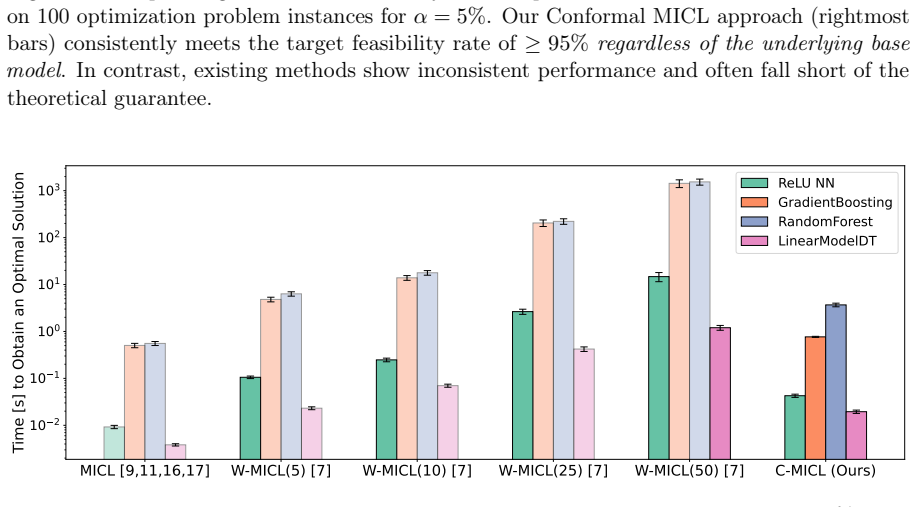
- Empirically the method needs at most two trained models, keeping runtimes near single-model MICL while ensemble-based heuristics grow with ensemble size.
Reading between the lines
- The same wrapper should generalize to learned objective functions: conformalize the predicted objective and optimize the worst-case value inside the set, obtaining a high-probability bound on true objective performance.
- A natural test is to replace the fixed conformal quantile with an adaptive variant (e.g., conformalized quantile regression or Mondrian groups by input region) to shrink $C(x)$ in high-confidence areas and reduce the objective loss the paper reports.
- If multiple learned constraints are needed, a per-constraint $\alpha/n$ budget with a union bound would preserve an overall $1-\alpha$ guarantee, at the price of conservatism.
- The most exposed case is when the optimizer deliberately seeks boundary points where $h(x)$ is near the edge of $Y$; synthetic adversarial objectives that maximize violation risk would show how much the conditional-independence assumption can degrade before the certificate breaks.
Editorial analysis
A structured set of objections, weighed in public.
Referee Report
Summary. The paper proposes Conformal Mixed-Integer Constraint Learning (C-MICL), a framework that embeds conformal prediction sets into mixed-integer constraint learning problems so that feasible solutions are claimed to satisfy an unknown ground-truth constraint with probability at least 1−α. The method is developed for regression, using an interval based on a learned uncertainty model, and for classification, using logit-based conformal scores. The central result is Theorem 4.1, which states a ground-truth feasibility guarantee under Assumption 4.1, a conditional-independence assumption. Experiments on a membrane-reactor design problem and a food-basket design problem compare C-MICL with single-model MICL and the ensemble heuristic W-MICL in terms of feasibility rate, objective value, and solve time.
Significance. The intended contribution is timely and practically relevant: a scalable, model-agnostic way to turn learned constraints into constraints with formal feasibility guarantees would be valuable for predict-then-optimize pipelines. The paper contains useful, explicit MIP reformulations (Appendix C) and a broad empirical comparison across multiple base models, 100 optimization instances per setting, and two values of α. However, the central theorem is not proved for the method as specified: the conformal sets used in Sections 4.1 and 4.2 are not the Mondrian sets for which Lemma 3.1 provides conditional coverage, and the probability statement in Theorem 4.1 concerns an optimizer-selected point rather than an exchangeable test point. Assumption 4.1 does most of the work, and the paper's own Discussion concedes that it can fail when the feasible region is biased. For these reasons, the headline feasibility guarantee is not established by the manuscript.
major comments (3)
- [§4.1, Eq. (4); §B.2] Lemma 3.1 is a Mondrian conformal guarantee requiring separate group-specific quantiles for the groups g(x,y)=1{y∈Y}, as made explicit in Appendix B.1, Eq. (11). The conformal set defined in Eq. (4) uses a single quantile q̂_{1−α} computed from the full calibration set, so Lemma 3.1 does not apply to the proposed method. Consequently, the inequalities P(h(X)∈C(X)|h(X)∈Y)≥1−α and P(h(X)∈C(X)|h(X)∉Y)≥1−α used in the proof of Theorem 4.1 are not established for the method actually implemented. The coverage numbers reported in Appendix E (95.38% on feasible and 89.31% on infeasible points at α=10% for the ReLU-NN model) are consistent with a non-Mondrian construction rather than with the conditional guarantee invoked in the proof. This is a load-bearing error: the proof of Theorem 4.1 fails at its first step.
- [Theorem 4.1, Eq. (3); Assumption 4.1] The probability statement in Eq. (3) is not a standard conformal coverage statement. The feasible region F_N is a function of the calibration set D_cal, and a feasible solution (x',z') is the output of an optimization problem that also depends on D_cal; hence (x',z') is not an exchangeable test point, and conditioning on (x',z')∈F_N is conditioning on an event that holds by construction for every solver output. The proof in Appendix B.2 silently replaces x' by an exchangeable test point X_{N+1}. Assumption 4.1 is then invoked to assert that C-MICL feasibility and conformal coverage are conditionally independent given ground-truth feasibility; this is precisely the selection-bias property that the theorem needs, and the Discussion concedes that it can fail when the feasible region is biased. Without a properly defined probability space or a validation of Assumption 4.1, Eq. (3) is not a proven guarantee.
- [§5 and Appendix E] The claim that the assumptions of Theorem 4.1 are empirically verified is not supported. Figures 9, 13, 17, and 18 report marginal coverage rates stratified by output buckets, but Assumption 4.1 is a conditional-independence statement about the optimizer-selected feasible region, which the experiments do not test: the 100 instances are generated by sampling cost vectors while D_cal is fixed, so the variation across instances does not include the calibration-set randomness over which the guarantee is claimed. At minimum, the empirical study should vary D_cal and report coverage conditional on C-MICL feasibility.
minor comments (3)
- [Appendix E] Figure captions contain typos: 'T arget' appears in the captions of Figures 9 and 13, and 'GradientBoosting' in Figures 7, 10, and 11 should be 'Gradient Boosting'.
- [Appendix C, Eq. (18)] The strict inequality is handled by a numerical tolerance ε, but no guidance is given for choosing ε relative to the scale of the logits; a brief comment on numerical robustness would be helpful.
- [References] Reference [31] contains the typo 'ltearned' in the title; it should be 'learned'.
Circularity Check
No significant circularity: Theorem 4.1 is an explicit conditional corollary of Assumption 4.1 and an external conformal-coverage lemma, not a renamed input or fitted prediction.
full rationale
The paper's central guarantee is not obtained by defining the output in terms of the input. Theorem 4.1 is proved from two explicitly stated ingredients: Lemma 3.1 (an external Mondrian conformal coverage result, quoted from Angelopoulos et al.) and Assumption 4.1, which the paper labels as an assumption and concedes in the Discussion 'could potentially fail in scenarios where the feasible region is biased towards data regions where the conformal coverage does not hold'. The proof in Appendix B.2 is a law-of-total-probability calculation; the conclusion is a logical consequence of these premises, not an equivalent restatement of them. No fitted parameter is renamed as a prediction: the conformal quantile is computed offline and the optimization constraints are then solved; the empirical feasibility rates are out-of-sample measurements, not the fitting objective. Self-citations in the paper (e.g., [17] for LMDTs, [40] for a review) are not load-bearing for the guarantee. I therefore find no circularity. Two correctness concerns are outside the circularity rubric: (i) Lemma 3.1 requires group-specific Mondrian quantiles, while Eqs. (4) and (6) use a single quantile from the full calibration set, so the lemma does not directly apply to the implemented method; and (ii) since C(x) is contained in Y on F_N, the conditional coverage probability given F_N and h(x) not in Y is zero, which conflicts with the proof's use of the not-in-Y branch of Lemma 3.1 unless P(h(x) not in Y | F_N) = 0. These are validity gaps, not circularity.
Assumptions & free parameters
free parameters (3)
- conformal quantile q̂_{1-alpha} =
(1-alpha)(1+1/N) empirical quantile of calibration conformal scores
- uncertainty model û(x) weights (regression) =
Trained on absolute residuals
- big-M constant M (classification) =
4 * max_i |ĥ(x_i)|
assumptions (5)
- domain assumption Calibration and test points are exchangeable (i.i.d. from a common distribution P_XY)
- domain assumption Predictive models ĥ and û admit exact MIP encodings
- ad hoc to paper Assumption 4.1: conditional independence of C-MICL feasibility and conformal coverage given ground-truth feasibility
- domain assumption Ground-truth classes partition into desired and undesired sets, with positive sampling probability in each group
- domain assumption True constraint function h(x) = E[Y|X=x] is inaccessible; only noisy samples are observed
Cite this review
Pith. "Pith review of Conformal Mixed-Integer Constraint Learning with Feasibility Guarantees." pith.science (2026). https://pith.science/paper/CS3KJ5GI
@misc{pith2026250603531,
  author       = {Pith},
  title        = {Pith review of: Conformal Mixed-Integer Constraint Learning with Feasibility Guarantees},
  year         = {2026},
  howpublished = {\url{https://pith.science/paper/CS3KJ5GI}},
  note         = {Machine review of arXiv:2506.03531}
}
abstract
We propose Conformal Mixed-Integer Constraint Learning (C-MICL), a novel framework that provides probabilistic feasibility guarantees for data-driven constraints in optimization problems. While standard Mixed-Integer Constraint Learning methods often violate the true constraints due to model error or data limitations, our C-MICL approach leverages conformal prediction to ensure feasible solutions are ground-truth feasible. This guarantee holds with probability at least $1{-}\alpha$, under a conditional independence assumption. The proposed framework supports both regression and classification tasks without requiring access to the true constraint function, while avoiding the scalability issues associated with ensemble-based heuristics. Experiments on real-world applications demonstrate that C-MICL consistently achieves target feasibility rates, maintains competitive objective performance, and significantly reduces computational cost compared to existing methods. Our work bridges mathematical optimization and machine learning, offering a principled approach to incorporate uncertainty-aware constraints into decision-making with rigorous statistical guarantees.
Figures


Figures from the paper (9 more)




Forward citations
Cited by 1 Pith paper
-
Position Paper: Post-Solve Robustness in Decision Engines: Feasible Regions and Smoothness Under Perturbations
MILP decision engines should attach a post-solve robustness layer that certifies feasible near-optimal neighborhoods, risk, adversarial margins, and nearby fallback solutions for the incumbent.
Reference graph
Works this paper leans on
-
[1]
Adejuyigbe O Fajemisin, Donato Maragno, and Dick den Hertog. Optimization with constraint learning: A framework and survey.European Journal of Operational Research, 314(1):1–14, 2024
work page 2024
-
[2]
Artificial intelligence for operations research: Revolutionizing the operations research process
Zhenan Fan, Bissan Ghaddar, Xinglu Wang, Linzi Xing, Yong Zhang, and Zirui Zhou. Artificial intelligence for operations research: Revolutionizing the operations research process. arXiv preprint arXiv:2401.03244, 2024
arXiv 2024
-
[3]
Francisco Javier López-Flores, César Ramírez-Márquez, and José María Ponce-Ortega. Process systems engineering tools for optimization of trained machine learning models: Comparative and perspective.Industrial & Engineering Chemistry Research, 63(32):13966– 13979, 2024
work page 2024
-
[4]
Atharv Bhosekar and Marianthi Ierapetritou. Advances in surrogate based modeling, feasibility analysis, and optimization: A review.Computers & Chemical Engineering, 108: 250–267, 2018
work page 2018
-
[5]
Sun Hye Kim and Fani Boukouvala. Machine learning-based surrogate modeling for data- driven optimization: a comparison of subset selection for regression techniques.Optimization Letters, 14(4):989–1010, 2020
work page 2020
-
[6]
Huayu Tian and Marianthi G Ierapetritou. A surrogate-based framework for feasibility-driven optimization of expensive simulations.AIChE Journal, 70(5):e18364, 2024
work page 2024
-
[7]
Mixed-integer optimization with constraint learning.Operations Research, 73(2):1011–1028, 2025
Donato Maragno, Holly Wiberg, Dimitris Bertsimas, Ş İlker Birbil, Dick den Hertog, and Adejuyigbe O Fajemisin. Mixed-integer optimization with constraint learning.Operations Research, 73(2):1011–1028, 2025. 11
work page 2025
-
[8]
Deep neural networks and mixed integer linear optimization
Matteo Fischetti and Jason Jo. Deep neural networks and mixed integer linear optimization. Constraints, 23(3):296–309, 2018
work page 2018
Show all 66 references
-
[9]
Relu networks as surrogate models in mixed-integer linear programs.Computers & Chemical Engineering, 131:106580, 2019
Bjarne Grimstad and Henrik Andersson. Relu networks as surrogate models in mixed-integer linear programs.Computers & Chemical Engineering, 131:106580, 2019
2019
-
[10]
Strong mixed-integer programming formulations for trained neural networks.Mathematical Programming, 183(1):3–39, 2020
Ross Anderson, Joey Huchette, Will Ma, Christian Tjandraatmadja, and Juan Pablo Vielma. Strong mixed-integer programming formulations for trained neural networks.Mathematical Programming, 183(1):3–39, 2020
2020
-
[11]
Mixed-integer convex nonlinear optimization with gradient-boosted trees embedded.IN- FORMS Journal on Computing, 33(3):1103–1119, 2021
Miten Mistry, Dimitrios Letsios, Gerhard Krennrich, Robert M Lee, and Ruth Misener. Mixed-integer convex nonlinear optimization with gradient-boosted trees embedded.IN- FORMS Journal on Computing, 33(3):1103–1119, 2021
2021
-
[12]
Tree ensemble kernels for bayesian optimization with known constraints over mixed-feature spaces.Advances in Neural Information Processing Systems, 35:37401–37415, 2022
Alexander Thebelt, Calvin Tsay, Robert Lee, Nathan Sudermann-Merx, David Walz, Behrang Shafei, and Ruth Misener. Tree ensemble kernels for bayesian optimization with known constraints over mixed-feature spaces.Advances in Neural Information Processing Systems, 35:37401–37415, 2022
2022
-
[13]
Regression and classification using optimal decision trees
Dimitris Bertsimas, Jack Dunn, and Aris Paschalidis. Regression and classification using optimal decision trees. In2017 IEEE MIT undergraduate research technology conference (URTC), pages 1–4. IEEE, 2017
2017
-
[14]
Embedding decision trees and random forests in constraint programming
Alessio Bonfietti, Michele Lombardi, and Michela Milano. Embedding decision trees and random forests in constraint programming. InIntegration of AI and OR Techniques in Constraint Programming: 12th International Conference, CPAIOR 2015, Barcelona, Spain, May 18-22, 2015, Proce...
2015
-
[15]
Optimizing objective functions determined from random forests.Available at SSRN 2986630, 2017
Max Biggs, Rim Hariss, and Georgia Perakis. Optimizing objective functions determined from random forests.Available at SSRN 2986630, 2017
2017
-
[16]
Optimization of tree ensembles.Operations Research, 68(5):1605–1624, 2020
Velibor V Mišić. Optimization of tree ensembles.Operations Research, 68(5):1605–1624, 2020
2020
-
[17]
Linear model decision trees as surrogates in optimization of engineering applications.Computers & Chemical Engineering, 178:108347, 2023
Bashar L Ammari, Emma S Johnson, Georgia Stinchfield, Taehun Kim, Michael Bynum, William E Hart, Joshua Pulsipher, and Carl D Laird. Linear model decision trees as surrogates in optimization of engineering applications.Computers & Chemical Engineering, 178:108347, 2023
2023
-
[18]
The trust region filter strategy: Survey of a rigorous approach for optimization with surrogate models.Digital Chemical Engineering, page 100197, 2024
Lorenz T Biegler. The trust region filter strategy: Survey of a rigorous approach for optimization with surrogate models.Digital Chemical Engineering, page 100197, 2024
2024
-
[19]
Optimizing over an ensemble of trained neural networks.INFORMS Journal on Computing, 35(3):652–674, 2023
Keliang Wang, Leonardo Lozano, Carlos Cardonha, and David Bergman. Optimizing over an ensemble of trained neural networks.INFORMS Journal on Computing, 35(3):652–674, 2023
2023
-
[20]
A unified view of piecewise linear neural network verification.Advances in neural information processing systems, 31, 2018
Rudy R Bunel, Ilker Turkaslan, Philip Torr, Pushmeet Kohli, and Pawan K Mudigonda. A unified view of piecewise linear neural network verification.Advances in neural information processing systems, 31, 2018
2018
-
[21]
Evaluating robustness of neural networks with mixed integer programming.arXiv preprint arXiv:1711.07356, 2017
Vincent Tjeng, Kai Xiao, and Russ Tedrake. Evaluating robustness of neural networks with mixed integer programming.arXiv preprint arXiv:1711.07356, 2017
2017 arXiv
-
[22]
Maximum resilience of artificial neural networks
Chih-Hong Cheng, Georg Nührenberg, and Harald Ruess. Maximum resilience of artificial neural networks. InAutomated Technology for Verification and Analysis: 15th International Symposium, ATVA 2017, Pune, India, October 3–6, 2017, Proceedings 15, pages 251–268. Springer, 2017. 12
2017
-
[23]
An approach to reachability analysis for feed-forward relu neural networks.arXiv preprint arXiv:1706.07351, 2017
Alessio Lomuscio and Lalit Maganti. An approach to reachability analysis for feed-forward relu neural networks.arXiv preprint arXiv:1706.07351, 2017
2017 arXiv
-
[24]
Efficient verification of relu-based neural networks via dependency analysis
Elena Botoeva, Panagiotis Kouvaros, Jan Kronqvist, Alessio Lomuscio, and Ruth Misener. Efficient verification of relu-based neural networks via dependency analysis. InProceedings of the AAAI Conference on Artificial Intelligence, volume 34, pages 3291–3299, 2020
2020
-
[25]
Fast and complete: Enabling complete neural network verification with rapid and massively parallel incomplete verifiers.arXiv preprint arXiv:2011.13824, 2020
Kaidi Xu, Huan Zhang, Shiqi Wang, Yihan Wang, Suman Jana, Xue Lin, and Cho-Jui Hsieh. Fast and complete: Enabling complete neural network verification with rapid and massively parallel incomplete verifiers.arXiv preprint arXiv:2011.13824, 2020
2011 arXiv
-
[26]
Towards scalable complete verification of relu neural networks via dependency-based branching
Panagiotis Kouvaros and Alessio Lomuscio. Towards scalable complete verification of relu neural networks via dependency-based branching. InIJCAI, pages 2643–2650, 2021
2021
-
[27]
Shiqi Wang, Huan Zhang, Kaidi Xu, Xue Lin, Suman Jana, Cho-Jui Hsieh, and J Zico Kolter. Beta-crown: Efficient bound propagation with per-neuron split constraints for neural network robustness verification.Advances in neural information processing systems, 34: 29909–29921, 2021
2021
-
[28]
Ead: elastic-net attacks to deep neural networks via adversarial examples
Pin-Yu Chen, Yash Sharma, Huan Zhang, Jinfeng Yi, and Cho-Jui Hsieh. Ead: elastic-net attacks to deep neural networks via adversarial examples. InProceedings of the AAAI conference on artificial intelligence, volume 32, 2018
2018
-
[29]
Minimally distorted adversarial examples with a fast adaptive boundary attack
Francesco Croce and Matthias Hein. Minimally distorted adversarial examples with a fast adaptive boundary attack. InInternational conference on machine learning, pages 2196–2205. PMLR, 2020
2020
-
[30]
Partition-based formu- lations for mixed-integer optimization of trained relu neural networks.Advances in neural information processing systems, 34:3068–3080, 2021
Calvin Tsay, Jan Kronqvist, Alexander Thebelt, and Ruth Misener. Partition-based formu- lations for mixed-integer optimization of trained relu neural networks.Advances in neural information processing systems, 34:3068–3080, 2021
2021
-
[31]
Nonlinear hybrid planning with deep net ltearned transition models and mixed-integer linear programming
Buser Say, Ga Wu, Yu Qing Zhou, and Scott Sanner. Nonlinear hybrid planning with deep net ltearned transition models and mixed-integer linear programming. InInternational Joint Conference on Artificial Intelligence 2017, pages 750–756. Association for the Advancement of Artifi...
2017
-
[32]
Caql: Continuous action q-learning.arXiv preprint arXiv:1909.12397, 2019
Moonkyung Ryu, Yinlam Chow, Ross Anderson, Christian Tjandraatmadja, and Craig Boutilier. Caql: Continuous action q-learning.arXiv preprint arXiv:1909.12397, 2019
1909 arXiv
-
[33]
Reinforcement learning with combinatorial actions: An application to vehicle routing.Advances in Neural Information Processing Systems, 33:609–620, 2020
Arthur Delarue, Ross Anderson, and Christian Tjandraatmadja. Reinforcement learning with combinatorial actions: An application to vehicle routing.Advances in Neural Information Processing Systems, 33:609–620, 2020
2020
-
[34]
Data-driven power system operation: Exploring the balance between cost and risk.IEEE Transactions on Power Systems, 34(1):791–801, 2018
Jochen L Cremer, Ioannis Konstantelos, Simon H Tindemans, and Goran Strbac. Data-driven power system operation: Exploring the balance between cost and risk.IEEE Transactions on Power Systems, 34(1):791–801, 2018
2018
-
[35]
From decision trees and neural networks to milp: power system optimization considering dynamic stability constraints
Spyros Chatzivasileiadis. From decision trees and neural networks to milp: power system optimization considering dynamic stability constraints. In2020 European control conference (ECC), page 594. IEEE, 2020
2020
-
[36]
An analytics approach to designing combination chemotherapy regimens for cancer.Management Science, 62(5):1511–1531, 2016
Dimitris Bertsimas, Allison O’Hair, Stephen Relyea, and John Silberholz. An analytics approach to designing combination chemotherapy regimens for cancer.Management Science, 62(5):1511–1531, 2016. 13
2016
-
[37]
Integrating tactical planning, operational planning and scheduling using data-driven feasibility analysis.Computers & Chemical Engineering, 161:107759, 2022
Oluwadare Badejo and Marianthi Ierapetritou. Integrating tactical planning, operational planning and scheduling using data-driven feasibility analysis.Computers & Chemical Engineering, 161:107759, 2022
2022
-
[38]
Integration of plant scheduling feasibility with supply chain network under disruptions using machine learning surrogates
Daniel Ovalle, Javal Vyas, Carl D Laird, and Ignacio E Grossmann. Integration of plant scheduling feasibility with supply chain network under disruptions using machine learning surrogates. InComputer aided chemical engineering, volume 53, pages 1489–1494. Elsevier, 2024
2024
-
[39]
Mixed-integer linear programming formulation with embedded machine learning surrogates for the design of chemical process families.Industrial & Engineering Chemistry Research, 2025
Georgia Stinchfield, Natali Khalife, Bashar L Ammari, Joshua C Morgan, Miguel Zamarripa, and Carl D Laird. Mixed-integer linear programming formulation with embedded machine learning surrogates for the design of chemical process families.Industrial & Engineering Chemistry Rese...
2025
-
[40]
Formulating data-driven surrogate models for process optimization.Computers & Chemical Engineering, 179:108411, 2023
Ruth Misener and Lorenz Biegler. Formulating data-driven surrogate models for process optimization.Computers & Chemical Engineering, 179:108411, 2023
2023
-
[41]
Reduced model trust region methods for embedding complex simulations in optimization problems
John P Eason and Lorenz T Biegler. Reduced model trust region methods for embedding complex simulations in optimization problems. InComputer Aided Chemical Engineering, volume 37, pages 773–778. Elsevier, 2015
2015
-
[42]
Advanced trust region optimization strategies for glass box/black box models.AIChE Journal, 64(11):3934–3943, 2018
John P Eason and Lorenz T Biegler. Advanced trust region optimization strategies for glass box/black box models.AIChE Journal, 64(11):3934–3943, 2018
2018
-
[43]
Nested conformal prediction and quantile out-of-bag ensemble methods.Pattern Recognition, 127:108496, 2022
Chirag Gupta, Arun K Kuchibhotla, and Aaditya Ramdas. Nested conformal prediction and quantile out-of-bag ensemble methods.Pattern Recognition, 127:108496, 2022
2022
-
[44]
Candès, Aaditya Ramdas, and Ryan J
Rina Foygel Barber, Emmanuel J. Candès, Aaditya Ramdas, and Ryan J. Tibshirani. Conformal prediction beyond exchangeability.The Annals of Statistics, 51(2):816–845, 2023
2023
-
[45]
Boosted conformal prediction intervals
Ran Xie, Rina Barber, and Emmanuel Candes. Boosted conformal prediction intervals. Advances in Neural Information Processing Systems, 37:71868–71899, 2024
2024
-
[46]
Conformal inverse optimization.Advances in Neural Information Processing Systems, 37:63534–63564, 2024
Bo Lin, Erick Delage, and Timothy Chan. Conformal inverse optimization.Advances in Neural Information Processing Systems, 37:63534–63564, 2024
2024
-
[47]
Conformal predictive programming for chance constrained optimization.arXiv preprint arXiv:2402.07407, 2024
Yiqi Zhao, Xinyi Yu, Jyotirmoy V Deshmukh, and Lars Lindemann. Conformal predictive programming for chance constrained optimization.arXiv preprint arXiv:2402.07407, 2024
2024 arXiv
-
[48]
Mixed integer linear programming formulation techniques.Siam Review, 57(1):3–57, 2015
Juan Pablo Vielma. Mixed integer linear programming formulation techniques.Siam Review, 57(1):3–57, 2015
2015
-
[49]
Exploiting integrality in the global optimization of mixed-integer nonlinear programming problems with baron.Optimization Methods and Software, 33(3):540–562, 2018
Mustafa R Kılınç and Nikolaos V Sahinidis. Exploiting integrality in the global optimization of mixed-integer nonlinear programming problems with baron.Optimization Methods and Software, 33(3):540–562, 2018
2018
-
[50]
Conformal prediction: Clas- sification and general case
Vladimir Vovk, Alexander Gammerman, and Glenn Shafer. Conformal prediction: Clas- sification and general case. InAlgorithmic Learning in a Random World, pages 71–106. Springer, 2022
2022
-
[51]
Conformal prediction under covariate shift.Advances in neural information processing systems, 32, 2019
Ryan J Tibshirani, Rina Foygel Barber, Emmanuel Candes, and Aaditya Ramdas. Conformal prediction under covariate shift.Advances in neural information processing systems, 32, 2019
2019
-
[52]
Theoretical foundations of conformal prediction.arXiv preprint arXiv:2411.11824, 2024
Anastasios N Angelopoulos, Rina Foygel Barber, and Stephen Bates. Theoretical foundations of conformal prediction.arXiv preprint arXiv:2411.11824, 2024. 14
2024 arXiv
-
[53]
Classification with valid and adaptive coverage.Advances in neural information processing systems, 33:3581–3591, 2020
Yaniv Romano, Matteo Sesia, and Emmanuel Candes. Classification with valid and adaptive coverage.Advances in neural information processing systems, 33:3581–3591, 2020
2020
-
[54]
Conformal prediction using conditional histograms
Matteo Sesia and Yaniv Romano. Conformal prediction using conditional histograms. Advances in Neural Information Processing Systems, 34:6304–6315, 2021
2021
-
[55]
Mondrianconfidence machine.Technical Report, 2003
VladimirVovk, DavidLindsay, IliaNouretdinov, andAlexGammerman. Mondrianconfidence machine.Technical Report, 2003
2003
-
[56]
Inductive confidence machines for regression
Harris Papadopoulos, Kostas Proedrou, Volodya Vovk, and Alex Gammerman. Inductive confidence machines for regression. InMachine learning: ECML 2002: 13th European conference on machine learning Helsinki, Finland, August 19–23, 2002 proceedings 13, pages 345–356. Springer, 2002
2002
-
[57]
Gurobi Optimizer Reference Manual, 2024
Gurobi Optimization, LLC. Gurobi Optimizer Reference Manual, 2024. URL https: //www.gurobi.com
2024
-
[58]
Springer, 2021
Michael L Bynum, Gabriel A Hackebeil, William E Hart, Carl D Laird, Bethany L Nicholson, John D Siirola, Jean-Paul Watson, David L Woodruff, et al.Pyomo-optimization modeling in python, volume 67. Springer, 2021
2021
-
[59]
Omlt: Optimization & machine learning toolkit.Journal of Machine Learning Research, 23(349):1–8, 2022
Francesco Ceccon, Jordan Jalving, Joshua Haddad, Alexander Thebelt, Calvin Tsay, Carl D Laird, and Ruth Misener. Omlt: Optimization & machine learning toolkit.Journal of Machine Learning Research, 23(349):1–8, 2022
2022
-
[60]
Nonlinear operability of a membrane reactor for direct methane aromatization.IFAC-PapersOnLine, 48(8):728–733, 2015
Juan C Carrasco and Fernando V Lima. Nonlinear operability of a membrane reactor for direct methane aromatization.IFAC-PapersOnLine, 48(8):728–733, 2015
2015
-
[61]
Novel operability-based approach for process design and intensification: Application to a membrane reactor for direct methane aromatization
Juan C Carrasco and Fernando V Lima. Novel operability-based approach for process design and intensification: Application to a membrane reactor for direct methane aromatization. AIChE Journal, 63(3):975–983, 2017
2017
-
[62]
The nutritious supply chain: optimizing humanitarian food assistance.INFORMS Journal on Optimization, 3(2):200–226, 2021
Koen Peters, Sérgio Silva, Rui Gonçalves, Mirjana Kavelj, Hein Fleuren, Dick Den Hertog, Ozlem Ergun, and Mallory Freeman. The nutritious supply chain: optimizing humanitarian food assistance.INFORMS Journal on Optimization, 3(2):200–226, 2021
2021
-
[63]
When deep learning meets polyhedral theory: A survey.arXiv preprint arXiv:2305.00241, 2023
Joey Huchette, Gonzalo Muñoz, Thiago Serra, and Calvin Tsay. When deep learning meets polyhedral theory: A survey.arXiv preprint arXiv:2305.00241, 2023
2023 arXiv
-
[64]
Improved big-m reformulation for general- ized disjunctive programs.Computers & Chemical Engineering, 76:98–103, 2015
Francisco Trespalacios and Ignacio E Grossmann. Improved big-m reformulation for general- ized disjunctive programs.Computers & Chemical Engineering, 76:98–103, 2015
2015
-
[65]
Opyrability: A python package for process operability analysis.Journal of Open Source Software, 9(94):5966, 2024
Victor Alves, San Dinh, John R Kitchin, Vitor Gazzaneo, Juan C Carrasco, and Fernando V Lima. Opyrability: A python package for process operability analysis.Journal of Open Source Software, 9(94):5966, 2024. 15 A Machine Learning Models as MIPs In the following we provide an o...
2024
-
[66]
Good" and
Additionally, Figure 9 reports the empirical coverage over 1,000 out-of-sample data points, stratified by deciles of the true output variabley. For each decile, we report the proportion of instances where the true value lies within the predicted interval, demonstrating strong ...
Reviewed August 7, 2026 · model on record in the stance chip above.
Discussion (0). Sign in to comment.