REVIEW 4 major objections 5 minor 37 references
Uniform Attention Maps: Boosting Image Fidelity in Reconstruction and Editing
T0 review · 4 major / 5 minor · reviewed 2026-08-12 · deepseek-v4-flash
Pith's one-line read Replacing cross-attention with a fixed uniform matrix over text tokens improves DDIM reconstruction fidelity, and an adaptive mask-guided blend carries the gain into editing.
desk verdict The uniform-attention swap is a real, training-free improvement for DDIM inversion reconstruction, but the paper's causal analysis oversells a correlation and the editing results rest on benchmark-tuned hyperparameters. read the letter →
The pith
A machine-rendered reading of the paper's core claim, the machinery that carries it, and where it could break.
The reading
What carries the argument
The load-bearing object is the uniform cross-attention map of Eq. (7), $S^{(l)}_{\mathrm{uniform}} = \frac{1}{N}\mathbf{1}_{M^{(l)}\times N}$, a constant matrix of ones scaled by the number of conditioning tokens that replaces the learned softmax score map in every U-Net cross-attention layer. Under this substitution the attention term becomes $A^{(l)}_t = S^{(l)}_{\mathrm{uniform}} V^{(l)}$, meaning each pixel receives the arithmetic mean of the prompt-derived value vectors, independent of the query and of the timestep. This removes the prompt-dependent attention update from both the inversion pass and the reconstruction pass, so the adjacent-timestep noise-prediction approximation on which DDIM inversion relies is no longer perturbed by cross-attention drift. The companion mechanism is the adaptive mask, $M = \mathrm{dilate}(|\hat{z}^{\mathrm{tgt}}_{0,t} - \hat{z}^{\mathrm{src}}_{0,t}| \le \lambda)$, which decides per timestep where the faithful uniform-attention prediction replaces the target-branch prediction.
What would settle it
A direct disconfirmation would be to run the same DDIM inversion–reconstruction protocol on a different backbone, such as a transformer-based diffusion model or a higher-resolution latent U-Net, with uniform cross-attention maps: if structure distance does not drop relative to the standard attention baseline, the pretraining-compatibility claim fails. A sharper test of the proposed mechanism measures the actual adjacent-timestep mismatch $\|\epsilon_\theta(z_t, t, c) - \epsilon_\theta(z_{t-1}, t-1, c)\|$ under standard versus uniform attention, since the paper's causal story predicts this mismatch shrinks with uniform maps and a measurement showing it unchanged or larger would separate the mechanism from the metric gains.
Extended reading notes
Core claim
The central claim is that non-uniform cross-attention, not the ODE discretization itself, is what breaks DDIM inversion–reconstruction in text-conditioned diffusion models, and that substituting a uniform average over conditioning tokens restores fidelity. With the standard update $\tilde{x}^{(l)}_t = x^{(l)}_t + A^{(l)}_t$ where $A^{(l)}_t = \mathrm{softmax}(Q^{(l)}_t (K^{(l)})^{\top}/\sqrt{d})\, V^{(l)}$, the paper replaces the softmax score map with $S^{(l)}_{\mathrm{uniform}} = \frac{1}{N}\mathbf{1}_{M^{(l)}\times N}$, so every visual token receives the same mean of the $N$ value vectors. The authors argue this respects the pretraining distribution better than zeroing the attention term entirely: Zero Cross-Attention Maps remove all semantic guidance and degrade fine details, while the uniform average keeps the expected attention update but removes prompt-dependent variance. For editing, they propose adaptive mask-guided editing with three parallel branches: an auxiliary branch (null prompt plus uniform attention) that reconstructs faithfully, a source branch, and a target branch; at each timestep a mask $M = \mathrm{dilate}(|\hat{z}^{\mathrm{tgt}}_{0,t} - \hat{z}^{\mathrm{src}}_{0,t}| \le \lambda)$ blends the auxiliary prediction into the target branch. The paper reports the best reconstruction numbers in its tables (structure distance $4.76\times10^{-3}$ versus $15.31\times10^{-3}$ for the null-prompt baseline) and consistent gains when wrapped around Prompt-to-Prompt, MasaCtrl, and TF-ICON editing pipelines.
Load-bearing premise
The load-bearing premise is that the pretrained U-Net continues to denoise accurately when its cross-attention score maps are replaced by a fixed uniform matrix; the paper asserts 'compatibility with the pretraining distribution' on the strength of its benchmark results but supplies no layer-wise statistics or causal test, so the method could silently fail on other model families, resolutions, or sampling schedules.
Editorial extensions
If this is right
- DDIM inversion–reconstruction on the PIE benchmark improves without training or per-image optimization, cutting structure distance from $15.31\times10^{-3}$ (null prompt) to $4.76\times10^{-3}$ at 20 steps.
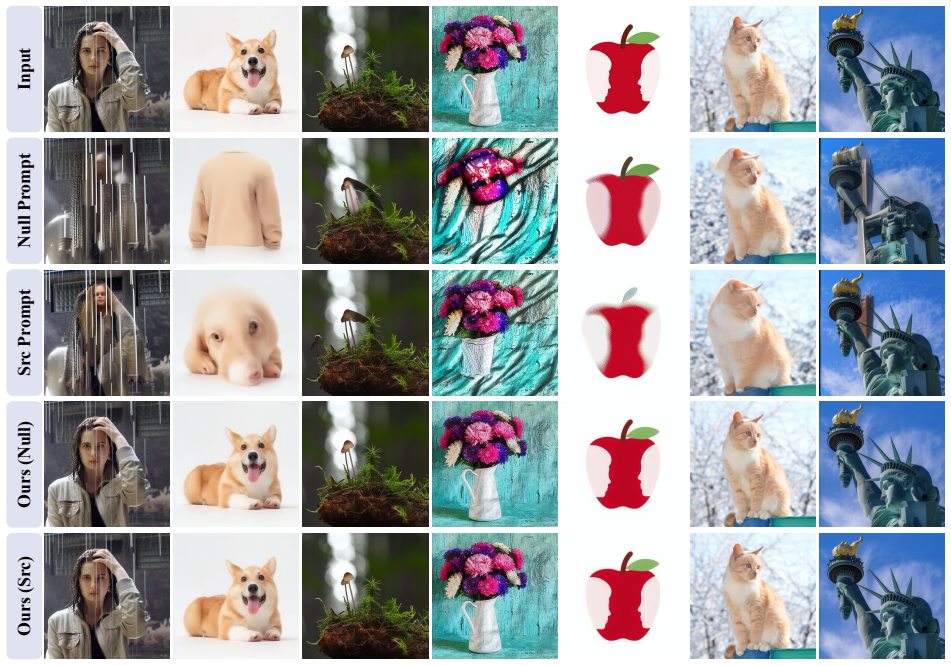
- Reconstruction becomes nearly prompt-independent: uniform attention with source-prompt values and with null-prompt values give almost identical fidelity (structure distance $4.67$ and $4.76$), so pipelines no longer need prompt tuning for reconstruction quality.
- Editing methods that rely on attention control (Prompt-to-Prompt, MasaCtrl) gain structure-distance, background-preservation, and CLIP-score improvements when the adaptive mask blend is added.
- The TF-ICON image composition pipeline improves under the same substitution, with lower LPIPS on foreground and background and a higher CLIP text score.
- Uniform attention maps outperform both the source/null prompt baselines and Zero Cross-Attention Maps, supporting the paper's claim that keeping the value-token mean preserves pretraining compatibility that wholesale zeroing destroys.
Reading between the lines
- Editorial inference: if the mechanism is correct, the uniform-map fix should transfer to other inversion schemes whose forward–reverse mismatch is driven by cross-attention drift, such as EDICT-style coupled inversions; a cheap test is to swap their attention maps for uniform ones and check whether reconstruction error falls the same way.
- Editorial inference: the Fig. 3 evidence is correlational, so the causal claim that cross-attention misalignment drives reconstruction error can be settled by a layer-wise ablation that applies uniform maps in only a subset of U-Net layers and locates where the error reduction concentrates.
- Editorial inference: because uniform attention averages the value tokens, the conditioning signal becomes effectively constant, which predicts that scrambled or meaningless prompts should reconstruct as faithfully as the true source prompt; this is directly testable and would delimit how much of reconstruction fidelity actually depends on text conditioning.
Editorial analysis
A structured set of objections, weighed in public.
Referee Report
Summary. The paper proposes Uniform Attention Maps (UAM) for diffusion-model inversion and editing: in Eq. (7), the cross-attention score map S_t^{(l)} is replaced by the uniform matrix S_uniform = (1/N) 1_{M^{(l)} x N}, and this replacement is used during DDIM inversion and reconstruction with value tokens taken from a chosen prompt. The paper also introduces an adaptive mask-guided editing algorithm (Sec. 3.3.2) that blends an auxiliary null-prompt/uniform-attention branch with the target branch using a timestep-dependent mask. Experiments on PIE, TF-ICON, and CelebA-HQ report improved reconstruction fidelity (Tabs. 1-2), composition (Tab. 5), and editing metrics (Tabs. 3-4) relative to several baselines, with ablations for the mask threshold lambda and mask timestep T_mask (Tab. 6). The authors attribute the gains to cross-attention misalignment between inversion and reconstruction (Sec. 3.2, Fig. 3) and assert that uniform maps 'maintain compatibility with the pretraining distribution' (Sec. 3.3.1).
Significance. If the empirical results hold, the method is a simple drop-in replacement that improves reconstruction fidelity across two Stable Diffusion versions and two solvers, and it modestly improves editing when combined with MasaCtrl or Prompt-to-Prompt. The paper provides code, and the reconstruction gains in Tab. 1 are large and consistent, which strengthens the plausibility of the central claim. However, the causal mechanism and the compatibility assertion are not yet supported, and some editing improvements are small and unreplicated. The contribution is therefore conditional on additional validation of the mechanism, generalization, and statistical significance; it is not yet ready for acceptance.
major comments (4)
- [Sec. 3.2, Fig. 3] The causal claim that cross-attention discrepancies cause reconstruction errors is supported only by a correlation scatter plot between MSE(A_inv - A_rec) and MSE(z_0,inv - z_0,rec). This correlation does not establish that the cross-attention term is the driver, as both quantities could reflect a common confound such as general trajectory mismatch. To make the attribution load-bearing, the authors should supply an intervention: for example, hold the attention maps fixed between inversion and reconstruction while varying the value tokens, or run inversion with original attention maps and reconstruction with uniform maps (and vice versa), and show that reconstruction error tracks the A-term mismatch. As written, Eq. (7) is motivated by a claim that the experiments do not isolate.
- [Sec. 3.3.1] The assertion that uniform attention maps 'maintain compatibility with the pretraining distribution' is unsupported. The paper provides no layer-wise statistics of the intermediate features x^{(l)} under original, uniform, and zero attention, and no evaluation on other model families, resolutions, or step counts beyond SD1.4 with 20-step DDIM and SD2.1 with DPM. The observed superiority of uniform over zero attention (Tab. 1) is consistent with the claim, but it does not demonstrate compatibility; many other fixed attention patterns could also outperform zero. Please either add direct distributional or causal evidence, or soften the claim to an empirical observation.
- [Sec. 4.6, Tabs. 3-4, 6] The editing hyperparameters lambda (quantile) and T_mask are selected by ablations on the PIE benchmark (Tab. 6) and then used to report the headline editing results on the same PIE split (Tabs. 3-4). This is a form of test-set selection; as a result, the reported editing gains may not generalize to new images. The authors should either use a held-out validation set, report the sensitivity of Tables 3-4 over a range of lambda and T_mask, or justify that the chosen values are not tuned to the test set.
- [Tabs. 3-4] The editing improvements for the strongest baseline (DI) are small: for example, Structure Distance 24.70 to 24.60, PSNR 22.64 to 22.68, and SSIM 81.33 to 81.52 in Tab. 3. No standard deviations, confidence intervals, or paired significance tests are reported for any table, so it is unclear whether these differences are statistically reliable. In addition, Tab. 4 shows CLIP(Edited) decreasing from 22.44 (DDIM) to 22.23 (DDIM+Ours), which contradicts the text's statement that CLIP scores in edited regions show 'notable gains'. Please report variance across images or runs and correct the overclaim.
minor comments (5)
- [Fig. 3] The axis label 'MSE(A_inv - A_rec) / MSE(z0,inv - z0,rec) x 1e-3' is ambiguous; please spell out the quantities and units used on both axes.
- [Sec. 3.2, Eq. (3)] The phrase 'using the noise prediction from the previous timestep' should clarify the order; DDIM inversion updates z_t using the noise prediction at t-1, which is an approximation rather than an assumption of equality between adjacent timesteps.
- [Algorithm 1] The symbol C is introduced for uniform cross-attention maps but the main text uses S_uniform; please unify the notation.
- [References] References [31] and [34] contain stray page numbers '8, 2' that appear to be artifacts; please correct the bibliography entries.
- [Various] There are several typos, including 'the clean predicted imageˆz0,t' in Sec. 3.2, 'T arget' in Algorithm 1, and 'bench mark' in Sec. 4.1; a careful proofread is needed.
Circularity Check
Editing gains are partly selected by ablation on the same PIE benchmark used for final reporting; the uniform-attention reconstruction result itself is self-contained.
-
fitted input called prediction
[Sec. 4.6 Ablation Study; hyperparameters set in Sec. 4 Experimental Setup; reported in Tabs. 3-4 on PIE]
"Consequently, a quantile of 0.5 is the chosen setting for subsequent experiments because it offers a balance by sufficiently reflecting the target text while preserving a close resemblance to the original image. ... Notably, T_mask = 200 emerges as the optimal setting, preserving the original image's details while effectively introducing the intended semantic changes. ... Therefore, we adopt T_mask = 200 for subsequent experiments."
The editing free parameters (threshold quantile and T_mask) are selected by an ablation on the PIE benchmark (Tab. 6) using the same editing metrics (Structure Distance, PSNR, LPIPS, MSE, SSIM, CLIP) that are then reported as headline 'ours' results on PIE in Tabs. 3-4. The quantile=0.5 row in Tab. 6(a) is numerically identical to the DDIM+Ours row in Tab. 3 (Structure Distance 24.80, PSNR 22.96), so the reported editing gain is not an independent prediction: the configuration was chosen because it produced that score on the same test set. The reconstruction core (Eq. 7) is not affected by this, but the editing contribution's benchmark numbers are partly self-selected.
full rationale
The reconstruction claim is self-contained: S_uniform is a fixed matrix with no fitted constants, and Tabs. 1-2 compare against external baselines under fixed sampling schedules. The correlation analysis in Fig. 3 is empirical, not a definitional identity. The two citations to the authors' own prior work ([18], [24]) are in related-work enumeration and do not carry the argument. The Sec. 3.3.1 assertion that uniform attention 'maintains compatibility with the pretraining distribution' is unsupported and is a generalization risk, but it is not circular because no equation or fitted value is defined in terms of the conclusion. The only circularity-like step is the editing hyperparameter selection on the same PIE benchmark used for final reporting; this adds a mild test-set feedback loop to the editing numbers without compromising the reconstruction derivation. Score 3 reflects this partial, non-derivation-level circularity.
Assumptions & free parameters
free parameters (3)
- mask threshold lambda (quantile) =
0.5 quantile of diff_t
- Tmask =
200
- dilation kernel size =
unspecified
assumptions (3)
- standard math DDIM inversion approximates adjacent noise predictions as approximately equal: eps(z_t, t, c) ~= eps(z_{t-1}, t-1, c).
- domain assumption Replacing cross-attention scores with uniform values keeps U-Net intermediate features within the pretraining distribution.
- domain assumption The per-timestep difference between target-branch and source-branch clean predictions localizes the regions that need editing.
Cite this review
Pith. "Pith review of Uniform Attention Maps: Boosting Image Fidelity in Reconstruction and Editing." pith.science (2026). https://pith.science/paper/CTNE3Y77
@misc{pith2026241119652,
  author       = {Pith},
  title        = {Pith review of: Uniform Attention Maps: Boosting Image Fidelity in Reconstruction and Editing},
  year         = {2026},
  howpublished = {\url{https://pith.science/paper/CTNE3Y77}},
  note         = {Machine review of arXiv:2411.19652}
}
read the original abstract
Text-guided image generation and editing using diffusion models have achieved remarkable advancements. Among these, tuning-free methods have gained attention for their ability to perform edits without extensive model adjustments, offering simplicity and efficiency. However, existing tuning-free approaches often struggle with balancing fidelity and editing precision. Reconstruction errors in DDIM Inversion are partly attributed to the cross-attention mechanism in U-Net, which introduces misalignments during the inversion and reconstruction process. To address this, we analyze reconstruction from a structural perspective and propose a novel approach that replaces traditional cross-attention with uniform attention maps, significantly enhancing image reconstruction fidelity. Our method effectively minimizes distortions caused by varying text conditions during noise prediction. To complement this improvement, we introduce an adaptive mask-guided editing technique that integrates seamlessly with our reconstruction approach, ensuring consistency and accuracy in editing tasks. Experimental results demonstrate that our approach not only excels in achieving high-fidelity image reconstruction but also performs robustly in real image composition and editing scenarios. This study underscores the potential of uniform attention maps to enhance the fidelity and versatility of diffusion-based image processing methods. Code is available at https://github.com/Mowenyii/Uniform-Attention-Maps.
Figures


Figures from the paper (10 more)




Reference graph
Works this paper leans on
-
[1]
Blended latent diffusion
Omri Avrahami, Ohad Fried, and Dani Lischinski. Blended latent diffusion. ACM Trans. Graph., 42(4):149:1–149:11,
-
[2]
Tim Brooks, Aleksander Holynski, and Alexei A. Efros. In- structpix2pix: Learning to follow image editing instructions. In IEEE/CVF Conference on Computer Vision and Pattern Recognition, CVPR 2023, Vancouver, BC, Canada, June 17- 24, 2023, pages 18392–18402. IEEE, 2023. 2
work page 2023
-
[3]
Masactrl: Tuning-free mutual self-attention control for consistent image synthesis and edit- ing
Mingdeng Cao, Xintao Wang, Zhongang Qi, Ying Shan, Xi- aohu Qie, and Yinqiang Zheng. Masactrl: Tuning-free mutual self-attention control for consistent image synthesis and edit- ing. In IEEE/CVF International Conference on Computer Vision, ICCV 2023, Paris, France, October 1-6, 2023, pages 22503–22513. IEEE, 2023. 2, 3, 6, 7
work page 2023
-
[4]
Wenhu Chen, Hexiang Hu, Chitwan Saharia, and William W. Cohen. Re-imagen: Retrieval-augmented text-to-image gen- erator. In The Eleventh International Conference on Learning Representations, ICLR 2023, Kigali, Rwanda, May 1-5, 2023. OpenReview.net, 2023. 1, 3
work page 2023
-
[5]
Diffedit: Diffusion-based semantic image editing with mask guidance
Guillaume Couairon, Jakob Verbeek, Holger Schwenk, and Matthieu Cord. Diffedit: Diffusion-based semantic image editing with mask guidance. In The Eleventh International Conference on Learning Representations, ICLR 2023, Kigali, Rwanda, May 1-5, 2023. OpenReview.net, 2023. 3
work page 2023
-
[6]
Continual vision-language retrieval via dynamic knowledge rectification
Zhenyu Cui, Yuxin Peng, Xun Wang, Manyu Zhu, and Ji- ahuan Zhou. Continual vision-language retrieval via dynamic knowledge rectification. In Michael J. Wooldridge, Jennifer G. Dy, and Sriraam Natarajan, editors, Thirty-Eighth AAAI Con- ference on Artificial Intelligence, AAAI 2024, Thirty-Sixth Conference on Innovative Applications of Artificial Intelli- ...
work page 2024
-
[7]
Scaling rectified flow trans- formers for high-resolution image synthesis
Patrick Esser, Sumith Kulal, Andreas Blattmann, Rahim En- tezari, Jonas Müller, Harry Saini, Yam Levi, Dominik Lorenz, Axel Sauer, Frederic Boesel, et al. Scaling rectified flow trans- formers for high-resolution image synthesis. arXiv preprint arXiv:2403.03206, 2024. 2
arXiv 2024
-
[8]
Taming transformers for high-resolution image synthesis
Patrick Esser, Robin Rombach, and Björn Ommer. Taming transformers for high-resolution image synthesis. In IEEE Conference on Computer Vision and Pattern Recognition, CVPR 2021, virtual, June 19-25, 2021, pages 12873–12883. Computer Vision Foundation / IEEE, 2021. 2, 6
work page 2021
Show all 37 references
-
[9]
Ligong Han, Song Wen, Qi Chen, Zhixing Zhang, Kunpeng Song, Mengwei Ren, Ruijiang Gao, Yuxiao Chen, Ding Liu, Qilong Zhangli, Anastasis Stathopoulos, Xiaoxiao He, Jin- dong Jiang, Zhaoyang Xia, Akash Srivastava, and Dimitris N. Metaxas. Proxedit: Improving tuning-free real ima...
2024
-
[10]
Prompt-to-prompt image editing with cross-attention control
Amir Hertz, Ron Mokady, Jay Tenenbaum, Kfir Aberman, Yael Pritch, and Daniel Cohen-Or. Prompt-to-prompt image editing with cross-attention control. In The Eleventh Interna- tional Conference on Learning Representations, ICLR 2023, Kigali, Rwanda, May 1-5, 2023. OpenReview.net,...
2023
-
[11]
Denoising diffu- sion probabilistic models
Jonathan Ho, Ajay Jain, and Pieter Abbeel. Denoising diffu- sion probabilistic models. In Hugo Larochelle, Marc’Aurelio Ranzato, Raia Hadsell, Maria-Florina Balcan, and Hsuan- Tien Lin, editors, Advances in Neural Information Processing Systems 33: Annual Conference on Neural ...
2020
-
[12]
Classifier-free diffusion guidance
Jonathan Ho and Tim Salimans. Classifier-free diffusion guidance. In NeurIPS 2021 Workshop on Deep Generative Models and Downstream Applications, 2021. 2
2021
-
[13]
An edit friendly DDPM noise space: Inversion and manipulations
Inbar Huberman-Spiegelglas, Vladimir Kulikov, and Tomer Michaeli. An edit friendly DDPM noise space: Inversion and manipulations. In IEEE/CVF Conference on Computer Vision and Pattern Recognition, CVPR 2024, Seattle, WA, USA, June 16-22, 2024, pages 12469–12478. IEEE, 2024. 3
2024
-
[14]
Pnp inversion: Boosting diffusion-based editing with 3 lines of code
Xuan Ju, Ailing Zeng, Yuxuan Bian, Shaoteng Liu, and Qiang Xu. Pnp inversion: Boosting diffusion-based editing with 3 lines of code. In The Twelfth International Conference on Learning Representations, ICLR 2024, Vienna, Austria, May 7-11, 2024. OpenReview.net, 2024. 1, 2, 3, 4, 6
2024
-
[15]
Progressive growing of gans for improved quality, stability, and variation
Tero Karras, Timo Aila, Samuli Laine, and Jaakko Lehtinen. Progressive growing of gans for improved quality, stability, and variation. In 6th International Conference on Learning Representations, ICLR 2018, Vancouver, BC, Canada, April 30 - May 3, 2018, Conference Track Procee...
2018
-
[16]
Imagic: Text-based real image editing with diffusion models
Bahjat Kawar, Shiran Zada, Oran Lang, Omer Tov, Hui- wen Chang, Tali Dekel, Inbar Mosseri, and Michal Irani. Imagic: Text-based real image editing with diffusion models. In IEEE/CVF Conference on Computer Vision and Pattern Recognition, CVPR 2023, Vancouver, BC, Canada, June 1...
2023
-
[17]
Dif- fusionclip: Text-guided diffusion models for robust image 9 manipulation
Gwanghyun Kim, Taesung Kwon, and Jong Chul Ye. Dif- fusionclip: Text-guided diffusion models for robust image 9 manipulation. In IEEE/CVF Conference on Computer Vision and Pattern Recognition, CVPR 2022, New Orleans, LA, USA, June 18-24, 2022, pages 2416–2425. IEEE, 2022. 2
2022
-
[18]
Supporting vision-language model in- ference with causality-pruning knowledge prompt
Jiangmeng Li, Wenyi Mo, Wenwen Qiang, Bing Su, and Changwen Zheng. Supporting vision-language model in- ference with causality-pruning knowledge prompt. CoRR, abs/2205.11100, 2022. 2
2022 arXiv
-
[19]
Styledif- fusion: Prompt-embedding inversion for text-based editing
Senmao Li, Joost van de Weijer, Taihang Hu, Fahad Shahbaz Khan, Qibin Hou, Yaxing Wang, and Jian Yang. Styledif- fusion: Prompt-embedding inversion for text-based editing. CoRR, abs/2303.15649, 2023. 6
2023 arXiv
-
[20]
Dpm-solver: A fast ODE solver for diffusion probabilistic model sampling in around 10 steps
Cheng Lu, Yuhao Zhou, Fan Bao, Jianfei Chen, Chongxuan Li, and Jun Zhu. Dpm-solver: A fast ODE solver for diffusion probabilistic model sampling in around 10 steps. In Sanmi Koyejo, S. Mohamed, A. Agarwal, Danielle Belgrave, K. Cho, and A. Oh, editors, Advances in Neural Infor...
2022
-
[21]
TF-ICON: diffusion-based training-free cross-domain image composi- tion
Shilin Lu, Yanzhu Liu, and Adams Wai-Kin Kong. TF-ICON: diffusion-based training-free cross-domain image composi- tion. In IEEE/CVF International Conference on Computer Vision, ICCV 2023, Paris, France, October 1-6, 2023, pages 2294–2305. IEEE, 2023. 1, 2, 3, 5, 6, 7
2023
-
[22]
Sdedit: Guided image synthesis and editing with stochastic differential equa- tions
Chenlin Meng, Yutong He, Yang Song, Jiaming Song, Jia- jun Wu, Jun-Yan Zhu, and Stefano Ermon. Sdedit: Guided image synthesis and editing with stochastic differential equa- tions. In The Tenth International Conference on Learning Representations, ICLR 2022, Virtual Event, Apri...
2022
-
[23]
Negative-prompt inversion: Fast image inver- sion for editing with text-guided diffusion models
Daiki Miyake, Akihiro Iohara, Yu Saito, and Toshiyuki Tanaka. Negative-prompt inversion: Fast image inver- sion for editing with text-guided diffusion models. CoRR, abs/2305.16807, 2023. 1, 2, 3, 6
2023 arXiv
-
[24]
Dynamic prompt optimizing for text- to-image generation
Wenyi Mo, Tianyu Zhang, Yalong Bai, Bing Su, Ji-Rong Wen, and Qing Yang. Dynamic prompt optimizing for text- to-image generation. In IEEE/CVF Conference on Computer Vision and Pattern Recognition, CVPR 2024, Seattle, WA, USA, June 16-22, 2024, pages 26617–26626. IEEE, 2024. 2
2024
-
[25]
Null-text inversion for editing real images using guided diffusion models
Ron Mokady, Amir Hertz, Kfir Aberman, Yael Pritch, and Daniel Cohen-Or. Null-text inversion for editing real images using guided diffusion models. In IEEE/CVF Conference on Computer Vision and Pattern Recognition, CVPR 2023, Vancouver, BC, Canada, June 17-24, 2023, pages 6038–...
2023
-
[26]
Learning transferable visual models from natural language supervision
Alec Radford, Jong Wook Kim, Chris Hallacy, Aditya Ramesh, Gabriel Goh, Sandhini Agarwal, Girish Sastry, Amanda Askell, Pamela Mishkin, Jack Clark, et al. Learning transferable visual models from natural language supervision. In International Conference on Machine Learning , p...
2021
-
[27]
High-resolution image synthesis with latent diffusion models
Robin Rombach, Andreas Blattmann, Dominik Lorenz, Patrick Esser, and Björn Ommer. High-resolution image synthesis with latent diffusion models. In Proceedings of the IEEE/CVF Conference on Computer Vision and Pattern Recognition (CVPR), pages 10684–10695, June 2022. 1, 2, 3, 4, 6
2022
-
[28]
Denton, Seyed Kamyar Seyed Ghasemipour, Raphael Gontijo Lopes, Burcu Karagol Ayan, Tim Salimans, Jonathan Ho, David J
Chitwan Saharia, William Chan, Saurabh Saxena, Lala Li, Jay Whang, Emily L. Denton, Seyed Kamyar Seyed Ghasemipour, Raphael Gontijo Lopes, Burcu Karagol Ayan, Tim Salimans, Jonathan Ho, David J. Fleet, and Mohammad Norouzi. Pho- torealistic text-to-image diffusion models with ...
2022
-
[29]
Denoising diffusion implicit models
Jiaming Song, Chenlin Meng, and Stefano Ermon. Denoising diffusion implicit models. In 9th International Conference on Learning Representations, ICLR 2021, Virtual Event, Austria, May 3-7, 2021. OpenReview.net, 2021. 1, 3, 6
2021
-
[30]
Fine-grained visual prompt learning of vision-language mod- els for image recognition
Hongbo Sun, Xiangteng He, Jiahuan Zhou, and Yuxin Peng. Fine-grained visual prompt learning of vision-language mod- els for image recognition. In Abdulmotaleb El-Saddik, Tao Mei, Rita Cucchiara, Marco Bertini, Diana Patricia Tobon Vallejo, Pradeep K. Atrey, and M. Shamim Hossa...
2023
-
[31]
Splicing vit features for semantic appearance transfer
Narek Tumanyan, Omer Bar-Tal, Shai Bagon, and Tali Dekel. Splicing vit features for semantic appearance transfer. In IEEE/CVF Conference on Computer Vision and Pattern Recognition, CVPR 2022, New Orleans, LA, USA, June 18-24, 2022, pages 10738–10747. IEEE, 2022. 8, 2
2022
-
[32]
Unitune: Text-driven image editing by fine tun- ing an image generation model on a single image
Dani Valevski, Matan Kalman, Yossi Matias, and Yaniv Leviathan. Unitune: Text-driven image editing by fine tun- ing an image generation model on a single image. CoRR, abs/2210.09477, 2022. 2
2022 arXiv
-
[33]
EDICT: exact diffusion inversion via coupled transformations
Bram Wallace, Akash Gokul, and Nikhil Naik. EDICT: exact diffusion inversion via coupled transformations. InIEEE/CVF Conference on Computer Vision and Pattern Recognition, CVPR 2023, Vancouver, BC, Canada, June 17-24, 2023, pages 22532–22541. IEEE, 2023. 2, 3, 4
2023
-
[34]
Bovik, Hamid R
Zhou Wang, Alan C. Bovik, Hamid R. Sheikh, and Eero P. Simoncelli. Image quality assessment: from error visibility to structural similarity. IEEE Trans. Image Process., 13(4):600– 612, 2004. 8, 2
2004
-
[35]
Paint by ex- ample: Exemplar-based image editing with diffusion models
Binxin Yang, Shuyang Gu, Bo Zhang, Ting Zhang, Xuejin Chen, Xiaoyan Sun, Dong Chen, and Fang Wen. Paint by ex- ample: Exemplar-based image editing with diffusion models. In IEEE/CVF Conference on Computer Vision and Pattern Recognition, CVPR 2023, Vancouver, BC, Canada, June 1...
2023
-
[36]
Deep image blending
Lingzhi Zhang, Tarmily Wen, and Jianbo Shi. Deep image blending. In IEEE Winter Conference on Applications of Computer Vision, WACV 2020, Snowmass Village, CO, USA, March 1-5, 2020, pages 231–240. IEEE, 2020. 7
2020
-
[37]
Efros, Eli Shechtman, and Oliver Wang
Richard Zhang, Phillip Isola, Alexei A. Efros, Eli Shechtman, and Oliver Wang. The unreasonable effectiveness of deep features as a perceptual metric. In 2018 IEEE Conference on Computer Vision and Pattern Recognition, CVPR 2018, Salt Lake City, UT, USA, June 18-22, 2018, page...
2018
Reviewed August 12, 2026 · model on record in the stance chip above.
Discussion (0). Continue with ORCID to comment.