REVIEW 4 major objections 4 minor 1 cited by
BiAssemble: Learning Collaborative Affordance for Bimanual Geometric Assembly
T0 review · 4 major / 4 minor · reviewed 2026-08-07 · deepseek-v4-flash
Pith's one-line read BiAssemble claims that a bimanual robot can reassemble broken 3D fragments by learning per-point grasp affordances that encode the whole pick-up, alignment, and assembly sequence, reaching 24.10% average success on novel instances and…
desk verdict A genuine extension of affordance-based bimanual manipulation with solid simulation evidence; the real-world claims need measured trials and the fixed-grasp assumption needs honest discussion. read the letter →
The pith
A machine-rendered reading of the paper's core claim, the machinery that carries it, and where it could break.
The reading
What carries the argument
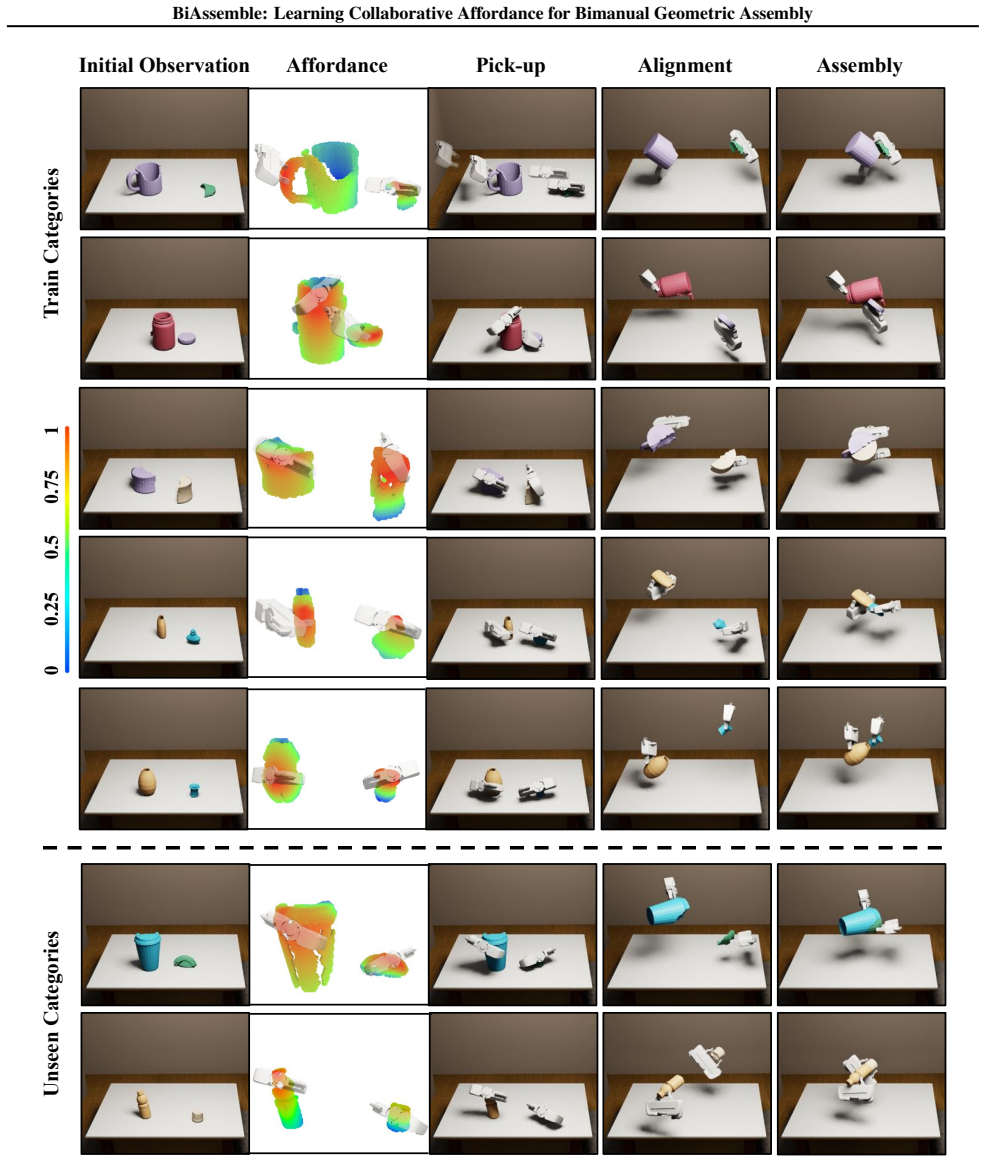
The load-bearing mechanism is the staged decomposition connected by the rigid gripper-object identity $g_{\text{pick}}^i q_{\text{pick}}^i = g_{\text{asm}}^i q_{\text{asm}}^i$ (Equation 1), which lets any successful grasp be converted into the required assembly pose without knowing a canonical object frame, provided the grasp does not slip. The other central object is the BiAffordance predictor: two conditional point-level affordance maps, one per gripper, trained so that a high score at a contact point means the entire three-step assembly tends to succeed, not merely the local grasp. A disassembly-direction predictor and an SE(3) transformation predictor (both conditional variational autoencoders) produce the collision-free alignment target that the affordance networks are conditioned on, and the second gripper's actions are predicted conditionally on the first gripper's chosen action.
What would settle it
Attach a motion tracker to each fragment, or track it with high-frequency RGB-D cameras, throughout pick-up, alignment, and assembly in real execution. If the measured relative pose between gripper and fragment drifts by more than the assembly tolerance on a substantial share of smooth or narrow-neck fragments, the paper's central invariant fails.
Extended reading notes
Core claim
The central claim is that bimanual geometric assembly can be decomposed into three stages---pick-up, alignment, and assembly---and that training a point-level affordance model on the success or failure of the complete sequence makes the model select grasp points and gripper orientations that generalize to unseen fragments. Given the partial observed point cloud and an imaginary assembled shape, BiAssemble first predicts a disassembly direction whose reverse is collision-free for the final assembly, then predicts an SE(3) transformation that moves the assembled shape into alignment poses reachable from the initial table poses, and finally predicts two conditional affordance maps, one per gripper, whose scores encode whether a contact point enables the whole downstream sequence. The paper's quantitative claim is 24.10% average success on novel instances within training categories and 17.40% on unseen categories, with real-world experiments showing the affordance predictions transferring to scanned fragments; success is defined as the final relative translation and rotation of the two parts falling within set thresholds.
Load-bearing premise
The whole action pipeline assumes each grasped fragment stays rigidly fixed relative to the gripper while it is picked up, aligned, and pushed into place; if the fragment slips, slides, or tips in the gripper, the computed assembly pose is wrong.
Editorial extensions
If this is right
- On novel instances within training categories the method reaches 24.10% average success, versus 8.40% for the strongest prior affordance baseline and 0.30% for the imitation baseline, indicating that conditioning affordance on downstream assembly, rather than graspability alone, drives the gain.
- On object categories never seen during training the method still reaches 17.40% average success, so the per-point representation transfers across categories rather than memorizing specific shapes.
- With an imperfect imaginary assembled shape from an upstream pose estimator, accuracy stays at 20.80% on training categories and 17.20% on unseen categories without fine-tuning, so the pipeline can operate behind existing assembly-pose predictors.
- The two-fragment policy extends to multi-fragment assembly by iterative application, reaching 16.6% average success on three-fragment tasks.
- A bottle-cap closing task trained on a few bottle shapes generalizes to novel bottle shapes at 67% average accuracy, suggesting the mechanism is not limited to broken-part restoration.
Reading between the lines
- Our inference: the fixed-grip assumption is the likeliest performance ceiling, since the paper's own failure analysis attributes real failures to relative displacement, sliding, and tipping on narrow-neck and smooth curved parts; adding slip-aware grasp selection or permitting regrasps is the natural next step.
- Our inference: because the affordance is conditioned on the imagined assembled shape, its utility should scale with the accuracy of upstream pose estimation; a testable prediction is that the gap between BiAssemble and a non-conditioned baseline widens as the imagined shape becomes more accurate.
- Our inference: the model's per-point scores could double as a recovery signal---low affordance at seam-adjacent and table-adjacent points could trigger a pre-grasp that re-poses the fragment, turning the paper's identified failure modes into explicit policy branches.
- Our inference: the release of reproducible scanned fragments and meshes enables a shared benchmark for bimanual assembly, but the paper itself does not run an inter-laboratory comparison, so establishing that reproducibility is an open step.
Editorial analysis
A structured set of objections, weighed in public.
Referee Report
Summary. The paper proposes BiAssemble, a framework for bimanual robotic assembly of fractured 3D parts. Given a partial point cloud and an imaginary assembled shape, it predicts a disassembly direction, an SE(3) transformation that maps the assembled shape to aligned poses, and a point-level bimanual affordance that guides two grippers through pick-up, alignment, and final assembly. Evaluation in SAPIEN on Breaking Bad fragments reports average success rates of 24.10% on novel instances within training categories and 17.40% on unseen categories, outperforming affordance-based, equivariance-based, and imitation-based baselines, with additional experiments on multi-fragment assembly, imperfect imaginary shapes, and real-world scans.
Significance. If the results hold, the contribution is valuable: it demonstrates that point-level affordance can encode long-horizon bimanual assembly constraints and generalize across object geometry. The paper's strengths include a large-scale simulation study, comparisons against several baselines, ablations that isolate the main components, a robustness test with imperfect imaginary assembled shapes, and an attempt at a reproducible real-world benchmark. However, the real-world generalization claim currently rests on qualitative demonstrations without measured success, and the simulation evaluation omits variance reporting and specific success thresholds. These gaps are load-bearing because the real-world claim and the quantitative margins over baselines are central to the paper's contribution.
major comments (4)
- [§6.5, Eq. (1)-(2), Appendix G.2] The real-world generalization claim in Section 6.5 is not supported by any measured success: the text reports only 'promising results' with no success count, error metric, or per-trial outcome. This matters because Eq. 2 computes the commanded assembly pose gasm under the assumption in Eq. 1 that the relative gripper-object pose is unchanged from pickup to assembly; Appendix G.2 explicitly lists relative displacement, sliding, and tipping for narrow-neck bottles and smooth curved parts, which violates Eq. 1 in the failure modes the method targets. Quantitative real-world trials with clear success criteria are needed before the central generalization claim can be accepted.
- [§6.2, Table 1] The success metric is not reproducible as reported: the text says success requires relative distance and rotation angle to be 'within the threshold range' but never specifies the distance and angle thresholds, and no confidence intervals, standard errors, or significance tests are provided for the 100-sample per-category rates. Several comparisons in Table 1 differ by only 1-2 percentage points (e.g., novel-instance WineGlass 13% vs. 13%, Teapot 9% vs. 9%, unseen-category Cup 14% vs. 14%), so without variance or significance reporting the claimed margin over the w/o SE(3) and w/ GT Target ablations is not firmly established.
- [§4.2-4.4, Appendix B, §6.2 w/ GT target] The training labels for disassembly direction, transformation, and affordance are produced by heuristic controllers in the same SAPIEN simulator used for evaluation, and the paper does not quantify how often these heuristics produce feasible or optimal ground truth. The w/ GT Target ablation is informative but not fully separating: it shows that providing the heuristic-sampled target underperforms the learned prediction on novel instances yet outperforms it on unseen categories, which suggests the heuristic labels are partially circular with the evaluation protocol; the authors should report the success rate of the heuristic data-collection policy itself and analyze how label quality varies across categories.
- [§5.2] The claimed 'global reproducibility' of the real-world benchmark is not yet verifiable: Section 5.2 describes scanning with a smartphone, COLMAP, Grounded SAM 2, Depth Anything V2, and SDFStudio, and mentions globally available objects, but it does not provide the object list, brand/model identifiers, scan protocol details, or a release URL for the meshes, ground-truth annotations, and assembly instructions. Without this information the benchmark cannot be reproduced by other groups.
minor comments (4)
- [§4.1] The framework is called BiAssemble in the title and elsewhere, but Section 4.1 refers to the 'BiAssembly framework'; please unify the name.
- [Table 1] The column header appears as 'A VG' instead of 'AVG'; the spacing should be fixed.
- [Appendix A, Table 2] The shape-level test split totals 129 shapes by summing the per-category test counts in Table 2, while the text states 131 shapes; please clarify the rounding or list the exact split.
- [§6.2] The ACT baseline is trained and tested on individual categories while all other learning-based methods are trained on all training categories, making the comparison asymmetric; the paper should state whether ACT is at a disadvantage beyond the reported numbers.
Circularity Check
No significant circularity: the learned predictors are trained on heuristic labels but evaluated by final assembly success on held-out instances and unseen categories.
full rationale
The paper's derivation chain is not circular. The disassembly direction, SE(3) transformation, and affordance labels are collected via heuristic controllers in simulation (Appendix B), but the evaluation metric is not agreement with those labels: success is measured by whether the final relative distance and rotation of the two parts are within thresholds (Section 6.2), using 100 fresh samples per category with identical initial observations. The w/ GT Target ablation is particularly informative: the model given ground-truth heuristic disassembly direction and transformation achieves 22.40% on novel training-category instances and 19% on unseen categories, while the fully learned method achieves 24.10% and 17.40% respectively (Table 1). This shows the learned components do not merely reproduce their training signal; predicting heuristic targets is not sufficient for assembly success. Held-out shapes within training categories and five completely unseen categories provide independent generalization evidence. Equation 2 is an exact kinematic consequence of Equation 1's fixed relative gripper-object pose assumption; it is a stated assumption rather than a hidden re-use of the prediction target. The self-citations to VN-DGCNN (Wu et al., 2023c) and DualAfford (Zhao et al., 2022) are architectural inspirations, not load-bearing justifications for the empirical claim, and no uniqueness theorem or prior result is invoked to forbid alternatives. The real-world experiments in Section 6.5 are qualitative and Appendix G documents slip/tipping failures, but that is a correctness or evidence-strength concern, not circularity. Overall, no claim reduces to its own inputs by construction.
Assumptions & free parameters
free parameters (5)
- Success thresholds for relative distance and rotation angle =
not reported
- Gripper x-axis candidate count n =
6
- Affordance label sample counts n and m =
not reported
- cVAE latent dimension z =
32
- Number of positive and negative training samples per method =
7000 each
assumptions (5)
- domain assumption A reliable imaginary assembled shape S is available as input.
- domain assumption The relative pose between gripper and object remains fixed during pick-up, alignment, and assembly.
- domain assumption Feasible disassembly directions are an inherent property of the fracture geometry and are SO(3)-equivariant.
- domain assumption SAPIEN simulation with Franka grippers is a sufficient proxy for real-world contact-rich assembly.
- domain assumption Heuristic-generated positive and negative labels are reliable ground truth for affordance and target poses.
Cite this review
Pith. "Pith review of BiAssemble: Learning Collaborative Affordance for Bimanual Geometric Assembly." pith.science (2026). https://pith.science/paper/CV6XBM6Y
@misc{pith2026250606221,
  author       = {Pith},
  title        = {Pith review of: BiAssemble: Learning Collaborative Affordance for Bimanual Geometric Assembly},
  year         = {2026},
  howpublished = {\url{https://pith.science/paper/CV6XBM6Y}},
  note         = {Machine review of arXiv:2506.06221}
}
read the original abstract
Shape assembly, the process of combining parts into a complete whole, is a crucial robotic skill with broad real-world applications. Among various assembly tasks, geometric assembly--where broken parts are reassembled into their original form (e.g., reconstructing a shattered bowl)--is particularly challenging. This requires the robot to recognize geometric cues for grasping, assembly, and subsequent bimanual collaborative manipulation on varied fragments. In this paper, we exploit the geometric generalization of point-level affordance, learning affordance aware of bimanual collaboration in geometric assembly with long-horizon action sequences. To address the evaluation ambiguity caused by geometry diversity of broken parts, we introduce a real-world benchmark featuring geometric variety and global reproducibility. Extensive experiments demonstrate the superiority of our approach over both previous affordance-based and imitation-based methods. Project page: https://sites.google.com/view/biassembly/.
Figures


Figures from the paper (8 more)



Forward citations
Cited by 1 Pith paper
-
AssemLM: A Spatial Reasoning Multimodal Large Language Model for Robotic Assembly
AssemLM uses a specialized point cloud encoder inside a multimodal LLM to reach state-of-the-art 6D pose prediction for assembly tasks, backed by a new 900K-sample benchmark called AssemBench.
Reference graph
Works this paper leans on
-
[1]
write newline
" write newline "" before.all 'output.state := FUNCTION n.dashify 't := "" t empty not t #1 #1 substring "-" = t #1 #2 substring "--" = not "--" * t #2 global.max substring 't := t #1 #1 substring "-" = "-" * t #2 global.max substring 't := while if t #1 #1 substring * t #2 global.max substring 't := if while FUNCTION format.date year duplicate empty "emp...
-
[2]
Juicer: Data-efficient imitation learning for robotic assembly
Ankile, L., Simeonov, A., Shenfeld, I., and Agrawal, P. Juicer: Data-efficient imitation learning for robotic assembly. arXiv preprint arXiv:2404.03729, 2024
arXiv 2024
-
[3]
Rt-2: Vision-language-action models transfer web knowledge to robotic control
Brohan, A., Brown, N., Carbajal, J., Chebotar, Y., Chen, X., Choromanski, K., Ding, T., Driess, D., Dubey, A., Finn, C., et al. Rt-2: Vision-language-action models transfer web knowledge to robotic control. arXiv preprint arXiv:2307.15818, 2023
arXiv 2023
-
[4]
Bi-dexhands: Towards human-level bimanual dexterous manipulation
Chen, Y., Geng, Y., Zhong, F., Ji, J., Jiang, J., Lu, Z., Dong, H., and Yang, Y. Bi-dexhands: Towards human-level bimanual dexterous manipulation. IEEE Transactions on Pattern Analysis and Machine Intelligence, 2023
work page 2023
-
[5]
Neural shape mating: Self-supervised object assembly with adversarial shape priors
Chen, Y.-C., Li, H., Turpin, D., Jacobson, A., and Garg, A. Neural shape mating: Self-supervised object assembly with adversarial shape priors. In Proceedings of the IEEE/CVF Conference on Computer Vision and Pattern Recognition, pp.\ 12724--12733, 2022
work page 2022
-
[6]
Efficient bimanual manipulation using learned task schemas
Chitnis, R., Tulsiani, S., Gupta, S., and Gupta, A. Efficient bimanual manipulation using learned task schemas. In 2020 IEEE International Conference on Robotics and Automation (ICRA), pp.\ 1149--1155. IEEE, 2020
work page 2020
-
[7]
Clarke, J. A., Tambussi, C. P., Noriega, J. I., Erickson, G. M., and Ketcham, R. A. Definitive fossil evidence for the extant avian radiation in the cretaceous. Nature, 433 0 (7023): 0 305--308, 2005
work page 2005
-
[8]
Community, B. O. Blender - a 3D modelling and rendering package. Blender Foundation, Stichting Blender Foundation, Amsterdam, 2018. URL http://www.blender.org
work page 2018
Show all 77 references
-
[9]
Deng, C., Litany, O., Duan, Y., Poulenard, A., Tagliasacchi, A., and Guibas, L. J. Vector neurons: A general framework for so (3)-equivariant networks. In Proceedings of the IEEE/CVF International Conference on Computer Vision, pp.\ 12200--12209, 2021
2021
-
[10]
Preafford: Universal affordance-based pre-grasping for diverse objects and environments
Ding, K., Chen, B., Wu, R., Li, Y., Zhang, Z., Gao, H.-a., Li, S., Zhu, Y., Zhou, G., Dong, H., et al. Preafford: Universal affordance-based pre-grasping for diverse objects and environments. IROS, 2024
2024
-
[11]
Z., and Finn, C
Fu, Z., Zhao, T. Z., and Finn, C. Mobile aloha: Learning bimanual mobile manipulation with low-cost whole-body teleoperation. arXiv preprint arXiv:2401.02117, 2024
2024 arXiv
-
[12]
Rvt: Robotic view transformer for 3d object manipulation
Goyal, A., Xu, J., Guo, Y., Blukis, V., Chao, Y.-W., and Fox, D. Rvt: Robotic view transformer for 3d object manipulation. In Conference on Robot Learning, pp.\ 694--710. PMLR, 2023
2023
-
[13]
Stabilize to act: Learning to coordinate for bimanual manipulation
Grannen, J., Wu, Y., Vu, B., and Sadigh, D. Stabilize to act: Learning to coordinate for bimanual manipulation. In Conference on Robot Learning, pp.\ 563--576. PMLR, 2023
2023
-
[14]
Peract2: A perceiver actor framework for bimanual manipulation tasks
Grotz, M., Shridhar, M., Asfour, T., and Fox, D. Peract2: A perceiver actor framework for bimanual manipulation tasks. arXiv preprint arXiv:2407.00278, 2024
2024 arXiv
-
[15]
Heo, M., Lee, Y., Lee, D., and Lim, J. J. Furniturebench: Reproducible real-world benchmark for long-horizon complex manipulation. arXiv preprint arXiv:2305.12821, 2023
2023 arXiv
-
[16]
G., and Schulz, A
Jones, B., Hildreth, D., Chen, D., Baran, I., Kim, V. G., and Schulz, A. Automate: A dataset and learning approach for automatic mating of cad assemblies. ACM Transactions on Graphics (TOG), 40 0 (6): 0 1--18, 2021
2021
-
[17]
Robo-abc: Affordance generalization beyond categories via semantic correspondence for robot manipulation
Ju, Y., Hu, K., Zhang, G., Zhang, G., Jiang, M., and Xu, H. Robo-abc: Affordance generalization beyond categories via semantic correspondence for robot manipulation. arXiv preprint arXiv:2401.07487, 2024
2024 arXiv
-
[18]
X., Lu, H., Gupta, A., Levine, S., and Abbeel, P
Lee, A. X., Lu, H., Gupta, A., Levine, S., and Abbeel, P. Learning force-based manipulation of deformable objects from multiple demonstrations. In 2015 IEEE International Conference on Robotics and Automation (ICRA), pp.\ 177--184. IEEE, 2015
2015
-
[19]
3d geometric shape assembly via efficient point cloud matching
Lee, N., Min, J., Lee, J., Kim, S., Lee, K., Park, J., and Cho, M. 3d geometric shape assembly via efficient point cloud matching. arXiv preprint arXiv:2407.10542, 2024
2024 arXiv
-
[20]
S., and Lim, J
Lee, Y., Hu, E. S., and Lim, J. J. Ikea furniture assembly environment for long-horizon complex manipulation tasks. In 2021 ieee international conference on robotics and automation (icra), pp.\ 6343--6349. IEEE, 2021
2021
-
[21]
Manipllm: Embodied multimodal large language model for object-centric robotic manipulation
Li, X., Zhang, M., Geng, Y., Geng, H., Long, Y., Shen, Y., Zhang, R., Liu, J., and Dong, H. Manipllm: Embodied multimodal large language model for object-centric robotic manipulation. In Proceedings of the IEEE/CVF Conference on Computer Vision and Pattern Recognition, pp.\ 18...
2024
-
[22]
Efficient bimanual handover and rearrangement via symmetry-aware actor-critic learning
Li, Y., Pan, C., Xu, H., Wang, X., and Wu, Y. Efficient bimanual handover and rearrangement via symmetry-aware actor-critic learning. In 2023 IEEE International Conference on Robotics and Automation (ICRA), pp.\ 3867--3874. IEEE, 2023
2023
-
[23]
Broadcasting support relations recursively from local dynamics for object retrieval in clutters
Li, Y., Wu, R., Lu, H., Ning, C., Shen, Y., Zhan, G., and Dong, H. Broadcasting support relations recursively from local dynamics for object retrieval in clutters. RSS, 2024 b
2024
-
[24]
Virtual plate pre-bending for the long bone fracture based on axis pre-alignment
Liu, B., Luo, X., Huang, R., Wan, C., Zhang, B., Hu, W., and Yue, Z. Virtual plate pre-bending for the long bone fracture based on axis pre-alignment. Computerized medical imaging and graphics, 38 0 (4): 0 233--244, 2014
2014
-
[25]
Robot cooking with stir-fry: Bimanual non-prehensile manipulation of semi-fluid objects
Liu, J., Chen, Y., Dong, Z., Wang, S., Calinon, S., Li, M., and Chen, F. Robot cooking with stir-fry: Bimanual non-prehensile manipulation of semi-fluid objects. IEEE Robotics and Automation Letters, 7 0 (2): 0 5159--5166, 2022
2022
-
[26]
Taco: Benchmarking generalizable bimanual tool-action-object understanding
Liu, Y., Yang, H., Si, X., Liu, L., Li, Z., Zhang, Y., Liu, Y., and Yi, L. Taco: Benchmarking generalizable bimanual tool-action-object understanding. In Proceedings of the IEEE/CVF Conference on Computer Vision and Pattern Recognition, pp.\ 21740--21751, 2024
2024
-
[27]
Unigarment: A unified simulation and benchmark for garment manipulation
Lu, H., Li, Y., Wu, R., Ning, C., Shen, Y., and Dong, H. Unigarment: A unified simulation and benchmark for garment manipulation. In ICRA Workshop on Deformable Object Manipulation, 2024 a
2024
-
[28]
A survey on computational solutions for reconstructing complete objects by reassembling their fractured parts
Lu, J., Liang, Y., Han, H., Hua, J., Jiang, J., Li, X., and Huang, Q. A survey on computational solutions for reconstructing complete objects by reassembling their fractured parts. arXiv preprint arXiv:2410.14770, 2024 b
2024 arXiv
-
[29]
Jigsaw: Learning to assemble multiple fractured objects
Lu, J., Sun, Y., and Huang, Q. Jigsaw: Learning to assemble multiple fractured objects. Advances in Neural Information Processing Systems, 36, 2024 c
2024
-
[30]
J., Mukadam, M., Gupta, A., and Tulsiani, S
Mo, K., Guibas, L. J., Mukadam, M., Gupta, A., and Tulsiani, S. Where2act: From pixels to actions for articulated 3d objects. In Proceedings of the IEEE/CVF International Conference on Computer Vision, pp.\ 6813--6823, 2021
2021
-
[31]
Maniskill: Learning-from-demonstrations benchmark for generalizable manipulation skills
Mu, T., Ling, Z., Xiang, F., Yang, D., Li, X., Tao, S., Huang, Z., Jia, Z., and Su, H. Maniskill: Learning-from-demonstrations benchmark for generalizable manipulation skills. CoRR, abs/2107.14483, 2021b. URL https://arxiv. org/abs/2107, 14483, 2021
2021 arXiv
-
[32]
Robotwin: Dual-arm robot benchmark with generative digital twins (early version)
Mu, Y., Chen, T., Peng, S., Chen, Z., Gao, Z., Zou, Y., Lin, L., Xie, Z., and Luo, P. Robotwin: Dual-arm robot benchmark with generative digital twins (early version). arXiv preprint arXiv:2409.02920, 2024
2024 arXiv
-
[33]
Factory: Fast contact for robotic assembly
Narang, Y., Storey, K., Akinola, I., Macklin, M., Reist, P., Wawrzyniak, L., Guo, Y., Moravanszky, A., State, G., Lu, M., et al. Factory: Fast contact for robotic assembly. arXiv preprint arXiv:2205.03532, 2022
2022 arXiv
-
[34]
Where2explore: Few-shot affordance learning for unseen novel categories of articulated objects
Ning, C., Wu, R., Lu, H., Mo, K., and Dong, H. Where2explore: Few-shot affordance learning for unseen novel categories of articulated objects. Advances in Neural Information Processing Systems, 36, 2024
2024
-
[35]
and Karabassi, E.-A
Papaioannou, G. and Karabassi, E.-A. On the automatic assemblage of arbitrary broken solid artefacts. Image and Vision Computing, 21 0 (5): 0 401--412, 2003
2003
-
[36]
pyk4a, 2019
pyk4a. pyk4a, 2019. URL https://github.com/etiennedub/pyk4a
2019
-
[37]
R., Su, H., Mo, K., and Guibas, L
Qi, C. R., Su, H., Mo, K., and Guibas, L. J. Pointnet: Deep learning on point sets for 3d classification and segmentation. Proc. Computer Vision and Pattern Recognition (CVPR), IEEE, 2017 a
2017
-
[38]
R., Yi, L., Su, H., and Guibas, L
Qi, C. R., Yi, L., Su, H., and Guibas, L. J. Pointnet++: Deep hierarchical feature learning on point sets in a metric space. Advances in neural information processing systems, 30, 2017 b
2017
-
[39]
L., and Xu, H
Qi, Y., Ju, Y., Wei, T., Chu, C., Wong, L. L., and Xu, H. Two by two: Learning multi-task pairwise objects assembly for generalizable robot manipulation. CVPR 2025, 2025
2025
-
[40]
Y., et al
Quigley, M., Conley, K., Gerkey, B., Faust, J., Foote, T., Leibs, J., Wheeler, R., Ng, A. Y., et al. Ros: an open-source robot operating system. In ICRA workshop on open source software, volume 3, pp.\ 5. Kobe, Japan, 2009
2009
-
[41]
V., Carion, N., Wu, C.-Y., Girshick, R., Doll \'a r, P., and Feichtenhofer, C
Ravi, N., Gabeur, V., Hu, Y.-T., Hu, R., Ryali, C., Ma, T., Khedr, H., R \"a dle, R., Rolland, C., Gustafson, L., Mintun, E., Pan, J., Alwala, K. V., Carion, N., Wu, C.-Y., Girshick, R., Doll \'a r, P., and Feichtenhofer, C. Sam 2: Segment anything in images and videos. arXiv ...
2024 arXiv
-
[42]
Grounded sam: Assembling open-world models for diverse visual tasks, 2024 a
Ren, T., Liu, S., Zeng, A., Lin, J., Li, K., Cao, H., Chen, J., Huang, X., Chen, Y., Yan, F., Zeng, Z., Zhang, H., Li, F., Yang, J., Li, H., Jiang, Q., and Zhang, L. Grounded sam: Assembling open-world models for diverse visual tasks, 2024 a
2024
-
[43]
Enabling versatility and dexterity of the dual-arm manipulators: A general framework toward universal cooperative manipulation
Ren, Y., Zhou, Z., Xu, Z., Yang, Y., Zhai, G., Leibold, M., Ni, F., Zhang, Z., Buss, M., and Zheng, Y. Enabling versatility and dexterity of the dual-arm manipulators: A general framework toward universal cooperative manipulation. IEEE Transactions on Robotics, 2024 b
2024
-
[44]
Diffassemble: A unified graph-diffusion model for 2d and 3d reassembly
Scarpellini, G., Fiorini, S., Giuliari, F., Morerio, P., and Del Bue , A. Diffassemble: A unified graph-diffusion model for 2d and 3d reassembly. In Proceedings of the IEEE/CVF Conference on Computer Vision and Pattern Recognition (CVPR), June 2024
2024
-
[45]
Sch\" o nberger, J. L. and Frahm, J.-M. Structure-from-motion revisited. In Conference on Computer Vision and Pattern Recognition (CVPR), 2016
2016
-
[46]
L., Zheng, E., Pollefeys, M., and Frahm, J.-M
Sch\" o nberger, J. L., Zheng, E., Pollefeys, M., and Frahm, J.-M. Pixelwise view selection for unstructured multi-view stereo. In European Conference on Computer Vision (ECCV), 2016
2016
-
[47]
Breaking bad: A dataset for geometric fracture and reassembly
Sell \'a n, S., Chen, Y.-C., Wu, Z., Garg, A., and Jacobson, A. Breaking bad: A dataset for geometric fracture and reassembly. In Thirty-sixth Conference on Neural Information Processing Systems Datasets and Benchmarks Track, 2022
2022
-
[48]
Breaking good: Fracture modes for realtime destruction
Sell \'a n, S., Luong, J., Mattos Da Silva, L., Ramakrishnan, A., Yang, Y., and Jacobson, A. Breaking good: Fracture modes for realtime destruction. ACM Transactions on Graphics, 42 0 (1): 0 1--12, 2023
2023
-
[49]
G., Wang, Z., Wan, W., and Harada, K
Sera, I., Yamanobe, N., Ramirez-Alpizar, I. G., Wang, Z., Wan, W., and Harada, K. Assembly planning by recognizing a graphical instruction manual. In 2021 IEEE/RSJ International Conference on Intelligent Robots and Systems (IROS), pp.\ 3138--3145. IEEE, 2021
2021
-
[50]
Learning structured output representation using deep conditional generative models
Sohn, K., Lee, H., and Yan, X. Learning structured output representation using deep conditional generative models. Advances in neural information processing systems, 28: 0 3483--3491, 2015
2015
-
[51]
Can robots assemble an ikea chair? Science Robotics, 3 0 (17): 0 eaat6385, 2018
Su \'a rez-Ruiz, F., Zhou, X., and Pham, Q.-C. Can robots assemble an ikea chair? Science Robotics, 3 0 (17): 0 eaat6385, 2018
2018
-
[52]
D., and Matusik, W
Tian, Y., Xu, J., Li, Y., Luo, J., Sueda, S., Li, H., Willis, K. D., and Matusik, W. Assemble them all: Physics-based planning for generalizable assembly by disassembly. ACM Transactions on Graphics (TOG), 41 0 (6): 0 1--11, 2022
2022
-
[53]
Manual2skill: Learning to read manuals and acquire robotic skills for furniture assembly using vision-language models
Tie, C., Sun, S., Zhu, J., Liu, Y., Guo, J., Hu, Y., Chen, H., Chen, J., Wu, R., and Shao, L. Manual2skill: Learning to read manuals and acquire robotic skills for furniture assembly using vision-language models. In Proceedings of Robotics: Science and Systems (RSS), 2025
2025
-
[54]
I., Scarpellini, G., Fiorini, S., Ohayon, Y., Alali, N., et al
Tsesmelis, T., Palmieri, L., Khoroshiltseva, M., Islam, A., Elkin, G., Shahar, O. I., Scarpellini, G., Fiorini, S., Ohayon, Y., Alali, N., et al. Re-assembling the past: The repair dataset and benchmark for real world 2d and 3d puzzle solving. arXiv preprint arXiv:2410.24010, 2024
-
[55]
Scanet: Correcting lego assembly errors with self-correct assembly network
Wan, Y., Zhou, K., Dong, H., et al. Scanet: Correcting lego assembly errors with self-correct assembly network. arXiv preprint arXiv:2403.18195, 2024
2024 arXiv
-
[56]
C., and Liu, Z
Wang, G., Chen, Z., Loy, C. C., and Liu, Z. Sparsenerf: Distilling depth ranking for few-shot novel view synthesis. In IEEE/CVF International Conference on Computer Vision (ICCV), 2023
2023
-
[57]
Neus: Learning neural implicit surfaces by volume rendering for multi-view reconstruction
Wang, P., Liu, L., Liu, Y., Theobalt, C., Komura, T., and Wang, W. Neus: Learning neural implicit surfaces by volume rendering for multi-view reconstruction. NeurIPS, 2021
2021
-
[58]
Ikea-manual: Seeing shape assembly step by step
Wang, R., Zhang, Y., Mao, J., Zhang, R., Cheng, C.-Y., and Wu, J. Ikea-manual: Seeing shape assembly step by step. Advances in Neural Information Processing Systems, 35: 0 28428--28440, 2022 a
2022
-
[59]
J., and Dong, H
Wang, Y., Wu, R., Mo, K., Ke, J., Fan, Q., Guibas, L. J., and Dong, H. Adaafford: Learning to adapt manipulation affordance for 3d articulated objects via few-shot interactions. In European conference on computer vision, pp.\ 90--107. Springer, 2022 b
2022
-
[60]
Foundationpose: Unified 6d pose estimation and tracking of novel objects
Wen, B., Yang, W., Kautz, J., and Birchfield, S. Foundationpose: Unified 6d pose estimation and tracking of novel objects. In Proceedings of the IEEE/CVF Conference on Computer Vision and Pattern Recognition, pp.\ 17868--17879, 2024
2024
-
[61]
D., Jayaraman, P
Willis, K. D., Jayaraman, P. K., Chu, H., Tian, Y., Li, Y., Grandi, D., Sanghi, A., Tran, L., Lambourne, J. G., Solar-Lezama, A., et al. Joinable: Learning bottom-up assembly of parametric cad joints. In Proceedings of the IEEE/CVF conference on computer vision and pattern rec...
2022
-
[62]
Vat-mart: Learning visual action trajectory proposals for manipulating 3d articulated objects
Wu, R., Zhao, Y., Mo, K., Guo, Z., Wang, Y., Wu, T., Fan, Q., Chen, X., Guibas, L., and Dong, H. Vat-mart: Learning visual action trajectory proposals for manipulating 3d articulated objects. ICLR, 2022
2022
-
[63]
Learning environment-aware affordance for 3d articulated object manipulation under occlusions
Wu, R., Cheng, K., Zhao, Y., Ning, C., Zhan, G., and Dong, H. Learning environment-aware affordance for 3d articulated object manipulation under occlusions. In Thirty-seventh Conference on Neural Information Processing Systems, 2023 a . URL https://openreview.net/forum?id=Re2NHYoZ5l
2023
-
[64]
Learning foresightful dense visual affordance for deformable object manipulation
Wu, R., Ning, C., and Dong, H. Learning foresightful dense visual affordance for deformable object manipulation. In Proceedings of the IEEE/CVF International Conference on Computer Vision, pp.\ 10947--10956, 2023 b
2023
-
[65]
Leveraging se (3) equivariance for learning 3d geometric shape assembly
Wu, R., Tie, C., Du, Y., Zhao, Y., and Dong, H. Leveraging se (3) equivariance for learning 3d geometric shape assembly. In Proceedings of the IEEE/CVF International Conference on Computer Vision, pp.\ 14311--14320, 2023 c
2023
-
[66]
Unigarmentmanip: A unified framework for category-level garment manipulation via dense visual correspondence
Wu, R., Lu, H., Wang, Y., Wang, Y., and Dong, H. Unigarmentmanip: A unified framework for category-level garment manipulation via dense visual correspondence. In Proceedings of the IEEE/CVF Conference on Computer Vision and Pattern Recognition, pp.\ 16340--16350, 2024
2024
-
[67]
Closed-chain manipulation of large objects by multi-arm robotic systems
Xian, Z., Lertkultanon, P., and Pham, Q.-C. Closed-chain manipulation of large objects by multi-arm robotic systems. IEEE Robotics and Automation Letters, 2 0 (4): 0 1832--1839, 2017
2017
-
[68]
Sapien: A simulated part-based interactive environment
Xiang, F., Qin, Y., Mo, K., Xia, Y., Zhu, H., Liu, F., Liu, M., Jiang, H., Yuan, Y., Wang, H., et al. Sapien: A simulated part-based interactive environment. In Proceedings of the IEEE/CVF Conference on Computer Vision and Pattern Recognition, pp.\ 11097--11107, 2020
2020
-
[69]
Deep imitation learning for bimanual robotic manipulation
Xie, F., Chowdhury, A., De Paolis Kaluza, M., Zhao, L., Wong, L., and Yu, R. Deep imitation learning for bimanual robotic manipulation. Advances in neural information processing systems, 33: 0 2327--2337, 2020
2020
-
[70]
Depth anything v2
Yang, L., Kang, B., Huang, Z., Zhao, Z., Xu, X., Feng, J., and Zhao, H. Depth anything v2. arXiv:2406.09414, 2024
2024 arXiv
-
[71]
Roboassembly: Learning generalizable furniture assembly policy in a novel multi-robot contact-rich simulation environment
Yu, M., Shao, L., Chen, Z., Wu, T., Fan, Q., Mo, K., and Dong, H. Roboassembly: Learning generalizable furniture assembly policy in a novel multi-robot contact-rich simulation environment. arXiv preprint arXiv:2112.10143, 2021
2021 arXiv
-
[72]
Sdfstudio: A unified framework for surface reconstruction, 2022
Yu, Z., Chen, A., Antic, B., Peng, S., Bhattacharyya, A., Niemeyer, M., Tang, S., Sattler, T., and Geiger, A. Sdfstudio: A unified framework for surface reconstruction, 2022. URL https://github.com/autonomousvision/sdfstudio
2022
-
[73]
3d diffusion policy
Ze, Y., Zhang, G., Zhang, K., Hu, C., Wang, M., and Xu, H. 3d diffusion policy. arXiv preprint arXiv:2403.03954, 2024
2024 arXiv
-
[74]
J., Dong, H., et al
Zhan, G., Fan, Q., Mo, K., Shao, L., Chen, B., Guibas, L. J., Dong, H., et al. Generative 3d part assembly via dynamic graph learning. Advances in Neural Information Processing Systems, 33: 0 6315--6326, 2020
2020
-
[75]
A modular robotic arm control stack for research: Franka-interface and frankapy
Zhang, K., Sharma, M., Liang, J., and Kroemer, O. A modular robotic arm control stack for research: Franka-interface and frankapy. arXiv preprint arXiv:2011.02398, 2020
2011 arXiv
-
[76]
Z., Kumar, V., Levine, S., and Finn, C
Zhao, T. Z., Kumar, V., Levine, S., and Finn, C. Learning fine-grained bimanual manipulation with low-cost hardware. arXiv preprint arXiv:2304.13705, 2023
2023 arXiv
-
[77]
Dualafford: Learning collaborative visual affordance for dual-gripper manipulation
Zhao, Y., Wu, R., Chen, Z., Zhang, Y., Fan, Q., Mo, K., and Dong, H. Dualafford: Learning collaborative visual affordance for dual-gripper manipulation. arXiv preprint arXiv:2207.01971, 2022
2022 arXiv
Reviewed August 7, 2026 · model on record in the stance chip above.
Discussion (0). Sign in to comment.