Dark Matter as an Inflationary Relic in Warm Inflation
Pith reviewed 2026-06-26 11:39 UTC · model grok-4.3
The pith
In warm inflation with strong dissipation proportional to temperature cubed, a remnant inflaton condensate survives as cold dark matter of mass around 0.02 MeV.
A machine-rendered reading of the paper's core claim, the machinery that carries it, and where it could break.
Core claim
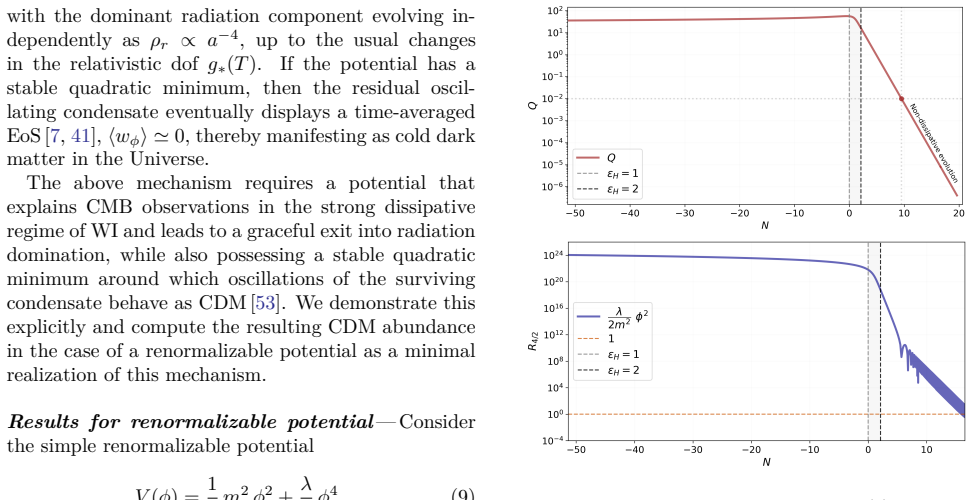
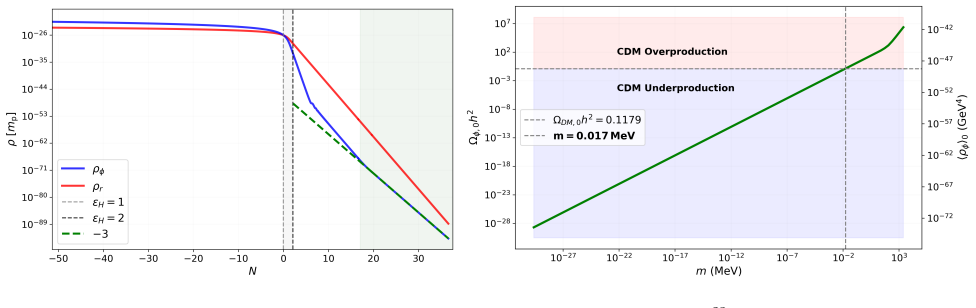
In a strongly dissipative warm inflationary scenario with Υ∝T³, the dissipative ratio Q falls rapidly after inflation, leaving a residual inflaton condensate that evolves as cold dark matter with mass m≈0.02 MeV fixed by the observed DM abundance.
What carries the argument
The dissipative ratio Q = Υ/(3H), which falls rapidly after inflation ends upon approaching radiation domination and thereby suppresses further energy transfer from the inflaton condensate.
If this is right
- The observed dark matter abundance fixes the inflaton mass at approximately 0.02 MeV for the minimal renormalizable potential.
- Larger inflaton masses would overclose the universe.
- The remnant inflaton transitions to matter-like scaling well before big bang nucleosynthesis.
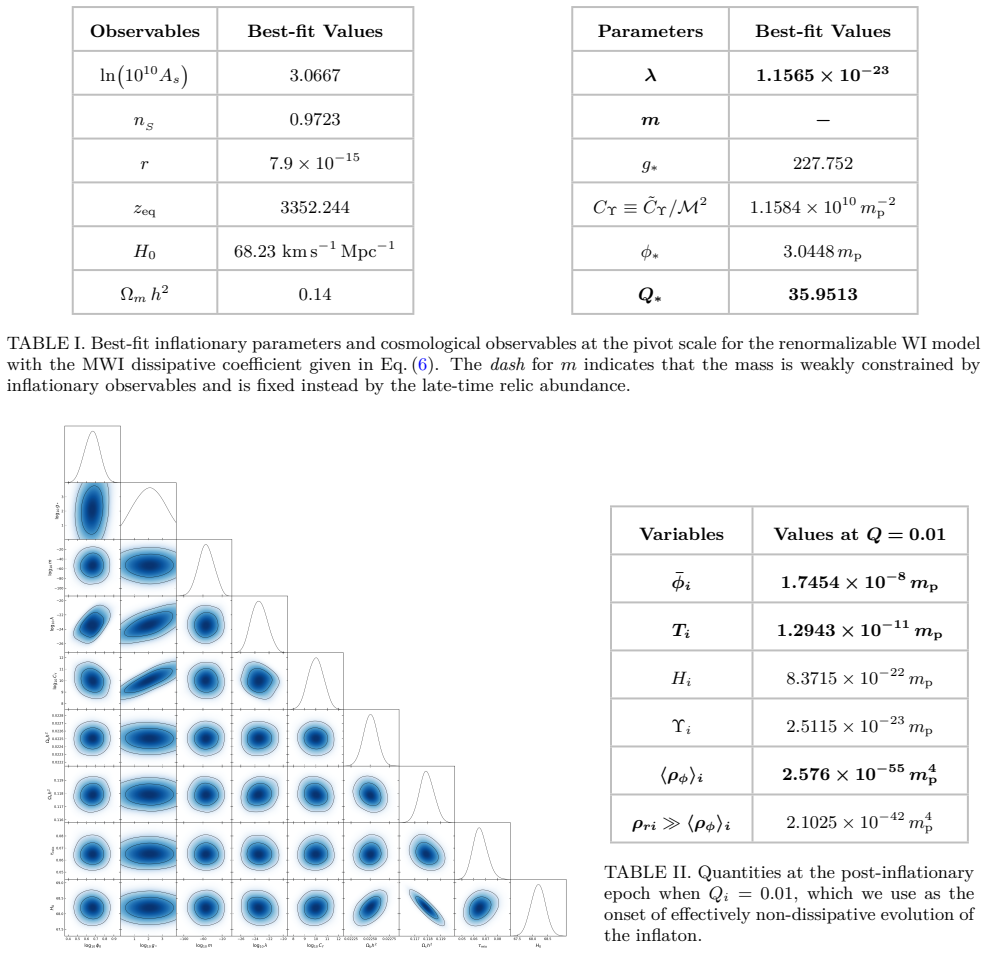
- Current cosmological data permit strong dissipation during inflation while leaving the mass only weakly constrained by inflationary observables.
Where Pith is reading between the lines
- The same drop in Q could preserve a remnant condensate for other potentials or dissipative coefficients if the post-inflationary dynamics are similar.
- This links warm inflation to searches for light scalar dark matter particles near the MeV scale through direct detection or cosmological probes.
- The mechanism adds a late-time consistency check that could be tested by measuring the dark matter particle mass independently of inflation parameters.
Load-bearing premise
The dissipative ratio Q falls rapidly enough after inflation ends to suppress further dissipation and preserve a non-dissipative remnant condensate.
What would settle it
A numerical solution of the background equations showing that Q remains large enough for the condensate to be fully depleted before radiation domination is reached.
Figures
read the original abstract
Warm inflation is usually expected to completely deplete the inflaton condensate by dissipating its energy into radiation. We show that this expectation fails in a simple and observationally viable regime. In a strongly dissipative warm inflationary scenario, the dissipative ratio, $Q=\Upsilon/(3H)$, can fall rapidly after the end of inflation as the system approaches radiation domination, thereby suppressing further energy transfer to the thermal bath. This leads to a residual inflaton condensate, which subsequently evolves as an effectively non-dissipative scalar field. For potentials with a stable quadratic minimum, this remnant inflaton manifests as a cold dark matter component. We establish this mechanism for the minimal renormalizable potential, with a dissipative coefficient $\Upsilon\propto T^3$. In this case, current cosmological data allow strong dissipation while leaving the inflaton mass weakly constrained by inflationary observables. The observed dark matter abundance then fixes its mass to be $m \approx 0.02\,{\rm MeV}$, while larger masses overclose the Universe. The transition to matter-like scaling occurs well before BBN, avoiding a long-lived inflaton dark radiation component. Relic inflaton dark matter therefore turns the post-inflationary dynamics of warm inflation into a new late time constraint on its parameter space.
Editorial analysis
A structured set of objections, weighed in public.
Referee Report
Summary. The paper proposes that in strongly dissipative warm inflation with Υ ∝ T³, the ratio Q = Υ/(3H) drops rapidly after inflation ends upon approaching radiation domination. This suppresses further dissipation, leaving a residual inflaton condensate that evolves as non-dissipative cold dark matter for a quadratic minimum. For the minimal renormalizable potential, inflationary observables weakly constrain the mass while the observed DM abundance fixes m ≈ 0.02 MeV; the transition to matter-like scaling occurs before BBN, yielding a new late-time constraint on warm inflation parameter space.
Significance. If the post-inflationary remnant survives with the claimed amplitude, the work identifies a novel regime where the usual complete depletion of the inflaton condensate fails, converting warm inflation into a source of CDM and imposing an additional consistency condition on its parameters from Ω_DM. This is a concrete, falsifiable link between early- and late-universe dynamics that is not present in standard cold inflation or generic warm inflation analyses.
major comments (2)
- [Post-inflationary dynamics] Post-inflationary evolution (abstract and associated dynamics section): The claim that Q falls rapidly enough to leave a non-depleted remnant condensate is load-bearing. In RD, H ∝ T² implies Q ∝ T, but the integrated energy loss depends on the coupled inflaton EOM (with Υ φ̇ term), radiation continuity equation, and T evolution from the end-of-inflation initial conditions. No explicit integration or analytic estimate of the remnant amplitude is provided to show that dissipation during the Q-drop phase removes only a small fraction of the condensate energy; without this, the survival of a viable CDM component remains unverified.
- [Abstract and parameter constraints] Mass determination (abstract): The value m ≈ 0.02 MeV is obtained by matching the observed DM density after assuming the remnant survives, rather than being independently fixed by the inflationary slow-roll or dissipation dynamics. The statement that 'current cosmological data allow strong dissipation while leaving the inflaton mass weakly constrained by inflationary observables' requires an explicit range or plot of allowed m from inflation before the DM matching is applied; otherwise the result functions as a consistency condition rather than a first-principles prediction.
minor comments (1)
- Notation: Define the precise criterion used to mark the end of inflation (e.g., when slow-roll parameters or Q conditions fail) and the initial conditions at that epoch, as these control the quantitative remnant amplitude.
Simulated Author's Rebuttal
We thank the referee for their careful reading and constructive comments. We address the major points below and will revise the manuscript to incorporate explicit calculations and ranges where needed.
read point-by-point responses
-
Referee: [Post-inflationary dynamics] Post-inflationary evolution (abstract and associated dynamics section): The claim that Q falls rapidly enough to leave a non-depleted remnant condensate is load-bearing. In RD, H ∝ T² implies Q ∝ T, but the integrated energy loss depends on the coupled inflaton EOM (with Υ φ̇ term), radiation continuity equation, and T evolution from the end-of-inflation initial conditions. No explicit integration or analytic estimate of the remnant amplitude is provided to show that dissipation during the Q-drop phase removes only a small fraction of the condensate energy; without this, the survival of a viable CDM component remains unverified.
Authors: We agree that an explicit demonstration is required to verify the remnant amplitude. The manuscript outlines the rapid suppression of Q as radiation domination is approached, but does not include the requested integration. In the revised manuscript we will add an analytic estimate (and supporting numerical check) of the integrated energy loss during the Q-drop phase, using the coupled inflaton and radiation equations with the given initial conditions at the end of inflation. This will show that only a small fraction of the condensate energy is dissipated before Q becomes ≪1, confirming that a viable CDM remnant survives. revision: yes
-
Referee: [Abstract and parameter constraints] Mass determination (abstract): The value m ≈ 0.02 MeV is obtained by matching the observed DM density after assuming the remnant survives, rather than being independently fixed by the inflationary slow-roll or dissipation dynamics. The statement that 'current cosmological data allow strong dissipation while leaving the inflaton mass weakly constrained by inflationary observables' requires an explicit range or plot of allowed m from inflation before the DM matching is applied; otherwise the result functions as a consistency condition rather than a first-principles prediction.
Authors: The mass is fixed by the observed DM abundance once the remnant is assumed to survive; this is presented as a consistency condition on the warm-inflation parameter space. To make the separation explicit, the revised manuscript will include the range of m permitted by inflationary observables (slow-roll parameters, spectral index, and tensor-to-scalar ratio) for the Υ ∝ T³ model at strong dissipation, together with a brief plot or table. This will show that m is only weakly constrained by inflation and that the DM value lies well inside the allowed window. revision: yes
Circularity Check
No significant circularity; mass is a standard observational constraint, not a first-principles prediction
full rationale
The paper's core claim is that in a strongly dissipative warm inflation regime with Υ∝T³, the dissipative ratio Q drops rapidly enough post-inflation to leave a non-dissipative inflaton remnant that behaves as CDM. The abstract explicitly states that the observed DM abundance 'fixes' m≈0.02 MeV rather than deriving it from inflation dynamics alone. No self-definitional equations, fitted inputs relabeled as predictions, or load-bearing self-citations appear in the provided text. The mechanism itself is presented as independent of the specific m value chosen to match Ω_DM, which is a conventional parameter adjustment against external data. The derivation chain therefore remains self-contained against benchmarks.
Axiom & Free-Parameter Ledger
free parameters (1)
- inflaton mass m =
0.02 MeV
axioms (2)
- domain assumption The potential possesses a stable quadratic minimum allowing matter-like oscillations.
- domain assumption Dissipation coefficient takes the form Υ∝T³ for the minimal renormalizable potential.
Reference graph
Works this paper leans on
-
[1]
A. A. Starobinsky, Phys. Lett. B91, 99 (1980)
1980
-
[2]
A. H. Guth, Phys. Rev. D23, 347 (1981)
1981
-
[3]
A. D. Linde, Phys. Lett. B108, 389 (1982)
1982
-
[4]
Albrecht and P
A. Albrecht and P. J. Steinhardt, Phys. Rev. Lett.48, 1220 (1982)
1982
-
[5]
V. F. Mukhanov and G. V. Chibisov, JETP Lett.33, 532 (1981)
1981
-
[6]
S. W. Hawking, Phys. Lett. B115, 295 (1982)
1982
-
[7]
A. A. Starobinsky, Phys. Lett. B117, 175 (1982)
1982
-
[8]
A. H. Guth and S. Y. Pi, Phys. Rev. Lett.49, 1110 (1982)
1982
-
[9]
A. D. Linde, Rept. Prog. Phys.47, 925 (1984)
1984
-
[10]
A. D. Linde,Particle physics and inflationary cosmol- ogy, Vol. 5 (1990) arXiv:hep-th/0503203
Pith/arXiv arXiv 1990
-
[11]
S. Dodelson, AIP Conf. Proc.689, 184 (2003), arXiv:hep-ph/0309057
Pith/arXiv arXiv 2003
-
[12]
Baumann, in (2011) arXiv:0907.5424 [hep-th]
D. Baumann, in (2011) arXiv:0907.5424 [hep-th]
Pith/arXiv arXiv 2011
- [13]
-
[14]
Baumann, PoSTASI2017, 009 (2018), arXiv:1807.03098 [hep-th]
D. Baumann, PoSTASI2017, 009 (2018), arXiv:1807.03098 [hep-th]
Pith/arXiv arXiv 2018
-
[15]
S. S. Mishra, (2024), arXiv:2403.10606 [gr-qc]
arXiv 2024
-
[16]
Albrecht, P
A. Albrecht, P. J. Steinhardt, M. S. Turner, and F. Wilczek, Phys. Rev. Lett.48, 1437 (1982)
1982
-
[17]
E. W. Kolb and M. S. Turner,The Early Universe, Vol. 69 (Taylor and Francis, 2019)
2019
-
[18]
L. Kofman, A. D. Linde, and A. A. Starobinsky, Phys. Rev. Lett.73, 3195 (1994), arXiv:hep-th/9405187. v
Pith/arXiv arXiv 1994
-
[19]
Y. Shtanov, J. H. Traschen, and R. H. Brandenberger, Phys. Rev. D51, 5438 (1995), arXiv:hep-ph/9407247
Pith/arXiv arXiv 1995
-
[20]
L. A. Kofman (1996) arXiv:astro-ph/9605155
Pith/arXiv arXiv 1996
-
[21]
L. Kofman, A. D. Linde, and A. A. Starobinsky, Phys. Rev. D56, 3258 (1997), arXiv:hep-ph/9704452
Pith/arXiv arXiv 1997
-
[22]
B. A. Bassett, S. Tsujikawa, and D. Wands, Rev. Mod. Phys.78, 537 (2006), arXiv:astro-ph/0507632
Pith/arXiv arXiv 2006
-
[23]
M. A. Amin, M. P. Hertzberg, D. I. Kaiser, and J. Karouby, Int. J. Mod. Phys. D24, 1530003 (2014), arXiv:1410.3808 [hep-ph]
Pith/arXiv arXiv 2014
-
[24]
K. D. Lozanov, (2019), arXiv:1907.04402 [astro- ph.CO]
Pith/arXiv arXiv 2019
-
[25]
A. Berera, Phys. Rev. Lett.75, 3218 (1995), arXiv:astro-ph/9509049
Pith/arXiv arXiv 1995
-
[26]
A. Berera and L.-Z. Fang, Phys. Rev. Lett.74, 1912 (1995), arXiv:astro-ph/9501024
Pith/arXiv arXiv 1912
- [27]
-
[28]
A. Berera, M. Gleiser, and R. O. Ramos, Phys. Rev. D58, 123508 (1998), arXiv:hep-ph/9803394
Pith/arXiv arXiv 1998
-
[29]
A. Berera, M. Gleiser, and R. O. Ramos, Phys. Rev. Lett.83, 264 (1999), arXiv:hep-ph/9809583
Pith/arXiv arXiv 1999
-
[30]
L. M. H. Hall, I. G. Moss, and A. Berera, Phys. Rev. D69, 083525 (2004), arXiv:astro-ph/0305015
Pith/arXiv arXiv 2004
- [31]
-
[32]
A. Berera, I. G. Moss, and R. O. Ramos, Rept. Prog. Phys.72, 026901 (2009), arXiv:0808.1855 [hep-ph]
Pith/arXiv arXiv 2009
-
[33]
M. Bastero-Gil and A. Berera, Int. J. Mod. Phys. A 24, 2207 (2009), arXiv:0902.0521 [hep-ph]
Pith/arXiv arXiv 2009
-
[34]
S. Bartrum, M. Bastero-Gil, A. Berera, R. Cerezo, R. O. Ramos, and J. G. Rosa, Phys. Lett. B732, 116 (2014), arXiv:1307.5868 [hep-ph]
Pith/arXiv arXiv 2014
-
[35]
Rangarajan, in18th Lomonosov Conference on Elementary Particle Physics(2019) pp
R. Rangarajan, in18th Lomonosov Conference on Elementary Particle Physics(2019) pp. 339–345, arXiv:1801.02648 [astro-ph.CO]
Pith/arXiv arXiv 2019
-
[36]
V.Kamali, M.Motaharfar,andR.O.Ramos,Universe 9, 124 (2023), arXiv:2302.02827 [hep-ph]
arXiv 2023
-
[37]
Berera, Universe9, 272 (2023), arXiv:2305.10879 [hep-ph]
A. Berera, Universe9, 272 (2023), arXiv:2305.10879 [hep-ph]
arXiv 2023
- [38]
-
[39]
J. G. Rosa and L. B. Ventura, Phys. Rev. Lett.122, 161301 (2019), arXiv:1811.05493 [hep-ph]
Pith/arXiv arXiv 2019
-
[40]
K. V. Berghaus, P. W. Graham, and D. E. Kaplan, JCAP03, 034, [Erratum: JCAP 10, E02 (2023)], arXiv:1910.07525 [hep-ph]
arXiv 2023
-
[41]
M. S. Turner, Phys. Rev. D28, 1243 (1983)
1983
-
[42]
M. Bastero-Gil, R. Cerezo, and J. G. Rosa, Phys. Rev. D93, 103531 (2016), arXiv:1501.05539 [hep-ph]
Pith/arXiv arXiv 2016
-
[43]
M. Bastero-Gil, A. Berera, R. O. Ramos, and J. G. Rosa, Phys. Rev. Lett.117, 151301 (2016), arXiv:1604.08838 [hep-ph]
Pith/arXiv arXiv 2016
-
[44]
M. Levy, J. G. Rosa, and L. B. Ventura, JHEP12, 176, arXiv:2012.03988 [hep-ph]
arXiv 2012
- [45]
-
[46]
R. de Souza, J. G. Rodrigues, C. Siqueira, F. B. M. d. Santos, and J. Alcaniz, JHEP04, 125, arXiv:2412.06778 [hep-ph]
-
[47]
Q.-Y. Wang, T. Jia, P.-R. Chen, and Y. Tang, Phys. Rev. D112, 043508 (2025), arXiv:2504.13147 [astro- ph.CO]
arXiv 2025
-
[48]
M. Bastero-Gil, A. Berera, R. O. Ramos, and J. G. Rosa, Phys. Lett. B813, 136055 (2021), arXiv:1907.13410 [hep-ph]
arXiv 2021
- [49]
-
[50]
M. Motaharfar and R. O. Ramos, Phys. Rev. D104, 043522 (2021), arXiv:2105.01131 [hep-th]
arXiv 2021
-
[51]
S. Das, U. Kumar, S. S. Mishra, and V. Sahni, Phys. Rev. D113, 063522 (2026), arXiv:2511.23219 [astro- ph.CO]
arXiv 2026
- [52]
-
[53]
W. Hu, R. Barkana, and A. Gruzinov, Phys. Rev. Lett. 85, 1158 (2000), arXiv:astro-ph/0003365
Pith/arXiv arXiv 2000
-
[54]
Y. Akramiet al.(Planck), Astron. Astrophys.641, A10 (2020), arXiv:1807.06211 [astro-ph.CO]
Pith/arXiv arXiv 2020
-
[55]
Louiset al.(Atacama Cosmology Telescope), JCAP 11, 062, arXiv:2503.14452 [astro-ph.CO]
T. Louiset al.(Atacama Cosmology Telescope), JCAP 11, 062, arXiv:2503.14452 [astro-ph.CO]
-
[56]
E. Camphuiset al.(SPT-3G), Phys. Rev. D113, 083504 (2026), arXiv:2506.20707 [astro-ph.CO]
Pith/arXiv arXiv 2026
-
[57]
M. Abdul Karimet al.(DESI), Phys. Rev. D112, 083515 (2025), arXiv:2503.14738 [astro-ph.CO]
Pith/arXiv arXiv 2025
-
[58]
R. O. Ramos and L. A. da Silva, JCAP03, 032, arXiv:1302.3544 [astro-ph.CO]
-
[59]
M. Benetti and R. O. Ramos, Phys. Rev. D95, 023517 (2017), arXiv:1610.08758 [astro-ph.CO]
Pith/arXiv arXiv 2017
- [60]
-
[61]
M. Y. Khlopov, B. A. Malomed, I. B. Zeldovich, and Y. B. Zeldovich, Mon. Not. Roy. Astron. Soc.215, 575 (1985)
1985
-
[62]
P. J. E. Peebles and A. Vilenkin, Phys. Rev. D60, 103506 (1999), arXiv:astro-ph/9904396
Pith/arXiv arXiv 1999
-
[63]
P. J. E. Peebles, Astrophys. J. Lett.534, L127 (2000), arXiv:astro-ph/0002495
Pith/arXiv arXiv 2000
-
[64]
S. S. Mishra, V. Sahni, and Y. Shtanov, JCAP06, 045, arXiv:1703.03295 [gr-qc]
-
[65]
L. Hui, J. P. Ostriker, S. Tremaine, and E. Witten, Phys. Rev. D95, 043541 (2017), arXiv:1610.08297 [astro-ph.CO]
Pith/arXiv arXiv 2017
-
[66]
Efstathiou and J
G. Efstathiou and J. R. Bond, Mon. Not. Roy. Astron. Soc.218, 103 (1986)
1986
-
[67]
W. H. Press, B. S. Ryden, and D. N. Spergel, Phys. Rev. Lett.64, 1084 (1990)
1990
- [68]
-
[69]
G. Montefalcone, V. Aragam, L. Visinelli, and K. Freese, JCAP01, 032, arXiv:2306.16190 [astro- ph.CO]
-
[70]
G. S. Rodrigues and R. O. Ramos, (2025), arXiv:2504.17760 [astro-ph.CO]. vi End Matter Inflationary observables and numerical set-up In the slow-roll regime of WI, the Hubble slow-roll parameter is approximately suppressed by the dissipative friction as ϵH≃ϵV 1 +Q ;whereϵ V = m2 p 2 ( 1 V dV dϕ )2 .(16) Thus, even relatively steep potentials can support W...
arXiv 2025
discussion (0)
Sign in with ORCID, Apple, or X to comment. Anyone can read and Pith papers without signing in.