REVIEW 2 major objections 4 minor 42 references
Thermalization dynamics of finite-size quantum critical systems
T0 review · 2 major / 4 minor · reviewed 2026-08-04 · deepseek-v4-flash
Pith's one-line read A holographic simulation shows finite-size quantum critical systems thermalize through three distinct regimes controlled by energy imbalance and scaled size, with wave reflection causing near-complete energy swapping.
desk verdict New finite-size holographic thermalization phenomena, but the no-matter brane constraint for the actual initial data is unproven and needs a direct numerical check. read the letter →
The pith
A machine-rendered reading of the paper's core claim, the machinery that carries it, and where it could break.
The reading
What carries the argument
The central object is a holographic black brane in an asymptotically anti-de Sitter spacetime with a tensionless end-of-the-world brane at each spatial end; the end-of-the-world brane—a bulk hypersurface anchored to the field-theory boundary—encodes the isolated-system condition of zero energy current at the boundary. Real-time evolution uses a characteristic numerical scheme in Eddington-Finkelstein coordinates, with the apparent horizon area supplying entropy production. Late-time decay is analyzed by Fourier-decomposing the energy current and comparing the modes to quasi-normal modes of the final equilibrium black brane, including forced-oscillation corrections when a dominant mode drives
What would settle it
Run the same thermalization with an initial profile that exactly satisfies the odd-derivative mirror-reflection conditions—for example, one constructed from even-parity spatial modes—against the tanh-smoothed step; if the recurrence peak at t=2L/c_s or the extracted quasi-normal frequencies shift measurably, the approximate boundary compatibility is contributing to the claimed dynamics.
Extended reading notes
Core claim
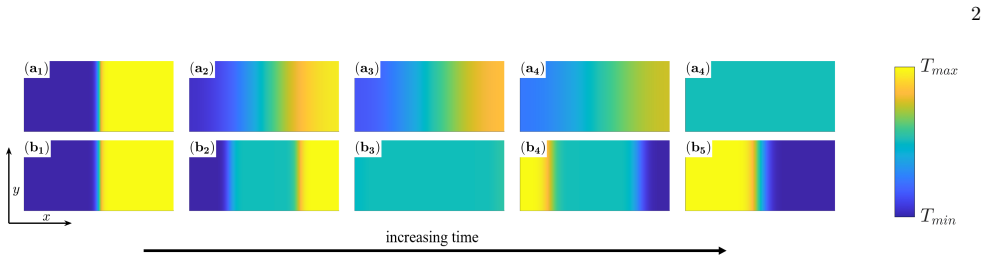
The paper claims that when two finite-size conformal field theories at different energy densities are joined at a perfectly transmitting interface, thermalization is controlled by two dimensionless parameters: the energy imbalance Δ=(E_R−E_L)/E_L and the scaled size L̄=L((E_R+E_L)/2)^{1/3}. In the holographic dual—a black brane confined between two tensionless end-of-the-world branes—the early contact region forms a non-equilibrium steady state with shock and rarefaction fronts moving at the sound speed. The finite boundaries reflect these fronts. For large L̄ and small Δ, the reflection produces near-mirror recurrences of the initial state at t=2L/c_s, with the NESS re-forming and collapsin
Load-bearing premise
The reliable long-time evolution assumes the boundary stays a perfect, matter-free wall, but that is proven only for specially symmetric starting states; the smoothed-step initial profile used here obeys that condition only approximately.
Editorial extensions
If this is right
- For large systems with small energy imbalance, thermalization is not monotonic: the system cycles through repeated formation and collapse of a non-equilibrium steady state, with near-mirror revivals every sound-crossing time 2L/c_s.
- For large energy imbalance, shock waves persist through many boundary reflections and dominate late-time energy transport, while rarefaction waves quickly homogenize.
- For sufficiently small systems, dissipation dominates: no sustained NESS or shock structure forms, and the system enters rapid synchronized oscillatory decay.
- The late-time decay is described by linear quasi-normal modes of the final equilibrium black brane, with higher modes entering a forced-oscillation regime where the fundamental mode acts as the driver.
- Wave-propagated energy transfer plus boundary reflection allows near-complete energy swapping between subsystems after separation; total entropy still increases, so the second law is not violated.
Reading between the lines
- A natural but untested extension: in two spatial dimensions the same phase diagram should persist with curved shock fronts, since the paper states that generalization to other dimensions is straightforward but does not demonstrate it.
- If the energy-swap mechanism survives weak external coupling, timed separation of the two subsystems after roughly one sound-crossing time could serve as a cooling or energy-harvesting protocol; the paper mentions cooling applications without detailing an engineered cycle.
- The recurrence time t=2L/c_s is a concrete, parameter-free prediction: ultracold-atom or nanowire realizations of conformal systems could look for oscillatory energy exchange at that period, which would support the holographic picture and whose absence would challenge it.
- The forced-oscillation crossover suggests that mode amplitudes, not just frequencies, retain memory of the initial energy gap; varying Δ in small systems could expose this memory effect in the late-time ringdown.
Editorial analysis
A structured set of objections, weighed in public.
Referee Report
Summary. This paper uses holographic duality (AdS/BCFT) to simulate the real-time thermalization of a finite-size strongly coupled CFT prepared with a spatially varying energy density. The setup is an asymptotically AdS_4 spacetime with two dynamical, tensionless end-of-the-world branes, dual to an isolated strip CFT. The initial state is a tanh-smoothed step in energy density (Eq. 4). By numerically solving the bulk Einstein equations, the authors identify three thermalization regimes controlled by two dimensionless parameters: the energy imbalance Δ and the scaled system size L̄. For large L̄ and small Δ, a recurrent NESS forms and collapses, with near-mirror revivals at t=2L/c_s. For large Δ, a long-lived confined shock wave persists, while for small L̄, the system undergoes oscillatory decay without persistent structures. Late-time decay is compared with linear quasi-normal modes of the final black brane, including nonlinear forced-oscillation corrections. The supplementary information contains the metric ansatz, boundary-condition derivation, numerical scheme, perturbation analysis, and error estimates.
Significance. If the results hold, they constitute a useful extension of holographic studies of NESS from infinite systems to finite, isolated systems, with falsifiable predictions: a three-regime phase diagram in (Δ, L̄), a revival time 2L/c_s, and late-time decay governed by black-brane QNMs. The numerical machinery is a notable strength: the paper reports two independent error estimators at the 10^-6–10^-4 level (Fig. S7–S8), energy conservation to 10^-9–10^-6 (Fig. S3), and entropy monotonicity (Fig. S2). The late-time comparison with linear QNMs appears to be an external, parameter-free benchmark, which is valuable. The main risk to the central claim is the consistency of the initial data with the tensionless-brane no-matter condition, as detailed below.
major comments (2)
- [SI1, Eqs. (S35)–(S41); main text Sec. II, Eq. (4)] The no-matter brane condition \hat T_uu=0 is not guaranteed for the initial data actually used. The paper itself states that for generic initial conditions (S35) requires a full nonlinear proof, and the only proven class is the mirror-reflection class (S37). The tanh-smoothed step (4) with α=0.07 is not exactly in this class: solving s1 from the energy profile gives odd x-derivatives at x=±L that are exponentially small but nonzero (∼sech^2(1/α)). The evolution scheme imposes (S38) but does not monitor the residual of (S35). Since the recurrent-NESS claim relies on many boundary reflections over t≈200L, a small spurious boundary stress could accumulate and change revival amplitudes. Please report the residual of (S35) on Q during the runs, or repeat the key simulations with initial data constructed to lie exactly in the class (S37), and show that the three regimes persist. This is load-b
- [Sec. II, Eq. (4) and Fig. 2] The phase diagram is obtained for a single interface sharpness α=0.07. The statement that this is 'sufficiently small' to not qualitatively alter the dynamics is not supported by a convergence study in α. Because α also controls the magnitude of the boundary odd derivatives of s1, this is intertwined with the consistency issue above. Please provide at least one representative trajectory (e.g., the recurrent-NESS case) for a smaller and a larger α (say 0.03 and 0.1), showing that the revival amplitude and the qualitative phase boundaries are stable.
minor comments (4)
- [Sec. IV (Oscillatory decay)] The text says the energy current for oscillatory decay is shown in the 'bottom-right panel of Fig. 2', but the figure caption identifies the bottom-right panel as recurrent NESS and the top-left panel as oscillatory decay. Please correct this cross-reference.
- [SI4] Typo: 'preform' should be 'perform'.
- [SI1] Typo: 'impost' should be 'impose'.
- [Eq. (5)] Eq. (5) introduces constants τ and ω without specifying their origin. If they are taken from the QNM spectrum of the final black brane, state this explicitly in the main text; if they are fits, clarify what is being fitted. This would make the predictive content of the late-time comparison precise.
Circularity Check
No significant circularity: the three-regime classification and late-time QNM match are independent of the initial data and prior work; the only flagged issue is an unproven brane constraint, which is a correctness gap, not a circular reduction.
full rationale
The paper's derivation chain is: (i) a holographic model with a tensionless EOW brane and the isolated-system condition J=0; (ii) an explicit initial energy profile (Eq. 4); (iii) numerical solution of the bulk Einstein equations; (iv) classification of the observed dynamics into three regimes; (v) a late-time comparison to QNMs of the final black brane. None of these steps uses the target conclusion as an input. The dimensionless parameters Δ and Lbar are fixed by the scaling symmetry (S44)-(S45) from the initial data, not fitted to the phase diagram; the phase diagram is a summary of simulation outputs, not a prediction derived from the inputs. The QNM analysis is a genuine external benchmark: the QNM frequencies are computed from linear perturbations around the final equilibrium black brane determined by conserved energy, and the extracted Fourier modes are compared with those frequencies (Figs. 5, S5, S6); at most amplitudes are matched, which is not circular. The only manuscript-acknowledged weakness is in SI1, where the authors state that the no-matter brane condition (S35) is 'not guaranteed' for generic initial conditions and that a full nonlinear proof is required; the tanh initial profile only asymptotically satisfies the mirror-reflection class (S37). This is a consistency/correctness limitation, not a circular reduction, because the simulation is not assuming the recurrent-NESS outcome. The single self-citation [29] for apparent-horizon entropy is not load-bearing, and independent references [28,30,31] are also cited. Thus the central claims remain self-contained against independent numerical and perturbative benchmarks, and the circularity score is low.
Assumptions & free parameters
free parameters (2)
- interface sharpness α =
0.07
- late-time decay amplitude parameters τ, ω in Eq. (5) =
not quoted explicitly; matched to QNM frequencies in Fig. 5, S4-S6
assumptions (5)
- domain assumption AdS/CFT duality maps the strongly coupled 2+1d CFT to classical gravity in asymptotically AdS4 (action Eq. 1).
- domain assumption AdS/BCFT with a tensionless end-of-the-world brane and Neumann condition T̂_ab=0 (Eq. 2 of main text, Eq. S22) correctly encodes an isolated finite-size CFT with J=0 at the boundary (Eq. 3).
- domain assumption The apparent horizon, not the event horizon, gives the correct non-equilibrium entropy used for second-law checks (S = area/4G_N).
- ad hoc to paper Initial data belongs to the mirror-reflection class (Eq. S37) for which the brane no-matter condition (Eq. S35) provably persists in time.
- ad hoc to paper α = 0.07 approximates a step function without qualitatively changing the dynamics.
Cite this review
Pith. "Pith review of Thermalization dynamics of finite-size quantum critical systems." pith.science (2026). https://pith.science/paper/CWRCAZEB
@misc{pith2026250906523,
  author       = {Pith},
  title        = {Pith review of: Thermalization dynamics of finite-size quantum critical systems},
  year         = {2026},
  howpublished = {\url{https://pith.science/paper/CWRCAZEB}},
  note         = {Machine review of arXiv:2509.06523}
}
read the original abstract
Using holographic duality, we investigate thermalization process when two finite-size quantum critical systems are brought into thermal contact along a perfectly transmitting interface. Through real-time simulations of gravitational dynamics, which are spatially inhomogeneous and anisotropic and are confined within two dynamical bulk branes, we identify three distinct thermalization patterns governed by the energy imbalance (temperature difference) and system size. For systems with large size and small energy imbalance, we observe recurrent cycles of formation and collapse of non-equilibrium steady states (NESS). Under large energy imbalance, shock waves persist for a prolonged period with sustained boundary reflections, while rarefaction waves rapidly homogenize. When the system size is sufficiently small, dissipation dominates and leads to oscillatory decay without sustained NESS or shock structure. In sharp contrast to diffusive systems, we uncover that wave-propagated energy transfer together with boundary reflections enables nearly complete energy swapping between subsystems during thermalization. Our results reveal rich thermalization dynamics in finite-size quantum critical systems across spatial scales and energy gradient regimes.
Figures


Figures from the paper (2 more)


Reference graph
Works this paper leans on
-
[1]
J.-y. Choi, S. Hild, J. Zeiher, P. Schauß, A. Rubio- Abadal, T. Yefsah, V. Khemani, D. A. Huse, I. Bloch, and C. Gross, Exploring the Many-Body Localization Transition in Two Dimensions, Science352, 1547 (2016)
work page 2016
-
[2]
L. V. Delacr´ etaz, A Bound on Thermalization from Dif- fusive Fluctuations, Nature Physics , 1 (2025)
work page 2025
-
[3]
A. M. Kaufman, M. E. Tai, A. Lukin, M. Rispoli, R. Schittko, P. M. Preiss, and M. Greiner, Quantum Thermalization through Entanglement in an Isolated Many-Body System, Science353, 794 (2016)
work page 2016
-
[4]
T. Kinoshita, T. Wenger, and D. S. Weiss, A Quantum Newton’s Cradle, Nature440, 900 (2006)
work page 2006
- [5]
-
[6]
Y. Le, Y. Zhang, S. Gopalakrishnan, M. Rigol, and D. S. Weiss, Observation of Hydrodynamization and Lo- cal Prethermalization in 1D Bose Gases, Nature618, 494 (2023)
work page 2023
-
[7]
C. Neillet al., Ergodic Dynamics and Thermalization in an Isolated Quantum System, Nature Phys.12, 1037 (2016)
work page 2016
-
[8]
J. J. Pulikkottil, A. Lakshminarayan, S. C. L. Srivas- tava, M. F. I. Kieler, A. B¨ acker, and S. Tomsovic, Quan- tum Coherence Controls the Nature of Equilibration and Thermalization in Coupled Chaotic Systems, Phys. Rev. E107, 024124 (2023)
work page 2023
Show all 42 references
-
[9]
Rigol, Breakdown of Thermalization in Finite One- Dimensional Systems, Physical Review Letters103, 100403 (2009)
M. Rigol, Breakdown of Thermalization in Finite One- Dimensional Systems, Physical Review Letters103, 100403 (2009)
2009
-
[10]
Shiraishi and H
N. Shiraishi and H. Tasaki, Nature Abhors a Vacuum: A Simple Rigorous Example of Thermalization in an Iso- lated Macroscopic Quantum System, J. Statist. Phys. 191, 82 (2024)
2024
-
[11]
Gogolin and J
C. Gogolin and J. Eisert, Equilibration, Thermalisation, and the Emergence of Statistical Mechanics in Closed Quantum Systems, Rept. Prog. Phys.79, 056001 (2016)
2016
-
[12]
Karrasch, R
C. Karrasch, R. Ilan, and J. E. Moore, Nonequilibrium Thermal Transport and Its Relation to Linear Response, Physical Review B88, 195129 (2013)
2013
-
[13]
Bernard and B
D. Bernard and B. Doyon, Energy Flow in Non- Equilibrium Conformal Field Theory, Journal of Physics A: Mathematical and Theoretical45, 362001 (2012)
2012
-
[14]
M. J. Bhaseen, B. Doyon, A. Lucas, and K. Schalm, En- ergy Flow in Quantum Critical Systems Far from Equi- librium, Nature Physics11, 509 (2015)
2015
-
[15]
Lucas, K
A. Lucas, K. Schalm, B. Doyon, and M. J. Bhaseen, Shock Waves, Rarefaction Waves, and Nonequilibrium Steady States in Quantum Critical Systems, Physical Re- view D94, 025004 (2016)
2016
-
[16]
Chang, A
H.-C. Chang, A. Karch, and A. Yarom, An Ansatz for One Dimensional Steady State Configurations, J. Stat. Mech.1406, P06018 (2014)
2014
-
[17]
Amado and A
I. Amado and A. Yarom, Black Brane Steady States, JHEP10, 015 (2015)
2015
-
[18]
Ecker, J
C. Ecker, J. Erdmenger, and W. van der Schee, Non- Equilibrium Steady State Formation in 3+1 Dimensions, SciPost Physics11, 047 (2021), arXiv:2103.10435 [hep- th]
2021 arXiv
-
[19]
P. M. Chesler and L. G. Yaffe, Numerical Solution of Gravitational Dynamics in Asymptotically Anti-de Sitter Spacetimes, JHEP7, 86
-
[20]
V. E. Hubeny and M. Rangamani, A Holographic View on Physics out of Equilibrium, Advances in High Energy Physics2010, 1 (2010), arXiv:1006.3675 [gr-qc]
2010 arXiv
-
[21]
Liu and J
H. Liu and J. Sonner, Holographic Systems Far from Equilibrium: A Review (2018), arXiv:1810.02367 [hep- th]
2018 arXiv
-
[22]
Cardoso, L
V. Cardoso, L. Gualtieri, C. Herdeiro, U. Sperhake,et al., NR/HEP: Roadmap for the Future, Classical and Quan- tum Gravity29, 244001 (2012), arXiv:1201.5118 [astro- ph]
2012 arXiv
-
[23]
Fujita, T
M. Fujita, T. Takayanagi, and E. Tonni, Aspects of AdS/BCFT, JHEP11, 043 (2011)
2011
-
[24]
Nozaki, T
M. Nozaki, T. Takayanagi, and T. Ugajin, Central Charges for BCFTs and Holography, JHEP06, 066 (2012)
2012
-
[25]
Takayanagi, Holographic Dual of BCFT, Phys
T. Takayanagi, Holographic Dual of BCFT, Phys. Rev. Lett.107, 101602 (2011)
2011
-
[26]
Andreiet al., Boundary and Defect CFT: Open Prob- lems and Applications, J
N. Andreiet al., Boundary and Defect CFT: Open Prob- lems and Applications, J. Phys. A53, 453002 (2020), arXiv:1810.05697 [hep-th]. 6
2020 arXiv
-
[27]
Izumi, T
K. Izumi, T. Shiromizu, K. Suzuki, T. Takayanagi, and N. Tanahashi, Brane Dynamics of Holographic BCFTs, JHEP10, 050 (2022)
2022
-
[28]
Engelhardt and A
N. Engelhardt and A. C. Wall, Decoding the Apparent Horizon: Coarse-Grained Holographic Entropy, Physical Review Letters121, 211301 (2018)
2018
-
[29]
Baggioli, L
M. Baggioli, L. Li, and H.-T. Sun, Shear Flows in Far- from-Equilibrium Strongly Coupled Fluids, Phys. Rev. Lett.129, 011602 (2022), arXiv:2112.14855 [hep-th]
2022 arXiv
-
[30]
Hollands, R
S. Hollands, R. M. Wald, and V. G. Zhang, Entropy of Dynamical Black Holes, Physical Review D110, 024070 (2024)
2024
-
[31]
Rougemont, W
R. Rougemont, W. Barreto, and J. Noronha, Hydrody- namization Times of a Holographic Fluid Far from Equi- librium, Physical Review D105, 046009 (2022)
2022
-
[32]
Baibhav, M
V. Baibhav, M. H.-Y. Cheung, E. Berti, V. Cardoso, G. Carullo, R. Cotesta, W. Del Pozzo, and F. Duque, Agnostic Black Hole Spectroscopy: Quasinormal Mode Content of Numerical Relativity Waveforms and Limits of Validity of Linear Perturbation Theory, Physical Re- view D108, 104...
2023
-
[33]
M. H.-Y. Cheunget al., Nonlinear Effects in Black Hole Ringdown, Phys. Rev. Lett.130, 081401 (2023)
2023
-
[34]
M. H.-Y. Cheung, E. Berti, V. Baibhav, and R. Cotesta, Extracting Linear and Nonlinear Quasinormal Modes from Black Hole Merger Simulations, Phys. Rev. D109, 044069 (2024). 7 SUPPLEMENT AR Y INFORMA TION SI1. The holographic setup We consider a four-dimensional holographic set...
2024
-
[36]
GivenBands 1, we use (S3) to solve Σ
-
[37]
GivenB,s 1,Jand Σ, we use (S4) to solveF
-
[38]
GivenB,s 1, Σ andF, we can use (S5) to solved +S. The boundary condition at the apparent horizon requires vanishing expansion, d+S u=uh = e−B FΣ∂ xB−Σ∂ xF+F 2u2Σ′ 2Σ2 .(S42) By fixing this horizon condition, the energy density can be extracted from the asymptotic solution ofd ...
-
[39]
GivenB,s 1, Σ,Fandd +S, we determined +Busing (S6)
-
[40]
The boundary condition at the apparent horizon is obtained by solving (S9) with the boundary condition (S38)
With all previous quantities known,i.e.B,s 1, Σ,F,d +Sandd +B, we solve forAusing (S7). The boundary condition at the apparent horizon is obtained by solving (S9) with the boundary condition (S38). 12
-
[41]
We then get ˙Busing the definition ofd + andd +B, and get ˙s1 from the asymptotically solution ofA, and get ˙Jfrom energy-momentum tensor conservation
-
[42]
We initialize our system as a locally boosted black brane
By employing fourth-order Runge-Kutta method for the first three time steps and then the fourth-order Adams- Bashforth method for subsequent steps, we computeB(u, t+δt, x),J(u, t+δt, x) ands1(u, t+δt, x), after which we repeat the entire procedure from step 1. We initialize ou...
2000
-
[100]
confined shock wave
The system change from the recurrent NESS stage to a phase of oscillatory decay at late times.Top panel:Time evolution of the energy density at two spatial pointsx/L=−1 (blue) andx/L=−0.5 (red).Bottom panel:Time evolution of the time derivative of the total entropy. While the ...
Reviewed August 4, 2026 · model on record in the stance chip above.
Discussion (0). Sign in to comment.