Synergies Between Pulsar Timing Array and Astrometry
Pith reviewed 2026-06-25 22:42 UTC · model grok-4.3
The pith
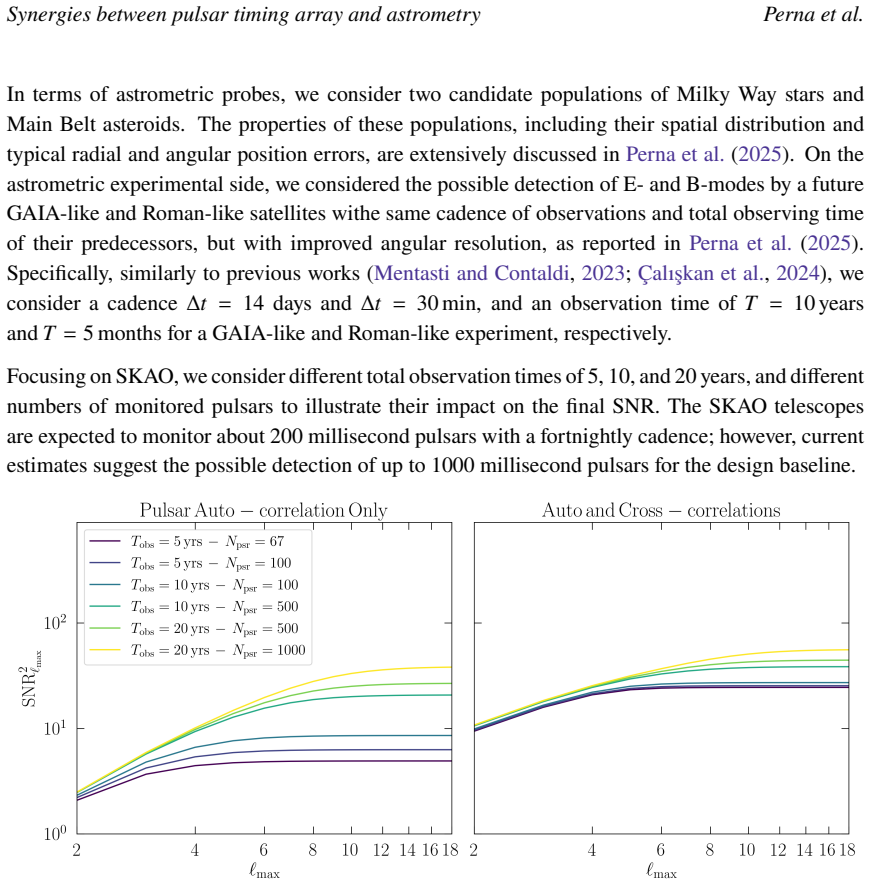
Combining pulsar timing arrays with astrometry improves sensitivity to a gravitational wave background by 10 to 50 percent.
A machine-rendered reading of the paper's core claim, the machinery that carries it, and where it could break.
Core claim
The same gravitational wave background that causes delays in the arrival times of pulses from pulsars also induces apparent angular displacements in the positions of galactic objects such as stars and asteroids. Joint analysis of SKAO pulsar timing measurements with astrometric observations therefore increases the forecast sensitivity to the background by an approximate factor ranging from 10 percent up to 50 percent relative to pulsar timing alone.
What carries the argument
The joint PTA-astrometry analysis that correlates timing residuals with astrometric displacements induced by the identical gravitational wave background.
If this is right
- SKAO pulsar timing data alone already carries potential to detect the gravitational wave background.
- Adding astrometric observations from current or future probes produces a measurable gain in overall sensitivity.
- The gain applies across a range of configurations and reaches as high as 50 percent in some cases.
- The improvement arises directly from the shared response of timing and position measurements to the same background.
Where Pith is reading between the lines
- The approach could shorten the observation time needed to reach a given detection threshold if systematics remain subdominant.
- It might help isolate the gravitational wave signal from other correlated noise sources by providing an independent observational channel.
- Similar joint analyses could be explored for other pairs of gravitational wave detection techniques that respond to the same background.
Load-bearing premise
The modeling assumes that the gravitational wave background produces correlated effects in both pulsar timing delays and astrometric displacements that can be jointly analyzed without dominant unmodeled systematics from other astrophysical or instrumental sources.
What would settle it
Simulations or real data comparisons showing that the joint PTA-astrometry sensitivity forecast is no better than PTA-only sensitivity would falsify the central claim.
Figures
read the original abstract
The presence of a gravitational wave background can be established not only via exquisitely precise pulsar timing array (PTA) measurements, but also via astrometric observations. In fact, the very same background responsible for the delay in the arrival time of pulse is also responsible of an apparent displacement of galactic objects as stars and asteroids. In this chapter we explore the natural synergy between the SKA Observatory, and current/future astrometric probes of the position of Milky Way objects. On top of presenting the potential of SKAO alone in terms of detecting a gravitational wave background, we also demonstrate the increased sensitivity that is actually achievable when SKAO measurements are used in combination with astrometric ones. In particular, we observe an approximate improvement ranging from~$10\%$ up to~$50\%$ in terms of forecast sensitivity for a PTA-astrometry joint-analysis.
Editorial analysis
A structured set of objections, weighed in public.
Referee Report
Summary. The manuscript explores synergies between pulsar timing array (PTA) observations with the Square Kilometre Array Observatory (SKAO) and astrometric measurements of Milky Way objects for detecting the gravitational wave background (GWB). It presents the standalone potential of SKAO and claims that a joint PTA-astrometry analysis yields an approximate 10% to 50% improvement in forecast sensitivity.
Significance. If the forecasted gains prove robust, the work would be significant for demonstrating the value of multi-observable approaches to GWB detection and for informing coordinated strategies between radio timing arrays and astrometric surveys. The quantitative range provides a concrete benchmark that could be compared against other proposed cross-probe methods.
major comments (2)
- [Abstract] Abstract: the claimed 10-50% sensitivity improvement is stated without reference to the specific GWB signal model, number of pulsars or astrometric targets, noise power spectra, or the form of the joint likelihood/covariance used in the forecast. This omission prevents assessment of whether the range depends on optimistic assumptions.
- [PTA-astrometry joint analysis] The section describing the PTA-astrometry joint analysis: the sensitivity gain is obtained under the assumption that the GWB induces perfectly correlated signals across timing residuals and astrometric displacements with uncorrelated noise and no dominant unmodeled systematics. No explicit tests with injected differential systematics (e.g., stellar jitter or PTA red-noise mismodeling) are described, which directly affects whether the quoted improvement remains load-bearing.
minor comments (1)
- The text refers to 'this chapter,' suggesting it may be excerpted from a larger document; adding a brief statement of scope or cross-references to related chapters would improve standalone readability.
Simulated Author's Rebuttal
We thank the referee for their constructive comments, which help clarify the presentation of our forecasts. We address each major point below and have revised the manuscript to incorporate additional details and discussion.
read point-by-point responses
-
Referee: [Abstract] Abstract: the claimed 10-50% sensitivity improvement is stated without reference to the specific GWB signal model, number of pulsars or astrometric targets, noise power spectra, or the form of the joint likelihood/covariance used in the forecast. This omission prevents assessment of whether the range depends on optimistic assumptions.
Authors: We agree that the abstract lacks sufficient context. The revised abstract now specifies the GWB signal model (power-law spectrum with index -13/3), the SKAO PTA setup (approximately 1000 pulsars at 10 ns timing precision), the astrometric sample (scaling from 10^5 to 10^6 targets), the noise power spectra (white plus red noise components), and the joint likelihood as a multivariate Gaussian whose covariance combines the Hellings-Downs spatial correlation for timing residuals with the corresponding astrometric deflection response. The quoted 10-50% range is obtained by varying the number of astrometric targets and the GWB amplitude within this framework. revision: yes
-
Referee: [PTA-astrometry joint analysis] The section describing the PTA-astrometry joint analysis: the sensitivity gain is obtained under the assumption that the GWB induces perfectly correlated signals across timing residuals and astrometric displacements with uncorrelated noise and no dominant unmodeled systematics. No explicit tests with injected differential systematics (e.g., stellar jitter or PTA red-noise mismodeling) are described, which directly affects whether the quoted improvement remains load-bearing.
Authors: The joint-analysis section employs the standard assumption of perfectly correlated GWB signals and uncorrelated noise to obtain an analytic expression for the combined information matrix. This is an ideal-case forecast intended to illustrate the maximum potential synergy. We have added a new paragraph acknowledging that unmodeled systematics (stellar jitter, red-noise mismodeling) could reduce the gain and noting that quantitative assessment would require dedicated injection studies beyond the scope of the present work. revision: partial
Circularity Check
No circularity: forecast sensitivity gain derived from independent cross-correlation modeling
full rationale
The paper presents a forecast for PTA-astrometry joint sensitivity improvement (10-50%) based on the shared gravitational wave background inducing correlated timing delays and astrometric displacements. No equations or steps reduce a claimed prediction to a fitted input by construction, nor rely on self-citation chains for uniqueness or ansatz smuggling. The derivation remains self-contained against external benchmarks, with the central claim resting on modeled covariance rather than tautological redefinition of inputs.
Axiom & Free-Parameter Ledger
Reference graph
Works this paper leans on
-
[1]
Astrometric Effects of a Stochastic Gravitational Wave Background
Book, Laura G. and Flanagan, Eanna E. Astrometric Effects of a Stochastic Gravitational Wave Background. Phys. Rev. D. 2011. doi:10.1103/PhysRevD.83.024024. arXiv:1009.4192
work page internal anchor Pith review Pith/arXiv arXiv doi:10.1103/physrevd.83.024024 2011
-
[2]
Perna, Gabriele and Bellomo, Nicola and Roatti, Vincenzo and Bertacca, Daniele. From the Solar System to cosmological distances: a complete formalism for gravitational wave astrometry. 2025. arXiv:2512.14668
arXiv 2025
-
[3]
Gravitational wave astronomy with the SKA
Janssen, Gemma and others. Gravitational wave astronomy with the SKA. PoS. 2015. doi:10.22323/1.215.0037. arXiv:1501.00127
work page internal anchor Pith review Pith/arXiv arXiv doi:10.22323/1.215.0037 2015
-
[4]
Search for an isotropic gravitational-wave background with the Parkes Pulsar Timing Array
Reardon, Daniel J. and others. Search for an Isotropic Gravitational-wave Background with the Parkes Pulsar Timing Array. Astrophys. J. Lett. 2023. doi:10.3847/2041-8213/acdd02. arXiv:2306.16215
work page internal anchor Pith review Pith/arXiv arXiv doi:10.3847/2041-8213/acdd02 2023
-
[5]
Antoniadis, J. and others. The second data release from the European Pulsar Timing Array - III. Search for gravitational wave signals. Astron. Astrophys. 2023. doi:10.1051/0004-6361/202346844. arXiv:2306.16214
work page internal anchor Pith review Pith/arXiv arXiv doi:10.1051/0004-6361/202346844 2023
-
[6]
The Science of the Einstein Telescope
Abac, Adrian and others. The Science of the Einstein Telescope. 2025. arXiv:2503.12263
Pith/arXiv arXiv 2025
-
[7]
Rubin Observatory LSST Stars Milky Way and Local Volume Star Clusters Roadmap
Usher, Christopher and others. Rubin Observatory LSST Stars Milky Way and Local Volume Star Clusters Roadmap. Publ. Astron. Soc. Pac. 2023. doi:10.1088/1538-3873/ace3f7. arXiv:2306.17333
-
[8]
Pulsar-timing arrays, astrometry, and gravitational waves
Qin, Wenzer and Boddy, Kimberly K. and Kamionkowski, Marc and Dai, Liang. Pulsar-timing arrays, astrometry, and gravitational waves. Phys. Rev. D. 2019. doi:10.1103/PhysRevD.99.063002. arXiv:1810.02369
work page internal anchor Pith review Pith/arXiv arXiv doi:10.1103/physrevd.99.063002 2019
-
[9]
Constraining the stochastic gravitational wave background with photometric surveys
Wang, Yijun and Pardo, Kris and Chang, Tzu-Ching and Dor\'e, Olivier. Constraining the stochastic gravitational wave background with photometric surveys. Phys. Rev. D. 2022. doi:10.1103/PhysRevD.106.084006. arXiv:2205.07962
-
[10]
Gravitational Wave Detection with Photometric Surveys
Wang, Yijun and Pardo, Kris and Chang, Tzu-Ching and Dor\'e, Olivier. Gravitational Wave Detection with Photometric Surveys. Phys. Rev. D. 2021. doi:10.1103/PhysRevD.103.084007. arXiv:2010.02218
-
[11]
Harmonic space analysis of pulsar timing array redshift maps
Roebber, Elinore and Holder, Gilbert. Harmonic space analysis of pulsar timing array redshift maps. Astrophys. J. 2017. doi:10.3847/1538-4357/835/1/21. arXiv:1609.06758
work page internal anchor Pith review Pith/arXiv arXiv doi:10.3847/1538-4357/835/1/21 2017
-
[12]
Gravitational Radiation and Very Long Baseline Interferometry
Pyne, Ted and Gwinn, Carl R. and Birkinshaw, Mark and Eubanks, T. Marshall and Matsakis, Demetrios N. Gravitational radiation and very long baseline interferometry. Astrophys. J. 1996. doi:10.1086/177443. arXiv:astro-ph/9507030
work page internal anchor Pith review Pith/arXiv arXiv doi:10.1086/177443 1996
-
[13]
Anholm, Melissa and Ballmer, Stefan and Creighton, Jolien D. E. and Price, Larry R. and Siemens, Xavier. Optimal strategies for gravitational wave stochastic background searches in pulsar timing data. Phys. Rev. D. 2009. doi:10.1103/PhysRevD.79.084030. arXiv:0809.0701
work page internal anchor Pith review Pith/arXiv arXiv doi:10.1103/physrevd.79.084030 2009
-
[14]
Modern Cosmology
Dodelson, Scott. Modern Cosmology. 2003
2003
-
[15]
2022, Cosmology, doi:10.1017/9781108937092
Baumann, Daniel. Cosmology. 2022. doi:10.1017/9781108937092
-
[16]
Constraining the Polarization Content of Gravitational Waves with Astrometry
O'Beirne, Logan and Cornish, Neil J. Constraining the Polarization Content of Gravitational Waves with Astrometry. Phys. Rev. D. 2018. doi:10.1103/PhysRevD.98.024020. arXiv:1804.03146
work page internal anchor Pith review Pith/arXiv arXiv doi:10.1103/physrevd.98.024020 2018
-
[17]
Abbott, B. P. and others. Observation of Gravitational Waves from a Binary Black Hole Merger. Phys. Rev. Lett. 2016. doi:10.1103/PhysRevLett.116.061102. arXiv:1602.03837
work page internal anchor Pith review Pith/arXiv arXiv doi:10.1103/physrevlett.116.061102 2016
-
[18]
Characterizing the cosmological gravitational wave background: Anisotropies and non-Gaussianity
Bartolo, Nicola and Bertacca, Daniele and Matarrese, Sabino and Peloso, Marco and Ricciardone, Angelo and Riotto, Antonio and Tasinato, Gianmassimo. Characterizing the cosmological gravitational wave background: Anisotropies and non-Gaussianity. Phys. Rev. D. 2020. doi:10.1103/PhysRevD.102.023527. arXiv:1912.09433
-
[19]
The astrophysical gravitational wave stochastic background
Regimbau, Tania. The astrophysical gravitational wave stochastic background. Res. Astron. Astrophys. 2011. doi:10.1088/1674-4527/11/4/001. arXiv:1101.2762
work page internal anchor Pith review Pith/arXiv arXiv doi:10.1088/1674-4527/11/4/001 2011
-
[20]
Relativistic Hydrodynamics[M/OL]
Maggiore, Michele. Gravitational Waves. Vol. 1: Theory and Experiments. 2007. doi:10.1093/acprof:oso/9780198570745.001.0001
work page doi:10.1093/acprof:oso/9780198570745.001.0001 2007
-
[21]
Gravitational Waves
Maggiore, Michele. Gravitational Waves. Vol. 2: Astrophysics and Cosmology. 2018
2018
-
[22]
Abbott, B. P. and others. A gravitational-wave standard siren measurement of the Hubble constant. Nature. 2017. doi:10.1038/nature24471. arXiv:1710.05835
work page internal anchor Pith review Pith/arXiv arXiv doi:10.1038/nature24471 2017
-
[24]
Sathyaprakash, B. S. and Schutz, B. F. Physics, Astrophysics and Cosmology with Gravitational Waves. Living Rev. Rel. 2009. doi:10.12942/lrr-2009-2. arXiv:0903.0338
work page internal anchor Pith review Pith/arXiv arXiv doi:10.12942/lrr-2009-2 2009
-
[25]
Guzzetti, M. C. and Bartolo, N. and Liguori, M. and Matarrese, S. Gravitational waves from inflation. Riv. Nuovo Cim. 2016. doi:10.1393/ncr/i2016-10127-1. arXiv:1605.01615
work page internal anchor Pith review Pith/arXiv arXiv doi:10.1393/ncr/i2016-10127-1 2016
-
[26]
doi:10.1088/0264-9381/29/12/124007
Somiya, Kentaro. Detector configuration of KAGRA: The Japanese cryogenic gravitational-wave detector. Class. Quant. Grav. 2012. doi:10.1088/0264-9381/29/12/124007. arXiv:1111.7185
-
[27]
Aasi, J. and others. Advanced LIGO. Class. Quant. Grav. 2015. doi:10.1088/0264-9381/32/7/074001. arXiv:1411.4547
work page internal anchor Pith review Pith/arXiv arXiv doi:10.1088/0264-9381/32/7/074001 2015
-
[28]
Advanced Virgo: a 2nd generation interferometric gravitational wave detector
Acernese, F. and others. Advanced Virgo: a second-generation interferometric gravitational wave detector. Class. Quant. Grav. 2015. doi:10.1088/0264-9381/32/2/024001. arXiv:1408.3978
work page internal anchor Pith review Pith/arXiv arXiv doi:10.1088/0264-9381/32/2/024001 2015
-
[29]
Laser Interferometer Space Antenna
Amaro-Seoane, Pau and others. Laser Interferometer Space Antenna. 2017. arXiv:1702.00786
Pith/arXiv arXiv 2017
-
[30]
Space gravitational wave antenna DECIGO and B-DECIGO
Kawamura, S. Space gravitational wave antenna DECIGO and B-DECIGO. 16th Marcel Grossmann Meeting on Recent Developments in Theoretical and Experimental General Relativity, Astrophysics and Relativistic Field Theories. 2023. doi:10.1142/9789811269776_0267
-
[31]
Brazier, A. and others. The NANOGrav Program for Gravitational Waves and Fundamental Physics. 2019. arXiv:1908.05356
arXiv 2019
-
[32]
Ferdman, R. D. and others. The European Pulsar Timing Array: current efforts and a LEAP toward the future. Class. Quant. Grav. 2010. doi:10.1088/0264-9381/27/8/084014. arXiv:1003.3405
work page internal anchor Pith review Pith/arXiv arXiv doi:10.1088/0264-9381/27/8/084014 2010
-
[33]
The Parkes Pulsar Timing Array project: second data release
Kerr, Matthew and others. The Parkes Pulsar Timing Array project: second data release. Publ. Astron. Soc. Austral. 2020. doi:10.1017/pasa.2020.11. arXiv:2003.09780
-
[34]
The NANOGrav 12.5 yr Data Set: Search for an Isotropic Stochastic Gravitational-wave Background
Arzoumanian, Zaven and others. The NANOGrav 12.5 yr Data Set: Search for an Isotropic Stochastic Gravitational-wave Background. Astrophys. J. Lett. 2020. doi:10.3847/2041-8213/abd401. arXiv:2009.04496
-
[35]
Chen, S. and others. Common-red-signal analysis with 24-yr high-precision timing of the European Pulsar Timing Array: inferences in the stochastic gravitational-wave background search. Mon. Not. Roy. Astron. Soc. 2021. doi:10.1093/mnras/stab2833. arXiv:2110.13184
-
[36]
Goncharov, Boris and others. On the Evidence for a Common-spectrum Process in the Search for the Nanohertz Gravitational-wave Background with the Parkes Pulsar Timing Array. Astrophys. J. Lett. 2021. doi:10.3847/2041-8213/ac17f4. arXiv:2107.12112
-
[37]
and Kuntz, Adrien and Barausse, Enrico and Contaldi, Carlo and Sesana, Alberto
Vaglio, Massimo and Falxa, Mikel and Mentasti, Giorgio and Renzini, Arianna I. and Kuntz, Adrien and Barausse, Enrico and Contaldi, Carlo and Sesana, Alberto. Searching for Gravitational Waves with Gaia and its Cross-Correlation with PTA: Absolute vs Relative Astrometry. 2025. arXiv:2507.18593
arXiv 2025
-
[38]
Antoniadis, J. and others. The International Pulsar Timing Array second data release: Search for an isotropic gravitational wave background. Mon. Not. Roy. Astron. Soc. 2022. doi:10.1093/mnras/stab3418. arXiv:2201.03980
-
[39]
Ade, P. A. R. and others. Improved Constraints on Primordial Gravitational Waves using Planck, WMAP, and BICEP/Keck Observations through the 2018 Observing Season. Phys. Rev. Lett. 2021. doi:10.1103/PhysRevLett.127.151301. arXiv:2110.00483
-
[40]
Braginsky, V. B. and Kardashev, N. S. and Novikov, I. D. and Polnarev, A. G. Propagation of electromagnetic radiation in a random field of gravitational waves and space radio interferometry. Nuovo Cim. B. 1990
1990
-
[41]
Stochastic gravitational wave background constraints from Gaia DR3 astrometry
Jaraba, Santiago and Garc\' a-Bellido, Juan and Kuroyanagi, Sachiko and Ferraiuolo, Sarah and Braglia, Matteo. Stochastic gravitational wave background constraints from Gaia DR3 astrometry. 2023. arXiv:2304.06350
arXiv 2023
-
[42]
Measuring Polarization In Cosmic Microwave Background
Seljak, Uros. Measuring polarization in cosmic microwave background. Astrophys. J. 1997. doi:10.1086/304123. arXiv:astro-ph/9608131
work page internal anchor Pith review Pith/arXiv arXiv doi:10.1086/304123 1997
-
[43]
A Probe of Primordial Gravity Waves and Vorticity
Kamionkowski, Marc and Kosowsky, Arthur and Stebbins, Albert. A Probe of primordial gravity waves and vorticity. Phys. Rev. Lett. 1997. doi:10.1103/PhysRevLett.78.2058. arXiv:astro-ph/9609132
work page internal anchor Pith review Pith/arXiv arXiv doi:10.1103/physrevlett.78.2058 1997
-
[44]
Signature of Gravity Waves in Polarization of the Microwave Background
Seljak, Uros and Zaldarriaga, Matias. Signature of gravity waves in polarization of the microwave background. Phys. Rev. Lett. 1997. doi:10.1103/PhysRevLett.78.2054. arXiv:astro-ph/9609169
work page internal anchor Pith review Pith/arXiv arXiv doi:10.1103/physrevlett.78.2054 1997
-
[45]
Gravitational Lensing Effect on Cosmic Microwave Background Polarization
Zaldarriaga, Matias and Seljak, Uros. Gravitational lensing effect on cosmic microwave background polarization. Phys. Rev. D. 1998. doi:10.1103/PhysRevD.58.023003. arXiv:astro-ph/9803150
work page internal anchor Pith review Pith/arXiv arXiv doi:10.1103/physrevd.58.023003 1998
-
[46]
Kawamura, S. and others. The Japanese space gravitational wave antenna DECIGO. Class. Quant. Grav. 2006. doi:10.1088/0264-9381/23/8/S17
-
[47]
Sathyaprakash, B. and others. Scientific Potential of Einstein Telescope. 46th Rencontres de Moriond on Gravitational Waves and Experimental Gravity. 2011. arXiv:1108.1423
Pith/arXiv arXiv 2011
-
[48]
Exploring the Sensitivity of Next Generation Gravitational Wave Detectors
Abbott, Benjamin P and others. Exploring the Sensitivity of Next Generation Gravitational Wave Detectors. Class. Quant. Grav. 2017. doi:10.1088/1361-6382/aa51f4. arXiv:1607.08697
work page internal anchor Pith review Pith/arXiv arXiv doi:10.1088/1361-6382/aa51f4 2017
-
[49]
Science Case for the Einstein Telescope
Maggiore, Michele and others. Science Case for the Einstein Telescope. JCAP. 2020. doi:10.1088/1475-7516/2020/03/050. arXiv:1912.02622
work page internal anchor Pith review Pith/arXiv arXiv doi:10.1088/1475-7516/2020/03/050 2020
-
[50]
Science with the space-based interferometer LISA. IV: Probing inflation with gravitational waves
Bartolo, Nicola and others. Science with the space-based interferometer LISA. IV: Probing inflation with gravitational waves. JCAP. 2016. doi:10.1088/1475-7516/2016/12/026. arXiv:1610.06481
work page internal anchor Pith review Pith/arXiv arXiv doi:10.1088/1475-7516/2016/12/026 2016
-
[51]
Stochastic Gravitational Wave Backgrounds
Christensen, Nelson. Stochastic Gravitational Wave Backgrounds. Rept. Prog. Phys. 2019. doi:10.1088/1361-6633/aae6b5. arXiv:1811.08797
work page internal anchor Pith review Pith/arXiv arXiv doi:10.1088/1361-6633/aae6b5 2019
-
[52]
and Goncharov, Boris and Jenkins, Alexander C
Renzini, Arianna I. and Goncharov, Boris and Jenkins, Alexander C. and Meyers, Pat M. Stochastic Gravitational-Wave Backgrounds: Current Detection Efforts and Future Prospects. Galaxies. 2022. doi:10.3390/galaxies10010034. arXiv:2202.00178
-
[53]
Phinney, E. S. A Practical theorem on gravitational wave backgrounds. 2001. arXiv:astro-ph/0108028
Pith/arXiv arXiv 2001
-
[54]
Detection of anisotropies in the gravitational-wave stochastic background , author =. Phys. Rev. D , volume =. 1997 , month =. doi:10.1103/PhysRevD.56.545 , url =
-
[55]
Cosmological Backgrounds of Gravitational Waves
Caprini, Chiara and Figueroa, Daniel G. Cosmological Backgrounds of Gravitational Waves. Class. Quant. Grav. 2018. doi:10.1088/1361-6382/aac608. arXiv:1801.04268
work page internal anchor Pith review Pith/arXiv arXiv doi:10.1088/1361-6382/aac608 2018
-
[56]
Ferrari, Valeria and Matarrese, Sabino and Schneider, Raffaella. Stochastic background of gravitational waves generated by a cosmological population of young, rapidly rotating neutron stars. Mon. Not. Roy. Astron. Soc. 1999. doi:10.1046/j.1365-8711.1999.02207.x. arXiv:astro-ph/9806357
-
[57]
Ferrari, Valeria and Matarrese, Sabino and Schneider, Raffaella. Gravitational wave background from a cosmological population of core collapse supernovae. Mon. Not. Roy. Astron. Soc. 1999. doi:10.1046/j.1365-8711.1999.02194.x. arXiv:astro-ph/9804259
-
[58]
Ignatiev, V. B. and Kuranov, A. G. and Postnov, K. A. and Prokhorov, M. E. Gravitational wave background from coalescing compact stars in eccentric orbits. Mon. Not. Roy. Astron. Soc. 2001. doi:10.1046/j.1365-8711.2001.04732.x. arXiv:astro-ph/0106299
-
[59]
2004, MNRAS, 353, 1311, doi: 10.1111/j.1365-2966.2004.08157.x
The gravitational wave background from neutron star birth throughout the cosmos. mnras , keywords =. doi:10.1111/j.1365-2966.2004.07863.x , adsurl =
-
[60]
Abbott, R. and others. Upper limits on the isotropic gravitational-wave background from Advanced LIGO and Advanced Virgo s third observing run. Phys. Rev. D. 2021. doi:10.1103/PhysRevD.104.022004. arXiv:2101.12130
-
[61]
Abbott, R. and others. Search for anisotropic gravitational-wave backgrounds using data from Advanced LIGO and Advanced Virgo s first three observing runs. Phys. Rev. D. 2021. doi:10.1103/PhysRevD.104.022005. arXiv:2103.08520
-
[62]
Klioner, S. A. GAIA: astrometry and gravitation. 50th Rencontres de Moriond on Gravitation: 100 years after GR. 2015
2015
-
[63]
Light deflection by gravitational waves from localized sources
Damour, Thibault and Esposito-Farese, Gilles. Light deflection by gravitational waves from localized sources. Phys. Rev. D. 1998. doi:10.1103/PhysRevD.58.044003. arXiv:gr-qc/9802019
work page internal anchor Pith review Pith/arXiv arXiv doi:10.1103/physrevd.58.044003 1998
-
[64]
Observing Gravitational Radiation with QSO Proper Motions and the SKA
Jaffe, Andrew H. Observing gravitational radiation with QSO proper motions and the SKA. New Astron. Rev. 2004. doi:10.1016/j.newar.2004.09.018. arXiv:astro-ph/0409637
work page internal anchor Pith review Pith/arXiv arXiv doi:10.1016/j.newar.2004.09.018 2004
-
[65]
Bending of Light by Gravity Waves
Kaiser, Nick and Jaffe, Andrew H. Bending of light by gravity waves. Astrophys. J. 1997. doi:10.1086/304357. arXiv:astro-ph/9609043
work page internal anchor Pith review Pith/arXiv arXiv doi:10.1086/304357 1997
-
[66]
Relativistic scattering coherence
Linder, Eric V. Relativistic scattering coherence. Phys. Rev. D. 1986. doi:10.1103/PhysRevD.34.1759
-
[67]
Laureijs, R. and others. Euclid Definition Study Report. 2011. arXiv:1110.3193
Pith/arXiv arXiv 2011
-
[68]
WFIRST Science Investigation Team ''Cosmology with the High Latitude Survey'' Annual Report 2017
Dor\'e, Olivier and others. WFIRST Science Investigation Team ''Cosmology with the High Latitude Survey'' Annual Report 2017. 2018. arXiv:1804.03628
Pith/arXiv arXiv 2017
-
[69]
Snowmass2021 Cosmic Frontier White Paper: Rubin Observatory after LSST
Blum, Bob and others. Snowmass2021 Cosmic Frontier White Paper: Rubin Observatory after LSST. Snowmass 2021. 2022. arXiv:2203.07220
arXiv 2021
-
[70]
and Thorne, K
Misner, Charles W. and Thorne, K. S. and Wheeler, J. A. Gravitation. 1973
1973
-
[71]
Thorne, Kip S. Gravitational waves. 1994 DPF Summer Study on High-energy Physics: Particle and Nuclear Astrophysics and Cosmology in the Next Millenium (Snowmass 94). 1995. arXiv:gr-qc/9506086
Pith/arXiv arXiv 1994
-
[72]
The basics of gravitational wave theory
Flanagan, Eanna E. and Hughes, Scott A. The Basics of gravitational wave theory. New J. Phys. 2005. doi:10.1088/1367-2630/7/1/204. arXiv:gr-qc/0501041
work page internal anchor Pith review Pith/arXiv arXiv doi:10.1088/1367-2630/7/1/204 2005
-
[73]
Abbott, B. P. and others. The Rate of Binary Black Hole Mergers Inferred from Advanced LIGO Observations Surrounding GW150914. Astrophys. J. Lett. 2016. doi:10.3847/2041-8205/833/1/L1. arXiv:1602.03842
work page internal anchor Pith review Pith/arXiv arXiv doi:10.3847/2041-8205/833/1/l1 2016
-
[74]
Tristram, M. and others. Planck constraints on the tensor-to-scalar ratio. Astron. Astrophys. 2021. doi:10.1051/0004-6361/202039585. arXiv:2010.01139
-
[75]
LIGO Instrument Science List: A. Buikema et al. , title =. doi:10.1103/physrevd.102.062003 , url =
-
[76]
Moore, C. J. and Cole, R. H. and Berry, C. P. L. Gravitational-wave sensitivity curves. Class. Quant. Grav. 2015. doi:10.1088/0264-9381/32/1/015014. arXiv:1408.0740
work page internal anchor Pith review Pith/arXiv arXiv doi:10.1088/0264-9381/32/1/015014 2015
-
[77]
Gamma-Ray Bursts as the Death Throes of Massive Binary Stars
Narayan, Ramesh and Paczynski, Bohdan and Piran, Tsvi. Gamma-ray bursts as the death throes of massive binary stars. Astrophys. J. Lett. 1992. doi:10.1086/186493. arXiv:astro-ph/9204001
work page internal anchor Pith review Pith/arXiv arXiv doi:10.1086/186493 1992
-
[78]
Finn, Lee Samuel and Thorne, Kip S. Gravitational waves from a compact star in a circular, inspiral orbit, in the equatorial plane of a massive, spinning black hole, as observed by LISA. Phys. Rev. D. 2000. doi:10.1103/PhysRevD.62.124021. arXiv:gr-qc/0007074
work page internal anchor Pith review Pith/arXiv arXiv doi:10.1103/physrevd.62.124021 2000
-
[79]
Singh, Shailesh K. and Biswal, S. K. and Bhuyan, M. and Jha, T. K. and Patra, S. K. Gravitational wave from rotating neutron star. 2013. arXiv:1312.5840
Pith/arXiv arXiv 2013
-
[80]
The Stochastic gravity wave background: Sources and detection
Allen, Bruce. The Stochastic gravity wave background: Sources and detection. Les Houches School of Physics: Astrophysical Sources of Gravitational Radiation. 1996. arXiv:gr-qc/9604033
Pith/arXiv arXiv 1996
-
[81]
Astrophysical Sources of Stochastic Gravitational-Wave Background
Regimbau, T. and Mandic, V. Astrophysical Sources of Stochastic Gravitational-Wave Background. Class. Quant. Grav. 2008. doi:10.1088/0264-9381/25/18/184018. arXiv:0806.2794
work page internal anchor Pith review Pith/arXiv arXiv doi:10.1088/0264-9381/25/18/184018 2008
discussion (0)
Sign in with ORCID, Apple, or X to comment. Anyone can read and Pith papers without signing in.