REVIEW 3 major objections 4 minor 24 references
Uncovering Memorization Effect in the Presence of Spurious Correlations
T0 review · 3 major / 4 minor · reviewed 2026-08-10 · deepseek-v4-flash
Pith's one-line read The paper claims that spurious memorization, concentrated in a tiny subset of neurons, drives worst-group accuracy gaps, and that pruning 0.01% of those neurons during fine-tuning substantially closes those gaps.
desk verdict The descriptive finding on critical neurons is solid and worth taking seriously; the fine-tuning story needs controls before the mechanistic claim lands. read the letter →
The pith
A machine-rendered reading of the paper's core claim, the machinery that carries it, and where it could break.
The reading
What carries the argument
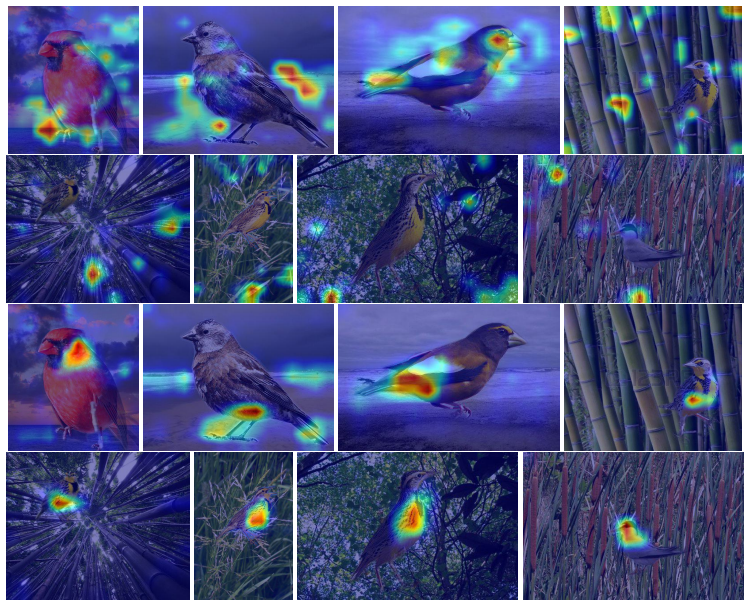
The central object is the 'critical neuron': a channel (in ResNet-50) or neuron (in ViT-Small) whose removal disproportionately affects minority group accuracy. They are identified by two criteria: gradient norm (group-specific loss gradient) and weight magnitude (group-invariant). The mechanism that carries the argument is a dual-branch fine-tuning framework: an auxiliary model is created by masking the top 0.01% of neurons by gradient or magnitude, and the target model is trained to align its features with the auxiliary model using NT-Xent contrastive loss plus MSE classification loss, so the model learns not to rely on the spurious memorization encapsulated in those neurons.
What would settle it
Run the same fine-tuning framework on Waterbirds/ResNet-50 with no pruning, or with 0.01% of neurons chosen at random for the auxiliary model; if worst-group accuracy still rises by roughly 17 points over ERM, then the identified critical neurons are not the cause of the improvement.
Extended reading notes
Core claim
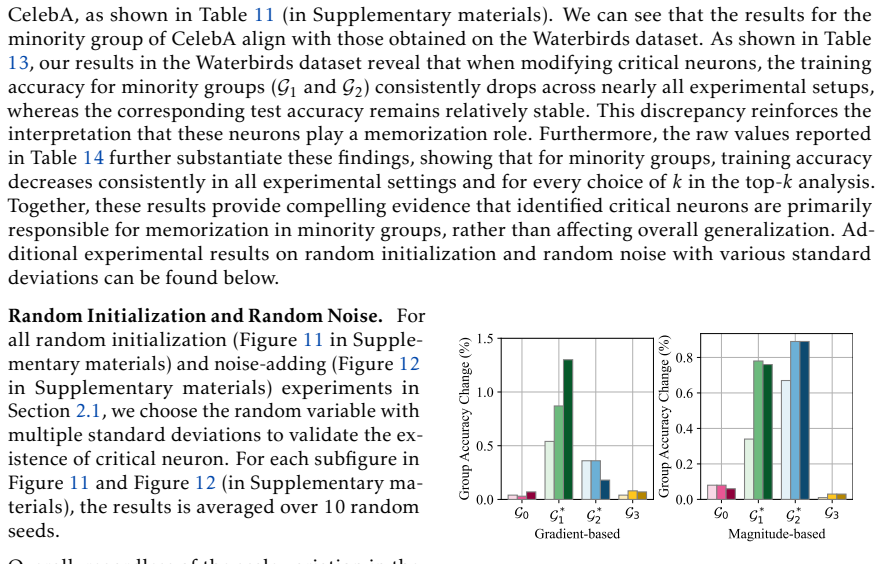
On the paper's own terms: neural networks trained by empirical risk minimization with spurious correlations store minority-group information in a very small set of 'critical neurons'. Evidence comes from three sources: unstructured tracing (zeroing top-k neurons by gradient or magnitude across the whole network), structured tracing (same within each layer), and perturbation experiments (random initialization and random noise). All three show minority-group training accuracy is disproportionately sensitive to these neurons, while majority groups are barely affected. The paper further claims that contrasting the target model with a pruned auxiliary model during fine-tuning removes this spurious memorization and improves worst-group accuracy.
Load-bearing premise
The load-bearing assumption is that the accuracy gains come specifically from removing the identified critical neurons, rather than from the fine-tuning procedure or from pruning any random neurons; the paper does not run a control that applies the same contrastive fine-tuning without pruning or with randomly selected neurons.
Editorial extensions
If this is right
- Worst-group robustness can be improved by intervening on 0.01% of parameters, suggesting that spurious memorization is highly localized rather than diffuse.
- The critical-neuron criterion (gradient norm or weight magnitude) provides a cheap diagnostic for which groups are memorized rather than generalized.
- Contrasting a model with its pruned twin can serve as a training signal that discourages reliance on a few neurons, without needing group labels for every sample.
- The reported gains on Waterbirds and CelebA across ResNet-50 and ViT-Small indicate the mechanism may transfer across architectures and spurious-correlation benchmarks.
Reading between the lines
- If the mechanism generalizes, measuring the concentration of critical neurons (e.g., how few neurons carry minority accuracy) could predict a model's vulnerability to spurious correlations before test-time evaluation.
- The paper's gradient-based criterion evaluates neurons on the same group whose accuracy they affect; a stricter test would check whether neurons identified on one minority group also matter for another, which would separate memorization from generic feature importance.
- No control runs the fine-tuning framework with zero pruning or random pruning, so part of the reported WGA gains may be attributable to contrastive fine-tuning itself rather than specifically to removing critical neurons.
- The 0.01% pruning ratio is surprisingly small; testing whether the optimal ratio scales with dataset size or number of minority examples would clarify whether the memorization set is truly fixed or grows with data.
Signed reviews
Editorial analysis
A structured set of objections, weighed in public.
Referee Report
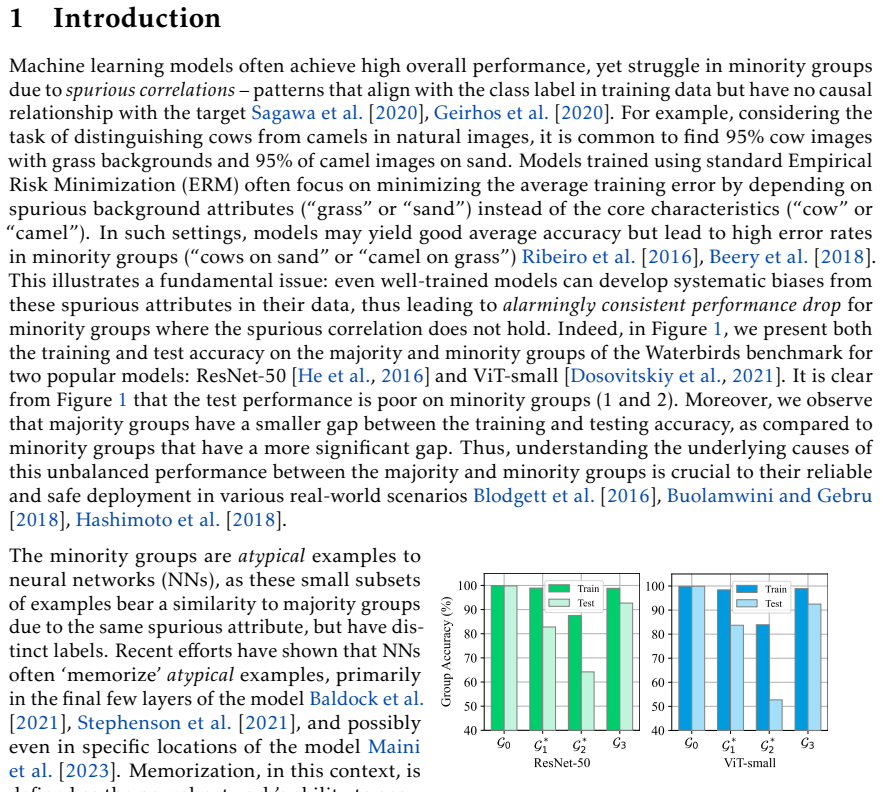
Summary. This paper studies the role of memorization in spurious-correlation group imbalance. Using Waterbirds and CelebA with ResNet-50 and ViT-Small, the authors define 'spurious memorization' as the concentration of minority-group training accuracy in a small set of critical neurons. In Stage I (Section 2.1), gradient- and magnitude-based tracing identify and prune or perturb top-k neurons, showing that minority group training accuracy drops substantially (up to 11.96%) while majority groups drop at most 2.15%; random-initialization and noise ablations plus Tables 13-14 support a memorization interpretation. In Stage II (Section 2.2), a fine-tuning framework contrasts a target model with an adaptively pruned auxiliary model under NT-Xent and MSE losses, reporting worst-group accuracy gains from 64.0 to 80.9 on Waterbirds/ResNet-50 and from 52.7 to 76.5 on Waterbirds/ViT-Small. The paper concludes that removing spurious memorization of critical neurons causes the robustness improvement.
Significance. The descriptive finding is valuable and, in part, well supported: the magnitude-based criterion is group-invariant, the random-initialization and noise controls show that minority training accuracy is unusually sensitive to a few neurons, and the train/test discrepancy in Tables 13-14 supports a memorization rather than a generalization role for those neurons. If the causal claim were established, the paper would be a strong contribution to mechanistic accounts of group robustness. However, the causal claim is not yet established, because the Stage II framework varies several components jointly and lacks controls for random masks or an unpruned auxiliary. The code link is included, which is useful for reproducibility, but the missing intervention controls are the main barrier to the paper's central conclusion.
major comments (3)
- [Section 2.2.1-2.2.2, Eq. (2.3)] The worst-group accuracy improvements in Figure 6 cannot be attributed to removal of the identified critical neurons, because the comparison is only against ERM. The proposed fine-tuning simultaneously changes the training schedule, replaces cross-entropy with MSE, adds an NT-Xent contrastive term against an auxiliary branch, selects hard examples for gradient computation, and adaptively recomputes a 0.01% mask each epoch. There is no control with an unpruned auxiliary branch, no control with a same-density random mask redrawn each epoch, and no control with a fixed non-adaptive mask. If a random-mask condition reproduces the 80.9% or 76.5% WGA, the result would be explained by the dual-branch contrastive regularizer rather than by critical-neuron memorization. Since the central causal claim in Section 3 rests on this experiment, these controls are required before the claim can be accepted.
- [Section 2.1.1, Figure 2] The gradient-based tracing criterion is partially circular: neurons are selected as the top-gradient neurons for group j and then evaluated on the same group j. The magnitude criterion does not share this issue, and Figure 3 shows overlap between the two sets, so the descriptive claim survives; nevertheless, the textual claim that 'both gradient and magnitude-based criteria are effective' should be qualified, and the authors should present the magnitude-based results as the primary non-circular evidence for critical-neuron existence.
- [Section 2.2.1, Table 6] The ablation in Table 6 shows that 10 fine-tuning epochs yields WGA 54.98%, which is below ERM, while 20 and 30 epochs yield 80.89%. This large and non-monotonic dependence on fine-tuning length suggests that the reported gains are not solely a simple function of the mask; without disclosing the checkpoint-selection details, this sensitivity undermines the attribution of the final gain to spurious memorization removal and should be discussed explicitly.
minor comments (4)
- [Section 4] The Methods text states that 'all accuracy metrics reported in this paper are derived from the test set', which contradicts the explicit statement in Section 2.1 that all group accuracy evaluated before and after pruning is evaluated on the training set; please clarify which numbers are train and which are test.
- [Eq. (2.1)] In the definition of cosine similarity, the denominator reads 'u· v/(||u||·|| b||)' where b is undefined; it should presumably be v.
- [Figure 9 caption] The caption contains a typo: 'L NE-Xent' should be 'NT-Xent'.
- [Section 2.2.1, Table 9] The paper says 0.01% pruning percentage serves as a hyperparameter, but Table 9 shows extreme sensitivity (10% gradient-based pruning drops WGA to 0.04%); a brief discussion of this sensitivity and its implications for the 0.01% default would strengthen the presentation.
Circularity Check
Gradient-based tracing selects neurons by a group's own gradient and then measures that same group's accuracy, a partial validation loop; the magnitude criterion and Stage I controls provide independent support, while Stage II lacks a random-mask control but is not circular by construction.
-
self definitional
[Section 2.1.1 (Unstructured Tracing), equations defining v(i,j) and Δacc(j)]
"For each group j, we select those neurons i′s of which the ∥v(i,j)∥2 are the top-k largest among all M neurons... The change in accuracy ∆acc for each group j is given by ∆acc(j) =|acc(Dj,f (θ,·))− acc(Dj,f (mj⊙ θ,·))|."
v(i,j) is the gradient of the cross-entropy loss on group Dj with respect to neuron zi, and the same group Dj is used both to select the top-k neurons and to measure the accuracy change. Removing neurons with the largest per-group loss gradient is a direct sensitivity operation on that group's training loss, so a subsequent drop in that group's training accuracy is partly guaranteed by the selection rule rather than being an independent discovery about memorization. The claim that the identified neurons are the 'critical' memorization loci for that group is thus partially tautological for the gradient criterion.
full rationale
The paper's core descriptive finding—that a small set of neurons disproportionately affects minority-group training accuracy—is supported by two selection criteria, and the magnitude criterion is group-invariant, so the gradient-criterion circularity does not by itself make the finding an artifact. Tables 13–14 strengthen the memorization interpretation by showing that training accuracy is affected much more than test accuracy when those neurons are modified, and the random-initialization/noise controls provide additional context. The Stage II fine-tuning results (80.9% vs 64.0% WGA on Waterbirds/ResNet-50) are genuine improvements over ERM, but the paper does not run a no-pruning or random-mask control, so the improvement cannot be uniquely attributed to removing critical neurons; that is an experimental underdetermination rather than a derivation-by-construction circularity. There are no load-bearing self-citations, imported uniqueness theorems, or renamed known results that would force the central claim. Overall, the score reflects one partially self-referential evaluation step in the gradient-based tracing, while the independent magnitude-based evidence and external benchmarks keep the central claim from reducing to its inputs.
Assumptions & free parameters
free parameters (6)
- Pruning percentage (0.01%) =
0.01%
- Loss balancing term lambda =
0.2
- Kick-in epoch (40) =
40
- Top-k pruned neurons in tracing =
k=1,2,3
- Hard-example batch size =
256 then 128
- Contrastive temperature tau =
Not reported
assumptions (5)
- domain assumption Memorization is operationalized as high training accuracy on atypical examples, not as literal storage of training inputs.
- domain assumption Gradient magnitude and weight magnitude identify the neurons responsible for memorizing a group.
- domain assumption Pruning 0.01% of neurons does not substantially harm the model's general capabilities, so any accuracy drop is attributable to the removed information.
- domain assumption The Waterbirds and CelebA group labels correctly define the spurious correlation structure.
- domain assumption ImageNet-pretrained models are a valid starting point for studying memorization in this setting.
invented entities (2)
-
Spurious memorization
independent evidence
-
Critical neurons
independent evidence
Cite this review
Pith. "Pith review of Uncovering Memorization Effect in the Presence of Spurious Correlations." pith.science (2026). https://pith.science/paper/CXRWUJE4
@misc{pith2026250100961,
  author       = {Pith},
  title        = {Pith review of: Uncovering Memorization Effect in the Presence of Spurious Correlations},
  year         = {2026},
  howpublished = {\url{https://pith.science/paper/CXRWUJE4}},
  note         = {Machine review of arXiv:2501.00961}
}
read the original abstract
Machine learning models often rely on simple spurious features -- patterns in training data that correlate with targets but are not causally related to them, like image backgrounds in foreground classification. This reliance typically leads to imbalanced test performance across minority and majority groups. In this work, we take a closer look at the fundamental cause of such imbalanced performance through the lens of memorization, which refers to the ability to predict accurately on atypical examples (minority groups) in the training set but failing in achieving the same accuracy in the testing set. This paper systematically shows the ubiquitous existence of spurious features in a small set of neurons within the network, providing the first-ever evidence that memorization may contribute to imbalanced group performance. Through three experimental sources of converging empirical evidence, we find the property of a small subset of neurons or channels in memorizing minority group information. Inspired by these findings, we hypothesize that spurious memorization, concentrated within a small subset of neurons, plays a key role in driving imbalanced group performance. To further substantiate this hypothesis, we show that eliminating these unnecessary spurious memorization patterns via a novel framework during training can significantly affect the model performance on minority groups. Our experimental results across various architectures and benchmarks offer new insights on how neural networks encode core and spurious knowledge, laying the groundwork for future research in demystifying robustness to spurious correlation.
Figures


Figures from the paper (9 more)





Reference graph
Works this paper leans on
-
[1]
Deep learning through the lens of example difficulty
Robert Baldock, Hartmut Maennel, and Behnam Neyshabur. Deep learning through the lens of example difficulty. In Advances in Neural Information Processing Systems, volume 34, pages 10876--10889, 2021
work page 2021
-
[2]
Recognition in terra incognita
Sara Beery, Grant Van Horn, and Pietro Perona. Recognition in terra incognita. In Proceedings of the European conference on computer vision (ECCV), pages 456--473, 2018
work page 2018
-
[3]
Demographic dialectal variation in social media: A case study of african-american english
Su Lin Blodgett, Lisa Green, and Brendan O’Connor. Demographic dialectal variation in social media: A case study of african-american english. In Proceedings of the 2016 Conference on Empirical Methods in Natural Language Processing, pages 1119--1130, 2016
work page 2016
-
[4]
Gender shades: Intersectional accuracy disparities in commercial gender classification
Joy Buolamwini and Timnit Gebru. Gender shades: Intersectional accuracy disparities in commercial gender classification. In Conference on fairness, accountability and transparency, pages 77--91. PMLR, 2018
2018
-
[5]
A simple framework for contrastive learning of visual representations
Ting Chen, Simon Kornblith, Mohammad Norouzi, and Geoffrey Hinton. A simple framework for contrastive learning of visual representations. In International conference on machine learning, pages 1597--1607. PMLR, 2020
2020
-
[6]
Imagenet: A large-scale hierarchical image database
Jia Deng, Wei Dong, Richard Socher, Li-Jia Li, Kai Li, and Li Fei-Fei. Imagenet: A large-scale hierarchical image database. In IEEE conference on computer vision and pattern recognition, pages 248--255. IEEE, 2009
work page 2009
-
[7]
An image is worth 16x16 words: Transformers for image recognition at scale
Alexey Dosovitskiy, Lucas Beyer, Alexander Kolesnikov, Dirk Weissenborn, Xiaohua Zhai, Thomas Unterthiner, Mostafa Dehghani, Matthias Minderer, Georg Heigold, Sylvain Gelly, Jakob Uszkoreit, and Neil Houlsby. An image is worth 16x16 words: Transformers for image recognition at scale. In International Conference on Learning Representations, 2021. URL https...
2021
-
[8]
Shortcut learning in deep neural networks
Robert Geirhos, J \"o rn-Henrik Jacobsen, Claudio Michaelis, Richard Zemel, Wieland Brendel, Matthias Bethge, and Felix A Wichmann. Shortcut learning in deep neural networks. Nature Machine Intelligence, 2 0 (11): 0 665--673, 2020
2020
Show all 24 references
-
[9]
Fairness without demographics in repeated loss minimization
Tatsunori Hashimoto, Megha Srivastava, Hongseok Namkoong, and Percy Liang. Fairness without demographics in repeated loss minimization. In International Conference on Machine Learning, pages 1929--1938. PMLR, 2018
1929
-
[10]
Deep residual learning for image recognition
Kaiming He, Xiangyu Zhang, Shaoqing Ren, and Jian Sun. Deep residual learning for image recognition. In Proceedings of the IEEE conference on computer vision and pattern recognition, pages 770--778, 2016
2016
-
[11]
What do compressed deep neural networks forget? arXiv preprint arXiv:1911.05248, 2019
Sara Hooker, Aaron Courville, Gregory Clark, Yann Dauphin, and Andrea Frome. What do compressed deep neural networks forget? arXiv preprint arXiv:1911.05248, 2019
1911 arXiv
-
[12]
Evaluation of neural architectures trained with square loss vs cross-entropy in classification tasks
Like Hui and Mikhail Belkin. Evaluation of neural architectures trained with square loss vs cross-entropy in classification tasks. In International Conference on Learning Representations, 2021. URL https://openreview.net/forum?id=hsFN92eQEla
2021
-
[13]
Simple data balancing achieves competitive worst-group-accuracy
Badr Youbi Idrissi, Martin Arjovsky, Mohammad Pezeshki, and David Lopez-Paz. Simple data balancing achieves competitive worst-group-accuracy. In Conference on Causal Learning and Reasoning, pages 336--351. PMLR, 2022
2022
-
[14]
Last layer re-training is sufficient for robustness to spurious correlations
Polina Kirichenko, Pavel Izmailov, and Andrew Gordon Wilson. Last layer re-training is sufficient for robustness to spurious correlations. In The Eleventh International Conference on Learning Representations, 2023. URL https://openreview.net/forum?id=Zb6c8A-Fghk
2023
-
[15]
Deep learning face attributes in the wild
Ziwei Liu, Ping Luo, Xiaogang Wang, and Xiaoou Tang. Deep learning face attributes in the wild. In Proceedings of the IEEE international conference on computer vision, pages 3730--3738, 2015
2015
-
[16]
Can neural network memorization be localized? In Proceedings of the 40th International Conference on Machine Learning, volume 202, pages 23536--23557
Pratyush Maini, Michael C Mozer, Hanie Sedghi, Zachary C Lipton, J Zico Kolter, and Chiyuan Zhang. Can neural network memorization be localized? In Proceedings of the 40th International Conference on Machine Learning, volume 202, pages 23536--23557. PMLR, 2023
2023
-
[17]
Simple and fast group robustness by automatic feature reweighting
Shikai Qiu, Andres Potapczynski, Pavel Izmailov, and Andrew Gordon Wilson. Simple and fast group robustness by automatic feature reweighting. In International Conference on Machine Learning, pages 28448--28467. PMLR, 2023
2023
-
[18]
Learning transferable visual models from natural language supervision
Alec Radford, Jong Wook Kim, Chris Hallacy, Aditya Ramesh, Gabriel Goh, Sandhini Agarwal, Girish Sastry, Amanda Askell, Pamela Mishkin, Jack Clark, et al. Learning transferable visual models from natural language supervision. In International conference on machine learning, pa...
2021
-
[19]
``why should i trust you?'' explaining the predictions of any classifier
Marco Tulio Ribeiro, Sameer Singh, and Carlos Guestrin. ``why should i trust you?'' explaining the predictions of any classifier. In Proceedings of the 22nd ACM SIGKDD international conference on knowledge discovery and data mining, pages 1135--1144, 2016
2016
-
[20]
Hashimoto, and Percy Liang
Shiori Sagawa, Pang Wei Koh, Tatsunori B. Hashimoto, and Percy Liang. Distributionally robust neural networks. In International Conference on Learning Representations, 2020. URL https://openreview.net/forum?id=ryxGuJrFvS
2020
-
[21]
Improved deep metric learning with multi-class n-pair loss objective
Kihyuk Sohn. Improved deep metric learning with multi-class n-pair loss objective. Advances in neural information processing systems, 29, 2016
2016
-
[22]
On the geometry of generalization and memorization in deep neural networks
Cory Stephenson, suchismita padhy, Abhinav Ganesh, Yue Hui, Hanlin Tang, and SueYeon Chung. On the geometry of generalization and memorization in deep neural networks. In International Conference on Learning Representations, 2021. URL https://openreview.net/forum?id=V8jrrnwGbuc
2021
-
[23]
C. Wah, S. Branson, P. Welinder, P. Perona, and S. Belongie. The caltech-ucsd birds-200-2011 dataset. Technical Report CNS-TR-2011-001, California Institute of Technology, Computation & Neural Systems Technical Report, 2011
2011
-
[24]
Mitigating spurious correlations in multi-modal models during fine-tuning
Yu Yang, Besmira Nushi, Hamid Palangi, and Baharan Mirzasoleiman. Mitigating spurious correlations in multi-modal models during fine-tuning. In International Conference on Machine Learning, pages 39365--39379. PMLR, 2023
2023
Reviewed August 10, 2026 · model on record in the stance chip above.
Discussion (0). Continue with ORCID to comment.