REVIEW 57 references
Space-Efficient Language Generation in the Limit
T0 review · reviewed 2026-06-25 · grok-4.3
Pith's one-line read A poly(s,k)-space streaming algorithm converges to a hypothesis for s-state DFA languages with generation gap O(k^{2s-2}) while capturing all strings of length at least 2s-1.
desk verdict The paper sets up a resource-bounded version of language generation in the limit for DFA languages and supplies matching poly-space upper and lower bounds on the generation gap. read the letter →
The pith
A machine-rendered reading of the paper's core claim, the machinery that carries it, and where it could break.
The reading
What carries the argument
the poly(s,k)-space streaming algorithm that processes a positive adversarial stream and outputs a hypothesis language L ⊆ K with bounded omissions
What would settle it
An explicit DFA with s states and alphabet size k together with an adversarial stream on which every poly(s,k)-space learner outputs a hypothesis that either misses more than O(k^{2s-2}) strings or misses some string of length at least 2s-1.
Extended reading notes
Core claim
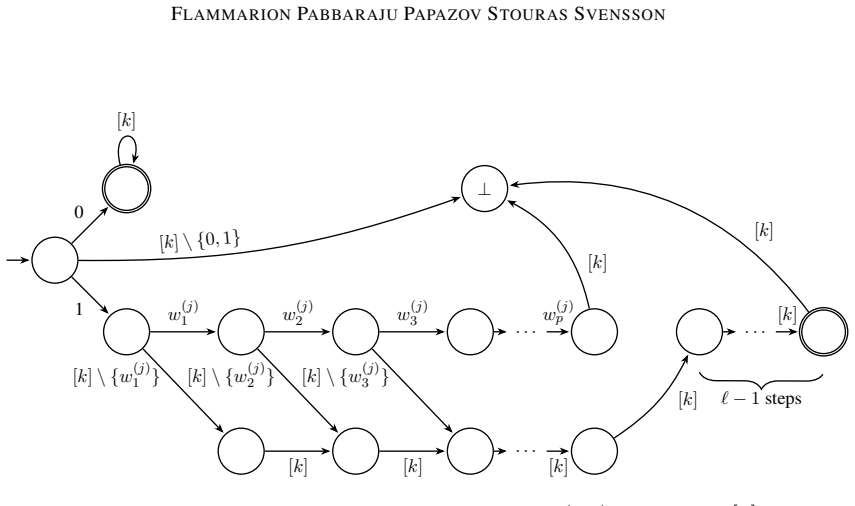
We present a streaming algorithm using poly(s,k) space that converges to a hypothesis with generation gap Δ = O(k^{2s-2}). Moreover, the learned hypothesis captures every string in K of length at least 2s-1. We complement this result with a near-matching lower bound through a reduction from a standard communication complexity problem: achieving generation gap Δ ≤ k^{(1-ε)s} requires k^{Ω(ε s)} memory.
Load-bearing premise
The target language belongs to the class of languages recognized by deterministic finite automata with at most s states.
Editorial extensions
If this is right
- Polynomial space is sufficient to guarantee that all strings of length 2s-1 or longer are included in the hypothesis.
- Exact identification of the target DFA language requires exponential space.
- The generation gap cannot be improved to k^{(1-ε)s} without increasing memory to k^{Ω(ε s)}.
- The algorithm works against an adversarial ordering of the positive examples.
Reading between the lines
- The exponential dependence on s in the gap size implies that the approach is most useful when the underlying automaton is very small.
- One could instantiate the learner on concrete small DFAs to measure the actual number of missed strings versus the O(k^{2s-2}) upper bound.
- The communication-complexity reduction technique may apply to other hypothesis classes beyond DFAs.
Signed reviews
Editorial analysis
A structured set of objections, weighed in public.
Referee Report
Summary. The paper initiates a resource-aware theory of language generation in the limit. For the class C_{s,k} of languages recognized by DFAs with at most s states over a k-letter alphabet, it gives a poly(s,k)-space streaming algorithm that outputs a hypothesis L ⊆ K with generation gap Δ = O(k^{2s-2}) while capturing every string of K of length at least 2s-1. It also shows that exact identification of K is possible with exponential space and proves a near-matching lower bound: achieving Δ ≤ k^{(1-ε)s} requires k^{Ω(ε s)} space via reduction from a communication-complexity problem.
Significance. If the stated results hold, the work cleanly separates the polynomial-space regime (approximate generation with gap polynomial in k of degree linear in s) from the exponential-space regime (exact identification). The upper bound is consistent with the fact that any s-state DFA accepts at most O(k^{2s-2}) strings of length < 2s-1, and the lower bound is obtained by standard communication-complexity techniques. This supplies quantitative, falsifiable guarantees on the best achievable generation gap under memory constraints.
Simulated Author's Rebuttal
We thank the referee for their positive evaluation of the manuscript, accurate summary of the results, and recommendation to accept. The referee's assessment correctly identifies the separation between the polynomial-space regime (approximate generation) and the exponential-space regime (exact identification).
Circularity Check
No significant circularity; self-contained algorithmic result
full rationale
The paper states direct algorithmic constructions achieving the stated poly(s,k)-space streaming learner and the Δ = O(k^{2s-2}) generation gap, together with a lower bound obtained via reduction from a standard communication-complexity problem. No load-bearing step reduces by definition or by self-citation to the claimed output; the short-string bound follows from the known size of the language of an s-state DFA rather than from any fitted parameter or renamed input. The derivation therefore remains independent of its own conclusions.
Assumptions & free parameters
assumptions (1)
- domain assumption The target language belongs to C_{s,k}, the class of languages recognized by DFAs with ≤ s states over alphabet size k.
Cite this review
Pith. "Pith review of Space-Efficient Language Generation in the Limit." pith.science (2026). https://pith.science/paper/CXZU6S6Z
@misc{pith2026260625777,
  author       = {Pith},
  title        = {Pith review of: Space-Efficient Language Generation in the Limit},
  year         = {2026},
  howpublished = {\url{https://pith.science/paper/CXZU6S6Z}},
  note         = {Machine review of arXiv:2606.25777}
}
abstract
We initiate a resource-aware theory of \textit{language generation in the limit} under the minimal constraint of space efficiency. In our framework, a learner observes an adversarial positive stream from a target language $K$ and must eventually output a hallucination-free hypothesis language $L \subseteq K$ while omitting at most $\Delta$ strings of $K$. We focus on $\mathcal{C}_{s,k}$, the collection of languages recognized by DFAs with at most $s$ states over an alphabet of size $k$, as the natural hypothesis class for memory-bounded learners. In the exponential-space regime, we prove that a learner can exactly identify the target $K$. Under a stricter memory budget, we characterize the strongest possible generation guarantees. In particular, we present a streaming algorithm using $\mathrm{poly}(s,k)$ space that converges to a hypothesis with generation gap $\Delta = O(k^{2s-2})$. Moreover, the learned hypothesis captures every string in $K$ of length at least $2s-1$. We complement this result with a near-matching lower bound through a reduction from a standard communication complexity problem. Specifically, achieving generation gap $\Delta \le k^{(1-\varepsilon)s}$ requires $k^{\Omega(\varepsilon s)}$ memory. Together, these results reveal a sharp transition between polynomial-space generation and exponential-space exact identification.
Figures
Reference graph
Works this paper leans on
-
[1]
2026 , eprint=
On Language Generation in the Limit with Bounded Memory , author=. 2026 , eprint=
2026
-
[2]
Advances in Neural Information Processing Systems , volume=
Language generation in the limit , author=. Advances in Neural Information Processing Systems , volume=
-
[3]
arXiv preprint arXiv:2412.18530 , pages=
Characterizations of language generation with breadth , author=. arXiv preprint arXiv:2412.18530 , pages=
-
[4]
1985 , publisher=
Systems that learn: An introduction to learning theory for cognitive and computer scientists , author=. 1985 , publisher=
1985
-
[5]
Learning Algorithms in the Limit
Learning Algorithms in the Limit , author=. arXiv preprint arXiv:2506.15543 , year=
-
[6]
arXiv preprint arXiv:2411.15364 , year=
Exploring facets of language generation in the limit , author=. arXiv preprint arXiv:2411.15364 , year=
-
[7]
arXiv preprint arXiv:2504.14370 , year=
Density Measures for Language Generation , author=. arXiv preprint arXiv:2504.14370 , year=
-
[8]
arXiv preprint arXiv:2410.13714 , year=
Generation through the lens of learning theory , author=. arXiv preprint arXiv:2410.13714 , year=
Show all 57 references
-
[9]
arXiv preprint arXiv:2510.02795 , year=
Pareto-optimal Non-uniform Language Generation , author=. arXiv preprint arXiv:2510.02795 , year=
-
[10]
arXiv preprint arXiv:2501.04179 , year=
Generation from Noisy Examples , author=. arXiv preprint arXiv:2501.04179 , year=
-
[11]
arXiv preprint arXiv:2505.21819 , year=
Representative Language Generation , author=. arXiv preprint arXiv:2505.21819 , year=
-
[12]
arXiv preprint arXiv:2506.18642 , year=
On Union-Closedness of Language Generation , author=. arXiv preprint arXiv:2506.18642 , year=
-
[13]
arXiv preprint arXiv:2511.04103 , year=
A Characterization of List Language Identification in the Limit , author=. arXiv preprint arXiv:2511.04103 , year=
-
[14]
Machine Learning , volume=
Characteristic sets for polynomial grammatical inference , author=. Machine Learning , volume=. 1997 , publisher=
1997
-
[15]
Information and control , volume=
Inductive inference of formal languages from positive data , author=. Information and control , volume=. 1980 , publisher=
1980
-
[16]
Information and control , volume=
Language identification in the limit , author=. Information and control , volume=. 1967 , publisher=
1967
-
[17]
Information and control , volume=
Complexity of automaton identification from given data , author=. Information and control , volume=. 1978 , publisher=
1978
-
[18]
Machine Learning , volume=
Learning DFA from simple examples , author=. Machine Learning , volume=. 2001 , publisher=
2001
-
[19]
Annual Symposium on Theoretical Aspects of Computer Science , pages=
PAC learning with simple examples , author=. Annual Symposium on Theoretical Aspects of Computer Science , pages=. 1996 , organization=
1996
-
[20]
International Workshop on Algorithmic Learning Theory , pages=
PAC learning under helpful distributions , author=. International Workshop on Algorithmic Learning Theory , pages=. 1997 , organization=
1997
-
[21]
2023 , publisher=
Automata theory: An algorithmic approach , author=. 2023 , publisher=
2023
-
[22]
ACM Sigact News , volume=
Introduction to the Theory of Computation , author=. ACM Sigact News , volume=. 1996 , publisher=
1996
-
[23]
Acm Sigact News , volume=
Introduction to automata theory, languages, and computation , author=. Acm Sigact News , volume=. 2001 , publisher=
2001
-
[24]
Theory of machines and computations , pages=
An n log n algorithm for minimizing states in a finite automaton , author=. Theory of machines and computations , pages=. 1971 , publisher=
1971
-
[25]
Acta Informatica , volume=
Describing an algorithm by Hopcroft , author=. Acta Informatica , volume=. 1973 , publisher=
1973
-
[26]
RAIRO-Theoretical Informatics and Applications , volume=
Hyper-minimizing minimized deterministic finite state automata , author=. RAIRO-Theoretical Informatics and Applications , volume=. 2009 , publisher=
2009
-
[27]
Theoretical computer science , volume=
An nlogn algorithm for hyper-minimizing a (minimized) deterministic automaton , author=. Theoretical computer science , volume=. 2010 , publisher=
2010
-
[28]
International Symposium on Mathematical Foundations of Computer Science , pages=
Hyper-minimisation made efficient , author=. International Symposium on Mathematical Foundations of Computer Science , pages=. 2009 , organization=
2009
-
[29]
International Symposium on Mathematical Foundations of Computer Science , pages=
On minimising automata with errors , author=. International Symposium on Mathematical Foundations of Computer Science , pages=. 2011 , organization=
2011
-
[30]
International Journal of Foundations of Computer Science , volume=
Optimal hyper-minimization , author=. International Journal of Foundations of Computer Science , volume=. 2011 , publisher=
2011
-
[31]
Problemy Kibernetiki , volume=
Enumeration of finite automata , author=. Problemy Kibernetiki , volume=
-
[32]
Theoretical Computer Science , volume=
Enumeration and random generation of accessible automata , author=. Theoretical Computer Science , volume=. 2007 , publisher=
2007
-
[33]
Discrete Mathematics & Theoretical Computer Science , volume=
On the asymptotic enumeration of accessible automata , author=. Discrete Mathematics & Theoretical Computer Science , volume=. 2010 , publisher=
2010
-
[34]
arXiv preprint arXiv:1109.5683 , year=
Asymptotic enumeration of minimal automata , author=. arXiv preprint arXiv:1109.5683 , year=
-
[35]
International Symposium on Mathematical Foundations of Computer Science , pages=
Random deterministic automata , author=. International Symposium on Mathematical Foundations of Computer Science , pages=. 2014 , organization=
2014
-
[36]
Stirling numbers of the second kind , author=
-
[37]
IRE Transactions on information theory , volume=
Three models for the description of language , author=. IRE Transactions on information theory , volume=. 1956 , publisher=
1956
-
[38]
Finitary models of language users , author=
-
[39]
Cognition , volume=
Negative evidence in language acquisition , author=. Cognition , volume=. 1993 , publisher=
1993
-
[40]
Journal of child language , volume=
Adult reformulations of child errors as negative evidence , author=. Journal of child language , volume=. 2003 , publisher=
2003
-
[41]
arXiv preprint arXiv:2310.05161 , year=
Recurrent neural language models as probabilistic finite-state automata , author=. arXiv preprint arXiv:2310.05161 , year=
-
[42]
Trends in cognitive sciences , volume=
Dissociating language and thought in large language models , author=. Trends in cognitive sciences , volume=. 2024 , publisher=
2024
-
[43]
Advances in neural information processing systems , volume=
Language models are few-shot learners , author=. Advances in neural information processing systems , volume=
-
[44]
OpenAI blog , volume=
Language models are unsupervised multitask learners , author=. OpenAI blog , volume=
-
[45]
Coding for Interactive Communication: A Survey , volume=
Communication complexity (for algorithm designers) , author=. Coding for Interactive Communication: A Survey , volume=. 2016 , publisher=
2016
-
[46]
Journal of computer and system sciences , volume=
Relationships between nondeterministic and deterministic tape complexities , author=. Journal of computer and system sciences , volume=. 1970 , publisher=
1970
-
[47]
arXiv preprint arXiv:2404.08819 , year=
The illusion of state in state-space models , author=. arXiv preprint arXiv:2404.08819 , year=
-
[48]
arXiv preprint arXiv:2404.14994 , year=
Transformers Can Represent n -gram Language Models , author=. arXiv preprint arXiv:2404.14994 , year=
-
[49]
Jack , title =
Copeland, B. Jack , title =. The. 2026 , edition =
2026
-
[50]
Communications of the ACM , volume=
A theory of the learnable , author=. Communications of the ACM , volume=. 1984 , publisher=
1984
-
[51]
1994 , publisher=
An introduction to computational learning theory , author=. 1994 , publisher=
1994
-
[52]
2010 , publisher=
Grammatical inference: learning automata and grammars , author=. 2010 , publisher=
2010
-
[53]
1999 , publisher=
Systems that learn: an introduction to learning theory , author=. 1999 , publisher=
1999
-
[54]
2007 , publisher=
Data streams: models and algorithms , author=. 2007 , publisher=
2007
-
[55]
Information Theory Methods in Communication Complexity , booktitle =
Ziv Bar. Information Theory Methods in Communication Complexity , booktitle =. 2002 , doi =
2002
-
[56]
T. S. Jayram and Ravi Kumar and D. Sivakumar , title =. Theory Comput. , volume =. 2008 , doi =
2008
-
[57]
Advances in Computers , volume=
Communication complexity , author=. Advances in Computers , volume=. 1997 , publisher=
1997
Reviewed June 25, 2026 · model on record in the stance chip above.
Discussion (0). Continue with ORCID to comment.