REVIEW 3 major objections 5 minor 61 references
RollingQ: Reviving the Cooperation Dynamics in Multimodal Transformer
T0 review · 3 major / 5 minor · reviewed 2026-08-07 · deepseek-v4-flash
Pith's one-line read The paper argues that dynamic attention fusion in multimodal Transformers collapses during training through a self-reinforcing bias loop, and that rotating the class-token query toward a rebalanced anchor restores it.
desk verdict RollingQ is a solid empirical paper with a cheap fix for a real attention-bias problem, but its theoretical story conflates pre-softmax logits with attention mass, so treat the diagnosis as suggestive. read the letter →
The pith
A machine-rendered reading of the paper's core claim, the machinery that carries it, and where it could break.
The reading
What carries the argument
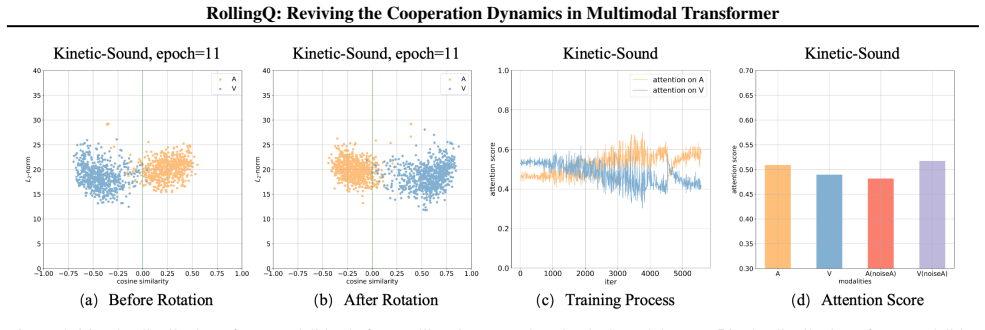
The load-bearing object is the query rotation used by RollingQ. After each training epoch the method freezes the model, computes each modality's average key $\hat{k}_m$, the Attention Imbalance Rate $\mathrm{AIR} = \mathbb{E}[\cos\theta_a - \cos\theta_v]$, and a balanced anchor $q_b = (\alpha \mathbb{E}[\hat{K}_a]/\lVert\mathbb{E}[\hat{K}_a]\rVert_2 + (1-\alpha)\mathbb{E}[\hat{K}_v]/\lVert\mathbb{E}[\hat{K}_v]\rVert_2)\,\lVert\mathbb{E}[Q]\rVert_2$ with $\alpha = \tfrac{1}{2}[1+\mathrm{Tanh}(-\rho\,\mathrm{AIR})]$. It then forms the rotation matrix $R_b = \mathrm{SVD}([\mathbb{E}[Q], q_b])$ satisfying $q_b = \mathbb{E}[Q]R_b$ and replaces each query by $q_r = qR_b$ (Equation 13). The rotation preserves the query's norm, so it changes only which keys the query points toward; this redirects optimization momentum to the underused modality without adding a trainable module.
What would settle it
Take a trained multimodal Transformer that exhibits the reported modality bias, compute the true softmax attention score for each modality, and compare it with the surrogate $L_m \|q\| \|\hat{k}_m\| \cos\theta_m$ that RollingQ's diagnosis uses. If key norms or sequence lengths differ substantially between modalities, or if the surrogate ranks the modalities differently from the true attention on even a small fraction of held-out samples, the anchor and rotation target in Equations (9)-(13) are miscalibrated and RollingQ should be expected to fail.
Extended reading notes
Core claim
The paper's central claim is that the loss of dynamic fusion in multimodal Transformers is a train-time pathology, not an architectural limitation. At initialization both modalities receive similar attention, but once one modality's features become slightly better, a feedback loop amplifies the advantage: feed-forward attention favors the biased modality, and backpropagation gives that modality's encoder more gradient, so its features improve further. The measurable signature of this loop is the Attention Imbalance Rate (AIR), the expected difference in cosine similarity between the query and the two modalities' average keys. RollingQ detects when the absolute AIR passes a threshold, builds a balanced anchor from the normalized average keys weighted by a Tanh function of AIR, and rotates the query by the singular-value-decomposition rotation matrix that maps the expected query onto the anchor. The rotated query then learns in a region where the previously neglected modality receives more attention, narrowing the key distribution gap and restoring the model's ability to lower attention when the biased modality is corrupted.
Load-bearing premise
The argument assumes that a modality's attention score is essentially set by how similar the query is to that modality's average key, because the keys' sizes and sequence lengths are roughly equal across the two modalities.
Editorial extensions
If this is right
- On the CREMA-D, Kinetic-Sound, and CMU-MOSEI benchmarks, RollingQ improves accuracy by 0.1 to 3.1 points over the corresponding vanilla or specialized multimodal Transformer baselines (Table 1).
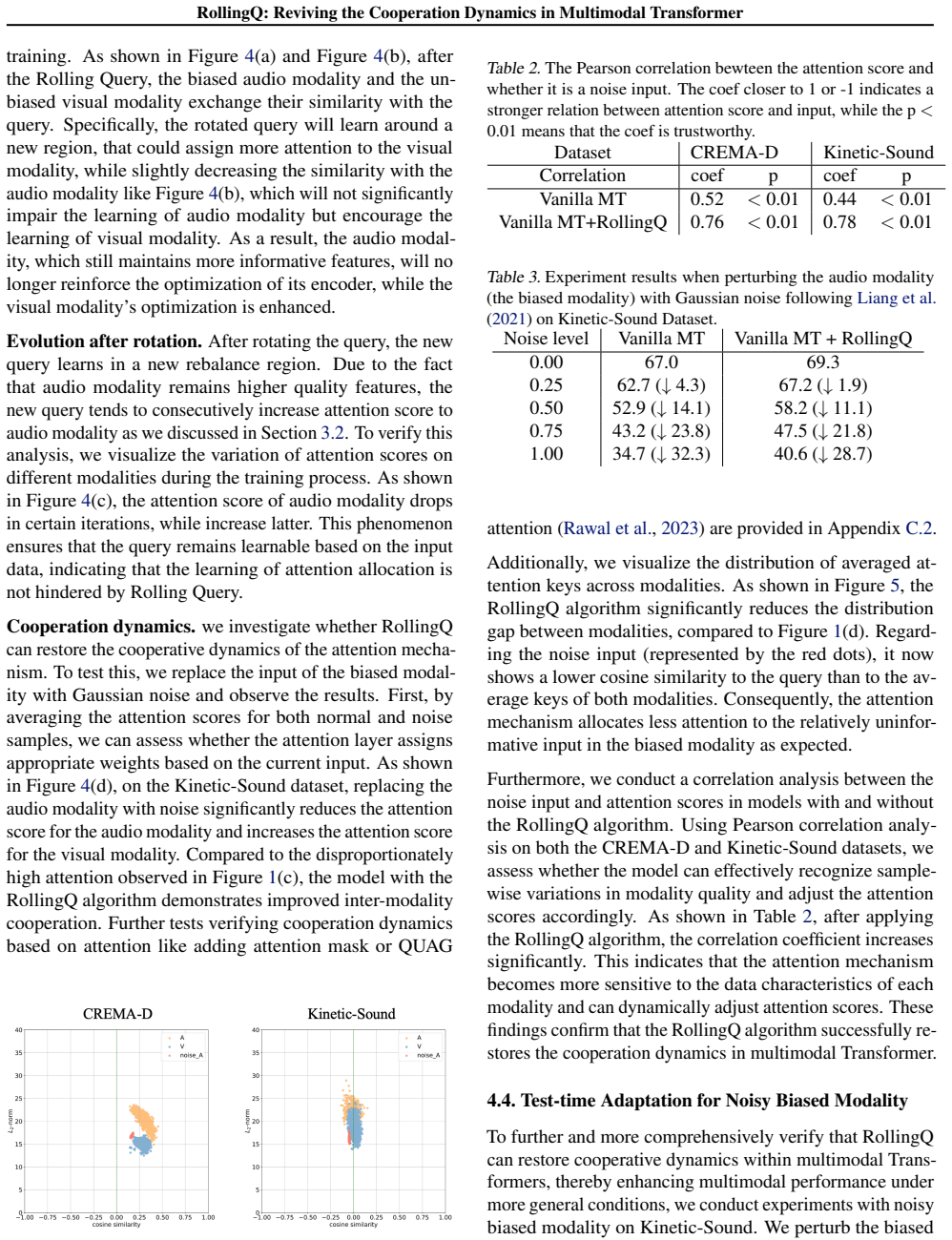
- When the biased modality is replaced with Gaussian noise, RollingQ sharply raises the correlation between attention scores and whether the input is noise (from about 0.44-0.52 to 0.76-0.78), showing that the attention mechanism has become sensitive to data quality again.
- At every tested noise level, RollingQ suffers a smaller accuracy drop than the vanilla model, indicating better robustness to unreliable modalities.
- The method adds roughly 1% parameters and 0.1% GFLOPs and improves performance across ViT depths, batch sizes, and a ResNet18 backbone, so the fix is cheap and portable.
Reading between the lines
- Because the AIR and anchor construction only use average keys and query expectations, the same rotation recipe should transfer to any attention-based fusion of two or more token sequences, such as vision-language or text-audio models, whenever key norms and sequence lengths are comparable.
- Tracking AIR during training could serve as a standalone diagnostic for emerging modality collapse, since the paper's analysis links a widening gap to degraded adaptation even before accuracy suffers.
- The rotation could plausibly be applied as a post-hoc correction on a frozen pretrained model, although the paper only reports train-time application; testing that variant would separate the training-dynamics effect from the inference-time redistribution.
- Because RollingQ acts on the query rather than on encoder features, combining it with encoder-level rebalancing methods may yield further gains; the paper itself notes it does not directly equalize unimodal feature quality.
Editorial analysis
A structured set of objections, weighed in public.
Referee Report
Summary. The paper studies why the attention mechanism in multimodal Transformers loses its dynamic adaptability, leading the model to favor one modality regardless of input quality. The authors argue that this bias is caused by a self-reinforcing cycle: the favored modality receives more attention, which amplifies its encoder gradients, which in turn further improves that modality's features and widens the gap between the attention-key distributions of different modalities. They propose Rolling Query (RollingQ), which detects imbalance with an Attention Imbalance Rate (AIR) indicator based on cosine similarity between the query and average keys, and then rotates the query toward a rebalance anchor that gives more weight to the under-attended modality. Experiments on CREMA-D, Kinetic-Sound, and CMU-MOSEI, plus noise-perturbation, correlation, and OOD tests, are presented as evidence that RollingQ restores dynamic attention and improves accuracy over vanilla and several specialized baselines.
Significance. If the central claim holds, the paper identifies a plausible and practically important failure mode of attention-based multimodal fusion and offers a remarkably simple intervention. The strength of the paper is that the proposed method is lightweight, the empirical demonstrations include a useful battery of diagnostic tests (noise corruption, Pearson correlation of attention with input quality, QUAG-style ablations, and OOD benchmarks), and the source code is promised. The claim that attention in multimodal Transformers becomes locked by a training feedback loop, and that a single query rotation can unlock it, is interesting and falsifiable. However, the paper's theoretical derivation is informal, the main accuracy numbers are reported without variance or multiple seeds, and the AIR indicator rests on a proxy that is not rigorously validated. The strongest baseline, MBT, still outperforms RollingQ on Kinetic-Sound and ties it on the other two datasets, so the practical edge over sophisticated baselines is not established even if the mechanism is correct.
major comments (3)
- [Table 1 and Section 4.2] The derivation equates the attention score for a modality with the sum of raw logits. This is not the post-softmax attention mass: the actual mass allocated to modality m is sum_{j in m} exp(q.k_j/sqrt(d)) divided by the sum over all tokens. Equation (4) rewrites the sum of raw logits, not the softmax allocation. Consequently, the AIR indicator in Eq. (9), the rebalance anchor in Eq. (10), and the rotation target all depend on the assumption that average-key cosine similarity tracks true softmax allocation. Even if ||k^a|| approx ||k^v|| and L_a approx L_v, this can fail: one modality with a few very large logits can dominate softmax while having a comparable sum of raw logits to a modality with many moderate logits. The noise-correlation experiments in Section 4.3 are suggestive but do not establish that the proxy remains faithful across the sample distribution or across different architectures. This is a load-bearing correctness risk; the paper should either reformulate AIR directly in terms of actual attention weights, or empirically validate the proxy, for example by reporting the correlation between the average-key cosine and the true softmax attention mass per sample.
- [Table 1 and Section 4.2] The reported accuracy improvements are not accompanied by standard deviations, confidence intervals, or multiple seeds. Some of the claimed gains are very small, e.g., +0.1 on MulT+RollingQ and +0.5 on Vanilla MT+RollingQ for CMU-MOSEI, and it is possible these are within run-to-run noise. The hyperparameters beta, rho, and the maximum rotation count are dataset-dependent, and the maximum rotation count is explicitly set to 1 or 3 per dataset in Appendix B. Without a sensitivity analysis or repeated-run statistics, the 'consistent accuracy gains' claim is not yet supported at the level the paper asserts. At minimum, the authors should provide mean and standard deviation over three or more seeds for the main comparison table and a sensitivity analysis for beta, rho, and rotation count.
- [Section 3.2, Eq. (8)] The self-reinforcing-cycle argument is presented as a theoretical analysis, but Eq. (8) does not rigorously imply that the modality receiving higher attention always obtains larger encoder gradients. The derivative of the softmax term through the attention weights can be negative for some tokens, and the gradient for modality m also includes the value-path term whose magnitude depends on the full attention distribution, not only on the total attention mass of that modality. The visualizations of gradient norms in Appendix A.2 are consistent with the proposed mechanism, but they are also consistent with other explanations such as differing learning dynamics of the two encoders. The paper should either formalize the cycle more carefully or explicitly label it as an intuitive mechanism supported only by empirical monitoring.
minor comments (5)
- [Abstract and Introduction] There are several typos and awkward phrasings: 'aims to to address', 'we has E[Q]=0', 'the the gradient', 'statisfied', and an inconsistent reference to the code repository as 'Github' without a URL in the abstract. These should be cleaned up.
- [Section 3.1] Equation (4) includes the sequence length L_m and the average key, but the text does not explain why the softmax denominator is ignored in the definition of 'attention score for modality m'. A sentence clarifying that this is a proxy, or a redefinition, would improve readability and prevent the misconception that it gives exact softmax mass.
- [Appendix B] The multi-layer extension trains the first attention block while 'temporarily dropping the second block' for several epochs, then switches to the second block. This is an unusual training schedule and the description is too brief to be reproducible; more detail on the number of epochs, how the dropped block is reintroduced, and how the AIR indicator is computed for the second block after switching is needed.
- [Table 4] The complexity analysis reports parameters and GFLOPs for CREMA-D, but the '1% increase in parameters' appears inconsistent with the table, which shows 59.87M to 60.46M, an increase of about 1% that checks out, while the GFLOPs increase is 0.07, about 0.005%. The text should state these numbers precisely rather than rounding to 0.1%, and the source of the GFLOPs value should be clarified.
- [Section 4.2] The paper claims RollingQ achieves 'comparable results' to static fusion imbalance techniques and 'strong performance' relative to MBT and JMT, but MBT outperforms RollingQ on Kinetic-Sound and ties on CREMA-D and MOSEI. The discussion should acknowledge this directly rather than implying superiority.
Circularity Check
Query rotation reduces the same AIR used to define imbalance, making part of the claimed 'revival' constructional; independent accuracy and noise tests prevent full circularity.
-
self definitional
[Section 3.3, Equations 9-13 (and Algorithm 1)]
"To quantify the distribution gap, we define the AttentionImbalanceRate (AIR) indicator: AIR=E[cosθ a −cosθ v]∈[−2,2].(9) ... qb = (α E[ ˆK a] ||E[ ˆK a]||2 + (1−α) E[ ˆK v] ||E[ ˆK v]||2 )||E[Q]||2,(10) while the weight α is derived, indicating AIR: α= 1 2 [1 +T anh(−ρAIR)],(11) ... qr =qR b.(13)"
The quantity RollingQ claims to restore is the same AIR that its update is constructed to reduce. AIR (Eq. 9) is the expected cosine difference between the query and the average keys. Eq. 11 makes the anchor weight α a decreasing function of AIR, Eq. 10 builds the anchor as the corresponding weighted average of the two normalized average keys, and Eqs. 12-13 rotate the query so that in expectation it becomes that anchor (q_b = E[Q]R_b, q_r = qR_b). Thus the immediate post-rotation decrease in AIR and the 'rebalancing' shown in Figures 4(a)-4(b) follow from the definition of the update rather than from a learned or independently verified training dynamic. The reported accuracy gains and noise-correlation experiments are separate results, so the circularity is partial rather than total.
full rationale
The paper's central diagnosis of a self-reinforcing cycle is an empirical/observational claim supported by visualizations and gradient monitoring; the softmax-versus-logit concern about Eq. 4 is a correctness risk, not a circularity. The circular step is in the intervention. AIR is defined as the expected cosine gap, and the rotation anchor is explicitly chosen to shrink that same gap: Eq. 11 sets α from AIR, Eq. 10 places the anchor as a weighted average of the normalized average keys, and Eqs. 12-13 enforce q_r = qR_b with E[Q]R_b = q_b. Hence 'rebalancing' after rotation is a mathematical identity of the update, not an independent empirical finding. However, the paper's most important validations—Table 1 accuracy gains, Table 3 noise-perturbation robustness, Table 2 Pearson correlations between attention and input quality, and Table 10 OOD results—do not follow from the construction and provide independent support. The self-citations in the related-work section (e.g., Peng et al. 2022, Huang et al. 2025) are baselines and background, not load-bearing justifications for the main claim. The authors' own limitation that the theoretical analysis focuses on a single attention layer is a scope restriction rather than a circularity. Overall, the central method is partially circular by construction, but the empirical evaluation keeps the paper from being fully circular.
Assumptions & free parameters
free parameters (3)
- beta (AIR rotation threshold)
- rho (anchor weight sharpness)
- maximum rotation count =
1 for CREMA-D and MOSEI, 3 for Kinetic-Sound
assumptions (4)
- domain assumption At initialization, the query and average keys are independent with E[Q]=0, so both modalities receive similar attention scores.
- domain assumption The attention score for a modality is dominated by cosine similarity between the query and the modality's average key.
- ad hoc to paper Higher attention to a modality amplifies its encoder gradients, which further improves that modality and entrenches the bias.
- domain assumption Multimodal deep networks are greedy and favor the modality that first provides higher quality features.
Cite this review
Pith. "Pith review of RollingQ: Reviving the Cooperation Dynamics in Multimodal Transformer." pith.science (2026). https://pith.science/paper/D4XXRMWY
@misc{pith2026250611465,
  author       = {Pith},
  title        = {Pith review of: RollingQ: Reviving the Cooperation Dynamics in Multimodal Transformer},
  year         = {2026},
  howpublished = {\url{https://pith.science/paper/D4XXRMWY}},
  note         = {Machine review of arXiv:2506.11465}
}
read the original abstract
Multimodal learning faces challenges in effectively fusing information from diverse modalities, especially when modality quality varies across samples. Dynamic fusion strategies, such as attention mechanism in Transformers, aim to address such challenge by adaptively emphasizing modalities based on the characteristics of input data. However, through amounts of carefully designed experiments, we surprisingly observed that the dynamic adaptability of widely-used self-attention models diminishes. Model tends to prefer one modality regardless of data characteristics. This bias triggers a self-reinforcing cycle that progressively overemphasizes the favored modality, widening the distribution gap in attention keys across modalities and deactivating attention mechanism's dynamic properties. To revive adaptability, we propose a simple yet effective method Rolling Query (RollingQ), which balances attention allocation by rotating the query to break the self-reinforcing cycle and mitigate the key distribution gap. Extensive experiments on various multimodal scenarios validate the effectiveness of RollingQ and the restoration of cooperation dynamics is pivotal for enhancing the broader capabilities of widely deployed multimodal Transformers. The source code is available at https://github.com/GeWu-Lab/RollingQ_ICML2025.
Figures


Figures from the paper (6 more)


Reference graph
Works this paper leans on
-
[1]
write newline
" write newline "" before.all 'output.state := FUNCTION n.dashify 't := "" t empty not t #1 #1 substring "-" = t #1 #2 substring "--" = not "--" * t #2 global.max substring 't := t #1 #1 substring "-" = "-" * t #2 global.max substring 't := while if t #1 #1 substring * t #2 global.max substring 't := if while FUNCTION format.date year duplicate empty "emp...
-
[2]
Arandjelovic, R. and Zisserman, A. Look, listen and learn. In Proceedings of the IEEE international conference on computer vision, pp.\ 609--617, 2017
work page 2017
-
[3]
Singular value decomposition tutorial
Baker, K. Singular value decomposition tutorial. The Ohio State University, 24: 0 22, 2005
work page 2005
-
[4]
Multimodal machine learning: A survey and taxonomy
Baltru s aitis, T., Ahuja, C., and Morency, L.-P. Multimodal machine learning: A survey and taxonomy. IEEE transactions on pattern analysis and machine intelligence, 41 0 (2): 0 423--443, 2018
work page 2018
-
[5]
Bridle, J. Training stochastic model recognition algorithms as networks can lead to maximum mutual information estimation of parameters. Advances in neural information processing systems, 2, 1989
work page 1989
-
[6]
Cao, H., Cooper, D. G., Keutmann, M. K., Gur, R. C., Nenkova, A., and Verma, R. Crema-d: Crowd-sourced emotional multimodal actors dataset. IEEE transactions on affective computing, 5 0 (4): 0 377--390, 2014
work page 2014
-
[7]
End-to-end object detection with transformers
Carion, N., Massa, F., Synnaeve, G., Usunier, N., Kirillov, A., and Zagoruyko, S. End-to-end object detection with transformers. In European conference on computer vision, pp.\ 213--229. Springer, 2020
2020
-
[8]
Vggsound: A large-scale audio-visual dataset
Chen, H., Xie, W., Vedaldi, A., and Zisserman, A. Vggsound: A large-scale audio-visual dataset. In ICASSP 2020-2020 IEEE International Conference on Acoustics, Speech and Signal Processing (ICASSP), pp.\ 721--725. IEEE, 2020
work page 2020
Show all 61 references
-
[9]
T., Rubanova, Y., Bettencourt, J., and Duvenaud, D
Chen, R. T., Rubanova, Y., Bettencourt, J., and Duvenaud, D. K. Neural ordinary differential equations. Advances in neural information processing systems, 31, 2018
2018
-
[10]
Self-attention fusion for audiovisual emotion recognition with incomplete data
Chumachenko, K., Iosifidis, A., and Gabbouj, M. Self-attention fusion for audiovisual emotion recognition with incomplete data. In 2022 26th International Conference on Pattern Recognition (ICPR), pp.\ 2822--2828. IEEE, 2022
2022
-
[11]
What does bert look at? an analysis of bert’s attention
Clark, K. What does bert look at? an analysis of bert’s attention. arXiv preprint arXiv:1906.04341, 2019
1906 arXiv
-
[12]
Addressing failure prediction by learning model confidence
Corbi \`e re, C., Thome, N., Bar-Hen, A., Cord, M., and P \'e rez, P. Addressing failure prediction by learning model confidence. Advances in Neural Information Processing Systems, 32, 2019
2019
-
[13]
Multiood: Scaling out-of-distribution detection for multiple modalities
Dong, H., Zhao, Y., Chatzi, E., and Fink, O. Multiood: Scaling out-of-distribution detection for multiple modalities. arXiv preprint arXiv:2405.17419, 2024
2024 arXiv
-
[14]
An image is worth 16x16 words: Transformers for image recognition at scale
Dosovitskiy, A. An image is worth 16x16 words: Transformers for image recognition at scale. arXiv preprint arXiv:2010.11929, 2020
2010 arXiv
-
[15]
Pmr: Prototypical modal rebalance for multimodal learning
Fan, Y., Xu, W., Wang, H., Wang, J., and Guo, S. Pmr: Prototypical modal rebalance for multimodal learning. In Proceedings of the IEEE/CVF Conference on Computer Vision and Pattern Recognition, pp.\ 20029--20038, 2023
2023
-
[16]
A survey on deep learning for multimodal data fusion
Gao, J., Li, P., Chen, Z., and Zhang, J. A survey on deep learning for multimodal data fusion. Neural Computation, 32 0 (5): 0 829--864, 2020
2020
-
[17]
C., Wang, X., and Li, H
Gao, P., Jiang, Z., You, H., Lu, P., Hoi, S. C., Wang, X., and Li, H. Dynamic fusion with intra-and inter-modality attention flow for visual question answering. In Proceedings of the IEEE/CVF conference on computer vision and pattern recognition, pp.\ 6639--6648, 2019
2019
-
[18]
A mathematical perspective on transformers
Geshkovski, B., Letrouit, C., Polyanskiy, Y., and Rigollet, P. A mathematical perspective on transformers. arXiv preprint arXiv:2312.10794, 2023
2023 arXiv
-
[19]
Multimodal dynamics: Dynamical fusion for trustworthy multimodal classification
Han, Z., Yang, F., Huang, J., Zhang, C., and Yao, J. Multimodal dynamics: Dynamical fusion for trustworthy multimodal classification. In Proceedings of the IEEE/CVF conference on computer vision and pattern recognition, pp.\ 20707--20717, 2022
2022
-
[20]
Deep residual learning for image recognition
He, K., Zhang, X., Ren, S., and Sun, J. Deep residual learning for image recognition. In Proceedings of the IEEE conference on computer vision and pattern recognition, pp.\ 770--778, 2016
2016
-
[21]
Masked autoencoders are scalable vision learners
He, K., Chen, X., Xie, S., Li, Y., Doll \'a r, P., and Girshick, R. Masked autoencoders are scalable vision learners. In Proceedings of the IEEE/CVF conference on computer vision and pattern recognition, pp.\ 16000--16009, 2022
2022
-
[22]
Reconboost: Boosting can achieve modality reconcilement
Hua, C., Xu, Q., Bao, S., Yang, Z., and Huang, Q. Reconboost: Boosting can achieve modality reconcilement. arXiv preprint arXiv:2405.09321, 2024
2024 arXiv
-
[23]
Adaptive unimodal regulation for balanced multimodal information acquisition
Huang, C., Wei, Y., Yang, Z., and Hu, D. Adaptive unimodal regulation for balanced multimodal information acquisition. In Proceedings of the Computer Vision and Pattern Recognition Conference, pp.\ 25854--25863, 2025
2025
-
[24]
Modality competition: What makes joint training of multi-modal network fail in deep learning?(provably)
Huang, Y., Lin, J., Zhou, C., Yang, H., and Huang, L. Modality competition: What makes joint training of multi-modal network fail in deep learning?(provably). In International conference on machine learning, pp.\ 9226--9259. PMLR, 2022
2022
-
[25]
Pixel-bert: Aligning image pixels with text by deep multi-modal transformers
Huang, Z., Zeng, Z., Liu, B., Fu, D., and Fu, J. Pixel-bert: Aligning image pixels with text by deep multi-modal transformers. arXiv preprint arXiv:2004.00849, 2020
2004 arXiv
-
[26]
Joze, H. R. V., Shaban, A., Iuzzolino, M. L., and Koishida, K. Mmtm: Multimodal transfer module for cnn fusion. In Proceedings of the IEEE/CVF conference on computer vision and pattern recognition, pp.\ 13289--13299, 2020
2020
-
[27]
Vilt: Vision-and-language transformer without convolution or region supervision
Kim, W., Son, B., and Kim, I. Vilt: Vision-and-language transformer without convolution or region supervision. In International conference on machine learning, pp.\ 5583--5594. PMLR, 2021
2021
-
[28]
Revealing the dark secrets of bert
Kovaleva, O. Revealing the dark secrets of bert. arXiv preprint arXiv:1908.08593, 2019
1908 arXiv
-
[29]
Hmdb: a large video database for human motion recognition
Kuehne, H., Jhuang, H., Garrote, E., Poggio, T., and Serre, T. Hmdb: a large video database for human motion recognition. In 2011 International conference on computer vision, pp.\ 2556--2563. IEEE, 2011
2011
-
[30]
H., Yatskar, M., Yin, D., Hsieh, C.-J., and Chang, K.-W
Li, L. H., Yatskar, M., Yin, D., Hsieh, C.-J., and Chang, K.-W. Visualbert: A simple and performant baseline for vision and language. arXiv preprint arXiv:1908.03557, 2019
1908 arXiv
-
[31]
P., Lyu, Y., Fan, X., Wu, Z., Cheng, Y., Wu, J., Chen, L., Wu, P., Lee, M
Liang, P. P., Lyu, Y., Fan, X., Wu, Z., Cheng, Y., Wu, J., Chen, L., Wu, P., Lee, M. A., Zhu, Y., et al. Multibench: Multiscale benchmarks for multimodal representation learning. Advances in neural information processing systems, 2021 0 (DB1): 0 1, 2021
2021
-
[32]
P., Zadeh, A., and Morency, L.-P
Liang, P. P., Zadeh, A., and Morency, L.-P. Foundations and trends in multimodal machine learning: Principles, challenges, and open questions. arXiv preprint arXiv:2209.03430, 2022
2022 arXiv
-
[33]
B., Liang, P
Liu, Z., Shen, Y., Lakshminarasimhan, V. B., Liang, P. P., Zadeh, A., and Morency, L.-P. Efficient low-rank multimodal fusion with modality-specific factors. arXiv preprint arXiv:1806.00064, 2018
2018 arXiv
-
[34]
Attention bottlenecks for multimodal fusion
Nagrani, A., Yang, S., Arnab, A., Jansen, A., Schmid, C., and Sun, C. Attention bottlenecks for multimodal fusion. Advances in neural information processing systems, 34: 0 14200--14213, 2021
2021
-
[35]
Balanced multimodal learning via on-the-fly gradient modulation
Peng, X., Wei, Y., Deng, A., Wang, D., and Hu, D. Balanced multimodal learning via on-the-fly gradient modulation. In Proceedings of the IEEE/CVF conference on computer vision and pattern recognition, pp.\ 8238--8247, 2022
2022
-
[36]
S., Matyasko, A., Jaiswal, S., Fernando, B., and Tan, C
Rawal, I. S., Matyasko, A., Jaiswal, S., Fernando, B., and Tan, C. Dissecting multimodality in videoqa transformer models by impairing modality fusion. arXiv preprint arXiv:2306.08889, 2023
2023 arXiv
-
[37]
Zorro: the masked multimodal transformer
Recasens, A., Lin, J., Carreira, J., Jaegle, D., Wang, L., Alayrac, J.-b., Luc, P., Miech, A., Smaira, L., Hemsley, R., et al. Zorro: the masked multimodal transformer. arXiv preprint arXiv:2301.09595, 2023
2023 arXiv
-
[38]
Imagenet-21k pretraining for the masses
Ridnik, T., Ben-Baruch, E., Noy, A., and Zelnik-Manor, L. Imagenet-21k pretraining for the masses. arXiv preprint arXiv:2104.10972, 2021
2021 arXiv
-
[39]
and Monro, S
Robbins, H. and Monro, S. A stochastic approximation method. The annals of mathematical statistics, pp.\ 400--407, 1951
1951
-
[40]
R., and Shah, M
Soomro, K., Zamir, A. R., and Shah, M. Ucf101: A dataset of 101 human actions classes from videos in the wild. arXiv preprint arXiv:1212.0402, 2012
2012 arXiv
-
[41]
L., Tickoo, O., and Huang, J
Subedar, M., Krishnan, R., Meyer, P. L., Tickoo, O., and Huang, J. Uncertainty-aware audiovisual activity recognition using deep bayesian variational inference. In Proceedings of the IEEE/CVF international conference on computer vision, pp.\ 6301--6310, 2019
2019
-
[42]
H., Bai, S., Liang, P
Tsai, Y.-H. H., Bai, S., Liang, P. P., Kolter, J. Z., Morency, L.-P., and Salakhutdinov, R. Multimodal transformer for unaligned multimodal language sequences. In Proceedings of the conference. Association for computational linguistics. Meeting, volume 2019, pp.\ 6558. NIH Pub...
2019
-
[43]
Attention is all you need
Vaswani, A. Attention is all you need. Advances in Neural Information Processing Systems, 2017
2017
-
[44]
H., Zeeshan, M
Waligora, P., Aslam, M. H., Zeeshan, M. O., Belharbi, S., Koerich, A. L., Pedersoli, M., Bacon, S., and Granger, E. Joint multimodal transformer for emotion recognition in the wild. In Proceedings of the IEEE/CVF Conference on Computer Vision and Pattern Recognition, pp.\ 4625...
2024
-
[45]
What makes training multi-modal classification networks hard? In Proceedings of the IEEE/CVF conference on computer vision and pattern recognition, pp.\ 12695--12705, 2020 a
Wang, W., Tran, D., and Feiszli, M. What makes training multi-modal classification networks hard? In Proceedings of the IEEE/CVF conference on computer vision and pattern recognition, pp.\ 12695--12705, 2020 a
2020
-
[46]
Deep multimodal fusion by channel exchanging
Wang, Y., Huang, W., Sun, F., Xu, T., Rong, Y., and Huang, J. Deep multimodal fusion by channel exchanging. Advances in neural information processing systems, 33: 0 4835--4845, 2020 b
2020
-
[47]
Multimodal token fusion for vision transformers
Wang, Y., Chen, X., Cao, L., Huang, W., Sun, F., and Wang, Y. Multimodal token fusion for vision transformers. In Proceedings of the IEEE/CVF conference on computer vision and pattern recognition, pp.\ 12186--12195, 2022
2022
-
[48]
Wankhade, M., Rao, A. C. S., and Kulkarni, C. A survey on sentiment analysis methods, applications, and challenges. Artificial Intelligence Review, 55 0 (7): 0 5731--5780, 2022
2022
-
[49]
Enhancing multimodal cooperation via sample-level modality valuation
Wei, Y., Feng, R., Wang, Z., and Hu, D. Enhancing multimodal cooperation via sample-level modality valuation. In Proceedings of the IEEE/CVF Conference on Computer Vision and Pattern Recognition, pp.\ 27338--27347, 2024
2024
-
[50]
Wu, N., Jastrzebski, S., Cho, K., and Geras, K. J. Characterizing and overcoming the greedy nature of learning in multi-modal deep neural networks. In International Conference on Machine Learning, pp.\ 24043--24055. PMLR, 2022
2022
-
[51]
Multimodal fusion with co-attention networks for fake news detection
Wu, Y., Zhan, P., Zhang, Y., Wang, L., and Xu, Z. Multimodal fusion with co-attention networks for fake news detection. In Findings of the association for computational linguistics: ACL-IJCNLP 2021, pp.\ 2560--2569, 2021
2021
-
[52]
Multimodal multi-loss fusion network for sentiment analysis
Wu, Z., Gong, Z., Koo, J., and Hirschberg, J. Multimodal multi-loss fusion network for sentiment analysis. In Proceedings of the 2024 Conference of the North American Chapter of the Association for Computational Linguistics: Human Language Technologies (Volume 1: Long Papers),...
2024
-
[53]
Balanced audiovisual dataset for imbalance analysis
Xia, W., Zhao, X., Pang, X., Zhang, C., and Hu, D. Balanced audiovisual dataset for imbalance analysis. arXiv preprint arXiv:2302.10912, 2023
2023 arXiv
-
[54]
Xu, P., Zhu, X., and Clifton, D. A. Multimodal learning with transformers: A survey. IEEE Transactions on Pattern Analysis and Machine Intelligence, 45 0 (10): 0 12113--12132, 2023
2023
-
[55]
Facilitating multimodal classification via dynamically learning modality gap
Yang, Y., Wan, F., Jiang, Q., and Xu, Y. Facilitating multimodal classification via dynamically learning modality gap. In Advances in Neural Information Processing Systems 38, 2024
2024
-
[56]
Learning to rebalance multi-modal optimization by adaptively masking subnetworks
Yang, Y., Pan, H., Jiang, Q., Xu, Y., and Tang, J. Learning to rebalance multi-modal optimization by adaptively masking subnetworks. IEEE Trans. Pattern Anal. Mach. Intell. , 2025
2025
-
[57]
Deep modular co-attention networks for visual question answering
Yu, Z., Yu, J., Cui, Y., Tao, D., and Tian, Q. Deep modular co-attention networks for visual question answering. In Proceedings of the IEEE/CVF conference on computer vision and pattern recognition, pp.\ 6281--6290, 2019
2019
-
[58]
Tensor fusion network for multimodal sentiment analysis
Zadeh, A., Chen, M., Poria, S., Cambria, E., and Morency, L.-P. Tensor fusion network for multimodal sentiment analysis. arXiv preprint arXiv:1707.07250, 2017
2017 arXiv
-
[59]
B., Liang, P
Zadeh, A. B., Liang, P. P., Poria, S., Cambria, E., and Morency, L.-P. Multimodal language analysis in the wild: Cmu-mosei dataset and interpretable dynamic fusion graph. In Proceedings of the 56th Annual Meeting of the Association for Computational Linguistics (Volume 1: Long...
2018
-
[60]
T., and Peng, X
Zhang, Q., Wu, H., Zhang, C., Hu, Q., Fu, H., Zhou, J. T., and Peng, X. Provable dynamic fusion for low-quality multimodal data. In International conference on machine learning, pp.\ 41753--41769. PMLR, 2023
2023
-
[61]
Multimodal fusion on low-quality data: A comprehensive survey
Zhang, Q., Wei, Y., Han, Z., Fu, H., Peng, X., Deng, C., Hu, Q., Xu, C., Wen, J., Hu, D., et al. Multimodal fusion on low-quality data: A comprehensive survey. arXiv preprint arXiv:2404.18947, 2024
2024 arXiv
Reviewed August 7, 2026 · model on record in the stance chip above.
Discussion (0). Sign in to comment.