REVIEW 3 major objections 5 minor 26 references
Using LLMs to identify features of personal and professional skills in an open-response situational judgment test
T0 review · 3 major / 5 minor · reviewed 2026-08-06 · deepseek-v4-flash
Pith's one-line read Zero-shot LLMs can extract construct-relevant features from open-ended situational judgment test responses, with agreement that improves when prompts include level descriptions.
desk verdict Zero-shot LLM feature extraction for SJTs is a plausible, honestly reported pilot, but the Study 2 prompt-engineering gain is inflated by evaluating on the same responses used to tune the prompts. read the letter →
The pith
A machine-rendered reading of the paper's core claim, the machinery that carries it, and where it could break.
The reading
What carries the argument
The load-bearing object is the set of seven construct-relevant features (INT, LACKINF, JUST, VAGUE, PERSP, DISRES, CREAT) taken from a prior mixed-methods study of what drives Casper raters' scores. Each feature is defined by levels on an ordinal or binary scale, and the task is a per-feature classification of each response. The method is zero-shot prompting: one LLM at a time receives the scenario context, the questions, and a feature description, and returns a JSON decision plus reasoning. Agreement is measured with Cohen's $\kappa$ with quadratic weighting against each of two human raters, averaged. The level descriptions added in the second study are the mechanism that reduces threshold misalignment, which the authors diagnose by comparing the proportions of levels selected by humans versus the LLM.
What would settle it
A direct test would be to extract the same features from a larger set of responses scored by a larger panel of raters and check whether the reported $\kappa$ improvements hold against the more reliable reference; a simpler check is whether the extracted features predict Casper's holistic human scores, a correlation the paper does not report.
Extended reading notes
Core claim
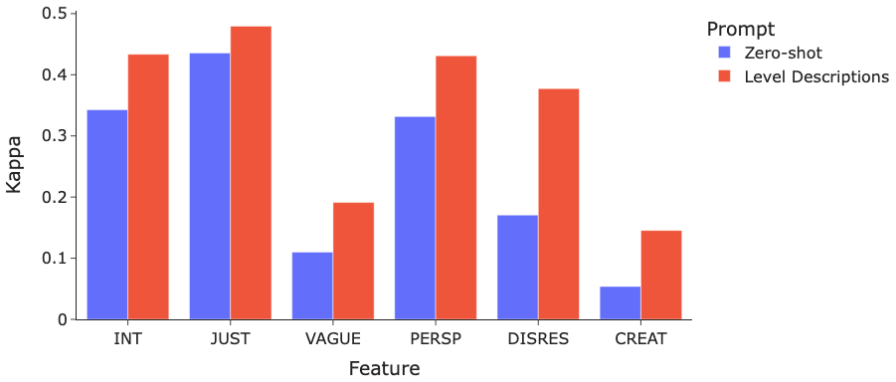
The paper's central claim is that construct-relevant features of SJT responses can be extracted automatically by prompting LLMs to classify one feature at a time, and that richer level descriptions in the prompt move LLM classifications closer to human raters. With a shared zero-shot prompt, the best model achieved the highest average Cohen's $\kappa$ on four of seven features and near-human agreement on LACKINF; no model approached human-level agreement on most features, with gaps between 0.209 and 0.352 in $\kappa$. Prompt engineering with inclusion and exclusion criteria for each feature level improved agreement on all six features tested, with the largest gain on DISRES ($\Delta\kappa = 0.206$). The authors conclude this is a feasible route toward automated scoring, while noting that the dataset is small and human-human agreement is itself imperfect.
Load-bearing premise
The whole comparison assumes the seven features are the right ones for the construct and that the two human raters' classifications are a stable, valid reference; with human-human kappas as low as 0.356 for VAGUE, the benchmark itself is noisy.
Editorial extensions
If this is right
- Zero-shot LLM feature extraction is feasible for open-response SJTs and can support the development of automated scoring.
- Classifying one feature per response, rather than all features at once, is a workable prompting strategy for nuanced constructs.
- Adding level descriptions and inclusion or exclusion criteria to prompts materially improves LLM-human agreement.
- A production system may use different LLMs for different features, or an ensemble voting scheme, since each model excelled on at least one feature.
- Features like LACKINF that track specific wording may be extractable with simpler keyword or semantic methods.
Reading between the lines
- If feature extraction becomes reliable, the same pipeline could extend beyond SJTs to personal essays and reference letters, where generative AI has made authenticity harder to judge.
- The 'reasoning' field the models return is currently unused; using it for validity evidence or respondent feedback is a natural next step the paper names but does not test.
- The level-description gain suggests that calibrating thresholds from human annotations could close more of the remaining gap than prompt text alone.
- A testable extension is to measure whether these features predict holistic Casper scores, connecting feature extraction to construct validity.
Signed reviews
Editorial analysis
A structured set of objections, weighed in public.
Referee Report
Summary. The paper investigates whether zero-shot LLMs can identify seven construct-relevant features in 162 open-response Casper SJT responses. Study 1 compares five LLMs (GPT-4o-mini, DeepSeek-R1, Llama 4 Maverick, o4-mini, Claude Sonnet 4) against two human raters, reporting Cohen's kappa for each feature and finding that Claude Sonnet 4 and o4-mini generally perform best, though mostly below human-rater agreement. Study 2 uses o4-mini with prompts augmented by level descriptions, reporting improved kappa values (Δκ ≈ 0.08–0.206). The paper concludes that LLM-based feature extraction is promising and that prompt details can improve agreement, laying groundwork for automated SJT scoring.
Significance. If the zero-shot results are taken on their own, the paper provides a useful, honestly reported feasibility demonstration: multiple LLMs were evaluated with a reproducible prompt, and the authors disclose low human-human agreement for several features. The study also ships a minimal reproducible example and makes no exaggerated claim of human-level performance for most features. However, the headline improvement claim in Study 2 is compromised by evaluation leakage, because the level-description prompts were designed after inspecting model and human classifications on the same 162 responses. As a result, the quantitative evidence for the paper's central methodological recommendation is not identifiable from the reported data. The work is still publishable after a revision that validates the prompt-engineering step on a holdout set and substantially adds uncertainty-aware reporting.
major comments (3)
- [§5.2, Table 3, Table 4] The improvement reported in the last column of Table 3 is not a valid estimate of the benefit of level descriptions, because the enriched prompts were developed after inspecting o4-mini's and the human raters' distributions on the same 162 responses (as stated in the Table 4 discussion: "We used these results to motivate our prompt engineering strategy"). Any prompt edit that shifts o4-mini's labels toward the observed human labels, including rater idiosyncrasies and sampling noise, will inflate Δκ. The paper acknowledges the small sample but does not acknowledge this evaluation leakage. To support the claim that adding level details improves agreement, the authors must validate on a held-out set of responses (or use cross-validation) and report the corresponding kappa.
- [Table 1, §5.1] For VAGUE, human-human Cohen's κ is 0.356, and for CREAT it is 0.510. With such noisy reference labels, the absolute LLM-human kappa values are hard to interpret; a low LLM-human kappa could reflect rater unreliability rather than LLM deficiency, and a high kappa could be partially an artifact of fitting one rater's pattern. The paper should report LLM-human κ separately for each human rater (or the range across raters) and discuss the ceiling imposed by rater disagreement. As it stands, statements such as Claude Sonnet 4 "generally outperforms" on features with κ differences of 0.03–0.07 (e.g., INT 0.404 vs o4-mini 0.343) are not supported without uncertainty quantification.
- [§5.1, Table 3] No confidence intervals, standard errors, or significance tests are reported for any kappa values. With n=162 and many comparisons across models and features, small numerical differences (e.g., GPT-4o-mini 0.658 vs DeepSeek-R1 0.603 for LACKINF, or Claude Sonnet 4 0.277 vs o4-mini 0.054 for CREAT) cannot be interpreted as meaningful without error bars. The phrase "super-human agreement" for GPT-4o-mini on LACKINF (0.658 vs human-human 0.640) is particularly misleading because human-human agreement is not a hard ceiling and the difference is within likely sampling error. At minimum, the authors should provide bootstrap confidence intervals for all reported kappa values.
minor comments (5)
- [Table 1 and Table 3] The feature name "VAGUE" is typeset with a space as "V AGUE" and the model "Llama 4 Maverick" appears as "Lllama 4 Maverick"; these typos should be corrected.
- [§4, prompt example] The system prompt labels the scenario as an "ethical dilemma," but not all Casper scenarios are ethical dilemmas. Using neutral wording such as "situation" would avoid biasing the model and better match the assessment design.
- [§2 and §3] The paper omits two of the nine features from Iqbal et al. because they are scenario-specific, but does not describe what those features are. A sentence in §2 or §3 listing the omitted features would help readers judge the generalizability of the approach.
- [§5.2] The paper collects "reasoning" outputs but never analyzes them. Since the authors explicitly cite Casabianca et al. on the validity value of reasoning traces, a brief explanation of why the reasoning outputs were not inspected (or a plan to inspect them in future work) would strengthen the validity discussion.
- [Abstract and §6] The abstract calls the approach "novel," but prior work on LLM-based feature extraction in essay scoring is cited in §1. The claimed novelty should be scoped to open-response SJTs specifically, or the wording should be softened.
Circularity Check
Level-description prompt improvements are measured on the same 162 responses used to design the prompts, so the reported Δκ is an overfit estimate; the zero-shot feasibility claim is otherwise externally benchmarked.
-
fitted input called prediction
[Section 5.2 (Table 4 used to motivate prompt engineering; Table 3 last column reports the resulting κ on the same responses)]
"Table 4 shows the proportion of classifications made by the two human raters and o4-mini for each level of each feature. We can see that o4-mini is typically misaligned with the human raters in terms of how to separate the levels of a feature. ... We used these results to motivate our prompt engineering strategy and further delineate feature levels. ... We find that including additional details about the levels for a feature in the prompt effectively improves the LLM’s agreement with humans."
The level descriptions are the fitted input. They were written after inspecting the human and o4-mini classifications on the same 162 responses (Table 4), and the improved κ values in the last column of Table 3 are computed on those same 162 responses. With human–human agreement as low as κ=0.356 (VAGUE) and κ=0.510 (CREAT), the reference labels contain rater-specific noise; any prompt edit that moves o4-mini's level proportions toward the observed human proportions (e.g., reducing the 22.2% DISRES rate toward the humans' 5–6%, or moving o4-mini off the 59.9% 'Reasonable Justification' mid-scale spike) will inflate κ on this sample by construction, even if it would not generalize.
full rationale
The zero-shot feasibility study (Table 3, first five columns) is not circular: each LLM is prompted with only the feature description and scenario, and agreement is computed against independently produced human rater labels. The feature taxonomy is taken from the authors' prior work (Iqbal et al., 2025), which is a self-citation and weakens construct-validity claims, but it does not make the LLM-human agreement circular because the LLM outputs are not derived from the human labels. The second experiment is different. Section 5.2 uses Table 4, which displays human and o4-mini classifications on the same 162 responses, to motivate new level descriptions, and then reports improved κ on those same 162 responses. Any prompt adjustment that shifts o4-mini's level proportions toward the observed human proportions will raise κ on the fitting sample, so the paper's claim that adding level details improves agreement is not identified. No held-out split, cross-validation, or external validation is reported, and the paper's small-sample caveat does not acknowledge this evaluation leakage. Because the basic feasibility result is independently benchmarked, the circularity is partial rather than total: the prompt-engineering improvement claim reduces to a fit to the evaluation data, while the zero-shot extraction comparison retains external content.
Assumptions & free parameters
free parameters (1)
- Level-description prompt add-ons (Study 2) =
N/A
assumptions (4)
- domain assumption Seven features from Iqbal et al. are construct-relevant for Casper SJT ratings.
- domain assumption Human raters' feature classifications provide a stable, valid ground truth.
- domain assumption Video summaries used in prompts faithfully represent the video-based scenarios.
- standard math Quadratic-weighted Cohen's kappa after mapping ordinal feature levels to a numeric scale is an appropriate agreement metric.
Cite this review
Pith. "Pith review of Using LLMs to identify features of personal and professional skills in an open-response situational judgment test." pith.science (2026). https://pith.science/paper/D6FZYYEL
@misc{pith2026250713881,
  author       = {Pith},
  title        = {Pith review of: Using LLMs to identify features of personal and professional skills in an open-response situational judgment test},
  year         = {2026},
  howpublished = {\url{https://pith.science/paper/D6FZYYEL}},
  note         = {Machine review of arXiv:2507.13881}
}
read the original abstract
Academic programs are increasingly recognizing the importance of personal and professional skills and their critical role alongside technical expertise in preparing students for future success in diverse career paths. With this growing demand comes the need for scalable systems to measure, evaluate, and develop these skills. Situational Judgment Tests (SJTs) offer one potential avenue for measuring these skills in a standardized and reliable way, but open-response SJTs have traditionally relied on trained human raters for evaluation, presenting operational challenges to delivering SJTs at scale. Past attempts at developing NLP-based scoring systems for SJTs have fallen short due to issues with construct validity of these systems. In this article, we explore a novel approach to extracting construct-relevant features from SJT responses using large language models (LLMs). We use the Casper SJT to demonstrate the efficacy of this approach. This study sets the foundation for future developments in automated scoring for personal and professional skills.
Figures

Reference graph
Works this paper leans on
-
[1]
Okan Bulut, Alexander MacIntosh, and Cole Walsh. 2022. Leveraging natural language processing for quality assurance of a situational judgement test. In International Conference on Artificial Intelligence in Education, pages 84--88. Springer
work page 2022
-
[2]
Ramsey Cardwell, Geoffrey T LaFlair, and Burr Settles. 2022. Duolingo english test: technical manual. Duolingo Research Report
work page 2022
-
[3]
Jodi M Casabianca, Daniel F McCaffrey, Matthew S Johnson, Naim Alper, and Vladimir Zubenko. 2025. Validity arguments for constructed response scoring using generative artificial intelligence applications. arXiv preprint arXiv:2501.02334
arXiv 2025
-
[4]
Jeffrey Chen, Brendan K Tao, Shihyun Park, and Esta Bovill. 2024. Can chatgpt fool the match? artificial intelligence personal statements for plastic surgery residency applications: a comparative study. Plastic Surgery, page 22925503241264832
work page 2024
-
[5]
Martin Chodorow and Jill Burstein. 2004. Beyond essay length: evaluating e-rater 's performance on toefl essays. ETS Research Report Series, 2004(1):i--38
work page 2004
-
[6]
Thomas G Dietterich. 2000. Ensemble methods in machine learning. In International workshop on multiple classifier systems, pages 1--15. Springer
work page 2000
-
[7]
Kelly L Dore, Harold I Reiter, Sharyn Kreuger, and Geoffrey R Norman. 2017. Casper, an online pre-interview screen for personal/professional characteristics: prediction of national licensure scores. Advances in Health Sciences Education, 22:327--336
work page 2017
-
[8]
Kevin W Eva, Harold I Reiter, Kien Trinh, Parveen Wasi, Jack Rosenfeld, and Geoffrey R Norman. 2009. Predictive validity of the multiple mini-interview for selecting medical trainees. Medical education, 43(8):767--775
work page 2009
Show all 26 references
-
[9]
James J Heckman and Tim Kautz. 2012. Hard evidence on soft skills. Labour economics, 19(4):451--464
2012
-
[10]
Muhammad Zafar Iqbal, Rodica Ivan, Colleen Robb, and Jillian Derby. 2025. Evaluating factors that impact scoring an open response situational judgment test: a mixed methods approach. Frontiers in Medicine, 11:1525156
2025
-
[11]
Nathan R Kuncel, Rachael J Kochevar, and Deniz S Ones. 2014. A meta-analysis of letters of recommendation in college and graduate admissions: Reasons for hope. International Journal of Selection and Assessment, 22(1):101--107
2014
-
[12]
Claudia Leacock and Martin Chodorow. 2003. C-rater: Automated scoring of short-answer questions. Computers and the Humanities, 37:389--405
2003
-
[13]
Gyeong-Geon Lee, Ehsan Latif, Xuansheng Wu, Ninghao Liu, and Xiaoming Zhai. 2024. Applying large language models and chain-of-thought for automatic scoring. Computers and Education: Artificial Intelligence, 6:100213
2024
-
[14]
Filip Lievens. 2013. Adjusting medical school admission: assessing interpersonal skills using situational judgement tests. Medical education, 47(2):182--189
2013
-
[15]
Filip Lievens and Stephan J Motowidlo. 2016. Situational judgment tests: From measures of situational judgment to measures of general domain knowledge. Industrial and Organizational Psychology, 9(1):3--22
2016
-
[16]
Daniel F McCaffrey, Jodi M Casabianca, Kathryn L Ricker-Pedley, Ren \'e R Lawless, and Cathy Wendler. 2022. Best practices for constructed-response scoring. ETS Research Report Series, 2022(1):1--58
2022
-
[17]
Michael A McDaniel, Nathan S Hartman, Deborah L Whetzel, and W LEE GRUBB III. 2007. Situational judgment tests, response instructions, and validity: A meta-analysis. Personnel psychology, 60(1):63--91
2007
-
[18]
Azad Iqram Nadmilail, Mohd Effendi Ewan Mohd Matore, Siti Mistima Maat, and Lynn Sheridan. 2023. Broad vs. narrow traits: a scoping review of measuring personality traits in teacher selection using the situational judgment test. Frontiers in Psychology, 14:1217321
2023
-
[19]
Peter Organisciak, Selcuk Acar, Denis Dumas, and Kelly Berthiaume. 2023. Beyond semantic distance: Automated scoring of divergent thinking greatly improves with large language models. Thinking Skills and Creativity, 49:101356
2023
-
[20]
Fiona Patterson, Alec Knight, Jon Dowell, Sandra Nicholson, Fran Cousans, and Jennifer Cleland. 2016. How effective are selection methods in medical education? a systematic review. Medical education, 50(1):36--60
2016
-
[21]
Chaitanya Ramineni, Catherine S Trapani, David M Williamson, Tim Davey, and Brent Bridgeman. 2012. Evaluation of the e-rater scoring engine for the gre issue and argument prompts. ETS Research Report Series, 2012(1):i--106
2012
-
[22]
Anurag Saxena, Loni Desanghere, Kelly Dore, and Harold Reiter. 2024. Incorporating a situational judgement test in residency selections: clinical, educational and organizational outcomes. BMC Medical Education, 24(1):339
2024
-
[23]
Edward S Shipper, Laura M Mazer, Sylvia Bereknyei Merrell, Dana T Lin, James N Lau, and Marc L Melcher. 2017. Pilot evaluation of the computer-based assessment for sampling personal characteristics test. Journal of Surgical Research, 215:211--218
2017
-
[24]
Salvatore Valenti, Francesca Neri, and Alessandro Cucchiarelli. 2003. An overview of current research on automated essay grading. Journal of Information Technology Education: Research, 2(1):319--330
2003
-
[25]
Cole Walsh, Alexander MacIntosh, Okan Bulut, and Jinnie Shin. 2022. What are we measuring?: A topic modeling framework to map professionalism aspects to responses in a situational judgment test. In Companion Proceedings of the 12th International Conference on Learning Analytic...
2022
-
[26]
Elin S Webster, Lewis W Paton, Paul ES Crampton, and Paul A Tiffin. 2020. Situational judgement test validity for selection: A systematic review and meta-analysis. Medical Education, 54(10):888--902
2020
Reviewed August 6, 2026 · model on record in the stance chip above.
Discussion (0). Continue with ORCID to comment.