TF-SNO: Time-Frequency Gated Spectral Neural Operators for Learning Non-Stationary Partial Differential Equations
Pith reviewed 2026-06-26 14:27 UTC · model grok-4.3
The pith
TF-SNO generates modulation coefficients from the current state to let spectral responses evolve with non-stationary PDE dynamics.
A machine-rendered reading of the paper's core claim, the machinery that carries it, and where it could break.
Core claim
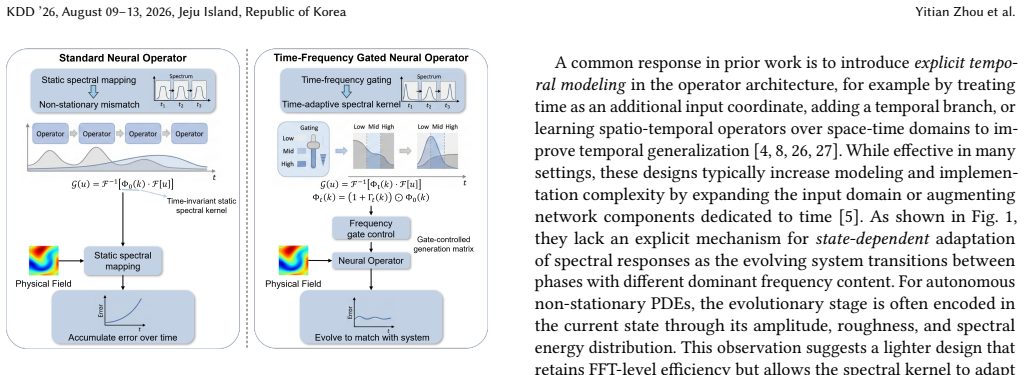
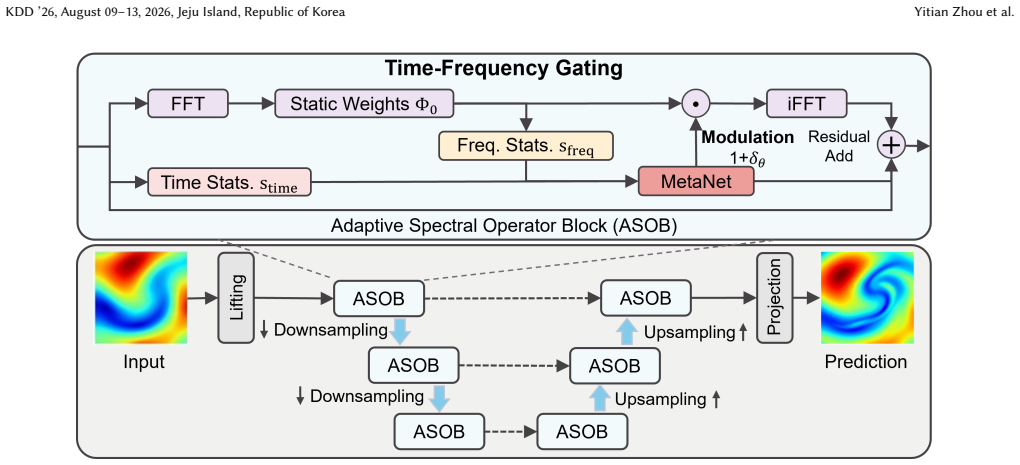
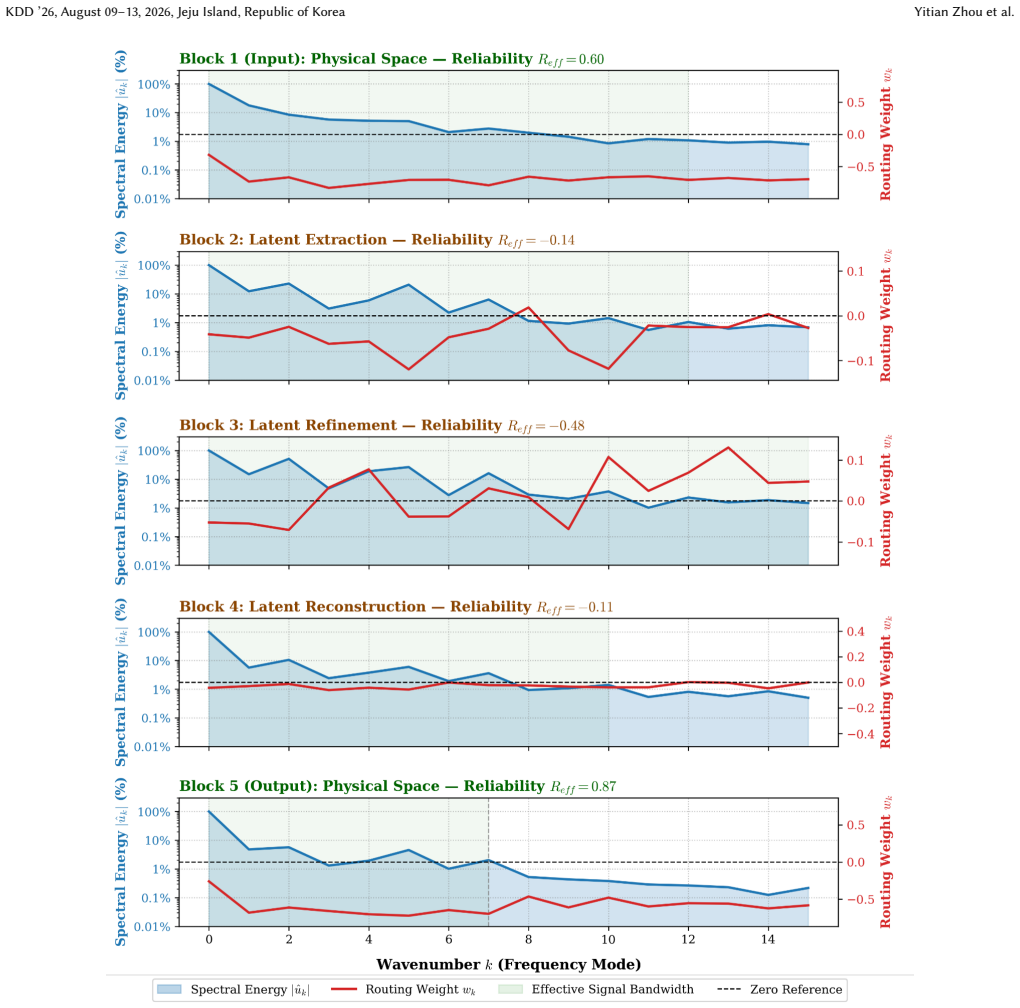
The Time-Frequency Gated Spectral Neural Operator extracts frequency-domain and physical-space statistics from the current state alone, uses them to generate modulation coefficients, and thereby lets the spectral response change with the underlying non-stationary dynamics without an explicit time dimension or time embedding.
What carries the argument
Time-frequency gated spectral blocks that produce state-dependent modulation coefficients for adaptive spectral responses.
If this is right
- Long-horizon rollout stability improves because the spectral response can track drifting energy distributions.
- Modeling complexity stays low since adaptation occurs implicitly through state statistics rather than added time inputs.
- Multi-scale features are captured more accurately by embedding the adaptive blocks inside the operator.
- Robustness gains appear across both 1-D and 2-D non-stationary PDE benchmarks.
Where Pith is reading between the lines
- The same state-only gating idea could be tested on operator-learning tasks outside spectral architectures where dynamics depend on the instantaneous field.
- If state statistics prove insufficient in some regimes, an inexpensive auxiliary time channel could be added without changing the core design.
- Real-world sensor data with unknown non-stationarities would provide a direct test of whether the extracted statistics generalize beyond synthetic benchmarks.
Load-bearing premise
Compact frequency-domain and physical-space statistics taken from the current state are enough to generate the correct modulation coefficients for time-varying dynamics.
What would settle it
A controlled non-stationary PDE test in which long-rollout error remains equal to that of a non-adaptive spectral baseline even after the gating mechanism is added.
Figures
read the original abstract
Non-stationary partial differential equations (PDEs) arise throughout scientific computing, where the dominant frequency content and energy distribution can drift over time. While efficient in PDE solving, many spectral neural operators apply a shared spectral response across rollout stages, leading to mismatch with time-varying spectra in non-stationary systems. To address this issue, we propose Time-Frequency Gated Spectral Neural Operator (TF-SNO), a state-adaptive framework with learnable time-frequency gating inside spectral blocks. TF-SNO extracts compact frequency-domain and physical-space statistics from the current state to generate modulation coefficients, enabling the spectral response to evolve with the dynamics. TF-SNO learns temporal variation implicitly from the evolving state without introducing an explicit time dimension or time embedding, keeping the modeling complexity low. We further embed the adaptive operator blocks to accurately capture the multi-scale features, thereby improving long-horizon stability. Experiments on six non-stationary PDE benchmarks in 1D and 2D demonstrate that TF-SNO significantly reduces prediction errors and improves robustness compared to strong baselines, with particularly clear gains in long rollout, suggesting the effectiveness of state-dependent spectral adaptation in modeling non-stationary physical systems.
Editorial analysis
A structured set of objections, weighed in public.
Referee Report
Summary. The paper proposes TF-SNO, a Time-Frequency Gated Spectral Neural Operator for non-stationary PDEs. It augments spectral neural operator blocks with a learnable time-frequency gating mechanism that extracts compact frequency-domain and physical-space statistics from the instantaneous state to produce modulation coefficients. These coefficients adapt the spectral response on the fly, allowing the operator to track drifting frequency content without an explicit time coordinate or embedding. The adaptive blocks are embedded in a multi-scale architecture and evaluated on six 1D/2D non-stationary PDE benchmarks, where TF-SNO reports lower prediction errors and greater long-rollout stability than strong baselines.
Significance. If the reported error reductions and robustness gains hold under full experimental scrutiny, the work provides a practical route to state-dependent spectral adaptation for non-stationary systems. The design choice to derive modulation from instantaneous statistics rather than explicit time is a clear contribution that keeps model complexity modest while addressing a recognized limitation of fixed spectral responses in neural operators. Reproducible code or parameter-free derivations are not mentioned, but the empirical focus on long-horizon stability on multiple benchmarks is a positive feature.
minor comments (3)
- [Abstract / §2] The abstract and introduction would benefit from a concise equation or diagram showing how the modulation coefficients are computed from the extracted statistics (e.g., the precise form of the gating function).
- [§4] Experimental section should report the precise baseline implementations, hyper-parameter search ranges, and whether error bars reflect multiple random seeds or single runs.
- [§4] Clarify whether the six benchmarks include any stationary controls to isolate the benefit of the adaptive mechanism from general architectural improvements.
Simulated Author's Rebuttal
We thank the referee for the positive summary and recommendation of minor revision. The assessment correctly captures the core contribution of state-adaptive time-frequency gating derived from instantaneous statistics. No major comments were raised in the report.
Circularity Check
No significant circularity
full rationale
The paper presents TF-SNO as a new architectural design for state-adaptive spectral operators, where modulation coefficients are generated from instantaneous state statistics. No equations, derivations, or claims reduce by construction to fitted inputs, self-definitions, or self-citation chains; the central contribution is an empirical architecture choice evaluated on external benchmarks. The reported gains in long-rollout error are presented as direct experimental outcomes rather than predictions forced by the model definition itself. The design avoids explicit time embeddings by construction but does not claim this as a derived theorem that loops back to its own assumptions.
Axiom & Free-Parameter Ledger
axioms (1)
- domain assumption Extracting compact frequency-domain and physical-space statistics from the current state suffices to generate effective modulation coefficients for spectral adaptation.
Reference graph
Works this paper leans on
-
[1]
Wouter JT Bos. 2024. Unsteady and inhomogeneous turbulent fluctuations around isotropic equilibrium.Atmosphere15, 5 (2024), 547
2024
-
[2]
Ricardo Buitrago Ruiz, Tanya Marwah, Albert Gu, and Andrej Risteski. 2025. On the benefits of memory for modeling time-dependent pdes. InInternational Conference on Learning Representations, Vol. 2025. 54972–55002
2025
-
[3]
Qianying Cao, Somdatta Goswami, and George Em Karniadakis. 2024. Laplace neural operator for solving differential equations.Nature Machine Intelligence6, 6 (2024), 631–640
2024
-
[4]
Shuhao Cao, Francesco Brarda, Ruipeng Li, and Yuanzhe Xi. 2025. Spectral- Refiner: Accurate Fine-Tuning of Spatiotemporal Fourier Neural Operator for Turbulent Flows. InThe Thirteenth International Conference on Learning Repre- sentations, ICLR 2025
2025
-
[5]
Chuanqi Chen and Jin-Long Wu. 2025. Neural dynamical operator: Continuous spatial-temporal model with gradient-based and derivative-free optimization methods.J. Comput. Phys.520 (2025), 113480
2025
-
[6]
Tianping Chen and Hong Chen. 1995. Universal approximation to nonlinear operators by neural networks with arbitrary activation functions and its appli- cation to dynamical systems.IEEE transactions on neural networks6, 4 (1995), 911–917
1995
-
[7]
Chun-Wun Cheng, Bin Dong, Carola-Bibiane Schönlieb, and Angelica I Aviles- Rivero. 2025. PDE Solvers Should Be Local: Fast, Stable Rollouts with Learned Local Stencils.arXiv preprint arXiv:2509.26186(2025)
arXiv 2025
-
[8]
Waleed Diab and Mohammed Al Kobaisi. 2025. Temporal neural operator for modeling time-dependent physical phenomena.Scientific Reports15, 1 (2025), 32791
2025
-
[9]
Mohammad Sadegh Eshaghi, Cosmin Anitescu, Manish Thombre, Yizheng Wang, Xiaoying Zhuang, and Timon Rabczuk. 2025. Variational physics-informed neural operator (VINO) for solving partial differential equations.Computer Methods in Applied Mechanics and Engineering437 (2025), 117785
2025
-
[10]
Wenhan Gao, Jian Luo, Ruichen Xu, and Yi Liu. 2025. Dynamic Schwartz-Fourier Neural Operator for Enhanced Expressive Power.Transactions on Machine Learn- ing Research(2025)
2025
-
[11]
Junyan He, Shashank Kushwaha, Jaewan Park, Seid Koric, Diab Abueidda, and Iwona Jasiuk. 2024. Sequential deep operator networks (s-deeponet) for predicting full-field solutions under time-dependent loads.Engineering Applications of Artificial Intelligence127 (2024), 107258
2024
-
[12]
Peiyan Hu, Rui Wang, Xiang Zheng, Tao Zhang, Haodong Feng, Ruiqi Feng, Long Wei, Yue Wang, Zhi-Ming Ma, and Tailin Wu. 2025. Wavelet diffusion neural operator. InInternational Conference on Learning Representations, Vol. 2025. 12291– 12333
2025
-
[13]
Peiyan Hu, Yue Wang, and Zhi-Ming Ma. 2024. Better neural PDE solvers through data-free mesh movers. InInternational Conference on Learning Representations, Vol. 2024. 4550–4576
2024
-
[14]
Zhenzhen Huang, Haoyu Bian, Jiaquan Zhang, Yibei Liu, Kuien Liu, Caiyan Qin, Guoqing Wang, Yang Yang, and Chaoning Zhang. 2026. Rethinking Input Domains in Physics-Informed Neural Networks via Geometric Compactification Mappings.arXiv preprint arXiv:2602.16193(2026)
arXiv 2026
-
[15]
Nikola Kovachki, Zongyi Li, Burigede Liu, Kamyar Azizzadenesheli, Kaushik Bhattacharya, Andrew Stuart, and Anima Anandkumar. 2023. Neural operator: Learning maps between function spaces with applications to pdes.Journal of Machine Learning Research24, 89 (2023), 1–97
2023
-
[16]
2002.Finite volume methods for hyperbolic problems
Randall J LeVeque. 2002.Finite volume methods for hyperbolic problems. Vol. 31. Cambridge university press
2002
-
[17]
Zongyi Li, Daniel Zhengyu Huang, Burigede Liu, and Anima Anandkumar. 2023. Fourier Neural Operator with Learned Deformations for PDEs on General Ge- ometries.Journal of Machine Learning Research24, 388 (2023), 1–26
2023
-
[18]
Zongyi Li, Nikola Kovachki, Kamyar Azizzadenesheli, Burigede Liu, Kaushik Bhat- tacharya, Andrew Stuart, and Anima Anandkumar. 2020. Neural operator: Graph kernel network for partial differential equations.arXiv preprint arXiv:2003.03485 (2020)
Pith/arXiv arXiv 2020
-
[19]
Zongyi Li, Nikola Kovachki, Kamyar Azizzadenesheli, Burigede Liu, Andrew Stuart, Kaushik Bhattacharya, and Anima Anandkumar. 2020. Multipole graph neural operator for parametric partial differential equations.Advances in Neural Information Processing Systems33 (2020), 6755–6766
2020
-
[20]
Zongyi Li, Nikola Borislavov Kovachki, Kamyar Azizzadenesheli, Kaushik Bhat- tacharya, Andrew Stuart, Anima Anandkumar, et al. 2021. Fourier Neural Opera- tor for Parametric Partial Differential Equations. InInternational Conference on Learning Representations
2021
-
[21]
Zhijie Li, Wenhui Peng, Zelong Yuan, and Jianchun Wang. 2023. Long-term predictions of turbulence by implicit U-Net enhanced Fourier neural operator. Physics of Fluids35, 7 (2023)
2023
-
[22]
Zongyi Li, Hongkai Zheng, Nikola Kovachki, David Jin, Haoxuan Chen, Burigede Liu, Kamyar Azizzadenesheli, and Anima Anandkumar. 2024. Physics-informed neural operator for learning partial differential equations.ACM/IMS Journal of Data Science1, 3 (2024), 1–27
2024
-
[23]
Miguel Liu-Schiaffini, Julius Berner, Boris Bonev, Thorsten Kurth, Kamyar Aziz- zadenesheli, and Anima Anandkumar. 2024. Neural Operators with Localized Integral and Differential Kernels. InInternational Conference on Machine Learning. PMLR, 32576–32594
2024
-
[24]
Ilya Loshchilov and Frank Hutter. 2017. Decoupled weight decay regularization. arXiv preprint arXiv:1711.05101(2017)
Pith/arXiv arXiv 2017
-
[25]
Ilya Loshchilov and Frank Hutter. 2017. SGDR: Stochastic Gradient Descent with Warm Restarts.International Conference on Learning Representations (ICLR) (2017)
2017
-
[26]
Lu Lu, Pengzhan Jin, Guofei Pang, Zhongqiang Zhang, and George Em Karni- adakis. 2021. Learning nonlinear operators via DeepONet based on the universal approximation theorem of operators.Nature machine intelligence3, 3 (2021), 218–229
2021
-
[27]
Dibyajyoti Nayak and Somdatta Goswami. 2025. TI-DeepONet: Learnable Time Integration for Stable Long-Term Extrapolation.arXiv preprint arXiv:2505.17341 (2025)
arXiv 2025
-
[28]
Md Ashiqur Rahman, Zachary E Ross, and Kamyar Azizzadenesheli. 2023. U-NO: U-shaped Neural Operators.Transactions on Machine Learning Research(2023)
2023
-
[29]
Maziar Raissi, Paris Perdikaris, and George E Karniadakis. 2019. Physics-informed neural networks: A deep learning framework for solving forward and inverse problems involving nonlinear partial differential equations.Journal of Computa- tional physics378 (2019), 686–707
2019
-
[30]
Makoto Takamoto, Timothy Praditia, Raphael Leiteritz, Dan MacKinlay, Francesco Alesiani, Dirk Pflüger, and Mathias Niepert. 2022. PDEBENCH: An Extensive Benchmark for Scientific Machine Learning. InProceedings of the 36th Conference on Neural Information Processing Systems (NeurIPS 2022) Track on Datasets and Benchmarks
2022
-
[31]
Karn Tiwari, NM Krishnan, et al . 2025. CoNO: Complex neural operator for continous dynamical physical systems.APL Machine Learning3, 2 (2025)
2025
-
[32]
Alasdair Tran, Alexander Mathews, Lexing Xie, and Cheng Soon Ong. 2023. Factorized Fourier Neural Operators. InInternational Conference on Learning Representations
2023
-
[33]
Tapas Tripura and Souvik Chakraborty. 2023. Wavelet neural operator for solving parametric partial differential equations in computational mechanics problems. Computer Methods in Applied Mechanics and Engineering404 (2023), 115783
2023
-
[34]
Sifan Wang, Yujun Teng, and Paris Perdikaris. 2021. Understanding and mitigating gradient flow pathologies in physics-informed neural networks.SIAM Journal on Scientific Computing43, 5 (2021), A3055–A3081
2021
-
[35]
Colin White, Julius Berner, Jean Kossaifi, Mogab Elleithy, David Pitt, Daniel Leibovici, Zongyi Li, Kamyar Azizzadenesheli, and Anima Anandkumar. 2023. Physics-informed neural operators with exact differentiation on arbitrary geome- tries. InThe symbiosis of deep learning and differential equations III
2023
-
[36]
Zipeng Xiao, Zhongkai Hao, Bokai Lin, Zhijie Deng, and Hang Su. 2024. Im- proved Operator Learning by Orthogonal Attention. InInternational Conference on Machine Learning. PMLR, 54288–54299
2024
-
[37]
Jiaxin Yan, Chaoning Zhang, Xudong Wang, Pengcheng Zheng, Ya Wen, Qigan Sun, Jiaxin Huang, Shuxu Chen, Yang Yang, and Hyundong Shin. 2026. Predicting the World via Video Representation: A Comprehensive Survey on Video World Models.Preprints(May 2026). doi:10.20944/preprints202605.0435.v1
-
[38]
Minglang Yin, Nicolas Charon, Ryan Brody, Lu Lu, Natalia Trayanova, and Mauro Maggioni. 2024. A scalable framework for learning the geometry-dependent solution operators of partial differential equations.Nature computational science 4, 12 (2024), 928–940
2024
-
[39]
Jiaquan Zhang, Fachrina Dewi Puspitasari, Songbo Zhang, Yibei Liu, Kuien Liu, Caiyan Qin, Fan Mo, Peng Wang, Yang Yang, and Chaoning Zhang. 2026. Geometric Neural Operators via Lie Group-Constrained Latent Dynamics.arXiv preprint arXiv:2602.16209(2026)
arXiv 2026
-
[40]
Jiaquan Zhang, Caiyan Qin, Haoyu Bian, Libin Cai, Yi Lu, Chaoning Zhang, Wei Dong, Yuanfang Guo, Yang Yang, and Heng Tao Shen. 2026. Autoregression-Free Neural Operators for Time-Dependent PDEs.arXiv preprint arXiv:2605.25413 (2026)
Pith/arXiv arXiv 2026
-
[41]
Jiaquan Zhang, Chaoning Zhang, Shuxu Chen, Zhenzhen Huang, Pengcheng Zheng, Zhicheng Wang, Ping Guo, Fan Mo, Sung-Ho Bae, Jie Zou, et al . 2026. Lightweight llm agent memory with small language models.arXiv preprint arXiv:2604.07798(2026)
Pith/arXiv arXiv 2026
-
[42]
Yitian Zhou, Chaoning Zhang, Jiaquan Zhang, Zhenzhen Huang, Jinyu Guo, Sung-Ho Bae, Lik-Hang Lee, Caiyan Qin, and Yang Yang. 2026. From Similarity to Structure: Training-free LLM Context Compression with Hybrid Graph Priors. arXiv preprint arXiv:2604.23277(2026)
Pith/arXiv arXiv 2026
discussion (0)
Sign in with ORCID, Apple, or X to comment. Anyone can read and Pith papers without signing in.