REVIEW 3 major objections 6 minor 2 cited by
This paper argues that interaction-ready 3D reconstruction can be driven by counterfactual consistency: removing objects and restoring them should recover the original scene, and enforcing that match yields appearance, spatial, and physical
Reviewed by Pith at T0; open to challenge. T0 means a machine referee read the full paper against a public rubric. the ladder, T0–T4 →
T0 review · deepseek-v4-flash
2026-08-04 04:54 UTC pith:D7DKQ6LU
load-bearing objection The abstract sells a counterfactual alignment framework that doesn't exist in the body; what's actually there is a decent but under-validated pipeline paper under a mismatched title. the 3 major comments →
CA-World: Multi-Object Counterfactual Alignment for Efficient Interactive-Ready Reconstruction
The pith
A machine-rendered reading of the paper's core claim, the machinery that carries it, and where it could break.
Core claim
On the paper's own terms, the central claim is that interaction-ready reconstruction reduces to counterfactual alignment learning. The authors define object removal and background inpainting as a counterfactual intervention, object completion as counterfactual generation, and scene reintegration as the inverse intervention. The requirement that the reintegrated scene match the original in appearance, spatial layout, and physical plausibility provides direct supervision without ground-truth object states. Locality of object-level interventions means each counterfactual state is constrained by the observed scene rather than by jointly optimizing all objects, cutting cost and error accumulation
What carries the argument
The central mechanism is counterfactual consistency over a decoupling-reintegration cycle. Foreground-background separation is treated as a visual intervention; separate object generation and background inpainting are treated as counterfactual generation; and scene reintegration is treated as the inverse intervention. The paper claims that enforcing equality between reintegrated and original scenes in appearance, spatial relationship, and physical plausibility is a sufficient supervision signal, and that the locality of object-level interventions lets each object be aligned independently using the observed scene, without joint optimization. In the implementation, this appears as three post-p
Load-bearing premise
The load-bearing premise is that removing and reintegrating an object is an invertible intervention—that any mismatch between the reintegrated scene and the original genuinely reflects incorrect completion or alignment, rather than generative ambiguity, lighting changes, or inpainting artifacts.
What would settle it
Set up a scene with a known object, remove the object, inpaint the background, and reintegrate the exact original object at its exact pose. If the three consistency losses (appearance, spatial, physical) do not drop near zero—for example because the background inpainting changes lighting or shadows—then counterfactual consistency cannot serve as a faithful supervision signal for interaction readiness.
If this is right
- If counterfactual consistency is a valid supervisory signal, interaction-ready 3D reconstruction can be trained from ordinary multi-view images, since the original scene serves as its own ground truth.
- Locality of object-level interventions implies reconstruction cost scales with the number of objects rather than jointly with all object states, reducing computational load and error accumulation in cluttered scenes.
- The three consistency objectives (appearance, spatial, physical) provide a concrete checklist for whether a reconstructed scene will behave correctly under interaction—not merely render well.
- The training-free implementation can run on consumer hardware and support real-time multi-object physical simulation, making interactive reconstruction practical outside research labs.
- Clean object-scene separation plus completion enables dynamic scene editing, such as removing, replacing, or re-simulating individual objects.
Where Pith is reading between the lines
- The abstract promises counterfactual alignment learning, but the full-text implementation is a training-free pipeline that uses a frozen generative prior and optimization-based post-processing; a direct test of the counterfactual claim would be to train the completion model itself with the three consistency losses and measure improvement.
- The counterfactual framing naturally suggests an automatic evaluation protocol: perform an intervention (remove and reintegrate an object), then measure the three consistencies; scenes that score well should be the ones that simulate correctly. This could become a standard benchmark for interaction-ready reconstruction.
- The locality argument implies that the method's benefit grows with scene clutter; in sparse scenes the counterfactual supervision may provide little signal, so the approach may be best suited for dense multi-object environments.
- If the invertibility assumption is violated (e.g., shadows, specular highlights, or inpainting ambiguity), the consistency loss could misattribute generative ambiguity to causal error; extending the framework to model these effects is a natural next step.
Editorial analysis
A structured set of objections, weighed in public.
Referee Report
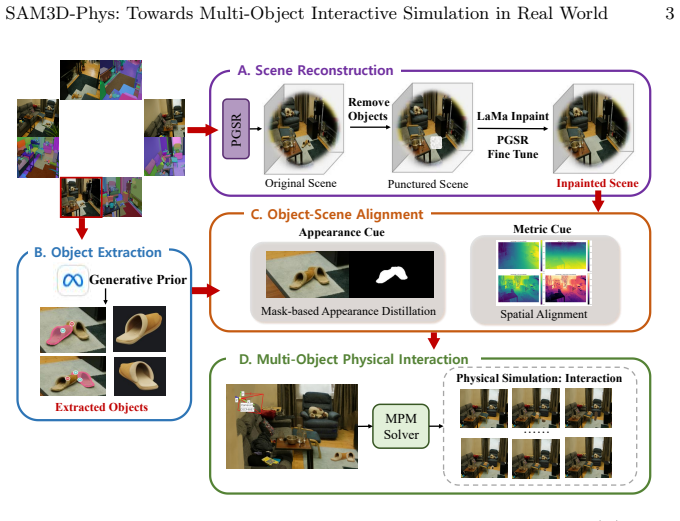
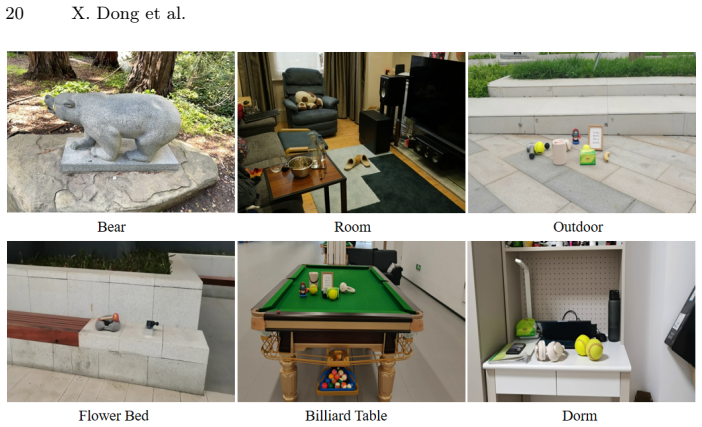
Summary. The abstract of arXiv:2605.30239 introduces CA-World, an 'efficient framework that integrates counterfactual alignment learning into a decoupling-reintegration reconstruction pipeline,' with three alignment objectives (appearance, spatial, physical) that enforce counterfactual consistency by requiring that reversing an intervention recovers the factual world. The full text, however, is a different paper titled 'SAM3D-Phys: Towards Multi-Object Interactive Simulation in Real World.' This body presents a four-stage, training-free pipeline: PGSR scene reconstruction, SAM3D object generation, object–scene alignment (physics-constrained pose optimization and mask-guided appearance distillation), and MPM-based multi-object simulation. There is no mention of CA-World, counterfactual states, inverse interventions, or any objective that compares the reintegrated scene to the original under a counterfactual intervention. The experimental section evaluates SAM3D-Phys on six real-world scenes against Feature Splatting and DecoupledGaussian, with a 12-participant user study and LMM-as-judge scores. As submitted, the paper's stated central contribution is entirely absent from the body.
Significance. If the CA-World counterfactual-alignment formulation were actually developed and experimentally validated, it could offer a new way to train interaction-ready reconstruction with direct supervision from counterfactual consistency, potentially improving efficiency by avoiding joint optimization of all object states. However, the manuscript as submitted does not deliver this: the abstract claims a method that the full text does not describe. The body's SAM3D-Phys pipeline is a plausible engineering contribution—combining a generative 3D prior with reconstruction and physics-based constraints—but it is a different contribution, and its own evidence (six scenes, two baselines, no error bars, small user study) is thin. The mismatch between the abstract and body prevents assessment of the claimed novelty and precludes acceptance. The manuscript contains machine-checkable equations only for standard 3DGS, MPM, and basic penalty constraints; the central counterfactual consistency objectives have no formalization.
major comments (3)
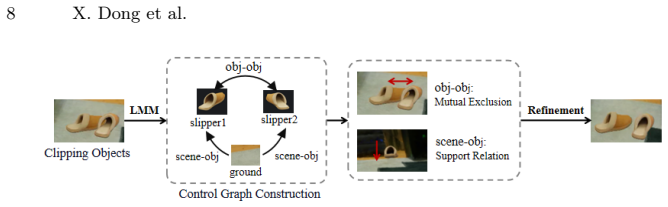
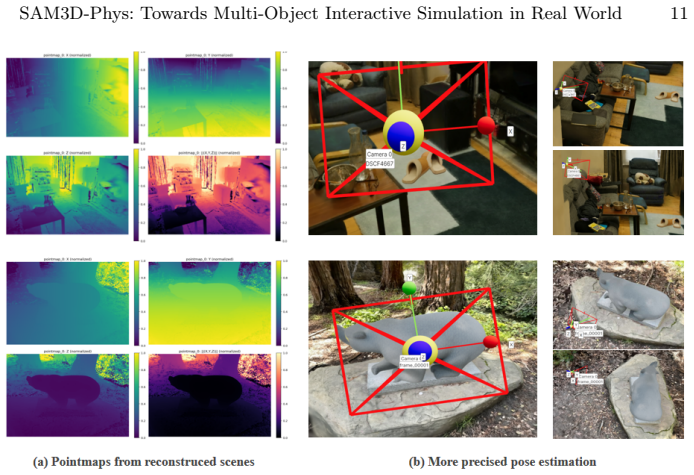
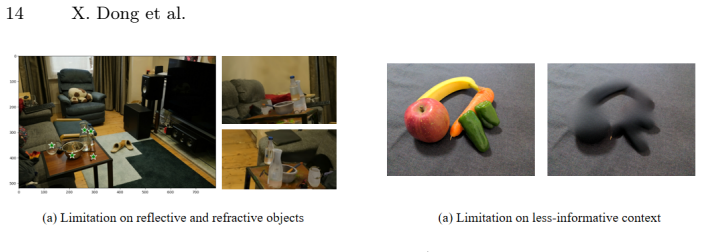
- [Abstract and Section 3 (whole body)] The abstract claims CA-World counterfactual alignment learning with three objectives between reintegrated and original scenes, and formulates foreground-background decoupling as a visual intervention, object generation/inpainting as counterfactual generation, and reintegration as an inverse intervention. The full text contains none of this. Section 3.2 presents a pipeline (PGSR, SAM3D, alignment, MPM) with no mention of counterfactual states; Sections 3.3–3.4 give render-and-compare pose optimization (Eq. 5), physics penalty constraints (Eqs. 6–8), and a mask-guided VGG distillation loss, none of which are derived from or compared against a counterfactual 'inverse intervention.' No equation, algorithm, or experiment implements the abstract's central claim. The Limitations (Fig. 9) only discuss appearance/context failures, not this missing formalization. This is a load-bearing absence: th
- [Abstract (counterfactual consistency formulation)] The abstract's formulation is circular if interpreted literally. It states that 'reversing the intervention should recover the factual world' and motivates 'three alignment objectives between the reintegrated and original scenes.' If the reintegrated scene is directly supervised against the original observed scene, then the 'counterfactual state' is matched to the factual observation it is supposed to counterfactually predict—this is not causal consistency but regression to the factual scene. Since the body does not formalize these objectives, the claim is untestable as stated. The reader is left with either a circular training target or an undefined one; neither supports the claimed novelty.
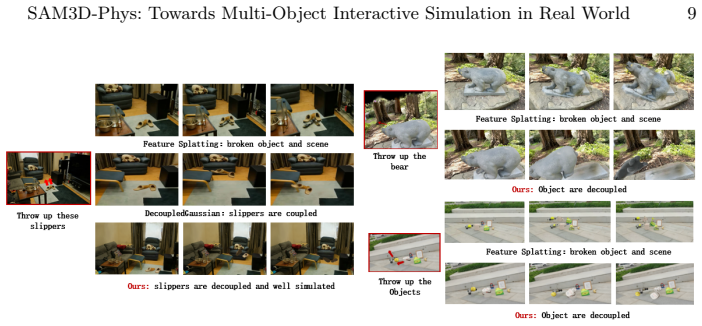
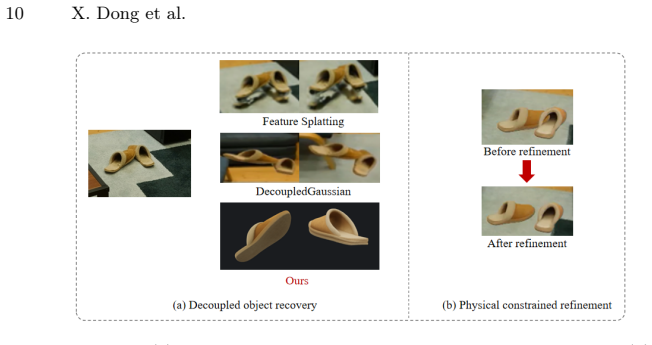
- [Section 4 (Experiments)] Even for the body's more modest SAM3D-Phys contribution, the quantitative evidence is thin. The evaluation uses six scenes (two from DecoupledGaussian, four self-captured), two baselines, and a 12-participant user study with no reported variance, inter-rater reliability, or significance tests. Table 1 reports single ablation numbers for edge error, PSNR, and SSIM with no error bars. Baselines O2-Recon and Amodal3R are excluded with the justification that performance on real scenes is poor—this is not a substitute for a comparative experiment. These limitations undermine the claim of 'demonstrate effectiveness' (Section 4.2) for the body's method.
minor comments (6)
- [Eq. (5)] The notation in Eq. (5) is tangled: subscripts and superscripts on t and R are difficult to parse, and the use of '⊙' for rotation composition is nonstandard. Please clarify.
- [Abstract vs. body project page] The abstract gives the project page as https://chnxindong.github.io/ca-world/, while the body (title and footer) gives https://chnxindong.github.io/sam3d-phys/. These should match.
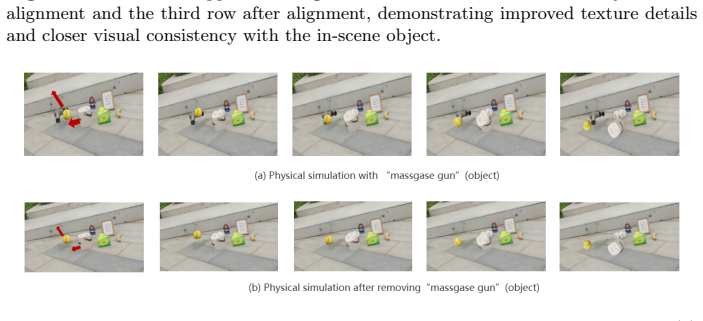
- [Fig. 8 caption] The caption contains 'massgase gun,' which appears to be a typo for 'massage gun.'
- [References] O2-Recon and Amodal3R are cited twice with different reference numbers (13/14 and 40/41 respectively); please use a single reference per work.
- [Eq. (7) and Supplementary Equation (7)] Equation (7) uses a minimum distance margin 'm,' while the supplementary text says the tolerance can be defined as zero and uses 'epsilon.' This symbol inconsistency should be resolved.
- [Table 2 (User study)] The user study reports only aggregate scores. Please report per-participant variance or inter-rater agreement to support the claim that the method 'significantly outperforms' baselines.
Circularity Check
Abstract's counterfactual-consistency objective is defined as matching the reintegrated scene to the original observed scene, making it a reconstruction loss; the full text omits the claimed CA-World method entirely.
specific steps
-
self definitional
[Abstract, 'counterfactual consistency' paragraph]
"According to counterfactual consistency, reversing the intervention should recover the factual world, motivating three alignment objectives between the reintegrated and original scenes: appearance, spatial, and physical consistency. This formulates interaction-ready reconstruction as counterfactual alignment learning with direct supervision."
The counterfactual state is defined as the reintegrated scene, and consistency is defined as agreement with the original observed scene. The supervision for the counterfactual is therefore the very factual observation it is supposed to counterfactually predict; 'reversing the intervention should recover the factual world' is an autoencoding/reconstruction loss, not an independent causal check. By construction, any reintegration fitted to the original scene trivially satisfies the stated objective, so the claimed counterfactual alignment reduces to reconstruction.
full rationale
The only concrete circular reduction is in the abstract: the three 'counterfactual consistency' objectives are defined as matching the reintegrated scene to the original observed scene, which makes the counterfactual constraint equivalent to a reconstruction/autoencoding objective by construction. The full text compounds this by omitting the claimed CA-World machinery entirely: the body is a different paper, SAM3D-Phys, whose alignment modules fit object pose and texture to the observed images via render-and-compare and mask-guided VGG distillation. Those are straightforward supervised fitting steps, not counterfactual predictions, and no equation in the body defines the abstract's appearance, spatial, or physical consistency objectives under an inverse intervention. There is no load-bearing self-citation chain; the self-citation to Pos3R is only related work, and the generative prior SAM3D is an external system. Because the central advertised result is both definitionally circular where stated and absent where the method is described, the circularity score is 6 rather than 2. The body's own experiments are self-contained benchmark comparisons, but they evaluate SAM3D-Phys, not the CA-World claim in the abstract.
Axiom & Free-Parameter Ledger
free parameters (4)
- per-object pose (translation t, rotation R) =
optimized per scene; values not reported
- physical-constraint tolerance epsilon and margin m =
epsilon 'small predefined tolerance'; m unspecified
- MPM material parameters =
inherited from PhysGaussian/DreamPhysics; not measured
- background inpainting / PGSR fine-tune settings =
not reported
axioms (6)
- standard math 3D Gaussian Splatting forward model (Eq. 1) and pinhole back-projection (Eq. 4) are correct.
- domain assumption PGSR unbiased depth (Eq. 3) approximates the physical surface.
- domain assumption SAM3D infers complete object geometry from partial observations consistently with the scene.
- ad hoc to paper LaMa inpainting plus PGSR fine-tuning yields a clean background suitable as a counterfactual state.
- ad hoc to paper Counterfactual consistency: reversing the intervention should recover the factual world.
- domain assumption Gemini 3 Pro relation graph correctly identifies object-object and object-scene contacts.
invented entities (1)
-
counterfactual state
no independent evidence
Cite this review
Pith. "Pith review of CA-World: Multi-Object Counterfactual Alignment for Efficient Interactive-Ready Reconstruction." pith.science (2026). https://pith.science/paper/D7DKQ6LU
@misc{pith2026260530239,
  author       = {Pith},
  title        = {Pith review of: CA-World: Multi-Object Counterfactual Alignment for Efficient Interactive-Ready Reconstruction},
  year         = {2026},
  howpublished = {\url{https://pith.science/paper/D7DKQ6LU}},
  note         = {Machine review of arXiv:2605.30239}
}
read the original abstract
Reconstructing interaction-ready 3D worlds is essential for physical simulation, virtual reality, robotics, and autonomous driving. However, existing methods mainly optimize static and holistic visual fidelity, with limited support for multi-object interaction. We argue that an interaction-ready reconstruction should anticipate potential scene changes and preserve geometric completeness, visual quality, multi-object spatial relationship, and physical plausibility under potential interactions. To this end, motivated by the causal intervention, we propose CA-World, an efficient framework that integrates counterfactual alignment learning into a decoupling-reintegration reconstruction pipeline. Specifically, we formulate foreground-background decoupling as a visual intervention, separate object generation and background inpainting as counterfactual generation, and scene reintegration as an inverse intervention. According to counterfactual consistency, reversing the intervention should recover the factual world, motivating three alignment objectives between the reintegrated and original scenes: appearance, spatial, and physical consistency. This formulates interaction-ready reconstruction as counterfactual alignment learning with direct supervision. Moreover, leveraging the locality of object-level interventions, CA-World constrains counterfactual states using the observed scene, enabling efficient and coherent reintegration without jointly optimizing all object states, thereby reducing computational cost and error accumulation. Experiments on object completeness, spatial accuracy, outdoor background completion, rendering quality, simulated dynamics, and downstream applications demonstrate the effectiveness of CA-World. Project page: https://chnxindong.github.io/ca-world/.
Figures
Forward citations
Cited by 2 Pith papers
-
Occlusion-Robust Multi-Object Decoupling for Physics-Based Robotic Interaction
A pipeline combining SAM2 segmentation, 3D Gaussian Splatting, and joint Score Distillation Sampling with 2D/3D diffusion priors reconstructs decoupled multi-object geometries from occluded sparse views for MPM simulation.
-
Occlusion-Robust Multi-Object Decoupling for Physics-Based Robotic Interaction
A new pipeline for occlusion-robust multi-object 3D reconstruction from sparse views supports physics-based robotic interaction.
Reference graph
Works this paper leans on
-
[1]
In: ICML (2024)
Bruce, J., Dennis, M.D., Edwards, A., Parker-Holder, J., Shi, Y., Hughes, E., Lai, M., Mavalankar, A., Steigerwald, R., Apps, C., et al.: Genie: Generative interactive environments. In: ICML (2024)
2024
-
[2]
Cai, D., Heikkilä, J., Rahtu, E.: Gs-pose: Generalizable segmentation-based 6d object pose estimation with 3d gaussian splatting (2024)
2024
-
[3]
In: CVPR
Cao, T., Luo, F., Qin, J., Jiang, Y., Wang, Y., Xiao, C.: ig-6dof: Model-free 6dof pose estimation for unseen object via iterative 3d gaussian splatting. In: CVPR. pp. 6436–6446 (2025)
2025
-
[4]
IEEE TVCG31, 6100–6111 (2024)
Chen, D., Li, H., Ye, W., Wang, Y., Xie, W., Zhai, S., Wang, N., Liu, H., Bao, H., Zhang, G.: Pgsr: Planar-based gaussian splatting for efficient and high-fidelity surface reconstruction. IEEE TVCG31, 6100–6111 (2024)
2024
-
[5]
arXiv preprint arXiv:2511.16624 (2025)
Chen, X., Chu, F.J., Gleize, P., Liang, K.J., Sax, A., Tang, H., Wang, W., Guo, M., Hardin, T., Li, X., et al.: Sam 3d: 3dfy anything in images. arXiv preprint arXiv:2511.16624 (2025)
Pith/arXiv arXiv 2025
-
[6]
In: CVPR
Deng, W., Campbell, D., Sun, C., Zhang, J., Kanitkar, S., Shaffer, M.E., Gould, S.: Pos3r: 6d pose estimation for unseen objects made easy. In: CVPR. pp. 16818– 16828 (2025)
2025
-
[7]
Feng, J., Li, X., Lin, J., Liu, J., Liu, G., Lou, W., Ma, S., Shi, G., Wang, Q., Wang, J., et al.: Seed3d 1.0: From images to high-fidelity simulation-ready 3d assets (2025)
2025
-
[8]
In: CVPR
Geng, D., Herrmann, C., Hur, J., Cole, F., Zhang, S., Pfaff, T., Lopez-Guevara, T., Aytar, Y., Rubinstein, M., Sun, C., et al.: Motion prompting: Controlling video generation with motion trajectories. In: CVPR. pp. 1–12 (2025)
2025
-
[9]
arXiv preprint arXiv:2307.04725 (2023)
Guo, Y., Yang, C., Rao, A., Liang, Z., Wang, Y., Qiao, Y., Agrawala, M., Lin, D., Dai, B.: Animatediff: Animate your personalized text-to-image diffusion models without specific tuning. arXiv preprint arXiv:2307.04725 (2023)
Pith/arXiv arXiv 2023
-
[10]
arXiv preprint arXiv:2311.04400 (2023)
Hong, Y., Zhang, K., Gu, J., Bi, S., Zhou, Y., Liu, D., Liu, F., Sunkavalli, K., Bui, T., Tan, H.: Lrm: Large reconstruction model for single image to 3d. arXiv preprint arXiv:2311.04400 (2023)
Pith/arXiv arXiv 2023
-
[11]
arXiv preprint arXiv:2605.15843 (2026)
Hu, J., Guo, J., Cen, J., Yang, C., Li, S., Shen, W.: Worldact: Activating monolithic 3d worlds into interactive-ready object-centric scenes. arXiv preprint arXiv:2605.15843 (2026)
Pith/arXiv arXiv 2026
-
[12]
ACM Transactions on Graphics (TOG)37(4), 1–14 (2018)
Hu, Y., Fang, Y., Ge, Z., Qu, Z., Zhu, Y., Pradhana, A., Jiang, C.: A moving least squares material point method with displacement discontinuity and two-way rigid body coupling. ACM Transactions on Graphics (TOG)37(4), 1–14 (2018)
2018
-
[13]
In: Proceedings of the AAAI Conference on Artificial Intelligence
Hu, Y., Ye, S., Zhao, W., Lin, M., He, Y., Wen, Y.H., He, Y., Liu, Y.J.: Oˆ 2-recon: Completing3dreconstructionofoccludedobjectsinthescenewithapre-trained2d diffusion model. In: Proceedings of the AAAI Conference on Artificial Intelligence. vol. 38, pp. 2285–2293 (2024)
2024
-
[14]
In: AAAI
Hu, Y., Ye, S., Zhao, W., Lin, M., He, Y., Wen, Y.H., He, Y., Liu, Y.J.: O2-recon: completing 3d reconstruction of occluded objects in the scene with a pre-trained 2d diffusion model. In: AAAI. vol. 38, pp. 2285–2293 (2024)
2024
-
[15]
In: Pro- ceedings of the AAAI Conference on Artificial Intelligence
Huang, T., Zhang, H., Zeng, Y., Zhang, Z., Li, H., Zuo, W., Lau, R.W.: Dream- physics: Learning physics-based 3d dynamics with video diffusion priors. In: Pro- ceedings of the AAAI Conference on Artificial Intelligence. vol. 39, pp. 3733–3741 (2025)
2025
-
[16]
In: ACM SIGGRAPH
Jiang, Y., Yu, C., Xie, T., Li, X., Feng, Y., Wang, H., Li, M., Lau, H., Gao, F., Yang, Y., et al.: Vr-gs: A physical dynamics-aware interactive gaussian splatting system in virtual reality. In: ACM SIGGRAPH. pp. 1–1 (2024) 16 X. Dong et al
2024
-
[17]
ACM TOG42(4), 139–1 (2023)
Kerbl, B., Kopanas, G., Leimkühler, T., Drettakis, G.: 3d gaussian splatting for real-time radiance field rendering. ACM TOG42(4), 139–1 (2023)
2023
-
[18]
In: IROS
Kruzliak, A., Hartvich, J., Patni, S.P., Rustler, L., Behrens, J.K., Abu-Dakka, F.J., Mikolajczyk, K., Kyrki, V., Hoffmann, M.: Interactive learning of physical object properties through robot manipulation and database of object measurements. In: IROS. pp. 7596–7603 (2024)
2024
-
[19]
In: CoRL (2022)
Labbé, Y., Manuelli, L., Mousavian, A., Tyree, S., Birchfield, S., Tremblay, J., Carpentier, J., Aubry, M., Fox, D., Sivic, J.: Megapose: 6d pose estimation of novel objects via render & compare. In: CoRL (2022)
2022
-
[20]
arXiv preprint arXiv:2509.07920 (2025)
Li, A., Liu, J., Zhu, Y., Tang, Y.: Scorehoi: Physically plausible reconstruc- tion of human-object interaction via score-guided diffusion. arXiv preprint arXiv:2509.07920 (2025)
Pith/arXiv arXiv 2025
-
[21]
arXiv preprint arXiv:2303.05512 (2023)
Li, X., Qiao, Y.L., Chen, P.Y., Jatavallabhula, K.M., Lin, M., Jiang, C., Gan, C.: Pac-nerf: Physics augmented continuum neural radiance fields for geometry- agnostic system identification. arXiv preprint arXiv:2303.05512 (2023)
Pith/arXiv arXiv 2023
-
[22]
In: CVPR
Li, Z., Tucker, R., Snavely, N., Holynski, A.: Generative image dynamics. In: CVPR. pp. 24142–24153 (2024)
2024
-
[23]
ICLR (2025)
Lin, Y., Lin, C., Xu, J., Mu, Y.: Omniphysgs: 3d constitutive gaussians for general physics-based dynamics generation. ICLR (2025)
2025
-
[24]
arXiv preprint arXiv:2406.04338 (2024)
Liu,F.,Wang,H.,Yao,S.,Zhang,S.,Zhou,J.,Duan,Y.:Physics3d:Learningphys- ical properties of 3d gaussians via video diffusion. arXiv preprint arXiv:2406.04338 (2024)
Pith/arXiv arXiv 2024
-
[25]
In: ECCV
Liu, S., Ren, Z., Gupta, S., Wang, S.: Physgen: Rigid-body physics-grounded image-to-video generation. In: ECCV. pp. 360–378 (2024)
2024
-
[26]
In: CVPR
Liu, Z., Ye, W., Luximon, Y., Wan, P., Zhang, D.: Unleashing the potential of multi-modal foundation models and video diffusion for 4d dynamic physical scene simulation. In: CVPR. pp. 11016–11025 (2025)
2025
-
[27]
In: ICRA
Lou, H., Liu, Y., Pan, Y., Geng, Y., Chen, J., Ma, W., Li, C., Wang, L., Feng, H., Shi, L., et al.: Robo-gs: A physics consistent spatial-temporal model for robotic arm with hybrid representation. In: ICRA. pp. 15379–15386 (2025)
2025
-
[28]
In: ECCV
Lu, G., Zhang, S., Wang, Z., Liu, C., Lu, J., Tang, Y.: Manigaussian: Dynamic gaussian splatting for multi-task robotic manipulation. In: ECCV. pp. 349–366 (2024)
2024
-
[29]
In: IEEE Conference on Virtual Reality and 3D User Interfaces Abstracts and Workshops (VRW)
Mao, H., Xu, Z., Wei, S., Quan, Y., Deng, N., Yang, X.: Live-gs: Llm powers interactive vr by enhancing gaussian splatting. In: IEEE Conference on Virtual Reality and 3D User Interfaces Abstracts and Workshops (VRW). pp. 1234–1235 (2025)
2025
-
[30]
CACM 65(1), 99–106 (2021)
Mildenhall, B., Srinivasan, P.P., Tancik, M., Barron, J.T., Ramamoorthi, R., Ng, R.: Nerf: Representing scenes as neural radiance fields for view synthesis. CACM 65(1), 99–106 (2021)
2021
-
[31]
arXiv preprint arXiv:2404.01223 (2024)
Qiu, R.Z., Yang, G., Zeng, W., Wang, X.: Feature splatting: Language-driven physics-based scene synthesis and editing. arXiv preprint arXiv:2404.01223 (2024)
Pith/arXiv arXiv 2024
-
[32]
arXiv preprint arXiv:2408.00714 (2024)
Ravi, N., Gabeur, V., Hu, Y.T., Hu, R., Ryali, C., Ma, T., Khedr, H., Rädle, R., Rolland, C., Gustafson, L., et al.: Sam 2: Segment anything in images and videos. arXiv preprint arXiv:2408.00714 (2024)
Pith/arXiv arXiv 2024
-
[33]
arXiv preprint arXiv:1409.1556 (2014)
Simonyan, K., Zisserman, A.: Very deep convolutional networks for large-scale image recognition. arXiv preprint arXiv:1409.1556 (2014)
Pith/arXiv arXiv 2014
-
[34]
Suvorov, R., Logacheva, E., Mashikhin, A., Remizova, A., Ashukha, A., Silvestrov, A., Kong, N., Goka, H., Park, K., Lempitsky, V.: Resolution-robust large mask inpainting with fourier convolutions. arXiv preprint arXiv:2109.07161 (2021) SAM3D-Phys: Towards Multi-Object Interactive Simulation in Real World 17
Pith/arXiv arXiv 2021
-
[35]
arXiv preprint arXiv:2402.05054 (2024)
Tang, J., Chen, Z., Chen, X., Wang, T., Zeng, G., Liu, Z.: Lgm: Large multi- view gaussian model for high-resolution 3d content creation. arXiv preprint arXiv:2402.05054 (2024)
Pith/arXiv arXiv 2024
-
[36]
Team, T.H.: Hunyuan3d 2.0: Scaling diffusion models for high resolution textured 3d assets generation (2025)
2025
-
[37]
arXiv preprint arXiv:2509.20358 (2025)
Wang, C., Chen, C., Huang, Y., Dou, Z., Liu, Y., Gu, J., Liu, L.: Physctrl: Genera- tive physics for controllable and physics-grounded video generation. arXiv preprint arXiv:2509.20358 (2025)
arXiv 2025
-
[38]
In: CVPR
Wang, M., Zhang, Y., Xu, W., Ma, R., Zou, C., Morris, D.: Decoupledgaussian: Object-scene decoupling for physics-based interaction. In: CVPR. pp. 11361–11372 (2025)
2025
-
[40]
Wu, T., Zheng, C., Guan, F., Vedaldi, A., Cham, T.J.: Amodal3r: Amodal 3d reconstruction from occluded 2d images (2025)
2025
-
[41]
arXiv preprint arXiv:2503.13439 (2025)
Wu, T., Zheng, C., Guan, F., Vedaldi, A., Cham, T.J.: Amodal3r: Amodal 3d reconstruction from occluded 2d images. arXiv preprint arXiv:2503.13439 (2025)
Pith/arXiv arXiv 2025
-
[42]
NeurIPS38, 32501–32524 (2026)
Xia, H., Lin, C.H., Hsu, H.Y., Leboutet, Q., Gao, K., Paulitsch, M., Ummenhofer, B.,Wang,S.:Holoscene:Simulation-readyinteractive3dworldsfromasinglevideo. NeurIPS38, 32501–32524 (2026)
2026
-
[43]
arXiv preprint arXiv:2412.01506 (2024)
Xiang, J., Lv, Z., Xu, S., Deng, Y., Wang, R., Zhang, B., Chen, D., Tong, X., Yang, J.: Structured 3d latents for scalable and versatile 3d generation. arXiv preprint arXiv:2412.01506 (2024)
Pith/arXiv arXiv 2024
-
[44]
In: Proceedings of the IEEE/CVF conference on computer vision and pattern recognition
Xiang, J., Lv, Z., Xu, S., Deng, Y., Wang, R., Zhang, B., Chen, D., Tong, X., Yang, J.: Structured 3d latents for scalable and versatile 3d generation. In: Proceedings of the IEEE/CVF conference on computer vision and pattern recognition. pp. 21469–21480 (2025)
2025
-
[45]
In: CVPR
Xie, T., Zong, Z., Qiu, Y., et al.: Physgaussian: Physics-integrated 3d gaussians for generative dynamics. In: CVPR. pp. 4389–4398 (2024)
2024
-
[46]
In: Proceedings of the CVPR
Yang, Z., Wang, J., Tang, Y., Chen, K., Zhao, H., Torr, P.H.: Lavt: Language- aware vision transformer for referring image segmentation. In: Proceedings of the CVPR. pp. 18155–18165 (2022)
2022
-
[47]
In: CVPR
Yu, H.X., Duan, H., Herrmann, C., Freeman, W.T., Wu, J.: Wonderworld: Inter- active 3d scene generation from a single image. In: CVPR. pp. 5916–5926 (2025)
2025
-
[48]
In: ECCV
Zhang, T., Yu, H.X., Wu, R., et al.: Physdreamer: Physics-based interaction with 3d objects via video generation. In: ECCV. pp. 388–406 (2024)
2024
-
[49]
Zhang, X., Chen, Y., Fang, Y., Qu, W., Huang, H., Zhang, C., Xu, F., Li, X.: Telephysics: Physics-grounded multi-object scene generation from a single image with real-time interaction (2026),https://arxiv.org/abs/2605.20290 18 X. Dong et al. Supplementary Material A Zoomed-in Comparisons with Baselines To better highlight the differences between our metho...
Pith/arXiv arXiv 2026
discussion (0)
Sign in with ORCID, Apple, or X to comment. Anyone can read and Pith papers without signing in.