Elastic deuteron-deuteron scattering within Nuclear Lattice Effective Field Theory
Pith reviewed 2026-07-02 04:42 UTC · model grok-4.3
The pith
Nuclear lattice calculation produces a deuteron-deuteron scattering length of 12.96 fm with stronger repulsion than earlier estimates.
A machine-rendered reading of the paper's core claim, the machinery that carries it, and where it could break.
Core claim
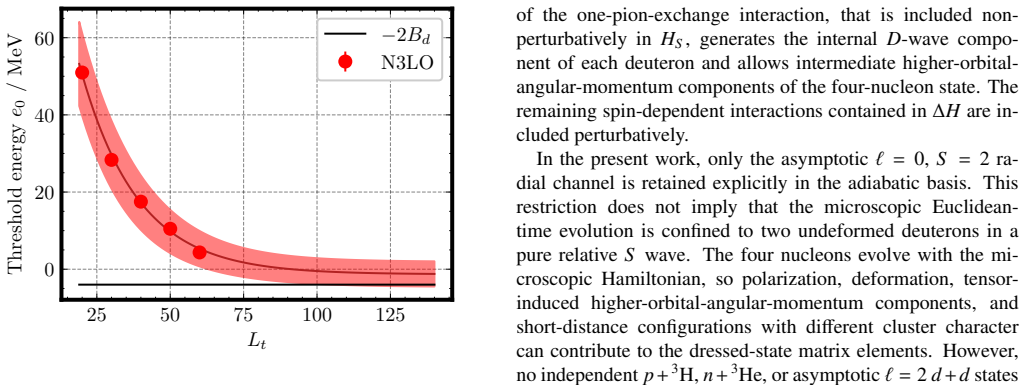
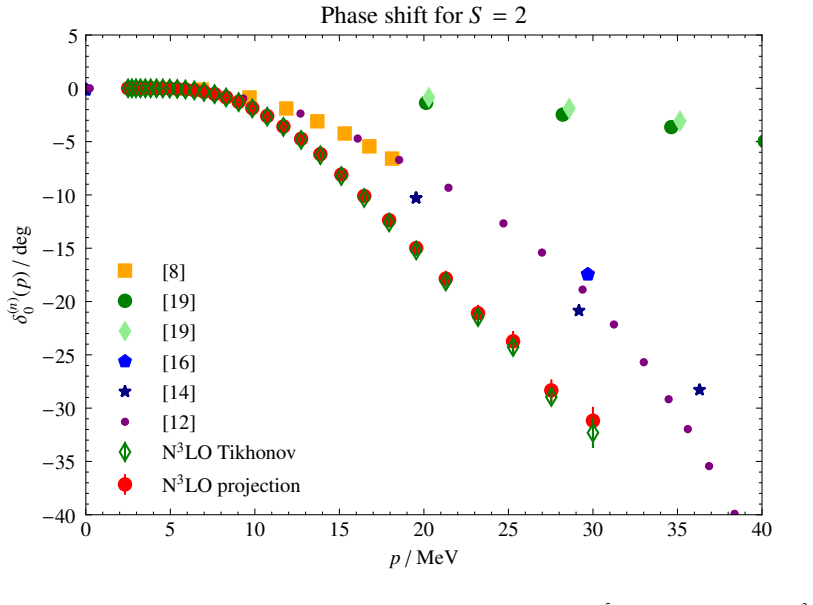
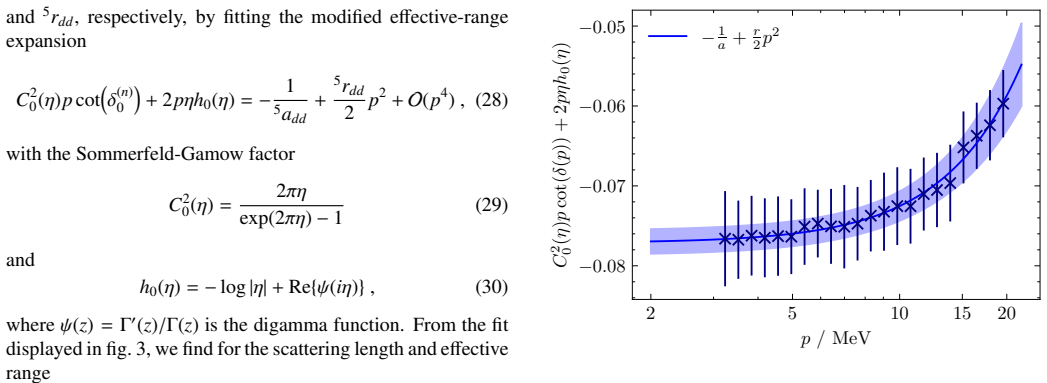
The calculation yields Coulomb-subtracted phase shifts in the 5S2 channel that are more negative than those obtained in previous work. A Coulomb-modified effective-range analysis gives the values 5a_dd = (12.96 ± 0.26) fm and 5r_dd = (3.62 ± 0.79) fm. The two stabilization procedures, Tikhonov regularization and projection onto well-resolved norm eigenmodes, produce results consistent within statistical and numerical uncertainties.
What carries the argument
The adiabatic projection method applied to a radial cluster basis, stabilized by either Tikhonov regularization or projection onto well-resolved norm eigenmodes to control small eigenvalues at large Euclidean projection time.
If this is right
- The phase shifts are more negative than those reported in earlier calculations.
- The scattering length is substantially larger, indicating stronger effective repulsion in the 5S2 channel.
- The results constitute the first nuclear-lattice benchmark for deuteron-deuteron scattering.
- The framework supplies a basis for future coupled-channel calculations of deuteron-induced reactions.
Where Pith is reading between the lines
- The benchmark values could be inserted into reaction networks to update predicted abundances of light elements formed in the early universe.
- Applying the same stabilized projection method to other partial waves or three-body systems would test whether the observed repulsion pattern persists.
- A direct comparison of the lattice phase shifts with measured low-energy cross sections would provide an external check on both the chiral forces and the stabilization techniques.
Load-bearing premise
The stabilization procedures remove numerical artifacts from small norm-matrix eigenvalues without biasing the extracted physical phase shifts.
What would settle it
An independent lattice or continuum calculation, or a direct experimental extraction, of the 5S2 deuteron-deuteron scattering length that lies outside 12.7 to 13.22 fm would falsify the central numerical result.
Figures
read the original abstract
We calculate low-energy deuteron-deuteron scattering in the spin-quintet $^{5}S_2$ channel using nuclear lattice effective field theory. The calculation combines chiral interactions at next-to-next-to-next-to-leading order, implemented through wavefunction matching, with the adiabatic projection method. Because the radial cluster basis develops small norm-matrix eigenvalues at large Euclidean projection time, we investigate two stabilization procedures: Tikhonov regularization and projection onto well-resolved norm eigenmodes. The two procedures yield consistent Coulomb-subtracted phase shifts within their statistical and numerical uncertainties. A Coulomb-modified effective-range analysis gives ${}^5a_{dd} = (12.96 \pm 0.26)\,\mathrm{fm}$ and ${}^5r_{dd} = (3.62 \pm 0.79)\,\mathrm{fm}$. The phase shifts are more negative, and the scattering length is substantially larger than in previous calculations, corresponding to a stronger effective repulsion in the $^{5}S_2$ channel. These results provide a first nuclear-lattice benchmark for deuteron-deuteron scattering and establish a basis for future coupled-channel calculations of the deuteron-induced reactions relevant to big-bang nucleosynthesis.
Editorial analysis
A structured set of objections, weighed in public.
Referee Report
Summary. The manuscript calculates low-energy elastic deuteron-deuteron scattering in the spin-quintet 5S2 channel within nuclear lattice effective field theory. It combines N3LO chiral interactions (implemented via wavefunction matching) with the adiabatic projection method on a radial cluster basis. Two stabilization procedures—Tikhonov regularization and projection onto well-resolved norm eigenmodes—are applied to handle small eigenvalues of the norm matrix at large Euclidean projection times. The procedures produce consistent Coulomb-subtracted phase shifts, from which a Coulomb-modified effective-range expansion yields 5a_dd = (12.96 ± 0.26) fm and 5r_dd = (3.62 ± 0.79) fm. These values indicate stronger effective repulsion than in prior calculations and are presented as the first nuclear-lattice benchmark for dd scattering.
Significance. If the central results hold, the work supplies the first lattice-EFT benchmark for deuteron-deuteron scattering parameters, directly relevant to big-bang nucleosynthesis reaction networks. Credit is due for the use of established N3LO interactions, the adiabatic projection framework, and the demonstration of internal consistency between two independent stabilization methods on the same observable.
major comments (1)
- [abstract / paragraph on radial cluster basis at large Euclidean projection time] Abstract / paragraph on radial cluster basis at large Euclidean projection time: the claim that the two stabilization procedures leave the physical phase shifts invariant rests on internal consistency within quoted uncertainties, but the manuscript provides no independent cross-check (e.g., application to a system with known exact results) that Tikhonov regularization or eigenmode projection preserves low-energy phase shifts without bias.
Simulated Author's Rebuttal
We thank the referee for the careful review and for recognizing the significance of providing the first nuclear-lattice benchmark for deuteron-deuteron scattering. We address the single major comment below.
read point-by-point responses
-
Referee: Abstract / paragraph on radial cluster basis at large Euclidean projection time: the claim that the two stabilization procedures leave the physical phase shifts invariant rests on internal consistency within quoted uncertainties, but the manuscript provides no independent cross-check (e.g., application to a system with known exact results) that Tikhonov regularization or eigenmode projection preserves low-energy phase shifts without bias.
Authors: We agree that an external benchmark on a system with known exact results would constitute the strongest possible validation. However, the two stabilization procedures (Tikhonov regularization and projection onto well-resolved norm eigenmodes) are mathematically distinct and were applied independently to the identical set of lattice data. Their agreement on the Coulomb-subtracted phase shifts within combined statistical and systematic uncertainties therefore functions as an internal cross-check against method-specific bias. Any residual bias would have to conspire to produce the same low-energy phase shifts in both approaches, which we regard as unlikely. We will revise the relevant paragraph and abstract to state this reasoning more explicitly and to note that a dedicated benchmark study on a simpler system remains a worthwhile direction for future work. revision: partial
Circularity Check
No circularity; scattering parameters are direct simulation outputs
full rationale
The derivation computes low-energy phase shifts and effective-range parameters via nuclear lattice EFT with N3LO interactions and the adiabatic projection method applied to the deuteron-deuteron system. The two stabilization procedures (Tikhonov regularization and eigenmode projection) are shown to produce internally consistent results within uncertainties, but the extracted 5a_dd and 5r_dd are outputs of the lattice calculation rather than quantities defined from or fitted to the target observables. No self-definitional steps, fitted-input predictions, or load-bearing self-citations that reduce the central claim to prior inputs by construction appear in the provided text. The work is a first benchmark application to a new channel and remains self-contained against external benchmarks.
Axiom & Free-Parameter Ledger
axioms (2)
- domain assumption Chiral effective field theory at N3LO provides an accurate description of low-energy nuclear forces in the relevant channels
- domain assumption The adiabatic projection method combined with wavefunction matching can be applied to extract Coulomb-subtracted phase shifts from lattice wave functions
Reference graph
Works this paper leans on
-
[1]
R. V . Wagoner, W. A. Fowler, F. Hoyle, On the Synthesis of elements at very high temperatures, Astrophys. J. 148 (1967) 3–49. doi:10.1086/149126
-
[2]
R. H. Cyburt, B. D. Fields, K. A. Olive, T.- H. Yeh, Big Bang Nucleosynthesis: 2015, Rev. Mod. Phys. 88 (2016) 015004. arXiv:1505.01076, doi:10.1103/RevModPhys.88.015004
work page internal anchor Pith review Pith/arXiv arXiv doi:10.1103/revmodphys.88.015004 2015
-
[3]
Pitrou, A
C. Pitrou, A. Coc, J.-P. Uzan, E. Vangioni, Resolving con- clusions about the early Universe requires accurate nu- clear measurements, Nature Rev. Phys. 3 (4) (2021) 231–
2021
-
[4]
arXiv:2104.11148, doi:10.1038/s42254-021-00294- 6
-
[5]
A.-K. Burns, T. M. P. Tait, M. Valli, PRyMordial: the first three minutes, within and beyond the standard model, Eur. Phys. J. C 84 (1) (2024) 86. arXiv:2307.07061, doi:10.1140/epjc/s10052-024-12442-0
-
[6]
Y . Xu, S. Goriely, A. Jorissen, G. Chen, M. Arnould, Databases and tools for nuclear astrophysics applica- tions BRUSsels Nuclear LIBrary (BRUSLIB), Nuclear 6 Astrophysics Compilation of REactions II (NACRE II) and Nuclear NETwork GENerator (NETGEN), As- tron. Astrophys. 549 (2013) A106. arXiv:1212.0628, doi:10.1051/0004-6361/201220537
work page internal anchor Pith review Pith/arXiv arXiv doi:10.1051/0004-6361/201220537 2013
-
[7]
C. Pitrou, A. Coc, J.-P. Uzan, E. Vangioni, Precision big bang nucleosynthesis with improved Helium-4 predic- tions, Phys. Rept. 754 (2018) 1–66. arXiv:1801.08023, doi:10.1016/j.physrep.2018.04.005
-
[8]
T. A. Lähde, U.-G. Meißner, Nuclear Lattice Effective Field Theory: An introduction, V ol. 957, Springer, 2019. doi:10.1007/978-3-030-14189-9
-
[9]
W. Meier, W. Glöckle, Elastic scattering 2 H(d, d) 2 H below 360 keV, Nucl. Phys. A 255 (1975) 21–34. doi:10.1016/0375-9474(75)90144-X
-
[10]
K. Wildermuth, W. McClure, Cluster Representa- tions of Nuclei, Springer Berlin, Heidelberg, 1966. doi:10.1007/BFb0045472
-
[11]
K. Wildermuth, Y . C. Tang, A Unified Theory of the Nucleus, Vieweg+Teubner Verlag, Wiesbaden, 1977. doi:10.1007/978-3-322-85255-7
-
[12]
R. A. Malfliet, J. A. Tjon, Solution of the Faddeev equations for the triton problem using local two par- ticle interactions, Nucl. Phys. A 127 (1969) 161–168. doi:10.1016/0375-9474(69)90775-1
-
[13]
I. N. Filikhin, S. L. Yakovlev, Microscopic calculation of low-energy deuteron-deuteron scattering on the basis of the cluster-reduction method, Phys. Atom. Nucl. 63 (2000). doi:10.1134/1.855624
-
[14]
S. L. Yakovlev, I. N. Filikhin, Calculations of scatter- ing lengths in four nucleon system on the basis of clus- ter reduction method for Yakubovsky equations (1 1997). arXiv:nucl-th/9701020
work page internal anchor Pith review Pith/arXiv arXiv 1997
-
[15]
H. M. Hofmann, G. M. Hale, Microscopic calcula- tion of the He-4 system, Nucl. Phys. A 613 (1997) 69–106. arXiv:nucl-th/9608046, doi:10.1016/S0375- 9474(96)00418-6
work page internal anchor Pith review Pith/arXiv arXiv doi:10.1016/s0375- 1997
-
[16]
Kellermann, H
H. Kellermann, H. M. Hofmann, C. Elster, Gaussian Pa- rameterization of a Meson TheoreticalNNPotential for Microscopic Nuclear Structure Calculations, Acta Phys. Austriaca 7 (1989) 31–53
1989
-
[17]
H. M. Hofmann, G. M. Hale, He-4 can experiments serve as a database for determining the three-nucleon force?, Phys. Rev. C 77 (2008) 044002. arXiv:nucl-th/0512065, doi:10.1103/PhysRevC.77.044002
work page internal anchor Pith review Pith/arXiv arXiv doi:10.1103/physrevc.77.044002 2008
-
[18]
R. B. Wiringa, V . G. J. Stoks, R. Schiavilla, An Accu- rate nucleon-nucleon potential with charge independence breaking, Phys. Rev. C 51 (1995) 38–51. arXiv:nucl- th/9408016, doi:10.1103/PhysRevC.51.38
-
[19]
B. S. Pudliner, V . R. Pandharipande, J. Carlson, S. C. Pieper, R. B. Wiringa, Quantum Monte Carlo calculations of nuclei with A<=7, Phys. Rev. C 56 (1997) 1720–1750. arXiv:nucl-th/9705009, doi:10.1103/PhysRevC.56.1720
work page internal anchor Pith review Pith/arXiv arXiv doi:10.1103/physrevc.56.1720 1997
-
[20]
J. F. Carew, Deuteron-deuteron elastic and three- and four- body breakup scattering using the Faddeev-Yakubovskii equations, Phys. Rev. C 103 (1) (2021) 014002. doi:10.1103/PhysRevC.103.014002
-
[21]
J. F. Carew, Variational bounds in n-particle scatter- ing using the faddeev–yakubovskii equations: Deuteron- deuteron s=2 scattering, Few-Body Systems 55 (2014) 171–190. doi:10.1007/s00601-014-0844-0
-
[22]
Modern Theory of Nuclear Forces
E. Epelbaum, H.-W. Hammer, U.-G. Meißner, Modern Theory of Nuclear Forces, Rev. Mod. Phys. 81 (2009) 1773–1825. arXiv:0811.1338, doi:10.1103/RevModPhys.81.1773
work page internal anchor Pith review Pith/arXiv arXiv doi:10.1103/revmodphys.81.1773 2009
-
[23]
S. Elhatisari, et al., Wavefunction matching for solv- ing quantum many-body problems, Nature 630 (8015) (2024) 59–63. arXiv:2210.17488, doi:10.1038/s41586- 024-07422-z
-
[24]
F. Hildenbrand, S. Elhatisari, U.-G. Meißner, H. Meyer, Z. Ren, A. Herten, M. Bode, Lattice Calculation of the Sn Isotopes near the Proton Dripline, Phys. Rev. Lett. 136 (6) (2026) 062501. arXiv:2509.08579, doi:10.1103/n7nt- s64t
-
[25]
Z. Ren, S. Elhatisari, U.-G. Meißner, Ab Initio Study of the Radii of Oxygen Isotopes, Phys. Rev. Lett. 135 (15) (2025) 152502. arXiv:2506.02597, doi:10.1103/y6s2- 43ym
-
[26]
Ab initio alpha-alpha scattering
S. Elhatisari, D. Lee, G. Rupak, E. Epelbaum, H. Krebs, T. A. Lähde, T. Luu, U.-G. Meißner, Ab initio alpha-alpha scattering, Nature 528 (2015) 111. arXiv:1506.03513, doi:10.1038/nature16067
work page internal anchor Pith review Pith/arXiv arXiv doi:10.1038/nature16067 2015
-
[27]
N. Li, S. Elhatisari, E. Epelbaum, D. Lee, B.-N. Lu, U.-G. Meißner, Neutron-proton scattering with lattice chiral effective field theory at next-to-next-to-next-to- leading order, Phys. Rev. C 98 (4) (2018) 044002. arXiv:1806.07994, doi:10.1103/PhysRevC.98.044002
work page internal anchor Pith review Pith/arXiv arXiv doi:10.1103/physrevc.98.044002 2018
-
[28]
S. Elhatisari, T. A. Lähde, D. Lee, U.-G. Meißner, T. V onk, Alpha-alpha scattering in the Multi- verse, JHEP 02 (2022) 001. arXiv:2112.09409, doi:10.1007/JHEP02(2022)001
-
[29]
S. Elhatisari, F. Hildenbrand, U.-G. Meißner, Ab ini- tio lattice study of neutron–alpha scattering with chi- ral forces at N3LO, J. Phys. G 52 (12) (2025) 125102. arXiv:2507.08495, doi:10.1088/1361-6471/ae2145
-
[30]
H. Tong, S. Elhatisari, U.-G. Meißner, Ab initio calcula- tion of hyper-neutron matter, Sci. Bull. 70 (2025) 825–
2025
-
[31]
arXiv:2405.01887, doi:10.1016/j.scib.2025.01.008. 7
-
[32]
D. Lee, Lattice Effective Field Theory Simulations of Nuclei, Ann. Rev. Nucl. Part. Sci. 75 (1) (2025) 109–128. arXiv:2501.03303, doi:10.1146/annurev-nucl- 101918-023343
-
[33]
Ab initio $\alpha$-$\alpha$ scattering with high-fidelity chiral interactions
A. Sarkar, S. Elhatisari, T. A. Lähde, U.-G. Meißner, Ab initioα-αscattering with high-fidelity chiral interactions (6 2026). arXiv:2606.28987
work page internal anchor Pith review Pith/arXiv arXiv 2026
-
[34]
M. Pine, D. Lee, G. Rupak, Adiabatic projection method for scattering and reactions on the lattice, Eur. Phys. J. A 49 (2013) 151. arXiv:1309.2616, doi:10.1140/epja/i2013- 13151-3
work page internal anchor Pith review Pith/arXiv arXiv doi:10.1140/epja/i2013- 2013
-
[35]
Nucleon-deuteron scattering using the adiabatic projection method
S. Elhatisari, D. Lee, U.-G. Meißner, G. Rupak, Nucleon- deuteron scattering using the adiabatic projection method, Eur. Phys. J. A 52 (6) (2016) 174. arXiv:1603.02333, doi:10.1140/epja/i2016-16174-2
work page internal anchor Pith review Pith/arXiv arXiv doi:10.1140/epja/i2016-16174-2 2016
-
[36]
Elhatisari, Adiabatic projection method with Euclidean time subspace projection, Eur
S. Elhatisari, Adiabatic projection method with Euclidean time subspace projection, Eur. Phys. J. A 55 (8) (2019)
2019
-
[37]
arXiv:1906.01046, doi:10.1140/epja/i2019-12844-9
-
[38]
A. N. Tikhonov, V . Y . Arsenin, Solutions of Ill-Posed Problems, V . H. Winston & Sons, Washington, DC, 1977, distributed by Halsted Press, New York
1977
-
[39]
D. E. Hilt, D. W. Seegrist, U. S. F. Service, P. Northeast- ern Forest Experiment Station (Radnor, Ridge, a computer program for calculating ridge regression estimates, V ol. no.236, Upper Darby, Pa, Dept. of Agriculture, Forest Ser- vice, Northeastern Forest Experiment Station, 1977
1977
-
[40]
P. C. Hansen, Rank-Deficient and Discrete Ill-Posed Prob- lems, Society for Industrial and Applied Mathematics,
-
[41]
doi:10.1137/1.9780898719697
-
[42]
B.-N. Lu, T. A. Lähde, D. Lee, U.-G. Meißner, Precise determination of lattice phase shifts and mixing angles, Phys. Lett. B 760 (2016) 309–313. arXiv:1506.05652, doi:10.1016/j.physletb.2016.06.081. 8 Appendix A. Euclidean time extrapolation of phase shift results For each individual momentum point we calculate the phase shift as described in section 2.3 ...
work page internal anchor Pith review Pith/arXiv arXiv doi:10.1016/j.physletb.2016.06.081 2016
discussion (0)
Sign in with ORCID, Apple, or X to comment. Anyone can read and Pith papers without signing in.